THE CEREBELLUM
OUTLINE
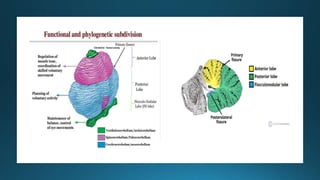
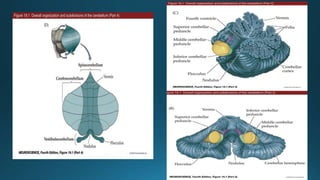
INTRODUCTION ORGANIZATION
AND SUBDIVISONS
CEREBELLAR
PEDUNCLES
AFFERENTAND
EFFERENT
CONNECTIONS
CEREBELLAR
CIRCUIT
FUNCTIONS LESIONSAND
CONSEQUENCES
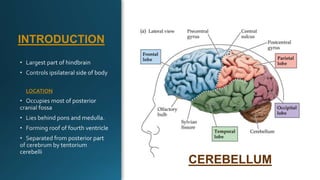
INTRODUCTION
LOCATION
CEREBELLUM
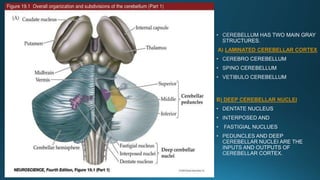
A) LAMINATED CEREBELLAR CORTEX
B) DEEP CEREBELLAR NUCLEI
CEREBELLAR PEDUNCLES
connect the cerebellum to the brain
stem.[1]
1) Superior cerebellar peduncle
(brachium conjunctiva)
Connects cerebellum to mid-brain.
2) Middle cerebellar peduncles
(Brachium pontis)
Connects cerebellum to the pons
3) Inferior cerebellar peduncle
(Restiform body )
Connects with medulla oblongata.
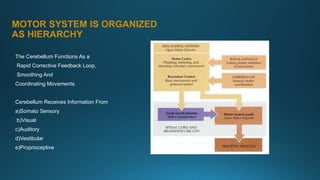
MOTOR SYSTEM IS ORGANIZED
AS HIERARCHY
The Cerebellum Functions As a
Rapid Corrective Feedback Loop,
Smoothing And
Coordinating Movements.
Cerebellum Receives Information From
a)Somato Sensory
b)Visual
c)Auditory
d)Vestibular
e)Proprioceptive
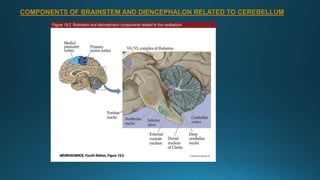
COMPONENTS OF BRAINSTEM AND DIENCEPHALON RELATED TO CEREBELLUM
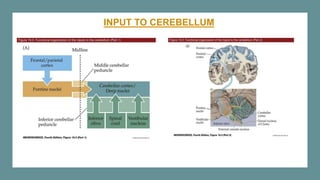
INPUT TO CEREBELLUM
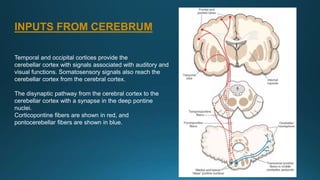
Temporal and occipital cortices provide the
cerebellar cortex with signals associated with auditory and
visual functions. Somatosensory signals also reach the
cerebellar cortex from the cerebral cortex.
The disynaptic pathway from the cerebral cortex to the
cerebellar cortex with a synapse in the deep pontine
nuclei.
Corticopontine fibers are shown in red, and
pontocerebellar fibers are shown in blue.
INPUTS FROM CEREBRUM
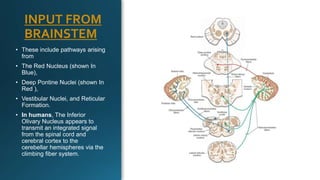
INPUT FROM
BRAINSTEM
• These include pathways arising
from
• The Red Nucleus (shown In
Blue),
• Deep Pontine Nuclei (shown In
Red ),
• Vestibular Nuclei, and Reticular
Formation.
• In humans, The Inferior
Olivary Nucleus appears to
transmit an integrated signal
from the spinal cord and
cerebral cortex to the
cerebellar hemispheres via the
climbing fiber system.
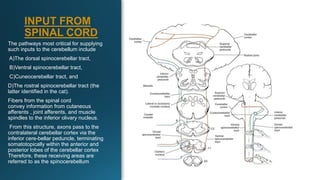
The pathways most critical for supplying
such inputs to the cerebellum include
A)The dorsal spinocerebellar tract,
B)Ventral spinocerebellar tract,
C)Cuneocerebellar tract, and
D)The rostral spinocerebellar tract (the
latter identified in the cat).
Fibers from the spinal cord
convey information from cutaneous
afferents , joint afferents, and muscle
spindles to the inferior olivary nucleus.
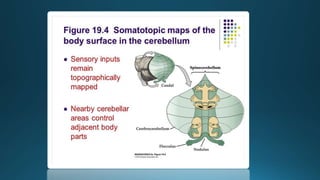
From this structure, axons pass to the
contralateral cerebellar cortex via the
inferior cere-bellar peduncle, terminating
somatotopically within the anterior and
posterior lobes of the cerebellar cortex
Therefore, these receiving areas are
referred to as the spinocerebellum
INPUT FROM
SPINAL CORD
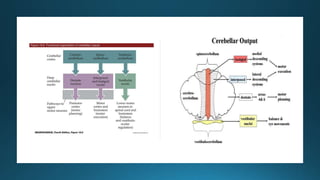
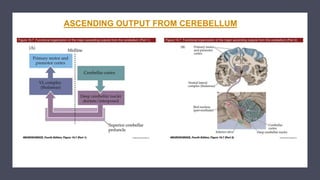
ASCENDING OUTPUT FROM CEREBELLUM
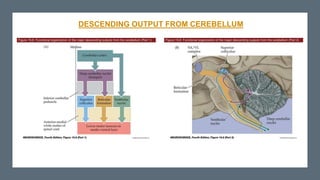
DESCENDING OUTPUT FROM CEREBELLUM
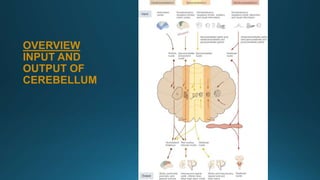
OVERVIEW
INPUT AND
OUTPUT OF
CEREBELLUM
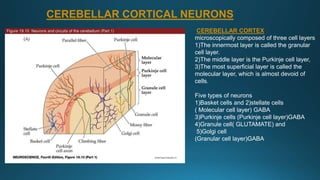
CEREBELLAR CORTEX
microscopically composed of three cell layers
1)The innermost layer is called the granular
cell layer.
2)The middle layer is the Purkinje cell layer,
3)The most superficial layer is called the
molecular layer, which is almost devoid of
cells.
Five types of neurons
1)Basket cells and 2)stellate cells
( Molecular cell layer) GABA
3)Purkinje cells (Purkinje cell layer)GABA
4)Granule cell( GLUTAMATE) and
5)Golgi cell
(Granular cell layer)GABA
CEREBELLAR CORTICAL NEURONS
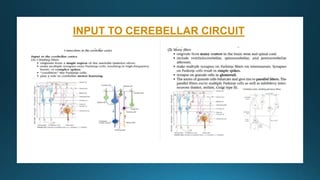
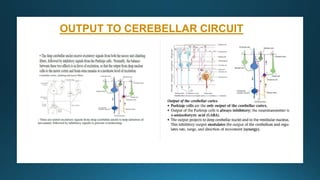
CEREBELLAR CIRCUIT
INPUT TO CEREBELLAR CIRCUIT
OUTPUT TO CEREBELLAR CIRCUIT
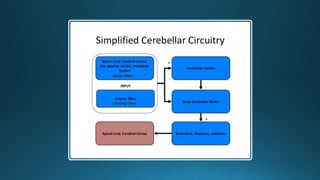
INPUT AND OUTPUT OF CEREBELLAR CORTEX
• EXCITATORY LOOP
• INHIBITORY LOOP
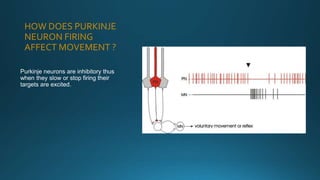
HOW DOES PURKINJE
NEURON FIRING
AFFECT MOVEMENT ?
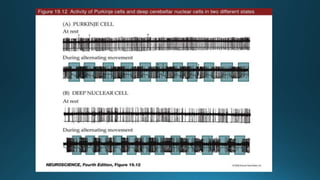
Purkinje neurons are inhibitory thus
when they slow or stop firing their
targets are excited.
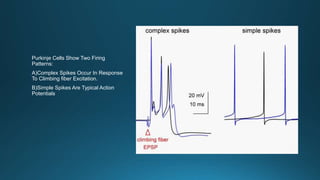
Purkinje Cells Show Two Firing
Patterns:
A)Complex Spikes Occur In Response
To Climbing fiber Excitation.
B)Simple Spikes Are Typical Action
Potentials
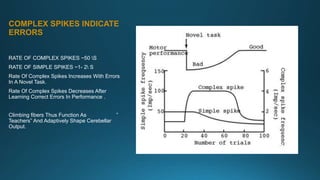
COMPLEX SPIKES INDICATE
ERRORS
RATE OF COMPLEX SPIKES ~50 S
RATE OF SIMPLE SPIKES ~1- 2 S
Rate Of Complex Spikes Increases With Errors
In A Novel Task.
Rate Of Complex Spikes Decreases After
Learning Correct Errors In Performance .
Climbing fibers Thus Function As ”
Teachers” And Adaptively Shape Cerebellar
Output.
FUNCTIONS OF CEREBELLUM
CEREBELLAR DYSFUNCTION
CEREBELLUM IS A FAST FEEDBACK LOOP FOR
COORDINATING ,MOVEMENT CEREBELLAR LESIONS.
CHARACTERISTICS FEATURE
A)DISTURBANCE OF POSTURE
HYPOTONIA
FACE ROTATED TOWARDS OPPOSITE SIDE
BODY WEIGHT THROWN ON HEALTHY LEG,CONCAVITY OF TRUNK
TOWARDS AFFECTED SIDE
NYSTAGMUS
B) INTENTION TREMORS
JERKY MOVEMENTS WITH TO AND FRO MOTION ON REACHING
AN OBJECT
COARSE TREMOR OCCURING AT4- 6/SECD
C)ATAXIA
INCOORDINATION OF MOVEMENTS
MOVEMENTS DECOMPOSED INTO JERKY AND IMPRECISE ACTIONS.
DYSMETRIA MOVEMENT IS POORLY CARRIED OUT IN DIRECTION,RANGE
AND FORCE PAST
POINTING HYPERMETRIA FALLING SHORT HYPOMETRIA
D)SLOW AND LALLING SPEECH
E)DRUNKEN GAIT
F)DYSDIADOKINESIA
ALSO DEFICITS IN MOTOR LEARNING.
CONT….
SUMMARY
1) The cerebellum balances motor commands and sensory information to smooth and coordinate movement.
2)Lesions of cerebellum cause ataxia,tremor,balance and posture problems.
3)Inputs to cerebellum mossy fibers (pons and spinal cord) and climbing fibers( inferior olive)
The inputs from the spinal cord provide the cerebellum with essential information (i.e., The status and position
of individual as well as groups of muscles) with which it can control both muscle tone and the execution of
movements.
4)Purkinje neurons use the neuro transmitter GABA and inhibit their targets in the deep nuclei.
Output from cerebellum deep nuclei to red nucleus, thalamus, inferior olive and vestibular nuclei.
5)Associative forms of motor learning occur in the cerebellum.
THANKYOU

Cerebellum physiology ppt

  • 1.
  • 2.
  • 3.
  • 5.
    A) LAMINATED CEREBELLARCORTEX B) DEEP CEREBELLAR NUCLEI
  • 7.
    CEREBELLAR PEDUNCLES connect thecerebellum to the brain stem.[1] 1) Superior cerebellar peduncle (brachium conjunctiva) Connects cerebellum to mid-brain. 2) Middle cerebellar peduncles (Brachium pontis) Connects cerebellum to the pons 3) Inferior cerebellar peduncle (Restiform body ) Connects with medulla oblongata.
  • 8.
    MOTOR SYSTEM ISORGANIZED AS HIERARCHY The Cerebellum Functions As a Rapid Corrective Feedback Loop, Smoothing And Coordinating Movements. Cerebellum Receives Information From a)Somato Sensory b)Visual c)Auditory d)Vestibular e)Proprioceptive
  • 9.
    COMPONENTS OF BRAINSTEMAND DIENCEPHALON RELATED TO CEREBELLUM
  • 10.
  • 11.
    Temporal and occipitalcortices provide the cerebellar cortex with signals associated with auditory and visual functions. Somatosensory signals also reach the cerebellar cortex from the cerebral cortex. The disynaptic pathway from the cerebral cortex to the cerebellar cortex with a synapse in the deep pontine nuclei. Corticopontine fibers are shown in red, and pontocerebellar fibers are shown in blue. INPUTS FROM CEREBRUM
  • 12.
    INPUT FROM BRAINSTEM • Theseinclude pathways arising from • The Red Nucleus (shown In Blue), • Deep Pontine Nuclei (shown In Red ), • Vestibular Nuclei, and Reticular Formation. • In humans, The Inferior Olivary Nucleus appears to transmit an integrated signal from the spinal cord and cerebral cortex to the cerebellar hemispheres via the climbing fiber system.
  • 13.
    The pathways mostcritical for supplying such inputs to the cerebellum include A)The dorsal spinocerebellar tract, B)Ventral spinocerebellar tract, C)Cuneocerebellar tract, and D)The rostral spinocerebellar tract (the latter identified in the cat). Fibers from the spinal cord convey information from cutaneous afferents , joint afferents, and muscle spindles to the inferior olivary nucleus. From this structure, axons pass to the contralateral cerebellar cortex via the inferior cere-bellar peduncle, terminating somatotopically within the anterior and posterior lobes of the cerebellar cortex Therefore, these receiving areas are referred to as the spinocerebellum INPUT FROM SPINAL CORD
  • 16.
  • 17.
  • 18.
  • 19.
    CEREBELLAR CORTEX microscopically composedof three cell layers 1)The innermost layer is called the granular cell layer. 2)The middle layer is the Purkinje cell layer, 3)The most superficial layer is called the molecular layer, which is almost devoid of cells. Five types of neurons 1)Basket cells and 2)stellate cells ( Molecular cell layer) GABA 3)Purkinje cells (Purkinje cell layer)GABA 4)Granule cell( GLUTAMATE) and 5)Golgi cell (Granular cell layer)GABA CEREBELLAR CORTICAL NEURONS
  • 20.
  • 21.
  • 22.
  • 24.
    INPUT AND OUTPUTOF CEREBELLAR CORTEX • EXCITATORY LOOP • INHIBITORY LOOP
  • 25.
    HOW DOES PURKINJE NEURONFIRING AFFECT MOVEMENT ? Purkinje neurons are inhibitory thus when they slow or stop firing their targets are excited.
  • 26.
    Purkinje Cells ShowTwo Firing Patterns: A)Complex Spikes Occur In Response To Climbing fiber Excitation. B)Simple Spikes Are Typical Action Potentials
  • 27.
    COMPLEX SPIKES INDICATE ERRORS RATEOF COMPLEX SPIKES ~50 S RATE OF SIMPLE SPIKES ~1- 2 S Rate Of Complex Spikes Increases With Errors In A Novel Task. Rate Of Complex Spikes Decreases After Learning Correct Errors In Performance . Climbing fibers Thus Function As ” Teachers” And Adaptively Shape Cerebellar Output.
  • 31.
  • 32.
    CEREBELLAR DYSFUNCTION CEREBELLUM ISA FAST FEEDBACK LOOP FOR COORDINATING ,MOVEMENT CEREBELLAR LESIONS. CHARACTERISTICS FEATURE A)DISTURBANCE OF POSTURE HYPOTONIA FACE ROTATED TOWARDS OPPOSITE SIDE BODY WEIGHT THROWN ON HEALTHY LEG,CONCAVITY OF TRUNK TOWARDS AFFECTED SIDE NYSTAGMUS B) INTENTION TREMORS JERKY MOVEMENTS WITH TO AND FRO MOTION ON REACHING AN OBJECT COARSE TREMOR OCCURING AT4- 6/SECD
  • 33.
    C)ATAXIA INCOORDINATION OF MOVEMENTS MOVEMENTSDECOMPOSED INTO JERKY AND IMPRECISE ACTIONS. DYSMETRIA MOVEMENT IS POORLY CARRIED OUT IN DIRECTION,RANGE AND FORCE PAST POINTING HYPERMETRIA FALLING SHORT HYPOMETRIA D)SLOW AND LALLING SPEECH E)DRUNKEN GAIT F)DYSDIADOKINESIA ALSO DEFICITS IN MOTOR LEARNING. CONT….
  • 34.
    SUMMARY 1) The cerebellumbalances motor commands and sensory information to smooth and coordinate movement. 2)Lesions of cerebellum cause ataxia,tremor,balance and posture problems. 3)Inputs to cerebellum mossy fibers (pons and spinal cord) and climbing fibers( inferior olive) The inputs from the spinal cord provide the cerebellum with essential information (i.e., The status and position of individual as well as groups of muscles) with which it can control both muscle tone and the execution of movements. 4)Purkinje neurons use the neuro transmitter GABA and inhibit their targets in the deep nuclei. Output from cerebellum deep nuclei to red nucleus, thalamus, inferior olive and vestibular nuclei. 5)Associative forms of motor learning occur in the cerebellum.
  • 35.