




DIALOGUE, DISCOURSE, DIVERSITY
          JULY 2009


•ASSESSMENT FOR LEARNING
•FEEDBACK
 -WHO GIVES IT?
 - HOW DO WE GET IT?
Aims
• to reflect on the attributes of a quality
  assessment task

• to link those qualities to the Professional
  Standards for Accomplished Teachers of
  Languages and Cultures

• to examine the process of assessment for
  learning through the experience of staff at
  the Saturday School of Community
  Languages, Merewether HS

• to discuss the possible application of the
  above to participants’ own contexts
Professional Standards for Teachers
   of Languages and Culture


• Promote reflection
• Stimulus for professional
  dialogue

http://www.decs.sa.gov.au/curric/files/links/prof_standards.pdf
• Professional standards for
  accomplished teachers of
  languages and cultures.
Accomplished languages and cultures
  teaching is reflected through the
  following dimensions:
• educational theory and practice
• language and culture
• language pedagogy
• ethics and responsibility
• professional relationships
• awareness of wider context
• advocacy
• personal characteristics
Which standards does assessment
relate to?
• Language Pedagogy
  “….approach to assessment
  examines understanding,
  learning and performance, and
  uses assessment to foster
  learning as well as evaluate
  learning.............”
  “…..select assessment tasks
  which are appropriate to the
  purposes of the assessment and
  use the assessment for effective
  feedback and reporting.”
ACTIVITY
• What makes a quality
  assessment task?

Take a few minutes to think about this and discuss it
    with your colleagues.
Jot down no more than 5 points.
The 10 principles: Assessment for
              Learning


Assessment Reform Group, 2002
http://www.qca.org.uk/qca_4336.aspx
1. Assessment for learning
  should be part of effective
  planning of teaching and
  learning


2. Assessment for learning
  should focus on how
  students learn
3. Assessment for learning
  should be recognised as
  central to classroom
  practice


4. Assessment for learning
  should be regarded as a
  key professional skill for
  teachers
5. Assessment for learning
  should be sensitive and
  constructive because any
  assessment has an
  emotional impact


6. Assessment for learning
  should take account of the
  importance of learner
  motivation
7. Assessment for learning
  should promote
  commitment to learning
  goals and a shared
  understanding of the
  criteria by which they are
  assessed


8. Learners should receive
  constructive guidance
  about how to improve
9. Assessment for learning
  develops learners’
  capacity for self-
  assessment so that they
  can become reflective
  and self-managing


10. Assessment for learning
  should recognise the full
  range of achievements of
  all learners
Our challenge at SSCL
 Merewether High School

• To overcome the
  perception that Saturday
  School is not as important
  as mainstream school
• To encourage students
  and teachers to focus on
  the process rather than just
  the product.
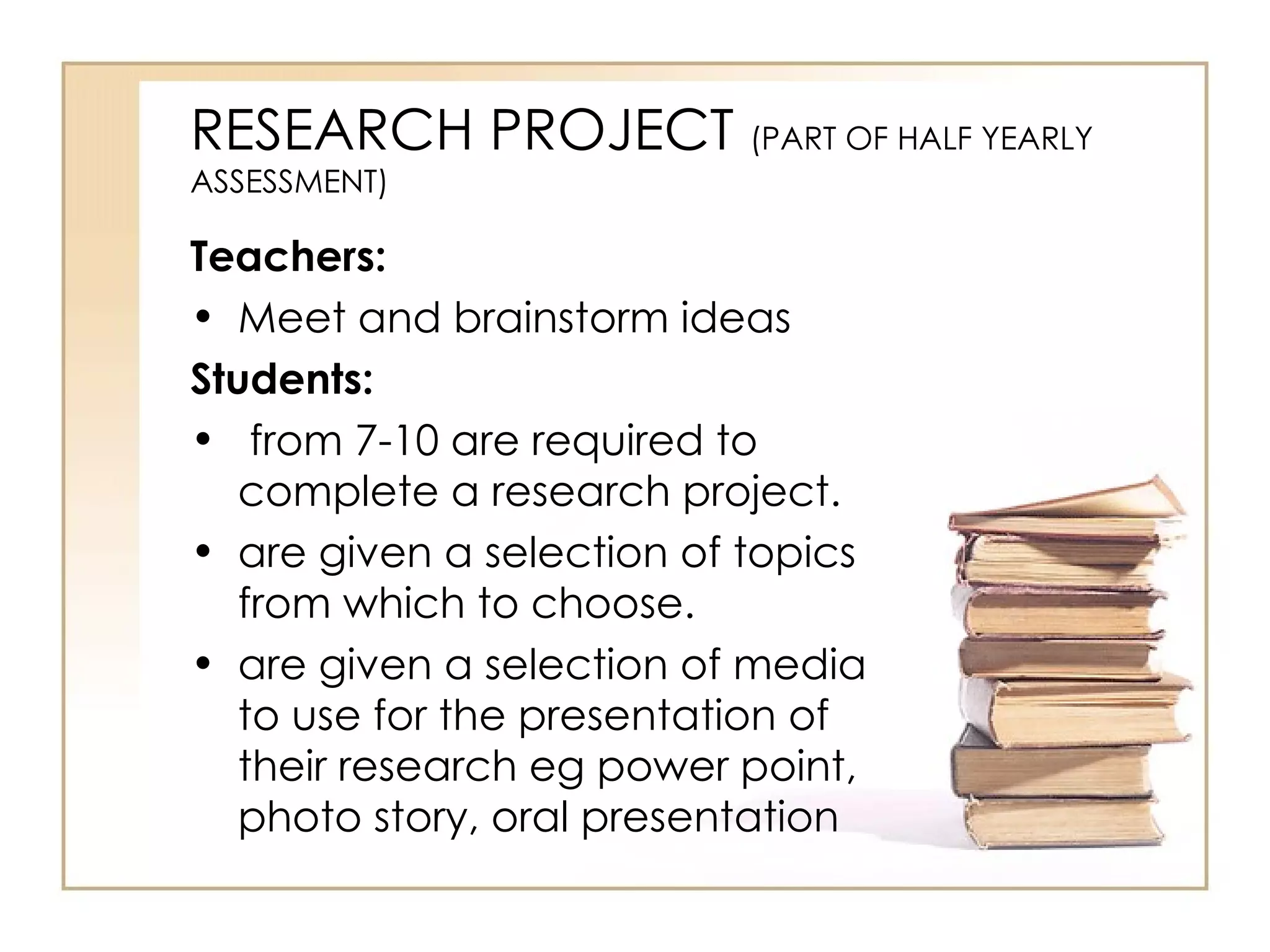
RESEARCH PROJECT (PART OF HALF YEARLY
ASSESSMENT)

Teachers:
• Meet and brainstorm ideas
Students:
• from 7-10 are required to
   complete a research project.
• are given a selection of topics
   from which to choose.
• are given a selection of media
   to use for the presentation of
   their research eg power point,
   photo story, oral presentation
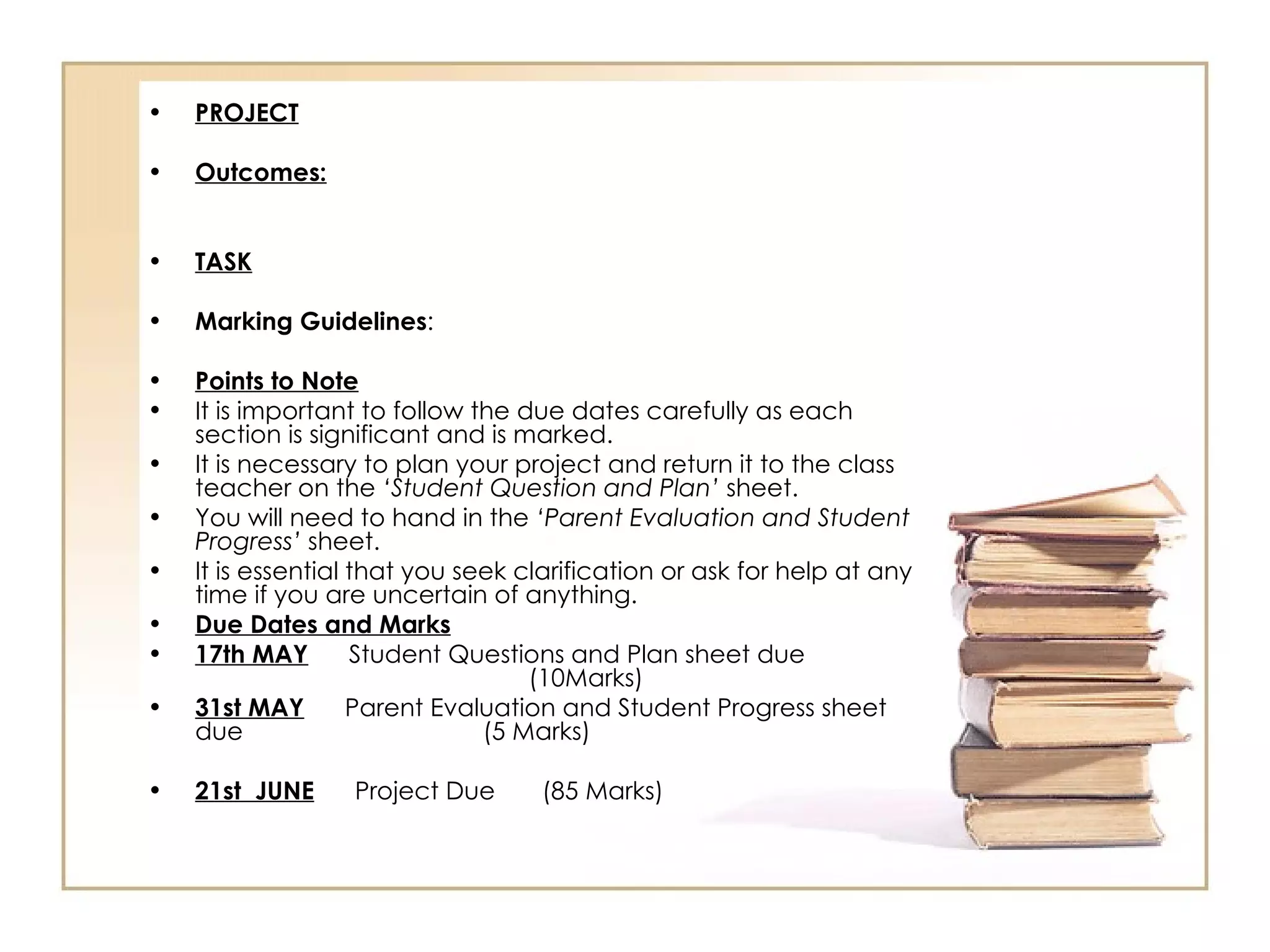
•   PROJECT

•   Outcomes:


•   TASK

•   Marking Guidelines:

•   Points to Note
•   It is important to follow the due dates carefully as each
    section is significant and is marked.
•   It is necessary to plan your project and return it to the class
    teacher on the ‘Student Question and Plan’ sheet.
•   You will need to hand in the ‘Parent Evaluation and Student
    Progress’ sheet.
•   It is essential that you seek clarification or ask for help at any
    time if you are uncertain of anything.
•   Due Dates and Marks
•   17th MAY        Student Questions and Plan sheet due
                                   (10Marks)
•   31st MAY        Parent Evaluation and Student Progress sheet
    due                        (5 Marks)

•   21st JUNE     Project Due      (85 Marks)
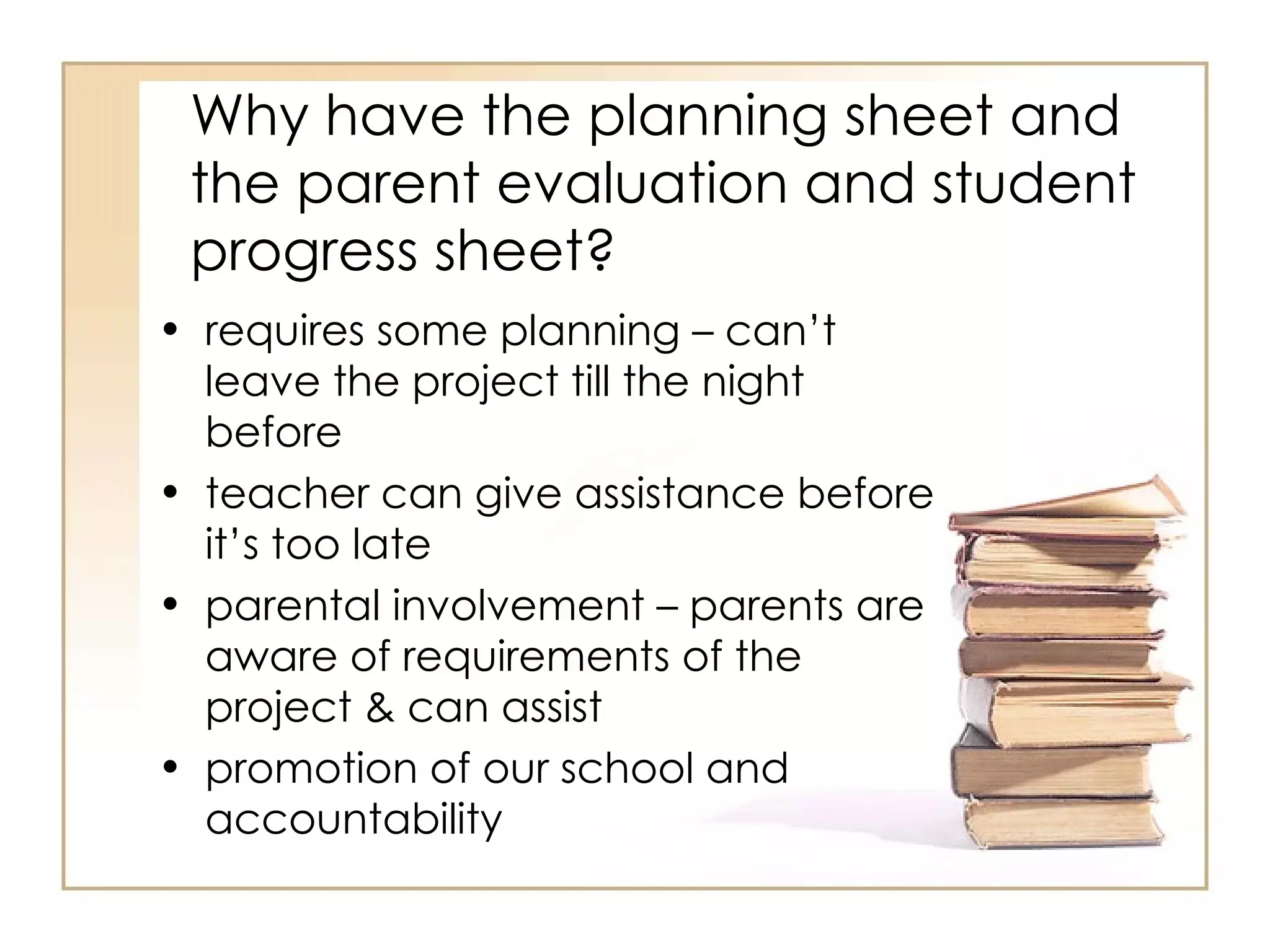
Why have the planning sheet and
 the parent evaluation and student
 progress sheet?
• requires some planning – can’t
  leave the project till the night
  before
• teacher can give assistance before
  it’s too late
• parental involvement – parents are
  aware of requirements of the
  project & can assist
• promotion of our school and
  accountability
Feedback to
  teachers
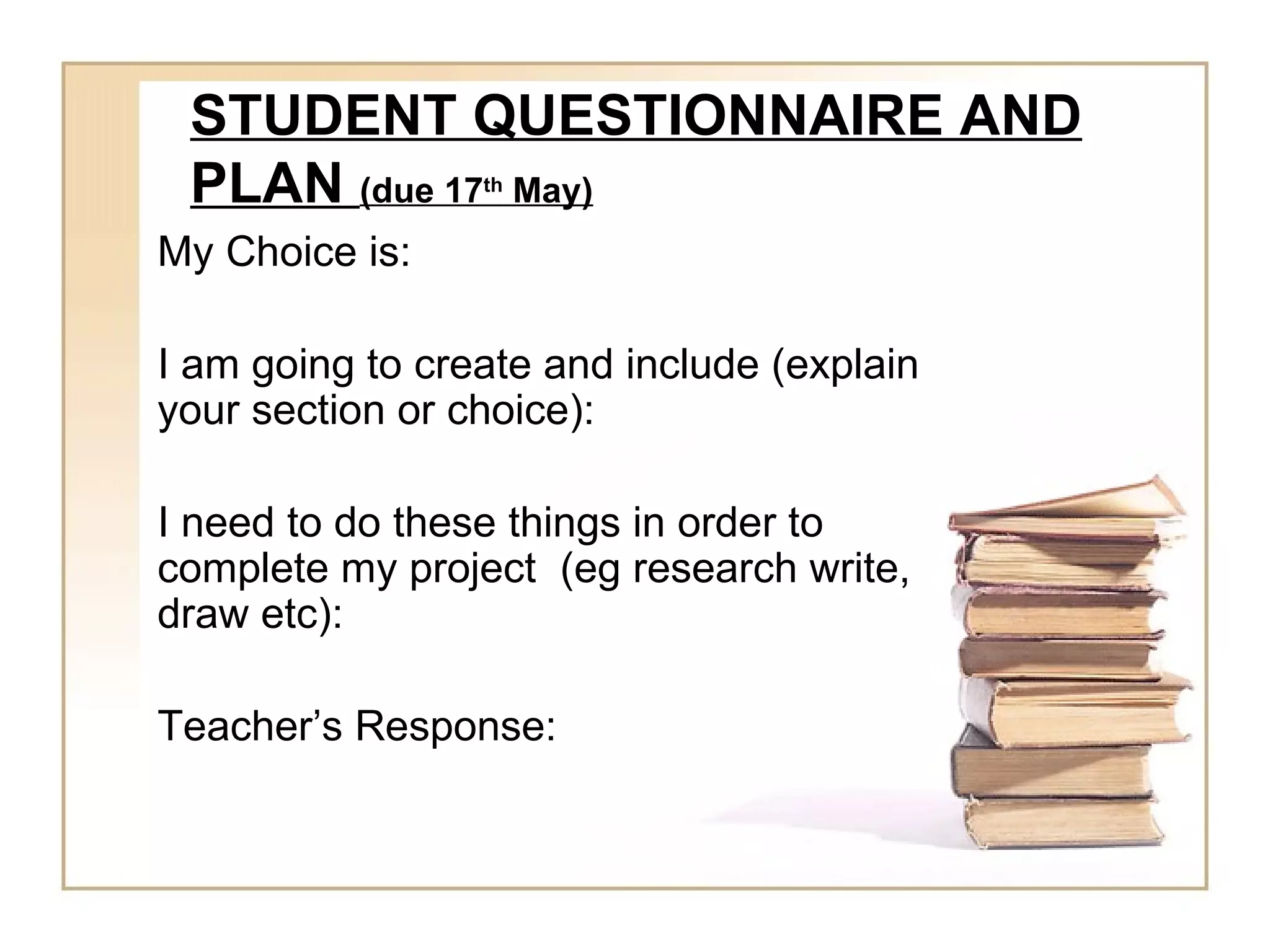
STUDENT QUESTIONNAIRE AND
 PLAN (due 17 May)
                 th


My Choice is:

I am going to create and include (explain
your section or choice):

I need to do these things in order to
complete my project (eg research write,
draw etc):

Teacher’s Response:
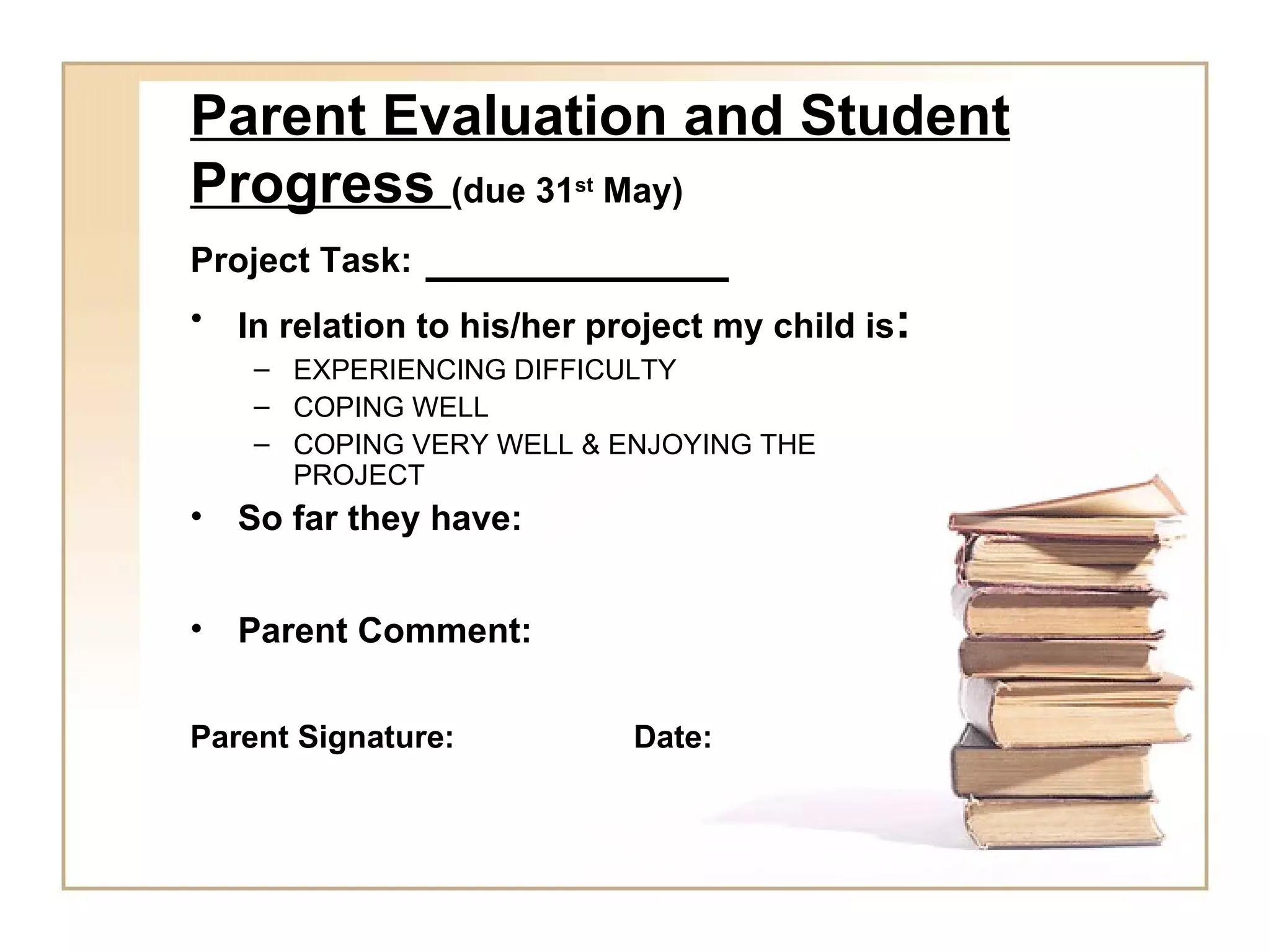
Parent Evaluation and Student
Progress (due 31 May)    st


Project Task:   ___________
•   In relation to his/her project my child is:
     – EXPERIENCING DIFFICULTY
     – COPING WELL
     – COPING VERY WELL & ENJOYING THE
       PROJECT
•   So far they have:


•   Parent Comment:

Parent Signature:             Date:
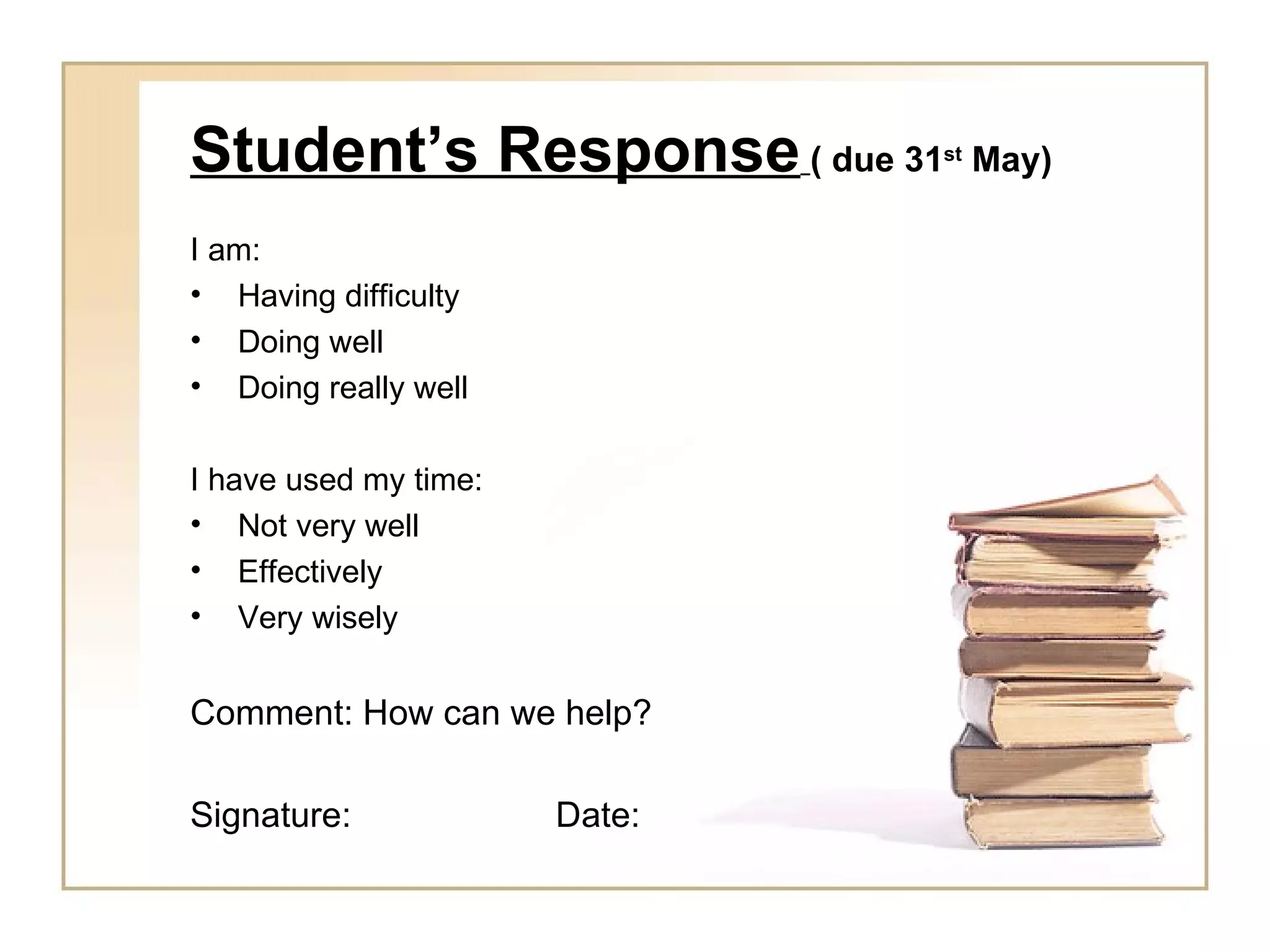
Student’s Response ( due 31    st
                                    May)

I am:
• Having difficulty
• Doing well
• Doing really well

I have used my time:
• Not very well
• Effectively
• Very wisely


Comment: How can we help?

Signature:             Date:
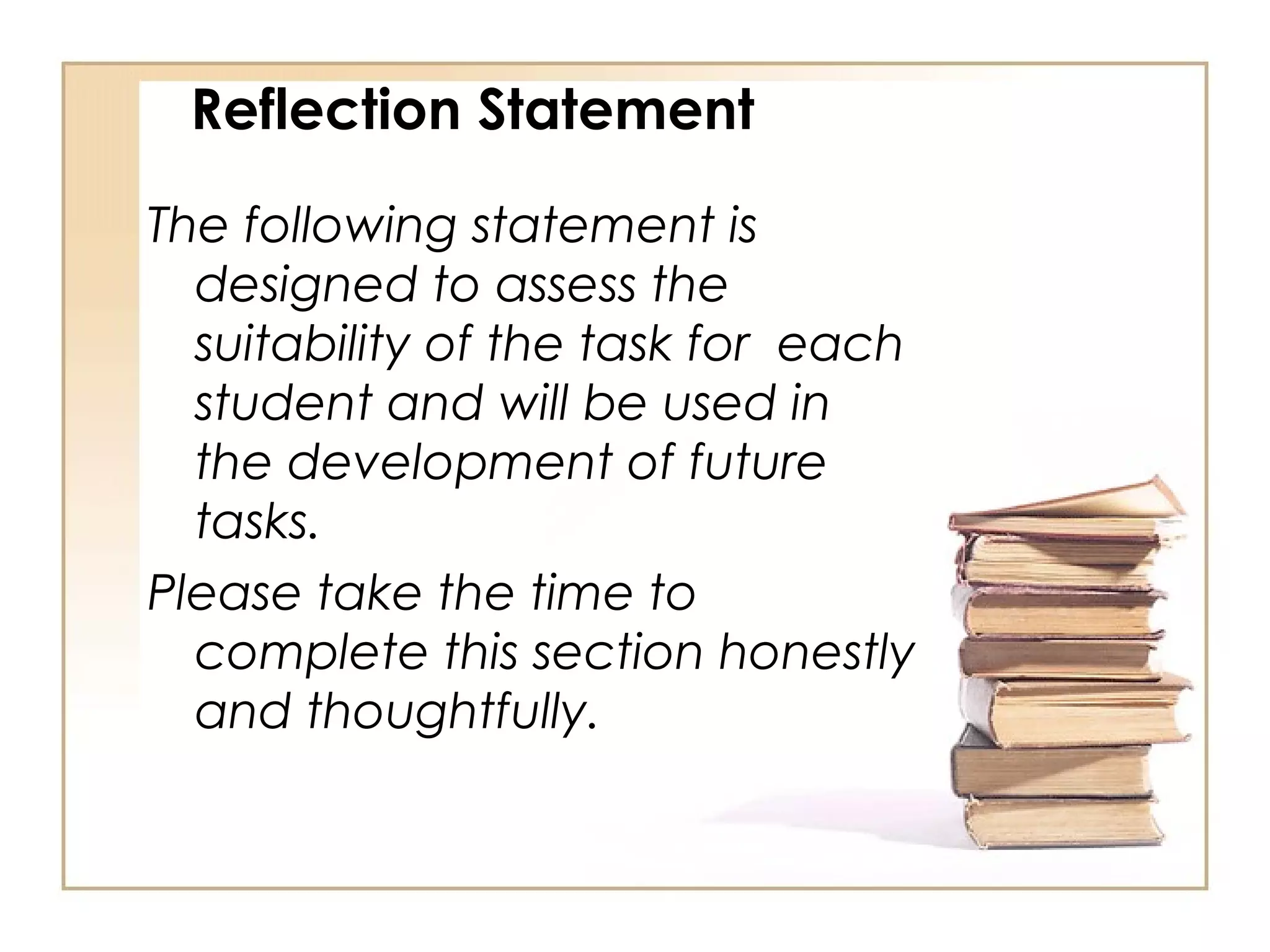
Reflection Statement

The following statement is
  designed to assess the
  suitability of the task for each
  student and will be used in
  the development of future
  tasks.
Please take the time to
  complete this section honestly
  and thoughtfully.
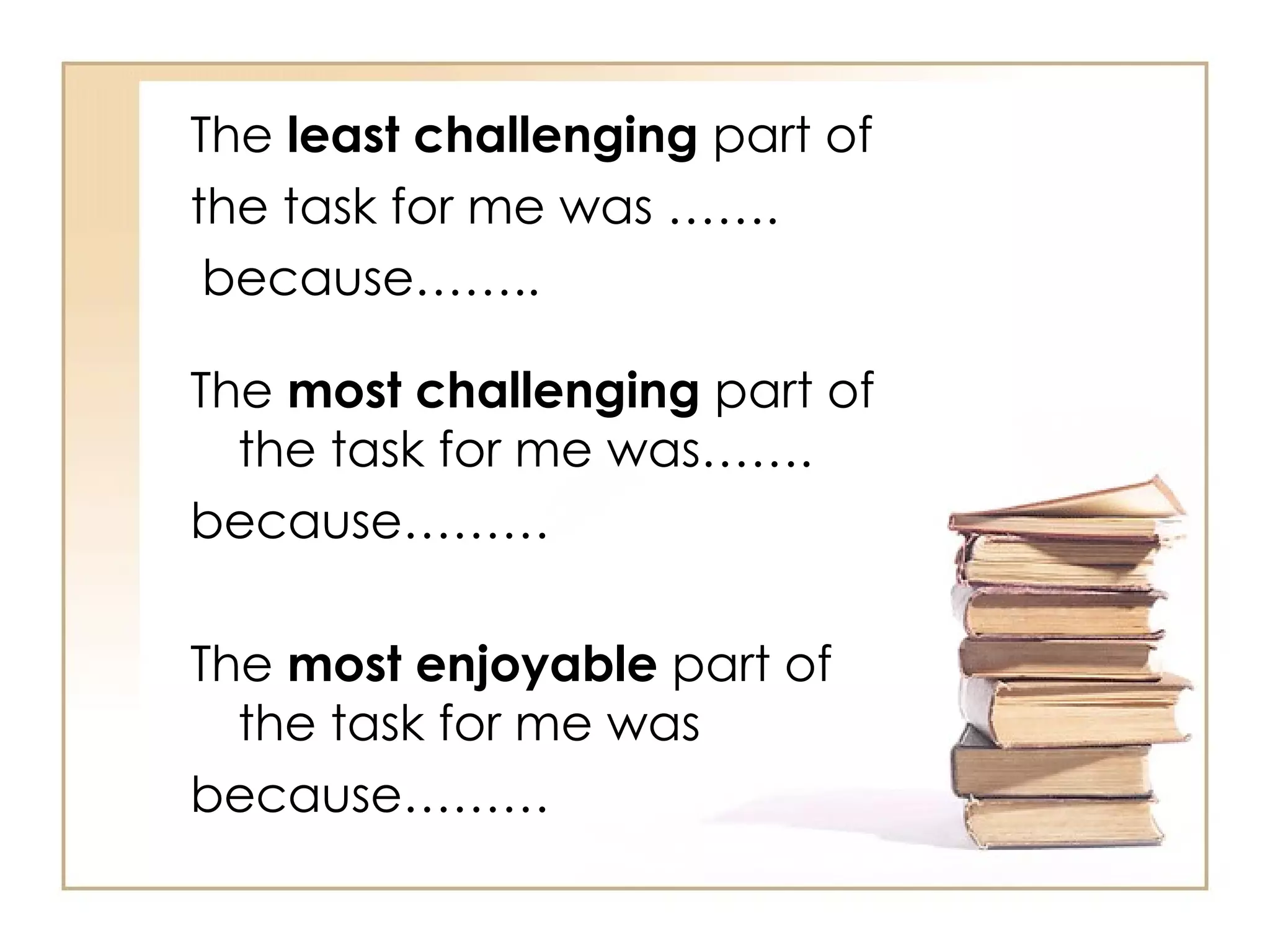
The least challenging part of
the task for me was …….
 because……..

The most challenging part of
  the task for me was…….
because………

The most enjoyable part of
  the task for me was
because………
From the project I learned:

You may list as many things as you wish.
  There is no need to complete all of
  the sections below or you may wish to
  add more. You should include
  statements about time management
  or research as well as things about the
  language and culture.
Parents’ Comments 1
So far my child has done:
Parent comment:
• So far Nick is doing very well with his
   project and there are no difficulties. We
   don’t believe he will have any difficulties
   but could you pay particular attention to
   his spelling.
• Has been planning and drawing for the
   project to get ready to publish it.
• Research/made enquiries about family
   members – constructed scaffold-
   researched basic Chinese family structure.
   Working well.
• Researched family names, bought
   cardboard. Collected information for
   power point and started writing speech.
   We have given Louisa most of the Chinese
   names. She will be collecting more
   information.
Parents’ Comments 2
“…. is very responsible in doing her
  assignments considering her lack of
  time due to school homework and
  work responsibilities”

“The timing of the assignment isn’t ideal
   as it clashes with her half yearly &
   assignments which need to be
   completed for her report.”

“ I think Sophie is getting a better
    understanding of differences of
    Australian & Chinese family life &
    learning more about her heritage”
Students’ Comments
“There aren’t many
   differences between my
   family and my friend’s. The
   only obvious difference
   was the time that we
   brushed our teeth.”
“.. some things don’t
   translate across cultures.”
Students’ Comments cont’d
“ I learnt what a mind map
   was.”
“I also learned to organise all
   the information so that
   when I make a book it
   looks organised”
“I learnt that google
   language tool exists”
Student comments cont’d
“The most enjoyable part for me
  was finishing it.”

“Sorry but too much normal
  school homework at ….”

“No comment.”

“I’m having a few problems with
   vocabulary.”
What can teachers learn from the
planning and evaluation sheets?

• Students’ preferred learning
  styles
• Students’ interest areas
• Areas of students’ strengths and
  weaknesses
• Data for planning of future
  lessons and tasks
Feedback to
  students
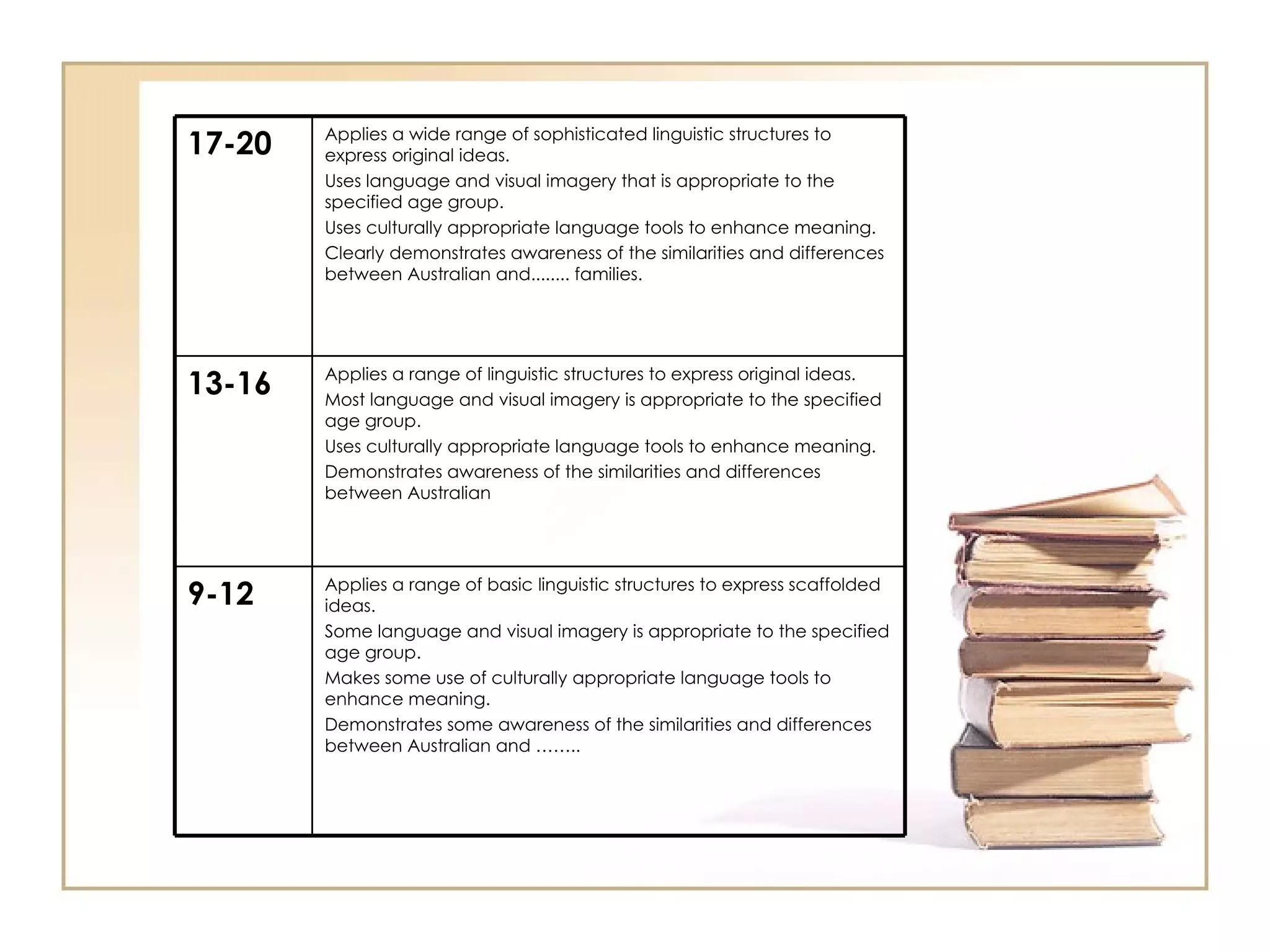
17-20   Applies a wide range of sophisticated linguistic structures to
        express original ideas.
        Uses language and visual imagery that is appropriate to the
        specified age group.
        Uses culturally appropriate language tools to enhance meaning.
        Clearly demonstrates awareness of the similarities and differences
        between Australian and........ families.


13-16   Applies a range of linguistic structures to express original ideas.
        Most language and visual imagery is appropriate to the specified
        age group.
        Uses culturally appropriate language tools to enhance meaning.
        Demonstrates awareness of the similarities and differences
        between Australian


9-12    Applies a range of basic linguistic structures to express scaffolded
        ideas.
        Some language and visual imagery is appropriate to the specified
        age group.
        Makes some use of culturally appropriate language tools to
        enhance meaning.
        Demonstrates some awareness of the similarities and differences
        between Australian and ……..
Less teacher speak
Teacher Comments:
You have demonstrated strengths in the following
      areas:
………………………………………………………………
………………………………………………………………
………………………………………………………………
.......................................................................................

In future tasks you should consider the following:
………………………………………………………………
………………………………………………………………
………………………………………………………………
Where to from
 here?
Due Dates and Marks
Date 28th March Student Questions and Plan
  sheet due               (10 Marks)

Date 4th April Parent Evaluation and Student
  Progress sheet due          (10 Marks)

Date 9th May Project due         (70 Marks)

Date 9th May Reflection Statement due
                                   (10
  Marks)

Increase the range of choice in the project to
   cater for different interests and learning
   styles.
Incorporate more teaching and learning
   strategies into lessons that cater for different
   interests and learning styles.
kristine.horan@det.nsw.edu.au


supai.zhao1@det.nsw.edu.au


pamela.m.burns@det.nsw.edu.au

Assessment for Learning

  • 1.
    DIALOGUE, DISCOURSE, DIVERSITY JULY 2009 •ASSESSMENT FOR LEARNING •FEEDBACK -WHO GIVES IT? - HOW DO WE GET IT?
  • 2.
    Aims • to reflecton the attributes of a quality assessment task • to link those qualities to the Professional Standards for Accomplished Teachers of Languages and Cultures • to examine the process of assessment for learning through the experience of staff at the Saturday School of Community Languages, Merewether HS • to discuss the possible application of the above to participants’ own contexts
  • 3.
    Professional Standards forTeachers of Languages and Culture • Promote reflection • Stimulus for professional dialogue http://www.decs.sa.gov.au/curric/files/links/prof_standards.pdf
  • 4.
    • Professional standardsfor accomplished teachers of languages and cultures. Accomplished languages and cultures teaching is reflected through the following dimensions: • educational theory and practice • language and culture • language pedagogy • ethics and responsibility • professional relationships • awareness of wider context • advocacy • personal characteristics
  • 5.
    Which standards doesassessment relate to? • Language Pedagogy “….approach to assessment examines understanding, learning and performance, and uses assessment to foster learning as well as evaluate learning.............” “…..select assessment tasks which are appropriate to the purposes of the assessment and use the assessment for effective feedback and reporting.”
  • 6.
    ACTIVITY • What makesa quality assessment task? Take a few minutes to think about this and discuss it with your colleagues. Jot down no more than 5 points.
  • 7.
    The 10 principles:Assessment for Learning Assessment Reform Group, 2002 http://www.qca.org.uk/qca_4336.aspx
  • 8.
    1. Assessment forlearning should be part of effective planning of teaching and learning 2. Assessment for learning should focus on how students learn
  • 9.
    3. Assessment forlearning should be recognised as central to classroom practice 4. Assessment for learning should be regarded as a key professional skill for teachers
  • 10.
    5. Assessment forlearning should be sensitive and constructive because any assessment has an emotional impact 6. Assessment for learning should take account of the importance of learner motivation
  • 11.
    7. Assessment forlearning should promote commitment to learning goals and a shared understanding of the criteria by which they are assessed 8. Learners should receive constructive guidance about how to improve
  • 12.
    9. Assessment forlearning develops learners’ capacity for self- assessment so that they can become reflective and self-managing 10. Assessment for learning should recognise the full range of achievements of all learners
  • 13.
    Our challenge atSSCL Merewether High School • To overcome the perception that Saturday School is not as important as mainstream school • To encourage students and teachers to focus on the process rather than just the product.
  • 14.
    RESEARCH PROJECT (PARTOF HALF YEARLY ASSESSMENT) Teachers: • Meet and brainstorm ideas Students: • from 7-10 are required to complete a research project. • are given a selection of topics from which to choose. • are given a selection of media to use for the presentation of their research eg power point, photo story, oral presentation
  • 15.
    PROJECT • Outcomes: • TASK • Marking Guidelines: • Points to Note • It is important to follow the due dates carefully as each section is significant and is marked. • It is necessary to plan your project and return it to the class teacher on the ‘Student Question and Plan’ sheet. • You will need to hand in the ‘Parent Evaluation and Student Progress’ sheet. • It is essential that you seek clarification or ask for help at any time if you are uncertain of anything. • Due Dates and Marks • 17th MAY Student Questions and Plan sheet due (10Marks) • 31st MAY Parent Evaluation and Student Progress sheet due (5 Marks) • 21st JUNE Project Due (85 Marks)
  • 16.
    Why have theplanning sheet and the parent evaluation and student progress sheet? • requires some planning – can’t leave the project till the night before • teacher can give assistance before it’s too late • parental involvement – parents are aware of requirements of the project & can assist • promotion of our school and accountability
  • 17.
    Feedback to teachers
  • 18.
    STUDENT QUESTIONNAIRE AND PLAN (due 17 May) th My Choice is: I am going to create and include (explain your section or choice): I need to do these things in order to complete my project (eg research write, draw etc): Teacher’s Response:
  • 19.
    Parent Evaluation andStudent Progress (due 31 May) st Project Task: ___________ • In relation to his/her project my child is: – EXPERIENCING DIFFICULTY – COPING WELL – COPING VERY WELL & ENJOYING THE PROJECT • So far they have: • Parent Comment: Parent Signature: Date:
  • 20.
    Student’s Response (due 31 st May) I am: • Having difficulty • Doing well • Doing really well I have used my time: • Not very well • Effectively • Very wisely Comment: How can we help? Signature: Date:
  • 21.
    Reflection Statement The followingstatement is designed to assess the suitability of the task for each student and will be used in the development of future tasks. Please take the time to complete this section honestly and thoughtfully.
  • 22.
    The least challengingpart of the task for me was ……. because…….. The most challenging part of the task for me was……. because……… The most enjoyable part of the task for me was because………
  • 23.
    From the projectI learned: You may list as many things as you wish. There is no need to complete all of the sections below or you may wish to add more. You should include statements about time management or research as well as things about the language and culture.
  • 24.
    Parents’ Comments 1 Sofar my child has done: Parent comment: • So far Nick is doing very well with his project and there are no difficulties. We don’t believe he will have any difficulties but could you pay particular attention to his spelling. • Has been planning and drawing for the project to get ready to publish it. • Research/made enquiries about family members – constructed scaffold- researched basic Chinese family structure. Working well. • Researched family names, bought cardboard. Collected information for power point and started writing speech. We have given Louisa most of the Chinese names. She will be collecting more information.
  • 25.
    Parents’ Comments 2 “….is very responsible in doing her assignments considering her lack of time due to school homework and work responsibilities” “The timing of the assignment isn’t ideal as it clashes with her half yearly & assignments which need to be completed for her report.” “ I think Sophie is getting a better understanding of differences of Australian & Chinese family life & learning more about her heritage”
  • 26.
    Students’ Comments “There aren’tmany differences between my family and my friend’s. The only obvious difference was the time that we brushed our teeth.” “.. some things don’t translate across cultures.”
  • 27.
    Students’ Comments cont’d “I learnt what a mind map was.” “I also learned to organise all the information so that when I make a book it looks organised” “I learnt that google language tool exists”
  • 28.
    Student comments cont’d “Themost enjoyable part for me was finishing it.” “Sorry but too much normal school homework at ….” “No comment.” “I’m having a few problems with vocabulary.”
  • 29.
    What can teacherslearn from the planning and evaluation sheets? • Students’ preferred learning styles • Students’ interest areas • Areas of students’ strengths and weaknesses • Data for planning of future lessons and tasks
  • 30.
    Feedback to students
  • 31.
    17-20 Applies a wide range of sophisticated linguistic structures to express original ideas. Uses language and visual imagery that is appropriate to the specified age group. Uses culturally appropriate language tools to enhance meaning. Clearly demonstrates awareness of the similarities and differences between Australian and........ families. 13-16 Applies a range of linguistic structures to express original ideas. Most language and visual imagery is appropriate to the specified age group. Uses culturally appropriate language tools to enhance meaning. Demonstrates awareness of the similarities and differences between Australian 9-12 Applies a range of basic linguistic structures to express scaffolded ideas. Some language and visual imagery is appropriate to the specified age group. Makes some use of culturally appropriate language tools to enhance meaning. Demonstrates some awareness of the similarities and differences between Australian and ……..
  • 32.
    Less teacher speak TeacherComments: You have demonstrated strengths in the following areas: ……………………………………………………………… ……………………………………………………………… ……………………………………………………………… ....................................................................................... In future tasks you should consider the following: ……………………………………………………………… ……………………………………………………………… ………………………………………………………………
  • 33.
  • 34.
    Due Dates andMarks Date 28th March Student Questions and Plan sheet due (10 Marks) Date 4th April Parent Evaluation and Student Progress sheet due (10 Marks) Date 9th May Project due (70 Marks) Date 9th May Reflection Statement due (10 Marks) Increase the range of choice in the project to cater for different interests and learning styles. Incorporate more teaching and learning strategies into lessons that cater for different interests and learning styles.
  • 35.