12 PHYSICS           CIRCULAR MOTION ASSIGNMENT               Name

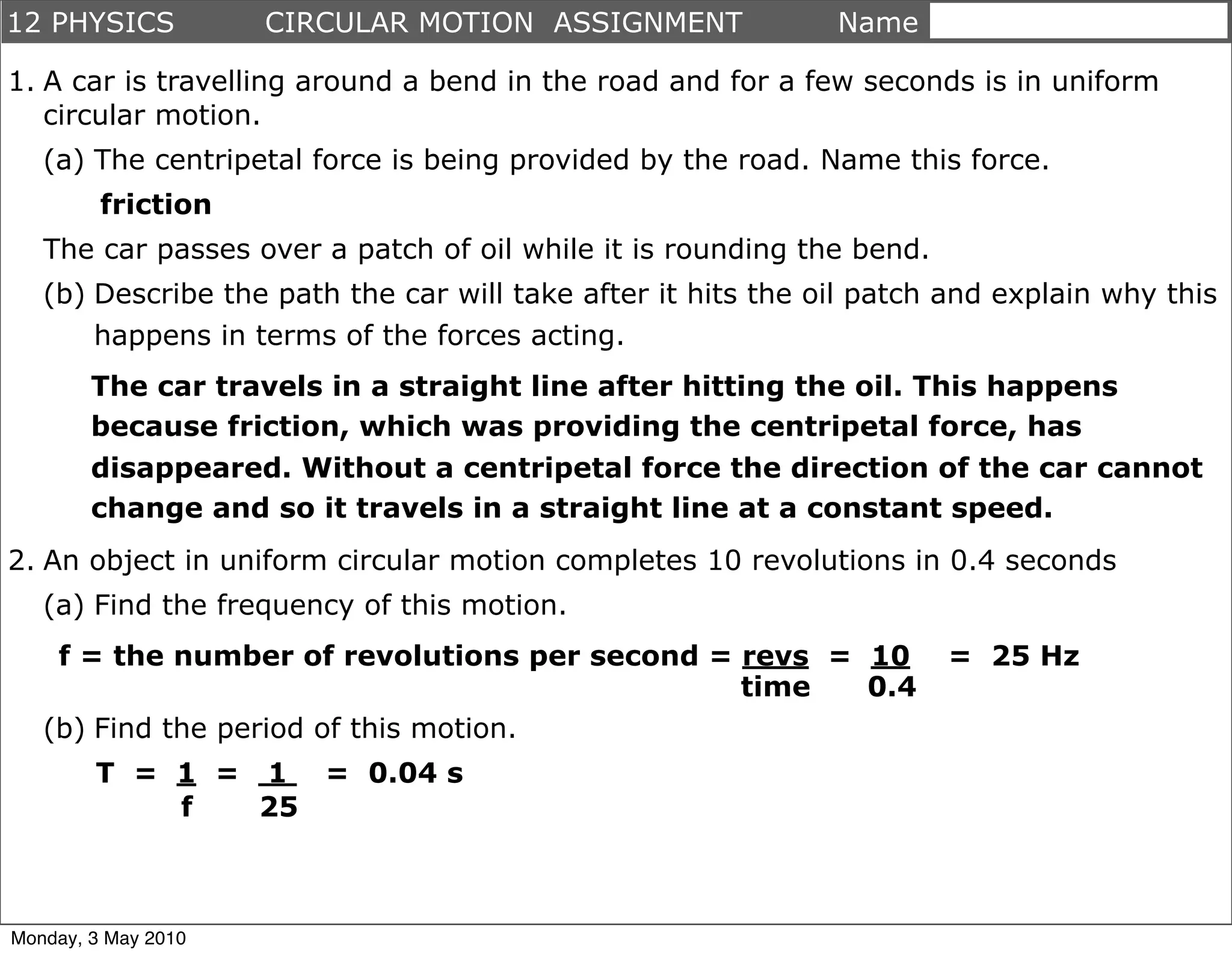
1. A car is travelling around a bend in the road and for a few seconds is in uniform
   circular motion.
   (a) The centripetal force is being provided by the road. Name this force.
         friction
   The car passes over a patch of oil while it is rounding the bend.
   (b) Describe the path the car will take after it hits the oil patch and explain why this
       happens in terms of the forces acting.
        The car travels in a straight line after hitting the oil. This happens
        because friction, which was providing the centripetal force, has
        disappeared. Without a centripetal force the direction of the car cannot
        change and so it travels in a straight line at a constant speed.
2. An object in uniform circular motion completes 10 revolutions in 0.4 seconds
   (a) Find the frequency of this motion.
    f = the number of revolutions per second = revs = 10               = 25 Hz
                                               time   0.4
   (b) Find the period of this motion.
        T = 1 = 1 = 0.04 s
            f   25


Monday, 3 May 2010
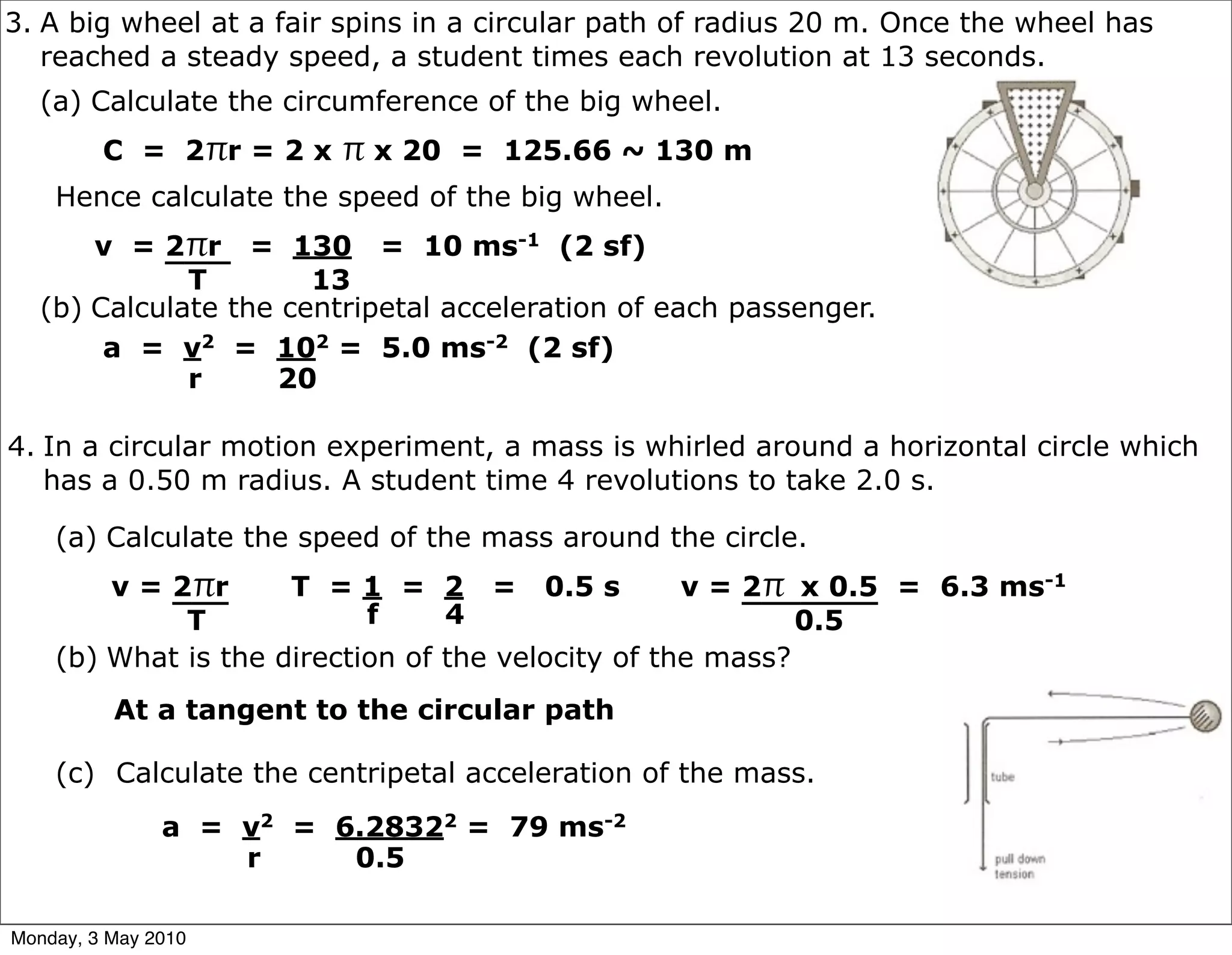
3. A big wheel at a fair spins in a circular path of radius 20 m. Once the wheel has
   reached a steady speed, a student times each revolution at 13 seconds.
   (a) Calculate the circumference of the big wheel.
         C = 2π r = 2 x   π x 20   = 125.66 ~ 130 m
    Hence calculate the speed of the big wheel.
       v = 2πr = 130 = 10 ms-1 (2 sf)
              T        13
   (b) Calculate the centripetal acceleration of each passenger.
        a = v2 = 102 = 5.0 ms-2 (2 sf)
              r     20

4. In a circular motion experiment, a mass is whirled around a horizontal circle which
   has a 0.50 m radius. A student time 4 revolutions to take 2.0 s.

    (a) Calculate the speed of the mass around the circle.
        v = 2πr      T = 1 = 2 = 0.5 s             v = 2π x 0.5 = 6.3 ms-1
             T             f     4                         0.5
    (b) What is the direction of the velocity of the mass?
          At a tangent to the circular path

    (c) Calculate the centripetal acceleration of the mass.
               a = v2 = 6.28322 = 79 ms-2
                   r     0.5

Monday, 3 May 2010
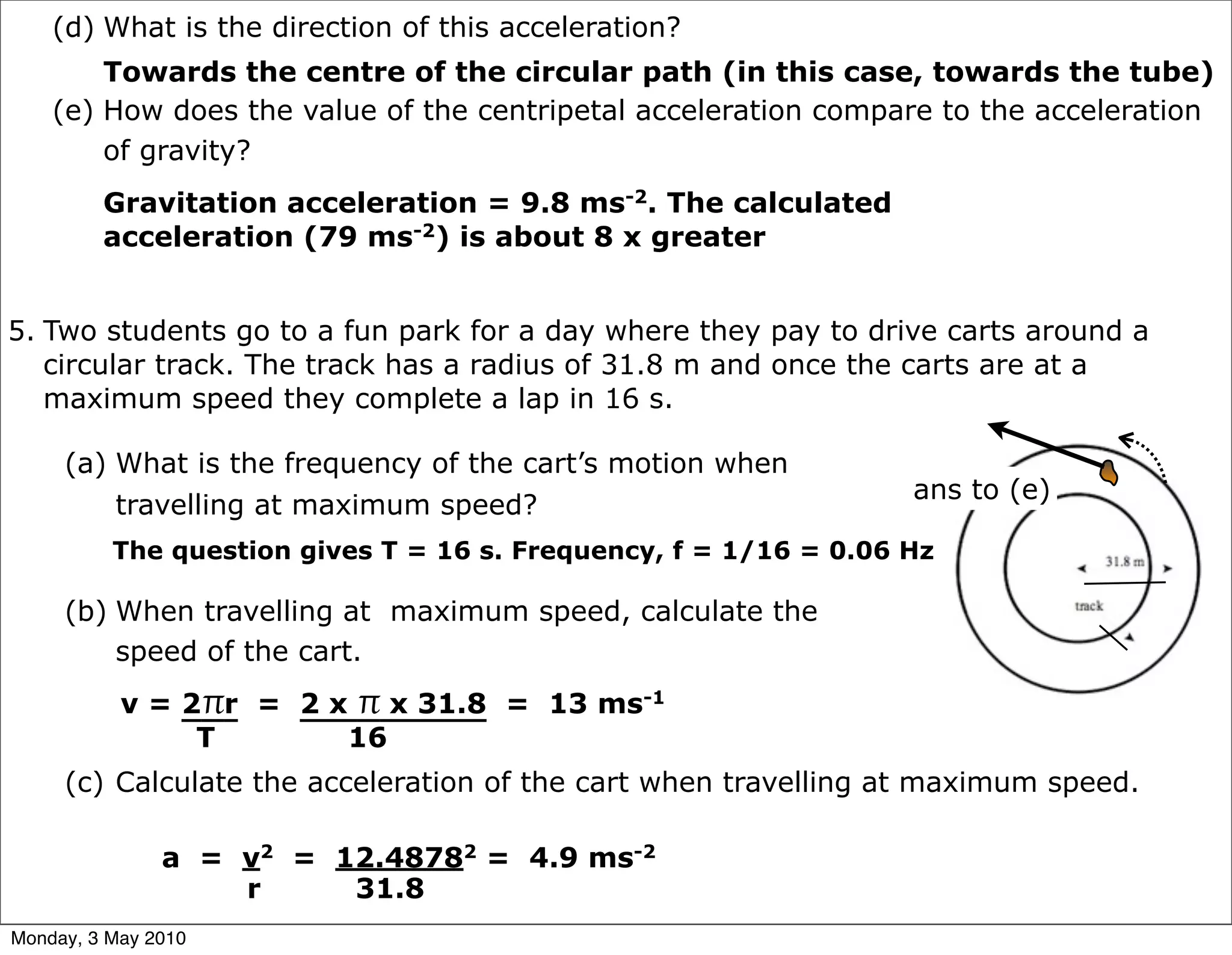
(d) What is the direction of this acceleration?
        Towards the centre of the circular path (in this case, towards the tube)
    (e) How does the value of the centripetal acceleration compare to the acceleration
        of gravity?
         Gravitation acceleration = 9.8 ms-2. The calculated
         acceleration (79 ms-2) is about 8 x greater


5. Two students go to a fun park for a day where they pay to drive carts around a
   circular track. The track has a radius of 31.8 m and once the carts are at a
   maximum speed they complete a lap in 16 s.

     (a) What is the frequency of the cart’s motion when
                                                                  ans to (e)
         travelling at maximum speed?
          The question gives T = 16 s. Frequency, f = 1/16 = 0.06 Hz

     (b) When travelling at maximum speed, calculate the
         speed of the cart.
           v = 2πr = 2 x π x 31.8 = 13 ms-1
                T       16
     (c) Calculate the acceleration of the cart when travelling at maximum speed.

               a = v2 = 12.48782 = 4.9 ms-2
                   r     31.8
Monday, 3 May 2010
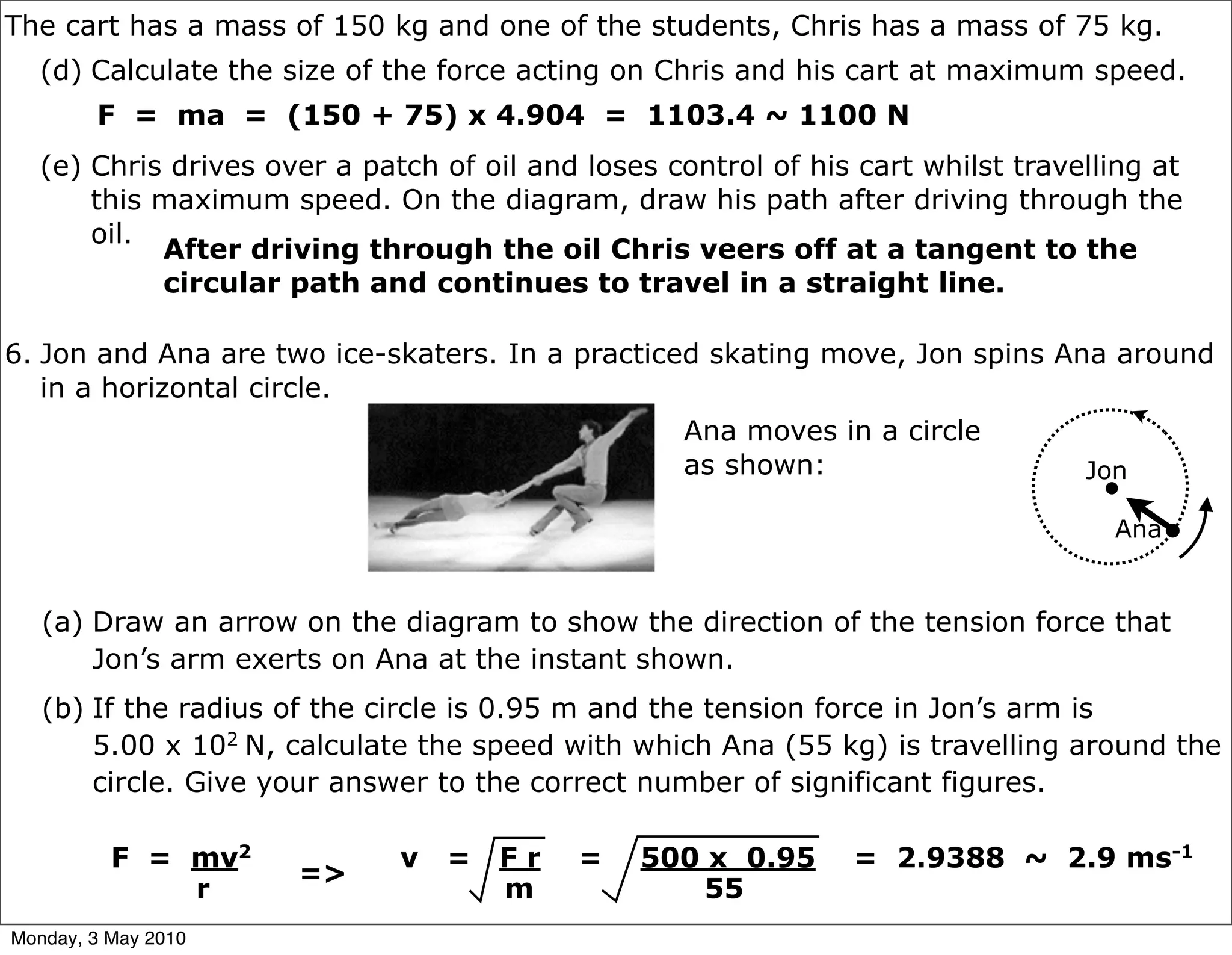
The cart has a mass of 150 kg and one of the students, Chris has a mass of 75 kg.
   (d) Calculate the size of the force acting on Chris and his cart at maximum speed.
        F = ma = (150 + 75) x 4.904 = 1103.4 ~ 1100 N
   (e) Chris drives over a patch of oil and loses control of his cart whilst travelling at
       this maximum speed. On the diagram, draw his path after driving through the
       oil.
            After driving through the oil Chris veers off at a tangent to the
            circular path and continues to travel in a straight line.

6. Jon and Ana are two ice-skaters. In a practiced skating move, Jon spins Ana around
   in a horizontal circle.
                                                   Ana moves in a circle
                                                   as shown:                      Jon

                                                                                    Ana


   (a) Draw an arrow on the diagram to show the direction of the tension force that
       Jon’s arm exerts on Ana at the instant shown.
   (b) If the radius of the circle is 0.95 m and the tension force in Jon’s arm is
       5.00 x 10² N, calculate the speed with which Ana (55 kg) is travelling around the
       circle. Give your answer to the correct number of significant figures.

          F = mv2             v   =   Fr   =    500 x 0.95      = 2.9388 ~ 2.9 ms-1
                      =>
              r                       m             55
Monday, 3 May 2010
(d) While Ana is still moving in a circle on the ice, Jon lets her go.
   (i) Describe her velocity (speed and direction) after he releases her.
     her velocity (speed and direction) become constant as she veers off at a
     tangent to the circular path the instant that Jon lets her go.


   (ii) Explain why Ana travels with this velocity.
     Anna travels with a constant velocity because now there is no longer a
     force to change the direction of her velocity. Her speed remains
     unchanged.


Monday, 3 May 2010

Circular Motion Assnt Answers

  • 1.
    12 PHYSICS CIRCULAR MOTION ASSIGNMENT Name 1. A car is travelling around a bend in the road and for a few seconds is in uniform circular motion. (a) The centripetal force is being provided by the road. Name this force. friction The car passes over a patch of oil while it is rounding the bend. (b) Describe the path the car will take after it hits the oil patch and explain why this happens in terms of the forces acting. The car travels in a straight line after hitting the oil. This happens because friction, which was providing the centripetal force, has disappeared. Without a centripetal force the direction of the car cannot change and so it travels in a straight line at a constant speed. 2. An object in uniform circular motion completes 10 revolutions in 0.4 seconds (a) Find the frequency of this motion. f = the number of revolutions per second = revs = 10 = 25 Hz time 0.4 (b) Find the period of this motion. T = 1 = 1 = 0.04 s f 25 Monday, 3 May 2010
  • 2.
    3. A bigwheel at a fair spins in a circular path of radius 20 m. Once the wheel has reached a steady speed, a student times each revolution at 13 seconds. (a) Calculate the circumference of the big wheel. C = 2π r = 2 x π x 20 = 125.66 ~ 130 m Hence calculate the speed of the big wheel. v = 2πr = 130 = 10 ms-1 (2 sf) T 13 (b) Calculate the centripetal acceleration of each passenger. a = v2 = 102 = 5.0 ms-2 (2 sf) r 20 4. In a circular motion experiment, a mass is whirled around a horizontal circle which has a 0.50 m radius. A student time 4 revolutions to take 2.0 s. (a) Calculate the speed of the mass around the circle. v = 2πr T = 1 = 2 = 0.5 s v = 2π x 0.5 = 6.3 ms-1 T f 4 0.5 (b) What is the direction of the velocity of the mass? At a tangent to the circular path (c) Calculate the centripetal acceleration of the mass. a = v2 = 6.28322 = 79 ms-2 r 0.5 Monday, 3 May 2010
  • 3.
    (d) What isthe direction of this acceleration? Towards the centre of the circular path (in this case, towards the tube) (e) How does the value of the centripetal acceleration compare to the acceleration of gravity? Gravitation acceleration = 9.8 ms-2. The calculated acceleration (79 ms-2) is about 8 x greater 5. Two students go to a fun park for a day where they pay to drive carts around a circular track. The track has a radius of 31.8 m and once the carts are at a maximum speed they complete a lap in 16 s. (a) What is the frequency of the cart’s motion when ans to (e) travelling at maximum speed? The question gives T = 16 s. Frequency, f = 1/16 = 0.06 Hz (b) When travelling at maximum speed, calculate the speed of the cart. v = 2πr = 2 x π x 31.8 = 13 ms-1 T 16 (c) Calculate the acceleration of the cart when travelling at maximum speed. a = v2 = 12.48782 = 4.9 ms-2 r 31.8 Monday, 3 May 2010
  • 4.
    The cart hasa mass of 150 kg and one of the students, Chris has a mass of 75 kg. (d) Calculate the size of the force acting on Chris and his cart at maximum speed. F = ma = (150 + 75) x 4.904 = 1103.4 ~ 1100 N (e) Chris drives over a patch of oil and loses control of his cart whilst travelling at this maximum speed. On the diagram, draw his path after driving through the oil. After driving through the oil Chris veers off at a tangent to the circular path and continues to travel in a straight line. 6. Jon and Ana are two ice-skaters. In a practiced skating move, Jon spins Ana around in a horizontal circle. Ana moves in a circle as shown: Jon Ana (a) Draw an arrow on the diagram to show the direction of the tension force that Jon’s arm exerts on Ana at the instant shown. (b) If the radius of the circle is 0.95 m and the tension force in Jon’s arm is 5.00 x 10² N, calculate the speed with which Ana (55 kg) is travelling around the circle. Give your answer to the correct number of significant figures. F = mv2 v = Fr = 500 x 0.95 = 2.9388 ~ 2.9 ms-1 => r m 55 Monday, 3 May 2010
  • 5.
    (d) While Anais still moving in a circle on the ice, Jon lets her go. (i) Describe her velocity (speed and direction) after he releases her. her velocity (speed and direction) become constant as she veers off at a tangent to the circular path the instant that Jon lets her go. (ii) Explain why Ana travels with this velocity. Anna travels with a constant velocity because now there is no longer a force to change the direction of her velocity. Her speed remains unchanged. Monday, 3 May 2010