Circular Motion
Lecture 6
Pre-reading: KJF §6.1 and 6.2
Please log in to Socrative, 

room HMJPHYS1002
CIRCULAR MOTION
KJF §6.1–6.4
Angular position
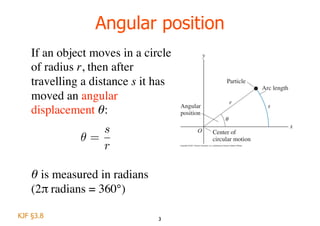
If an object moves in a circle
of radius r, then after
travelling a distance s it has
moved an angular
displacement θ:
θ is measured in radians

(2π radians = 360°)
KJF §3.8
θ =
s
r
3
Tangential velocity
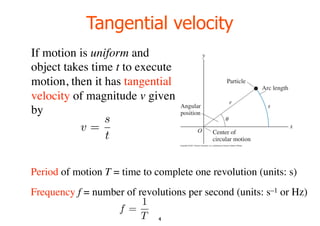
If motion is uniform and
object takes time t to execute
motion, then it has tangential
velocity of magnitude v given
by
v =
s
t
f =
1
T
Period of motion T = time to complete one revolution (units: s)
Frequency f = number of revolutions per second (units: s–1 or Hz)
4
Angular velocity
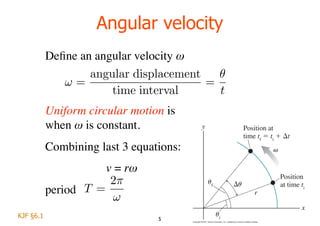
Define an angular velocity ω
Uniform circular motion is
when ω is constant.
Combining last 3 equations:
v = rω
period
ω =
angular displacement
time interval
=
θ
t
KJF §6.1
T =
2π
ω
5
Question
You place a beetle on a 

uniformly rotating record
(a)Is the beetle's tangential velocity different or
the same at different radial positions?
(b)Is the beetle's angular velocity different or the
same at the different radial positions?
Remember; all points on a rigid rotating object
will experience the same angular velocity
6
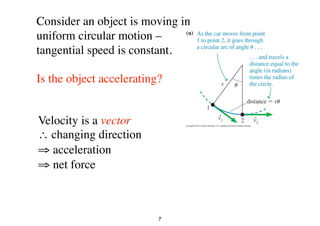
Consider an object is moving in
uniform circular motion –
tangential speed is constant.
Is the object accelerating?
Velocity is a vector

∴ changing direction 

⇒ acceleration 

⇒ net force
7
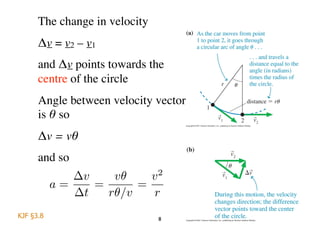
The change in velocity
Δv = v2 – v1
and Δv points towards the
centre of the circle
Angle between velocity vectors
is θ so
Δv = vθ
and so
a =
∆v
∆t
=
vθ
rθ/v
=
v2
r
KJF §3.8 8
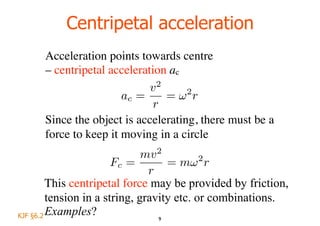
Acceleration points towards centre 

– centripetal acceleration ac
Since the object is accelerating, there must be a
force to keep it moving in a circle
Centripetal acceleration
KJF §6.2
ac =
v2
r
= ω2
r
Fc =
mv2
r
= mω2
r
This centripetal force may be provided by friction,
tension in a string, gravity etc. or combinations.
Examples? 9
Note that centripetal force is the name given to
the resultant force: it is not a separate force in
the free-body diagram.
The centripetal acceleration has to be provided
by some other force (tension, friction, normal
force) in order for circular motion to occur.
10
• Draw a free-body diagram
• If the object is moving in a circle, there must be a
net force pointing towards the centre of the circle.
• The magnitude of this net force is given by
11
Solving CM problems
Fc =
mv2
r
= mω2
r
12
Problem 1
You enter the carnival ride called "The Rotor". The
circular room is spinning and you and other riders are
stuck to the circular wall.
• Draw a free-body diagram of
the woman in red
• Is she in equilibrium? Explain
• What force is providing the
centripetal force?
Whirling bucket
A bucket of water is
whirled around in a vertical
circle with radius 1m.
What is the minimum
speed that it can be whirled
so the water remains in the
bucket?
13
[3 ms–1, or rotation period 2s]
Socrative questions
15
Car around a corner
A car of mass 1.6 t travels at a constant speed of
72 km/h around a horizontal curved road with radius
of curvature 190 m. (Draw a free-body diagram)
What is the minimum value of μs between the road
and the tyres that will prevent slippage?
[0.21]
16
Car over a hill
A car is driving at constant speed over a hill,
which is a circular dome of radius 240 m.
Above what speed will the car leave the road at
the top of the hill?
[175 km/h]
17
Banked road
On a curve, if the road surface is "banked" (tilted
towards the curve centre) then the horizontal
component of the normal force can provide some
(or all) of the required centripetal force. Choose v
& θ so that less or no static friction is required.
KJF example 6.6
18
KJF example 6.6
A curve of radius 70m is banked at a 15° angle. At
what speed can a car take this curve without
assistance from friction?
KJF example 6.6
[14 ms–1 = 50 km h–1]
NEXT LECTURE
Centre of mass and Torque
Read: KJF §7.2, 7.3

circular motion Mechanics

  • 1.
    Circular Motion Lecture 6 Pre-reading:KJF §6.1 and 6.2 Please log in to Socrative, 
 room HMJPHYS1002
  • 2.
  • 3.
    Angular position If anobject moves in a circle of radius r, then after travelling a distance s it has moved an angular displacement θ: θ is measured in radians
 (2π radians = 360°) KJF §3.8 θ = s r 3
  • 4.
    Tangential velocity If motionis uniform and object takes time t to execute motion, then it has tangential velocity of magnitude v given by v = s t f = 1 T Period of motion T = time to complete one revolution (units: s) Frequency f = number of revolutions per second (units: s–1 or Hz) 4
  • 5.
    Angular velocity Define anangular velocity ω Uniform circular motion is when ω is constant. Combining last 3 equations: v = rω period ω = angular displacement time interval = θ t KJF §6.1 T = 2π ω 5
  • 6.
    Question You place abeetle on a 
 uniformly rotating record (a)Is the beetle's tangential velocity different or the same at different radial positions? (b)Is the beetle's angular velocity different or the same at the different radial positions? Remember; all points on a rigid rotating object will experience the same angular velocity 6
  • 7.
    Consider an objectis moving in uniform circular motion – tangential speed is constant. Is the object accelerating? Velocity is a vector
 ∴ changing direction 
 ⇒ acceleration 
 ⇒ net force 7
  • 8.
    The change invelocity Δv = v2 – v1 and Δv points towards the centre of the circle Angle between velocity vectors is θ so Δv = vθ and so a = ∆v ∆t = vθ rθ/v = v2 r KJF §3.8 8
  • 9.
    Acceleration points towardscentre 
 – centripetal acceleration ac Since the object is accelerating, there must be a force to keep it moving in a circle Centripetal acceleration KJF §6.2 ac = v2 r = ω2 r Fc = mv2 r = mω2 r This centripetal force may be provided by friction, tension in a string, gravity etc. or combinations. Examples? 9
  • 10.
    Note that centripetalforce is the name given to the resultant force: it is not a separate force in the free-body diagram. The centripetal acceleration has to be provided by some other force (tension, friction, normal force) in order for circular motion to occur. 10
  • 11.
    • Draw afree-body diagram • If the object is moving in a circle, there must be a net force pointing towards the centre of the circle. • The magnitude of this net force is given by 11 Solving CM problems Fc = mv2 r = mω2 r
  • 12.
    12 Problem 1 You enterthe carnival ride called "The Rotor". The circular room is spinning and you and other riders are stuck to the circular wall. • Draw a free-body diagram of the woman in red • Is she in equilibrium? Explain • What force is providing the centripetal force?
  • 13.
    Whirling bucket A bucketof water is whirled around in a vertical circle with radius 1m. What is the minimum speed that it can be whirled so the water remains in the bucket? 13 [3 ms–1, or rotation period 2s]
  • 14.
  • 15.
    15 Car around acorner A car of mass 1.6 t travels at a constant speed of 72 km/h around a horizontal curved road with radius of curvature 190 m. (Draw a free-body diagram) What is the minimum value of μs between the road and the tyres that will prevent slippage? [0.21]
  • 16.
    16 Car over ahill A car is driving at constant speed over a hill, which is a circular dome of radius 240 m. Above what speed will the car leave the road at the top of the hill? [175 km/h]
  • 17.
    17 Banked road On acurve, if the road surface is "banked" (tilted towards the curve centre) then the horizontal component of the normal force can provide some (or all) of the required centripetal force. Choose v & θ so that less or no static friction is required. KJF example 6.6
  • 18.
    18 KJF example 6.6 Acurve of radius 70m is banked at a 15° angle. At what speed can a car take this curve without assistance from friction? KJF example 6.6 [14 ms–1 = 50 km h–1]
  • 19.
    NEXT LECTURE Centre ofmass and Torque Read: KJF §7.2, 7.3