The Rise of Centralized BI:
IT & The Business
There is a clear trend happening: The death of federated BI. This
model of Business Intelligence is failing because allowing individual
departments to have their own IT systems and services is creating silos
and is not helping organizations meet their goals and objectives.
Centralized BI is going to replace federated BI because when done
correctly, it can simplify administrative tasks, improve data security,
make data management and sharing a lot easier, and save the company a
lot of money. There is a growing sense of urgency to abandon federated
BI and deploy centralized BI.
The Rise of Centralized BI
Combined “Centralized & State of the Art BI”
To achieve the best results possible, we need to combine centralized and state
of the art BI. Centralized is about governability. It provides a solution that is just
one environment, both power users and business users can log in to the same
environment. Line managers keep the decision rights over what services should be
delivered, but IT has the authority over how the services are delivered. This aligns
the organization.
Centralized BI is critical, but enterprises also need state of the art BI. This
means getting the most advanced technology possible. Nowadays we see this in
automation of dashboards, automatic insights and exceptions, plus the ability of the
users to define their own thresholds, data anomalies, etc. Businesses need
solutions that will notify them while monitoring KPIs and distribute reports
automatically.
When comparing centralized and federated BI there are key points that
come to light. First, centralized BI is about connection, all users work
connected. In federated BI, users work in silos. This means that the findings
or insights they get stay in their desktop, instead of sharing the knowledge. A
centralized environment strives to achieve a single version of the truth. This
is impossible in a federated environment; there are thousands of excels that
are going across tables and being edited in different desktops, then they get
shared and edited again. It is really complicated to merge this data.
When referring to the ability to maintain the system and scaling it with a
specialized BI/IT team, there is no point of comparison. In federated BI there
are too many desktops, too many different solutions, tech savvy businesses
that don’t know how to scale BI to the whole enterprise. With centralized BI,
organizations can keep costs down, because they are not overlapping staff,
servers, licenses, and other things that are not necessary. Centralized BI
pushes high usage because it is catered. And it keeps the security on the
domain of the experts of IT in a central and smart analytic platform. In terms
of deployment, centralized BI is easier and simple. It allows users to draw a
web deployment, there’s no scripting or installation on desktops, and it
remains open to new users all the time because it can be scaled easily.
Centralized Federated
One version of the truth is about the organization being aligned. The
knowledge should not stay in just one department or get lost in excels
across the organization. It should aggregate multiple areas to enable the
company to get ahead of trends. The organization as a whole gets
smarter as people work together.
One Version of The Truth
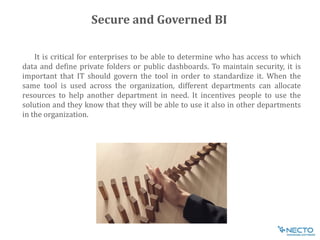
It is critical for enterprises to be able to determine who has access to which
data and define private folders or public dashboards. To maintain security, it is
important that IT should govern the tool in order to standardize it. When the
same tool is used across the organization, different departments can allocate
resources to help another department in need. It incentives people to use the
solution and they know that they will be able to use it also in other departments
in the organization.
Secure and Governed BI
Centralized BI ensures one version
of the truth: with accurate data in the
right context. It is also easier to
connect people in a centralized BI
solution, rather than having
disconnected desktops around the
organization. Everyone will see the
same insights, the same numbers and
data; instead of having the data stay in
only one domain.
Centralized BI works at its best
when using a fully web based solution
that is easy for deployment and
scalability and is going to help the
organization transfer knowledge from
domain to domain.
Centralized Ensures Veracity
With Centralized BI there is no need to maintain hundreds of systems, instead,
the organization can allocate resources for only one environment. If the
environment is a web solution, then it has great scalability and can be easily
deployed and expanded as more departments want to use BI. As more
departments start using the solution, IT does not have to do complicated desktop
installations that can be time and resource consuming. With centralization you can
move resources from one department to the other to help when needed. With
Federated BI, departments are disconnected so there is no knowledge or resource
sharing.
Centralized Ensures Economy of Scale
The law in organizations regarding allocating decision rights should be that
business managers should have authority over what services are delivered.
i.e. Need beautiful dashboards for the executives.
i.e. Need KPI alerts for sales people.
And IT should have authority over how the services are delivered.
i.e. Whether the system should be federated or centralized.
i.e. Whether to have the system on premise or on Azure.
Decision Rights: IT or Business?
Actually, centralized BI makes everyone’s lives easier. Business gets to take care
of business, not wasting time on technical skills that are not in their area of
expertise. And IT stops wasting time creating time consuming reports, and
focuses on the correct implementation of services, the development of policies to
make sure that things run smoothly as the organization adopts more and more
technology. If they were driving a car, business would be behind the wheel and IT
would be the copilot holding the GPS. Without a GPS, the driver would get
completely lost and would waste a lot of time. Without a driver, even the most
accurate GPS doesn’t get you there. Both are crucial and both are doing what
they are best at.
When it comes to security, centralized BI is the better
option. Federated BI has low security and a lot of
pointing fingers. If there is a data leak everybody
blames IT. But then IT claims they did not know there
were desktops in certain departments using data. This
is why centralization is so important. The system must
be managed by IT. It allows the organization to
maintain control. IT can oversee the security of data
on the organization’s servers, computers, and
networks. It won’t allow data leaks. Clear data
permissions are defined, and information can only be
seen and shared with the people that are allowed to do
so.
Responsibility and Security
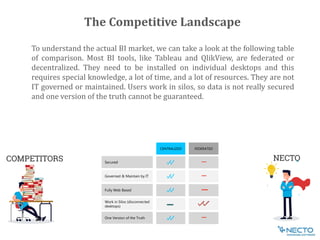
To understand the actual BI market, we can take a look at the following table
of comparison. Most BI tools, like Tableau and QlikView, are federated or
decentralized. They need to be installed on individual desktops and this
requires special knowledge, a lot of time, and a lot of resources. They are not
IT governed or maintained. Users work in silos, so data is not really secured
and one version of the truth cannot be guaranteed.
Secured
Governed & Maintain by IT
Fully Web Based
Work in Silos (disconnected
desktops)
One Version of the Truth
CENTRALIZED FEDERATED
The Competitive Landscape
A good BI solution must provide an easy deployment, beautiful dashboards,
top of the line analytics, automatic insights and KPI alerts; all in a centrally
managed system. Users need to connect multiple data sources, consolidate and
mashup all the data. They need to scale and deploy in a secure manner, in a
centrally administered environment that does not require scripting. Users
need to be able to automatically receive KPI alerts and notifications all the time
to be aware of what is happening in the business.
Necto offers all that, enhanced in a platform that allows you to collaborate,
share, and discuss your findings. It uncovers the hidden insights in your data
and presents them in beautiful dashboards with infographics that users can
understand better. It is an on premise solution with a web deployment, that is
centrally managed and secured.
Why Necto?
Centralized BI - IT and the Business

Centralized BI - IT and the Business

  • 1.
    The Rise ofCentralized BI: IT & The Business
  • 2.
    There is aclear trend happening: The death of federated BI. This model of Business Intelligence is failing because allowing individual departments to have their own IT systems and services is creating silos and is not helping organizations meet their goals and objectives. Centralized BI is going to replace federated BI because when done correctly, it can simplify administrative tasks, improve data security, make data management and sharing a lot easier, and save the company a lot of money. There is a growing sense of urgency to abandon federated BI and deploy centralized BI. The Rise of Centralized BI
  • 3.
    Combined “Centralized &State of the Art BI” To achieve the best results possible, we need to combine centralized and state of the art BI. Centralized is about governability. It provides a solution that is just one environment, both power users and business users can log in to the same environment. Line managers keep the decision rights over what services should be delivered, but IT has the authority over how the services are delivered. This aligns the organization. Centralized BI is critical, but enterprises also need state of the art BI. This means getting the most advanced technology possible. Nowadays we see this in automation of dashboards, automatic insights and exceptions, plus the ability of the users to define their own thresholds, data anomalies, etc. Businesses need solutions that will notify them while monitoring KPIs and distribute reports automatically.
  • 4.
    When comparing centralizedand federated BI there are key points that come to light. First, centralized BI is about connection, all users work connected. In federated BI, users work in silos. This means that the findings or insights they get stay in their desktop, instead of sharing the knowledge. A centralized environment strives to achieve a single version of the truth. This is impossible in a federated environment; there are thousands of excels that are going across tables and being edited in different desktops, then they get shared and edited again. It is really complicated to merge this data. When referring to the ability to maintain the system and scaling it with a specialized BI/IT team, there is no point of comparison. In federated BI there are too many desktops, too many different solutions, tech savvy businesses that don’t know how to scale BI to the whole enterprise. With centralized BI, organizations can keep costs down, because they are not overlapping staff, servers, licenses, and other things that are not necessary. Centralized BI pushes high usage because it is catered. And it keeps the security on the domain of the experts of IT in a central and smart analytic platform. In terms of deployment, centralized BI is easier and simple. It allows users to draw a web deployment, there’s no scripting or installation on desktops, and it remains open to new users all the time because it can be scaled easily. Centralized Federated
  • 5.
    One version ofthe truth is about the organization being aligned. The knowledge should not stay in just one department or get lost in excels across the organization. It should aggregate multiple areas to enable the company to get ahead of trends. The organization as a whole gets smarter as people work together. One Version of The Truth
  • 6.
    It is criticalfor enterprises to be able to determine who has access to which data and define private folders or public dashboards. To maintain security, it is important that IT should govern the tool in order to standardize it. When the same tool is used across the organization, different departments can allocate resources to help another department in need. It incentives people to use the solution and they know that they will be able to use it also in other departments in the organization. Secure and Governed BI
  • 7.
    Centralized BI ensuresone version of the truth: with accurate data in the right context. It is also easier to connect people in a centralized BI solution, rather than having disconnected desktops around the organization. Everyone will see the same insights, the same numbers and data; instead of having the data stay in only one domain. Centralized BI works at its best when using a fully web based solution that is easy for deployment and scalability and is going to help the organization transfer knowledge from domain to domain. Centralized Ensures Veracity
  • 8.
    With Centralized BIthere is no need to maintain hundreds of systems, instead, the organization can allocate resources for only one environment. If the environment is a web solution, then it has great scalability and can be easily deployed and expanded as more departments want to use BI. As more departments start using the solution, IT does not have to do complicated desktop installations that can be time and resource consuming. With centralization you can move resources from one department to the other to help when needed. With Federated BI, departments are disconnected so there is no knowledge or resource sharing. Centralized Ensures Economy of Scale
  • 9.
    The law inorganizations regarding allocating decision rights should be that business managers should have authority over what services are delivered. i.e. Need beautiful dashboards for the executives. i.e. Need KPI alerts for sales people. And IT should have authority over how the services are delivered. i.e. Whether the system should be federated or centralized. i.e. Whether to have the system on premise or on Azure. Decision Rights: IT or Business?
  • 10.
    Actually, centralized BImakes everyone’s lives easier. Business gets to take care of business, not wasting time on technical skills that are not in their area of expertise. And IT stops wasting time creating time consuming reports, and focuses on the correct implementation of services, the development of policies to make sure that things run smoothly as the organization adopts more and more technology. If they were driving a car, business would be behind the wheel and IT would be the copilot holding the GPS. Without a GPS, the driver would get completely lost and would waste a lot of time. Without a driver, even the most accurate GPS doesn’t get you there. Both are crucial and both are doing what they are best at.
  • 11.
    When it comesto security, centralized BI is the better option. Federated BI has low security and a lot of pointing fingers. If there is a data leak everybody blames IT. But then IT claims they did not know there were desktops in certain departments using data. This is why centralization is so important. The system must be managed by IT. It allows the organization to maintain control. IT can oversee the security of data on the organization’s servers, computers, and networks. It won’t allow data leaks. Clear data permissions are defined, and information can only be seen and shared with the people that are allowed to do so. Responsibility and Security
  • 12.
    To understand theactual BI market, we can take a look at the following table of comparison. Most BI tools, like Tableau and QlikView, are federated or decentralized. They need to be installed on individual desktops and this requires special knowledge, a lot of time, and a lot of resources. They are not IT governed or maintained. Users work in silos, so data is not really secured and one version of the truth cannot be guaranteed. Secured Governed & Maintain by IT Fully Web Based Work in Silos (disconnected desktops) One Version of the Truth CENTRALIZED FEDERATED The Competitive Landscape
  • 13.
    A good BIsolution must provide an easy deployment, beautiful dashboards, top of the line analytics, automatic insights and KPI alerts; all in a centrally managed system. Users need to connect multiple data sources, consolidate and mashup all the data. They need to scale and deploy in a secure manner, in a centrally administered environment that does not require scripting. Users need to be able to automatically receive KPI alerts and notifications all the time to be aware of what is happening in the business. Necto offers all that, enhanced in a platform that allows you to collaborate, share, and discuss your findings. It uncovers the hidden insights in your data and presents them in beautiful dashboards with infographics that users can understand better. It is an on premise solution with a web deployment, that is centrally managed and secured. Why Necto?