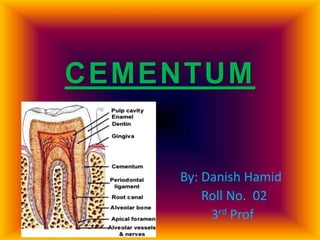
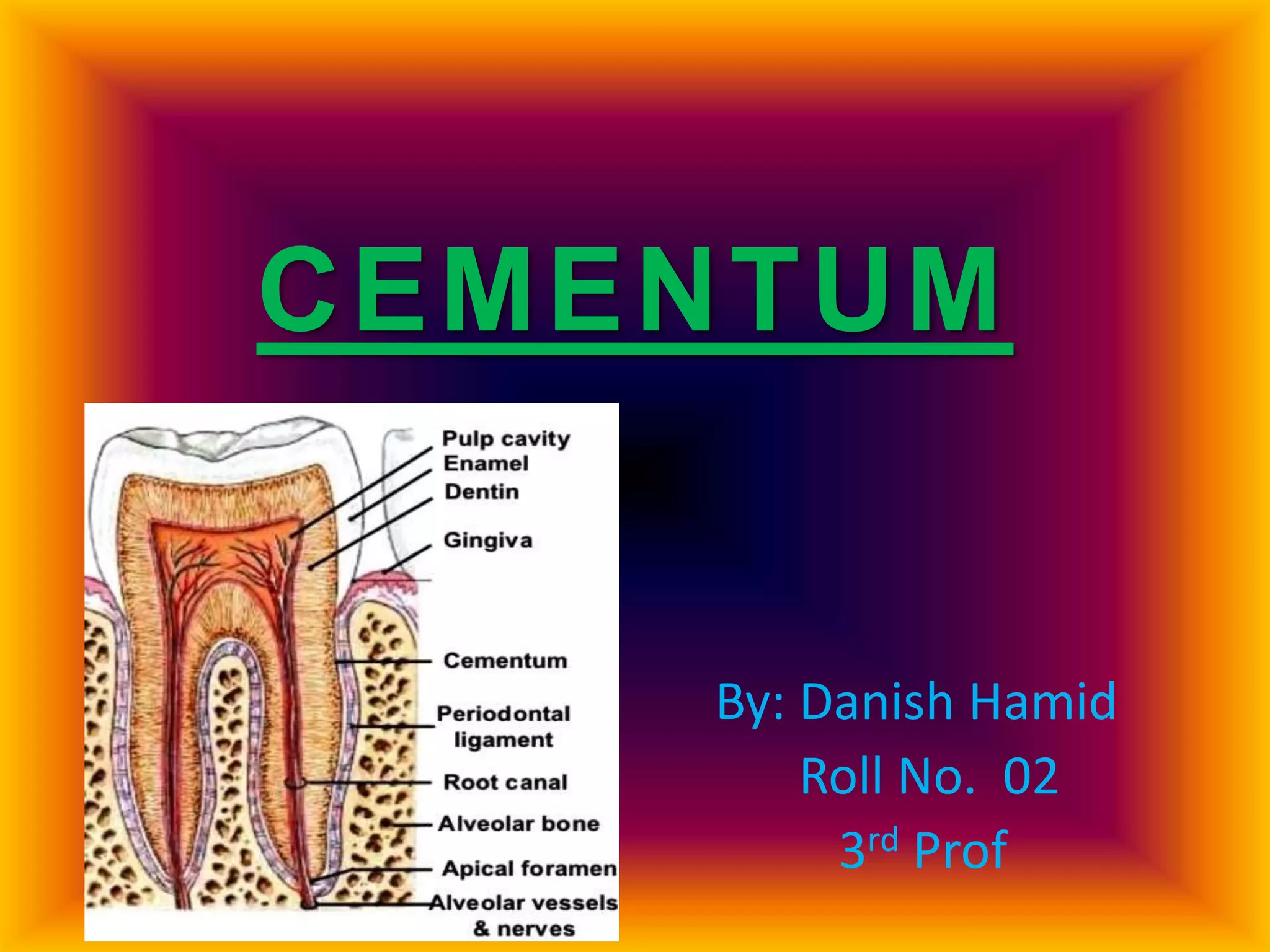
CEMENTUM
By: Danish Hamid
Roll No. 02
3rd Prof
Contents
 Introduction
 Physical Characteristics
 Chemical Composition
 Development
 Functions
 Types of Cementum
 Schroeder Classification
 Cementoenamel Junction
 Cementum Resorption and Repair
 Clinical Considerations
Introduction
o Cementum is calcified, avascular mesenchymal
tissue that forms the outer covering of the
anatomical root.
o It is part of the PERIODONTIUM.
o It begins at cervical portion of the tooth and
continues to apex.
Physical Characteristics
o Pale yellow in color.
o Lighter color, softer and more permeable than
dentin.
o Shows irregular surface.
o Thickness ;
– At coronal half:- 16 to 60 µm
– At apical third & furcation area:- 150 to 200 µm
Chemical Composition
Organic
50 – 55%
Type I (90%)and
Type III (5%) collagen
fibers are embedded
in ground substance.
Proteins and
Polysaccharides
Inorganic
45 -50 %
Hydroxyapatite
Calcium
Phosphorous
Fluoride
Water
 Source of collagen fibers
Extrinsic Fibers
o Formed by fibroblasts.
o Embedded portion of
principal fibers of PDL.
o Run in same direction
of principal fiber
o Also called Sharpey’s
fibers.
Intrinsic Fibers
o Produced by
cementoblasts.
o Belong to
cementum matrix.
o Run parallel to root
surface.
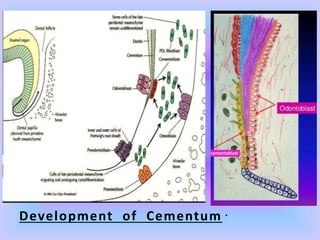
Development of Cementum
o Rupture of Hertwig Root Sheath allows the
mesenchymal cells of dental follicle to contact
dentin where they start forming a continuous
layer of cementoblasts.
o Begins with deposition of irregular meshwork of
collagen fibrils sparsely distributes in ground
substance called pre-cementum or cementoid.
.
o Followed by phase of matrix maturation, which
subsequently mineralizes to form cementum.
o Sometimes cementoblasts may get enclosed
and trapped in the matrix, they are referred as
cementocytes , and remain viable.
o The formation of cementum is incremental , so
we obtain Incremental lines of Salter.
.
Development of Cementum
Functions of cementum
Primary function of cementum is
anchorage that is by furnishing a
medium for attachment of collagen
fibres that bind the tooth to alveolar
bone.
Apical cementogenesis compensated
for attrition of enamel, thereby
maintaining functional occlusal
relationship.
It serves as reparative tissue in case root
fracture or resorption.
It provides for fiber reattachment or
relocation consequent to mesial drifting
of teeth.
Types of cementum
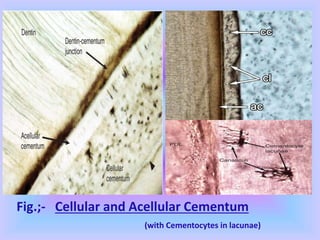
Cementum is of 2 two main types; Acellular and Cellular.
1. Acellular Cementum:-
o It is the first cementum formed also known
as Primary cementum.
o It doesn’t contain cells.
o It covers cervical third or half of the root.
.
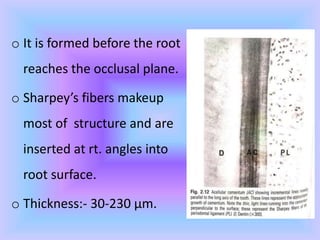
o It is formed before the root
reaches the occlusal plane.
o Sharpey’s fibers makeup
most of structure and are
inserted at rt. angles into
root surface.
o Thickness:- 30-230 µm.
2. Cellular cementum:-
o It is formed after the formation of Acellular
cementum so called Secondary cementum.
o It contains cells (Cementocytes) present in
lacunae.
o It covers apical third and inter-radicular region.
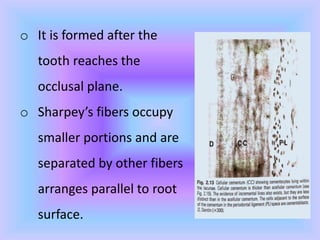
o It is formed after the
tooth reaches the
occlusal plane.
o Sharpey’s fibers occupy
smaller portions and are
separated by other fibers
arranges parallel to root
surface.
Fig.;- Cellular and Acellular Cementum
(with Cementocytes in lacunae)
Schroeder’s Classification
This classification is based on location, morphology
and histological appearance.
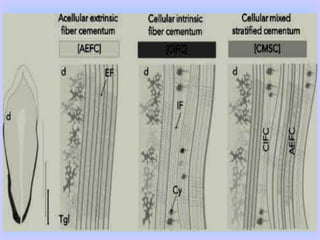
1. Acellular afibrillar cementum(AAC)
2. Acellular extrinsic fiber cementum(AEFC)
3. Cellular mixed stratified cementum(CMSC)
4. Cellular intrinsic fiber cementum(CIFC)
5. Intermediate cementum (The hyaline layer of Hope
Well Smith)
Acellular Afibrillar Cementum (AAC)
o It neither contains cells nor extrinsic or intrinsic
collagen fibres.
o It only contains mineralizes ground substance.
o It is a product of cementoblasts and is found as
coronal cementum.
o Thickness: 1-15 µm
Acellular extrinsic fiber cementum
(AEFC)
o It is composed entirely of densely packed bundles
of Sharpey fibres and lacks cells.
o It is a product of fibroblasts and cementoblasts.
o It is found in cervical third of root.
o Thickness: 30-230 µm
Cellular Mixed Stratified Cementum
(CMSC)
o It is composed of extrinsic and intrinsic fibers and
may contain cells.
o It is a co product of fibroblasts and
cementoblasts.
o It appears in apical third of roots, apices and
furcation areas.
o Thickness: 100-1000 µm
Cellular Intrinsic Fiber Cementum
(CIFC)
o It is composed of intrinsic fibres and cells
but no extrinsic fibers.
o It is a product of cementoblasts.
o It fills the resorption lacunae.
Intermediate cementum
o It is an ill-defined zone near cemento-dentinal
junction.
o It contains cellular remnant of the Hertwig’s
sheath embedded in calcified ground substance.
o It contains enamel like proteins which help in
attachment of cementum to dentin.
.
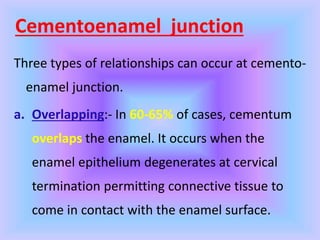
Cementoenamel junction
Three types of relationships can occur at cemento-
enamel junction.
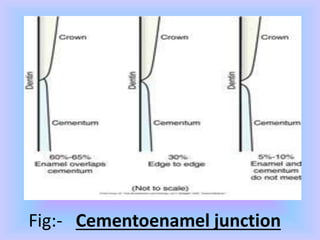
a. Overlapping:- In 60-65% of cases, cementum
overlaps the enamel. It occurs when the
enamel epithelium degenerates at cervical
termination permitting connective tissue to
come in contact with the enamel surface.
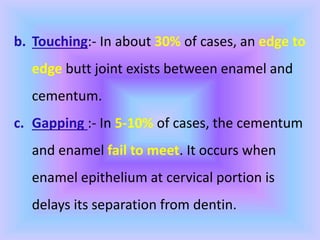
b. Touching:- In about 30% of cases, an edge to
edge butt joint exists between enamel and
cementum.
c. Gapping :- In 5-10% of cases, the cementum
and enamel fail to meet. It occurs when
enamel epithelium at cervical portion is
delays its separation from dentin.
Fig:- Cementoenamel junction
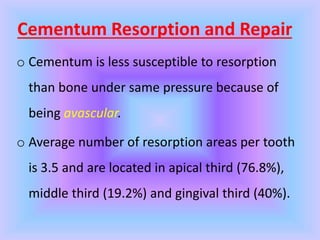
Cementum Resorption and Repair
o Cementum is less susceptible to resorption
than bone under same pressure because of
being avascular.
o Average number of resorption areas per tooth
is 3.5 and are located in apical third (76.8%),
middle third (19.2%) and gingival third (40%).
o Caused by local or systemic factors.
o Local conditions include trauma from
occlusion, orthodontic movement pressure,
cysts, periapical & periodontal diseases.
o Systemic conditions include calcium
deficiency, hyperthyroidism, hereditary fibrous
osteodystrophy and Paget disease.
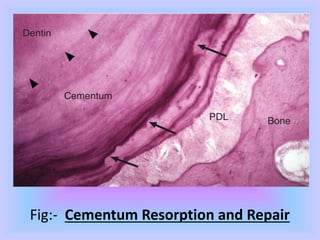
o Resorption areas appear as bay-like
concavities.
o Cementum resorption is not continuous and
may alternate with periods of repair and
deposition of new cementum.
o The reparative and resorbed cementum are
demarcated by an irregular reversal line.
.
o The repair of cementum requires the presence of
cementoblasts and viable connective tissue.
o The reparative cementum is less mineralized and
exhibits small calcifies globules.
 Anatomic repair:- outline is re-established.
 Functional repair:- little cementum is formed and
rest is filled by alveolar bone.
Fig:- Cementum Resorption and Repair
Clinical considerations
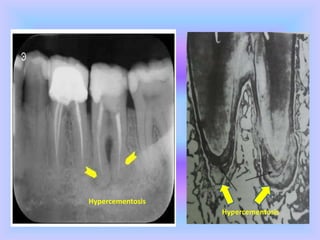
1. Hypercementosis
 It is an age-related phenomenon and refers to
prominent thickening of cementum.
 It may be localized to one tooth or affects entire
dentition.
 Occurs as generalized thickening of cementum
with nodular enlargement of apical third of root.
 It appears as spike like excrescences, created
either by coalescence of cementicles or
calcification of PDL fibres at site of insertion into
cementum.
 Roots appear thick with rounded apices.
 The causes can of hypercementosis can be:
accelerated elongation of tooth, inflammation,
tooth repair or Paget’s disease.
Hypercementosis
Hypercementosis
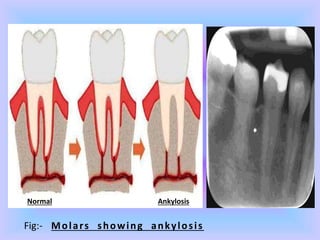
2. Ankylosis
oIt is the fusion of the cementum and the
alveolar bone with obliteration of PDL.
oIt results in resorption of the root and its
gradual replacement by bony tissue.
oIt occurs in case of cemental resorption, occlusal
trauma, chronic periapical inflammation,
reimplanted or embedded teeth.
.
o Ankylosed teeth lack physiologic mobility of
normal teeth and give dull, muffled metallic
sound on percussion.
o Physiological drifting and tooth eruption
doesn’t occur.
o Radiographically, blending of the bone with
the root is apparent.
Fig:- Molars showing ankylosis
Normal Ankylosis
3. Cementicles
o These are small areas of dystrophic calcified
tissue, which lie free in the periodontal
ligament of lateral and apical root areas.
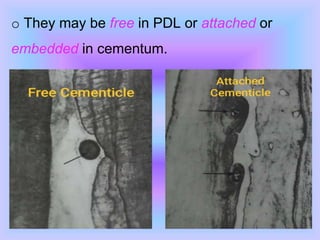
o They may be formed by calcification of
epithelial rests, CT between Sharpey’s fibers, or
thrombosed capillaries.
o They may be free in PDL or attached or
embedded in cementum.
4. Concrescence
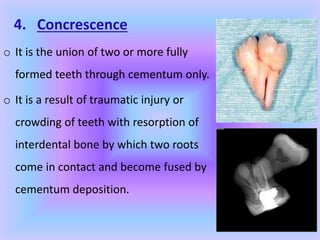
o It is the union of two or more fully
formed teeth through cementum only.
o It is a result of traumatic injury or
crowding of teeth with resorption of
interdental bone by which two roots
come in contact and become fused by
cementum deposition.
5. Cemental Spurs
o These are symmetrical spheres of cementum
attached to root surface.
o Found near cementoenamel junction.
o These result from irregular deposition of
cementum on the root.
o Can’t be easily removed since they are hard
dental tissue.
Bibliography
o Newmann and Carranza’s Clinical Periodontology
o Orban’s Oral Histology and Embryology
o Shafer’s Textbook of Oral Pathology
o Researchgate.net
o Wikipedia.org
o Slideshare.net

CEMENTUM by Danish Hamid.pptx

  • 1.
  • 2.
    Contents  Introduction  PhysicalCharacteristics  Chemical Composition  Development  Functions  Types of Cementum  Schroeder Classification  Cementoenamel Junction  Cementum Resorption and Repair  Clinical Considerations
  • 3.
    Introduction o Cementum iscalcified, avascular mesenchymal tissue that forms the outer covering of the anatomical root. o It is part of the PERIODONTIUM. o It begins at cervical portion of the tooth and continues to apex.
  • 4.
    Physical Characteristics o Paleyellow in color. o Lighter color, softer and more permeable than dentin. o Shows irregular surface. o Thickness ; – At coronal half:- 16 to 60 µm – At apical third & furcation area:- 150 to 200 µm
  • 5.
    Chemical Composition Organic 50 –55% Type I (90%)and Type III (5%) collagen fibers are embedded in ground substance. Proteins and Polysaccharides Inorganic 45 -50 % Hydroxyapatite Calcium Phosphorous Fluoride Water
  • 6.
     Source ofcollagen fibers Extrinsic Fibers o Formed by fibroblasts. o Embedded portion of principal fibers of PDL. o Run in same direction of principal fiber o Also called Sharpey’s fibers. Intrinsic Fibers o Produced by cementoblasts. o Belong to cementum matrix. o Run parallel to root surface.
  • 7.
    Development of Cementum oRupture of Hertwig Root Sheath allows the mesenchymal cells of dental follicle to contact dentin where they start forming a continuous layer of cementoblasts. o Begins with deposition of irregular meshwork of collagen fibrils sparsely distributes in ground substance called pre-cementum or cementoid.
  • 8.
    . o Followed byphase of matrix maturation, which subsequently mineralizes to form cementum. o Sometimes cementoblasts may get enclosed and trapped in the matrix, they are referred as cementocytes , and remain viable. o The formation of cementum is incremental , so we obtain Incremental lines of Salter.
  • 9.
  • 10.
    Functions of cementum Primaryfunction of cementum is anchorage that is by furnishing a medium for attachment of collagen fibres that bind the tooth to alveolar bone. Apical cementogenesis compensated for attrition of enamel, thereby maintaining functional occlusal relationship.
  • 11.
    It serves asreparative tissue in case root fracture or resorption. It provides for fiber reattachment or relocation consequent to mesial drifting of teeth.
  • 12.
    Types of cementum Cementumis of 2 two main types; Acellular and Cellular. 1. Acellular Cementum:- o It is the first cementum formed also known as Primary cementum. o It doesn’t contain cells. o It covers cervical third or half of the root.
  • 13.
    . o It isformed before the root reaches the occlusal plane. o Sharpey’s fibers makeup most of structure and are inserted at rt. angles into root surface. o Thickness:- 30-230 µm.
  • 14.
    2. Cellular cementum:- oIt is formed after the formation of Acellular cementum so called Secondary cementum. o It contains cells (Cementocytes) present in lacunae. o It covers apical third and inter-radicular region.
  • 15.
    o It isformed after the tooth reaches the occlusal plane. o Sharpey’s fibers occupy smaller portions and are separated by other fibers arranges parallel to root surface.
  • 16.
    Fig.;- Cellular andAcellular Cementum (with Cementocytes in lacunae)
  • 17.
    Schroeder’s Classification This classificationis based on location, morphology and histological appearance. 1. Acellular afibrillar cementum(AAC) 2. Acellular extrinsic fiber cementum(AEFC) 3. Cellular mixed stratified cementum(CMSC) 4. Cellular intrinsic fiber cementum(CIFC) 5. Intermediate cementum (The hyaline layer of Hope Well Smith)
  • 18.
    Acellular Afibrillar Cementum(AAC) o It neither contains cells nor extrinsic or intrinsic collagen fibres. o It only contains mineralizes ground substance. o It is a product of cementoblasts and is found as coronal cementum. o Thickness: 1-15 µm
  • 19.
    Acellular extrinsic fibercementum (AEFC) o It is composed entirely of densely packed bundles of Sharpey fibres and lacks cells. o It is a product of fibroblasts and cementoblasts. o It is found in cervical third of root. o Thickness: 30-230 µm
  • 20.
    Cellular Mixed StratifiedCementum (CMSC) o It is composed of extrinsic and intrinsic fibers and may contain cells. o It is a co product of fibroblasts and cementoblasts. o It appears in apical third of roots, apices and furcation areas. o Thickness: 100-1000 µm
  • 21.
    Cellular Intrinsic FiberCementum (CIFC) o It is composed of intrinsic fibres and cells but no extrinsic fibers. o It is a product of cementoblasts. o It fills the resorption lacunae.
  • 22.
    Intermediate cementum o Itis an ill-defined zone near cemento-dentinal junction. o It contains cellular remnant of the Hertwig’s sheath embedded in calcified ground substance. o It contains enamel like proteins which help in attachment of cementum to dentin.
  • 23.
  • 24.
    Cementoenamel junction Three typesof relationships can occur at cemento- enamel junction. a. Overlapping:- In 60-65% of cases, cementum overlaps the enamel. It occurs when the enamel epithelium degenerates at cervical termination permitting connective tissue to come in contact with the enamel surface.
  • 25.
    b. Touching:- Inabout 30% of cases, an edge to edge butt joint exists between enamel and cementum. c. Gapping :- In 5-10% of cases, the cementum and enamel fail to meet. It occurs when enamel epithelium at cervical portion is delays its separation from dentin.
  • 26.
  • 27.
    Cementum Resorption andRepair o Cementum is less susceptible to resorption than bone under same pressure because of being avascular. o Average number of resorption areas per tooth is 3.5 and are located in apical third (76.8%), middle third (19.2%) and gingival third (40%).
  • 28.
    o Caused bylocal or systemic factors. o Local conditions include trauma from occlusion, orthodontic movement pressure, cysts, periapical & periodontal diseases. o Systemic conditions include calcium deficiency, hyperthyroidism, hereditary fibrous osteodystrophy and Paget disease.
  • 29.
    o Resorption areasappear as bay-like concavities. o Cementum resorption is not continuous and may alternate with periods of repair and deposition of new cementum. o The reparative and resorbed cementum are demarcated by an irregular reversal line.
  • 30.
    . o The repairof cementum requires the presence of cementoblasts and viable connective tissue. o The reparative cementum is less mineralized and exhibits small calcifies globules.  Anatomic repair:- outline is re-established.  Functional repair:- little cementum is formed and rest is filled by alveolar bone.
  • 31.
  • 32.
    Clinical considerations 1. Hypercementosis It is an age-related phenomenon and refers to prominent thickening of cementum.  It may be localized to one tooth or affects entire dentition.  Occurs as generalized thickening of cementum with nodular enlargement of apical third of root.
  • 33.
     It appearsas spike like excrescences, created either by coalescence of cementicles or calcification of PDL fibres at site of insertion into cementum.  Roots appear thick with rounded apices.  The causes can of hypercementosis can be: accelerated elongation of tooth, inflammation, tooth repair or Paget’s disease.
  • 34.
  • 35.
    2. Ankylosis oIt isthe fusion of the cementum and the alveolar bone with obliteration of PDL. oIt results in resorption of the root and its gradual replacement by bony tissue. oIt occurs in case of cemental resorption, occlusal trauma, chronic periapical inflammation, reimplanted or embedded teeth.
  • 36.
    . o Ankylosed teethlack physiologic mobility of normal teeth and give dull, muffled metallic sound on percussion. o Physiological drifting and tooth eruption doesn’t occur. o Radiographically, blending of the bone with the root is apparent.
  • 37.
    Fig:- Molars showingankylosis Normal Ankylosis
  • 38.
    3. Cementicles o Theseare small areas of dystrophic calcified tissue, which lie free in the periodontal ligament of lateral and apical root areas. o They may be formed by calcification of epithelial rests, CT between Sharpey’s fibers, or thrombosed capillaries.
  • 39.
    o They maybe free in PDL or attached or embedded in cementum.
  • 40.
    4. Concrescence o Itis the union of two or more fully formed teeth through cementum only. o It is a result of traumatic injury or crowding of teeth with resorption of interdental bone by which two roots come in contact and become fused by cementum deposition.
  • 41.
    5. Cemental Spurs oThese are symmetrical spheres of cementum attached to root surface. o Found near cementoenamel junction. o These result from irregular deposition of cementum on the root. o Can’t be easily removed since they are hard dental tissue.
  • 42.
    Bibliography o Newmann andCarranza’s Clinical Periodontology o Orban’s Oral Histology and Embryology o Shafer’s Textbook of Oral Pathology o Researchgate.net o Wikipedia.org o Slideshare.net