ENAMEL
PRESENTER: LEKSHMY JAYAN
I MDS,
ORALANDMAXILLOFACIAL
PATHOLOGY
INTRODUCTION
• Ectodermally derived structure produced by ameloblasts
• Hardest substance in the body
• Wear resistant outer layer of the dental crown
• Forms insulating barrier – protects the tooth
[Rodrigo.S.Lacruz et al: Dental enamel
formation and for oral health and disease,
May 2017]
[Michel Goldberg el al : Dentin:
structure, composition and
mineralisation, January 2011]
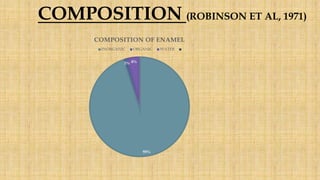
COMPOSITION (ROBINSON ET AL, 1971)
95%
1% 4%
COMPOSITION OF ENAMEL
INORGANIC ORGANIC WATER
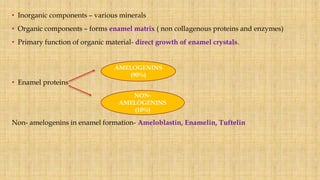
• Inorganic components – various minerals
• Organic components – forms enamel matrix ( non collagenous proteins and enzymes)
• Primary function of organic material- direct growth of enamel crystals.
• Enamel proteins
Non- amelogenins in enamel formation- Ameloblastin, Enamelin, Tuftelin
AMELOGENINS
(90%)
NON-
AMELOGENINS
(10%)
• Inorganic component – mainly hydroxyapatite crystals, carbonates and trace
elements.
• Enamel hydroxyapatite crystals- largest of all calcified tissues
• Susceptible to dissolution of acid- basis of dental caries.
• Water is present as a part of hydroxyapatite crystal, boundaries of rods.
[ Jayasudha et al: Enamel regeneration- Current progress and challenges,
September 2014]
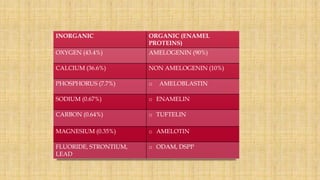
INORGANIC ORGANIC (ENAMEL
PROTEINS)
OXYGEN (43.4%) AMELOGENIN (90%)
CALCIUM (36.6%) NON AMELOGENIN (10%)
PHOSPHORUS (7.7%) o AMELOBLASTIN
SODIUM (0.67%) o ENAMELIN
CARBON (0.64%) o TUFTELIN
MAGNESIUM (0.35%) o AMELOTIN
FLUORIDE, STRONTIUM,
LEAD
o ODAM, DSPP
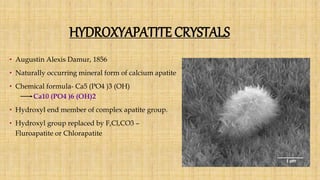
HYDROXYAPATITE CRYSTALS
• Augustin Alexis Damur, 1856
• Naturally occurring mineral form of calcium apatite
• Chemical formula- Ca5 (PO4 )3 (OH)
Ca10 (PO4 )6 (OH)2
• Hydroxyl end member of complex apatite group.
• Hydroxyl group replaced by F,Cl,CO3 –
Fluroapatite or Chlorapatite
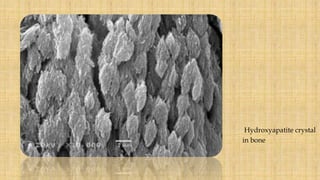
• Carbonated calcium deficient hydroxyapatite-
tooth and bone
• Also seen in calcification within pineal gland -
Corpora arenacea (Brain sand)
• CO3 substitution for OH or PO4 – susceptible to
acidic dissolution- progression of caries
• F substitution – resistant to dissolution- caries
prevention and erosion reduction
[Rodrigo.S.Lacruz et al: Dental enamel formation
and implication for
oral health and disease, May 2017]
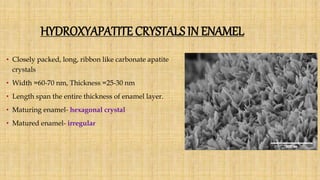
HYDROXYAPATITE CRYSTALS IN ENAMEL
• Closely packed, long, ribbon like carbonate apatite
crystals
• Width =60-70 nm, Thickness =25-30 nm
• Length span the entire thickness of enamel layer.
• Maturing enamel- hexagonal crystal
• Matured enamel- irregular
Hydroxyapatite crystal
in bone
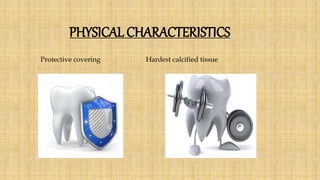
PHYSICAL CHARACTERISTICS
Protective covering Hardest calcified tissue
Resistant covering Brittle
• Modulus of elasticity- 1338.2+307 MPa
• Hardness – 274.8+18.1 kg/mm
• Specific gravity- 2.8
[ K.J.Chun et al: Comparison of mechanical properties and role between enamel and dentin
in the human teeth, 2014]
• Semipermeable membrane
- demonstrated by radioactive tracers and certain dyes
- (C- labelled urea, Iodine).
- The organic matrix and water in enamel is in a network of micropores-
dynamic connection between enamel and
systemic, pulpal or dentinal tubule fluids
- Micropores or cracks allow the penetration of fluids.
-Permeability decreases and hardness increases with age.
[Jansen et al: Permeability of normal enamel, 1951]
• Colour of enamel – yellowish white to greyish white
determined by translucency
[ K.J.Chun et al: Comparison of mechanical properties and role
between enamel and dentin in the human teeth, 2014]
STRUCTURE OF ENAMEL
• Rods or prisms
• Hunter Schreger bands
• Incremental lines
• Gnarled enamel
• Surface structures
• Enamel tufts and lamellae
• Enamel cuticle
• DEJ
• Enamel cuticle
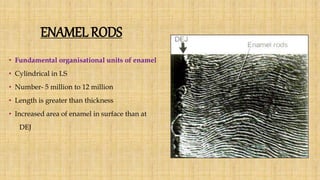
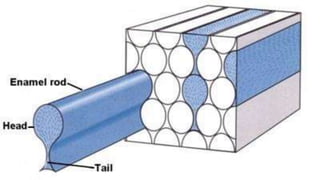
ENAMEL RODS
• Fundamental organisational units of enamel
• Cylindrical in LS
• Number- 5 million to 12 million
• Length is greater than thickness
• Increased area of enamel in surface than at
DEJ
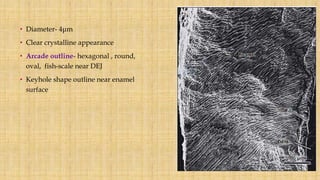
• Diameter- 4μm
• Clear crystalline appearance
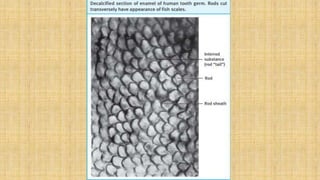
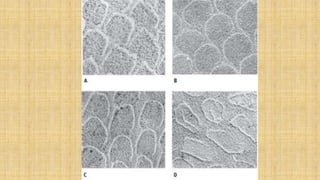
• Arcade outline- hexagonal , round,
oval, fish-scale near DEJ
• Keyhole shape outline near enamel
surface
ULTRASTRUCTURE:
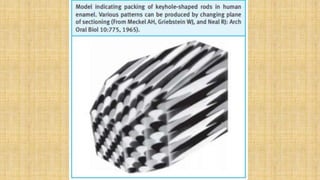
• Key hole pattern or paddle shaped pattern
• Width =5μm Thickness= 9μm
• In LS, sections pass through heads or bodies of one row of rods and tails of an
adjacent row, producing an appearance of rods separated by interrod substance.
• Bizarre pattern- packed tightly together.
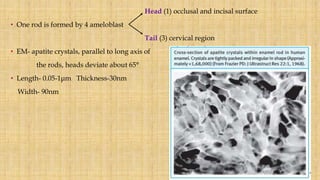
Head (1) occlusal and incisal surface
• One rod is formed by 4 ameloblast
Tail (3) cervical region
• EM- apatite crystals, parallel to long axis of
the rods, heads deviate about 65°
• Length- 0.05-1μm Thickness-30nm
Width- 90nm
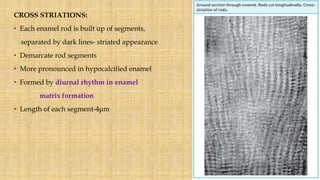
CROSS STRIATIONS:
• Each enamel rod is built up of segments,
separated by dark lines- striated appearance
• Demarcate rod segments
• More pronounced in hypocalcified enamel
• Formed by diurnal rhythm in enamel
matrix formation
• Length of each segment-4μm
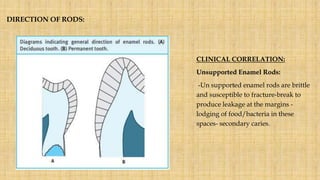
DIRECTION OF RODS:
CLINICAL CORRELATION:
Unsupported Enamel Rods:
-Un supported enamel rods are brittle
and susceptible to fracture-break to
produce leakage at the margins -
lodging of food/bacteria in these
spaces- secondary caries.
• Other patterns that complicate enamel structures:
-Irregular bending in transverse plane of tooth,
cervical- straight
-Intertwine in inner 2/3rd- dissimilar local orientation
- Wavy course in clockwise and anticlockwise direction in
cuspal and incisal edge
- Developmental pits and fissures- converge in outward
course
CLINICAL CORRELATION:
Wavy course of enamel rods:
The wavy course, oblique direction and interlocking of the enamel rods render
prevention from enamel fracture
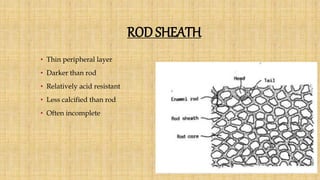
ROD SHEATH
• Thin peripheral layer
• Darker than rod
• Relatively acid resistant
• Less calcified than rod
• Often incomplete
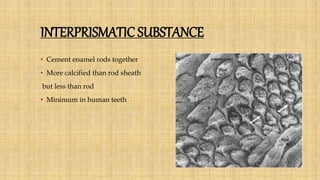
INTERPRISMATIC SUBSTANCE
• Cement enamel rods together
• More calcified than rod sheath
but less than rod
• Minimum in human teeth
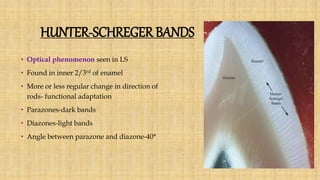
HUNTER-SCHREGER BANDS
• Optical phenomenon seen in LS
• Found in inner 2/3rd of enamel
• More or less regular change in direction of
rods- functional adaptation
• Parazones-dark bands
• Diazones-light bands
• Angle between parazone and diazone-40°
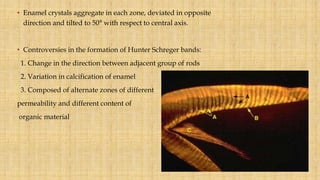
• Enamel crystals aggregate in each zone, deviated in opposite
direction and tilted to 50° with respect to central axis.
• Controversies in the formation of Hunter Schreger bands:
1. Change in the direction between adjacent group of rods
2. Variation in calcification of enamel
3. Composed of alternate zones of different
permeability and different content of
organic material
INCREMENTAL LINES
INCREMENTAL LINES NEONATAL LINE
OF RETZIUS
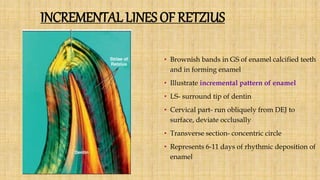
INCREMENTAL LINES OF RETZIUS
• Brownish bands in GS of enamel calcified teeth
and in forming enamel
• Illustrate incremental pattern of enamel
• LS- surround tip of dentin
• Cervical part- run obliquely from DEJ to
surface, deviate occlusally
• Transverse section- concentric circle
• Represents 6-11 days of rhythmic deposition of
enamel
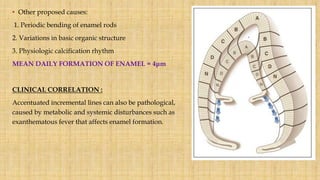
• Other proposed causes:
1. Periodic bending of enamel rods
2. Variations in basic organic structure
3. Physiologic calcification rhythm
MEAN DAILY FORMATION OF ENAMEL = 4μm
CLINICAL CORRELATION :
Accentuated incremental lines can also be pathological,
caused by metabolic and systemic disturbances such as
exanthematous fever that affects enamel formation.
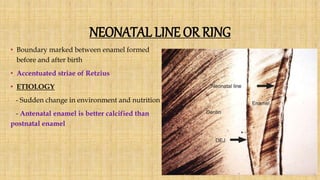
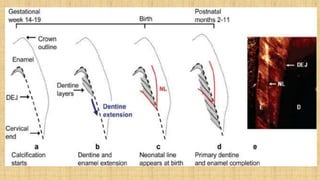
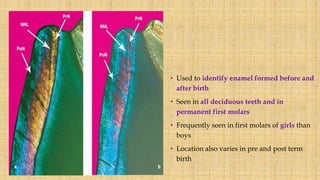
NEONATAL LINE OR RING
• Boundary marked between enamel formed
before and after birth
• Accentuated striae of Retzius
• ETIOLOGY
- Sudden change in environment and nutrition
- Antenatal enamel is better calcified than
postnatal enamel
• Used to identify enamel formed before and
after birth
• Seen in all deciduous teeth and in
permanent first molars
• Frequently seen in first molars of girls than
boys
• Location also varies in pre and post term
birth
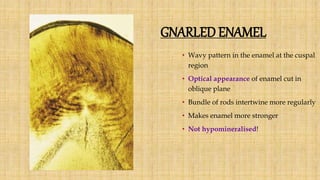
GNARLED ENAMEL
• Wavy pattern in the enamel at the cuspal
region
• Optical appearance of enamel cut in
oblique plane
• Bundle of rods intertwine more regularly
• Makes enamel more stronger
• Not hypomineralised!
SURFACE STRUCTURES
• Prismless enamel
• Perikymata
• Enamel pits and caps
• Cracks or enamel lamellae
• Enamel tufts
• Rod ends
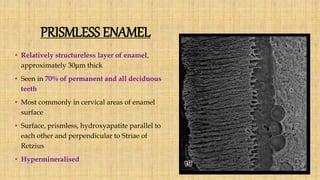
PRISMLESS ENAMEL
• Relatively structureless layer of enamel,
approximately 30μm thick
• Seen in 70% of permanent and all deciduous
teeth
• Most commonly in cervical areas of enamel
surface
• Surface, prismless, hydroxyapatite parallel to
each other and perpendicular to Striae of
Retzius
• Hypermineralised
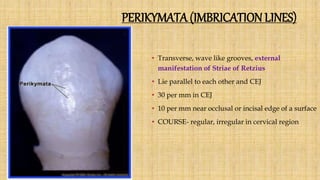
PERIKYMATA (IMBRICATION LINES)
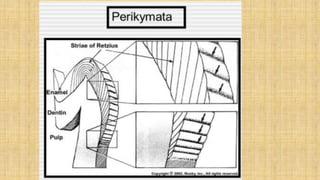
• Transverse, wave like grooves, external
manifestation of Striae of Retzius
• Lie parallel to each other and CEJ
• 30 per mm in CEJ
• 10 per mm near occlusal or incisal edge of a surface
• COURSE- regular, irregular in cervical region
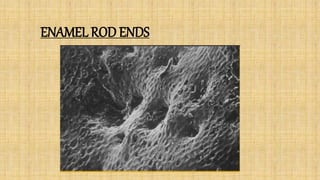
ENAMEL ROD ENDS
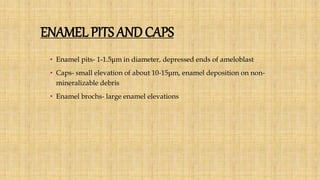
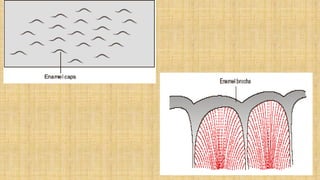
ENAMEL PITS AND CAPS
• Enamel pits- 1-1.5μm in diameter, depressed ends of ameloblast
• Caps- small elevation of about 10-15μm, enamel deposition on non-
mineralizable debris
• Enamel brochs- large enamel elevations
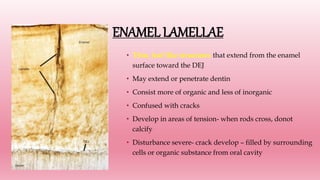
ENAMEL LAMELLAE
• Thin, leaf like structures that extend from the enamel
surface toward the DEJ
• May extend or penetrate dentin
• Consist more of organic and less of inorganic
• Confused with cracks
• Develop in areas of tension- when rods cross, donot
calcify
• Disturbance severe- crack develop – filled by surrounding
cells or organic substance from oral cavity
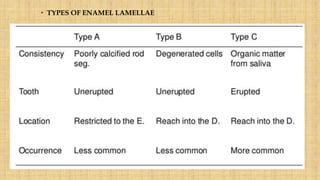
• TYPES OF ENAMEL LAMELLAE
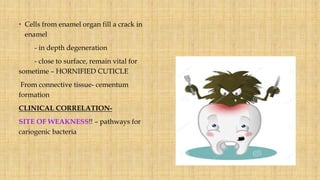
• Cells from enamel organ fill a crack in
enamel
- in depth degeneration
- close to surface, remain vital for
sometime – HORNIFIED CUTICLE
From connective tissue- cementum
formation
CLINICAL CORRELATION-
SITE OF WEAKNESS!! – pathways for
cariogenic bacteria
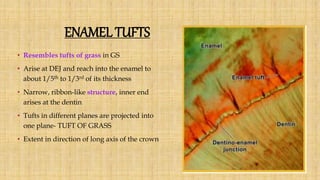
ENAMEL TUFTS
• Resembles tufts of grass in GS
• Arise at DEJ and reach into the enamel to
about 1/5th to 1/3rd of its thickness
• Narrow, ribbon-like structure, inner end
arises at the dentin
• Tufts in different planes are projected into
one plane- TUFT OF GRASS
• Extent in direction of long axis of the crown
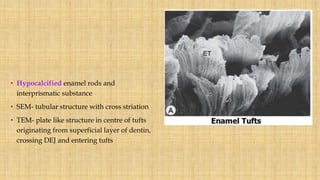
• Hypocalcified enamel rods and
interprismatic substance
• SEM- tubular structure with cross striation
• TEM- plate like structure in centre of tufts
originating from superficial layer of dentin,
crossing DEJ and entering tufts
ENAMEL CUTICLE
• PRIMARY ENAMEL CUTICLE- Nasmyth’s membrane
• SECONDARY ENAMEL CUTICLE- Afibrillar cementum
• PELLICLE- Precipitate of salivary protein
ENAMEL CUTICLE (NASMYTH’S MEMBRANE/
PRIMARY ENAMEL CUTICLE)
• Covers entire crown of newly erupted tooth
• Removed by mastication
• Basal lamina secreted by ameloblasts when enamel formation
is complete
• Protects enamel surface from resorption by adjacent vascular
tissue prior to eruption of teeth
SECONDARY ENAMEL CUTICLE
• Cover cervical area of the enamel
• Thickness=upto 10μm
• Continuous with cementum
• Probably of mesodermal origin or may be elaborated by
attachment epithelium
• Secreted after enamel organ is retracted from cervical
region during tooth development
PELLICLE
• Reform within hours after mechanical cleaning
• May be colonised by microorganisms to form a bacterial plaque
• Plaque may be calcified forming calculus
CLINICAL CORRELATION-
If not removed, the pellicle can get colonized by microbes to form
plaque which subsequently lead to caries.
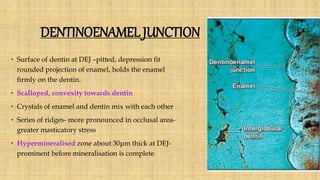
DENTINOENAMEL JUNCTION
• Surface of dentin at DEJ –pitted, depression fit
rounded projection of enamel, holds the enamel
firmly on the dentin.
• Scalloped, convexity towards dentin
• Crystals of enamel and dentin mix with each other
• Series of ridges- more pronounced in occlusal area-
greater masticatory stress
• Hypermineralised zone about 30μm thick at DEJ-
prominent before mineralisation is complete
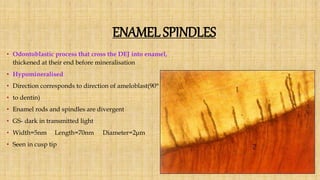
ENAMEL SPINDLES
• Odontoblastic process that cross the DEJ into enamel,
thickened at their end before mineralisation
• Hypomineralised
• Direction corresponds to direction of ameloblast(90°
• to dentin)
• Enamel rods and spindles are divergent
• GS- dark in transmitted light
• Width=5nm Length=70nm Diameter=2μm
• Seen in cusp tip
AGE CHANGES
• Attrition
• Generalised loss of enamel rods
• Flattening of perikymata
• Decreased permeability
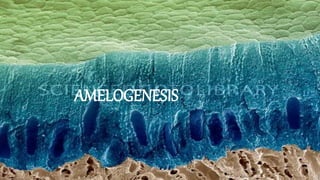
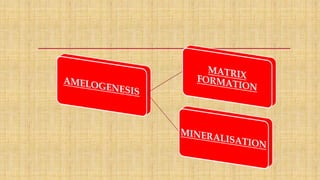
AMELOGENESIS
AMELOGENESIS
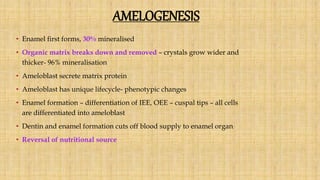
• Enamel first forms, 30% mineralised
• Organic matrix breaks down and removed – crystals grow wider and
thicker- 96% mineralisation
• Ameloblast secrete matrix protein
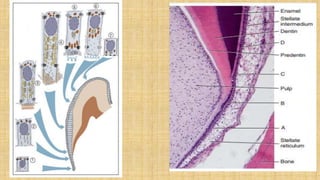
• Ameloblast has unique lifecycle- phenotypic changes
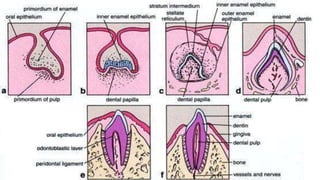
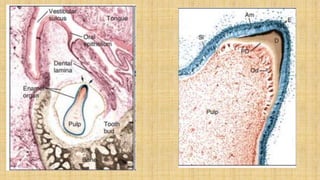
• Enamel formation – differentiation of IEE, OEE – cuspal tips – all cells
are differentiated into ameloblast
• Dentin and enamel formation cuts off blood supply to enamel organ
• Reversal of nutritional source
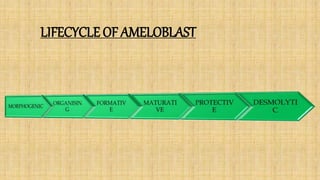
LIFECYCLE OF AMELOBLAST
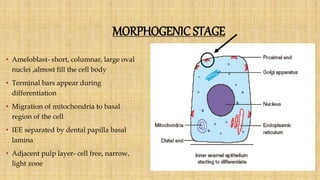
MORPHOGENIC STAGE
• Ameloblast- short, columnar, large oval
nuclei ,almost fill the cell body
• Terminal bars appear during
differentiation
• Migration of mitochondria to basal
region of the cell
• IEE separated by dental papilla basal
lamina
• Adjacent pulp layer- cell free, narrow,
light zone
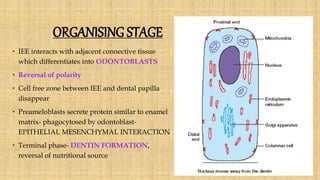
ORGANISING STAGE
• IEE interacts with adjacent connective tissue
which differentiates into ODONTOBLASTS
• Reversal of polarity
• Cell free zone between IEE and dental papilla
disappear
• Preameloblasts secrete protein similar to enamel
matrix- phagocytosed by odontoblast-
EPITHELIAL MESENCHYMAL INTERACTION
• Terminal phase- DENTIN FORMATION,
reversal of nutritional source
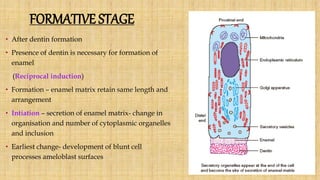
FORMATIVE STAGE
• After dentin formation
• Presence of dentin is necessary for formation of
enamel
(Reciprocal induction)
• Formation – enamel matrix retain same length and
arrangement
• Intiation – secretion of enamel matrix- change in
organisation and number of cytoplasmic organelles
and inclusion
• Earliest change- development of blunt cell
processes ameloblast surfaces
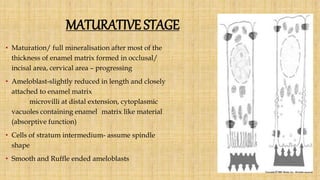
MATURATIVE STAGE
• Maturation/ full mineralisation after most of the
thickness of enamel matrix formed in occlusal/
incisal area, cervical area – progressing
• Ameloblast-slightly reduced in length and closely
attached to enamel matrix
microvilli at distal extension, cytoplasmic
vacuoles containing enamel matrix like material
(absorptive function)
• Cells of stratum intermedium- assume spindle
shape
• Smooth and Ruffle ended ameloblasts
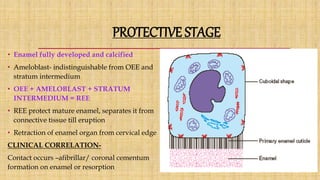
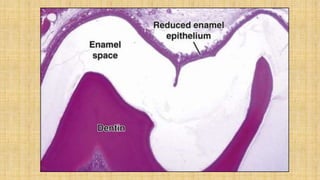
PROTECTIVE STAGE
• Enamel fully developed and calcified
• Ameloblast- indistinguishable from OEE and
stratum intermedium
• OEE + AMELOBLAST + STRATUM
INTERMEDIUM = REE
• REE protect mature enamel, separates it from
connective tissue till eruption
• Retraction of enamel organ from cervical edge
CLINICAL CORRELATION-
Contact occurs –afibrillar/ coronal cementum
formation on enamel or resorption
DESMOLYIC STAGE
• REE – separates oral epithelium and CT
• Elaborate desmolytic enzymes- destroy CT fibres
• Premature degeneration of REE- prevent eruption of tooth
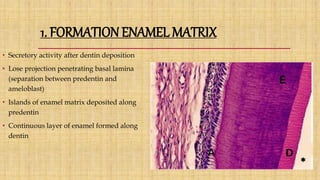
1. FORMATION ENAMEL MATRIX
• Secretory activity after dentin deposition
• Lose projection penetrating basal lamina
(separation between predentin and
ameloblast)
• Islands of enamel matrix deposited along
predentin
• Continuous layer of enamel formed along
dentin
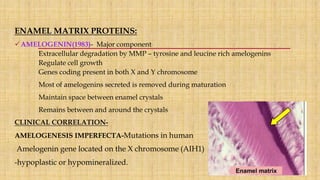
ENAMEL MATRIX PROTEINS:
AMELOGENIN(1983)- Major component
Extracellular degradation by MMP – tyrosine and leucine rich amelogenins
Regulate cell growth
Genes coding present in both X and Y chromosome
Most of amelogenins secreted is removed during maturation
Maintain space between enamel crystals
Remains between and around the crystals
CLINICAL CORRELATION-
AMELOGENESIS IMPERFECTA-Mutations in human
Amelogenin gene located on the X chromosome (AIH1)
-hypoplastic or hypomineralized.
KALLIKREIN-4 - Secreted in late enamel formation by ameloblast
Remove Amelogenin scaffold prior to mineralisation.
CLINICAL CORRELATION-
1. Over expression- Hypocalcified enamel
AMELOBLASTIN(1996)- Nucleation and growth of crystals
Cell-matrix attachment
Maintenance of ameloblast in differentiated state
CLINICAL CORRELATION-
1. Lack of expression- Termination of amelogenesis
Failure to produce any enamel.
ENAMELIN(1997)- Original enamel protein
CLINICAL CORRELATION-
1. Lack of expression- No true enamel formed
Thin, highly irregular mineralised crust covered the dentin
AMELOTIN – New protein – secreted by mature ameloblast
Late stage of enamel formation
CLINICAL CORRELATION-
1. Over expression- Extremely soft enamel
hypomineralisation of inner enamel and structural defects in outer enamel.
TUFTELIN- Localised to DEJ
Involved in cell signalling
Odontogenic Ameloblast associated gene(ODAM) (2006)-
Secreted in late secretory, transition stage, maturation stage
CLINICAL CORRELATION-
1. Lack of expression- No enamel defect but altered junctional epithelial attachment
Predispose tooth to periodontal infection
DENTIN SIALOPHOSPHOPROTEIN- Localised to DEJ
Transient in ameloblast and in odontoblast till dentin formation is complete
Proteolytic cleavage into Dentin Sialoprotein and dentin Phosphoprotein
Regarded as transition zone between dentin and enamel
CLINICAL CORRELATION-
1. Over expression DSP- Increase enamel hardness
DPP- Soften and weakened bulk enamel
NBCe1- Electrogenic sodium bicarbonate cotransporter
Also seen in renal proximal tubule, pancreas, eye, heart, brain, developing tooth.
Ameloblast- maintain pH buffering during mineralisation
CLINICAL CORRELATION-
1. Lack of expression- Enamel too soft to even measure
Dentin is significantly softened
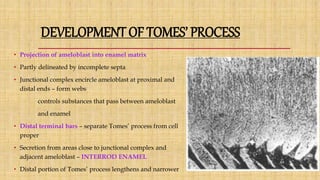
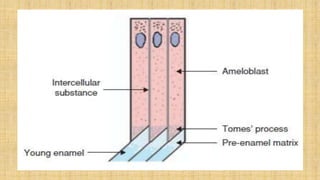
DEVELOPMENT OF TOMES’ PROCESS
• Projection of ameloblast into enamel matrix
• Partly delineated by incomplete septa
• Junctional complex encircle ameloblast at proximal and
distal ends – form webs
controls substances that pass between ameloblast
and enamel
• Distal terminal bars – separate Tomes’ process from cell
proper
• Secretion from areas close to junctional complex and
adjacent ameloblast – INTERROD ENAMEL
• Distal portion of Tomes’ process lengthens and narrower
AMELOBLAST COVERING MATURING ENAMEL
• Shorter than ameloblast over incompletely formed
enamel
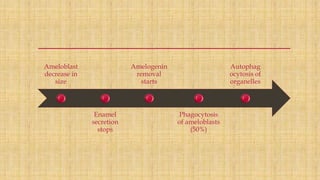
• TRANSITION STAGE- changes occurring in
ameloblast after secretory stage and prior to onset
of maturation process
Ameloblast
decrease in
size
Enamel
secretion
stops
Amelogenin
removal
starts
Phagocytosis
of ameloblasts
(50%)
Autophag
ocytosis of
organelles
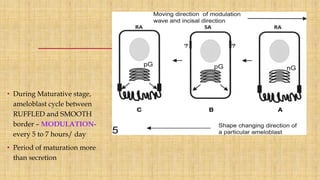
• During Maturative stage,
ameloblast cycle between
RUFFLED and SMOOTH
border – MODULATION-
every 5 to 7 hours/ day
• Period of maturation more
than secretion
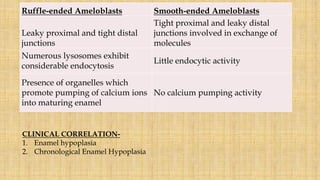
Ruffle-ended Ameloblasts Smooth-ended Ameloblasts
Leaky proximal and tight distal
junctions
Tight proximal and leaky distal
junctions involved in exchange of
molecules
Numerous lysosomes exhibit
considerable endocytosis
Little endocytic activity
Presence of organelles which
promote pumping of calcium ions
into maturing enamel
No calcium pumping activity
CLINICAL CORRELATION-
1. Enamel hypoplasia
2. Chronological Enamel Hypoplasia
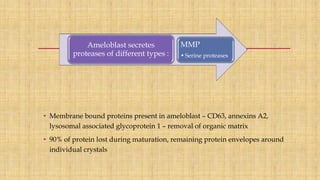
Ameloblast secretes
proteases of different types :
MMP
•Serine proteases
• Membrane bound proteins present in ameloblast – CD63, annexins A2,
lysosomal associated glycoprotein 1 – removal of organic matrix
• 90% of protein lost during maturation, remaining protein envelopes around
individual crystals
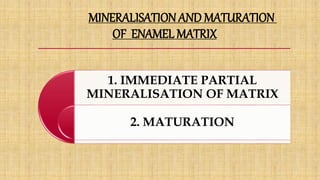
MINERALISATION AND MATURATION
OF ENAMEL MATRIX
1. IMMEDIATE PARTIAL
MINERALISATION OF MATRIX
2. MATURATION
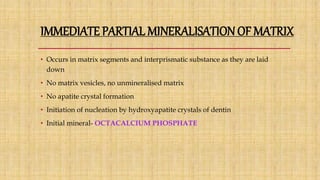
IMMEDIATE PARTIAL MINERALISATION OF MATRIX
• Occurs in matrix segments and interprismatic substance as they are laid
down
• No matrix vesicles, no unmineralised matrix
• No apatite crystal formation
• Initiation of nucleation by hydroxyapatite crystals of dentin
• Initial mineral- OCTACALCIUM PHOSPHATE
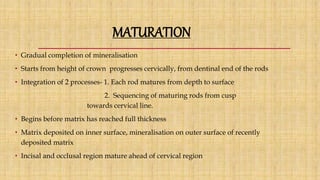
MATURATION
• Gradual completion of mineralisation
• Starts from height of crown progresses cervically, from dentinal end of the rods
• Integration of 2 processes- 1. Each rod matures from depth to surface
2. Sequencing of maturing rods from cusp
towards cervical line.
• Begins before matrix has reached full thickness
• Matrix deposited on inner surface, mineralisation on outer surface of recently
deposited matrix
• Incisal and occlusal region mature ahead of cervical region
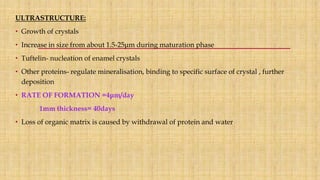
ULTRASTRUCTURE:
• Growth of crystals
• Increase in size from about 1.5-25μm during maturation phase
• Tuftelin- nucleation of enamel crystals
• Other proteins- regulate mineralisation, binding to specific surface of crystal , further
deposition
• RATE OF FORMATION =4μm/day
1mm thickness= 40days
• Loss of organic matrix is caused by withdrawal of protein and water
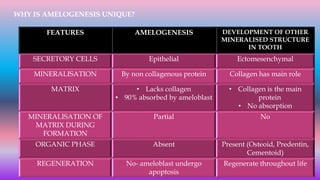
WHY IS AMELOGENESIS UNIQUE?
FEATURES AMELOGENESIS DEVELOPMENT OF OTHER
MINERALISED STRUCTURE
IN TOOTH
SECRETORY CELLS Epithelial Ectomesenchymal
MINERALISATION By non collagenous protein Collagen has main role
MATRIX • Lacks collagen
• 90% absorbed by ameloblast
• Collagen is the main
protein
• No absorption
MINERALISATION OF
MATRIX DURING
FORMATION
Partial No
ORGANIC PHASE Absent Present (Osteoid, Predentin,
Cementoid)
REGENERATION No- ameloblast undergo
apoptosis
Regenerate throughout life
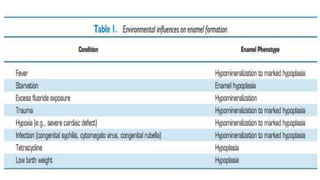
CLINICAL CONSIDERATION
• ENAMEL HYPOPLASIA
• ENAMEL HYPOCALCIFICATION
• FLUOROSIS
ENAMEL REGENERATION
• Enamel cannot regenerate or remodel on its own
• Various methods are employed to attempt regeneration of enamel
• Synthetic enamel fabrication , tissue engineering etc
• Can done by
a. Hydrothermal method- Controlled release of Ca from Ca-EDTA
b. Hydrothermal transformation- Octacalcium phosphate rod to Hydroxyapatite
nanorods and using hydrogen peroxide containing pastes
c. PAMAM-COOH solution- organic template on demineralised enamel produce
hydroxyapatite crystals
Skin
epithelial
cells
Oral
keratinocytes
Human
embryonic
stem cell
derived
epithelial
cells
Bone marrow
cells
Epithelial cell
rests of
Malassez
Alternative cell sources for enamel
formation are-
[ Jayasudha et al: Enamel regeneration- Current
progress and challenges,
September 2014]
ENAMEL BIOMIMETICS
• Biomimetic methods
• Enamel acts like a single crystal
• Replication of Enamel Translucency- should regenerate the highly organised structure
of enamel
• Fundamental difficulty in clinical application- low solubility of calcium phosphate
- difficult to remineralise deep lesion
• Crystal precipitate randomly- will not rebuild enamel structure- develop stabilising
agents
CASEIN
CHITOSAN
GEL
EDTA
Example of some enamel biomimetic materials
[Rodrigo.S.Lacruz et al: Dental enamel formation
and implication for
oral health and disease, May 2017]
REFERENCES
Rodrigo.S.Lacruz et al: Dental enamel formation and implication for oral health and
disease, May 2017
 Jayasudha et al: Enamel regeneration- Current progress and challenges, September 2014
Michel Goldberg el al : Dentin: structure, composition and mineralisation, January 2011
Yue Sa et al : Compositional, structural and mechanical comparisons of normal enamel and
hypomaturation enamel, August 2014
Rick J. Rauth et al: Dental Enamel: Genes Define Biomechanics, December 2009
J.P. Simmer et al: Molecular mechanisms of dental enamel formation, 1995
 Jansen et al: Permeability of normal enamel, 1951
Orban’s Oral Histology and Embryology(13th Edition): G.S.Kumar
Tencate’s Oral Histology, Development, Structure and Function(8th
Editon):Anonio Nanci
 Textbook of Oral Anatomy, Histology, Physiology and Tooth Morphology
(1st Edition) : Dr K. Rajkumar, Dr. R. Ramya
Enamel - structure and development

Enamel - structure and development

  • 2.
    ENAMEL PRESENTER: LEKSHMY JAYAN IMDS, ORALANDMAXILLOFACIAL PATHOLOGY
  • 3.
    INTRODUCTION • Ectodermally derivedstructure produced by ameloblasts • Hardest substance in the body • Wear resistant outer layer of the dental crown • Forms insulating barrier – protects the tooth [Rodrigo.S.Lacruz et al: Dental enamel formation and for oral health and disease, May 2017]
  • 4.
    [Michel Goldberg elal : Dentin: structure, composition and mineralisation, January 2011]
  • 5.
    COMPOSITION (ROBINSON ETAL, 1971) 95% 1% 4% COMPOSITION OF ENAMEL INORGANIC ORGANIC WATER
  • 6.
    • Inorganic components– various minerals • Organic components – forms enamel matrix ( non collagenous proteins and enzymes) • Primary function of organic material- direct growth of enamel crystals. • Enamel proteins Non- amelogenins in enamel formation- Ameloblastin, Enamelin, Tuftelin AMELOGENINS (90%) NON- AMELOGENINS (10%)
  • 7.
    • Inorganic component– mainly hydroxyapatite crystals, carbonates and trace elements. • Enamel hydroxyapatite crystals- largest of all calcified tissues • Susceptible to dissolution of acid- basis of dental caries. • Water is present as a part of hydroxyapatite crystal, boundaries of rods. [ Jayasudha et al: Enamel regeneration- Current progress and challenges, September 2014]
  • 8.
    INORGANIC ORGANIC (ENAMEL PROTEINS) OXYGEN(43.4%) AMELOGENIN (90%) CALCIUM (36.6%) NON AMELOGENIN (10%) PHOSPHORUS (7.7%) o AMELOBLASTIN SODIUM (0.67%) o ENAMELIN CARBON (0.64%) o TUFTELIN MAGNESIUM (0.35%) o AMELOTIN FLUORIDE, STRONTIUM, LEAD o ODAM, DSPP
  • 9.
    HYDROXYAPATITE CRYSTALS • AugustinAlexis Damur, 1856 • Naturally occurring mineral form of calcium apatite • Chemical formula- Ca5 (PO4 )3 (OH) Ca10 (PO4 )6 (OH)2 • Hydroxyl end member of complex apatite group. • Hydroxyl group replaced by F,Cl,CO3 – Fluroapatite or Chlorapatite
  • 10.
    • Carbonated calciumdeficient hydroxyapatite- tooth and bone • Also seen in calcification within pineal gland - Corpora arenacea (Brain sand) • CO3 substitution for OH or PO4 – susceptible to acidic dissolution- progression of caries • F substitution – resistant to dissolution- caries prevention and erosion reduction [Rodrigo.S.Lacruz et al: Dental enamel formation and implication for oral health and disease, May 2017]
  • 11.
    HYDROXYAPATITE CRYSTALS INENAMEL • Closely packed, long, ribbon like carbonate apatite crystals • Width =60-70 nm, Thickness =25-30 nm • Length span the entire thickness of enamel layer. • Maturing enamel- hexagonal crystal • Matured enamel- irregular
  • 12.
  • 13.
  • 14.
    Resistant covering Brittle •Modulus of elasticity- 1338.2+307 MPa • Hardness – 274.8+18.1 kg/mm • Specific gravity- 2.8 [ K.J.Chun et al: Comparison of mechanical properties and role between enamel and dentin in the human teeth, 2014]
  • 15.
    • Semipermeable membrane -demonstrated by radioactive tracers and certain dyes - (C- labelled urea, Iodine). - The organic matrix and water in enamel is in a network of micropores- dynamic connection between enamel and systemic, pulpal or dentinal tubule fluids - Micropores or cracks allow the penetration of fluids. -Permeability decreases and hardness increases with age. [Jansen et al: Permeability of normal enamel, 1951] • Colour of enamel – yellowish white to greyish white determined by translucency [ K.J.Chun et al: Comparison of mechanical properties and role between enamel and dentin in the human teeth, 2014]
  • 16.
    STRUCTURE OF ENAMEL •Rods or prisms • Hunter Schreger bands • Incremental lines • Gnarled enamel • Surface structures • Enamel tufts and lamellae • Enamel cuticle • DEJ • Enamel cuticle
  • 17.
    ENAMEL RODS • Fundamentalorganisational units of enamel • Cylindrical in LS • Number- 5 million to 12 million • Length is greater than thickness • Increased area of enamel in surface than at DEJ
  • 18.
    • Diameter- 4μm •Clear crystalline appearance • Arcade outline- hexagonal , round, oval, fish-scale near DEJ • Keyhole shape outline near enamel surface
  • 20.
    ULTRASTRUCTURE: • Key holepattern or paddle shaped pattern • Width =5μm Thickness= 9μm • In LS, sections pass through heads or bodies of one row of rods and tails of an adjacent row, producing an appearance of rods separated by interrod substance. • Bizarre pattern- packed tightly together.
  • 22.
    Head (1) occlusaland incisal surface • One rod is formed by 4 ameloblast Tail (3) cervical region • EM- apatite crystals, parallel to long axis of the rods, heads deviate about 65° • Length- 0.05-1μm Thickness-30nm Width- 90nm
  • 25.
    CROSS STRIATIONS: • Eachenamel rod is built up of segments, separated by dark lines- striated appearance • Demarcate rod segments • More pronounced in hypocalcified enamel • Formed by diurnal rhythm in enamel matrix formation • Length of each segment-4μm
  • 26.
    DIRECTION OF RODS: CLINICALCORRELATION: Unsupported Enamel Rods: -Un supported enamel rods are brittle and susceptible to fracture-break to produce leakage at the margins - lodging of food/bacteria in these spaces- secondary caries.
  • 27.
    • Other patternsthat complicate enamel structures: -Irregular bending in transverse plane of tooth, cervical- straight -Intertwine in inner 2/3rd- dissimilar local orientation - Wavy course in clockwise and anticlockwise direction in cuspal and incisal edge - Developmental pits and fissures- converge in outward course CLINICAL CORRELATION: Wavy course of enamel rods: The wavy course, oblique direction and interlocking of the enamel rods render prevention from enamel fracture
  • 28.
    ROD SHEATH • Thinperipheral layer • Darker than rod • Relatively acid resistant • Less calcified than rod • Often incomplete
  • 29.
    INTERPRISMATIC SUBSTANCE • Cementenamel rods together • More calcified than rod sheath but less than rod • Minimum in human teeth
  • 30.
    HUNTER-SCHREGER BANDS • Opticalphenomenon seen in LS • Found in inner 2/3rd of enamel • More or less regular change in direction of rods- functional adaptation • Parazones-dark bands • Diazones-light bands • Angle between parazone and diazone-40°
  • 31.
    • Enamel crystalsaggregate in each zone, deviated in opposite direction and tilted to 50° with respect to central axis. • Controversies in the formation of Hunter Schreger bands: 1. Change in the direction between adjacent group of rods 2. Variation in calcification of enamel 3. Composed of alternate zones of different permeability and different content of organic material
  • 32.
    INCREMENTAL LINES INCREMENTAL LINESNEONATAL LINE OF RETZIUS
  • 33.
    INCREMENTAL LINES OFRETZIUS • Brownish bands in GS of enamel calcified teeth and in forming enamel • Illustrate incremental pattern of enamel • LS- surround tip of dentin • Cervical part- run obliquely from DEJ to surface, deviate occlusally • Transverse section- concentric circle • Represents 6-11 days of rhythmic deposition of enamel
  • 34.
    • Other proposedcauses: 1. Periodic bending of enamel rods 2. Variations in basic organic structure 3. Physiologic calcification rhythm MEAN DAILY FORMATION OF ENAMEL = 4μm CLINICAL CORRELATION : Accentuated incremental lines can also be pathological, caused by metabolic and systemic disturbances such as exanthematous fever that affects enamel formation.
  • 35.
    NEONATAL LINE ORRING • Boundary marked between enamel formed before and after birth • Accentuated striae of Retzius • ETIOLOGY - Sudden change in environment and nutrition - Antenatal enamel is better calcified than postnatal enamel
  • 37.
    • Used toidentify enamel formed before and after birth • Seen in all deciduous teeth and in permanent first molars • Frequently seen in first molars of girls than boys • Location also varies in pre and post term birth
  • 38.
    GNARLED ENAMEL • Wavypattern in the enamel at the cuspal region • Optical appearance of enamel cut in oblique plane • Bundle of rods intertwine more regularly • Makes enamel more stronger • Not hypomineralised!
  • 39.
    SURFACE STRUCTURES • Prismlessenamel • Perikymata • Enamel pits and caps • Cracks or enamel lamellae • Enamel tufts • Rod ends
  • 40.
    PRISMLESS ENAMEL • Relativelystructureless layer of enamel, approximately 30μm thick • Seen in 70% of permanent and all deciduous teeth • Most commonly in cervical areas of enamel surface • Surface, prismless, hydroxyapatite parallel to each other and perpendicular to Striae of Retzius • Hypermineralised
  • 41.
    PERIKYMATA (IMBRICATION LINES) •Transverse, wave like grooves, external manifestation of Striae of Retzius • Lie parallel to each other and CEJ • 30 per mm in CEJ • 10 per mm near occlusal or incisal edge of a surface • COURSE- regular, irregular in cervical region
  • 43.
  • 44.
    ENAMEL PITS ANDCAPS • Enamel pits- 1-1.5μm in diameter, depressed ends of ameloblast • Caps- small elevation of about 10-15μm, enamel deposition on non- mineralizable debris • Enamel brochs- large enamel elevations
  • 46.
    ENAMEL LAMELLAE • Thin,leaf like structures that extend from the enamel surface toward the DEJ • May extend or penetrate dentin • Consist more of organic and less of inorganic • Confused with cracks • Develop in areas of tension- when rods cross, donot calcify • Disturbance severe- crack develop – filled by surrounding cells or organic substance from oral cavity
  • 47.
    • TYPES OFENAMEL LAMELLAE
  • 48.
    • Cells fromenamel organ fill a crack in enamel - in depth degeneration - close to surface, remain vital for sometime – HORNIFIED CUTICLE From connective tissue- cementum formation CLINICAL CORRELATION- SITE OF WEAKNESS!! – pathways for cariogenic bacteria
  • 49.
    ENAMEL TUFTS • Resemblestufts of grass in GS • Arise at DEJ and reach into the enamel to about 1/5th to 1/3rd of its thickness • Narrow, ribbon-like structure, inner end arises at the dentin • Tufts in different planes are projected into one plane- TUFT OF GRASS • Extent in direction of long axis of the crown
  • 50.
    • Hypocalcified enamelrods and interprismatic substance • SEM- tubular structure with cross striation • TEM- plate like structure in centre of tufts originating from superficial layer of dentin, crossing DEJ and entering tufts
  • 51.
    ENAMEL CUTICLE • PRIMARYENAMEL CUTICLE- Nasmyth’s membrane • SECONDARY ENAMEL CUTICLE- Afibrillar cementum • PELLICLE- Precipitate of salivary protein
  • 52.
    ENAMEL CUTICLE (NASMYTH’SMEMBRANE/ PRIMARY ENAMEL CUTICLE) • Covers entire crown of newly erupted tooth • Removed by mastication • Basal lamina secreted by ameloblasts when enamel formation is complete • Protects enamel surface from resorption by adjacent vascular tissue prior to eruption of teeth
  • 53.
    SECONDARY ENAMEL CUTICLE •Cover cervical area of the enamel • Thickness=upto 10μm • Continuous with cementum • Probably of mesodermal origin or may be elaborated by attachment epithelium • Secreted after enamel organ is retracted from cervical region during tooth development
  • 54.
    PELLICLE • Reform withinhours after mechanical cleaning • May be colonised by microorganisms to form a bacterial plaque • Plaque may be calcified forming calculus CLINICAL CORRELATION- If not removed, the pellicle can get colonized by microbes to form plaque which subsequently lead to caries.
  • 55.
    DENTINOENAMEL JUNCTION • Surfaceof dentin at DEJ –pitted, depression fit rounded projection of enamel, holds the enamel firmly on the dentin. • Scalloped, convexity towards dentin • Crystals of enamel and dentin mix with each other • Series of ridges- more pronounced in occlusal area- greater masticatory stress • Hypermineralised zone about 30μm thick at DEJ- prominent before mineralisation is complete
  • 56.
    ENAMEL SPINDLES • Odontoblasticprocess that cross the DEJ into enamel, thickened at their end before mineralisation • Hypomineralised • Direction corresponds to direction of ameloblast(90° • to dentin) • Enamel rods and spindles are divergent • GS- dark in transmitted light • Width=5nm Length=70nm Diameter=2μm • Seen in cusp tip
  • 57.
    AGE CHANGES • Attrition •Generalised loss of enamel rods • Flattening of perikymata • Decreased permeability
  • 58.
  • 60.
    AMELOGENESIS • Enamel firstforms, 30% mineralised • Organic matrix breaks down and removed – crystals grow wider and thicker- 96% mineralisation • Ameloblast secrete matrix protein • Ameloblast has unique lifecycle- phenotypic changes • Enamel formation – differentiation of IEE, OEE – cuspal tips – all cells are differentiated into ameloblast • Dentin and enamel formation cuts off blood supply to enamel organ • Reversal of nutritional source
  • 62.
  • 64.
    MORPHOGENIC STAGE • Ameloblast-short, columnar, large oval nuclei ,almost fill the cell body • Terminal bars appear during differentiation • Migration of mitochondria to basal region of the cell • IEE separated by dental papilla basal lamina • Adjacent pulp layer- cell free, narrow, light zone
  • 65.
    ORGANISING STAGE • IEEinteracts with adjacent connective tissue which differentiates into ODONTOBLASTS • Reversal of polarity • Cell free zone between IEE and dental papilla disappear • Preameloblasts secrete protein similar to enamel matrix- phagocytosed by odontoblast- EPITHELIAL MESENCHYMAL INTERACTION • Terminal phase- DENTIN FORMATION, reversal of nutritional source
  • 66.
    FORMATIVE STAGE • Afterdentin formation • Presence of dentin is necessary for formation of enamel (Reciprocal induction) • Formation – enamel matrix retain same length and arrangement • Intiation – secretion of enamel matrix- change in organisation and number of cytoplasmic organelles and inclusion • Earliest change- development of blunt cell processes ameloblast surfaces
  • 67.
    MATURATIVE STAGE • Maturation/full mineralisation after most of the thickness of enamel matrix formed in occlusal/ incisal area, cervical area – progressing • Ameloblast-slightly reduced in length and closely attached to enamel matrix microvilli at distal extension, cytoplasmic vacuoles containing enamel matrix like material (absorptive function) • Cells of stratum intermedium- assume spindle shape • Smooth and Ruffle ended ameloblasts
  • 68.
    PROTECTIVE STAGE • Enamelfully developed and calcified • Ameloblast- indistinguishable from OEE and stratum intermedium • OEE + AMELOBLAST + STRATUM INTERMEDIUM = REE • REE protect mature enamel, separates it from connective tissue till eruption • Retraction of enamel organ from cervical edge CLINICAL CORRELATION- Contact occurs –afibrillar/ coronal cementum formation on enamel or resorption
  • 70.
    DESMOLYIC STAGE • REE– separates oral epithelium and CT • Elaborate desmolytic enzymes- destroy CT fibres • Premature degeneration of REE- prevent eruption of tooth
  • 72.
    1. FORMATION ENAMELMATRIX • Secretory activity after dentin deposition • Lose projection penetrating basal lamina (separation between predentin and ameloblast) • Islands of enamel matrix deposited along predentin • Continuous layer of enamel formed along dentin
  • 73.
    ENAMEL MATRIX PROTEINS: AMELOGENIN(1983)-Major component Extracellular degradation by MMP – tyrosine and leucine rich amelogenins Regulate cell growth Genes coding present in both X and Y chromosome Most of amelogenins secreted is removed during maturation Maintain space between enamel crystals Remains between and around the crystals CLINICAL CORRELATION- AMELOGENESIS IMPERFECTA-Mutations in human Amelogenin gene located on the X chromosome (AIH1) -hypoplastic or hypomineralized.
  • 74.
    KALLIKREIN-4 - Secretedin late enamel formation by ameloblast Remove Amelogenin scaffold prior to mineralisation. CLINICAL CORRELATION- 1. Over expression- Hypocalcified enamel AMELOBLASTIN(1996)- Nucleation and growth of crystals Cell-matrix attachment Maintenance of ameloblast in differentiated state CLINICAL CORRELATION- 1. Lack of expression- Termination of amelogenesis Failure to produce any enamel.
  • 75.
    ENAMELIN(1997)- Original enamelprotein CLINICAL CORRELATION- 1. Lack of expression- No true enamel formed Thin, highly irregular mineralised crust covered the dentin AMELOTIN – New protein – secreted by mature ameloblast Late stage of enamel formation CLINICAL CORRELATION- 1. Over expression- Extremely soft enamel hypomineralisation of inner enamel and structural defects in outer enamel. TUFTELIN- Localised to DEJ Involved in cell signalling
  • 76.
    Odontogenic Ameloblast associatedgene(ODAM) (2006)- Secreted in late secretory, transition stage, maturation stage CLINICAL CORRELATION- 1. Lack of expression- No enamel defect but altered junctional epithelial attachment Predispose tooth to periodontal infection DENTIN SIALOPHOSPHOPROTEIN- Localised to DEJ Transient in ameloblast and in odontoblast till dentin formation is complete Proteolytic cleavage into Dentin Sialoprotein and dentin Phosphoprotein Regarded as transition zone between dentin and enamel
  • 77.
    CLINICAL CORRELATION- 1. Overexpression DSP- Increase enamel hardness DPP- Soften and weakened bulk enamel NBCe1- Electrogenic sodium bicarbonate cotransporter Also seen in renal proximal tubule, pancreas, eye, heart, brain, developing tooth. Ameloblast- maintain pH buffering during mineralisation CLINICAL CORRELATION- 1. Lack of expression- Enamel too soft to even measure Dentin is significantly softened
  • 78.
    DEVELOPMENT OF TOMES’PROCESS • Projection of ameloblast into enamel matrix • Partly delineated by incomplete septa • Junctional complex encircle ameloblast at proximal and distal ends – form webs controls substances that pass between ameloblast and enamel • Distal terminal bars – separate Tomes’ process from cell proper • Secretion from areas close to junctional complex and adjacent ameloblast – INTERROD ENAMEL • Distal portion of Tomes’ process lengthens and narrower
  • 80.
    AMELOBLAST COVERING MATURINGENAMEL • Shorter than ameloblast over incompletely formed enamel • TRANSITION STAGE- changes occurring in ameloblast after secretory stage and prior to onset of maturation process
  • 81.
  • 82.
    • During Maturativestage, ameloblast cycle between RUFFLED and SMOOTH border – MODULATION- every 5 to 7 hours/ day • Period of maturation more than secretion
  • 83.
    Ruffle-ended Ameloblasts Smooth-endedAmeloblasts Leaky proximal and tight distal junctions Tight proximal and leaky distal junctions involved in exchange of molecules Numerous lysosomes exhibit considerable endocytosis Little endocytic activity Presence of organelles which promote pumping of calcium ions into maturing enamel No calcium pumping activity CLINICAL CORRELATION- 1. Enamel hypoplasia 2. Chronological Enamel Hypoplasia
  • 84.
    Ameloblast secretes proteases ofdifferent types : MMP •Serine proteases • Membrane bound proteins present in ameloblast – CD63, annexins A2, lysosomal associated glycoprotein 1 – removal of organic matrix • 90% of protein lost during maturation, remaining protein envelopes around individual crystals
  • 85.
    MINERALISATION AND MATURATION OFENAMEL MATRIX 1. IMMEDIATE PARTIAL MINERALISATION OF MATRIX 2. MATURATION
  • 86.
    IMMEDIATE PARTIAL MINERALISATIONOF MATRIX • Occurs in matrix segments and interprismatic substance as they are laid down • No matrix vesicles, no unmineralised matrix • No apatite crystal formation • Initiation of nucleation by hydroxyapatite crystals of dentin • Initial mineral- OCTACALCIUM PHOSPHATE
  • 87.
    MATURATION • Gradual completionof mineralisation • Starts from height of crown progresses cervically, from dentinal end of the rods • Integration of 2 processes- 1. Each rod matures from depth to surface 2. Sequencing of maturing rods from cusp towards cervical line. • Begins before matrix has reached full thickness • Matrix deposited on inner surface, mineralisation on outer surface of recently deposited matrix • Incisal and occlusal region mature ahead of cervical region
  • 88.
    ULTRASTRUCTURE: • Growth ofcrystals • Increase in size from about 1.5-25μm during maturation phase • Tuftelin- nucleation of enamel crystals • Other proteins- regulate mineralisation, binding to specific surface of crystal , further deposition • RATE OF FORMATION =4μm/day 1mm thickness= 40days • Loss of organic matrix is caused by withdrawal of protein and water
  • 89.
    WHY IS AMELOGENESISUNIQUE? FEATURES AMELOGENESIS DEVELOPMENT OF OTHER MINERALISED STRUCTURE IN TOOTH SECRETORY CELLS Epithelial Ectomesenchymal MINERALISATION By non collagenous protein Collagen has main role MATRIX • Lacks collagen • 90% absorbed by ameloblast • Collagen is the main protein • No absorption MINERALISATION OF MATRIX DURING FORMATION Partial No ORGANIC PHASE Absent Present (Osteoid, Predentin, Cementoid) REGENERATION No- ameloblast undergo apoptosis Regenerate throughout life
  • 90.
    CLINICAL CONSIDERATION • ENAMELHYPOPLASIA • ENAMEL HYPOCALCIFICATION • FLUOROSIS
  • 92.
    ENAMEL REGENERATION • Enamelcannot regenerate or remodel on its own • Various methods are employed to attempt regeneration of enamel • Synthetic enamel fabrication , tissue engineering etc • Can done by a. Hydrothermal method- Controlled release of Ca from Ca-EDTA b. Hydrothermal transformation- Octacalcium phosphate rod to Hydroxyapatite nanorods and using hydrogen peroxide containing pastes c. PAMAM-COOH solution- organic template on demineralised enamel produce hydroxyapatite crystals
  • 93.
    Skin epithelial cells Oral keratinocytes Human embryonic stem cell derived epithelial cells Bone marrow cells Epithelialcell rests of Malassez Alternative cell sources for enamel formation are- [ Jayasudha et al: Enamel regeneration- Current progress and challenges, September 2014]
  • 94.
    ENAMEL BIOMIMETICS • Biomimeticmethods • Enamel acts like a single crystal • Replication of Enamel Translucency- should regenerate the highly organised structure of enamel • Fundamental difficulty in clinical application- low solubility of calcium phosphate - difficult to remineralise deep lesion • Crystal precipitate randomly- will not rebuild enamel structure- develop stabilising agents
  • 95.
    CASEIN CHITOSAN GEL EDTA Example of someenamel biomimetic materials [Rodrigo.S.Lacruz et al: Dental enamel formation and implication for oral health and disease, May 2017]
  • 96.
    REFERENCES Rodrigo.S.Lacruz et al:Dental enamel formation and implication for oral health and disease, May 2017  Jayasudha et al: Enamel regeneration- Current progress and challenges, September 2014 Michel Goldberg el al : Dentin: structure, composition and mineralisation, January 2011 Yue Sa et al : Compositional, structural and mechanical comparisons of normal enamel and hypomaturation enamel, August 2014 Rick J. Rauth et al: Dental Enamel: Genes Define Biomechanics, December 2009
  • 97.
    J.P. Simmer etal: Molecular mechanisms of dental enamel formation, 1995  Jansen et al: Permeability of normal enamel, 1951 Orban’s Oral Histology and Embryology(13th Edition): G.S.Kumar Tencate’s Oral Histology, Development, Structure and Function(8th Editon):Anonio Nanci  Textbook of Oral Anatomy, Histology, Physiology and Tooth Morphology (1st Edition) : Dr K. Rajkumar, Dr. R. Ramya