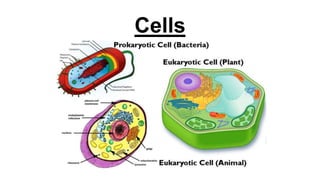
Cells
Cells: In General
● A cell is the smallest unit that is alive and can carry on all the processes of life
● Cells make up organisms (living things)
o Unicellular organisms are made up of 1 cell
o Multicellular organisms are made up of many cells
● Cells contain organelles, which are specialized compartments that carry out a specific function
● Types of cells
o Eukaryotic cells contain a nucleus, such as animal and plant cells
o Prokaryotic cells contain no nucleus, such as bacteria
Animal
Cells
● Usually round
● Organelles include
o nucleus: controls cell activities
o cell membrane: controls what enters and leaves the cell and
also protects the cell o endoplasmic reticulum (ER): tunnels
for compounds to move through the cell
o Golgi body: processes and stores protein
o Ribosomes: make proteins
o Mitochondria: Makes energy for the cell
o Lysosome: Has enzymes that digest waste and old
organelles
o Cytoplasm: Fills the empty space of the cell
o Vacuole: Stores food, water, and waste
o Centrioles: Help in cell division and is only found in animal,
not plant cells
Plant
Cells ● Usually square
● Organelles include
o Everything that an animal cell has plus more
o Chloroplast: Traps sunlight to make food for the plant
o Cell wall: Protects the cell
Bacterial
Cells
● Smaller and simpler than plant or animal cells
● Bacteria are unicellular
● No nucleus
● Have a single closed loop of DNA, cell wall, cell membrane,
cytoplasm and ribosomes
● Some have a capsule (shell for protection), pili (short hair like
structures to hold onto host cells), and flagella (whip like structure
for movement)

Cells

  • 1.
  • 2.
    Cells: In General ●A cell is the smallest unit that is alive and can carry on all the processes of life ● Cells make up organisms (living things) o Unicellular organisms are made up of 1 cell o Multicellular organisms are made up of many cells ● Cells contain organelles, which are specialized compartments that carry out a specific function ● Types of cells o Eukaryotic cells contain a nucleus, such as animal and plant cells o Prokaryotic cells contain no nucleus, such as bacteria
  • 3.
    Animal Cells ● Usually round ●Organelles include o nucleus: controls cell activities o cell membrane: controls what enters and leaves the cell and also protects the cell o endoplasmic reticulum (ER): tunnels for compounds to move through the cell o Golgi body: processes and stores protein o Ribosomes: make proteins o Mitochondria: Makes energy for the cell o Lysosome: Has enzymes that digest waste and old organelles o Cytoplasm: Fills the empty space of the cell o Vacuole: Stores food, water, and waste o Centrioles: Help in cell division and is only found in animal, not plant cells
  • 4.
    Plant Cells ● Usuallysquare ● Organelles include o Everything that an animal cell has plus more o Chloroplast: Traps sunlight to make food for the plant o Cell wall: Protects the cell
  • 5.
    Bacterial Cells ● Smaller andsimpler than plant or animal cells ● Bacteria are unicellular ● No nucleus ● Have a single closed loop of DNA, cell wall, cell membrane, cytoplasm and ribosomes ● Some have a capsule (shell for protection), pili (short hair like structures to hold onto host cells), and flagella (whip like structure for movement)