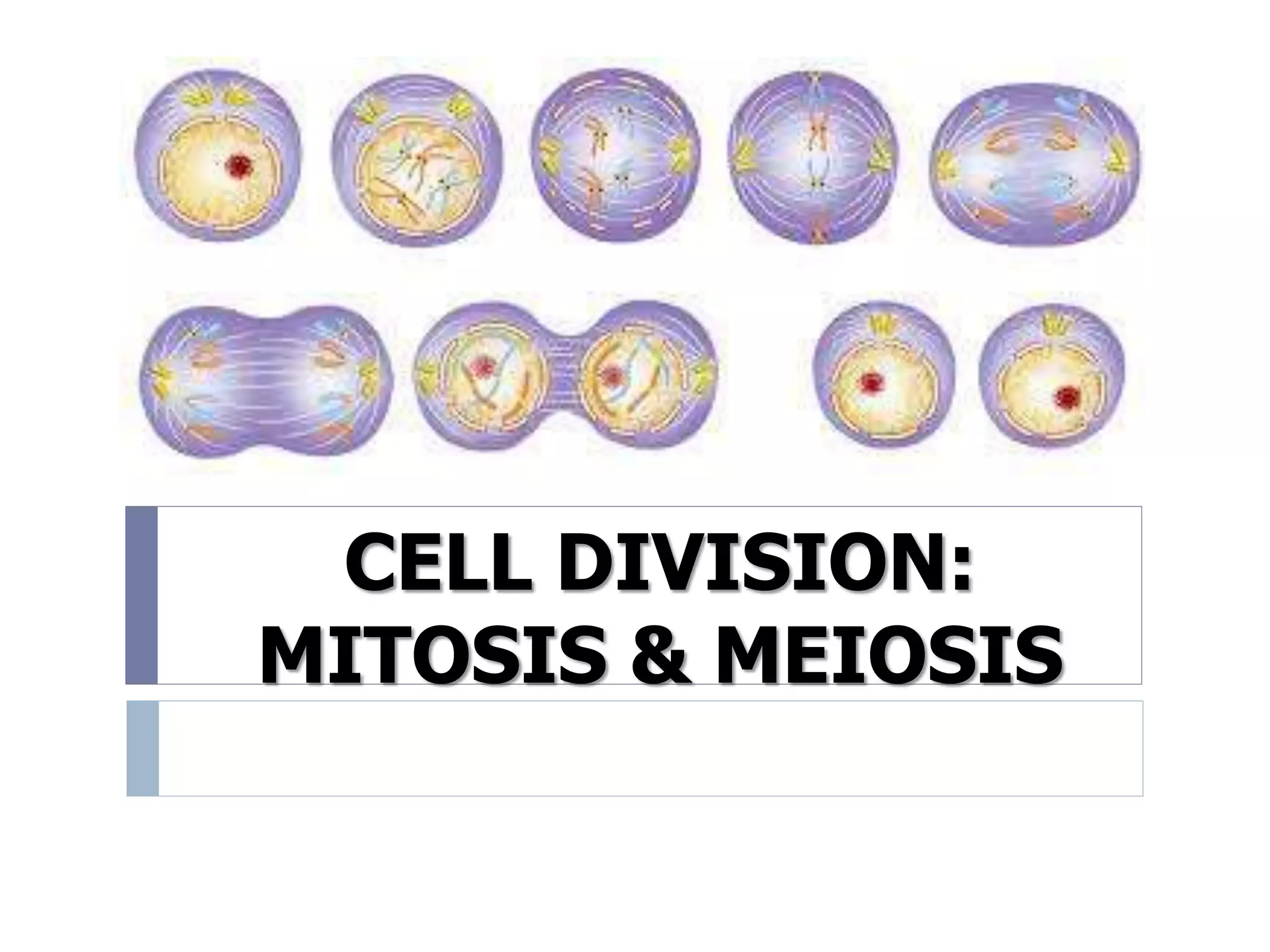
CELL DIVISION:
MITOSIS & MEIOSIS
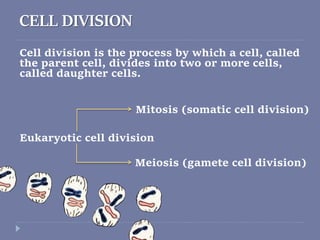
Cell division is the process by which a cell, called
the parent cell, divides into two or more cells,
called daughter cells.
Eukaryotic cell division
CELL DIVISION
Mitosis (somatic cell division)
Meiosis (gamete cell division)
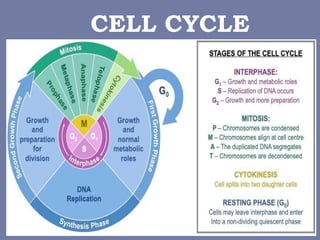
CELL CYCLE
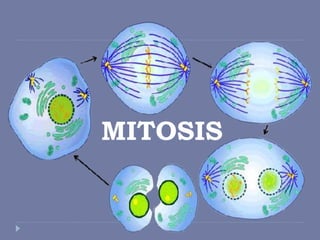
MITOSIS
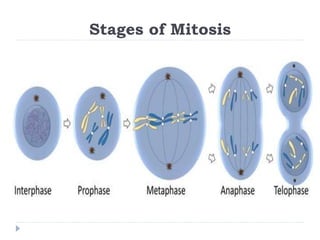
Stages of Mitosis
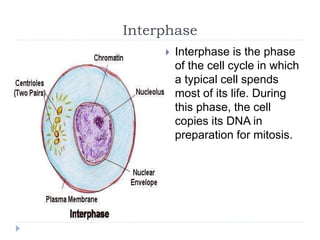
Interphase
 Interphase is the phase
of the cell cycle in which
a typical cell spends
most of its life. During
this phase, the cell
copies its DNA in
preparation for mitosis.
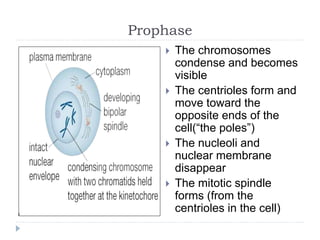
Prophase
 The chromosomes
condense and becomes
visible
 The centrioles form and
move toward the
opposite ends of the
cell(“the poles”)
 The nucleoli and
nuclear membrane
disappear
 The mitotic spindle
forms (from the
centrioles in the cell)
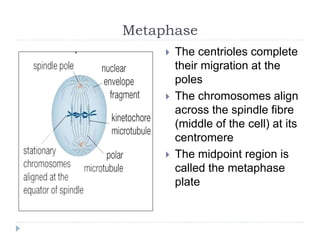
Metaphase
 The centrioles complete
their migration at the
poles
 The chromosomes align
across the spindle fibre
(middle of the cell) at its
centromere
 The midpoint region is
called the metaphase
plate
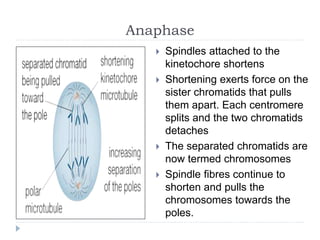
Anaphase
 Spindles attached to the
kinetochore shortens
 Shortening exerts force on the
sister chromatids that pulls
them apart. Each centromere
splits and the two chromatids
detaches
 The separated chromatids are
now termed chromosomes
 Spindle fibres continue to
shorten and pulls the
chromosomes towards the
poles.
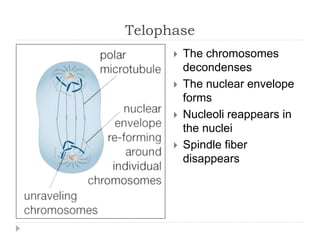
Telophase
 The chromosomes
decondenses
 The nuclear envelope
forms
 Nucleoli reappears in
the nuclei
 Spindle fiber
disappears
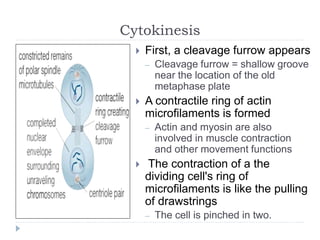
Cytokinesis
 First, a cleavage furrow appears
– Cleavage furrow = shallow groove
near the location of the old
metaphase plate
 A contractile ring of actin
microfilaments is formed
– Actin and myosin are also
involved in muscle contraction
and other movement functions
 The contraction of a the
dividing cell's ring of
microfilaments is like the pulling
of drawstrings
– The cell is pinched in two.
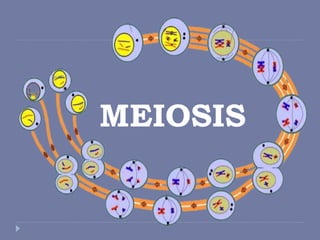
MEIOSIS
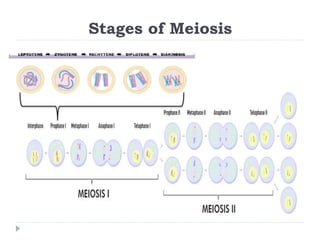
Stages of Meiosis
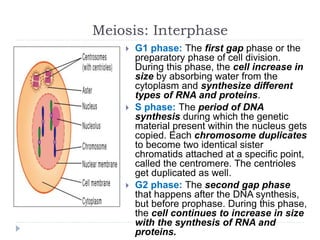
Meiosis: Interphase
 G1 phase: The first gap phase or the
preparatory phase of cell division.
During this phase, the cell increase in
size by absorbing water from the
cytoplasm and synthesize different
types of RNA and proteins.
 S phase: The period of DNA
synthesis during which the genetic
material present within the nucleus gets
copied. Each chromosome duplicates
to become two identical sister
chromatids attached at a specific point,
called the centromere. The centrioles
get duplicated as well.
 G2 phase: The second gap phase
that happens after the DNA synthesis,
but before prophase. During this phase,
the cell continues to increase in size
with the synthesis of RNA and
proteins.
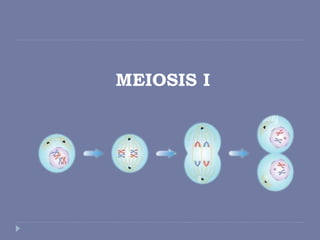
MEIOSIS I
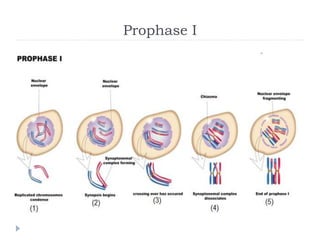
Prophase I
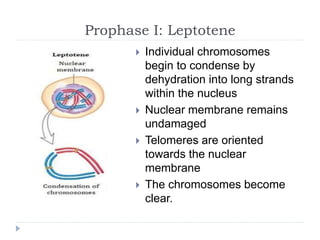
Prophase I: Leptotene
 Individual chromosomes
begin to condense by
dehydration into long strands
within the nucleus
 Nuclear membrane remains
undamaged
 Telomeres are oriented
towards the nuclear
membrane
 The chromosomes become
clear.
 The homologous chromosomes
come to lie side by side and get
attached laterally due to the
development of nucleoprotein
between them (synaptonemal
complex).
 This pairing of homologous
chromosomes is called synapsis or
syndesis.
 On account of synapsis,
chromosomes form pairs or
bivalent. The number of bivalents
is half number of the
chromosomes.
Prophase I: Zygotene
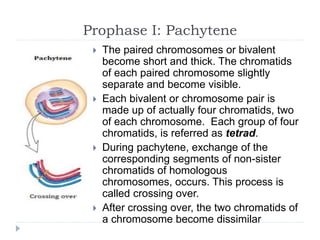
Prophase I: Pachytene
 The paired chromosomes or bivalent
become short and thick. The chromatids
of each paired chromosome slightly
separate and become visible.
 Each bivalent or chromosome pair is
made up of actually four chromatids, two
of each chromosome. Each group of four
chromatids, is referred as tetrad.
 During pachytene, exchange of the
corresponding segments of non-sister
chromatids of homologous
chromosomes, occurs. This process is
called crossing over.
 After crossing over, the two chromatids of
a chromosome become dissimilar
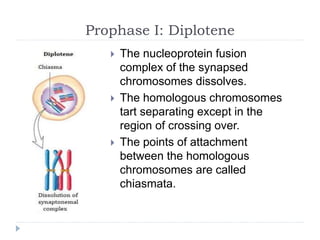
Prophase I: Diplotene
 The nucleoprotein fusion
complex of the synapsed
chromosomes dissolves.
 The homologous chromosomes
tart separating except in the
region of crossing over.
 The points of attachment
between the homologous
chromosomes are called
chiasmata.
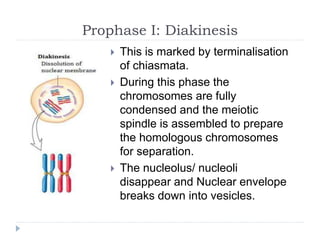
Prophase I: Diakinesis
 This is marked by terminalisation
of chiasmata.
 During this phase the
chromosomes are fully
condensed and the meiotic
spindle is assembled to prepare
the homologous chromosomes
for separation.
 The nucleolus/ nucleoli
disappear and Nuclear envelope
breaks down into vesicles.
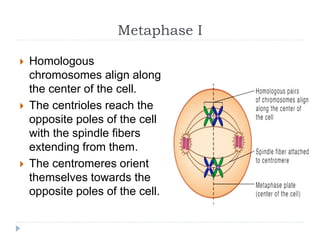
Metaphase I
 Homologous
chromosomes align along
the center of the cell.
 The centrioles reach the
opposite poles of the cell
with the spindle fibers
extending from them.
 The centromeres orient
themselves towards the
opposite poles of the cell.
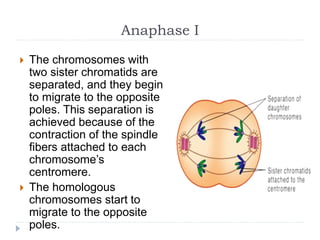
Anaphase I
 The chromosomes with
two sister chromatids are
separated, and they begin
to migrate to the opposite
poles. This separation is
achieved because of the
contraction of the spindle
fibers attached to each
chromosome’s
centromere.
 The homologous
chromosomes start to
migrate to the opposite
poles.
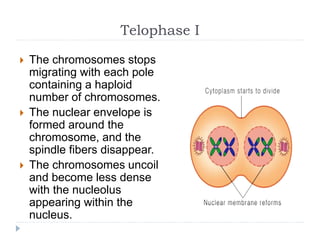
Telophase I
 The chromosomes stops
migrating with each pole
containing a haploid
number of chromosomes.
 The nuclear envelope is
formed around the
chromosome, and the
spindle fibers disappear.
 The chromosomes uncoil
and become less dense
with the nucleolus
appearing within the
nucleus.
Cytokinesis I
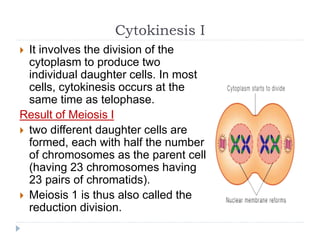
 It involves the division of the
cytoplasm to produce two
individual daughter cells. In most
cells, cytokinesis occurs at the
same time as telophase.
Result of Meiosis I
 two different daughter cells are
formed, each with half the number
of chromosomes as the parent cell
(having 23 chromosomes having
23 pairs of chromatids).
 Meiosis 1 is thus also called the
reduction division.
Interkinesis
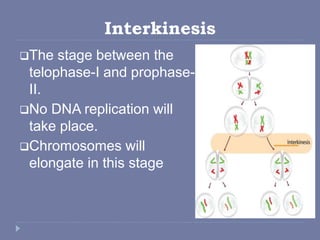
The stage between the
telophase-I and prophase-
II.
No DNA replication will
take place.
Chromosomes will
elongate in this stage
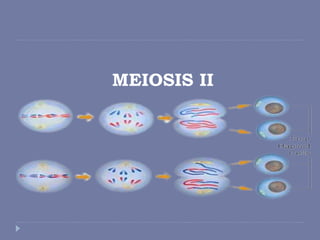
MEIOSIS II
Prophase II
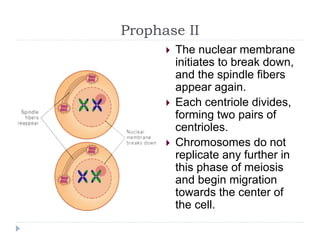
 The nuclear membrane
initiates to break down,
and the spindle fibers
appear again.
 Each centriole divides,
forming two pairs of
centrioles.
 Chromosomes do not
replicate any further in
this phase of meiosis
and begin migration
towards the center of
the cell.
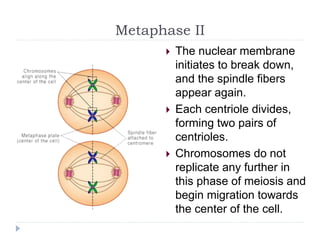
Metaphase II
 The nuclear membrane
initiates to break down,
and the spindle fibers
appear again.
 Each centriole divides,
forming two pairs of
centrioles.
 Chromosomes do not
replicate any further in
this phase of meiosis and
begin migration towards
the center of the cell.
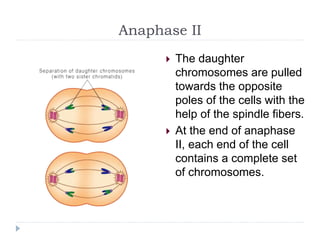
Anaphase II
 The daughter
chromosomes are pulled
towards the opposite
poles of the cells with the
help of the spindle fibers.
 At the end of anaphase
II, each end of the cell
contains a complete set
of chromosomes.
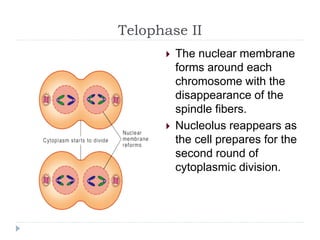
Telophase II
 The nuclear membrane
forms around each
chromosome with the
disappearance of the
spindle fibers.
 Nucleolus reappears as
the cell prepares for the
second round of
cytoplasmic division.
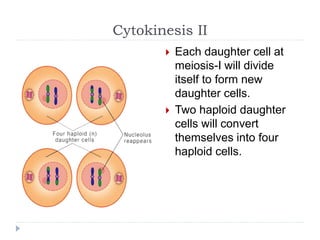
Cytokinesis II
 Each daughter cell at
meiosis-I will divide
itself to form new
daughter cells.
 Two haploid daughter
cells will convert
themselves into four
haploid cells.
ASSIGNMENT
Difference and Similarities between
Mitosis and Meiosis

CELL DIVISION.pptx

  • 1.
  • 2.
    Cell division isthe process by which a cell, called the parent cell, divides into two or more cells, called daughter cells. Eukaryotic cell division CELL DIVISION Mitosis (somatic cell division) Meiosis (gamete cell division)
  • 3.
  • 4.
  • 5.
  • 6.
    Interphase  Interphase isthe phase of the cell cycle in which a typical cell spends most of its life. During this phase, the cell copies its DNA in preparation for mitosis.
  • 7.
    Prophase  The chromosomes condenseand becomes visible  The centrioles form and move toward the opposite ends of the cell(“the poles”)  The nucleoli and nuclear membrane disappear  The mitotic spindle forms (from the centrioles in the cell)
  • 8.
    Metaphase  The centriolescomplete their migration at the poles  The chromosomes align across the spindle fibre (middle of the cell) at its centromere  The midpoint region is called the metaphase plate
  • 9.
    Anaphase  Spindles attachedto the kinetochore shortens  Shortening exerts force on the sister chromatids that pulls them apart. Each centromere splits and the two chromatids detaches  The separated chromatids are now termed chromosomes  Spindle fibres continue to shorten and pulls the chromosomes towards the poles.
  • 10.
    Telophase  The chromosomes decondenses The nuclear envelope forms  Nucleoli reappears in the nuclei  Spindle fiber disappears
  • 11.
    Cytokinesis  First, acleavage furrow appears – Cleavage furrow = shallow groove near the location of the old metaphase plate  A contractile ring of actin microfilaments is formed – Actin and myosin are also involved in muscle contraction and other movement functions  The contraction of a the dividing cell's ring of microfilaments is like the pulling of drawstrings – The cell is pinched in two.
  • 12.
  • 13.
  • 14.
    Meiosis: Interphase  G1phase: The first gap phase or the preparatory phase of cell division. During this phase, the cell increase in size by absorbing water from the cytoplasm and synthesize different types of RNA and proteins.  S phase: The period of DNA synthesis during which the genetic material present within the nucleus gets copied. Each chromosome duplicates to become two identical sister chromatids attached at a specific point, called the centromere. The centrioles get duplicated as well.  G2 phase: The second gap phase that happens after the DNA synthesis, but before prophase. During this phase, the cell continues to increase in size with the synthesis of RNA and proteins.
  • 15.
  • 16.
  • 17.
    Prophase I: Leptotene Individual chromosomes begin to condense by dehydration into long strands within the nucleus  Nuclear membrane remains undamaged  Telomeres are oriented towards the nuclear membrane  The chromosomes become clear.
  • 18.
     The homologouschromosomes come to lie side by side and get attached laterally due to the development of nucleoprotein between them (synaptonemal complex).  This pairing of homologous chromosomes is called synapsis or syndesis.  On account of synapsis, chromosomes form pairs or bivalent. The number of bivalents is half number of the chromosomes. Prophase I: Zygotene
  • 19.
    Prophase I: Pachytene The paired chromosomes or bivalent become short and thick. The chromatids of each paired chromosome slightly separate and become visible.  Each bivalent or chromosome pair is made up of actually four chromatids, two of each chromosome. Each group of four chromatids, is referred as tetrad.  During pachytene, exchange of the corresponding segments of non-sister chromatids of homologous chromosomes, occurs. This process is called crossing over.  After crossing over, the two chromatids of a chromosome become dissimilar
  • 20.
    Prophase I: Diplotene The nucleoprotein fusion complex of the synapsed chromosomes dissolves.  The homologous chromosomes tart separating except in the region of crossing over.  The points of attachment between the homologous chromosomes are called chiasmata.
  • 21.
    Prophase I: Diakinesis This is marked by terminalisation of chiasmata.  During this phase the chromosomes are fully condensed and the meiotic spindle is assembled to prepare the homologous chromosomes for separation.  The nucleolus/ nucleoli disappear and Nuclear envelope breaks down into vesicles.
  • 22.
    Metaphase I  Homologous chromosomesalign along the center of the cell.  The centrioles reach the opposite poles of the cell with the spindle fibers extending from them.  The centromeres orient themselves towards the opposite poles of the cell.
  • 23.
    Anaphase I  Thechromosomes with two sister chromatids are separated, and they begin to migrate to the opposite poles. This separation is achieved because of the contraction of the spindle fibers attached to each chromosome’s centromere.  The homologous chromosomes start to migrate to the opposite poles.
  • 24.
    Telophase I  Thechromosomes stops migrating with each pole containing a haploid number of chromosomes.  The nuclear envelope is formed around the chromosome, and the spindle fibers disappear.  The chromosomes uncoil and become less dense with the nucleolus appearing within the nucleus.
  • 25.
    Cytokinesis I  Itinvolves the division of the cytoplasm to produce two individual daughter cells. In most cells, cytokinesis occurs at the same time as telophase. Result of Meiosis I  two different daughter cells are formed, each with half the number of chromosomes as the parent cell (having 23 chromosomes having 23 pairs of chromatids).  Meiosis 1 is thus also called the reduction division.
  • 26.
    Interkinesis The stage betweenthe telophase-I and prophase- II. No DNA replication will take place. Chromosomes will elongate in this stage
  • 27.
  • 28.
    Prophase II  Thenuclear membrane initiates to break down, and the spindle fibers appear again.  Each centriole divides, forming two pairs of centrioles.  Chromosomes do not replicate any further in this phase of meiosis and begin migration towards the center of the cell.
  • 29.
    Metaphase II  Thenuclear membrane initiates to break down, and the spindle fibers appear again.  Each centriole divides, forming two pairs of centrioles.  Chromosomes do not replicate any further in this phase of meiosis and begin migration towards the center of the cell.
  • 30.
    Anaphase II  Thedaughter chromosomes are pulled towards the opposite poles of the cells with the help of the spindle fibers.  At the end of anaphase II, each end of the cell contains a complete set of chromosomes.
  • 31.
    Telophase II  Thenuclear membrane forms around each chromosome with the disappearance of the spindle fibers.  Nucleolus reappears as the cell prepares for the second round of cytoplasmic division.
  • 32.
    Cytokinesis II  Eachdaughter cell at meiosis-I will divide itself to form new daughter cells.  Two haploid daughter cells will convert themselves into four haploid cells.
  • 33.
    ASSIGNMENT Difference and Similaritiesbetween Mitosis and Meiosis