
CLINICAL BIOCHEMISTRY
MOHAMMAD AMIN
ROLL NO:- 17
→ Cell cycle.
→check points.
→Regulation of cell cycle
ameendelina@gmail.com
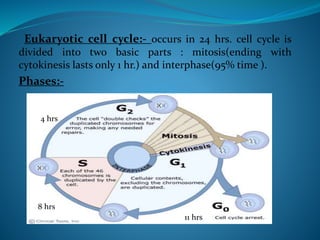
Eukaryotic cell cycle:- occurs in 24 hrs. cell cycle is
divided into two basic parts : mitosis(ending with
cytokinesis lasts only 1 hr.) and interphase(95% time ).
Phases:-
11 hrs
8 hrs
4 hrs
Regulation of cell cycle :-
1 :- extracellular signals (growth factors) which causes cell
proliferation by activating cell signaling.
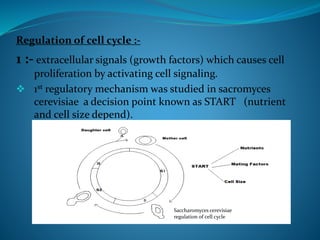
 1st regulatory mechanism was studied in sacromyces
cerevisiae a decision point known as START (nutrient
and cell size depend).
Saccharomyces cerevisiae
regulation of cell cycle
 In animals cell decision point is called a restriction point
depends primarily on appropriate growth factors otherwise
enter to G0 phase (e.g., skin fibroblast and liver cell) .
2:- Cell cycle checkpoints:-
Several checkpoints function to ensure that incomplete or
damaged chromosomes are not replicated and passed on to
daughter cells.
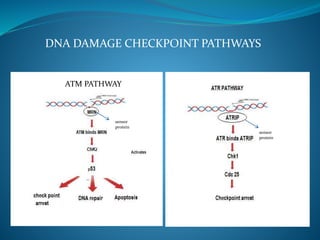
a)DNA damage response signaling pathway:- double and
single stranded breaks in DNA are recognized by two
proteins ATM (Ataxia Telangiectasia Mutated) and ATR
(Ataxia Telangiectasia Rad 3 related) serine threonine
kinases.
 In mammals, (Mre11/Rad50/Nbs1) double stranded
breaks sensors in ATM Pathways and RPA (replication
protein A ) acts as sensor in ATR pathway.
DNA DAMAGE CHECKPOINT PATHWAYS
ATM PATHWAY
sensor
protein
sensor
protein
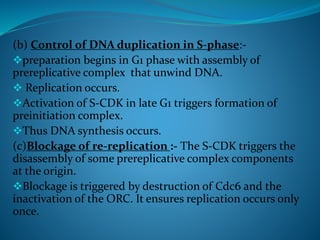
(b) Control of DNA duplication in S-phase:-
preparation begins in G1 phase with assembly of
prereplicative complex that unwind DNA.
 Replication occurs.
Activation of S-CDK in late G1 triggers formation of
preinitiation complex.
Thus DNA synthesis occurs.
(c)Blockage of re-replication :- The S-CDK triggers the
disassembly of some prereplicative complex components
at the origin.
Blockage is triggered by destruction of Cdc6 and the
inactivation of the ORC. It ensures replication occurs only
once.
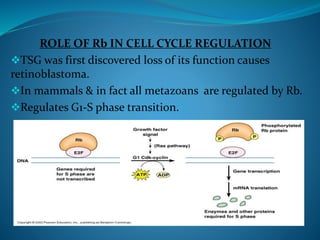
ROLE OF Rb IN CELL CYCLE REGULATION
TSG was first discovered loss of its function causes
retinoblastoma.
In mammals & in fact all metazoans are regulated by Rb.
Regulates G1-S phase transition.
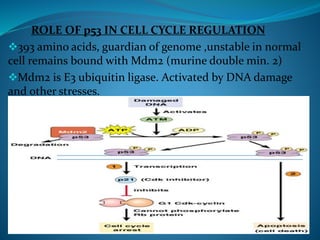
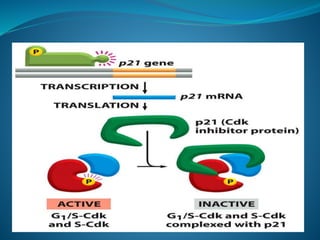
ROLE OF p53 IN CELL CYCLE REGULATION
393 amino acids, guardian of genome ,unstable in normal
cell remains bound with Mdm2 (murine double min. 2)
Mdm2 is E3 ubiquitin ligase. Activated by DNA damage
and other stresses.
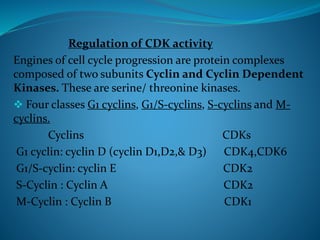
Regulation of CDK activity
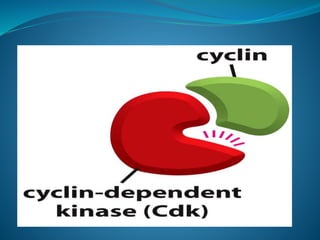
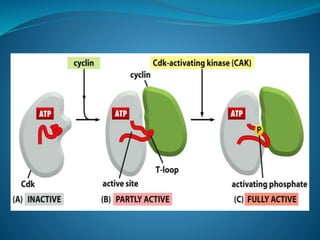
Engines of cell cycle progression are protein complexes
composed of two subunits Cyclin and Cyclin Dependent
Kinases. These are serine/ threonine kinases.
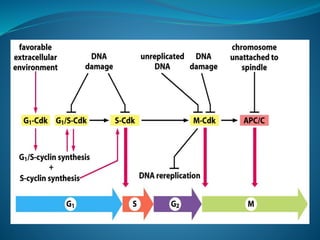
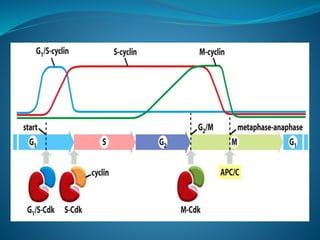
 Four classes G1 cyclins, G1/S-cyclins, S-cyclins and M-
cyclins.
Cyclins CDKs
G1 cyclin: cyclin D (cyclin D1,D2,& D3) CDK4,CDK6
G1/S-cyclin: cyclin E CDK2
S-Cyclin : Cyclin A CDK2
M-Cyclin : Cyclin B CDK1
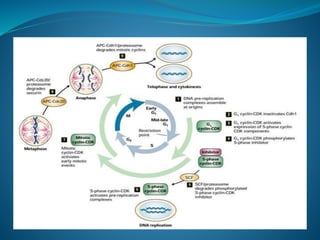
Regulation of activity of cyclin- CDK complex
 Ubiquitin dependent proteolysis.
 Enzyme SCF (E3 ubiquitin ligase) for G1 Phase Cyclins
SCF(Skp1/Cul1/F-box protein) ( its three subunits.)
 Second ubiquitin ligase (APC/C) anaphase promoting
complex / cyclosome for S and M-Phase Cyclin destruction.
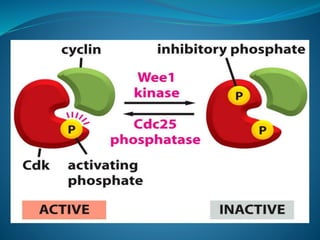
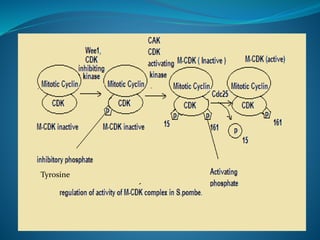
 Inhibitory protein kinase Wee1 phosphorylates an inhibitory
tyrosine residue at 15th position in CDK subunit. Wee1 inhibits
the entry into the M-phase when cell size is not adequate.
Cdc25 removes it.
 CDK inhibitors also regulate there function . All euk…
harbor CDK,s regulate S-phase and M-CDKs E.g.. INK4s for
CDK4&6 they bind them and block there binding with cyclins.
Tyrosine
ENTRY INTO MITOSIS
Process that partitions chromosomes equally into two
daughter cells.
ACTIVATION OF MITOTIC CDKs
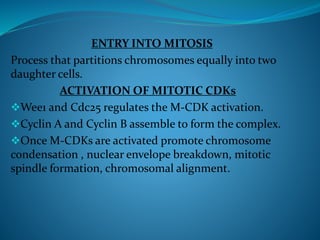
Wee1 and Cdc25 regulates the M-CDK activation.
Cyclin A and Cyclin B assemble to form the complex.
Once M-CDKs are activated promote chromosome
condensation , nuclear envelope breakdown, mitotic
spindle formation, chromosomal alignment.
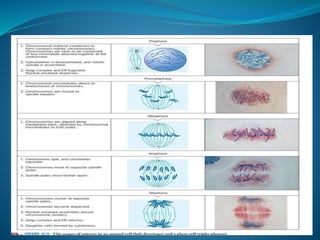
STAGES OF MITOSIS
Karyokinesis or mitosis and cytokinesis
PROPHASE
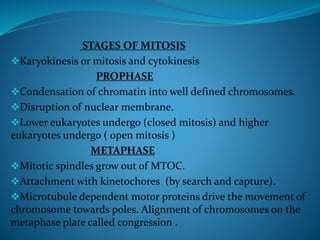
Condensation of chromatin into well defined chromosomes.
Disruption of nuclear membrane.
Lower eukaryotes undergo (closed mitosis) and higher
eukaryotes undergo ( open mitosis )
METAPHASE
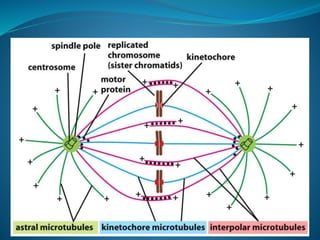
Mitotic spindles grow out of MTOC.
Attachment with kinetochores (by search and capture).
Microtubule dependent motor proteins drive the movement of
chromosome towards poles. Alignment of chromosomes on the
metaphase plate called congression .
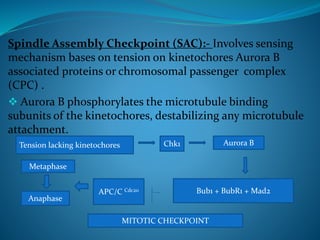
Spindle Assembly Checkpoint (SAC):- Involves sensing
mechanism bases on tension on kinetochores Aurora B
associated proteins or chromosomal passenger complex
(CPC) .
 Aurora B phosphorylates the microtubule binding
subunits of the kinetochores, destabilizing any microtubule
attachment.
Tension lacking kinetochores Chk1 Aurora B
Bub1 + BubR1 + Mad2APC/C Cdc20
Metaphase
Anaphase
MITOTIC CHECKPOINT
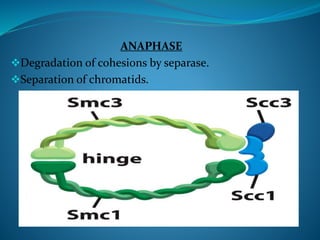
ANAPHASE
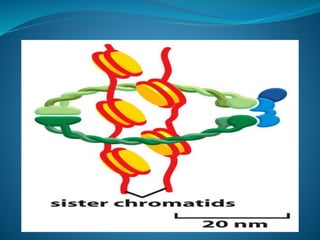
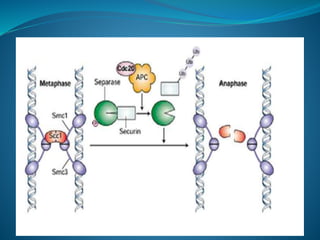
Degradation of cohesions by separase.
Separation of chromatids.
TELOPHASE
Separated chromosomes arrive at the poles and
microtubules disappear.
Nuclear envelope re-forms,
chromosomes expand, mitosis end.
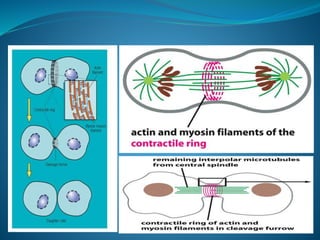
CYTOKINESIS
Douglas Marsland in 1950’s proposed this theory.
Contractile Ring Theory.
Contractile proteins assembled at
center by G protein Rho in GTP bound
state.
Cell cycle
Cell cycle
Cell cycle
Cell cycle

Cell cycle

  • 1.
    CLINICAL BIOCHEMISTRY MOHAMMAD AMIN ROLLNO:- 17 → Cell cycle. →check points. →Regulation of cell cycle ameendelina@gmail.com
  • 2.
    Eukaryotic cell cycle:-occurs in 24 hrs. cell cycle is divided into two basic parts : mitosis(ending with cytokinesis lasts only 1 hr.) and interphase(95% time ). Phases:- 11 hrs 8 hrs 4 hrs
  • 3.
    Regulation of cellcycle :- 1 :- extracellular signals (growth factors) which causes cell proliferation by activating cell signaling.  1st regulatory mechanism was studied in sacromyces cerevisiae a decision point known as START (nutrient and cell size depend). Saccharomyces cerevisiae regulation of cell cycle
  • 4.
     In animalscell decision point is called a restriction point depends primarily on appropriate growth factors otherwise enter to G0 phase (e.g., skin fibroblast and liver cell) . 2:- Cell cycle checkpoints:- Several checkpoints function to ensure that incomplete or damaged chromosomes are not replicated and passed on to daughter cells. a)DNA damage response signaling pathway:- double and single stranded breaks in DNA are recognized by two proteins ATM (Ataxia Telangiectasia Mutated) and ATR (Ataxia Telangiectasia Rad 3 related) serine threonine kinases.  In mammals, (Mre11/Rad50/Nbs1) double stranded breaks sensors in ATM Pathways and RPA (replication protein A ) acts as sensor in ATR pathway.
  • 5.
    DNA DAMAGE CHECKPOINTPATHWAYS ATM PATHWAY sensor protein sensor protein
  • 6.
    (b) Control ofDNA duplication in S-phase:- preparation begins in G1 phase with assembly of prereplicative complex that unwind DNA.  Replication occurs. Activation of S-CDK in late G1 triggers formation of preinitiation complex. Thus DNA synthesis occurs. (c)Blockage of re-replication :- The S-CDK triggers the disassembly of some prereplicative complex components at the origin. Blockage is triggered by destruction of Cdc6 and the inactivation of the ORC. It ensures replication occurs only once.
  • 8.
    ROLE OF RbIN CELL CYCLE REGULATION TSG was first discovered loss of its function causes retinoblastoma. In mammals & in fact all metazoans are regulated by Rb. Regulates G1-S phase transition.
  • 9.
    ROLE OF p53IN CELL CYCLE REGULATION 393 amino acids, guardian of genome ,unstable in normal cell remains bound with Mdm2 (murine double min. 2) Mdm2 is E3 ubiquitin ligase. Activated by DNA damage and other stresses.
  • 11.
    Regulation of CDKactivity Engines of cell cycle progression are protein complexes composed of two subunits Cyclin and Cyclin Dependent Kinases. These are serine/ threonine kinases.  Four classes G1 cyclins, G1/S-cyclins, S-cyclins and M- cyclins. Cyclins CDKs G1 cyclin: cyclin D (cyclin D1,D2,& D3) CDK4,CDK6 G1/S-cyclin: cyclin E CDK2 S-Cyclin : Cyclin A CDK2 M-Cyclin : Cyclin B CDK1
  • 15.
    Regulation of activityof cyclin- CDK complex  Ubiquitin dependent proteolysis.  Enzyme SCF (E3 ubiquitin ligase) for G1 Phase Cyclins SCF(Skp1/Cul1/F-box protein) ( its three subunits.)  Second ubiquitin ligase (APC/C) anaphase promoting complex / cyclosome for S and M-Phase Cyclin destruction.  Inhibitory protein kinase Wee1 phosphorylates an inhibitory tyrosine residue at 15th position in CDK subunit. Wee1 inhibits the entry into the M-phase when cell size is not adequate. Cdc25 removes it.  CDK inhibitors also regulate there function . All euk… harbor CDK,s regulate S-phase and M-CDKs E.g.. INK4s for CDK4&6 they bind them and block there binding with cyclins.
  • 17.
  • 18.
    ENTRY INTO MITOSIS Processthat partitions chromosomes equally into two daughter cells. ACTIVATION OF MITOTIC CDKs Wee1 and Cdc25 regulates the M-CDK activation. Cyclin A and Cyclin B assemble to form the complex. Once M-CDKs are activated promote chromosome condensation , nuclear envelope breakdown, mitotic spindle formation, chromosomal alignment.
  • 19.
    STAGES OF MITOSIS Karyokinesisor mitosis and cytokinesis PROPHASE Condensation of chromatin into well defined chromosomes. Disruption of nuclear membrane. Lower eukaryotes undergo (closed mitosis) and higher eukaryotes undergo ( open mitosis ) METAPHASE Mitotic spindles grow out of MTOC. Attachment with kinetochores (by search and capture). Microtubule dependent motor proteins drive the movement of chromosome towards poles. Alignment of chromosomes on the metaphase plate called congression .
  • 21.
    Spindle Assembly Checkpoint(SAC):- Involves sensing mechanism bases on tension on kinetochores Aurora B associated proteins or chromosomal passenger complex (CPC) .  Aurora B phosphorylates the microtubule binding subunits of the kinetochores, destabilizing any microtubule attachment. Tension lacking kinetochores Chk1 Aurora B Bub1 + BubR1 + Mad2APC/C Cdc20 Metaphase Anaphase MITOTIC CHECKPOINT
  • 22.
    ANAPHASE Degradation of cohesionsby separase. Separation of chromatids.
  • 25.
    TELOPHASE Separated chromosomes arriveat the poles and microtubules disappear. Nuclear envelope re-forms, chromosomes expand, mitosis end. CYTOKINESIS Douglas Marsland in 1950’s proposed this theory. Contractile Ring Theory. Contractile proteins assembled at center by G protein Rho in GTP bound state.