Cell Biology
Umang Jagani
 Cell Structure and Organelles
 Cell Molecular Components
 Water and Chemical properties
 Cell Membrane
 Osmotic Properties of cells
 Cell molecule transportation
Outline
 All organisms are made of cells or aggregates of
cells.
 Cells vary in their shape, size and functions. Based
on the presence or absence of a membrane
bound nucleus and other organelles, cells can be
named as Prokaryotic or Eukaryotic. Cell is the
fundamental structural and functional unit of all
living organisms.
 Anton Von Leeuwenhoek first observed and
described a liver cell.
 Robert Brown later discovered the nucleus.
CELL - THE UNIT OF LIFE
 Cell theory – Schleiden and Schwann ( later Virchow)
 All living organism are made of cells and their
products.
 All cells arise from pre – existing cells.
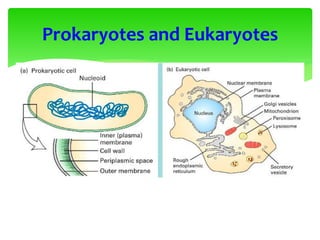
Prokaryotes and Eukaryotes
 Bacteria, Blue-green algae, Mycoplasma, PPLP
(Pleuro Pneumonia Like Organisms. Glycocalyx,
cell wall, plasma membrane
 Based on staining property gram + and gram –ve
bacteria.
 Mesosome, chromatophores (extension of
plasma membrane)
 Motile, non motile,
 Flagellum- three parts are – filament. Hook, and
basal body
Prokaryotic cell :
 Pili, fimbriae – surface structure do not play a role
in motility but helps in attachment
 Ribosomes and inclusion bodies.
 Ribosomes. 15-20 nm, 2 sub – units 50S and 30S-
together form 70S. – help in Protein synthesis –
polysomes / polyribosomes on m RNA
 Inclusion bodies. Reserve materials: Phosphate
granules, Cyanophycean , Glycogen granules, Gas
vacuoles
 Protists, Fungi, Plant cell and animal cell. Cell
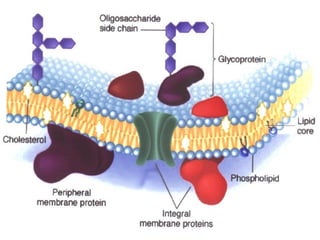
membrane – fluid mosaic model by Singer &
Nicholson (1972) - bilipid layer of phospholipids with
two types of membrane proteins called peripheral
protein and integral proteins with cholestral,
glycolipids and glycoproteins.
Eukaryotic cell
 It gives shape, mechanical support, cell-to-cell interaction –
made of cellulose, hemicelluloses, pectins (in plants) and
cellulose, galactans, mannans, calcium carbonate (in
algae).
 Primary cell wall – in young plant cell, capable of growing
till cell matures
 Secondary cell wall – formed on the inner side of the cell.
 Middle lamellae – calcium pectate
 The cell wall middle lamellae may be traversed by
plasmodesmata which connect the cytoplasm of
neighbouring cells.
Cell wall
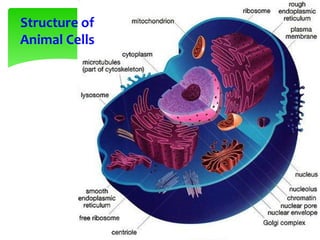
Structure of
Animal Cells
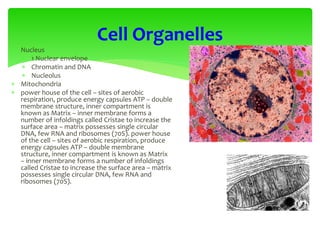
 Nucleus
 1 Nuclear envelope
 Chromatin and DNA
 Nucleolus
 Mitochondria
 power house of the cell – sites of aerobic
respiration, produce energy capsules ATP – double
membrane structure, inner compartment is
known as Matrix – inner membrane forms a
number of infoldings called Cristae to increase the
surface area – matrix possesses single circular
DNA, few RNA and ribosomes (70S). power house
of the cell – sites of aerobic respiration, produce
energy capsules ATP – double membrane
structure, inner compartment is known as Matrix
– inner membrane forms a number of infoldings
called Cristae to increase the surface area – matrix
possesses single circular DNA, few RNA and
ribosomes (70S).
Cell Organelles
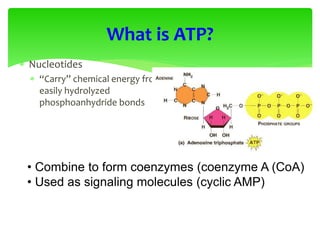
 Nucleotides
 “Carry” chemical energy from
easily hydrolyzed
phosphoanhydride bonds
What is ATP?
• Combine to form coenzymes (coenzyme A (CoA)
• Used as signaling molecules (cyclic AMP)
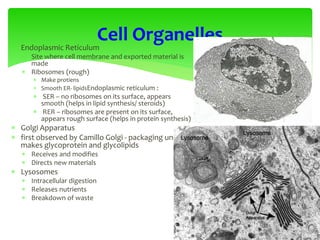
 Endoplasmic Reticulum
 Site where cell membrane and exported material is
made
 Ribosomes (rough)
 Make protiens
 Smooth ER- lipidsEndoplasmic reticulum :
 SER – no ribosomes on its surface, appears
smooth (helps in lipid synthesis/ steroids)
 RER – ribosomes are present on its surface,
appears rough surface (helps in protein synthesis)
 Golgi Apparatus
 first observed by Camillo Golgi - packaging unit -
makes glycoprotein and glycolipids
 Receives and modifies
 Directs new materials
 Lysosomes
 Intracellular digestion
 Releases nutrients
 Breakdown of waste
Cell Organelles
 Vacoule- tonoplast is vacuole membrane - contractile
vacuole (for excretion) – food vacuole (engulfing).
 Peroxisomes
 Hydrogen Peroxide generated and degraded
 Cytosol
 Water based gel
 Chemical reactions
 Cytoskeleton
 Filaments (actin, intermediate and microtubules)
 Movement of organelles and cell
 Structure/strengthen cell
 Vessicles
 Material transport
 Membrane, ER, Golgi derived vessicles
Cell Organelles
 Plastids – chloroplast, chromoplast and leucoplasts -
Leucoplasts - amyloplasts, (starch); Elaioplasts (oil/fat);
Aleuroplasts (proteins).
 Ribosomes (George Palade) - Composed of RNA and proteins -
Eukaryotic ribosomes are 80 S ‘S’ stand for the sedimentation
coefficient (Svedbergs unit) - Site of protein synthesis.
 Cilia and flagella: Core is called axoneme - has 9
pairs of doublets of microtubules on peripheral
and one pair in the centre 9+2 array emerged
from centriole like structure called the Basal
bodies.
 Centrosome and centrioles: Centrosome contains
2 centrioles - Each centriole has a cart wheel like
organization with 9 evenly spaced microtubule -
triplets connected to central hub by radial spokes
– produces spindle apparatus dueing cell division
 Nucleus ( Robert brown, 1831) : Chromatin named by
Flemming.
 Nucleoli – active ribosomal RNA synthesis Nucleoplasm –
nucleolus + chromatin
 Nuclear membrane – with perinuclear space
 Chromosome – DNA + histone proteins
 Centromere –primary constriction – disc is known as
kinetochores
 No nucleus in erythrocytes (RBC) of mammals and sieve
tube cells in vascular plants
 Based on the position of centromere
 Metacentric, sub-metacentric, acrocentric, telocentric
 Microbodies: Minute vesicles containing various
enzyme (in plant and animal cell).
 Living cells are composed of both organic and
inorganic components. How to analyse chemical
composition: For organic compounds:
 Living tissue + trichloro acetic acid and grind it to
form slurry. Filter the slurry to obtain 2 fractions like
Filtrate/ acid soluble and Retentate/ acid insoluble
BIOMOLECULES
 For inorganic compounds: Sample of tissue should be
burnt to obtain ash and different kinds of inorganic
compounds were identified.
Micro molecules and Macro molecules
 Micro molecules are known as monomers
Macromolecules are known as polymers
Types of biomolecules -
 Cytoskeleton: Network of filaments proteinaceous structures
in the cytoplasm - made up of microtubules and micro
philaments. Functions:- Mechanical support, motility,
maintenance of the shape of the cell.
 These are biomolecules in living cells metabolites.
Primary metabolites are those which have identifiable
functions and play specific roles in normal
physiological processes. Eg. Amino acids, nitrogenous
bases, proteins and nucleic acid
Primary and Secondary metabolites
 Secondary metabolites are product of certain
metabolic pathways from primary metabolites.
 Pigments – anthocyanin, carotenoids
 Drugs – vinblastin, curcumin
 Alkaloids - morphine, codeine
 Essential oils – lemon grass oil
 Polymeric compounds - rubber gum, cellulose, resins
 It is molecules with weight greater than 1000 dalton
found in acid insoluble fraction. Eg- polysaccharides,
nucleic acid, proteins and lipids
Biomacromolecules
 Long chain of polymers of monosaccharides – 2
types of Mono-polysaccharides (cellulose, starch
– made of only Glucose monomers).
 Heteropolymer – chitin
 Inulin -is a polymer of fructose
 Glycogen – polymer of glucose in animal tissues
Monosaccharides are joined by Glycosidic acid
bond, right end is reducing and left end is non
reducing
Polysaccharides
 Starch forms helical secondary structures. Starch
can hold Iodine molecules in helical portion and
form blue colour. But Cellulose does not contain
complex helices and cannot hold iodine.
 Complex polysaccharide: .Plant cell wall
(cellulose ), Paper (plant pulp ), Cotton, Fibre
(cellulose) Exoskeleton of animals, building
blocks, amino-sugars and chemically modified
Sugars like, Eg. – Giucosamine (N – acetyl
galactosamine).
 DNA – Polynucleotide chain, double stranded (deoxy
ribose sugar) – nitrogenous bases are A, G, C and T
 RNA – single stranded Polymer of ribo-nucleotides
(ribose sugar) – A, G, C and
 Nucleotides – nitrogenous base + pentose sugar +
phosphate group
Nucleic acids:
 Nucleoside – nitrogenous base + pentose sugar
 Nitrogenous bases 1. Adenine (A) 2. Guanine(G) 3.
Cytosine( C ) 4. Thymine (T) Phospho-diester bonds –
covalent bond formed between nucleotides.
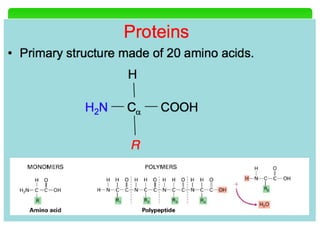
 Polymer of amino acids (peptide bonds) 1.
Primary structure – linear chain of aminoacids
linked by peptide bonds – non functional.
 2. Secondary structure – alpha-helix or beta-
pleated structure with peptide and hydrogen
bonds.
 3. Tertiary structure – long chain of coiled
structure with peptide, hydrogen, disulphide and
ionic bonds – functional structurte of protein.
 4. Quaternary structure – group of more than two
tertiary structured proteins (eg- haemoglobin –
made of two alpha and two beta chains)
Proteins:
 1. Amino acids are linked by Peptide bonds
 2. Monosaccharides are linked by Glycosidic bond
 3. Nucleotides are linked by Phosphodiester bond
between 3-C of one nucleotide with 5-C of another -
Each helix of DNA contains 10 base pairs with the
length of 3.4 nm (34
Nature of bonds linking monomers in a
polymer
 Concept of Metabolism:
 Biomolecules have turn over (because constantly
changing from one form to another)
 Chemical reactions are called metabolism.
Examples: Amino acids can be formed by the
removal of amino group in a nucleotide base.
 Hydrolysis of disaccharides – 2 monosacharides
 Linked chemical reactions are called Metabolic
pathways, it is a catalysed reaction by enzymes.
 Anabolic pathways - making / constructing big
molecules from micromolecules (eg –
photosynthesis)
 Catabolic pathways – breaking down of big
molecules in to smaller ones (eg – respiration)
 For both ATP is required (energy currency)
Metabolic pathways in living system
 The living state
 Blood glucose – should be 4.5 -5.0mM
 Hormones – in nanograms/mL
 System at equilibrium cannot perform work
 As living organisms work constantly, it is non
equilibrium.
 Hence the living state is non equilibrium steady state
to be able to perform work.
 Enzyme – helps in chemical reactions
 Inorganic reaction :- Ba(OH)2 + H2SO4 --> BaSO4 + 2
H2O – No enzyme used.
 Organic reaction - Enzyme used
 Carbonic anhydrase – fastest enzyme - without
enzyme 200 molecules / hr - with enzyme 600,000
molecules / sec.
 Activation energy is the energy needed to do work.
Enzymes Vs Catalysts:
 Nature of enzyme action:
 Enzyme + Substrate --> ES complex --> Enzyme +
Product
 ENZYME
 It is produced by living cells and made of protein.
 It can work well at optimum temperature of 40o
C..
 It reduces the activation energy.
CATALYST
 It is chemical substances and help in chemical
reactions
 It can work even at 80 – 90o C
 It requires different level of energy.
 1. All enzymes are proteins, but all proteins are not
enzymes. 2. Enzymes are specific with their substrates
as their active sites are different for different
substrates. 3. Enzymes are of 2 types 1. Builders. 2.
Breakers 4. Enzyme does not get used up during the
reaction, as it does not change its shape – hence less
enzymes are required.
Properties of Enzymes:
 Denaturation: The enzyme changes its shape and the
substrate cannot bind with the enzyme - affect
tertiary structure of the protein.
 Factors affecting enzyme activity:
 Effect of temperature: temperature at which the enzyme gives its
maximum rate of reaction is known as optimum temperature (40o C).
 Effect of pH - different enzymes work at different pH, for example,
enzyme pepsin works at pH 2, and enzyme amylase at pH 7, it is called
optimum pH.
 Substrate concentration - Enzyme inhibition – enzyme action can be
inhibited by other chemical molecules called inhibitors. Competitive
inhibition: Inhibitor chemical molecule resembles the structure of
substrate and bind with the active site of enzyme instead of substrate,
hence there is no production of products.
 Eg. Inhibition of Succinic dehydrogenase by Malonate (inhibitor), which
resembles the substrate Succinate in structure.
 All enzymes are proteins but all proteins are not enzymes. Eg.
Heamoglobin is a protein but not an enzyme.
 Enzymes at low temperature become inactive, enzymes at high
temperature denatures
 Based on type of reaction they classified into 6
classes.
 1. Dehydrogenases/ oxidoreductases - S reduced +
S’ oxidized ------ S oxidized + S’ reduced 2.
Transferases - S-G + S’------- S+S’-G 3. Hydrolases -
Hydrolysis of ester ether, peptide and glycoside C –
C , C- halides , P-N bonds 4. Lyases - Removal of
group from substrates other than hydrolysis ( from
double bond ) X Y l l C C ------ X-Y+C =C 5. Isomerases
- Inter-conversion of optical geometrical or
positional isomers. 6. Ligases – linking two
compounds. C-O, C-S, C-N, P-O
Classification and nomenclature of
enzymes:
 It is a non – protein part, makes enzyme more active –
protein part is called Apoenzyme.
 There are 3 kinds of factors: 1. Prosthetic group - tightly
bound with apoenzyme. Eg. Peroxidase, Catalases. 2. Co-
enzyme – bound transient form. Eg. NAD, NADP
(Nicotinamide Adenine Dinucleotide Phosphate) 3. Metal
ions - Form coordination bonds. Eg. Fe, Zn.
Co-factors
 Cell cycle It is a series of events that takes
place in a cell, leading to the formation of two
daughter cells from a single mother cell. Cell
cycle is divided into two basic phases:
 Interphase and M phase Phases of cell cycle.
 Interphase
 M phase (mitosis phase) karyokinesis and
cytokinesis
CELL CYCLE AND CELL DIVISION
 Interphase
 G1 phase
 S phase
 G2 phase
 Go phase-quiescent stage
 Mitotic phase
 Karyokinesis (nuclear division): – Prophase,
Metaphase, Anaphase and Telophase.
 Cytokinesis (division of cytoplasm)
 Interphase involves a series of changes that prepares the
cell for division. It involves the period of cell growth and
cell division in an orderly manner. It is divided into three
phases:
 G1 phase – It involves growth of cell and preparation of
DNA for replication.
 S phase – It involves DNA synthesis. The amount of DNA
doubles, but the chromosome number remains the same.
 G2 phase – It involves protein synthesis and further
growth of cell, which prepares it for division.
 G0 phase or Quiescent phase – It is the stage when
metabolically active cell remains quiescent for long period
of time.
Interphase
 It is a process of cell division where chromosomes
replicate and get equally distributed into two
daughter cells. Hence, it is also called equational
division.
 The process of mitosis keeps the chromosome
number equal in daughter as well as parental cell.
 Mitosis usually takes place in somatic cells.
I Mitosis
 Prophase . It involves initiation and condensation
of chromosomes.
 Nucleolus and nuclear membrane disappears.
Metaphase
 Chromosomal material condenses to form
compact chromosomes that get aligned in the
middle of nucleus at equatorial plate.
 Anaphase -Centromere splits and chromosomes
move apart towards two opposite poles due to
shortening of spindle fibres.
Mitosis involves four stages:
 Telophase Chromosomes finally reach their
respective poles.
 Nuclear envelope assembles around each
chromosome clusters.
 Nucleolus and other organelles reform.
 Karyokinesis is the division of nucleus during mitosis or
meiosis which is followed by cytokinesis.
 Cytokinesis involves the division of cytoplasm of a cell.
 Cytokinesis is achieved in animal cell by cleavage, which
deepens and divides the cell into two.
 It is achieved in plant cell by cell plate formation.
 When karyokinesis is not followed by cytokinesis, a
multinucleated condition arises. This is called Syncytium.
Karyokinesis and Cytokinesis
 Results in formation of diploid genetically identical daughter
cells
 Growth of the body takes place by mitosis.
 Cell repair and replacement of worn out tissues
 Maintenance of nucleo-cytoplasmic ratio Vegetative
reproduction in plants takes place by mitosis.
Significance of mitosis
 It is the process which involves the reduction in the
amount of genetic material.
 It mainly occurs in germ cells.
 At the end of meiosis II, four haploid cells are
formed.
 It is comprised of two successive nuclear and cell
division with a single cycle of DNA replication.
 The phases of meiosis are as shown below
II Meiosis
 1. Prophase I – It comprises of 5 stages: i. Leptotene
 Chromosomes start condensing.
ii. Zygotene
 Pairing of chromosomes called synapsis occurs.
 A pair of synapsed homologous chromosomes is
called bivalent or tetrad.
Meiosis I
 iii. Pachytene
 Exchange of genetic material (crossing over)
between non-sister chromatids occurs.
 Chiasmata formation iv. Diplotene
 Bivalents formed during pachytene separate from
each other (except at chiasmata) due to dissolution
of synaptonemal complex.
 v. Diakinesis
 Terminalisation of chiasmata can be observed.
 By the end of this stage, the nucleolus disappears and the
nuclear envelope breaks.
 2. Metaphase I Bivalents (tetrad) get aligned along
metaphase plate through spindle fibres.
 3. Anaphase I Homologous chromosomes separate while
chromatids remain attached at their centromere.
 4. Telophase Nucleolus and nuclear membrane reappear
around chromosome clusters at each pole. Inter-kinesis –
It is the stage between two meiotic divisions.
 1. Prophase II Chromosomes become compact. Nuclear
membrane disappears.
 2. Metaphase II Chromosomes align at the equator.
Kinetochores of sister chromatids attach to spindle fibres
at each pole.
 3. Anaphase II Chromatids separate by splitting of
centromere. As a result, chromatids move towards their
respective poles in the cell.
 4. Telophase II Nuclear envelope and nucleolus reform
around the chromosome clusters.
 Cytokinesis: After meiosis II, the process of cytokinesis
results in the formation of four haploid cells.
Meiosis II
 Significance of meiosis:
 It results in reduction of chromosome number by
half in gametes, which again doubles during
fertilization. Therefore, it helps to conserve the
chromosome number of species from generation
to generation.
 Crossing-over, occurring in pachytene stage of
meiosis I, is a source of genetic variation in
sexually reproducing organisms.
 The variation thus formed helps in evolution.
 MITOSIS 1.
 It occurs in Somatic cells.
 It gives 2 daughter cells.
 Cells formed are diploid (2n). During Metaphase, chromosomes are not lined in pair.
 During Prophase no recombination takes place.
 During Anaphase, centromere splits and chromatids move towards opposite poles.
 It takes very short duration..
 Only one division occurs and forms two diploid daughter cells.
 MEIOSIS
 It occurs in Sex cells.
 It gives 4 gametes
 Cells formed are haploid (n) 4
 During Metaphase I, homologous chromosomes are lined up in pairs
 During Prophase I, recombination / crossing over occur between homologous
chromosomes.
 During Anaphase I, homologous chromosomes separate and Anaphase II, centromere
splits and chromatids move towards opposite poles.
 It takes very long duration
 Two divisions occur and form 4 haploid cells
Differences between Mitosis and Meiosis:
 Proteins
 Carbohydrates
 Lipids
 Nucleic acids
Organic Molecules of Cells
 Most diverse and complex macromolecules in the cell
 Used for structure, function and information
 Made of linearly arranged amino acid residues
 “folded” up with “active” regions
Proteins
1) Enzymes – catalyzes covalent bond breakage or formation
2) Structural – collagen, elastin, keratin, etc.
3) Motility – actin, myosin, tubulin, etc.
4) Regulatory – bind to DNA to switch genes on or off
5) Storage – ovalbumin, casein, etc.
6) Hormonal – insulin, nerve growth factor (NGF), etc.
7) Receptors – hormone and neurotransmitter receptors
8) Transport – carries small molecules or irons
9) Special purpose proteins – green fluorescent protein, etc.
Types of Proteins
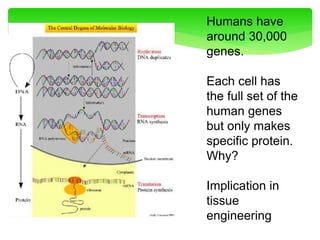
Humans have
around 30,000
genes.
Each cell has
the full set of the
human genes
but only makes
specific protein.
Why?
Implication in
tissue
engineering
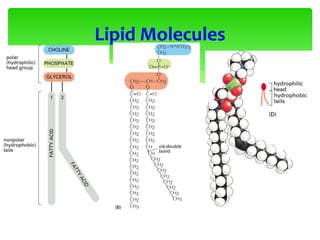
 Hydrophobic molecules
 Energy storage, membrane components, signal molecules
 Triglycerides (fat), phospholipids, waxes, sterols
Lipids
• Sugars, storage (glycogen, starch), Structural
polymers (cellulose and chitin)
• Major substrates of energy metabolism
Carbohydrates
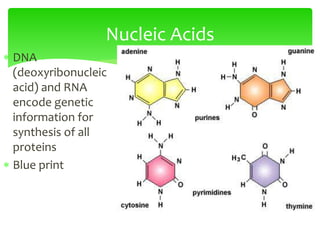
 DNA
(deoxyribonucleic
acid) and RNA
encode genetic
information for
synthesis of all
proteins
 Blue print
Nucleic Acids
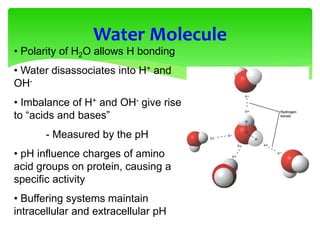
Water Molecule
• Polarity of H2O allows H bonding
• Water disassociates into H+ and
OH-
• Imbalance of H+ and OH- give rise
to “acids and bases”
- Measured by the pH
• pH influence charges of amino
acid groups on protein, causing a
specific activity
• Buffering systems maintain
intracellular and extracellular pH
 Hydrophobic “Water-fearing”
 Molecule is not polar, cannot form H bonds and is
“repelled” from water
 Insoluble
 Hydrophillic “Water-loving”
 Molecule is polar, forms H bonds with water
 Soluble
Water Molecule
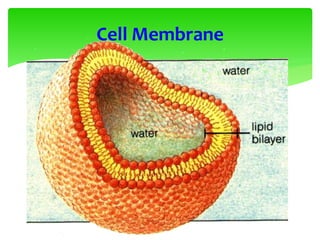
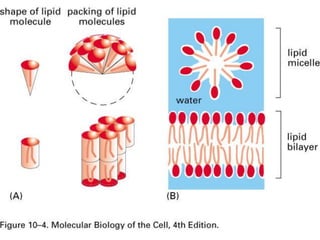
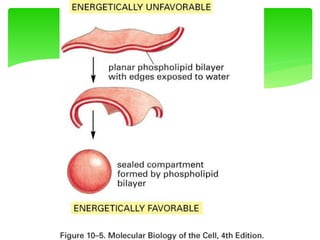
Cell Membrane
 Plasma membrane encloses cell and cell organelles
 Made of hydrophobic and hydrophillic components
 Semi-permeable and fluid-like
 “lipid bilayer”
Cell Membrane Composition
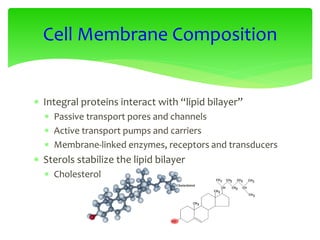
 Integral proteins interact with “lipid bilayer”
 Passive transport pores and channels
 Active transport pumps and carriers
 Membrane-linked enzymes, receptors and transducers
 Sterols stabilize the lipid bilayer
 Cholesterol
Cell Membrane Composition
Lipid Molecules
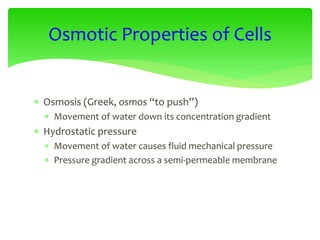
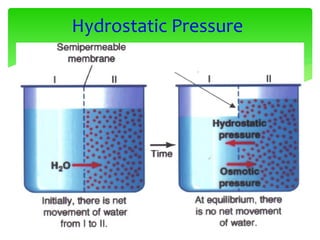
 Osmosis (Greek, osmos “to push”)
 Movement of water down its concentration gradient
 Hydrostatic pressure
 Movement of water causes fluid mechanical pressure
 Pressure gradient across a semi-permeable membrane
Osmotic Properties of Cells
Hydrostatic Pressure
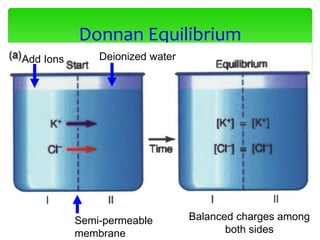
Donnan Equilibrium
Semi-permeable
membrane
Deionized waterAdd Ions
Balanced charges among
both sides
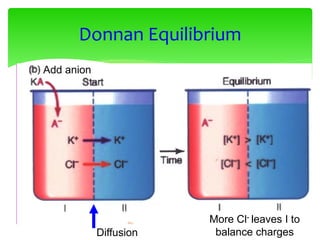
Add anion
More Cl- leaves I to
balance charges
Donnan Equilibrium
Diffusion
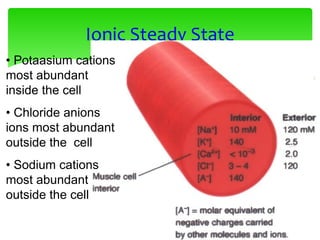
Ionic Steady State
• Potaasium cations
most abundant
inside the cell
• Chloride anions
ions most abundant
outside the cell
• Sodium cations
most abundant
outside the cell
Erythrocyte Cell
Equilibrium
•No osmotic pressure
- cell is in an isotonic solution
- Water does not cross
membrane
•Increased [Osmotic] in cytoplasm
- cell is in an hypotonic solution
- Water enters cell, swelling
•Decreased [Osmotic] in cytoplasm
- cell is in an hypotonic solution
- Water leaves cell, shrinking
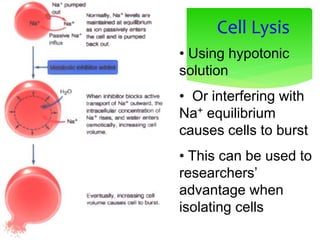
Cell Lysis
• Using hypotonic
solution
• Or interfering with
Na+ equilibrium
causes cells to burst
• This can be used to
researchers’
advantage when
isolating cells
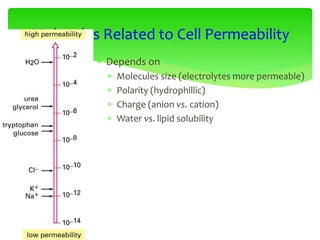
 Depends on
 Molecules size (electrolytes more permeable)
 Polarity (hydrophillic)
 Charge (anion vs. cation)
 Water vs. lipid solubility
Molecules Related to Cell Permeability
 Passive transport is carrier mediated
 Facilitated diffusion
 Solute molecule combines with a “carrier” or
transporter
 Electrochemical gradients determines the direction
 Integral membrane proteins form channels
Cell Permeability
 Simple or passive diffusion
 Passive transport
 Channels or pores
 Facilitated transport
 Assisted by membrane-floating proteins
 Active transport pumps and carriers
 ATP is required
 Enzymes and reactions may be required
Crossing the Membrane
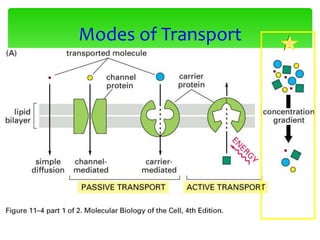
Modes of Transport
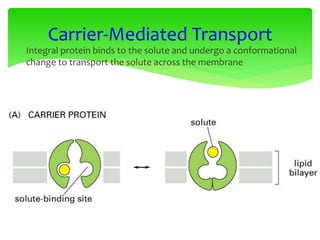
• Integral protein binds to the solute and undergo a conformational
change to transport the solute across the membrane
Carrier-Mediated Transport
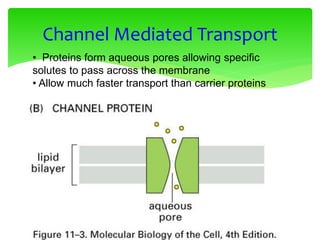
Channel Mediated Transport
• Proteins form aqueous pores allowing specific
solutes to pass across the membrane
• Allow much faster transport than carrier proteins
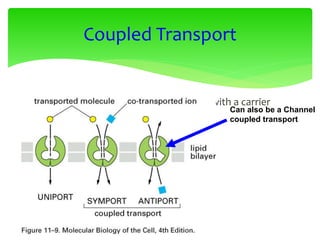
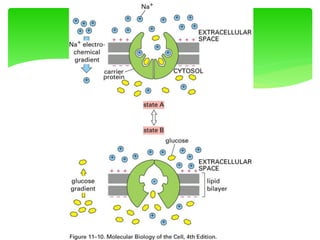
 Some solutes “go along for the ride” with a carrier
protien or an ionophore
Coupled Transport
Can also be a Channel
coupled transport
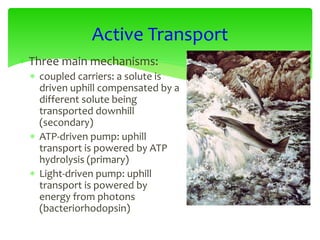
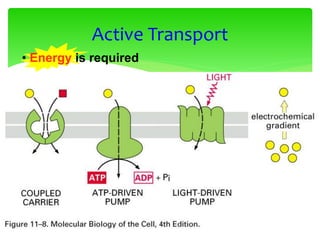
 Three main mechanisms:
 coupled carriers: a solute is
driven uphill compensated by a
different solute being
transported downhill
(secondary)
 ATP-driven pump: uphill
transport is powered by ATP
hydrolysis (primary)
 Light-driven pump: uphill
transport is powered by
energy from photons
(bacteriorhodopsin)
Active Transport
Active Transport
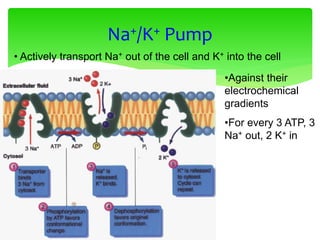
• Energy is required
•Against their
electrochemical
gradients
•For every 3 ATP, 3
Na+ out, 2 K+ in
Na+/K+ Pump
• Actively transport Na+ out of the cell and K+ into the cell
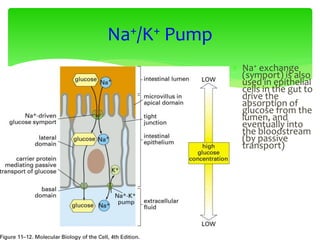
 Na+ exchange
(symport) is also
used in epithelial
cells in the gut to
drive the
absorption of
glucose from the
lumen, and
eventually into
the bloodstream
(by passive
transport)
Na+/K+ Pump
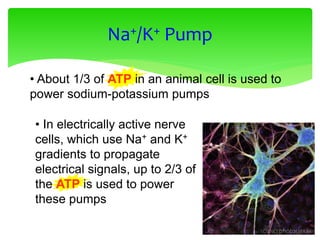
• About 1/3 of ATP in an animal cell is used to
power sodium-potassium pumps
Na+/K+ Pump
• In electrically active nerve
cells, which use Na+ and K+
gradients to propagate
electrical signals, up to 2/3 of
the ATP is used to power
these pumps
 Exocytosis
- membrane vesicle fuses with cell membrane,
releases enclosed material to extracellular space.
 Endocytosis
- cell membrane invaginates, pinches in, creates
vesicle enclosing contents
Endocytosis and Exocytosis
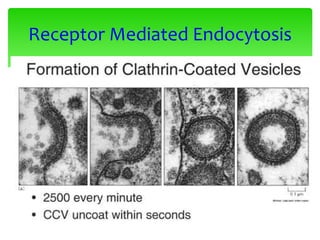
Receptor Mediated Endocytosis
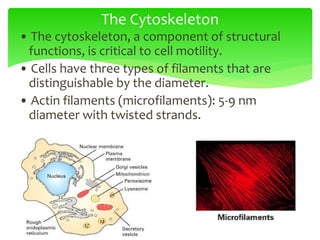
• The cytoskeleton, a component of structural
functions, is critical to cell motility.
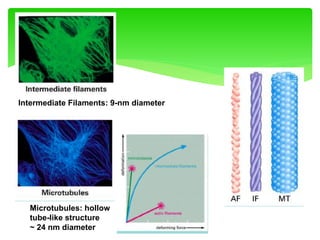
• Cells have three types of filaments that are
distinguishable by the diameter.
• Actin filaments (microfilaments): 5-9 nm
diameter with twisted strands.
The Cytoskeleton
Microtubules: hollow
tube-like structure
~ 24 nm diameter
Intermediate Filaments: 9-nm diameter
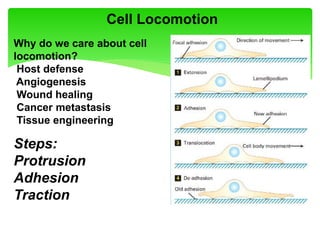
Cell Locomotion
Why do we care about cell
locomotion?
Host defense
Angiogenesis
Wound healing
Cancer metastasis
Tissue engineering
Steps:
Protrusion
Adhesion
Traction
 External signals must dictate the direction of cell
migration.
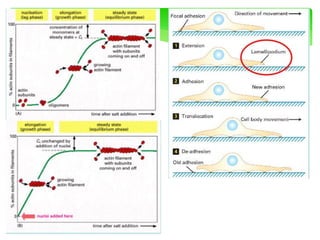
 Cell migration is initiated by the formation of large
membrane protrusion.
 Video microscopy showed that G-actin polymerizes to
F-actin. (Drugs can alter this process).
 Actin exists as a globular monomer (G-actin) and;
A filamentous polymer (F-actin) protein.
 The addition of Mg2+, K+ or Na+ to a solution of G-actin
induces the formation of F-actin and this process is
reversible.
 Elastic mechanical property of actin filament.
 Thank you

Cell biology

  • 1.
  • 2.
     Cell Structureand Organelles  Cell Molecular Components  Water and Chemical properties  Cell Membrane  Osmotic Properties of cells  Cell molecule transportation Outline
  • 3.
     All organismsare made of cells or aggregates of cells.  Cells vary in their shape, size and functions. Based on the presence or absence of a membrane bound nucleus and other organelles, cells can be named as Prokaryotic or Eukaryotic. Cell is the fundamental structural and functional unit of all living organisms.  Anton Von Leeuwenhoek first observed and described a liver cell.  Robert Brown later discovered the nucleus. CELL - THE UNIT OF LIFE
  • 4.
     Cell theory– Schleiden and Schwann ( later Virchow)  All living organism are made of cells and their products.  All cells arise from pre – existing cells.
  • 5.
  • 6.
     Bacteria, Blue-greenalgae, Mycoplasma, PPLP (Pleuro Pneumonia Like Organisms. Glycocalyx, cell wall, plasma membrane  Based on staining property gram + and gram –ve bacteria.  Mesosome, chromatophores (extension of plasma membrane)  Motile, non motile,  Flagellum- three parts are – filament. Hook, and basal body Prokaryotic cell :
  • 7.
     Pili, fimbriae– surface structure do not play a role in motility but helps in attachment  Ribosomes and inclusion bodies.  Ribosomes. 15-20 nm, 2 sub – units 50S and 30S- together form 70S. – help in Protein synthesis – polysomes / polyribosomes on m RNA  Inclusion bodies. Reserve materials: Phosphate granules, Cyanophycean , Glycogen granules, Gas vacuoles
  • 8.
     Protists, Fungi,Plant cell and animal cell. Cell membrane – fluid mosaic model by Singer & Nicholson (1972) - bilipid layer of phospholipids with two types of membrane proteins called peripheral protein and integral proteins with cholestral, glycolipids and glycoproteins. Eukaryotic cell
  • 9.
     It givesshape, mechanical support, cell-to-cell interaction – made of cellulose, hemicelluloses, pectins (in plants) and cellulose, galactans, mannans, calcium carbonate (in algae).  Primary cell wall – in young plant cell, capable of growing till cell matures  Secondary cell wall – formed on the inner side of the cell.  Middle lamellae – calcium pectate  The cell wall middle lamellae may be traversed by plasmodesmata which connect the cytoplasm of neighbouring cells. Cell wall
  • 10.
  • 11.
     Nucleus  1Nuclear envelope  Chromatin and DNA  Nucleolus  Mitochondria  power house of the cell – sites of aerobic respiration, produce energy capsules ATP – double membrane structure, inner compartment is known as Matrix – inner membrane forms a number of infoldings called Cristae to increase the surface area – matrix possesses single circular DNA, few RNA and ribosomes (70S). power house of the cell – sites of aerobic respiration, produce energy capsules ATP – double membrane structure, inner compartment is known as Matrix – inner membrane forms a number of infoldings called Cristae to increase the surface area – matrix possesses single circular DNA, few RNA and ribosomes (70S). Cell Organelles
  • 12.
     Nucleotides  “Carry”chemical energy from easily hydrolyzed phosphoanhydride bonds What is ATP? • Combine to form coenzymes (coenzyme A (CoA) • Used as signaling molecules (cyclic AMP)
  • 13.
     Endoplasmic Reticulum Site where cell membrane and exported material is made  Ribosomes (rough)  Make protiens  Smooth ER- lipidsEndoplasmic reticulum :  SER – no ribosomes on its surface, appears smooth (helps in lipid synthesis/ steroids)  RER – ribosomes are present on its surface, appears rough surface (helps in protein synthesis)  Golgi Apparatus  first observed by Camillo Golgi - packaging unit - makes glycoprotein and glycolipids  Receives and modifies  Directs new materials  Lysosomes  Intracellular digestion  Releases nutrients  Breakdown of waste Cell Organelles
  • 14.
     Vacoule- tonoplastis vacuole membrane - contractile vacuole (for excretion) – food vacuole (engulfing).  Peroxisomes  Hydrogen Peroxide generated and degraded  Cytosol  Water based gel  Chemical reactions  Cytoskeleton  Filaments (actin, intermediate and microtubules)  Movement of organelles and cell  Structure/strengthen cell  Vessicles  Material transport  Membrane, ER, Golgi derived vessicles Cell Organelles
  • 15.
     Plastids –chloroplast, chromoplast and leucoplasts - Leucoplasts - amyloplasts, (starch); Elaioplasts (oil/fat); Aleuroplasts (proteins).  Ribosomes (George Palade) - Composed of RNA and proteins - Eukaryotic ribosomes are 80 S ‘S’ stand for the sedimentation coefficient (Svedbergs unit) - Site of protein synthesis.
  • 16.
     Cilia andflagella: Core is called axoneme - has 9 pairs of doublets of microtubules on peripheral and one pair in the centre 9+2 array emerged from centriole like structure called the Basal bodies.  Centrosome and centrioles: Centrosome contains 2 centrioles - Each centriole has a cart wheel like organization with 9 evenly spaced microtubule - triplets connected to central hub by radial spokes – produces spindle apparatus dueing cell division
  • 17.
     Nucleus (Robert brown, 1831) : Chromatin named by Flemming.  Nucleoli – active ribosomal RNA synthesis Nucleoplasm – nucleolus + chromatin  Nuclear membrane – with perinuclear space  Chromosome – DNA + histone proteins  Centromere –primary constriction – disc is known as kinetochores  No nucleus in erythrocytes (RBC) of mammals and sieve tube cells in vascular plants  Based on the position of centromere  Metacentric, sub-metacentric, acrocentric, telocentric
  • 18.
     Microbodies: Minutevesicles containing various enzyme (in plant and animal cell).
  • 19.
     Living cellsare composed of both organic and inorganic components. How to analyse chemical composition: For organic compounds:  Living tissue + trichloro acetic acid and grind it to form slurry. Filter the slurry to obtain 2 fractions like Filtrate/ acid soluble and Retentate/ acid insoluble BIOMOLECULES
  • 20.
     For inorganiccompounds: Sample of tissue should be burnt to obtain ash and different kinds of inorganic compounds were identified.
  • 21.
    Micro molecules andMacro molecules  Micro molecules are known as monomers Macromolecules are known as polymers Types of biomolecules -
  • 22.
     Cytoskeleton: Networkof filaments proteinaceous structures in the cytoplasm - made up of microtubules and micro philaments. Functions:- Mechanical support, motility, maintenance of the shape of the cell.
  • 23.
     These arebiomolecules in living cells metabolites. Primary metabolites are those which have identifiable functions and play specific roles in normal physiological processes. Eg. Amino acids, nitrogenous bases, proteins and nucleic acid Primary and Secondary metabolites
  • 24.
     Secondary metabolitesare product of certain metabolic pathways from primary metabolites.  Pigments – anthocyanin, carotenoids  Drugs – vinblastin, curcumin  Alkaloids - morphine, codeine  Essential oils – lemon grass oil  Polymeric compounds - rubber gum, cellulose, resins
  • 25.
     It ismolecules with weight greater than 1000 dalton found in acid insoluble fraction. Eg- polysaccharides, nucleic acid, proteins and lipids Biomacromolecules
  • 26.
     Long chainof polymers of monosaccharides – 2 types of Mono-polysaccharides (cellulose, starch – made of only Glucose monomers).  Heteropolymer – chitin  Inulin -is a polymer of fructose  Glycogen – polymer of glucose in animal tissues Monosaccharides are joined by Glycosidic acid bond, right end is reducing and left end is non reducing Polysaccharides
  • 27.
     Starch formshelical secondary structures. Starch can hold Iodine molecules in helical portion and form blue colour. But Cellulose does not contain complex helices and cannot hold iodine.  Complex polysaccharide: .Plant cell wall (cellulose ), Paper (plant pulp ), Cotton, Fibre (cellulose) Exoskeleton of animals, building blocks, amino-sugars and chemically modified Sugars like, Eg. – Giucosamine (N – acetyl galactosamine).
  • 28.
     DNA –Polynucleotide chain, double stranded (deoxy ribose sugar) – nitrogenous bases are A, G, C and T  RNA – single stranded Polymer of ribo-nucleotides (ribose sugar) – A, G, C and  Nucleotides – nitrogenous base + pentose sugar + phosphate group Nucleic acids:
  • 29.
     Nucleoside –nitrogenous base + pentose sugar  Nitrogenous bases 1. Adenine (A) 2. Guanine(G) 3. Cytosine( C ) 4. Thymine (T) Phospho-diester bonds – covalent bond formed between nucleotides.
  • 30.
     Polymer ofamino acids (peptide bonds) 1. Primary structure – linear chain of aminoacids linked by peptide bonds – non functional.  2. Secondary structure – alpha-helix or beta- pleated structure with peptide and hydrogen bonds.  3. Tertiary structure – long chain of coiled structure with peptide, hydrogen, disulphide and ionic bonds – functional structurte of protein.  4. Quaternary structure – group of more than two tertiary structured proteins (eg- haemoglobin – made of two alpha and two beta chains) Proteins:
  • 31.
     1. Aminoacids are linked by Peptide bonds  2. Monosaccharides are linked by Glycosidic bond  3. Nucleotides are linked by Phosphodiester bond between 3-C of one nucleotide with 5-C of another - Each helix of DNA contains 10 base pairs with the length of 3.4 nm (34 Nature of bonds linking monomers in a polymer
  • 32.
     Concept ofMetabolism:  Biomolecules have turn over (because constantly changing from one form to another)  Chemical reactions are called metabolism. Examples: Amino acids can be formed by the removal of amino group in a nucleotide base.  Hydrolysis of disaccharides – 2 monosacharides  Linked chemical reactions are called Metabolic pathways, it is a catalysed reaction by enzymes.
  • 33.
     Anabolic pathways- making / constructing big molecules from micromolecules (eg – photosynthesis)  Catabolic pathways – breaking down of big molecules in to smaller ones (eg – respiration)  For both ATP is required (energy currency) Metabolic pathways in living system
  • 34.
     The livingstate  Blood glucose – should be 4.5 -5.0mM  Hormones – in nanograms/mL  System at equilibrium cannot perform work  As living organisms work constantly, it is non equilibrium.  Hence the living state is non equilibrium steady state to be able to perform work.
  • 35.
     Enzyme –helps in chemical reactions  Inorganic reaction :- Ba(OH)2 + H2SO4 --> BaSO4 + 2 H2O – No enzyme used.  Organic reaction - Enzyme used  Carbonic anhydrase – fastest enzyme - without enzyme 200 molecules / hr - with enzyme 600,000 molecules / sec.  Activation energy is the energy needed to do work. Enzymes Vs Catalysts:
  • 36.
     Nature ofenzyme action:  Enzyme + Substrate --> ES complex --> Enzyme + Product
  • 37.
     ENZYME  Itis produced by living cells and made of protein.  It can work well at optimum temperature of 40o C..  It reduces the activation energy. CATALYST  It is chemical substances and help in chemical reactions  It can work even at 80 – 90o C  It requires different level of energy.
  • 38.
     1. Allenzymes are proteins, but all proteins are not enzymes. 2. Enzymes are specific with their substrates as their active sites are different for different substrates. 3. Enzymes are of 2 types 1. Builders. 2. Breakers 4. Enzyme does not get used up during the reaction, as it does not change its shape – hence less enzymes are required. Properties of Enzymes:
  • 39.
     Denaturation: Theenzyme changes its shape and the substrate cannot bind with the enzyme - affect tertiary structure of the protein.
  • 40.
     Factors affectingenzyme activity:  Effect of temperature: temperature at which the enzyme gives its maximum rate of reaction is known as optimum temperature (40o C).  Effect of pH - different enzymes work at different pH, for example, enzyme pepsin works at pH 2, and enzyme amylase at pH 7, it is called optimum pH.  Substrate concentration - Enzyme inhibition – enzyme action can be inhibited by other chemical molecules called inhibitors. Competitive inhibition: Inhibitor chemical molecule resembles the structure of substrate and bind with the active site of enzyme instead of substrate, hence there is no production of products.  Eg. Inhibition of Succinic dehydrogenase by Malonate (inhibitor), which resembles the substrate Succinate in structure.  All enzymes are proteins but all proteins are not enzymes. Eg. Heamoglobin is a protein but not an enzyme.  Enzymes at low temperature become inactive, enzymes at high temperature denatures
  • 41.
     Based ontype of reaction they classified into 6 classes.  1. Dehydrogenases/ oxidoreductases - S reduced + S’ oxidized ------ S oxidized + S’ reduced 2. Transferases - S-G + S’------- S+S’-G 3. Hydrolases - Hydrolysis of ester ether, peptide and glycoside C – C , C- halides , P-N bonds 4. Lyases - Removal of group from substrates other than hydrolysis ( from double bond ) X Y l l C C ------ X-Y+C =C 5. Isomerases - Inter-conversion of optical geometrical or positional isomers. 6. Ligases – linking two compounds. C-O, C-S, C-N, P-O Classification and nomenclature of enzymes:
  • 42.
     It isa non – protein part, makes enzyme more active – protein part is called Apoenzyme.  There are 3 kinds of factors: 1. Prosthetic group - tightly bound with apoenzyme. Eg. Peroxidase, Catalases. 2. Co- enzyme – bound transient form. Eg. NAD, NADP (Nicotinamide Adenine Dinucleotide Phosphate) 3. Metal ions - Form coordination bonds. Eg. Fe, Zn. Co-factors
  • 43.
     Cell cycleIt is a series of events that takes place in a cell, leading to the formation of two daughter cells from a single mother cell. Cell cycle is divided into two basic phases:  Interphase and M phase Phases of cell cycle.  Interphase  M phase (mitosis phase) karyokinesis and cytokinesis CELL CYCLE AND CELL DIVISION
  • 44.
     Interphase  G1phase  S phase  G2 phase  Go phase-quiescent stage
  • 45.
     Mitotic phase Karyokinesis (nuclear division): – Prophase, Metaphase, Anaphase and Telophase.  Cytokinesis (division of cytoplasm)
  • 46.
     Interphase involvesa series of changes that prepares the cell for division. It involves the period of cell growth and cell division in an orderly manner. It is divided into three phases:  G1 phase – It involves growth of cell and preparation of DNA for replication.  S phase – It involves DNA synthesis. The amount of DNA doubles, but the chromosome number remains the same.  G2 phase – It involves protein synthesis and further growth of cell, which prepares it for division.  G0 phase or Quiescent phase – It is the stage when metabolically active cell remains quiescent for long period of time. Interphase
  • 47.
     It isa process of cell division where chromosomes replicate and get equally distributed into two daughter cells. Hence, it is also called equational division.  The process of mitosis keeps the chromosome number equal in daughter as well as parental cell.  Mitosis usually takes place in somatic cells. I Mitosis
  • 48.
     Prophase .It involves initiation and condensation of chromosomes.  Nucleolus and nuclear membrane disappears. Metaphase  Chromosomal material condenses to form compact chromosomes that get aligned in the middle of nucleus at equatorial plate.  Anaphase -Centromere splits and chromosomes move apart towards two opposite poles due to shortening of spindle fibres. Mitosis involves four stages:
  • 49.
     Telophase Chromosomesfinally reach their respective poles.  Nuclear envelope assembles around each chromosome clusters.  Nucleolus and other organelles reform.
  • 50.
     Karyokinesis isthe division of nucleus during mitosis or meiosis which is followed by cytokinesis.  Cytokinesis involves the division of cytoplasm of a cell.  Cytokinesis is achieved in animal cell by cleavage, which deepens and divides the cell into two.  It is achieved in plant cell by cell plate formation.  When karyokinesis is not followed by cytokinesis, a multinucleated condition arises. This is called Syncytium. Karyokinesis and Cytokinesis
  • 51.
     Results information of diploid genetically identical daughter cells  Growth of the body takes place by mitosis.  Cell repair and replacement of worn out tissues  Maintenance of nucleo-cytoplasmic ratio Vegetative reproduction in plants takes place by mitosis. Significance of mitosis
  • 52.
     It isthe process which involves the reduction in the amount of genetic material.  It mainly occurs in germ cells.  At the end of meiosis II, four haploid cells are formed.  It is comprised of two successive nuclear and cell division with a single cycle of DNA replication.  The phases of meiosis are as shown below II Meiosis
  • 53.
     1. ProphaseI – It comprises of 5 stages: i. Leptotene  Chromosomes start condensing. ii. Zygotene  Pairing of chromosomes called synapsis occurs.  A pair of synapsed homologous chromosomes is called bivalent or tetrad. Meiosis I
  • 54.
     iii. Pachytene Exchange of genetic material (crossing over) between non-sister chromatids occurs.  Chiasmata formation iv. Diplotene  Bivalents formed during pachytene separate from each other (except at chiasmata) due to dissolution of synaptonemal complex.
  • 55.
     v. Diakinesis Terminalisation of chiasmata can be observed.  By the end of this stage, the nucleolus disappears and the nuclear envelope breaks.  2. Metaphase I Bivalents (tetrad) get aligned along metaphase plate through spindle fibres.  3. Anaphase I Homologous chromosomes separate while chromatids remain attached at their centromere.  4. Telophase Nucleolus and nuclear membrane reappear around chromosome clusters at each pole. Inter-kinesis – It is the stage between two meiotic divisions.
  • 56.
     1. ProphaseII Chromosomes become compact. Nuclear membrane disappears.  2. Metaphase II Chromosomes align at the equator. Kinetochores of sister chromatids attach to spindle fibres at each pole.  3. Anaphase II Chromatids separate by splitting of centromere. As a result, chromatids move towards their respective poles in the cell.  4. Telophase II Nuclear envelope and nucleolus reform around the chromosome clusters.  Cytokinesis: After meiosis II, the process of cytokinesis results in the formation of four haploid cells. Meiosis II
  • 57.
     Significance ofmeiosis:  It results in reduction of chromosome number by half in gametes, which again doubles during fertilization. Therefore, it helps to conserve the chromosome number of species from generation to generation.  Crossing-over, occurring in pachytene stage of meiosis I, is a source of genetic variation in sexually reproducing organisms.  The variation thus formed helps in evolution.
  • 58.
     MITOSIS 1. It occurs in Somatic cells.  It gives 2 daughter cells.  Cells formed are diploid (2n). During Metaphase, chromosomes are not lined in pair.  During Prophase no recombination takes place.  During Anaphase, centromere splits and chromatids move towards opposite poles.  It takes very short duration..  Only one division occurs and forms two diploid daughter cells.  MEIOSIS  It occurs in Sex cells.  It gives 4 gametes  Cells formed are haploid (n) 4  During Metaphase I, homologous chromosomes are lined up in pairs  During Prophase I, recombination / crossing over occur between homologous chromosomes.  During Anaphase I, homologous chromosomes separate and Anaphase II, centromere splits and chromatids move towards opposite poles.  It takes very long duration  Two divisions occur and form 4 haploid cells Differences between Mitosis and Meiosis:
  • 60.
     Proteins  Carbohydrates Lipids  Nucleic acids Organic Molecules of Cells
  • 61.
     Most diverseand complex macromolecules in the cell  Used for structure, function and information  Made of linearly arranged amino acid residues  “folded” up with “active” regions Proteins
  • 62.
    1) Enzymes –catalyzes covalent bond breakage or formation 2) Structural – collagen, elastin, keratin, etc. 3) Motility – actin, myosin, tubulin, etc. 4) Regulatory – bind to DNA to switch genes on or off 5) Storage – ovalbumin, casein, etc. 6) Hormonal – insulin, nerve growth factor (NGF), etc. 7) Receptors – hormone and neurotransmitter receptors 8) Transport – carries small molecules or irons 9) Special purpose proteins – green fluorescent protein, etc. Types of Proteins
  • 64.
    Humans have around 30,000 genes. Eachcell has the full set of the human genes but only makes specific protein. Why? Implication in tissue engineering
  • 65.
     Hydrophobic molecules Energy storage, membrane components, signal molecules  Triglycerides (fat), phospholipids, waxes, sterols Lipids • Sugars, storage (glycogen, starch), Structural polymers (cellulose and chitin) • Major substrates of energy metabolism Carbohydrates
  • 66.
     DNA (deoxyribonucleic acid) andRNA encode genetic information for synthesis of all proteins  Blue print Nucleic Acids
  • 67.
    Water Molecule • Polarityof H2O allows H bonding • Water disassociates into H+ and OH- • Imbalance of H+ and OH- give rise to “acids and bases” - Measured by the pH • pH influence charges of amino acid groups on protein, causing a specific activity • Buffering systems maintain intracellular and extracellular pH
  • 68.
     Hydrophobic “Water-fearing” Molecule is not polar, cannot form H bonds and is “repelled” from water  Insoluble  Hydrophillic “Water-loving”  Molecule is polar, forms H bonds with water  Soluble Water Molecule
  • 69.
  • 70.
     Plasma membraneencloses cell and cell organelles  Made of hydrophobic and hydrophillic components  Semi-permeable and fluid-like  “lipid bilayer” Cell Membrane Composition
  • 71.
     Integral proteinsinteract with “lipid bilayer”  Passive transport pores and channels  Active transport pumps and carriers  Membrane-linked enzymes, receptors and transducers  Sterols stabilize the lipid bilayer  Cholesterol Cell Membrane Composition
  • 73.
  • 76.
     Osmosis (Greek,osmos “to push”)  Movement of water down its concentration gradient  Hydrostatic pressure  Movement of water causes fluid mechanical pressure  Pressure gradient across a semi-permeable membrane Osmotic Properties of Cells
  • 77.
  • 78.
  • 79.
    Add anion More Cl-leaves I to balance charges Donnan Equilibrium Diffusion
  • 80.
    Ionic Steady State •Potaasium cations most abundant inside the cell • Chloride anions ions most abundant outside the cell • Sodium cations most abundant outside the cell
  • 81.
    Erythrocyte Cell Equilibrium •No osmoticpressure - cell is in an isotonic solution - Water does not cross membrane •Increased [Osmotic] in cytoplasm - cell is in an hypotonic solution - Water enters cell, swelling •Decreased [Osmotic] in cytoplasm - cell is in an hypotonic solution - Water leaves cell, shrinking
  • 82.
    Cell Lysis • Usinghypotonic solution • Or interfering with Na+ equilibrium causes cells to burst • This can be used to researchers’ advantage when isolating cells
  • 83.
     Depends on Molecules size (electrolytes more permeable)  Polarity (hydrophillic)  Charge (anion vs. cation)  Water vs. lipid solubility Molecules Related to Cell Permeability
  • 84.
     Passive transportis carrier mediated  Facilitated diffusion  Solute molecule combines with a “carrier” or transporter  Electrochemical gradients determines the direction  Integral membrane proteins form channels Cell Permeability
  • 85.
     Simple orpassive diffusion  Passive transport  Channels or pores  Facilitated transport  Assisted by membrane-floating proteins  Active transport pumps and carriers  ATP is required  Enzymes and reactions may be required Crossing the Membrane
  • 86.
  • 87.
    • Integral proteinbinds to the solute and undergo a conformational change to transport the solute across the membrane Carrier-Mediated Transport
  • 88.
    Channel Mediated Transport •Proteins form aqueous pores allowing specific solutes to pass across the membrane • Allow much faster transport than carrier proteins
  • 89.
     Some solutes“go along for the ride” with a carrier protien or an ionophore Coupled Transport Can also be a Channel coupled transport
  • 90.
     Three mainmechanisms:  coupled carriers: a solute is driven uphill compensated by a different solute being transported downhill (secondary)  ATP-driven pump: uphill transport is powered by ATP hydrolysis (primary)  Light-driven pump: uphill transport is powered by energy from photons (bacteriorhodopsin) Active Transport
  • 91.
  • 92.
    •Against their electrochemical gradients •For every3 ATP, 3 Na+ out, 2 K+ in Na+/K+ Pump • Actively transport Na+ out of the cell and K+ into the cell
  • 93.
     Na+ exchange (symport)is also used in epithelial cells in the gut to drive the absorption of glucose from the lumen, and eventually into the bloodstream (by passive transport) Na+/K+ Pump
  • 95.
    • About 1/3of ATP in an animal cell is used to power sodium-potassium pumps Na+/K+ Pump • In electrically active nerve cells, which use Na+ and K+ gradients to propagate electrical signals, up to 2/3 of the ATP is used to power these pumps
  • 96.
     Exocytosis - membranevesicle fuses with cell membrane, releases enclosed material to extracellular space.  Endocytosis - cell membrane invaginates, pinches in, creates vesicle enclosing contents Endocytosis and Exocytosis
  • 97.
  • 98.
    • The cytoskeleton,a component of structural functions, is critical to cell motility. • Cells have three types of filaments that are distinguishable by the diameter. • Actin filaments (microfilaments): 5-9 nm diameter with twisted strands. The Cytoskeleton
  • 99.
    Microtubules: hollow tube-like structure ~24 nm diameter Intermediate Filaments: 9-nm diameter
  • 100.
    Cell Locomotion Why dowe care about cell locomotion? Host defense Angiogenesis Wound healing Cancer metastasis Tissue engineering Steps: Protrusion Adhesion Traction
  • 101.
     External signalsmust dictate the direction of cell migration.  Cell migration is initiated by the formation of large membrane protrusion.  Video microscopy showed that G-actin polymerizes to F-actin. (Drugs can alter this process).  Actin exists as a globular monomer (G-actin) and; A filamentous polymer (F-actin) protein.  The addition of Mg2+, K+ or Na+ to a solution of G-actin induces the formation of F-actin and this process is reversible.  Elastic mechanical property of actin filament.
  • 103.