
Forecasting
Creating and Presenting Strategic Plans
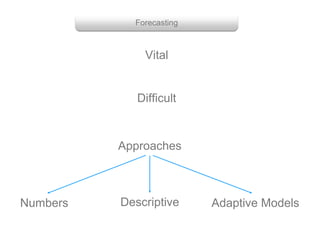
Forecasting
Difficult
Vital
Approaches
Numbers Descriptive Adaptive Models
Forecasting
Numbers
Numbers
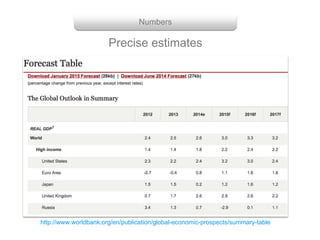
Precise estimates
http://www.worldbank.org/en/publication/global-economic-prospects/summary-table
Numbers
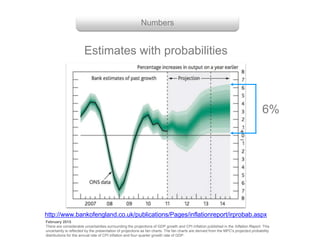
February 2015
There are considerable uncertainties surrounding the projections of GDP growth and CPI inflation published in the Inflation Report. This
uncertainty is reflected by the presentation of projections as fan charts. The fan charts are derived from the MPC's projected probability
distributions for the annual rate of CPI inflation and four-quarter growth rate of GDP.
Estimates with probabilities
http://www.bankofengland.co.uk/publications/Pages/inflationreport/irprobab.aspx
6%
What’s to be done?
…The MPC’s recent forecast performance has been noticeably worse than prior to the crisis,
and marginally worse than that of outside forecasters. The forecast errors of the MPC have
been characterized by persistent over-prediction of output growth and persistent under-
prediction of CPI inflation…
….The central model used by staff for processing news and judgments .. is a Dynamic
Stochastic General Equilibrium (DSGE) model with a relatively parsimonious 16 variables at
its core…
…there may be too few incentives and opportunities for staff to seriously challenge the MPC
…Some former MPC members… reported that they encountered difficulties getting divergent
points of view to be seriously considered in the forecasting process.
Report on Monetary Policy Committee’s Forecasting Capability, 2012
Source: REVIEW OF THE MONETARY POLICY COMMITTEE’S FORECASTING CAPABILITY Report by David Stockton
http://www.bankofengland.co.uk/publications/Documents/news/2012/cr3stockton.pdf
The ECB record
Date Event ECB Forecast
9 August
2007
BNP Paribas ceases trading in 3
US hedge funds specialising in
US mortgage debt
‘The outlook for the external environment…remains
favourable’
15
September
2008
US Government allows Lehman
Brothers to go bankrupt
‘…..growth in the world economy is expected to remain
relatively resilient.’
2 April 2009
G20 Summit agrees $5tn fiscal
expansion of $1.1tn to help IMF
‘….However, the risks to global activity appear to be broadly
balanced.’
9 May 2010
Governments declared insolvent:
Financial aid to Greece debt
crises
‘Global economic prospects remain subject to high levels of
uncertainty. On the one hand, there are concerns that the
financial market turmoil could have a greater impact on the
real economy, as well as fears that protectionist pressures
could intensify ….On the other hand, there may be stronger
than anticipated positive effects due to the decrease in
commodity prices…
5 August
2011
America’s debt loses triple A
status
Looking ahead, the expected gradual retreat of some adverse
transitory factors should support world economic activity in
the second half of the year.…. In emerging economies, the
growth outlook remains buoyant…’
https://www.ecb.europa.eu/pub/economic-bulletin/mb/html/index.en.htmlSource:
Forecasting: An astonishing record of complete failure
2001: The accuracy of economic forecasts in the 1990s
1. All much the same: IMF, World Bank and private forecasters.
2. The predictive record of economists was terrible.
“The record of failure to predict recessions is virtually unblemished.”
An astonishing record – of complete failure By Tim Harford:
Source http://www.ft.com/cms/s/2/14e323ee-e602-11e3-aeef-00144feabdc0.html
The accuracy of economic forecasts from 2007
2008: no recessions in 2009: most of world.
2011 Spring: no recessions in 2012:15 occurred.
Conclusion on Forecasting Numbers
Dreadful
Forecasting
Descriptive
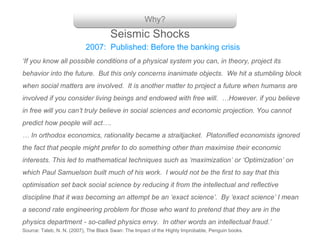
Why?
‘If you know all possible conditions of a physical system you can, in theory, project its
behavior into the future. But this only concerns inanimate objects. We hit a stumbling block
when social matters are involved. It is another matter to project a future when humans are
involved if you consider living beings and endowed with free will. …However. if you believe
in free will you can’t truly believe in social sciences and economic projection. You cannot
predict how people will act….
… In orthodox economics, rationality became a straitjacket. Platonified economists ignored
the fact that people might prefer to do something other than maximise their economic
interests. This led to mathematical techniques such as ‘maximization’ or ‘Optimization’ on
which Paul Samuelson built much of his work. I would not be the first to say that this
optimisation set back social science by reducing it from the intellectual and reflective
discipline that it was becoming an attempt be an ‘exact science’. By ‘exact science’ I mean
a second rate engineering problem for those who want to pretend that they are in the
physics department - so-called physics envy. In other words an intellectual fraud.’
Source: Taleb, N. N. (2007), The Black Swan: The Impact of the Highly Improbable, Penguin books.
2007: Published: Before the banking crisis
Seismic Shocks
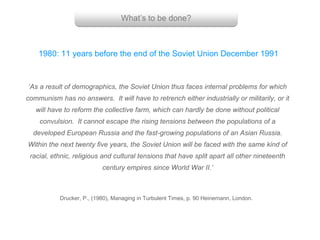
What’s to be done?
‘As a result of demographics, the Soviet Union thus faces internal problems for which
communism has no answers. It will have to retrench either industrially or militarily, or it
will have to reform the collective farm, which can hardly be done without political
convulsion. It cannot escape the rising tensions between the populations of a
developed European Russia and the fast-growing populations of an Asian Russia.
Within the next twenty five years, the Soviet Union will be faced with the same kind of
racial, ethnic, religious and cultural tensions that have split apart all other nineteenth
century empires since World War II.’
Drucker, P., (1980), Managing in Turbulent Times, p. 90 Heinemann, London.
1980: 11 years before the end of the Soviet Union December 1991
Process and structure
Process: listening to people
No figures or mathematical models
Unfairness: Poverty, food, religion, regions, race
Forecasting
Adaptive Models
Adaptive models
Adapt to change
Build ‘What if’ scenarios
Discussion before numbers
Disruptive change
Stage 1: Descriptive
Just words
Scenarios
Those involved
Group diversity
Listening
Sales 201X to 201Z
By Product
By Territory
By Customer
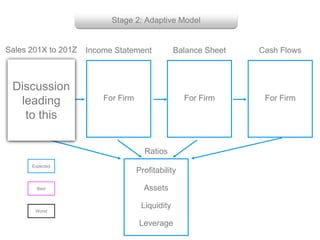
Stage 2: Adaptive Model
Sales 201X to 201Z
By Product
By Territory
By Customer
Ratios
Profitability
Assets
Liquidity
Leverage
Income Statement
For Firm
Balance Sheet
For Firm
Cash Flows
For Firm
Sales 201X to 201Z
By Product
By Territory
By Customer
Discussion
leading
to this
Expected
Best
Worst
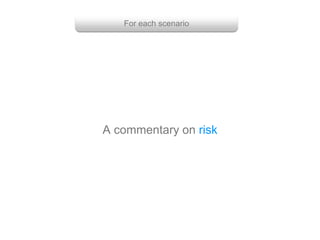
For each scenario
A commentary on risk
The end

Cpsp forecasting 1

  • 1.
  • 2.
  • 3.
  • 4.
  • 5.
    Numbers February 2015 There areconsiderable uncertainties surrounding the projections of GDP growth and CPI inflation published in the Inflation Report. This uncertainty is reflected by the presentation of projections as fan charts. The fan charts are derived from the MPC's projected probability distributions for the annual rate of CPI inflation and four-quarter growth rate of GDP. Estimates with probabilities http://www.bankofengland.co.uk/publications/Pages/inflationreport/irprobab.aspx 6%
  • 6.
    What’s to bedone? …The MPC’s recent forecast performance has been noticeably worse than prior to the crisis, and marginally worse than that of outside forecasters. The forecast errors of the MPC have been characterized by persistent over-prediction of output growth and persistent under- prediction of CPI inflation… ….The central model used by staff for processing news and judgments .. is a Dynamic Stochastic General Equilibrium (DSGE) model with a relatively parsimonious 16 variables at its core… …there may be too few incentives and opportunities for staff to seriously challenge the MPC …Some former MPC members… reported that they encountered difficulties getting divergent points of view to be seriously considered in the forecasting process. Report on Monetary Policy Committee’s Forecasting Capability, 2012 Source: REVIEW OF THE MONETARY POLICY COMMITTEE’S FORECASTING CAPABILITY Report by David Stockton http://www.bankofengland.co.uk/publications/Documents/news/2012/cr3stockton.pdf
  • 7.
    The ECB record DateEvent ECB Forecast 9 August 2007 BNP Paribas ceases trading in 3 US hedge funds specialising in US mortgage debt ‘The outlook for the external environment…remains favourable’ 15 September 2008 US Government allows Lehman Brothers to go bankrupt ‘…..growth in the world economy is expected to remain relatively resilient.’ 2 April 2009 G20 Summit agrees $5tn fiscal expansion of $1.1tn to help IMF ‘….However, the risks to global activity appear to be broadly balanced.’ 9 May 2010 Governments declared insolvent: Financial aid to Greece debt crises ‘Global economic prospects remain subject to high levels of uncertainty. On the one hand, there are concerns that the financial market turmoil could have a greater impact on the real economy, as well as fears that protectionist pressures could intensify ….On the other hand, there may be stronger than anticipated positive effects due to the decrease in commodity prices… 5 August 2011 America’s debt loses triple A status Looking ahead, the expected gradual retreat of some adverse transitory factors should support world economic activity in the second half of the year.…. In emerging economies, the growth outlook remains buoyant…’ https://www.ecb.europa.eu/pub/economic-bulletin/mb/html/index.en.htmlSource:
  • 8.
    Forecasting: An astonishingrecord of complete failure 2001: The accuracy of economic forecasts in the 1990s 1. All much the same: IMF, World Bank and private forecasters. 2. The predictive record of economists was terrible. “The record of failure to predict recessions is virtually unblemished.” An astonishing record – of complete failure By Tim Harford: Source http://www.ft.com/cms/s/2/14e323ee-e602-11e3-aeef-00144feabdc0.html The accuracy of economic forecasts from 2007 2008: no recessions in 2009: most of world. 2011 Spring: no recessions in 2012:15 occurred.
  • 9.
    Conclusion on ForecastingNumbers Dreadful
  • 10.
  • 11.
    Why? ‘If you knowall possible conditions of a physical system you can, in theory, project its behavior into the future. But this only concerns inanimate objects. We hit a stumbling block when social matters are involved. It is another matter to project a future when humans are involved if you consider living beings and endowed with free will. …However. if you believe in free will you can’t truly believe in social sciences and economic projection. You cannot predict how people will act…. … In orthodox economics, rationality became a straitjacket. Platonified economists ignored the fact that people might prefer to do something other than maximise their economic interests. This led to mathematical techniques such as ‘maximization’ or ‘Optimization’ on which Paul Samuelson built much of his work. I would not be the first to say that this optimisation set back social science by reducing it from the intellectual and reflective discipline that it was becoming an attempt be an ‘exact science’. By ‘exact science’ I mean a second rate engineering problem for those who want to pretend that they are in the physics department - so-called physics envy. In other words an intellectual fraud.’ Source: Taleb, N. N. (2007), The Black Swan: The Impact of the Highly Improbable, Penguin books. 2007: Published: Before the banking crisis Seismic Shocks
  • 12.
    What’s to bedone? ‘As a result of demographics, the Soviet Union thus faces internal problems for which communism has no answers. It will have to retrench either industrially or militarily, or it will have to reform the collective farm, which can hardly be done without political convulsion. It cannot escape the rising tensions between the populations of a developed European Russia and the fast-growing populations of an Asian Russia. Within the next twenty five years, the Soviet Union will be faced with the same kind of racial, ethnic, religious and cultural tensions that have split apart all other nineteenth century empires since World War II.’ Drucker, P., (1980), Managing in Turbulent Times, p. 90 Heinemann, London. 1980: 11 years before the end of the Soviet Union December 1991
  • 13.
    Process and structure Process:listening to people No figures or mathematical models Unfairness: Poverty, food, religion, regions, race
  • 14.
  • 15.
    Adaptive models Adapt tochange Build ‘What if’ scenarios Discussion before numbers Disruptive change
  • 16.
    Stage 1: Descriptive Justwords Scenarios Those involved Group diversity Listening
  • 17.
    Sales 201X to201Z By Product By Territory By Customer Stage 2: Adaptive Model Sales 201X to 201Z By Product By Territory By Customer Ratios Profitability Assets Liquidity Leverage Income Statement For Firm Balance Sheet For Firm Cash Flows For Firm Sales 201X to 201Z By Product By Territory By Customer Discussion leading to this Expected Best Worst
  • 18.
    For each scenario Acommentary on risk
  • 19.