International Journal of Modern Engineering Research (IJMER)
                www.ijmer.com            Vol.3, Issue.2, March-April. 2013 pp-944-948      ISSN: 2249-6645


             Water Susceptible Properties of Silt Loam Soil in Sub grades
                            in South West Pennsylvania

                                      Robert M. Brooks, 1 Mehmet Cetin2
1
    Corresponding Author, Associate Professor, Department of Civil and Environmental Engineering, Temple University, USA,
                2
                  Ph.D. Student, Department of Civil and Environmental Engineering, Temple University, USA,

Abstract: Water susceptible properties of subgrade soils play important role in the structural design of highways. In this
research study laboratory investigations were conducted on subgrade soil samples for determining the influence of water
susceptible properties on Natural moisture content, Optimum moisture content, Compaction, California Bearing Ratio
(CBR)-soaked and unsoaked, and Unconfined Compression Strength (UCS). All tests were done using appropriate ASTM
standards. Relationships were developed using regression equations for predicting the performance of seven engineering
variables.

Key Words: Water Absorption characteristics, Engineering Properties, Optimum Moisture Content, CBR, UCS.

                                                    I. INTRODUCTION
         Water is an enemy of road materials. This is because water plays an important role in causing cumulative damage of
road structure over time. Because of high water absorption property silt loam poses performance problems especially under
heavy loads over longer periods of time. The problem is aggravated during rainy season because of significant loss of
bearing capacity and shear strength of the subgrade material [1, 2, 3]. These losses in the subgrade material will translate into
the loss of structural performance of the road itself. Silt loam soils are found on and around the river beds in Southwest
Pennsylvania. In these regions many rural roads are usually constructed on compacted silt loam soils. Therefore, there is
need to study in detail the influence of water susceptibility on various engineering properties of this material as applicable to
Southwest Pennsylvania. This research study attempts to determine relationship between the degree of water absorption of
loam soils at subgrade level and essential engineering properties.

                                            II. MATERIALS AND METHODS
Twenty samples were collected at 3 feet depth of the subgrade soil of US 19 near Pittsburg.

The following laboratory tests were conducted on the soil according to the ASTM standards.
1. Grain size distribution (wet/dry sieving),
2. Soil classification, ASTM D2487 – 11 [4]
3. Natural moisture content, ASTM D2216 – 10 [5]
4. Optimum moisture content ASTM D558 – 11 [6]
5. Compaction test, ASTM D 698, D 1557 [7]
6. California Bearing Ratio (CBR) – soaked and unsoaked, ASTM D1883 - 07e2 and [8]
7. Unconfined Compression Strength (UCS). ASTM D2166 – 06 [9]

The following statistical tests were conducted to establish the mean values and associated variances of the parameters. The
variances were determined for inter and intra-groups of samples at a statistical significance of α = 0.05.
1. One-way Analysis of Variance (ANOVA)
2. Two-way ANOVA

     Seven regression equations were established showing the influence of independent variable on the dependent variable.
For each regression equation correlation coefficient was determined. The correlation coefficient was significant at α = 0.05
level for the following correlated quantities: Swell and UCS, Swell and CBR (soaked), Void Ratio and MDD, Shrinkage
limit and liquid limit, Clay content and NMC.
     The correlation coefficient was significant at α = 0.01 level for the following correlated quantities: Swell and CBR
(unsoaked), Plasticity index, and Shrinkage limit. All the significance tests were done at 2 tailed tests.

                                           III. RESULTS AND DISCUSSIONS
3.1 Soil Classification
         As per the ASTM D 2487 [4] standard the Unified Soil Classification System was used in classifying the soils. 57%
of the samples were classified as inorganic sandy clays of low to medium plasticity (CL). Others were classified as elastic
silt (MH).


                                                             www.ijmer.com                                            944 | Page
International Journal of Modern Engineering Research (IJMER)
              www.ijmer.com             Vol.3, Issue.2, March-April. 2013 pp-944-948      ISSN: 2249-6645

3.2 Comparison of Sections
         Comparison of the mean values of many of the geotechnical properties of soils beneath the stable and unstable
sections of roads in the region revealed that there was significant differences shown in the results of California Bearing Ratio
(CBR) and Maximum Dry Density (MDD), swell and UCS.The high values for these properties were due to the presence of
high clay content (though statistically insignificant in difference) and low degree of compaction of the subgrade.

3.3 Natural Moisture and Clay Contents
          The minimum and maximum natural moisture contents were 10% and 24% respectively as shown in Table I. The
mean moisture content was 17%. The minimum and maximum clay contents were18 and 54% respectively. The mean clay
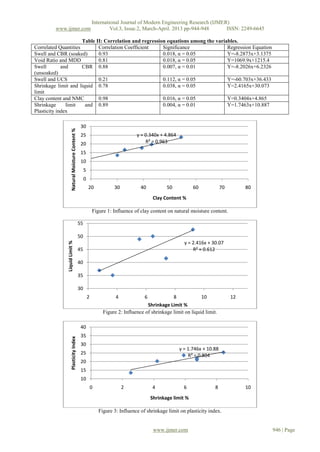
content was 38%. Alinear correlation with R = 0.98 was established between the clay content and the natural moisture
content as shown in Table II and Fig. 1. The correlations between shrinkage limit and liquid limit; and shrinkage limit and
plasticity index were R = 0.78 and R = 0.89 [10,11,12] respectively as shown in Fig. 2 and Fig.3.The correlation established
in this study indicates that the clay content has a strong positive influence on water content. Other researchers established
that there is strong attraction between the water and the clay particles. This is because the high ratio of particles surface to
particle mass for clay soils attracts large amount of water [13].

3.4 Void Ratio and MDD
         The minimum and maximum void ratio was 0.44 and 0.65 respectively as shown in Table I. The mean void ratio
was 0.52. The minimum and maximum MDD were 1594 kg/m3 and 1884 kg/m3respectively. The mean MDD was 1788
kg/m3. A linear correlation with R = 0.81 was established between the void ratio and MDD as shown in Table II and Fig.4.
The void ratio has a linear relationship with the Maximum Dry Density (MDD). The core The soil void increased rather than
decrease as shown by the laboratory compaction tests ASTM D 698 and D 1557 [7] as shown in Fig. 4. The results indicate
that adequate field compaction was not obtained.

3.5 Swell, CBR and UCS
         The minimum and maximum Swell were 0.02 and 0.267 respectively as shown in Table I. The mean Swell was
0.14. The minimum and maximum CBR unsoaked were 3% and 6% respectively. The mean CBR unsoaked was 4%. A
linear correlation with R = 0.88 was established between Swell and CBR unsoaked as sown in Table II and Fig. 5. The
minimum and maximum CBR soaked were 1% and 3% respectively. The mean CBR soaked was 2%. A linear correlation
with R = 0.93 was established between Swell and CBR soaked as shown in Fig. 6.
         The minimum and maximum UCS were 16 KN/m2 and 63 KN/m2 respectively. The mean Swell was 28 KN/m2. A
linear correlation with R = 0.21 was established between Swell and UCS as shown in Fig. 7.
         It is important to note that swell has a negative influence on the CBR unsoaked and CBR soaked. This means that a
swell % increased both CBR unsoaked and CBR soaked decreased indicating strength loss. Similarly swell has negative
influence on the UCS indicating strength loss while swell % increased.

         Table I: Comparison of ranges and mean values of various geotechnical properties of subgrade soils.
         Properties          Stable      Location Unstable              Differences            Mean Value
                             Range                  Location Range
         Clay content (%)    18-48                  22-54               Insignificant          38
         Natural Moisture 10-19                     12-24               Insignificant          17
         Cont. (%)
         OMC (%)             10-18                  13-20               Insignificant          18
         Shrinkage limit     2-9                    2-9                 Insignificant          6
         Plastic Limit (%)   13-21                  16-25               Insignificant          21
         Liquid Limit (%)    36-48                  38-52               Insignificant          44
         Absorption Limit 17-39                     21-42               Insignificant          32
         (%)
         Max. Dry Density 1742-1884                 1594-1676           Significant            1788
         (kg/m3)
         CBR (%)-unsoaked 4-6                       3-4                 Significant            4
         CBR (%)-soaked      2-3                    1-2                 Significant            2
         Void Ratio          0.44-0.58              0.56-0.65           Significant            0.52
         UCS (KN/m2)         20-63                  16-43               Significant            28
         Swell               0.02-0.18              0.10-0.267          Significant            0.14


                                                            www.ijmer.com                                            945 | Page
International Journal of Modern Engineering Research (IJMER)
         www.ijmer.com                                                  Vol.3, Issue.2, March-April. 2013 pp-944-948      ISSN: 2249-6645

                      Table II: Correlation and regression equations among the variables.
Correlated Quantities        Correlation Coefficient     Significance               Regression Equation
Swell and CBR (soaked)       0.93                        0.018, α = 0.05            Y=-8.2873x+3.1375
Void Ratio and MDD           0.81                        0.018, α = 0.05            Y=1069.9x+1215.4
Swell        and      CBR 0.88                           0.007, α = 0.01            Y=-8.2026x+6.2326
(unsoaked)
Swell and UCS                0.21                        0.112, α = 0.05            Y=-60.703x+36.433
Shrinkage limit and liquid 0.78                          0.038, α = 0.05            Y=2.4165x+30.073
limit
Clay content and NMC         0.98                        0.016, α = 0.05            Y=0.3404x+4.865
Shrinkage      limit   and 0.89                          0.004, α = 0.01            Y=1.7463x+10.887
Plasticity index

                                                   30
                     Natural Moisture Content %


                                                   25                                y = 0.340x + 4.864
                                                   20                                    R² = 0.963

                                                   15
                                                   10
                                                       5
                                                       0
                                                           20             30           40           50           60            70        80
                                                                                              Clay Content %

                                                               Figure 1: Influence of clay content on natural moisture content.

                                                  55

                                                  50
                                                                                                            y = 2.416x + 30.07
              Liquid Limit %


                                                  45                                                            R² = 0.612

                                                  40

                                                  35

                                                  30
                                                           2               4             6            8             10              12
                                                                                          Shrinkage Limit %
                                                                     Figure 2: Influence of shrinkage limit on liquid limit.

                                                   40
                                                   35
                     Plasticity Index


                                                   30
                                                                                                          y = 1.746x + 10.88
                                                   25                                                         R² = 0.804
                                                   20
                                                   15
                                                   10
                                                               0               2             4              6              8             10
                                                                                             Shrinkage limit %

                                                                   Figure 3: Influence of shrinkage limit on plasticity index.


                                                                                              www.ijmer.com                                   946 | Page
International Journal of Modern Engineering Research (IJMER)
www.ijmer.com                                           Vol.3, Issue.2, March-April. 2013 pp-944-948      ISSN: 2249-6645

                              2500
                                                                               y = 1069.x + 1215.


   Maximum Dry Density
                              2000                                                 R² = 0.667


        (Kg/m3)
                              1500

                              1000

                                   500

                                       0
                                           0.3         0.35      0.4     0.45       0.5    0.55    0.6     0.65            0.7
                                                                             Void Ratio (e)
                                                   Figure 4: Influence of void ratio on maximum dry density.


                                   8
                  CBR Unsoaked %


                                   6

                                   4

                                   2
                                                                                           y = -8.202x + 6.232
                                   0
                                                                                                R² = 0.784
                                           0            0.05            0.1           0.15         0.2        0.25          0.3
                                                                                    Swell %

                                                        Figure 5: Influence of swell on CBR unsoaked.

                           3.5
                                   3
                           2.5
   CBR Soaked %


                                   2
                           1.5
                                   1                                          y = -8.287x + 3.137
                           0.5                                                     R² = 0.880
                                   0
                                       0               0.05            0.1      0.15       0.2       0.25                  0.3
                                                                              Swell %
                                                         Figure 6: Influence of swell on CBR soaked.

                                   80                                                         y = -60.70x + 36.43
                                                                                                   R² = 0.044
                  UCS (KN/m2)


                                   60

                                   40

                                   20

                                       0
                                               0         0.05           0.1            0.15          0.2            0.25    0.3
                                                                                     Swell %

                                                               Figure 7: Influence of swell on UCS.

                                                                                 www.ijmer.com                                    947 | Page
International Journal of Modern Engineering Research (IJMER)
                www.ijmer.com              Vol.3, Issue.2, March-April. 2013 pp-944-948      ISSN: 2249-6645

Similar results were found by Alayaki F. M. (2012) [14].
         When an engineer is encountered with subgrade soils with high water absorption properties it is important for him
or her to consider improving the drainage condition of the pavement. Additionally, the engineer should also consider
improving the soil performance by adding admixtures such as lime, fly ash, cement.

                                                        IV. CONCLUSIONS
         The following seven regression relationships were found with statistically significant correlation coefficients for
predicting the performance of several engineering variables.
1. Clay is content is directly proportional to the moisture content of the soil with a linear correlation with R = 0.98.
2. Shrinkage Limit is directly proportional to the Liquid Limit of the soil with a linear correlation with R = 0.78.
3. Shrinkage Limit is directly proportional to the Plasticity Index of the soil with a linear correlation with R = 0.89.
4. Void Ratio is directly proportional to the Maximum Dry Density of the soil with a linear correlation with R = 0.81.
5. Swell percentage is inversely proportional to the Unsoaked California Bearing Ratio of the soil with a negative linear
    correlation with R = 0.88.
6. Swell percentage is inversely proportional to the Soaked California Bearing Ratio of the soil with a negative linear
    correlation with R = 0.93.
7. Swell percentage is inversely proportional to the Unconfined Compressive Strength of the soil with a negative linear
    correlation with R = 0.21.

                                                       ACKNOWLEDGMENTS
         The Republic Of Turkey, Ministry Of National Education Scholarships is duly acknowledged for providing
scholarship.

                                                              REFERENCES
[1]    Brooks, R. M., Soil stabilization with RHA and Flyash, International Journal of Research and Reviews in Applied Sciences. Volume
       1, Issue 3, 2009, pp. 209-217.
[2]    Brooks, R. M., Soil stabilization with Lime and RHA, International Journal of Applied Engineering, Volume 5, Number 7, 2010, pp.
       1077-1086.
[3]    Liu C., and Evett J. B., Soils and foundations (The University of North Carolina at Charlotte. Pearson Prentice Hall. Seventh
       Edition, 2008).
[4]    ASTM D2487 - 11 Standard Practice for Classification of Soils for Engineering Purposes (Unified Soil Classification System)
[5]    ASTM D2216 - 10 Standard Test Methods for Laboratory Determination of Water (Moisture) Content of Soil and Rock by Mass
[6]    ASTM D558 - 11 Standard Test Methods for Moisture-Density (Unit Weight) Relations of Soil-Cement Mixtures
[7]    ASTM D 698, D 1557- Laboratory Compaction Tests
[8]    ASTM D1883 - 07e2 Standard Test Method for CBR (California Bearing Ratio) of Laboratory-Compacted Soils
[9]    ASTM D2166 - 06 Standard Test Method for Unconfined Compressive Strength of Cohesive Soil.
[10]   Moore D. S., McCabe G. P., and Craig, B. A., Introduction to the practice of statistics (W H Freeman & Co (Sd),7th Edition, New
       York., 2005).
[11]   Devore J. L., and Farnum N. R., Applied statistics for engineers and scientists (Duxbury Press. ISBN 05435601X, 1stedition, 2004).
[12]   Montgomery, D. C. Design and analysis of experiments (John Wiley & Sons Inc. 7th edition, 2008).
[13]   McCarthy, D. F., Essential of soil mechanics and foundations (Basic Geotechnics. Pearson Prentice Hall. New Jersey. 2007).
[14]   Alayaki F. M., Water absorption properties of laterite soil in road pavement: a case study If-Ilesha Highway, South Western Nigeria,
       International Journal of Emerging Technology and advanced Engineering. Volume 2, issue 11, November, 2012.


                                                                  www.ijmer.com                                                948 | Page

Ce32944948

  • 1.
    International Journal ofModern Engineering Research (IJMER) www.ijmer.com Vol.3, Issue.2, March-April. 2013 pp-944-948 ISSN: 2249-6645 Water Susceptible Properties of Silt Loam Soil in Sub grades in South West Pennsylvania Robert M. Brooks, 1 Mehmet Cetin2 1 Corresponding Author, Associate Professor, Department of Civil and Environmental Engineering, Temple University, USA, 2 Ph.D. Student, Department of Civil and Environmental Engineering, Temple University, USA, Abstract: Water susceptible properties of subgrade soils play important role in the structural design of highways. In this research study laboratory investigations were conducted on subgrade soil samples for determining the influence of water susceptible properties on Natural moisture content, Optimum moisture content, Compaction, California Bearing Ratio (CBR)-soaked and unsoaked, and Unconfined Compression Strength (UCS). All tests were done using appropriate ASTM standards. Relationships were developed using regression equations for predicting the performance of seven engineering variables. Key Words: Water Absorption characteristics, Engineering Properties, Optimum Moisture Content, CBR, UCS. I. INTRODUCTION Water is an enemy of road materials. This is because water plays an important role in causing cumulative damage of road structure over time. Because of high water absorption property silt loam poses performance problems especially under heavy loads over longer periods of time. The problem is aggravated during rainy season because of significant loss of bearing capacity and shear strength of the subgrade material [1, 2, 3]. These losses in the subgrade material will translate into the loss of structural performance of the road itself. Silt loam soils are found on and around the river beds in Southwest Pennsylvania. In these regions many rural roads are usually constructed on compacted silt loam soils. Therefore, there is need to study in detail the influence of water susceptibility on various engineering properties of this material as applicable to Southwest Pennsylvania. This research study attempts to determine relationship between the degree of water absorption of loam soils at subgrade level and essential engineering properties. II. MATERIALS AND METHODS Twenty samples were collected at 3 feet depth of the subgrade soil of US 19 near Pittsburg. The following laboratory tests were conducted on the soil according to the ASTM standards. 1. Grain size distribution (wet/dry sieving), 2. Soil classification, ASTM D2487 – 11 [4] 3. Natural moisture content, ASTM D2216 – 10 [5] 4. Optimum moisture content ASTM D558 – 11 [6] 5. Compaction test, ASTM D 698, D 1557 [7] 6. California Bearing Ratio (CBR) – soaked and unsoaked, ASTM D1883 - 07e2 and [8] 7. Unconfined Compression Strength (UCS). ASTM D2166 – 06 [9] The following statistical tests were conducted to establish the mean values and associated variances of the parameters. The variances were determined for inter and intra-groups of samples at a statistical significance of α = 0.05. 1. One-way Analysis of Variance (ANOVA) 2. Two-way ANOVA Seven regression equations were established showing the influence of independent variable on the dependent variable. For each regression equation correlation coefficient was determined. The correlation coefficient was significant at α = 0.05 level for the following correlated quantities: Swell and UCS, Swell and CBR (soaked), Void Ratio and MDD, Shrinkage limit and liquid limit, Clay content and NMC. The correlation coefficient was significant at α = 0.01 level for the following correlated quantities: Swell and CBR (unsoaked), Plasticity index, and Shrinkage limit. All the significance tests were done at 2 tailed tests. III. RESULTS AND DISCUSSIONS 3.1 Soil Classification As per the ASTM D 2487 [4] standard the Unified Soil Classification System was used in classifying the soils. 57% of the samples were classified as inorganic sandy clays of low to medium plasticity (CL). Others were classified as elastic silt (MH). www.ijmer.com 944 | Page
  • 2.
    International Journal ofModern Engineering Research (IJMER) www.ijmer.com Vol.3, Issue.2, March-April. 2013 pp-944-948 ISSN: 2249-6645 3.2 Comparison of Sections Comparison of the mean values of many of the geotechnical properties of soils beneath the stable and unstable sections of roads in the region revealed that there was significant differences shown in the results of California Bearing Ratio (CBR) and Maximum Dry Density (MDD), swell and UCS.The high values for these properties were due to the presence of high clay content (though statistically insignificant in difference) and low degree of compaction of the subgrade. 3.3 Natural Moisture and Clay Contents The minimum and maximum natural moisture contents were 10% and 24% respectively as shown in Table I. The mean moisture content was 17%. The minimum and maximum clay contents were18 and 54% respectively. The mean clay content was 38%. Alinear correlation with R = 0.98 was established between the clay content and the natural moisture content as shown in Table II and Fig. 1. The correlations between shrinkage limit and liquid limit; and shrinkage limit and plasticity index were R = 0.78 and R = 0.89 [10,11,12] respectively as shown in Fig. 2 and Fig.3.The correlation established in this study indicates that the clay content has a strong positive influence on water content. Other researchers established that there is strong attraction between the water and the clay particles. This is because the high ratio of particles surface to particle mass for clay soils attracts large amount of water [13]. 3.4 Void Ratio and MDD The minimum and maximum void ratio was 0.44 and 0.65 respectively as shown in Table I. The mean void ratio was 0.52. The minimum and maximum MDD were 1594 kg/m3 and 1884 kg/m3respectively. The mean MDD was 1788 kg/m3. A linear correlation with R = 0.81 was established between the void ratio and MDD as shown in Table II and Fig.4. The void ratio has a linear relationship with the Maximum Dry Density (MDD). The core The soil void increased rather than decrease as shown by the laboratory compaction tests ASTM D 698 and D 1557 [7] as shown in Fig. 4. The results indicate that adequate field compaction was not obtained. 3.5 Swell, CBR and UCS The minimum and maximum Swell were 0.02 and 0.267 respectively as shown in Table I. The mean Swell was 0.14. The minimum and maximum CBR unsoaked were 3% and 6% respectively. The mean CBR unsoaked was 4%. A linear correlation with R = 0.88 was established between Swell and CBR unsoaked as sown in Table II and Fig. 5. The minimum and maximum CBR soaked were 1% and 3% respectively. The mean CBR soaked was 2%. A linear correlation with R = 0.93 was established between Swell and CBR soaked as shown in Fig. 6. The minimum and maximum UCS were 16 KN/m2 and 63 KN/m2 respectively. The mean Swell was 28 KN/m2. A linear correlation with R = 0.21 was established between Swell and UCS as shown in Fig. 7. It is important to note that swell has a negative influence on the CBR unsoaked and CBR soaked. This means that a swell % increased both CBR unsoaked and CBR soaked decreased indicating strength loss. Similarly swell has negative influence on the UCS indicating strength loss while swell % increased. Table I: Comparison of ranges and mean values of various geotechnical properties of subgrade soils. Properties Stable Location Unstable Differences Mean Value Range Location Range Clay content (%) 18-48 22-54 Insignificant 38 Natural Moisture 10-19 12-24 Insignificant 17 Cont. (%) OMC (%) 10-18 13-20 Insignificant 18 Shrinkage limit 2-9 2-9 Insignificant 6 Plastic Limit (%) 13-21 16-25 Insignificant 21 Liquid Limit (%) 36-48 38-52 Insignificant 44 Absorption Limit 17-39 21-42 Insignificant 32 (%) Max. Dry Density 1742-1884 1594-1676 Significant 1788 (kg/m3) CBR (%)-unsoaked 4-6 3-4 Significant 4 CBR (%)-soaked 2-3 1-2 Significant 2 Void Ratio 0.44-0.58 0.56-0.65 Significant 0.52 UCS (KN/m2) 20-63 16-43 Significant 28 Swell 0.02-0.18 0.10-0.267 Significant 0.14 www.ijmer.com 945 | Page
  • 3.
    International Journal ofModern Engineering Research (IJMER) www.ijmer.com Vol.3, Issue.2, March-April. 2013 pp-944-948 ISSN: 2249-6645 Table II: Correlation and regression equations among the variables. Correlated Quantities Correlation Coefficient Significance Regression Equation Swell and CBR (soaked) 0.93 0.018, α = 0.05 Y=-8.2873x+3.1375 Void Ratio and MDD 0.81 0.018, α = 0.05 Y=1069.9x+1215.4 Swell and CBR 0.88 0.007, α = 0.01 Y=-8.2026x+6.2326 (unsoaked) Swell and UCS 0.21 0.112, α = 0.05 Y=-60.703x+36.433 Shrinkage limit and liquid 0.78 0.038, α = 0.05 Y=2.4165x+30.073 limit Clay content and NMC 0.98 0.016, α = 0.05 Y=0.3404x+4.865 Shrinkage limit and 0.89 0.004, α = 0.01 Y=1.7463x+10.887 Plasticity index 30 Natural Moisture Content % 25 y = 0.340x + 4.864 20 R² = 0.963 15 10 5 0 20 30 40 50 60 70 80 Clay Content % Figure 1: Influence of clay content on natural moisture content. 55 50 y = 2.416x + 30.07 Liquid Limit % 45 R² = 0.612 40 35 30 2 4 6 8 10 12 Shrinkage Limit % Figure 2: Influence of shrinkage limit on liquid limit. 40 35 Plasticity Index 30 y = 1.746x + 10.88 25 R² = 0.804 20 15 10 0 2 4 6 8 10 Shrinkage limit % Figure 3: Influence of shrinkage limit on plasticity index. www.ijmer.com 946 | Page
  • 4.
    International Journal ofModern Engineering Research (IJMER) www.ijmer.com Vol.3, Issue.2, March-April. 2013 pp-944-948 ISSN: 2249-6645 2500 y = 1069.x + 1215. Maximum Dry Density 2000 R² = 0.667 (Kg/m3) 1500 1000 500 0 0.3 0.35 0.4 0.45 0.5 0.55 0.6 0.65 0.7 Void Ratio (e) Figure 4: Influence of void ratio on maximum dry density. 8 CBR Unsoaked % 6 4 2 y = -8.202x + 6.232 0 R² = 0.784 0 0.05 0.1 0.15 0.2 0.25 0.3 Swell % Figure 5: Influence of swell on CBR unsoaked. 3.5 3 2.5 CBR Soaked % 2 1.5 1 y = -8.287x + 3.137 0.5 R² = 0.880 0 0 0.05 0.1 0.15 0.2 0.25 0.3 Swell % Figure 6: Influence of swell on CBR soaked. 80 y = -60.70x + 36.43 R² = 0.044 UCS (KN/m2) 60 40 20 0 0 0.05 0.1 0.15 0.2 0.25 0.3 Swell % Figure 7: Influence of swell on UCS. www.ijmer.com 947 | Page
  • 5.
    International Journal ofModern Engineering Research (IJMER) www.ijmer.com Vol.3, Issue.2, March-April. 2013 pp-944-948 ISSN: 2249-6645 Similar results were found by Alayaki F. M. (2012) [14]. When an engineer is encountered with subgrade soils with high water absorption properties it is important for him or her to consider improving the drainage condition of the pavement. Additionally, the engineer should also consider improving the soil performance by adding admixtures such as lime, fly ash, cement. IV. CONCLUSIONS The following seven regression relationships were found with statistically significant correlation coefficients for predicting the performance of several engineering variables. 1. Clay is content is directly proportional to the moisture content of the soil with a linear correlation with R = 0.98. 2. Shrinkage Limit is directly proportional to the Liquid Limit of the soil with a linear correlation with R = 0.78. 3. Shrinkage Limit is directly proportional to the Plasticity Index of the soil with a linear correlation with R = 0.89. 4. Void Ratio is directly proportional to the Maximum Dry Density of the soil with a linear correlation with R = 0.81. 5. Swell percentage is inversely proportional to the Unsoaked California Bearing Ratio of the soil with a negative linear correlation with R = 0.88. 6. Swell percentage is inversely proportional to the Soaked California Bearing Ratio of the soil with a negative linear correlation with R = 0.93. 7. Swell percentage is inversely proportional to the Unconfined Compressive Strength of the soil with a negative linear correlation with R = 0.21. ACKNOWLEDGMENTS The Republic Of Turkey, Ministry Of National Education Scholarships is duly acknowledged for providing scholarship. REFERENCES [1] Brooks, R. M., Soil stabilization with RHA and Flyash, International Journal of Research and Reviews in Applied Sciences. Volume 1, Issue 3, 2009, pp. 209-217. [2] Brooks, R. M., Soil stabilization with Lime and RHA, International Journal of Applied Engineering, Volume 5, Number 7, 2010, pp. 1077-1086. [3] Liu C., and Evett J. B., Soils and foundations (The University of North Carolina at Charlotte. Pearson Prentice Hall. Seventh Edition, 2008). [4] ASTM D2487 - 11 Standard Practice for Classification of Soils for Engineering Purposes (Unified Soil Classification System) [5] ASTM D2216 - 10 Standard Test Methods for Laboratory Determination of Water (Moisture) Content of Soil and Rock by Mass [6] ASTM D558 - 11 Standard Test Methods for Moisture-Density (Unit Weight) Relations of Soil-Cement Mixtures [7] ASTM D 698, D 1557- Laboratory Compaction Tests [8] ASTM D1883 - 07e2 Standard Test Method for CBR (California Bearing Ratio) of Laboratory-Compacted Soils [9] ASTM D2166 - 06 Standard Test Method for Unconfined Compressive Strength of Cohesive Soil. [10] Moore D. S., McCabe G. P., and Craig, B. A., Introduction to the practice of statistics (W H Freeman & Co (Sd),7th Edition, New York., 2005). [11] Devore J. L., and Farnum N. R., Applied statistics for engineers and scientists (Duxbury Press. ISBN 05435601X, 1stedition, 2004). [12] Montgomery, D. C. Design and analysis of experiments (John Wiley & Sons Inc. 7th edition, 2008). [13] McCarthy, D. F., Essential of soil mechanics and foundations (Basic Geotechnics. Pearson Prentice Hall. New Jersey. 2007). [14] Alayaki F. M., Water absorption properties of laterite soil in road pavement: a case study If-Ilesha Highway, South Western Nigeria, International Journal of Emerging Technology and advanced Engineering. Volume 2, issue 11, November, 2012. www.ijmer.com 948 | Page