Slamet Widodo, Abdelazim Ibrahim / International Journal of Engineering Research and
                     Applications (IJERA) ISSN: 2248-9622 www.ijera.com
                     Vol. 2, Issue 5, September- October 2012, pp.2232-2236
    Estimation of Primary Compression Index (Cc) Using Physical
                  Properties of Pontianak Soft Clay
                             *Slamet Widodo, **Abdelazim Ibrahim
                                  *Technische Universitat Bergakademie Freiberg
                              Gustav Zeuner Strasse 1, 09599 Freiberg (SN),Germany
               **Technische Universitat Bergakademie Freiberg-Germany &Al Neelain University-Sudan


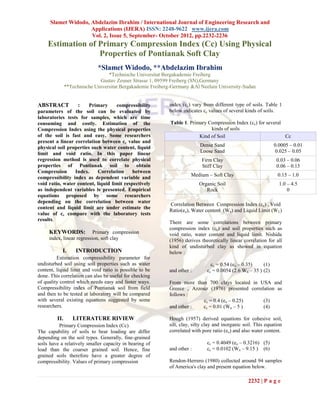
ABSTRACT             :  Primary     compressibility         index (cc) vary from different type of soils. Table 1
parameters of the soil can be evaluated by                  below indicates cc values of several kinds of soils.
laboratories tests for samples, which are time
consuming and costly. Estimation of the                      Table 1. Primary Compression Index (cc) for several
Compression Index using the physical properties                                kinds of soils
of the soil is fast and easy. Some researchers                            Kind of Soil                           Cc
present a linear correlation between cc value and
physical soil properties such water content, liquid                        Dense Sand                          0.0005 – 0.01
limit and void ratio. In this paper linear                                 Loose Sand                          0.025 – 0.05
regression method is used to correlate physical                             Firm Clay                            0.03 – 0.06
properties of Pontianak soil to obtain                                      Stiff Clay                           0.06 – 0.15
Compression      Index.     Correlation     between
                                                                      Medium – Soft Clay                         0.15 – 1.0
compressibility index as dependent variable and
void ratio, water content, liquid limit respectively                      Organic Soil                            1.0 – 4.5
as independent variables is presented. Empirical                             Rock                                     0
equations proposed by some researchers
depending on the correlation between water
                                                            Correlation Between Compression Index (cc) , Void
content and liquid limit are under estimate the
                                                            Ratio(eo), Water content (Wn) and Liquid Limit (W L)
value of cc compare with the laboratory tests
results.
                                                            There are some correlations between primary
                                                            compression index (cc) and soil properties such as
     KEYWORDS:             Primary compression              void ratio, water content and liquid limit. Nishida
     index, linear regression, soft clay                    (1956) derives theoretically linear correlation for all
                                                            kind of undisturbed clay as showed in equation
            I.      INTRODUCTION                            below :
         Estimation compressibility parameter for
undisturbed soil using soil properties such as water                            cc = 0.54 (eo – 0.35)    (1)
content, liquid limit and void ratio is possible to be      and other :       cc = 0.0054 (2.6 Wn – 35 ) (2)
done. This correlation can also be useful for checking
of quality control which needs easy and faster ways.        From more than 700 clays located in USA and
Compressibility index of Pontianak soil from field          Greece , Azzouz (1976) presented correlation as
and then to be tested at laboratory will be compared        follows :
with several existing equations suggested by some                        cc = 0.4 (eo – 0.25)      (3)
researchers.                                                and other :  cc = 0.01 (Wn – 5 )       (4)

         II.      LITERATURE RIVIEW                         Hough (1957) derived equations for cohesive soil,
          Primary Compression Index (Cc)                    silt, clay, silty clay and inorganic soil. This equation
The capability of soils to bear loading are differ          correlated with pore ratio (eo) and also water content.
depending on the soil types. Generally, fine-grained
soils have a relatively smaller capacity in bearing of                        cc = 0.4049 (eo – 0.3216) (5)
load than the coarser grained soil. Hence, fine             and other :       cc = 0.0102 (Wn – 9.15 ) (6)
grained soils therefore have a greater degree of
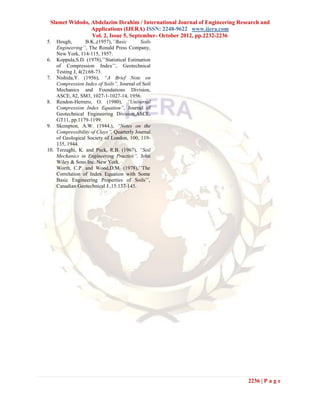
compressibility. Values of primary compression              Rendon-Herrero (1980) collected around 94 samples
                                                            of America's clay and present equation below.

                                                                                                   2232 | P a g e
Slamet Widodo, Abdelazim Ibrahim / International Journal of Engineering Research and
                     Applications (IJERA) ISSN: 2248-9622 www.ijera.com
                     Vol. 2, Issue 5, September- October 2012, pp.2232-2236
         cc = 0.30 (eo – 0.27)               (7)         will be extended 2.550 m length and 45 m width.
                                                         From each borehole two samples were taken hence
Serajuddin (1987) gave a linear equation for 130         there are 20 samples for testing at laboratory. Detail
alluvial clay and silt in Bangladesh as given in the     data from soil investigation results for the project is
following equation.                                      shown in Table 2.

        cc = 0.0102 (Wn – 9.15)               (8)
Terzhagi and Peck (1967) present a linear correlation
                                                          STA     No. of   Depth      g       s   i   Wn    WL    Wp       Ip     IL     eo      Cc
between primary compression index (cc) and liquid                sample     (m)    (kN/m3)    kPa     (%)   (%)   (%)     (%)
limit (WL) as ilustrated in the following equation.
                                                         0+072         1    9.30   14.23     132.34 75.79 35.23 25.81      9.42 5.31     1.887   0.829
                                                                       2   20.30   14.33     290.90 49.85 49.38 26.38     23.00 1.02     1.390   0.738
         cc = 0.009 (WL– 10)                 (9)         0+303         1    3.30   15.43      50.92 69.17 48.79 30.64     18.15 2.12     1.811   0.803
                                                                       2   12.30   18.25     224.48 34.86 24.90 14.66     10.24 1.97     0.910   0.349
                                                         0+639         1    9.30   15.64     145.45 68.83 48.29 26.23     22.06 1.93     1.850   0.663
For all parameters cc, eo, Wn and WL is primary                        2   20.30   15.66     317.90 60.38 62.46 32.79     29.67 0.93     1.791   1.663
compression index, pore ratio,water content and          1+054         1    3.30   14.74      48.64 81.55 48.73 27.53     21.20 2.55     2.321   1.236
                                                                       2   12.30   15.82     194.59 71.80 54.89 28.97     25.92 1.65     1.886   0.436
liquid limit respectively.
                                                         1+435         1    6.30   16.33     102.88 66.96 51.52 26.64     24.88 1.62     1.522   0.653
                                                                       2   15.30   15.88     242.96 66.00 49.12 29.55     19.57 1.86     1.748   0.872
In addition, another correlation for disturbed clay      1+773         1    9.30   16.03     149.08 90.96 53.44 26.86     26.58 2.41     2.258   0.866
                                                                       2   18.30   18.54     339.28 35.59 22.62 19.08      3.54 4.66     0.884   0.279
sample or remoulding, Skempton (1944) gave a             2+106         1    3.30   14.23      46.96 86.42 54.02 38.44     15.58 3.08     7.114   0.993
linear correlation using liquid limit.                                 2   12.30   16.21     199.38 49.59 55.13 29.11     26.02 0.79     1.610   1.196
                                                         2+250         1    6.30    14.4      90.72 83.01 52.27 28.50     23.77 2.29     2.351   1.013
                                                                       2   15.30   17.19     263.01 43.83 46.46 25.55     20.91 0.87     1.178   0.488
           cc ' = 0.007 (WL– 7)     (10)                 2+400         1   12.30   13.93     171.34 56.82 17.10 14.62      2.48 17.02    1.444   0.556
                                                                       2   20.30   14.64     297.19 50.14 46.16 25.71     20.45 1.19     1.347   0.511
                                                         2+550         1    9.30   16.87     156.89 54.10 51.96 24.87     27.09 1.08     1.308   0.452
Koppula (1981) and Wroth et al. (1978) propose a                       2   18.30   16.28     297.92 52.31 39.08 22.91     16.17 1.82     1.347   0.511
correlation using plasticity index for primary                   Max       20.30     18.54 339.28 90.96     62.46 38.44 29.67 17.02      7.114   1.663
compressive strength of remoulding clay.                         Min        3.30     13.93    46.96 34.86   17.10 14.62    2.48   0.79   0.884   0.279
                                                                 A vg      11.85     15.73 188.14 62.40     45.58 26.24 19.34     2.81   1.898   0.755


         cc ' = 1.325 Ip            (11)                  Table 2. Data from soil investigation of expanded
                                                                 runway project at Supadio airport
                Linear Regression Method
                                                                IV.        DISCUSSION FOR ANALYSIS
Linear regression is a simple method to analyze data                               RESULTS
and take conclusion afterwards. By using
spreadsheets program (Excel for windows) data base
                                                          Primary Compression Index (Cc) from Equations
can be easily calculated. Trend line linearly indicate
                                                                  The results for primary compression index
between independent variable (cc) and dependent
                                                         (cc) from laboratory testing and that from some
variables (eo, Wn,WL). Coefficient of determination
                                                         equations above is shown in Table 3. Nishida
(R2) indicates a correlation each other. Ratio
                                                         (1956), Azzouz (1976) and Hough (1957) gave two
coefficient regression to standard error is T-value
                                                         results for cc values. Left one of coulomb is based
indicating validity of equation. Practically, T-value
                                                         void ratio and other is based from water content.
more than 2.0 hints a valid equation.
                                                         Rendon-Herrero (1980) only give linear correlation
                                                         between cc and void ratio and Seradjuddin (1987)
         III.      DATA COLLECTING                       uses water content to get cc value whereas only
        Main data for calculation and analysis came      Terzhagi and Peck (1967) propose correlation of cc
from soil investigation of expanded runway project       based on liquid limit.
of Supadio airport in Pontianak, Indonesia. There are
10 boreholes along at left and right of existing
runway having 2.250 m length and 30 m width. It


                                                                                                            2233 | P a g e
Slamet Widodo, Abdelazim Ibrahim / International Journal of Engineering Research and
                     Applications (IJERA) ISSN: 2248-9622 www.ijera.com
                     Vol. 2, Issue 5, September- October 2012, pp.2232-2236
                           Table 3. Values of cc from laboratory test using some equations

                                                                                                                      Rendon-
              Location    Lab.       Nishida         A zzouz                                          Hough           Herrero     Seradjuddin     Terzhagi
                           Cc      Cc      Cc      Cc       Cc                                   Cc           Cc         Cc           Cc            Cc


               0+072     0.829    0.830   0.875   0.655    0.708                                0.634     0.680        0.485         0.680         0.227
                         0.738    0.562   0.511   0.456    0.449                                0.433     0.415        0.336         0.415         0.354
               0+303     0.803    0.789   0.782   0.624    0.642                                0.603     0.612        0.462         0.612         0.349
                         0.349    0.302   0.300   0.264    0.299                                0.238     0.262        0.192         0.262         0.134
               0+639     0.663    0.810   0.777   0.640    0.638                                0.619     0.609        0.474         0.609         0.345
                         1.663    0.778   0.659   0.616    0.554                                0.595     0.523        0.456         0.523         0.472
               1+054     1.236    1.064   0.956   0.828    0.766                                0.810     0.738        0.615         0.738         0.349
                         0.436    0.829   0.819   0.654    0.668                                0.633     0.639        0.485         0.639         0.404
               1+435     0.653    0.633   0.751   0.509    0.620                                0.486     0.590        0.376         0.590         0.374
                         0.872    0.755   0.738   0.599    0.610                                0.578     0.580        0.443         0.580         0.352
               1+773     0.866    1.030   1.088   0.803    0.860                                0.784     0.834        0.596         0.834         0.391
                         0.279    0.288   0.311   0.254    0.306                                0.228     0.270        0.184         0.270         0.114
               2+106     0.993    3.653   1.024   2.746    0.814                                2.750     0.788        2.053         0.788         0.396
                         1.196    0.680   0.507   0.544    0.446                                0.522     0.412        0.402         0.412         0.406
               2+250     1.013    1.081   0.976   0.840    0.780                                0.822     0.753        0.624         0.753         0.380
                         0.488    0.447   0.426   0.371    0.388                                0.347     0.354        0.272         0.354         0.328
               2+400     0.556    0.591   0.609   0.478    0.518                                0.454     0.486        0.352         0.486         0.064
                         0.511    0.538   0.515   0.439    0.451                                0.415     0.418        0.323         0.418         0.325
               2+550     0.452    0.517   0.571   0.423    0.491                                0.399     0.458        0.311         0.458         0.378
                         0.511    0.538   0.545   0.439    0.473                                0.415     0.440        0.323         0.440         0.262
              Max        1.663    3.653   1.088   2.746    0.860                                2.750     0.834        2.053         0.834         0.472
              Min        0.279    0.288   0.300   0.254    0.299                                0.228     0.262        0.184         0.262         0.064
              A verage   0.755    0.836   0.687   0.659    0.574                                0.638     0.543        0.488         0.543         0.320
                                                                 Com pres s ibility index, Cc


cc values from correlation using parameter of void
ratio show higher than water content for three                                                  2.000
equations Nishida (1956), Azzouz (1976) and Hough
(1957) whereas Rendon-Herrero (1980) and
Seradjuddin      (1987)     gave      different   trend.                                        1.000 f(x) = 0.52x - 0.1
Furthermore, Terzhagi and Peck's equation based
liquid limit gives the smallest of cc value. From Table                                                 R² = 0.43
                                                                                                0.000
1 above that average value of cc for Pontianak Soil is
0.755 and classified as soft soil in ranging from 0.15                                              0.800 1.000 1.200 1.400 1.600 1.800 2.000 2.200 2.400 2.600
to 1.0 for medium-soft soil in grouping.
                                                                                                                                 Void ratio, eo
Linear Regression of Laboratory Data
                                                                                                                   Figure 1. cc versus. eo
By using linear regression, analysis and validation
for Pontianak soft soil is done and new equation for
                                                                 Com pres s ibility index, Cc


soil model is found. There are three kind of equations
will be showed. Firstly, it is based on void ratio.                                             2.000
Secondly, it is based on water content and the last
one is a correlation between cc values and liquid
limits. The correlation between cc and different types                                          1.000
of physical properties are shown in Figures 1, 2, 3.
                                                                                                          f(x) = 0.01x + 0.12
                                                                                                          R² = 0.24
                                                                                                0.000
                                                                                                    30.00 40.00 50.00 60.00 70.00 80.00 90.00 100.00
                                                                                                                                Water content, Wn


                                                                                                                   Figure 2. cc versus. Wn

                                                                                                                                             2234 | P a g e
Slamet Widodo, Abdelazim Ibrahim / International Journal of Engineering Research and
                                                         Applications (IJERA) ISSN: 2248-9622 www.ijera.com
                                                         Vol. 2, Issue 5, September- October 2012, pp.2232-2236
                                                                                               Table 4. Comparison of equations
Com pres s ibility Index, Cc


                                                                                               Researchers          Existing equations         Alternative equations
                               2.000
                                                                                           Nishida (1956)         cc = 0.54 (eo – 0.35)  cc = 0.5217 (eo – 0.2)
                               1.000                                                                              cc = 0.01404(Wn-13.46)
                                       f(x) = 0.02x - 0.02
                                                                                                                                         cc = 0.0102 (Wn +11.57)
                                       R² = 0.35                                           Azzouz (1976)         cc = 0.4 (eo – 0.25)
                               0.000                                                                             cc = 0.01 (Wn – 5 )     cc = 0.01706 (WL – 1.29)
                                   10.00 20.00 30.00 40.00 50.00 60.00 70.00
                                                                                           Hough (1957)          cc = 0.4049 (eo - 0.3216)
                                                      Liquid limit, WL                                           cc = 0.0102 (Wn – 9.15)
                                                                                           Rendon-Herrero
                                                                                           (1980)                cc = 0.3 (eo - 0.27)
                                                    Figure 3. cc versus WL
                                                                                           Seradjuddin (1987)    cc = 0.0102 (Wn – 9.15)
                                   Correlation between Compression index (cc) and
                                   Void ratio (eo) uses linear regression as depicted in   Terzhagi-Peck         cc = 0.009 (WL - 10)
                                   Figure 1. with cofficient of determination R2 = 0.427   (1967)
                                   gives equation:
                                                                                                                 CONCLUSIONS
                                             cc = 0.5217 eo - 0.10428    (12.a)
                                                                                               Based on compression index (cc) at laboratory testing
                                              = 0.5217 ( eo - 0.20 )      (12.b)
                                                                                               for Pontianak soil which average of cc value is 0.755
                                                                                               and the values ranging from 0.279 to 1.663 indicates
                                   Furthermore, in Figure 2. for coefficient of
                                                                                               as soft clay. Compression index values using
                                   determination R2 = 0.238 gives equation:
                                                                                               independent variables such as water content and
                                                                                               liquid limit are under estimated compared laboratory
                                           cc = 0.0102 Wn + 0.11807      (13.a)
                                                                                               testing whereas void ratio is shown better result.
                                              = 0.0102 ( Wn + 11.57 ) (13.b)
                                                                                               Coefficients of determination (R2) for three grouping
                                                                                               from regression analysis are below 0.5. Hence, they
                                   Figure 3. presents a linear correlation between
                                                                                               indicate as low correlation between cc and
                                   compression index (cc) and Liquid limit taking
                                                                                               independent variables void ratio, water content,
                                   coefficient of determination R2 = 0.349 gives
                                                                                               liquid limit respectively. Large number of sample is
                                   equation:
                                                                                               more needed for further analysis in other to present
                                            cc = 0.01706 WL - 0.02209      (14.a)
                                                                                               valid equations having high correlation.
                                            = 0.01706 ( WL- 1.30 )         (14.b)

                                   From coefficient of determination (R2) above that all
                                   equations give low correlation and the worst is the                           REFERENCES
                                   correlation between cc and water content (Wn). In                1.    Azzous, A.S., Krizek, R.J., and Corotis,
                                   addition, constant or intercept for the equation                       R.B., “Regression Analysis of Soil
                                   between cc and Wn having positive value are different                  Compressibility”, Soils and Foundations,
                                   than other which are negative signs. Table 4 right                     16(2), 19-29, 1976.
                                   column gives new equations as alternative equations              2.    Das,     B.M.,(1985),   ‘’Principles   of
                                   using linear regression analysis.                                      Geotechnical Engineering’’, University of
                                                                                                          Texas at El Paso, USA.

                                                                                                    3.    Davison, L.R.and Atkinson, J.H.,(1990),
                                                                                                          ‘’Continous Loading Oedometer Testing of
                                                                                                          Soils’’, Quarterly Journal of Engineering
                                                                                                          Geology, Vol.23, pp.347-355,
                                                                                                          London.
                                                                                                    4.    Dermawan, H., (2002), ‘’Consolidation
                                                                                                          Test’’, Universitas Pendidikan Indonesia.


                                                                                                                                        2235 | P a g e
Slamet Widodo, Abdelazim Ibrahim / International Journal of Engineering Research and
                Applications (IJERA) ISSN: 2248-9622 www.ijera.com
                Vol. 2, Issue 5, September- October 2012, pp.2232-2236
5.  Hough,        B.K.,(1957),’’Basic      Soils
    Engineering’’, The Ronald Press Company,
    New York, 114-115, 1957.
6. Koppula,S.D. (1978),’’Statistical Estimation
    of Compression Index’’, Geotechnical
    Testing J, 4(2):68-73.
7. Nishida,Y. (1956), “A Brief Note on
    Compression Index of Soils”, Journal of Soil
    Mechanics and Foundations Division,
    ASCE, 82, SM3, 1027-1-1027-14, 1956.
8. Rendon-Herrero, O. (1980), “Universal
    Compression Index Equation”, Journal of
    Geotechnical Engineering Division,ASCE,
    GT11, pp.1179-1199.
9. Skempton, A.W. (1944,), “Notes on the
    Compressibility of Clays”, Quarterly Journal
    of Geological Society of London, 100, 119-
    135, 1944.
10. Terzaghi, K. and Peck, R.B. (1967), “Soil
    Mechanics in Engineering Practice”, John
    Wiley & Sons Inc. New York.
    Worth, C.P. and Wood,D.M. (1978),’’The
    Correlation of Index Equation with Some
    Basic Engineering Properties of Soils’’,
    Canadian Geotechnical J.,15:137-145.


                                                                            2236 | P a g e

Nb2522322236

  • 1.
    Slamet Widodo, AbdelazimIbrahim / International Journal of Engineering Research and Applications (IJERA) ISSN: 2248-9622 www.ijera.com Vol. 2, Issue 5, September- October 2012, pp.2232-2236 Estimation of Primary Compression Index (Cc) Using Physical Properties of Pontianak Soft Clay *Slamet Widodo, **Abdelazim Ibrahim *Technische Universitat Bergakademie Freiberg Gustav Zeuner Strasse 1, 09599 Freiberg (SN),Germany **Technische Universitat Bergakademie Freiberg-Germany &Al Neelain University-Sudan ABSTRACT : Primary compressibility index (cc) vary from different type of soils. Table 1 parameters of the soil can be evaluated by below indicates cc values of several kinds of soils. laboratories tests for samples, which are time consuming and costly. Estimation of the Table 1. Primary Compression Index (cc) for several Compression Index using the physical properties kinds of soils of the soil is fast and easy. Some researchers Kind of Soil Cc present a linear correlation between cc value and physical soil properties such water content, liquid Dense Sand 0.0005 – 0.01 limit and void ratio. In this paper linear Loose Sand 0.025 – 0.05 regression method is used to correlate physical Firm Clay 0.03 – 0.06 properties of Pontianak soil to obtain Stiff Clay 0.06 – 0.15 Compression Index. Correlation between Medium – Soft Clay 0.15 – 1.0 compressibility index as dependent variable and void ratio, water content, liquid limit respectively Organic Soil 1.0 – 4.5 as independent variables is presented. Empirical Rock 0 equations proposed by some researchers depending on the correlation between water Correlation Between Compression Index (cc) , Void content and liquid limit are under estimate the Ratio(eo), Water content (Wn) and Liquid Limit (W L) value of cc compare with the laboratory tests results. There are some correlations between primary compression index (cc) and soil properties such as KEYWORDS: Primary compression void ratio, water content and liquid limit. Nishida index, linear regression, soft clay (1956) derives theoretically linear correlation for all kind of undisturbed clay as showed in equation I. INTRODUCTION below : Estimation compressibility parameter for undisturbed soil using soil properties such as water cc = 0.54 (eo – 0.35) (1) content, liquid limit and void ratio is possible to be and other : cc = 0.0054 (2.6 Wn – 35 ) (2) done. This correlation can also be useful for checking of quality control which needs easy and faster ways. From more than 700 clays located in USA and Compressibility index of Pontianak soil from field Greece , Azzouz (1976) presented correlation as and then to be tested at laboratory will be compared follows : with several existing equations suggested by some cc = 0.4 (eo – 0.25) (3) researchers. and other : cc = 0.01 (Wn – 5 ) (4) II. LITERATURE RIVIEW Hough (1957) derived equations for cohesive soil, Primary Compression Index (Cc) silt, clay, silty clay and inorganic soil. This equation The capability of soils to bear loading are differ correlated with pore ratio (eo) and also water content. depending on the soil types. Generally, fine-grained soils have a relatively smaller capacity in bearing of cc = 0.4049 (eo – 0.3216) (5) load than the coarser grained soil. Hence, fine and other : cc = 0.0102 (Wn – 9.15 ) (6) grained soils therefore have a greater degree of compressibility. Values of primary compression Rendon-Herrero (1980) collected around 94 samples of America's clay and present equation below. 2232 | P a g e
  • 2.
    Slamet Widodo, AbdelazimIbrahim / International Journal of Engineering Research and Applications (IJERA) ISSN: 2248-9622 www.ijera.com Vol. 2, Issue 5, September- October 2012, pp.2232-2236 cc = 0.30 (eo – 0.27) (7) will be extended 2.550 m length and 45 m width. From each borehole two samples were taken hence Serajuddin (1987) gave a linear equation for 130 there are 20 samples for testing at laboratory. Detail alluvial clay and silt in Bangladesh as given in the data from soil investigation results for the project is following equation. shown in Table 2. cc = 0.0102 (Wn – 9.15) (8) Terzhagi and Peck (1967) present a linear correlation STA No. of Depth g s i Wn WL Wp Ip IL eo Cc between primary compression index (cc) and liquid sample (m) (kN/m3) kPa (%) (%) (%) (%) limit (WL) as ilustrated in the following equation. 0+072 1 9.30 14.23 132.34 75.79 35.23 25.81 9.42 5.31 1.887 0.829 2 20.30 14.33 290.90 49.85 49.38 26.38 23.00 1.02 1.390 0.738 cc = 0.009 (WL– 10) (9) 0+303 1 3.30 15.43 50.92 69.17 48.79 30.64 18.15 2.12 1.811 0.803 2 12.30 18.25 224.48 34.86 24.90 14.66 10.24 1.97 0.910 0.349 0+639 1 9.30 15.64 145.45 68.83 48.29 26.23 22.06 1.93 1.850 0.663 For all parameters cc, eo, Wn and WL is primary 2 20.30 15.66 317.90 60.38 62.46 32.79 29.67 0.93 1.791 1.663 compression index, pore ratio,water content and 1+054 1 3.30 14.74 48.64 81.55 48.73 27.53 21.20 2.55 2.321 1.236 2 12.30 15.82 194.59 71.80 54.89 28.97 25.92 1.65 1.886 0.436 liquid limit respectively. 1+435 1 6.30 16.33 102.88 66.96 51.52 26.64 24.88 1.62 1.522 0.653 2 15.30 15.88 242.96 66.00 49.12 29.55 19.57 1.86 1.748 0.872 In addition, another correlation for disturbed clay 1+773 1 9.30 16.03 149.08 90.96 53.44 26.86 26.58 2.41 2.258 0.866 2 18.30 18.54 339.28 35.59 22.62 19.08 3.54 4.66 0.884 0.279 sample or remoulding, Skempton (1944) gave a 2+106 1 3.30 14.23 46.96 86.42 54.02 38.44 15.58 3.08 7.114 0.993 linear correlation using liquid limit. 2 12.30 16.21 199.38 49.59 55.13 29.11 26.02 0.79 1.610 1.196 2+250 1 6.30 14.4 90.72 83.01 52.27 28.50 23.77 2.29 2.351 1.013 2 15.30 17.19 263.01 43.83 46.46 25.55 20.91 0.87 1.178 0.488 cc ' = 0.007 (WL– 7) (10) 2+400 1 12.30 13.93 171.34 56.82 17.10 14.62 2.48 17.02 1.444 0.556 2 20.30 14.64 297.19 50.14 46.16 25.71 20.45 1.19 1.347 0.511 2+550 1 9.30 16.87 156.89 54.10 51.96 24.87 27.09 1.08 1.308 0.452 Koppula (1981) and Wroth et al. (1978) propose a 2 18.30 16.28 297.92 52.31 39.08 22.91 16.17 1.82 1.347 0.511 correlation using plasticity index for primary Max 20.30 18.54 339.28 90.96 62.46 38.44 29.67 17.02 7.114 1.663 compressive strength of remoulding clay. Min 3.30 13.93 46.96 34.86 17.10 14.62 2.48 0.79 0.884 0.279 A vg 11.85 15.73 188.14 62.40 45.58 26.24 19.34 2.81 1.898 0.755 cc ' = 1.325 Ip (11) Table 2. Data from soil investigation of expanded runway project at Supadio airport Linear Regression Method IV. DISCUSSION FOR ANALYSIS Linear regression is a simple method to analyze data RESULTS and take conclusion afterwards. By using spreadsheets program (Excel for windows) data base Primary Compression Index (Cc) from Equations can be easily calculated. Trend line linearly indicate The results for primary compression index between independent variable (cc) and dependent (cc) from laboratory testing and that from some variables (eo, Wn,WL). Coefficient of determination equations above is shown in Table 3. Nishida (R2) indicates a correlation each other. Ratio (1956), Azzouz (1976) and Hough (1957) gave two coefficient regression to standard error is T-value results for cc values. Left one of coulomb is based indicating validity of equation. Practically, T-value void ratio and other is based from water content. more than 2.0 hints a valid equation. Rendon-Herrero (1980) only give linear correlation between cc and void ratio and Seradjuddin (1987) III. DATA COLLECTING uses water content to get cc value whereas only Main data for calculation and analysis came Terzhagi and Peck (1967) propose correlation of cc from soil investigation of expanded runway project based on liquid limit. of Supadio airport in Pontianak, Indonesia. There are 10 boreholes along at left and right of existing runway having 2.250 m length and 30 m width. It 2233 | P a g e
  • 3.
    Slamet Widodo, AbdelazimIbrahim / International Journal of Engineering Research and Applications (IJERA) ISSN: 2248-9622 www.ijera.com Vol. 2, Issue 5, September- October 2012, pp.2232-2236 Table 3. Values of cc from laboratory test using some equations Rendon- Location Lab. Nishida A zzouz Hough Herrero Seradjuddin Terzhagi Cc Cc Cc Cc Cc Cc Cc Cc Cc Cc 0+072 0.829 0.830 0.875 0.655 0.708 0.634 0.680 0.485 0.680 0.227 0.738 0.562 0.511 0.456 0.449 0.433 0.415 0.336 0.415 0.354 0+303 0.803 0.789 0.782 0.624 0.642 0.603 0.612 0.462 0.612 0.349 0.349 0.302 0.300 0.264 0.299 0.238 0.262 0.192 0.262 0.134 0+639 0.663 0.810 0.777 0.640 0.638 0.619 0.609 0.474 0.609 0.345 1.663 0.778 0.659 0.616 0.554 0.595 0.523 0.456 0.523 0.472 1+054 1.236 1.064 0.956 0.828 0.766 0.810 0.738 0.615 0.738 0.349 0.436 0.829 0.819 0.654 0.668 0.633 0.639 0.485 0.639 0.404 1+435 0.653 0.633 0.751 0.509 0.620 0.486 0.590 0.376 0.590 0.374 0.872 0.755 0.738 0.599 0.610 0.578 0.580 0.443 0.580 0.352 1+773 0.866 1.030 1.088 0.803 0.860 0.784 0.834 0.596 0.834 0.391 0.279 0.288 0.311 0.254 0.306 0.228 0.270 0.184 0.270 0.114 2+106 0.993 3.653 1.024 2.746 0.814 2.750 0.788 2.053 0.788 0.396 1.196 0.680 0.507 0.544 0.446 0.522 0.412 0.402 0.412 0.406 2+250 1.013 1.081 0.976 0.840 0.780 0.822 0.753 0.624 0.753 0.380 0.488 0.447 0.426 0.371 0.388 0.347 0.354 0.272 0.354 0.328 2+400 0.556 0.591 0.609 0.478 0.518 0.454 0.486 0.352 0.486 0.064 0.511 0.538 0.515 0.439 0.451 0.415 0.418 0.323 0.418 0.325 2+550 0.452 0.517 0.571 0.423 0.491 0.399 0.458 0.311 0.458 0.378 0.511 0.538 0.545 0.439 0.473 0.415 0.440 0.323 0.440 0.262 Max 1.663 3.653 1.088 2.746 0.860 2.750 0.834 2.053 0.834 0.472 Min 0.279 0.288 0.300 0.254 0.299 0.228 0.262 0.184 0.262 0.064 A verage 0.755 0.836 0.687 0.659 0.574 0.638 0.543 0.488 0.543 0.320 Com pres s ibility index, Cc cc values from correlation using parameter of void ratio show higher than water content for three 2.000 equations Nishida (1956), Azzouz (1976) and Hough (1957) whereas Rendon-Herrero (1980) and Seradjuddin (1987) gave different trend. 1.000 f(x) = 0.52x - 0.1 Furthermore, Terzhagi and Peck's equation based liquid limit gives the smallest of cc value. From Table R² = 0.43 0.000 1 above that average value of cc for Pontianak Soil is 0.755 and classified as soft soil in ranging from 0.15 0.800 1.000 1.200 1.400 1.600 1.800 2.000 2.200 2.400 2.600 to 1.0 for medium-soft soil in grouping. Void ratio, eo Linear Regression of Laboratory Data Figure 1. cc versus. eo By using linear regression, analysis and validation for Pontianak soft soil is done and new equation for Com pres s ibility index, Cc soil model is found. There are three kind of equations will be showed. Firstly, it is based on void ratio. 2.000 Secondly, it is based on water content and the last one is a correlation between cc values and liquid limits. The correlation between cc and different types 1.000 of physical properties are shown in Figures 1, 2, 3. f(x) = 0.01x + 0.12 R² = 0.24 0.000 30.00 40.00 50.00 60.00 70.00 80.00 90.00 100.00 Water content, Wn Figure 2. cc versus. Wn 2234 | P a g e
  • 4.
    Slamet Widodo, AbdelazimIbrahim / International Journal of Engineering Research and Applications (IJERA) ISSN: 2248-9622 www.ijera.com Vol. 2, Issue 5, September- October 2012, pp.2232-2236 Table 4. Comparison of equations Com pres s ibility Index, Cc Researchers Existing equations Alternative equations 2.000 Nishida (1956) cc = 0.54 (eo – 0.35) cc = 0.5217 (eo – 0.2) 1.000 cc = 0.01404(Wn-13.46) f(x) = 0.02x - 0.02 cc = 0.0102 (Wn +11.57) R² = 0.35 Azzouz (1976) cc = 0.4 (eo – 0.25) 0.000 cc = 0.01 (Wn – 5 ) cc = 0.01706 (WL – 1.29) 10.00 20.00 30.00 40.00 50.00 60.00 70.00 Hough (1957) cc = 0.4049 (eo - 0.3216) Liquid limit, WL cc = 0.0102 (Wn – 9.15) Rendon-Herrero (1980) cc = 0.3 (eo - 0.27) Figure 3. cc versus WL Seradjuddin (1987) cc = 0.0102 (Wn – 9.15) Correlation between Compression index (cc) and Void ratio (eo) uses linear regression as depicted in Terzhagi-Peck cc = 0.009 (WL - 10) Figure 1. with cofficient of determination R2 = 0.427 (1967) gives equation: CONCLUSIONS cc = 0.5217 eo - 0.10428 (12.a) Based on compression index (cc) at laboratory testing = 0.5217 ( eo - 0.20 ) (12.b) for Pontianak soil which average of cc value is 0.755 and the values ranging from 0.279 to 1.663 indicates Furthermore, in Figure 2. for coefficient of as soft clay. Compression index values using determination R2 = 0.238 gives equation: independent variables such as water content and liquid limit are under estimated compared laboratory cc = 0.0102 Wn + 0.11807 (13.a) testing whereas void ratio is shown better result. = 0.0102 ( Wn + 11.57 ) (13.b) Coefficients of determination (R2) for three grouping from regression analysis are below 0.5. Hence, they Figure 3. presents a linear correlation between indicate as low correlation between cc and compression index (cc) and Liquid limit taking independent variables void ratio, water content, coefficient of determination R2 = 0.349 gives liquid limit respectively. Large number of sample is equation: more needed for further analysis in other to present cc = 0.01706 WL - 0.02209 (14.a) valid equations having high correlation. = 0.01706 ( WL- 1.30 ) (14.b) From coefficient of determination (R2) above that all equations give low correlation and the worst is the REFERENCES correlation between cc and water content (Wn). In 1. Azzous, A.S., Krizek, R.J., and Corotis, addition, constant or intercept for the equation R.B., “Regression Analysis of Soil between cc and Wn having positive value are different Compressibility”, Soils and Foundations, than other which are negative signs. Table 4 right 16(2), 19-29, 1976. column gives new equations as alternative equations 2. Das, B.M.,(1985), ‘’Principles of using linear regression analysis. Geotechnical Engineering’’, University of Texas at El Paso, USA. 3. Davison, L.R.and Atkinson, J.H.,(1990), ‘’Continous Loading Oedometer Testing of Soils’’, Quarterly Journal of Engineering Geology, Vol.23, pp.347-355, London. 4. Dermawan, H., (2002), ‘’Consolidation Test’’, Universitas Pendidikan Indonesia. 2235 | P a g e
  • 5.
    Slamet Widodo, AbdelazimIbrahim / International Journal of Engineering Research and Applications (IJERA) ISSN: 2248-9622 www.ijera.com Vol. 2, Issue 5, September- October 2012, pp.2232-2236 5. Hough, B.K.,(1957),’’Basic Soils Engineering’’, The Ronald Press Company, New York, 114-115, 1957. 6. Koppula,S.D. (1978),’’Statistical Estimation of Compression Index’’, Geotechnical Testing J, 4(2):68-73. 7. Nishida,Y. (1956), “A Brief Note on Compression Index of Soils”, Journal of Soil Mechanics and Foundations Division, ASCE, 82, SM3, 1027-1-1027-14, 1956. 8. Rendon-Herrero, O. (1980), “Universal Compression Index Equation”, Journal of Geotechnical Engineering Division,ASCE, GT11, pp.1179-1199. 9. Skempton, A.W. (1944,), “Notes on the Compressibility of Clays”, Quarterly Journal of Geological Society of London, 100, 119- 135, 1944. 10. Terzaghi, K. and Peck, R.B. (1967), “Soil Mechanics in Engineering Practice”, John Wiley & Sons Inc. New York. Worth, C.P. and Wood,D.M. (1978),’’The Correlation of Index Equation with Some Basic Engineering Properties of Soils’’, Canadian Geotechnical J.,15:137-145. 2236 | P a g e