COURSE OBJECTIVES
• IntroduceCloud Service Management terminology, definition &
concepts
• Compare and contrast cloud service management with traditional IT
service management
• Identify strategies to reduce risk and eliminate issues associated with
adoption of cloud services
• Select appropriate structures for designing, deploying and running
cloud-based services in a business environment
• Illustrate the benefits and drive the adoption of cloud-based services
to solve real world problems
CCS336-Cloud Services Management 2
UNIT-I
3.
Unit - I
CLOUDSERVICE MANAGEMENT FUNDAMENTALS
• Cloud Ecosystem
• The Essential Characteristics
• Basics of Information Technology Service Management and
Cloud Service Management
• Service Perspectives
• Cloud Service Models
• Cloud Service Deployment Models
CCS336-Cloud Services Management 3
UNIT-I
4.
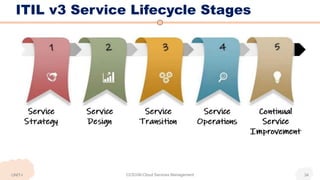
Cloud Service Management
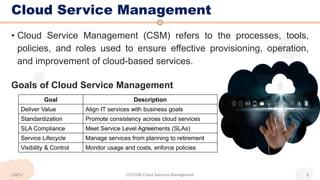
•Cloud Service Management (CSM) refers to the processes, tools,
policies, and roles used to ensure effective provisioning, operation,
and improvement of cloud-based services.
Goals of Cloud Service Management
Goal Description
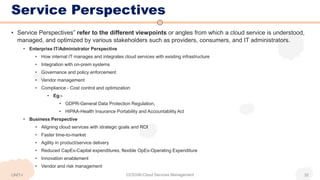
Deliver Value Align IT services with business goals
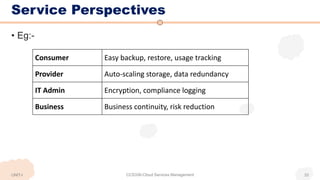
Standardization Promote consistency across cloud services
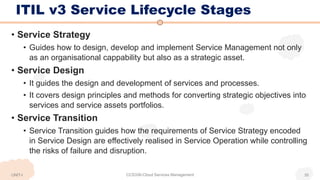
SLA Compliance Meet Service Level Agreements (SLAs)
Service Lifecycle Manage services from planning to retirement
Visibility & Control Monitor usage and costs, enforce policies
CCS336-Cloud Services Management 4
UNIT-I
5.
Cloud Service Management
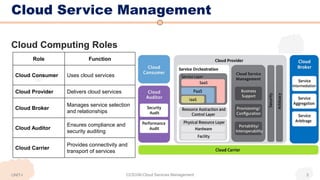
CloudComputing Roles
Role Function
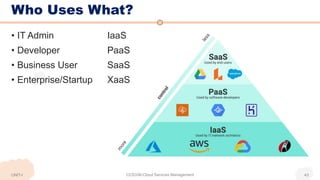
Cloud Consumer Uses cloud services
Cloud Provider Delivers cloud services
Cloud Broker
Manages service selection
and relationships
Cloud Auditor
Ensures compliance and
security auditing
Cloud Carrier
Provides connectivity and
transport of services
CCS336-Cloud Services Management 5
UNIT-I
6.
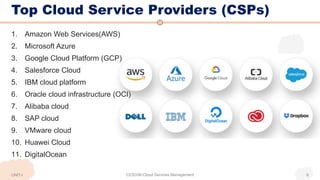
Top Cloud ServiceProviders (CSPs)
1. Amazon Web Services(AWS)
2. Microsoft Azure
3. Google Cloud Platform (GCP)
4. Salesforce Cloud
5. IBM cloud platform
6. Oracle cloud infrastructure (OCI)
7. Alibaba cloud
8. SAP cloud
9. VMware cloud
10. Huawei Cloud
11. DigitalOcean
CCS336-Cloud Services Management 6
UNIT-I
7.
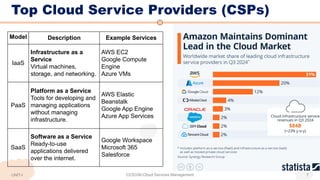
Top Cloud ServiceProviders (CSPs)
UNIT-I CCS336-Cloud Services Management 7
Model Description Example Services
IaaS
Infrastructure as a
Service
Virtual machines,
storage, and networking.
AWS EC2
Google Compute
Engine
Azure VMs
PaaS
Platform as a Service
Tools for developing and
managing applications
without managing
infrastructure.
AWS Elastic
Beanstalk
Google App Engine
Azure App Services
SaaS
Software as a Service
Ready-to-use
applications delivered
over the internet.
Google Workspace
Microsoft 365
Salesforce
8.
Cloud Ecosystem
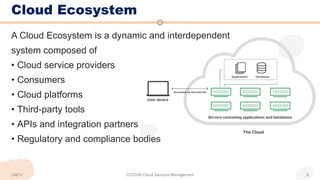
A CloudEcosystem is a dynamic and interdependent
system composed of
• Cloud service providers
• Consumers
• Cloud platforms
• Third-party tools
• APIs and integration partners
• Regulatory and compliance bodies
CCS336-Cloud Services Management 8
UNIT-I
9.
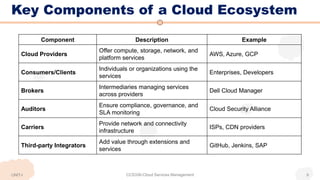
Key Components ofa Cloud Ecosystem
Component Description Example
Cloud Providers
Offer compute, storage, network, and
platform services
AWS, Azure, GCP
Consumers/Clients
Individuals or organizations using the
services
Enterprises, Developers
Brokers
Intermediaries managing services
across providers
Dell Cloud Manager
Auditors
Ensure compliance, governance, and
SLA monitoring
Cloud Security Alliance
Carriers
Provide network and connectivity
infrastructure
ISPs, CDN providers
Third-party Integrators
Add value through extensions and
services
GitHub, Jenkins, SAP
CCS336-Cloud Services Management 9
UNIT-I
10.
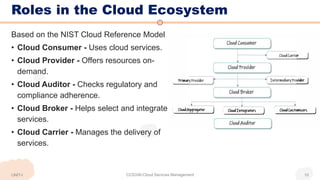
Roles in theCloud Ecosystem
Based on the NIST Cloud Reference Model
• Cloud Consumer - Uses cloud services.
• Cloud Provider - Offers resources on-
demand.
• Cloud Auditor - Checks regulatory and
compliance adherence.
• Cloud Broker - Helps select and integrate
services.
• Cloud Carrier - Manages the delivery of
services.
CCS336-Cloud Services Management 10
UNIT-I
11.
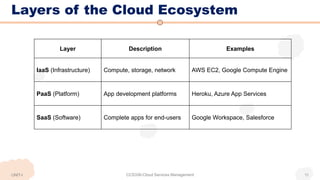
Layers of theCloud Ecosystem
Layer Description Examples
IaaS (Infrastructure) Compute, storage, network AWS EC2, Google Compute Engine
PaaS (Platform) App development platforms Heroku, Azure App Services
SaaS (Software) Complete apps for end-users Google Workspace, Salesforce
CCS336-Cloud Services Management 11
UNIT-I
12.
Essential Characteristics
• TheNational Institute of Standards and Technology (NIST) defines
five essential characteristics that distinguish cloud computing from
traditional IT environments. These are widely accepted in both
industry and academia.
1. On-Demand Self-Service
2. Broad Network Access
3. Resource Pooling
4. Rapid Elasticity
5. Measured Service
CCS336-Cloud Services Management 12
UNIT-I
13.
On-Demand Self-Service
• Userscan provision computing resources like server time and storage
automatically, without human interaction with the provider.
• Eg:-
• Launching a VM instance in AWS EC2 without calling support.
Benefits:
• Faster deployment
• User empowerment
• Reduces administrative burden
CCS336-Cloud Services Management 13
UNIT-I
14.
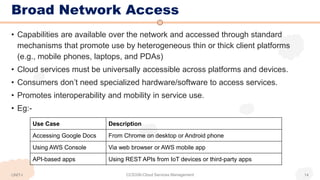
Broad Network Access
•Capabilities are available over the network and accessed through standard
mechanisms that promote use by heterogeneous thin or thick client platforms
(e.g., mobile phones, laptops, and PDAs)
• Cloud services must be universally accessible across platforms and devices.
• Consumers don’t need specialized hardware/software to access services.
• Promotes interoperability and mobility in service use.
• Eg:-
Use Case Description
Accessing Google Docs From Chrome on desktop or Android phone
Using AWS Console Via web browser or AWS mobile app
API-based apps Using REST APIs from IoT devices or third-party apps
CCS336-Cloud Services Management 14
UNIT-I
15.
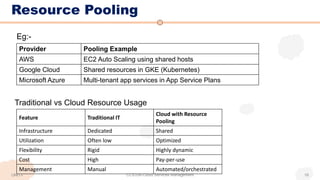
Resource Pooling
• Theprovider’s computing resources are pooled to serve multiple
consumers using a multi-tenant model, with different physical and
virtual resources dynamically assigned and reassigned according to
consumer demand.
• Cloud providers aggregate and share resources (compute, storage,
memory, network) among multiple customers dynamically, leading to
efficiency, elasticity, and cost optimization.
• Multiple users (tenants) share the same physical infrastructure but
operate in logically isolated environments.
• Resources are provisioned and deprovisioned automatically using
hypervisors, orchestrators, and container platforms.
CCS336-Cloud Services Management 15
UNIT-I
16.
Resource Pooling
Provider PoolingExample
AWS EC2 Auto Scaling using shared hosts
Google Cloud Shared resources in GKE (Kubernetes)
Microsoft Azure Multi-tenant app services in App Service Plans
Eg:-
Feature Traditional IT
Cloud with Resource
Pooling
Infrastructure Dedicated Shared
Utilization Often low Optimized
Flexibility Rigid Highly dynamic
Cost High Pay-per-use
Management Manual Automated/orchestrated
Traditional vs Cloud Resource Usage
CCS336-Cloud Services Management 16
UNIT-I
17.
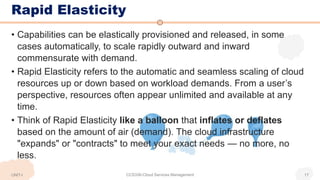
• Capabilities canbe elastically provisioned and released, in some
cases automatically, to scale rapidly outward and inward
commensurate with demand.
• Rapid Elasticity refers to the automatic and seamless scaling of cloud
resources up or down based on workload demands. From a user’s
perspective, resources often appear unlimited and available at any
time.
• Think of Rapid Elasticity like a balloon that inflates or deflates
based on the amount of air (demand). The cloud infrastructure
"expands" or "contracts" to meet your exact needs — no more, no
less.
Rapid Elasticity
CCS336-Cloud Services Management 17
UNIT-I
18.
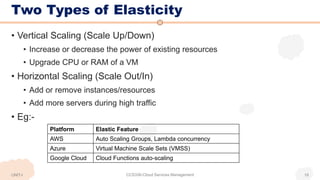
Two Types ofElasticity
• Vertical Scaling (Scale Up/Down)
• Increase or decrease the power of existing resources
• Upgrade CPU or RAM of a VM
• Horizontal Scaling (Scale Out/In)
• Add or remove instances/resources
• Add more servers during high traffic
• Eg:-
UNIT-I CCS336-Cloud Services Management 18
Platform Elastic Feature
AWS Auto Scaling Groups, Lambda concurrency
Azure Virtual Machine Scale Sets (VMSS)
Google Cloud Cloud Functions auto-scaling
19.
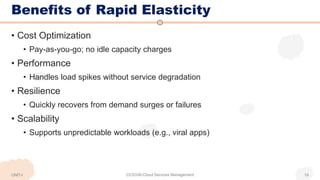
Benefits of RapidElasticity
• Cost Optimization
• Pay-as-you-go; no idle capacity charges
• Performance
• Handles load spikes without service degradation
• Resilience
• Quickly recovers from demand surges or failures
• Scalability
• Supports unpredictable workloads (e.g., viral apps)
UNIT-I CCS336-Cloud Services Management 19
20.
Measured Service
• Cloudsystems automatically control and optimize resource use by
leveraging a metering capability at some level of abstraction
appropriate to the type of service.
• Measured Service means that every resource usage in the cloud is
monitored, controlled, reported, and billed. This is fundamental to pay-
as-you-go and cloud cost transparency models.
UNIT-I CCS336-Cloud Services Management 20
21.
Information Technology ServiceManagement
What is IT Service Management (ITSM)?
• ITSM is a disciplined approach to designing, delivering, managing,
and improving the way IT services are used in organizations, to meet
business goals and customer needs.
• Delivering value to customers
• Managing the end-to-end lifecycle of IT services
• Aligning IT with business processes
• It ensures IT services align with business needs
• It's process-oriented, focusing on service delivery and continual
improvement.
UNIT-I CCS336-Cloud Services Management 21
22.
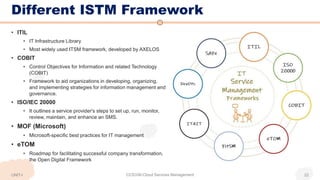
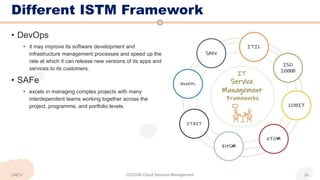
Different ISTM Framework
•ITIL
• IT Infrastructure Library
• Most widely used ITSM framework, developed by AXELOS
• COBIT
• Control Objectives for Information and related Technology
(COBIT)
• Framework to aid organizations in developing, organizing,
and implementing strategies for information management and
governance.
• ISO/IEC 20000
• It outlines a service provider's steps to set up, run, monitor,
review, maintain, and enhance an SMS.
• MOF (Microsoft)
• Microsoft-specific best practices for IT management
• eTOМ
• Roadmap for facilitating successful company transformation,
the Open Digital Framework
UNIT-I CCS336-Cloud Services Management 22
23.
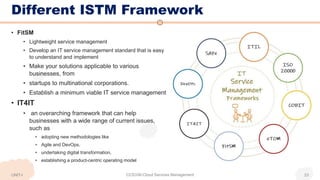
Different ISTM Framework
•FitSM
• Lightweight service management
• Develop an IT service management standard that is easy
to understand and implement
• Make your solutions applicable to various
businesses, from
• startups to multinational corporations.
• Establish a minimum viable IT service management
• IT4IT
• an overarching framework that can help
businesses with a wide range of current issues,
such as
• adopting new methodologies like
• Agile and DevOps,
• undertaking digital transformation,
• establishing a product-centric operating model
UNIT-I CCS336-Cloud Services Management 23
24.
Different ISTM Framework
•DevOps
• it may improve its software development and
infrastructure management processes and speed up the
rate at which it can release new versions of its apps and
services to its customers.
• SAFe
• excels in managing complex projects with many
interdependent teams working together across the
project, programme, and portfolio levels.
UNIT-I CCS336-Cloud Services Management 24
25.
Goals of ITSM
•Align IT with Business
• Ensure IT services support business objectives
• Standardize Processes
• Define repeatable and efficient workflows
• Improve Service Quality
• Reduce downtime and improve performance
• Reduce Costs
• Optimize resources, avoid over-provisioning
• Enhance User Experience
• Faster issue resolution, better service access
UNIT-I CCS336-Cloud Services Management 25
26.
ITSM Processes
• ServiceStrategy
• Define service offerings, value creation
• Service Design
• Design services, SLAs, availability, capacity
• Service Transition
• Change management, release, configuration
• Service Operation
• Incident management, problem solving, service desk
• Continual Service Improvement (CSI)
• Metrics, reporting, feedback loops
UNIT-I CCS336-Cloud Services Management 26
27.
Benefits of ITSM
•Improved efficiency
• Repeatable processes save time and reduce errors
• Better service quality
• Consistent SLAs and faster resolution
• Clear communication
• Defined roles, responsibilities, escalation paths
• Performance visibility
• Dashboards and reports for management
• Lower operational costs
• Through automation and optimized usage
UNIT-I CCS336-Cloud Services Management 27
28.
Cloud Service Management(CSM)
• A cloud service is a service that exists in the cloud and is offered
through the internet.
• It refers to the end-to-end management of cloud-based services,
ensuring that service delivery, monitoring, optimization, and
governance align with business and technical goals.
• CSM involves managing the lifecycle of cloud services through
planning, delivery, operation, and retirement while ensuring
performance, compliance, and cost-efficiency.
UNIT-I CCS336-Cloud Services Management 28
29.
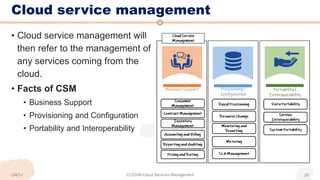
Cloud service management
•Cloud service management will
then refer to the management of
any services coming from the
cloud.
• Facts of CSM
• Business Support
• Provisioning and Configuration
• Portability and Interoperability
UNIT-I CCS336-Cloud Services Management 29
30.
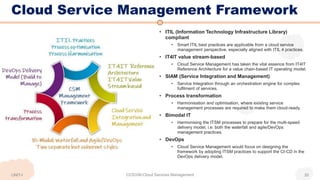
Cloud Service ManagementFramework
UNIT-I CCS336-Cloud Services Management 30
• ITIL (Information Technology Infrastructure Library)
compliant
• Smart ITIL best practices are applicable from a cloud service
management perspective, especially aligned with ITIL 4 practices.
• IT4IT value stream-based
• Cloud Service Management has taken the vital essence from IT4IT
Reference Architecture for a value chain-based IT operating model.
• SIAM (Service Integration and Management)
• Service Integration through an orchestration engine for complex
fulfilment of services.
• Process transformation
• Harmonisation and optimisation, where existing service
management processes are required to make them cloud-ready.
• Bimodal IT
• Harmonising the ITSM processes to prepare for the multi-speed
delivery model, i.e. both the waterfall and agile/DevOps
management practices.
• DevOps
• Cloud Service Management would focus on designing the
framework by adopting ITSM practices to support the CI-CD in the
DevOps delivery model.
31.
Service Perspectives
UNIT-I CCS336-CloudServices Management 31
• Service Perspectives” refer to the different viewpoints or angles from which a cloud service is
understood, managed, and optimized by various stakeholders such as providers, consumers, and
IT administrators.
• Consumer Perspective
• How end-users view and experience the service
• Simplicity & usability
• Performance
• Customization
• Billing transparency
• Service Level Agreements (SLAs)
• Provider Perspective
• How the cloud provider manages, delivers, and optimizes the service
• Service provisioning and orchestration
• Monitoring, metering, and reporting
• Multi-tenancy management
• Automation and scalability
• Compliance and security controls
32.
Service Perspectives
UNIT-I CCS336-CloudServices Management 32
• Service Perspectives” refer to the different viewpoints or angles from which a cloud service is understood,
managed, and optimized by various stakeholders such as providers, consumers, and IT administrators.
• Enterprise IT/Administrator Perspective
• How internal IT manages and integrates cloud services with existing infrastructure
• Integration with on-prem systems
• Governance and policy enforcement
• Vendor management
• Compliance - Cost control and optimization
• Eg:-
• GDPR-General Data Protection Regulation,
• HIPAA-Health Insurance Portability and Accountability Act
• Business Perspective
• Aligning cloud services with strategic goals and ROI
• Faster time-to-market
• Agility in product/service delivery
• Reduced CapEx-Capital expenditures, flexible OpEx-Operating Expenditure
• Innovation enablement
• Vendor and risk management
33.
Service Perspectives
UNIT-I CCS336-CloudServices Management 33
• Eg:-
Consumer Easy backup, restore, usage tracking
Provider Auto-scaling storage, data redundancy
IT Admin Encryption, compliance logging
Business Business continuity, risk reduction
ITIL v3 ServiceLifecycle Stages
• Service Strategy
• Guides how to design, develop and implement Service Management not only
as an organisational capраbility but also as a strategic asset.
• Service Design
• It guides the design and development of services and processes.
• It covers design principles and methods for converting strategic objectives into
services and service assets portfolios.
• Service Transition
• Service Transition guides how the requirements of Service Strategy encoded
in Service Design are effectively realised in Service Operation while controlling
the risks of failure and disruption.
UNIT-I CCS336-Cloud Services Management 35
36.
ITIL v3 ServiceLifecycle Stages
• Service Operation
• Service Operations embodies practices in the management of Service
Operation.
• It includes guidance on achieving effectiveness and efficiency in delivering and
supporting services to ensure value for the customer and the service provider.
• Continual Service Improvement
• It provides instrumental guidance in creating and maintaining customer value
through better design, introduction and operation of services.
UNIT-I CCS336-Cloud Services Management 36
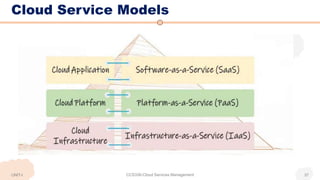
Infrastructure-as-a-Service (IaaS)
• Thisbase layer provides capabilities such as storage, networks, and
other fundamental computing resources.
• AWS Elastic Computer Cloud (E2C), Azure Virtual Machines,IBM
Cloud, and Google Compute Engine are the most protuberant
examples of Iaas.
UNIT-I CCS336-Cloud Services Management 38
39.
Platform-as-a-Service (PaaS)
• Theability to deploy locally developed or purchased apps written in
any language, library, service, or tool available in the cloud is made
possible by this feature.
• Platform-as-a-service solutions include Amazon Elastic Beanstalk,
Microsoft Azure Web App, and Google App Engine.
UNIT-I CCS336-Cloud Services Management 39
40.
Software-as-a-Service (SaaS)
• Thinclient interfaces, such as a web browser (for example, web-
based e-mail), or programme interfaces, allow the programmes to be
accessed from various client devices.
• Among the most well-known SaaS companies are Salesforce,
Workday, ServiceNow, and Slack.
• Popular software companies, including Microsoft, Adobe, SAP, Oracle,
and Autodesk, have SaaS options.
UNIT-I CCS336-Cloud Services Management 40
41.
Anything as aService (XaaS)
• The umbrella term "XaaS" describes any methodology for providing a
service in the cloud. Inother words, XaaS refers to "everything" as a
service.
• XaaS encompasses various cloudbased services that can be
utilised on a pay-as-you-go or subscription basis.
• Instead of purchasing X as a solution, you can pay to access X’s
features through XaaS.
• It's not unlike renting the specific technological capabilities you
require. For as long as you require the service, you pay a monthly
subscription, but you never actually own the product.
UNIT-I CCS336-Cloud Services Management 41
42.
Anything as aService (XaaS)
• XaaS is an umbrella term that refers to any service that can be
delivered over the internet instead of being hosted on-premises.
• It includes:
• FaaS – Function as a Service (e.g., AWS Lambda)
• DBaaS – Database as a Service (e.g., Firebase, Amazon RDS)
• BaaS – Backend as a Service (e.g., Parse, Backendless)
• AIaaS – Artificial Intelligence as a Service (e.g., IBM Watson)
• NaaS – Network as a Service (e.g., Megaport, Aryaka)
UNIT-I CCS336-Cloud Services Management 42
43.
Who Uses What?
•IT Admin IaaS
• Developer PaaS
• Business User SaaS
• Enterprise/Startup XaaS
UNIT-I CCS336-Cloud Services Management 43
44.
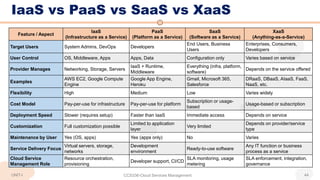
IaaS vs PaaSvs SaaS vs XaaS
Feature / Aspect
IaaS
(Infrastructure as a Service)
PaaS
(Platform as a Service)
SaaS
(Software as a Service)
XaaS
(Anything-as-a-Service)
Target Users System Admins, DevOps Developers
End Users, Business
Users
Enterprises, Consumers,
Developers
User Control OS, Middleware, Apps Apps, Data Configuration only Varies based on service
Provider Manages Networking, Storage, Servers
IaaS + Runtime,
Middleware
Everything (infra, platform,
software)
Depends on the service offered
Examples
AWS EC2, Google Compute
Engine
Google App Engine,
Heroku
Gmail, Microsoft 365,
Salesforce
DRaaS, DBaaS, AIaaS, FaaS,
NaaS, etc.
Flexibility High Medium Low Varies widely
Cost Model Pay-per-use for infrastructure Pay-per-use for platform
Subscription or usage-
based
Usage-based or subscription
Deployment Speed Slower (requires setup) Faster than IaaS Immediate access Depends on service
Customization Full customization possible
Limited to application
layer
Very limited
Depends on provider/service
type
Maintenance by User Yes (OS, apps) Yes (apps only) No Varies
Service Delivery Focus
Virtual servers, storage,
networks
Development
environment
Ready-to-use software
Any IT function or business
process as a service
Cloud Service
Management Role
Resource orchestration,
provisioning
Developer support, CI/CD
SLA monitoring, usage
metering
SLA enforcement, integration,
governance
UNIT-I CCS336-Cloud Services Management 44
45.
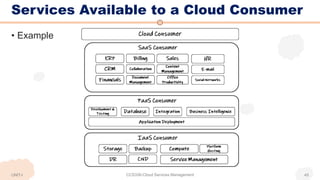
Services Available toa Cloud Consumer
• Example
UNIT-I CCS336-Cloud Services Management 45
46.
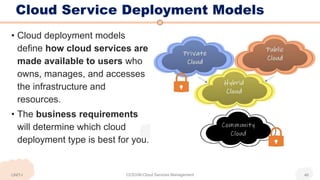
Cloud Service DeploymentModels
• Cloud deployment models
define how cloud services are
made available to users who
owns, manages, and accesses
the infrastructure and
resources.
• The business requirements
will determine which cloud
deployment type is best for you.
UNIT-I CCS336-Cloud Services Management 46
47.
Private Cloud
• Thecloud infrastructure built and provisioned solely for the private use
of a single organisation is called "Private Cloud".
• It can be owned and managed by the organization that uses it or by a
third party and can be hosted on the owner's or consumer's premises.
• It can also be a dedicated platform in a public cloud environment for
your organisation only.
• Suitable For:
• Banks, government agencies, Organizations with regulatory requirements
• Eg:-
• VMware vCloud, OpenStack deployments
UNIT-I CCS336-Cloud Services Management 47
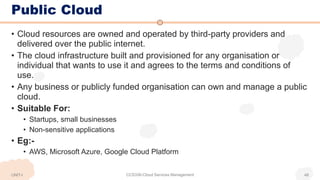
48.
Public Cloud
• Cloudresources are owned and operated by third-party providers and
delivered over the public internet.
• The cloud infrastructure built and provisioned for any organisation or
individual that wants to use it and agrees to the terms and conditions of
use.
• Any business or publicly funded organisation can own and manage a public
cloud.
• Suitable For:
• Startups, small businesses
• Non-sensitive applications
• Eg:-
• AWS, Microsoft Azure, Google Cloud Platform
UNIT-I CCS336-Cloud Services Management 48
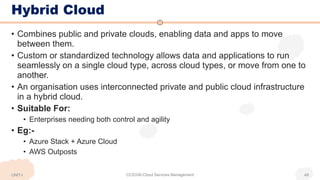
49.
Hybrid Cloud
• Combinespublic and private clouds, enabling data and apps to move
between them.
• Custom or standardized technology allows data and applications to run
seamlessly on a single cloud type, across cloud types, or move from one to
another.
• An organisation uses interconnected private and public cloud infrastructure
in a hybrid cloud.
• Suitable For:
• Enterprises needing both control and agility
• Eg:-
• Azure Stack + Azure Cloud
• AWS Outposts
UNIT-I CCS336-Cloud Services Management 49
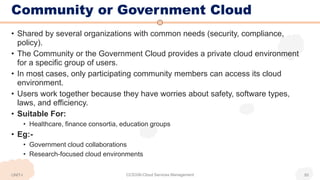
50.
Community or GovernmentCloud
• Shared by several organizations with common needs (security, compliance,
policy).
• The Community or the Government Cloud provides a private cloud environment
for a specific group of users.
• In most cases, only participating community members can access its cloud
environment.
• Users work together because they have worries about safety, software types,
laws, and efficiency.
• Suitable For:
• Healthcare, finance consortia, education groups
• Eg:-
• Government cloud collaborations
• Research-focused cloud environments
UNIT-I CCS336-Cloud Services Management 50
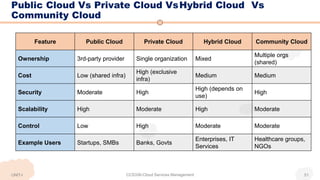
51.
Public Cloud VsPrivate Cloud VsHybrid Cloud Vs
Community Cloud
Feature Public Cloud Private Cloud Hybrid Cloud Community Cloud
Ownership 3rd-party provider Single organization Mixed
Multiple orgs
(shared)
Cost Low (shared infra)
High (exclusive
infra)
Medium Medium
Security Moderate High
High (depends on
use)
High
Scalability High Moderate High Moderate
Control Low High Moderate Moderate
Example Users Startups, SMBs Banks, Govts
Enterprises, IT
Services
Healthcare groups,
NGOs
UNIT-I CCS336-Cloud Services Management 51
52.
References
Text Book
• CloudService Management and Governance: Smart Service Management in Cloud Era by Enamul Haque, Enel
Publications.
• Cloud Computing: Concepts, Technology & Architecture by Thomas Erl, Ricardo Puttini, Zaigham Mohammad 2013.
Online
• https://www.datamation.com/cloud/cloud-service-providers/
• https://www.softwebsolutions.com/resources/top-cloud-service-providers.html
• https://www.youtube.com/watch?v=A3FPxuKlnkU&t=2s
• https://onlinecourses.nptel.ac.in/noc21_cs14/preview
• https://www.computersciencejunction.in/2021/11/16/nist-cloud-computing-reference-architecture/
• https://www.emma.ms/blog/top-10-cloud-computing-service-providers
CCS336-Cloud Services Management 52
UNIT-I