Cloud Computing
Introduction
 Google has something called Google Drive,Microsoft have OneDrive(earlier
Skydrive and now Microsoft Azure), Amazon having something like EC2
(Elastic Compute Cloud) and many others likewise. All these belong to the
rapidly growing technology called Cloud Computing.
 Here we are going to a brief description of following terms related to Cloud
Computing :-
Definition of Cloud Computing
History of Cloud Computing
Essential Cloud Characteristics
Benefits of Cloud Computing
Cloud Models and Classification
Major Cloud Service Providers
Security Issues In Cloud Computing Demerits
of Cloud Model etc.
Definition
• A style of computing in which massively scalable IT related capabilities are
provided "as a Service" using internet technology, to multiple external
customers.
...Gartner
• Cloud Computing is a large scale distributed computing paradigm that is
driven by economies of scale in which a pool is abstracted, virtualized,
dynamically scalable, managed computing power, storage, platform and
services are delivered on demand to external customers over the internet.
...Ian Foster
• Cloud Computing is using internet to access someone else's software running
on someone else's hardware in someone else's datacentre. ...L Cunninghum
• Key Components: Abstraction and Virtualization
History
 In 2006, Amazon provided first Public Cloud -AWS (Amazon Web
Services).
 In later 2006, Google docs came into existence.
 2009 was remarkable year in the history of cloud:
a).Browser based cloud enterprise application developed -
Google Apps working on Chrome.
b).Microsoft entered in Cloud with Windows Azure in later
November.
 Later Office 2013 and 15 based on Cloud services were also developed
by Microsoft.
 Lot of cloud activities and development occured upto now,even if we see
a single company such as Microsoft, it started from Windows Azure,
progressed with Skydrive & Onedrive and now had began the Microsoft
Azure, in the area of cloud based services.
Essential Characteristics
There are five essential characteristics that the cloud computing system offers:1).On-
Demand Self Service
2).Broad Network Access
3).Resource Pooling
4).Rapid Elasticity
5) .Measured Service
1).On-Demand Self Service: A consumer can unilaterally provision computing
capababilities such as service time and network storage as needed
automatically without requiring human interaction with a service provider.
2).Broad Network Access: Access to resources in cloud is available through
standard mechanism that provide use by heterogenous thin or thick platforms
(Example- mobile phone, laptops etc.) as well as other traditional cloudbased
software services
Essential Characteristics(Cont.)
3).Resource Pooling: The cloud service provider's computing resources are
pooled to serve multiple customers using a multi-tenant model with different
physical and virtual resources dynamically assigned and reassigned
according to consumer's demand .
4).Rapid Elasticity: Resources can be rapidly and elastically provisioned- in some
cases automatically- to quick scale out and quickly scale in.To the consumers,
the resources for provisioning often appears to be unlimited and can be
purchased in any quantity at any time.
5).Measured Service: Cloud system automatically controls and optimize
resource usage by employing a metring capability at some level of abstraction
appropriate to the type of service.Resource usage can be monitored,
controlled, and reported-providing transparency for both the users and
providers of the service.
Cloud Types
Cloud services are generally separated into two distinct set of models, which
are further classified as follows:-
1) . Deployment Models
a)Public Cloud
b).Private Cloud
c).Community Cloud
d).Hybrid Cloud
2) . Service Models
a).Infrastructure as a Service(Iaas)
b).Platform as a Service(Paas)
c).Software as a Service(Saas)
The service model is also known as SPI Model.
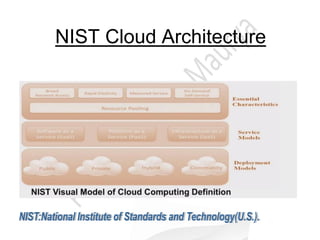
NIST Cloud Architecture
Deployment Models
Deployment model refers the location and management of cloud
infrastructure.In other words, it defines the purpose of the cloud and the
nature of how cloud is located.The four basic deployment models are defined
as follows:
1).Public Cloud: The cloud infrastructure is made available to the general public
or a large industry group and is owned by an organization selling cloud
services.Ex- Amazon, Google, Microsoft, Salesforce.
2).Private Cloud: The cloud infrastructure is operated solely for a single
organization. It may be managed by the organization or a third party and may
exist on-or-off premises.Ex -HP Data Center, IBM, Sun, Oracle.
3).Community Cloud: Cloud infrastructure is shared by several organizations
and supports a specific community that has shared concerns(like
security,mission.policy etc.).It may be managed by the organizations or by a
third party that may exists on-or-off premises.
Deployment Models(Cont.)
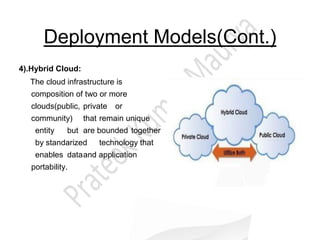
4).Hybrid Cloud:
The cloud infrastructure is
composition of two or more
clouds(public, private or
community) that remain unique
entity but are bounded together
by standarized technology that
enables dataand application
portability.
Service Models
Service model consists of the particular type of services that can be
accessed on a cloud computing platform.This model offer three principle
services(i.e. Infrastructure, Platform and Software) and hence is also popular
as SPI models, whose services are defined as follows:-
1). Infrastructure as a Service(IaaS):
 IaaS provides virtual machines, virtual storage etc that clients can provision.
 Consumer is able to deploy and run arbitrary software which can include
operaing systems and applications.
 The consumer does not manage or control the underlying cloud infrastructure
but has controlover operating system,storage,deployed applications and
possibily limited control over selection of networking components(e.g. host
firewalls).
 Amazon's EC2( Elastic Compute Cloud ) is the largest pure IaaS provider
with Rackspace being it's biggest competitors and many others also exist
such as Eucalyptus, GoGrid, FlexiScale, Linode and Terremark.
Service Model(Contd.)
2).Platform as a Service(PaaS):
 PaaS provides virtual machines, operating systems,application services,
development frameworks, transactions and control structures.
 The capability provided to the consumers is to deploy onto the cloud
infrastructure-the consumer created or acquired applications created using
programming languages and tools supported by the provider.
 The consumer does not manage or control the underlying cloud infrastructure
including network,services, operating system or storage but has control over
the deployed applications and possibly application hosting the environment
configuration.
 Some of the examples of PaaS service providers are:- Force.com, GoGrid
CloudCenter, Google AppEngine, Windows Azure Platform.
Service Model(Contd.)
3). Software as a Service(SaaS):
 SaaS is a complete operating environment with applications, management and
the user interface.
 The capability provided to the consumer is to use providers' applications running
on cloud infrastructure.
 The applications are accessible from various client devices through a thin client
interface such as a web browser.
 The consumer does not manage or control the underlying cloud infrastructure
including networks, services, operating systems, storage or even application
capabilities with possible exception of limited user specific configuration settings.
 Some of the examples of Saas cloud service providers are: GoogleApps, Oracle
On Demand, SalesForce.com, SQL Azure.
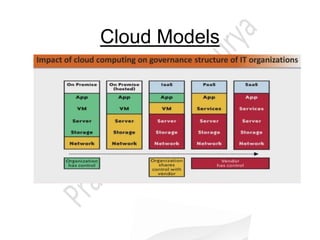
Cloud Models
Benefits of Cloud Computing
There are several benefits of usage of cloud computing which are classified into
two main areas are as follows:
1).Business Benefits
i) Almost-zero upfront infrastructure
investment ii) Just in Time Infrastructure iii)
More efficient resource utilization iv) Usage
Based Costing
v) Reduced Time to Market
2).Technical Benefits
i) Automation-"Scriptable Infrastructure"
ii) Auto and Proactive Scaling
iii) More effective development lifecycle iv)
Improved testability
v) Disaster Recovery and Business Continuity
Security Issues
Security:
 Assurance of the three pillars of Information Security- CIA(Confidentiality,
Integrity & Availability).
 Proper authorization and authentication.
 Security issues in cloud computing generally aims at minimization of:
a).Third Party Computing
b).Lack of Trust
c).Loss of Control
d).Multi-Tenancy
 For the lookup of security issues and management Cloud Security Alliance is
being organized which has it's own reference working model based on different
level of security boundaries.
Disadvantages
Some of the demerits seen in the area of cloud computing are:
 Cloud services depends on internet connectivity.
 It is impossible to utilize cloud services properly if you do not have internet
connection
 All cloud computing applications suffer from the inherent latency that is intrinsic
in their WAN connectivity.
 In cases applications needs large amount of data transfer, cloud computing may
not be the best model.
 Likewise there are few more such as peoples' fear to use it etc.
References
• Cloud Computing (Bible) by Barrie Sosinky
• Web:
https://onlinecourses.nptel.ac.in/noc15_cs03/unit?unit=23&lesson=2
7

Cloud computing

  • 1.
  • 2.
    Introduction  Google hassomething called Google Drive,Microsoft have OneDrive(earlier Skydrive and now Microsoft Azure), Amazon having something like EC2 (Elastic Compute Cloud) and many others likewise. All these belong to the rapidly growing technology called Cloud Computing.  Here we are going to a brief description of following terms related to Cloud Computing :- Definition of Cloud Computing History of Cloud Computing Essential Cloud Characteristics Benefits of Cloud Computing Cloud Models and Classification Major Cloud Service Providers Security Issues In Cloud Computing Demerits of Cloud Model etc.
  • 3.
    Definition • A styleof computing in which massively scalable IT related capabilities are provided "as a Service" using internet technology, to multiple external customers. ...Gartner • Cloud Computing is a large scale distributed computing paradigm that is driven by economies of scale in which a pool is abstracted, virtualized, dynamically scalable, managed computing power, storage, platform and services are delivered on demand to external customers over the internet. ...Ian Foster • Cloud Computing is using internet to access someone else's software running on someone else's hardware in someone else's datacentre. ...L Cunninghum • Key Components: Abstraction and Virtualization
  • 4.
    History  In 2006,Amazon provided first Public Cloud -AWS (Amazon Web Services).  In later 2006, Google docs came into existence.  2009 was remarkable year in the history of cloud: a).Browser based cloud enterprise application developed - Google Apps working on Chrome. b).Microsoft entered in Cloud with Windows Azure in later November.  Later Office 2013 and 15 based on Cloud services were also developed by Microsoft.  Lot of cloud activities and development occured upto now,even if we see a single company such as Microsoft, it started from Windows Azure, progressed with Skydrive & Onedrive and now had began the Microsoft Azure, in the area of cloud based services.
  • 5.
    Essential Characteristics There arefive essential characteristics that the cloud computing system offers:1).On- Demand Self Service 2).Broad Network Access 3).Resource Pooling 4).Rapid Elasticity 5) .Measured Service 1).On-Demand Self Service: A consumer can unilaterally provision computing capababilities such as service time and network storage as needed automatically without requiring human interaction with a service provider. 2).Broad Network Access: Access to resources in cloud is available through standard mechanism that provide use by heterogenous thin or thick platforms (Example- mobile phone, laptops etc.) as well as other traditional cloudbased software services
  • 6.
    Essential Characteristics(Cont.) 3).Resource Pooling:The cloud service provider's computing resources are pooled to serve multiple customers using a multi-tenant model with different physical and virtual resources dynamically assigned and reassigned according to consumer's demand . 4).Rapid Elasticity: Resources can be rapidly and elastically provisioned- in some cases automatically- to quick scale out and quickly scale in.To the consumers, the resources for provisioning often appears to be unlimited and can be purchased in any quantity at any time. 5).Measured Service: Cloud system automatically controls and optimize resource usage by employing a metring capability at some level of abstraction appropriate to the type of service.Resource usage can be monitored, controlled, and reported-providing transparency for both the users and providers of the service.
  • 7.
    Cloud Types Cloud servicesare generally separated into two distinct set of models, which are further classified as follows:- 1) . Deployment Models a)Public Cloud b).Private Cloud c).Community Cloud d).Hybrid Cloud 2) . Service Models a).Infrastructure as a Service(Iaas) b).Platform as a Service(Paas) c).Software as a Service(Saas) The service model is also known as SPI Model.
  • 8.
  • 9.
    Deployment Models Deployment modelrefers the location and management of cloud infrastructure.In other words, it defines the purpose of the cloud and the nature of how cloud is located.The four basic deployment models are defined as follows: 1).Public Cloud: The cloud infrastructure is made available to the general public or a large industry group and is owned by an organization selling cloud services.Ex- Amazon, Google, Microsoft, Salesforce. 2).Private Cloud: The cloud infrastructure is operated solely for a single organization. It may be managed by the organization or a third party and may exist on-or-off premises.Ex -HP Data Center, IBM, Sun, Oracle. 3).Community Cloud: Cloud infrastructure is shared by several organizations and supports a specific community that has shared concerns(like security,mission.policy etc.).It may be managed by the organizations or by a third party that may exists on-or-off premises.
  • 10.
    Deployment Models(Cont.) 4).Hybrid Cloud: Thecloud infrastructure is composition of two or more clouds(public, private or community) that remain unique entity but are bounded together by standarized technology that enables dataand application portability.
  • 11.
    Service Models Service modelconsists of the particular type of services that can be accessed on a cloud computing platform.This model offer three principle services(i.e. Infrastructure, Platform and Software) and hence is also popular as SPI models, whose services are defined as follows:- 1). Infrastructure as a Service(IaaS):  IaaS provides virtual machines, virtual storage etc that clients can provision.  Consumer is able to deploy and run arbitrary software which can include operaing systems and applications.  The consumer does not manage or control the underlying cloud infrastructure but has controlover operating system,storage,deployed applications and possibily limited control over selection of networking components(e.g. host firewalls).  Amazon's EC2( Elastic Compute Cloud ) is the largest pure IaaS provider with Rackspace being it's biggest competitors and many others also exist such as Eucalyptus, GoGrid, FlexiScale, Linode and Terremark.
  • 12.
    Service Model(Contd.) 2).Platform asa Service(PaaS):  PaaS provides virtual machines, operating systems,application services, development frameworks, transactions and control structures.  The capability provided to the consumers is to deploy onto the cloud infrastructure-the consumer created or acquired applications created using programming languages and tools supported by the provider.  The consumer does not manage or control the underlying cloud infrastructure including network,services, operating system or storage but has control over the deployed applications and possibly application hosting the environment configuration.  Some of the examples of PaaS service providers are:- Force.com, GoGrid CloudCenter, Google AppEngine, Windows Azure Platform.
  • 13.
    Service Model(Contd.) 3). Softwareas a Service(SaaS):  SaaS is a complete operating environment with applications, management and the user interface.  The capability provided to the consumer is to use providers' applications running on cloud infrastructure.  The applications are accessible from various client devices through a thin client interface such as a web browser.  The consumer does not manage or control the underlying cloud infrastructure including networks, services, operating systems, storage or even application capabilities with possible exception of limited user specific configuration settings.  Some of the examples of Saas cloud service providers are: GoogleApps, Oracle On Demand, SalesForce.com, SQL Azure.
  • 14.
  • 15.
    Benefits of CloudComputing There are several benefits of usage of cloud computing which are classified into two main areas are as follows: 1).Business Benefits i) Almost-zero upfront infrastructure investment ii) Just in Time Infrastructure iii) More efficient resource utilization iv) Usage Based Costing v) Reduced Time to Market 2).Technical Benefits i) Automation-"Scriptable Infrastructure" ii) Auto and Proactive Scaling iii) More effective development lifecycle iv) Improved testability v) Disaster Recovery and Business Continuity
  • 16.
    Security Issues Security:  Assuranceof the three pillars of Information Security- CIA(Confidentiality, Integrity & Availability).  Proper authorization and authentication.  Security issues in cloud computing generally aims at minimization of: a).Third Party Computing b).Lack of Trust c).Loss of Control d).Multi-Tenancy  For the lookup of security issues and management Cloud Security Alliance is being organized which has it's own reference working model based on different level of security boundaries.
  • 17.
    Disadvantages Some of thedemerits seen in the area of cloud computing are:  Cloud services depends on internet connectivity.  It is impossible to utilize cloud services properly if you do not have internet connection  All cloud computing applications suffer from the inherent latency that is intrinsic in their WAN connectivity.  In cases applications needs large amount of data transfer, cloud computing may not be the best model.  Likewise there are few more such as peoples' fear to use it etc.
  • 18.
    References • Cloud Computing(Bible) by Barrie Sosinky • Web: https://onlinecourses.nptel.ac.in/noc15_cs03/unit?unit=23&lesson=2 7