1
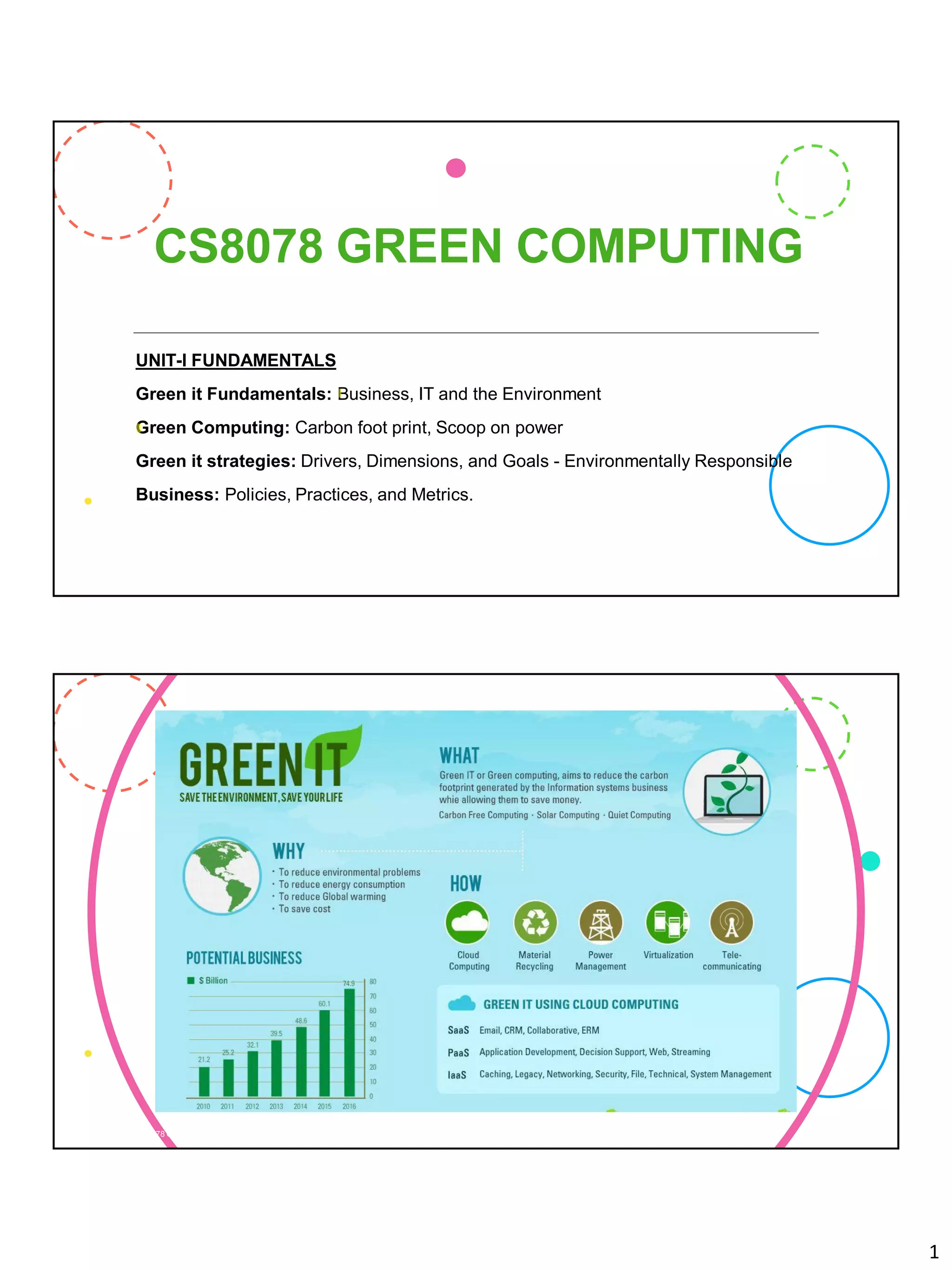
CS8078 GREEN COMPUTING
UNIT-I FUNDAMENTALS
Green it Fundamentals: Business, IT and the Environment
Green Computing: Carbon foot print, Scoop on power
Green it strategies: Drivers, Dimensions, and Goals - Environmentally Responsible
Business: Policies, Practices, and Metrics.
CS8078 GREEN COMPUTING 2
2
▪ Green computing is the environmentally responsible and eco-friendly use
of computers and their resources.
▪ It is also defined as the study of designing, manufacturing/engineering, using and
disposing of computing devices in a way that reduces their environmental impact.
▪ It is also called as Green IT
CS8078 GREEN COMPUTING 3
INTRODUCTION
▪ Green computing was Originated in 1992
at the U.S Environmental Protection
Agency that launched Energy Star
program.
▪ Shortly after that the term “Green
Computing” was coined.
HISTORY
CS8078 GREEN COMPUTING 4
3
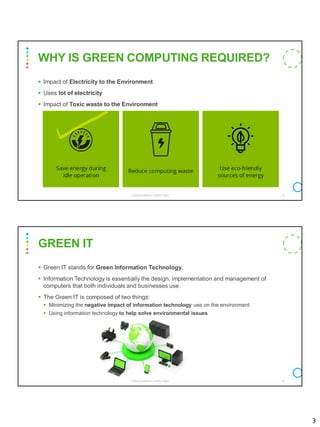
▪ Impact of Electricity to the Environment
▪ Uses lot of electricity
▪ Impact of Toxic waste to the Environment
CS8078 GREEN COMPUTING 5
WHY IS GREEN COMPUTING REQUIRED?
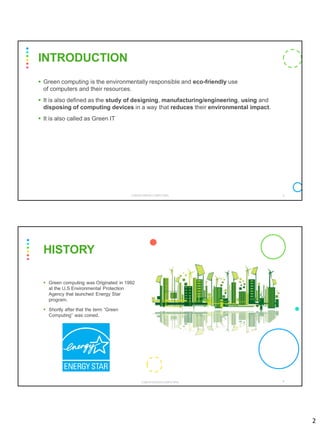
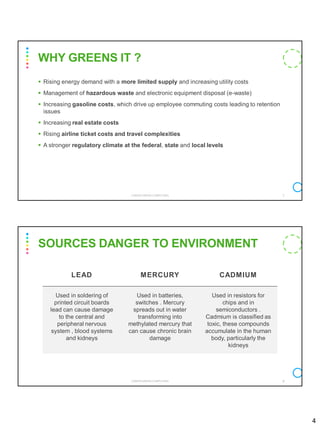
▪ Green IT stands for Green Information Technology.
▪ Information Technology is essentially the design, implementation and management of
computers that both individuals and businesses use.
▪ The Green IT is composed of two things:
▪ Minimizing the negative impact of information technology use on the environment
▪ Using information technology to help solve environmental issues
CS8078 GREEN COMPUTING 6
GREEN IT
4
▪ Rising energy demand with a more limited supply and increasing utility costs
▪ Management of hazardous waste and electronic equipment disposal (e-waste)
▪ Increasing gasoline costs, which drive up employee commuting costs leading to retention
issues
▪ Increasing real estate costs
▪ Rising airline ticket costs and travel complexities
▪ A stronger regulatory climate at the federal, state and local levels
CS8078 GREEN COMPUTING 7
WHY GREENS IT ?
LEAD MERCURY CADMIUM
Used in soldering of
printed circuit boards
lead can cause damage
to the central and
peripheral nervous
system , blood systems
and kidneys
Used in batteries,
switches . Mercury
spreads out in water
transforming into
methylated mercury that
can cause chronic brain
damage
Used in resistors for
chips and in
semiconductors .
Cadmium is classified as
toxic, these compounds
accumulate in the human
body, particularly the
kidneys
SOURCES DANGER TO ENVIRONMENT
CS8078 GREEN COMPUTING 8
5
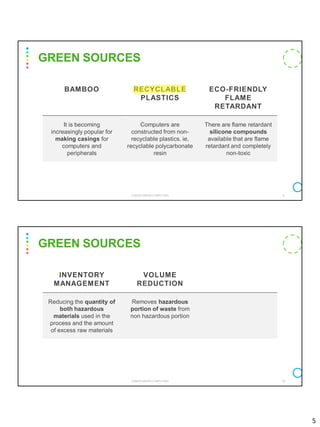
BAMBOO RECYCLABLE
PLASTICS
ECO-FRIENDLY
FLAME
RETARDANT
It is becoming
increasingly popular for
making casings for
computers and
peripherals
Computers are
constructed from non-
recyclable plastics. ie,
recyclable polycarbonate
resin
There are flame retardant
silicone compounds
available that are flame
retardant and completely
non-toxic
GREEN SOURCES
CS8078 GREEN COMPUTING 9
INVENTORY
MANAGEMENT
VOLUME
REDUCTION
Reducing the quantity of
both hazardous
materials used in the
process and the amount
of excess raw materials
Removes hazardous
portion of waste from
non hazardous portion
GREEN SOURCES
CS8078 GREEN COMPUTING 10
6
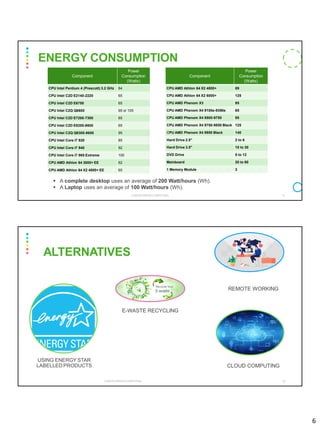
Component
Power
Consumption
(Watts)
CPU Intel Pentium 4 (Prescott) 3.2 GHz 84
CPU Intel C2D E2140-2220 65
CPU Intel C2D E6750 65
CPU Intel C2Q Q6600 95 or 105
CPU Intel C2D E7200-7300 65
CPU Intel C2D E8200-8600 65
CPU Intel C2Q Q9300-9650 95
CPU Intel Core i7 920 85
CPU Intel Core i7 940 92
CPU Intel Core i7 965 Extreme 100
CPU AMD Athlon 64 3800+ EE 62
CPU AMD Athlon 64 X2 4800+ EE 65
CS8078 GREEN COMPUTING 11
ENERGY CONSUMPTION
Component
Power
Consumption
(Watts)
CPU AMD Athlon 64 X2 4800+ 89
CPU AMD Athlon 64 X2 6000+ 125
CPU AMD Phenom X3 95
CPU AMD Phenom X4 9100e-9350e 65
CPU AMD Phenom X4 9500-9750 95
CPU AMD Phenom X4 9750-9850 Black 125
CPU AMD Phenom X4 9950 Black 140
Hard Drive 2.5" 2 to 6
Hard Drive 3.5" 10 to 30
DVD Drive 5 to 12
Mainboard 20 to 60
1 Memory Module 3
▪ A complete desktop uses an average of 200 Watt/hours (Wh).
▪ A Laptop uses an average of 100 Watt/hours (Wh).
USING ENERGY STAR
LABELLED PRODUCTS
E-WASTE RECYCLING
REMOTE WORKING
ALTERNATIVES
CS8078 GREEN COMPUTING 12
CLOUD COMPUTING
7
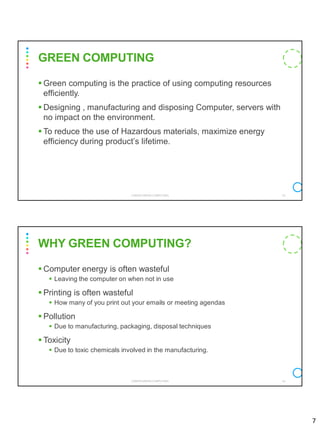
▪ Green computing is the practice of using computing resources
efficiently.
▪ Designing , manufacturing and disposing Computer, servers with
no impact on the environment.
▪ To reduce the use of Hazardous materials, maximize energy
efficiency during product’s lifetime.
CS8078 GREEN COMPUTING 13
GREEN COMPUTING
▪ Computer energy is often wasteful
▪ Leaving the computer on when not in use
▪ Printing is often wasteful
▪ How many of you print out your emails or meeting agendas
▪ Pollution
▪ Due to manufacturing, packaging, disposal techniques
▪ Toxicity
▪ Due to toxic chemicals involved in the manufacturing.
CS8078 GREEN COMPUTING 14
WHY GREEN COMPUTING?
8
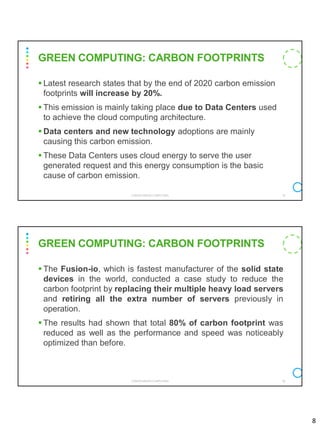
▪ Latest research states that by the end of 2020 carbon emission
footprints will increase by 20%.
▪ This emission is mainly taking place due to Data Centers used
to achieve the cloud computing architecture.
▪ Data centers and new technology adoptions are mainly
causing this carbon emission.
▪ These Data Centers uses cloud energy to serve the user
generated request and this energy consumption is the basic
cause of carbon emission.
CS8078 GREEN COMPUTING 15
GREEN COMPUTING: CARBON FOOTPRINTS
▪ The Fusion-io, which is fastest manufacturer of the solid state
devices in the world, conducted a case study to reduce the
carbon footprint by replacing their multiple heavy load servers
and retiring all the extra number of servers previously in
operation.
▪ The results had shown that total 80% of carbon footprint was
reduced as well as the performance and speed was noticeably
optimized than before.
CS8078 GREEN COMPUTING 16
GREEN COMPUTING: CARBON FOOTPRINTS
9
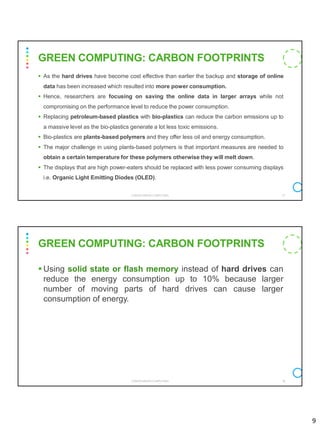
▪ As the hard drives have become cost effective than earlier the backup and storage of online
data has been increased which resulted into more power consumption.
▪ Hence, researchers are focusing on saving the online data in larger arrays while not
compromising on the performance level to reduce the power consumption.
▪ Replacing petroleum-based plastics with bio-plastics can reduce the carbon emissions up to
a massive level as the bio-plastics generate a lot less toxic emissions.
▪ Bio-plastics are plants-based polymers and they offer less oil and energy consumption.
▪ The major challenge in using plants-based polymers is that important measures are needed to
obtain a certain temperature for these polymers otherwise they will melt down.
▪ The displays that are high power-eaters should be replaced with less power consuming displays
i.e. Organic Light Emitting Diodes (OLED).
CS8078 GREEN COMPUTING 17
GREEN COMPUTING: CARBON FOOTPRINTS
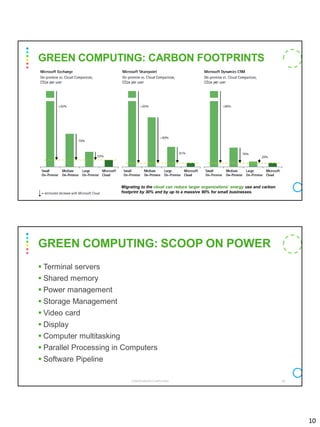
▪ Using solid state or flash memory instead of hard drives can
reduce the energy consumption up to 10% because larger
number of moving parts of hard drives can cause larger
consumption of energy.
CS8078 GREEN COMPUTING 18
GREEN COMPUTING: CARBON FOOTPRINTS
10
CS8078 GREEN COMPUTING 19
GREEN COMPUTING: CARBON FOOTPRINTS
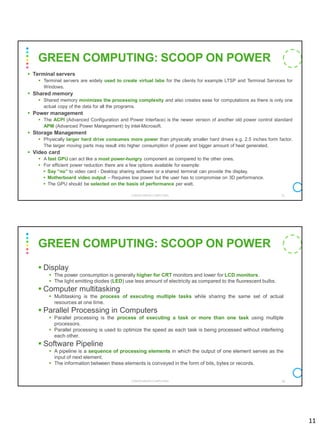
Migrating to the cloud can reduce larger organizations’ energy use and carbon
footprint by 30% and by up to a massive 90% for small businesses.
▪ Terminal servers
▪ Shared memory
▪ Power management
▪ Storage Management
▪ Video card
▪ Display
▪ Computer multitasking
▪ Parallel Processing in Computers
▪ Software Pipeline
CS8078 GREEN COMPUTING 20
GREEN COMPUTING: SCOOP ON POWER
11
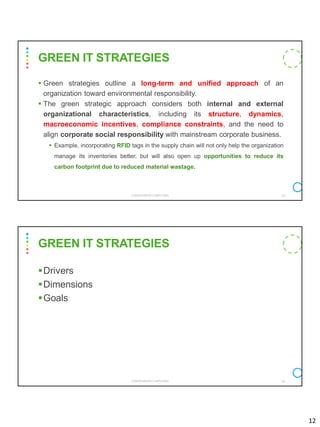
▪ Terminal servers
▪ Terminal servers are widely used to create virtual labs for the clients for example LTSP and Terminal Services for
Windows.
▪ Shared memory
▪ Shared memory minimizes the processing complexity and also creates ease for computations as there is only one
actual copy of the data for all the programs.
▪ Power management
▪ The ACPI (Advanced Configuration and Power Interface) is the newer version of another old power control standard
APM (Advanced Power Management) by Intel-Microsoft.
▪ Storage Management
▪ Physically larger hard drive consumes more power than physically smaller hard drives e.g. 2.5 inches form factor.
The larger moving parts may result into higher consumption of power and bigger amount of heat generated.
▪ Video card
▪ A fast GPU can act like a most power-hungry component as compared to the other ones.
▪ For efficient power reduction there are a few options available for example:
▪ Say “no” to video card - Desktop sharing software or a shared terminal can provide the display.
▪ Motherboard video output – Requires low power but the user has to compromise on 3D performance.
▪ The GPU should be selected on the basis of performance per watt.
CS8078 GREEN COMPUTING 21
GREEN COMPUTING: SCOOP ON POWER
▪ Display
▪ The power consumption is generally higher for CRT monitors and lower for LCD monitors.
▪ The light emitting diodes (LED) use less amount of electricity as compared to the fluorescent bulbs.
▪ Computer multitasking
▪ Multitasking is the process of executing multiple tasks while sharing the same set of actual
resources at one time.
▪ Parallel Processing in Computers
▪ Parallel processing is the process of executing a task or more than one task using multiple
processors.
▪ Parallel processing is used to optimize the speed as each task is being processed without interfering
each other.
▪ Software Pipeline
▪ A pipeline is a sequence of processing elements in which the output of one element serves as the
input of next element.
▪ The information between these elements is conveyed in the form of bits, bytes or records.
CS8078 GREEN COMPUTING 22
GREEN COMPUTING: SCOOP ON POWER
12
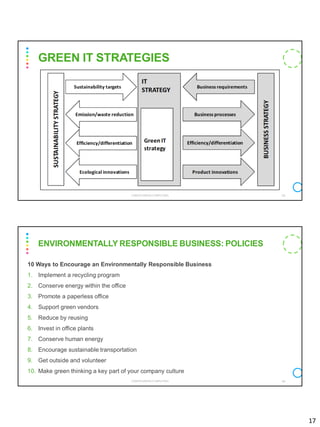
▪ Green strategies outline a long-term and unified approach of an
organization toward environmental responsibility.
▪ The green strategic approach considers both internal and external
organizational characteristics, including its structure, dynamics,
macroeconomic incentives, compliance constraints, and the need to
align corporate social responsibility with mainstream corporate business.
▪ Example, incorporating RFID tags in the supply chain will not only help the organization
manage its inventories better, but will also open up opportunities to reduce its
carbon footprint due to reduced material wastage.
CS8078 GREEN COMPUTING 23
GREEN IT STRATEGIES
▪Drivers
▪Dimensions
▪Goals
CS8078 GREEN COMPUTING 24
GREEN IT STRATEGIES
13
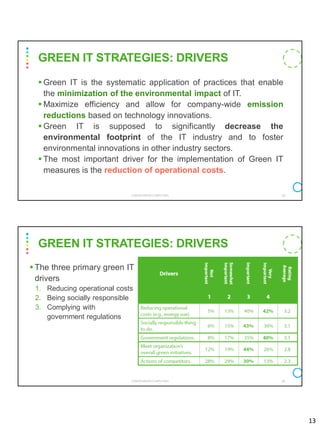
▪ Green IT is the systematic application of practices that enable
the minimization of the environmental impact of IT.
▪ Maximize efficiency and allow for company-wide emission
reductions based on technology innovations.
▪ Green IT is supposed to significantly decrease the
environmental footprint of the IT industry and to foster
environmental innovations in other industry sectors.
▪ The most important driver for the implementation of Green IT
measures is the reduction of operational costs.
CS8078 GREEN COMPUTING 25
GREEN IT STRATEGIES: DRIVERS
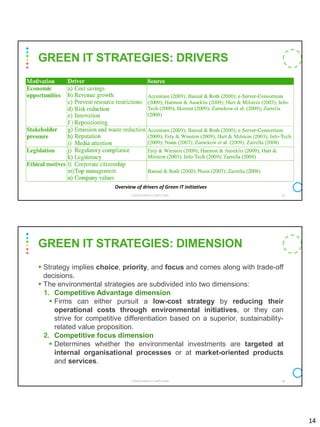
▪ The three primary green IT
drivers
1. Reducing operational costs
2. Being socially responsible
3. Complying with
government regulations
CS8078 GREEN COMPUTING 26
GREEN IT STRATEGIES: DRIVERS
14
CS8078 GREEN COMPUTING 27
GREEN IT STRATEGIES: DRIVERS
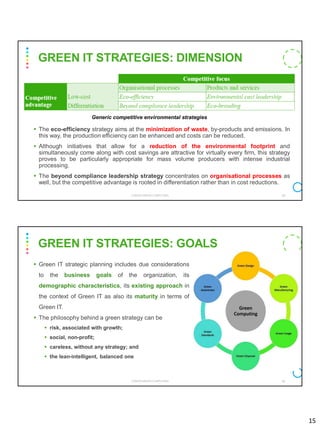
Overview of drivers of Green IT initiatives
▪ Strategy implies choice, priority, and focus and comes along with trade-off
decisions.
▪ The environmental strategies are subdivided into two dimensions:
1. Competitive Advantage dimension
▪ Firms can either pursuit a low-cost strategy by reducing their
operational costs through environmental initiatives, or they can
strive for competitive differentiation based on a superior, sustainability-
related value proposition.
2. Competitive focus dimension
▪ Determines whether the environmental investments are targeted at
internal organisational processes or at market-oriented products
and services.
CS8078 GREEN COMPUTING 28
GREEN IT STRATEGIES: DIMENSION
15
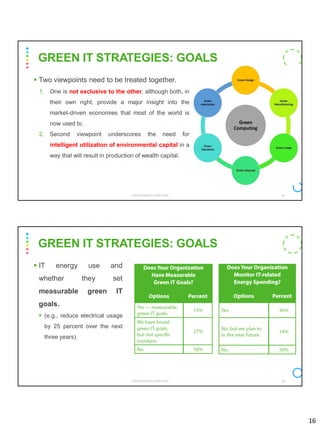
▪ The eco-efficiency strategy aims at the minimization of waste, by-products and emissions. In
this way, the production efficiency can be enhanced and costs can be reduced.
▪ Although initiatives that allow for a reduction of the environmental footprint and
simultaneously come along with cost savings are attractive for virtually every firm, this strategy
proves to be particularly appropriate for mass volume producers with intense industrial
processing.
▪ The beyond compliance leadership strategy concentrates on organisational processes as
well, but the competitive advantage is rooted in differentiation rather than in cost reductions.
CS8078 GREEN COMPUTING 29
GREEN IT STRATEGIES: DIMENSION
Generic competitive environmental strategies
▪ Green IT strategic planning includes due considerations
to the business goals of the organization, its
demographic characteristics, its existing approach in
the context of Green IT as also its maturity in terms of
Green IT.
▪ The philosophy behind a green strategy can be
▪ risk, associated with growth;
▪ social, non-profit;
▪ careless, without any strategy; and
▪ the lean-intelligent, balanced one
CS8078 GREEN COMPUTING 30
GREEN IT STRATEGIES: GOALS
16
▪ Two viewpoints need to be treated together.
1. One is not exclusive to the other, although both, in
their own right, provide a major insight into the
market-driven economies that most of the world is
now used to.
2. Second viewpoint underscores the need for
intelligent utilization of environmental capital in a
way that will result in production of wealth capital.
CS8078 GREEN COMPUTING 31
GREEN IT STRATEGIES: GOALS
▪ IT energy use and
whether they set
measurable green IT
goals.
▪ (e.g., reduce electrical usage
by 25 percent over the next
three years).
CS8078 GREEN COMPUTING 32
GREEN IT STRATEGIES: GOALS
17
CS8078 GREEN COMPUTING 33
GREEN IT STRATEGIES
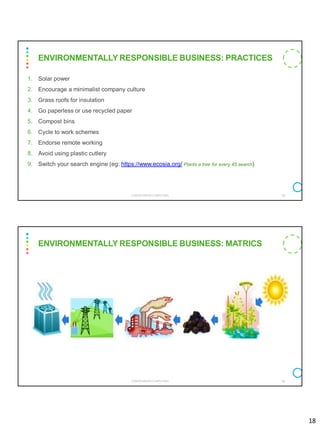
10 Ways to Encourage an Environmentally Responsible Business
1. Implement a recycling program
2. Conserve energy within the office
3. Promote a paperless office
4. Support green vendors
5. Reduce by reusing
6. Invest in office plants
7. Conserve human energy
8. Encourage sustainable transportation
9. Get outside and volunteer
10. Make green thinking a key part of your company culture
CS8078 GREEN COMPUTING 34
ENVIRONMENTALLY RESPONSIBLE BUSINESS: POLICIES
18
1. Solar power
2. Encourage a minimalist company culture
3. Grass roofs for insulation
4. Go paperless or use recycled paper
5. Compost bins
6. Cycle to work schemes
7. Endorse remote working
8. Avoid using plastic cutlery
9. Switch your search engine (eg: https://www.ecosia.org/ Plants a tree for every 45 search)
CS8078 GREEN COMPUTING 35
ENVIRONMENTALLY RESPONSIBLE BUSINESS: PRACTICES
CS8078 GREEN COMPUTING 36
ENVIRONMENTALLY RESPONSIBLE BUSINESS: MATRICS
19
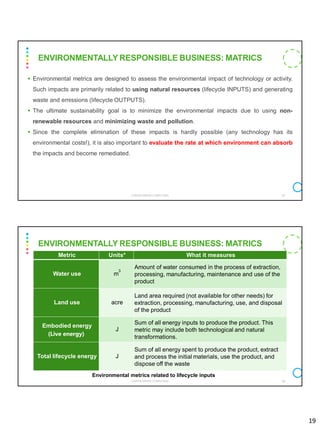
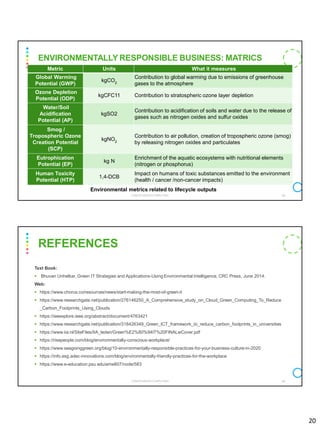
▪ Environmental metrics are designed to assess the environmental impact of technology or activity.
Such impacts are primarily related to using natural resources (lifecycle INPUTS) and generating
waste and emissions (lifecycle OUTPUTS).
▪ The ultimate sustainability goal is to minimize the environmental impacts due to using non-
renewable resources and minimizing waste and pollution.
▪ Since the complete elimination of these impacts is hardly possible (any technology has its
environmental costs!), it is also important to evaluate the rate at which environment can absorb
the impacts and become remediated.
CS8078 GREEN COMPUTING 37
ENVIRONMENTALLY RESPONSIBLE BUSINESS: MATRICS
Metric Units* What it measures
Water use m
3
Amount of water consumed in the process of extraction,
processing, manufacturing, maintenance and use of the
product
Land use acre
Land area required (not available for other needs) for
extraction, processing, manufacturing, use, and disposal
of the product
Embodied energy
(Live energy)
J
Sum of all energy inputs to produce the product. This
metric may include both technological and natural
transformations.
Total lifecycle energy J
Sum of all energy spent to produce the product, extract
and process the initial materials, use the product, and
dispose off the waste
CS8078 GREEN COMPUTING 38
ENVIRONMENTALLY RESPONSIBLE BUSINESS: MATRICS
Environmental metrics related to lifecycle inputs
20
CS8078 GREEN COMPUTING 39
ENVIRONMENTALLY RESPONSIBLE BUSINESS: MATRICS
Environmental metrics related to lifecycle outputs
Metric Units What it measures
Global Warming
Potential (GWP)
kgCO2
Contribution to global warming due to emissions of greenhouse
gases to the atmosphere
Ozone Depletion
Potential (ODP)
kgCFC11 Contribution to stratospheric ozone layer depletion
Water/Soil
Acidification
Potential (AP)
kgSO2
Contribution to acidification of soils and water due to the release of
gases such as nitrogen oxides and sulfur oxides
Smog /
Tropospheric Ozone
Creation Potential
(SCP)
kgNO2
Contribution to air pollution, creation of tropospheric ozone (smog)
by releasing nitrogen oxides and particulates
Eutrophication
Potential (EP)
kg N
Enrichment of the aquatic ecosystems with nutritional elements
(nitrogen or phosphorus)
Human Toxicity
Potential (HTP)
1,4-DCB
Impact on humans of toxic substances emitted to the environment
(health / cancer /non-cancer impacts)
REFERENCES
CS8078 GREEN COMPUTING 40
Text Book:
▪ Bhuvan Unhelkar, Green IT Strategies and Applications-Using Environmental Intelligence, CRC Press, June 2014.
Web:
▪ https://www.chorus.co/resources/news/start-making-the-most-of-green-it
▪ https://www.researchgate.net/publication/276146250_A_Comprehensive_study_on_Cloud_Green_Computing_To_Reduce
_Carbon_Footprints_Using_Clouds
▪ https://ieeexplore.ieee.org/abstract/document/4763421
▪ https://www.researchgate.net/publication/318426349_Green_ICT_framework_to_reduce_carbon_footprints_in_universities
▪ https://www.iia.nl/SiteFiles/IIA_leden/Green%E2%80%94IT%20FINALwCover.pdf
▪ https://risepeople.com/blog/environmentally-conscious-workplace/
▪ https://www.seagoinggreen.org/blog/10-environmentally-responsible-practices-for-your-business-culture-in-2020
▪ https://info.esg.adec-innovations.com/blog/environmentally-friendly-practices-for-the-workplace
▪ https://www.e-education.psu.edu/eme807/node/583

CS8078-Green Computing Unit-1

  • 1.
    1 CS8078 GREEN COMPUTING UNIT-IFUNDAMENTALS Green it Fundamentals: Business, IT and the Environment Green Computing: Carbon foot print, Scoop on power Green it strategies: Drivers, Dimensions, and Goals - Environmentally Responsible Business: Policies, Practices, and Metrics. CS8078 GREEN COMPUTING 2
  • 2.
    2 ▪ Green computingis the environmentally responsible and eco-friendly use of computers and their resources. ▪ It is also defined as the study of designing, manufacturing/engineering, using and disposing of computing devices in a way that reduces their environmental impact. ▪ It is also called as Green IT CS8078 GREEN COMPUTING 3 INTRODUCTION ▪ Green computing was Originated in 1992 at the U.S Environmental Protection Agency that launched Energy Star program. ▪ Shortly after that the term “Green Computing” was coined. HISTORY CS8078 GREEN COMPUTING 4
  • 3.
    3 ▪ Impact ofElectricity to the Environment ▪ Uses lot of electricity ▪ Impact of Toxic waste to the Environment CS8078 GREEN COMPUTING 5 WHY IS GREEN COMPUTING REQUIRED? ▪ Green IT stands for Green Information Technology. ▪ Information Technology is essentially the design, implementation and management of computers that both individuals and businesses use. ▪ The Green IT is composed of two things: ▪ Minimizing the negative impact of information technology use on the environment ▪ Using information technology to help solve environmental issues CS8078 GREEN COMPUTING 6 GREEN IT
  • 4.
    4 ▪ Rising energydemand with a more limited supply and increasing utility costs ▪ Management of hazardous waste and electronic equipment disposal (e-waste) ▪ Increasing gasoline costs, which drive up employee commuting costs leading to retention issues ▪ Increasing real estate costs ▪ Rising airline ticket costs and travel complexities ▪ A stronger regulatory climate at the federal, state and local levels CS8078 GREEN COMPUTING 7 WHY GREENS IT ? LEAD MERCURY CADMIUM Used in soldering of printed circuit boards lead can cause damage to the central and peripheral nervous system , blood systems and kidneys Used in batteries, switches . Mercury spreads out in water transforming into methylated mercury that can cause chronic brain damage Used in resistors for chips and in semiconductors . Cadmium is classified as toxic, these compounds accumulate in the human body, particularly the kidneys SOURCES DANGER TO ENVIRONMENT CS8078 GREEN COMPUTING 8
  • 5.
    5 BAMBOO RECYCLABLE PLASTICS ECO-FRIENDLY FLAME RETARDANT It isbecoming increasingly popular for making casings for computers and peripherals Computers are constructed from non- recyclable plastics. ie, recyclable polycarbonate resin There are flame retardant silicone compounds available that are flame retardant and completely non-toxic GREEN SOURCES CS8078 GREEN COMPUTING 9 INVENTORY MANAGEMENT VOLUME REDUCTION Reducing the quantity of both hazardous materials used in the process and the amount of excess raw materials Removes hazardous portion of waste from non hazardous portion GREEN SOURCES CS8078 GREEN COMPUTING 10
  • 6.
    6 Component Power Consumption (Watts) CPU Intel Pentium4 (Prescott) 3.2 GHz 84 CPU Intel C2D E2140-2220 65 CPU Intel C2D E6750 65 CPU Intel C2Q Q6600 95 or 105 CPU Intel C2D E7200-7300 65 CPU Intel C2D E8200-8600 65 CPU Intel C2Q Q9300-9650 95 CPU Intel Core i7 920 85 CPU Intel Core i7 940 92 CPU Intel Core i7 965 Extreme 100 CPU AMD Athlon 64 3800+ EE 62 CPU AMD Athlon 64 X2 4800+ EE 65 CS8078 GREEN COMPUTING 11 ENERGY CONSUMPTION Component Power Consumption (Watts) CPU AMD Athlon 64 X2 4800+ 89 CPU AMD Athlon 64 X2 6000+ 125 CPU AMD Phenom X3 95 CPU AMD Phenom X4 9100e-9350e 65 CPU AMD Phenom X4 9500-9750 95 CPU AMD Phenom X4 9750-9850 Black 125 CPU AMD Phenom X4 9950 Black 140 Hard Drive 2.5" 2 to 6 Hard Drive 3.5" 10 to 30 DVD Drive 5 to 12 Mainboard 20 to 60 1 Memory Module 3 ▪ A complete desktop uses an average of 200 Watt/hours (Wh). ▪ A Laptop uses an average of 100 Watt/hours (Wh). USING ENERGY STAR LABELLED PRODUCTS E-WASTE RECYCLING REMOTE WORKING ALTERNATIVES CS8078 GREEN COMPUTING 12 CLOUD COMPUTING
  • 7.
    7 ▪ Green computingis the practice of using computing resources efficiently. ▪ Designing , manufacturing and disposing Computer, servers with no impact on the environment. ▪ To reduce the use of Hazardous materials, maximize energy efficiency during product’s lifetime. CS8078 GREEN COMPUTING 13 GREEN COMPUTING ▪ Computer energy is often wasteful ▪ Leaving the computer on when not in use ▪ Printing is often wasteful ▪ How many of you print out your emails or meeting agendas ▪ Pollution ▪ Due to manufacturing, packaging, disposal techniques ▪ Toxicity ▪ Due to toxic chemicals involved in the manufacturing. CS8078 GREEN COMPUTING 14 WHY GREEN COMPUTING?
  • 8.
    8 ▪ Latest researchstates that by the end of 2020 carbon emission footprints will increase by 20%. ▪ This emission is mainly taking place due to Data Centers used to achieve the cloud computing architecture. ▪ Data centers and new technology adoptions are mainly causing this carbon emission. ▪ These Data Centers uses cloud energy to serve the user generated request and this energy consumption is the basic cause of carbon emission. CS8078 GREEN COMPUTING 15 GREEN COMPUTING: CARBON FOOTPRINTS ▪ The Fusion-io, which is fastest manufacturer of the solid state devices in the world, conducted a case study to reduce the carbon footprint by replacing their multiple heavy load servers and retiring all the extra number of servers previously in operation. ▪ The results had shown that total 80% of carbon footprint was reduced as well as the performance and speed was noticeably optimized than before. CS8078 GREEN COMPUTING 16 GREEN COMPUTING: CARBON FOOTPRINTS
  • 9.
    9 ▪ As thehard drives have become cost effective than earlier the backup and storage of online data has been increased which resulted into more power consumption. ▪ Hence, researchers are focusing on saving the online data in larger arrays while not compromising on the performance level to reduce the power consumption. ▪ Replacing petroleum-based plastics with bio-plastics can reduce the carbon emissions up to a massive level as the bio-plastics generate a lot less toxic emissions. ▪ Bio-plastics are plants-based polymers and they offer less oil and energy consumption. ▪ The major challenge in using plants-based polymers is that important measures are needed to obtain a certain temperature for these polymers otherwise they will melt down. ▪ The displays that are high power-eaters should be replaced with less power consuming displays i.e. Organic Light Emitting Diodes (OLED). CS8078 GREEN COMPUTING 17 GREEN COMPUTING: CARBON FOOTPRINTS ▪ Using solid state or flash memory instead of hard drives can reduce the energy consumption up to 10% because larger number of moving parts of hard drives can cause larger consumption of energy. CS8078 GREEN COMPUTING 18 GREEN COMPUTING: CARBON FOOTPRINTS
  • 10.
    10 CS8078 GREEN COMPUTING19 GREEN COMPUTING: CARBON FOOTPRINTS Migrating to the cloud can reduce larger organizations’ energy use and carbon footprint by 30% and by up to a massive 90% for small businesses. ▪ Terminal servers ▪ Shared memory ▪ Power management ▪ Storage Management ▪ Video card ▪ Display ▪ Computer multitasking ▪ Parallel Processing in Computers ▪ Software Pipeline CS8078 GREEN COMPUTING 20 GREEN COMPUTING: SCOOP ON POWER
  • 11.
    11 ▪ Terminal servers ▪Terminal servers are widely used to create virtual labs for the clients for example LTSP and Terminal Services for Windows. ▪ Shared memory ▪ Shared memory minimizes the processing complexity and also creates ease for computations as there is only one actual copy of the data for all the programs. ▪ Power management ▪ The ACPI (Advanced Configuration and Power Interface) is the newer version of another old power control standard APM (Advanced Power Management) by Intel-Microsoft. ▪ Storage Management ▪ Physically larger hard drive consumes more power than physically smaller hard drives e.g. 2.5 inches form factor. The larger moving parts may result into higher consumption of power and bigger amount of heat generated. ▪ Video card ▪ A fast GPU can act like a most power-hungry component as compared to the other ones. ▪ For efficient power reduction there are a few options available for example: ▪ Say “no” to video card - Desktop sharing software or a shared terminal can provide the display. ▪ Motherboard video output – Requires low power but the user has to compromise on 3D performance. ▪ The GPU should be selected on the basis of performance per watt. CS8078 GREEN COMPUTING 21 GREEN COMPUTING: SCOOP ON POWER ▪ Display ▪ The power consumption is generally higher for CRT monitors and lower for LCD monitors. ▪ The light emitting diodes (LED) use less amount of electricity as compared to the fluorescent bulbs. ▪ Computer multitasking ▪ Multitasking is the process of executing multiple tasks while sharing the same set of actual resources at one time. ▪ Parallel Processing in Computers ▪ Parallel processing is the process of executing a task or more than one task using multiple processors. ▪ Parallel processing is used to optimize the speed as each task is being processed without interfering each other. ▪ Software Pipeline ▪ A pipeline is a sequence of processing elements in which the output of one element serves as the input of next element. ▪ The information between these elements is conveyed in the form of bits, bytes or records. CS8078 GREEN COMPUTING 22 GREEN COMPUTING: SCOOP ON POWER
  • 12.
    12 ▪ Green strategiesoutline a long-term and unified approach of an organization toward environmental responsibility. ▪ The green strategic approach considers both internal and external organizational characteristics, including its structure, dynamics, macroeconomic incentives, compliance constraints, and the need to align corporate social responsibility with mainstream corporate business. ▪ Example, incorporating RFID tags in the supply chain will not only help the organization manage its inventories better, but will also open up opportunities to reduce its carbon footprint due to reduced material wastage. CS8078 GREEN COMPUTING 23 GREEN IT STRATEGIES ▪Drivers ▪Dimensions ▪Goals CS8078 GREEN COMPUTING 24 GREEN IT STRATEGIES
  • 13.
    13 ▪ Green ITis the systematic application of practices that enable the minimization of the environmental impact of IT. ▪ Maximize efficiency and allow for company-wide emission reductions based on technology innovations. ▪ Green IT is supposed to significantly decrease the environmental footprint of the IT industry and to foster environmental innovations in other industry sectors. ▪ The most important driver for the implementation of Green IT measures is the reduction of operational costs. CS8078 GREEN COMPUTING 25 GREEN IT STRATEGIES: DRIVERS ▪ The three primary green IT drivers 1. Reducing operational costs 2. Being socially responsible 3. Complying with government regulations CS8078 GREEN COMPUTING 26 GREEN IT STRATEGIES: DRIVERS
  • 14.
    14 CS8078 GREEN COMPUTING27 GREEN IT STRATEGIES: DRIVERS Overview of drivers of Green IT initiatives ▪ Strategy implies choice, priority, and focus and comes along with trade-off decisions. ▪ The environmental strategies are subdivided into two dimensions: 1. Competitive Advantage dimension ▪ Firms can either pursuit a low-cost strategy by reducing their operational costs through environmental initiatives, or they can strive for competitive differentiation based on a superior, sustainability- related value proposition. 2. Competitive focus dimension ▪ Determines whether the environmental investments are targeted at internal organisational processes or at market-oriented products and services. CS8078 GREEN COMPUTING 28 GREEN IT STRATEGIES: DIMENSION
  • 15.
    15 ▪ The eco-efficiencystrategy aims at the minimization of waste, by-products and emissions. In this way, the production efficiency can be enhanced and costs can be reduced. ▪ Although initiatives that allow for a reduction of the environmental footprint and simultaneously come along with cost savings are attractive for virtually every firm, this strategy proves to be particularly appropriate for mass volume producers with intense industrial processing. ▪ The beyond compliance leadership strategy concentrates on organisational processes as well, but the competitive advantage is rooted in differentiation rather than in cost reductions. CS8078 GREEN COMPUTING 29 GREEN IT STRATEGIES: DIMENSION Generic competitive environmental strategies ▪ Green IT strategic planning includes due considerations to the business goals of the organization, its demographic characteristics, its existing approach in the context of Green IT as also its maturity in terms of Green IT. ▪ The philosophy behind a green strategy can be ▪ risk, associated with growth; ▪ social, non-profit; ▪ careless, without any strategy; and ▪ the lean-intelligent, balanced one CS8078 GREEN COMPUTING 30 GREEN IT STRATEGIES: GOALS
  • 16.
    16 ▪ Two viewpointsneed to be treated together. 1. One is not exclusive to the other, although both, in their own right, provide a major insight into the market-driven economies that most of the world is now used to. 2. Second viewpoint underscores the need for intelligent utilization of environmental capital in a way that will result in production of wealth capital. CS8078 GREEN COMPUTING 31 GREEN IT STRATEGIES: GOALS ▪ IT energy use and whether they set measurable green IT goals. ▪ (e.g., reduce electrical usage by 25 percent over the next three years). CS8078 GREEN COMPUTING 32 GREEN IT STRATEGIES: GOALS
  • 17.
    17 CS8078 GREEN COMPUTING33 GREEN IT STRATEGIES 10 Ways to Encourage an Environmentally Responsible Business 1. Implement a recycling program 2. Conserve energy within the office 3. Promote a paperless office 4. Support green vendors 5. Reduce by reusing 6. Invest in office plants 7. Conserve human energy 8. Encourage sustainable transportation 9. Get outside and volunteer 10. Make green thinking a key part of your company culture CS8078 GREEN COMPUTING 34 ENVIRONMENTALLY RESPONSIBLE BUSINESS: POLICIES
  • 18.
    18 1. Solar power 2.Encourage a minimalist company culture 3. Grass roofs for insulation 4. Go paperless or use recycled paper 5. Compost bins 6. Cycle to work schemes 7. Endorse remote working 8. Avoid using plastic cutlery 9. Switch your search engine (eg: https://www.ecosia.org/ Plants a tree for every 45 search) CS8078 GREEN COMPUTING 35 ENVIRONMENTALLY RESPONSIBLE BUSINESS: PRACTICES CS8078 GREEN COMPUTING 36 ENVIRONMENTALLY RESPONSIBLE BUSINESS: MATRICS
  • 19.
    19 ▪ Environmental metricsare designed to assess the environmental impact of technology or activity. Such impacts are primarily related to using natural resources (lifecycle INPUTS) and generating waste and emissions (lifecycle OUTPUTS). ▪ The ultimate sustainability goal is to minimize the environmental impacts due to using non- renewable resources and minimizing waste and pollution. ▪ Since the complete elimination of these impacts is hardly possible (any technology has its environmental costs!), it is also important to evaluate the rate at which environment can absorb the impacts and become remediated. CS8078 GREEN COMPUTING 37 ENVIRONMENTALLY RESPONSIBLE BUSINESS: MATRICS Metric Units* What it measures Water use m 3 Amount of water consumed in the process of extraction, processing, manufacturing, maintenance and use of the product Land use acre Land area required (not available for other needs) for extraction, processing, manufacturing, use, and disposal of the product Embodied energy (Live energy) J Sum of all energy inputs to produce the product. This metric may include both technological and natural transformations. Total lifecycle energy J Sum of all energy spent to produce the product, extract and process the initial materials, use the product, and dispose off the waste CS8078 GREEN COMPUTING 38 ENVIRONMENTALLY RESPONSIBLE BUSINESS: MATRICS Environmental metrics related to lifecycle inputs
  • 20.
    20 CS8078 GREEN COMPUTING39 ENVIRONMENTALLY RESPONSIBLE BUSINESS: MATRICS Environmental metrics related to lifecycle outputs Metric Units What it measures Global Warming Potential (GWP) kgCO2 Contribution to global warming due to emissions of greenhouse gases to the atmosphere Ozone Depletion Potential (ODP) kgCFC11 Contribution to stratospheric ozone layer depletion Water/Soil Acidification Potential (AP) kgSO2 Contribution to acidification of soils and water due to the release of gases such as nitrogen oxides and sulfur oxides Smog / Tropospheric Ozone Creation Potential (SCP) kgNO2 Contribution to air pollution, creation of tropospheric ozone (smog) by releasing nitrogen oxides and particulates Eutrophication Potential (EP) kg N Enrichment of the aquatic ecosystems with nutritional elements (nitrogen or phosphorus) Human Toxicity Potential (HTP) 1,4-DCB Impact on humans of toxic substances emitted to the environment (health / cancer /non-cancer impacts) REFERENCES CS8078 GREEN COMPUTING 40 Text Book: ▪ Bhuvan Unhelkar, Green IT Strategies and Applications-Using Environmental Intelligence, CRC Press, June 2014. Web: ▪ https://www.chorus.co/resources/news/start-making-the-most-of-green-it ▪ https://www.researchgate.net/publication/276146250_A_Comprehensive_study_on_Cloud_Green_Computing_To_Reduce _Carbon_Footprints_Using_Clouds ▪ https://ieeexplore.ieee.org/abstract/document/4763421 ▪ https://www.researchgate.net/publication/318426349_Green_ICT_framework_to_reduce_carbon_footprints_in_universities ▪ https://www.iia.nl/SiteFiles/IIA_leden/Green%E2%80%94IT%20FINALwCover.pdf ▪ https://risepeople.com/blog/environmentally-conscious-workplace/ ▪ https://www.seagoinggreen.org/blog/10-environmentally-responsible-practices-for-your-business-culture-in-2020 ▪ https://info.esg.adec-innovations.com/blog/environmentally-friendly-practices-for-the-workplace ▪ https://www.e-education.psu.edu/eme807/node/583