Building Cloud Network
Presentation
Cloud Network
A cloud network refers to a distributed computing environment
that utilizes the internet and remote servers to store, manage, and
process data rather than relying on a local server or a personal
computer. Cloud networking has become a fundamental
component of modern computing, offering scalability, flexibility,
and cost-effectiveness. Here are the important points to
understand about cloud networks:
Cloud Network()
• Infrastructure as a Service (IaaS)
• Scalability
• Virtualization
• Service Model
• Resource Pooling
• Broad Network access
• Managed Services
• Pay-per-use Billing
• Security Measure
• Global Availability
• Data Redundancy and Backup
Managed Service Provider (MSP)
• The evolution of MSPs began in the 1990s with the emergence
of application service providers (ASPs)
• Which offered a level of service for remote application hosting
• ASPs helped pave the way for cloud computing and companies
that would provide remote support for customers' IT
infrastructure.
• MSPs initially focused on the remote monitoring and
management (RMM) of servers and networks.
• Over time, they have expanded the scope of their services as a
way to differentiate themselves from other providers.
What is Managed Service Provider
• A managed service provider (MSP) is a third-party
company that remotely manages a customer's information
technology (IT) infrastructure and end-user systems. Small
and medium-sized businesses (SMBs), nonprofits and
government agencies hire MSPs to perform a defined set
of day-to-day management services. These services may
include network and infrastructure management, security
and monitoring.
What are MSPs used For
• handle the management of IT infrastructure;
• offer technical support to staff;
• add cybersecurity software to IT;
• manage user access accounts;
• handle contract management;
• offer compliance and risk management; and
• provide payroll services.
How do MSFs Work?
• When a managed service provider is requested to meet the
business objectives of an organization, it is often expected
to fill in some gap or role in an IT system or staff.
Communication between the MSP and the organization
typically begins with an assessment that determines the
organization's current environment. This assessment may
point out potential room for improvement and how to
properly support business goals.
What are the Types of MSPs
• Pure-play MSPs. These tend to be smaller providers that focus
on monitoring networks and application performance. They offer
their own native services that focus mainly on reporting and
alerts.
• Staffing legacy MSPs. These MSPs generally target midlevel
organizations and Fortune 500 companies and often offer a
wide range of services, including monitoring, reporting, and
software installation and upgrades.
• High-level MSPs. These consist of small and large providers
that enable their clients to outsource as much of their IT
processes as needed. Typically, high-level MSPs offer a wide
range of services.
• MSPs can also be categorized by the type of services
they offer:
• Monitoring ,Remote Support, Proactive Support, centralized management,
Schedule Maintenance, Simplified billing
• What are the benefits of managed service providers?
• Help an organization fill staff shortages. Provide expertise Provide business
continuity Provide constant network monitoring Improve security. Improve cost
efficiency.
From Single-Purpose Architectures to
Multipurpose Architectures
• In the early days of MSPs, the providers would actually go onto
customer sites and perform their services on customer-owned
premises. Over time, these MSPs specialized in implementation of
infrastructure and quickly figured out ways to build out data centers and
sell those capabilities off in small chunks commonly known as monthly
recurring services, in addition to the basic fees charged for ping, power,
and pipe (PPP).
• Ping refers to the ability to have a live Internet connection,
• power is obvious enough, and
• pipe refers to the amount of data throughput that a customer is willing
to pay for
Data Center Virtualization
•
Data center virtualization involves creating virtual instances
of physical resources such as servers, storage, and
networks. Key components include server virtualization
with hypervisors and virtual machines, storage
virtualization like SAN and NAS, and network virtualization
through SDN and VLANs. Benefits include resource
efficiency, scalability, cost savings, improved disaster
recovery, and enhanced flexibility and agility in IT
infrastructure.
Cloud Data Center
•
A cloud data centre is a facility owned by a cloud service
provider where computing resources like servers, storage,
and networking are hosted. It enables on-demand access
to scalable and virtualized resources over the internet.
Cloud data centers support multi-tenancy, provide high
availability, and offer managed services, making them a
key component of cloud computing. Examples of cloud
service providers include AWS, Azure, and Google Cloud
Platform.
Collaboration
• Collaboration in cloud computing involves using online platforms
and services to enable seamless teamwork, document sharing,
real-time communication, and project management. It facilitates
access to resources from anywhere, supports collaborative
editing, ensures version control, and provides security features.
Cloud collaboration enhances productivity and flexibility for
individuals and teams.
Service Oriented Architecture
• Service-Oriented Architecture (SOA) is an architectural
style that defines a set of principles and design patterns for
creating software systems based on the concept of
services. In SOA, software functionality is organized into
independently deployable and loosely coupled services.
These services communicate with each other to achieve a
larger business goal. The primary goal of SOA is to enable
the creation of flexible, scalable, and interoperable
software systems
1.Free-standing, independent components: In SOA, services
are designed as standalone, self-contained units of functionality.
Each service performs a specific business function and can
operate independently of other services. This modularity allows
for better scalability, maintainability, and reusability. Services
can be developed, deployed, and updated without affecting the
entire system.
2.Combined by loose coupling: Loose coupling is a
fundamental principle in SOA. Services are connected in a way
that minimizes dependencies between them. This ensures that
changes to one service do not have a cascading effect on other
services. Loose coupling also facilitates the replacement or
upgrade of individual services without disrupting the entire
system. Communication between services is typically done
through well-defined interfaces, promoting flexibility and
interoperability.
1.Message (XML)-based instead of API-based: SOA often relies on
message-based communication between services. Instead of tight
coupling through specific APIs, services exchange messages, usually
in XML format. This approach allows for greater flexibility and
interoperability, as services can communicate without being bound to
a particular programming language or platform. It also enables
asynchronous communication, where services can send messages to
each other without waiting for an immediate response.
2.Physical location, etc., not important: In SOA, the physical
location of services is abstracted, meaning that services can be
distributed across different servers, data centers, or even hosted in
the cloud. This abstraction allows for better scalability and fault
tolerance. Services can be deployed and accessed regardless of
their physical location. This flexibility is crucial for modern, distributed
systems where components may be spread across diverse
environments.
• Planning for Capacity
• Planning for Availability
• Planning for SOA Security
The Role of open source software in data
center
• The term open source broadly describes a general type of
software license that makes source code available to the
public without significant copyright restrictions.
• open source code is open and transparent, developers can
troubleshoot problems and learn how other developers have
addressed issues. Users gain the freedom to use these
products across their organizations, all over the world,
without worrying about tracking client license.
• Now that we understand exactly what open source is, let’s look at
how some open source software is used in cloud computing.
• Web Presence:
• Many components of web presence, such as web servers, content
management systems, and web frameworks, are often open source.
Examples include the Apache HTTP Server, Nginx, WordPress,
Drupal, and Django.
• Database Tier:
• The database tier, responsible for storing and managing data,
commonly leverages open source database management systems.
MySQL and PostgreSQL are two prominent examples of open source
databases widely used in web applications.
• MySQL:
• MySQL:
• MySQL is an open source relational database management
system (RDBMS) that is widely used in web development. It is
known for its speed, reliability, and ease of use. MySQL is
distributed under the GNU General Public License (GPL) or a
proprietary license for commercial use.
• PostgreSQL:
• PostgreSQL, often referred to as Postgres, is another open
source RDBMS used in web applications. It is known for its
advanced features, extensibility, and support for complex
queries. PostgreSQL is released under the PostgreSQL
License, a permissive open source license.
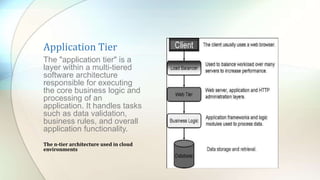
Application Tier
The "application tier" is a
layer within a multi-tiered
software architecture
responsible for executing
the core business logic and
processing of an
application. It handles tasks
such as data validation,
business rules, and overall
application functionality.
The n-tier architecture used in cloud
environments
• Zope: is an open source application server for building content
management systems, intranets, portals, and custom applications.
• Zope Content Management Framework: The Content
Management Framework (CMF) for Zope provides a powerful,
tailorable platform for building content management applications
together with the Zope Application Server.
• AJAX (Asynchronous JavaScript and XML) is a collection of
interrelated standards- based web development techniques that
are used to create highly interactive (rich) Internet applications.
The use of AJAX has led to an increase in interactive animation on
web pages. AJAX web applications can retrieve data from the
server asynchronously, without interfering with the display or
behaviour of the current page.
Building Cloud Network.pptx

Building Cloud Network.pptx

  • 1.
  • 2.
    Cloud Network A cloudnetwork refers to a distributed computing environment that utilizes the internet and remote servers to store, manage, and process data rather than relying on a local server or a personal computer. Cloud networking has become a fundamental component of modern computing, offering scalability, flexibility, and cost-effectiveness. Here are the important points to understand about cloud networks:
  • 3.
    Cloud Network() • Infrastructureas a Service (IaaS) • Scalability • Virtualization • Service Model • Resource Pooling • Broad Network access • Managed Services • Pay-per-use Billing • Security Measure • Global Availability • Data Redundancy and Backup
  • 4.
    Managed Service Provider(MSP) • The evolution of MSPs began in the 1990s with the emergence of application service providers (ASPs) • Which offered a level of service for remote application hosting • ASPs helped pave the way for cloud computing and companies that would provide remote support for customers' IT infrastructure. • MSPs initially focused on the remote monitoring and management (RMM) of servers and networks. • Over time, they have expanded the scope of their services as a way to differentiate themselves from other providers.
  • 5.
    What is ManagedService Provider • A managed service provider (MSP) is a third-party company that remotely manages a customer's information technology (IT) infrastructure and end-user systems. Small and medium-sized businesses (SMBs), nonprofits and government agencies hire MSPs to perform a defined set of day-to-day management services. These services may include network and infrastructure management, security and monitoring.
  • 6.
    What are MSPsused For • handle the management of IT infrastructure; • offer technical support to staff; • add cybersecurity software to IT; • manage user access accounts; • handle contract management; • offer compliance and risk management; and • provide payroll services.
  • 7.
    How do MSFsWork? • When a managed service provider is requested to meet the business objectives of an organization, it is often expected to fill in some gap or role in an IT system or staff. Communication between the MSP and the organization typically begins with an assessment that determines the organization's current environment. This assessment may point out potential room for improvement and how to properly support business goals.
  • 8.
    What are theTypes of MSPs • Pure-play MSPs. These tend to be smaller providers that focus on monitoring networks and application performance. They offer their own native services that focus mainly on reporting and alerts. • Staffing legacy MSPs. These MSPs generally target midlevel organizations and Fortune 500 companies and often offer a wide range of services, including monitoring, reporting, and software installation and upgrades. • High-level MSPs. These consist of small and large providers that enable their clients to outsource as much of their IT processes as needed. Typically, high-level MSPs offer a wide range of services.
  • 9.
    • MSPs canalso be categorized by the type of services they offer: • Monitoring ,Remote Support, Proactive Support, centralized management, Schedule Maintenance, Simplified billing • What are the benefits of managed service providers? • Help an organization fill staff shortages. Provide expertise Provide business continuity Provide constant network monitoring Improve security. Improve cost efficiency.
  • 10.
    From Single-Purpose Architecturesto Multipurpose Architectures • In the early days of MSPs, the providers would actually go onto customer sites and perform their services on customer-owned premises. Over time, these MSPs specialized in implementation of infrastructure and quickly figured out ways to build out data centers and sell those capabilities off in small chunks commonly known as monthly recurring services, in addition to the basic fees charged for ping, power, and pipe (PPP). • Ping refers to the ability to have a live Internet connection, • power is obvious enough, and • pipe refers to the amount of data throughput that a customer is willing to pay for
  • 11.
    Data Center Virtualization • Datacenter virtualization involves creating virtual instances of physical resources such as servers, storage, and networks. Key components include server virtualization with hypervisors and virtual machines, storage virtualization like SAN and NAS, and network virtualization through SDN and VLANs. Benefits include resource efficiency, scalability, cost savings, improved disaster recovery, and enhanced flexibility and agility in IT infrastructure.
  • 12.
    Cloud Data Center • Acloud data centre is a facility owned by a cloud service provider where computing resources like servers, storage, and networking are hosted. It enables on-demand access to scalable and virtualized resources over the internet. Cloud data centers support multi-tenancy, provide high availability, and offer managed services, making them a key component of cloud computing. Examples of cloud service providers include AWS, Azure, and Google Cloud Platform.
  • 13.
    Collaboration • Collaboration incloud computing involves using online platforms and services to enable seamless teamwork, document sharing, real-time communication, and project management. It facilitates access to resources from anywhere, supports collaborative editing, ensures version control, and provides security features. Cloud collaboration enhances productivity and flexibility for individuals and teams.
  • 14.
    Service Oriented Architecture •Service-Oriented Architecture (SOA) is an architectural style that defines a set of principles and design patterns for creating software systems based on the concept of services. In SOA, software functionality is organized into independently deployable and loosely coupled services. These services communicate with each other to achieve a larger business goal. The primary goal of SOA is to enable the creation of flexible, scalable, and interoperable software systems
  • 15.
    1.Free-standing, independent components:In SOA, services are designed as standalone, self-contained units of functionality. Each service performs a specific business function and can operate independently of other services. This modularity allows for better scalability, maintainability, and reusability. Services can be developed, deployed, and updated without affecting the entire system. 2.Combined by loose coupling: Loose coupling is a fundamental principle in SOA. Services are connected in a way that minimizes dependencies between them. This ensures that changes to one service do not have a cascading effect on other services. Loose coupling also facilitates the replacement or upgrade of individual services without disrupting the entire system. Communication between services is typically done through well-defined interfaces, promoting flexibility and interoperability.
  • 16.
    1.Message (XML)-based insteadof API-based: SOA often relies on message-based communication between services. Instead of tight coupling through specific APIs, services exchange messages, usually in XML format. This approach allows for greater flexibility and interoperability, as services can communicate without being bound to a particular programming language or platform. It also enables asynchronous communication, where services can send messages to each other without waiting for an immediate response. 2.Physical location, etc., not important: In SOA, the physical location of services is abstracted, meaning that services can be distributed across different servers, data centers, or even hosted in the cloud. This abstraction allows for better scalability and fault tolerance. Services can be deployed and accessed regardless of their physical location. This flexibility is crucial for modern, distributed systems where components may be spread across diverse environments.
  • 17.
    • Planning forCapacity • Planning for Availability • Planning for SOA Security
  • 18.
    The Role ofopen source software in data center • The term open source broadly describes a general type of software license that makes source code available to the public without significant copyright restrictions. • open source code is open and transparent, developers can troubleshoot problems and learn how other developers have addressed issues. Users gain the freedom to use these products across their organizations, all over the world, without worrying about tracking client license.
  • 19.
    • Now thatwe understand exactly what open source is, let’s look at how some open source software is used in cloud computing. • Web Presence: • Many components of web presence, such as web servers, content management systems, and web frameworks, are often open source. Examples include the Apache HTTP Server, Nginx, WordPress, Drupal, and Django. • Database Tier: • The database tier, responsible for storing and managing data, commonly leverages open source database management systems. MySQL and PostgreSQL are two prominent examples of open source databases widely used in web applications. • MySQL:
  • 20.
    • MySQL: • MySQLis an open source relational database management system (RDBMS) that is widely used in web development. It is known for its speed, reliability, and ease of use. MySQL is distributed under the GNU General Public License (GPL) or a proprietary license for commercial use. • PostgreSQL: • PostgreSQL, often referred to as Postgres, is another open source RDBMS used in web applications. It is known for its advanced features, extensibility, and support for complex queries. PostgreSQL is released under the PostgreSQL License, a permissive open source license.
  • 21.
    Application Tier The "applicationtier" is a layer within a multi-tiered software architecture responsible for executing the core business logic and processing of an application. It handles tasks such as data validation, business rules, and overall application functionality. The n-tier architecture used in cloud environments
  • 22.
    • Zope: isan open source application server for building content management systems, intranets, portals, and custom applications. • Zope Content Management Framework: The Content Management Framework (CMF) for Zope provides a powerful, tailorable platform for building content management applications together with the Zope Application Server. • AJAX (Asynchronous JavaScript and XML) is a collection of interrelated standards- based web development techniques that are used to create highly interactive (rich) Internet applications. The use of AJAX has led to an increase in interactive animation on web pages. AJAX web applications can retrieve data from the server asynchronously, without interfering with the display or behaviour of the current page.