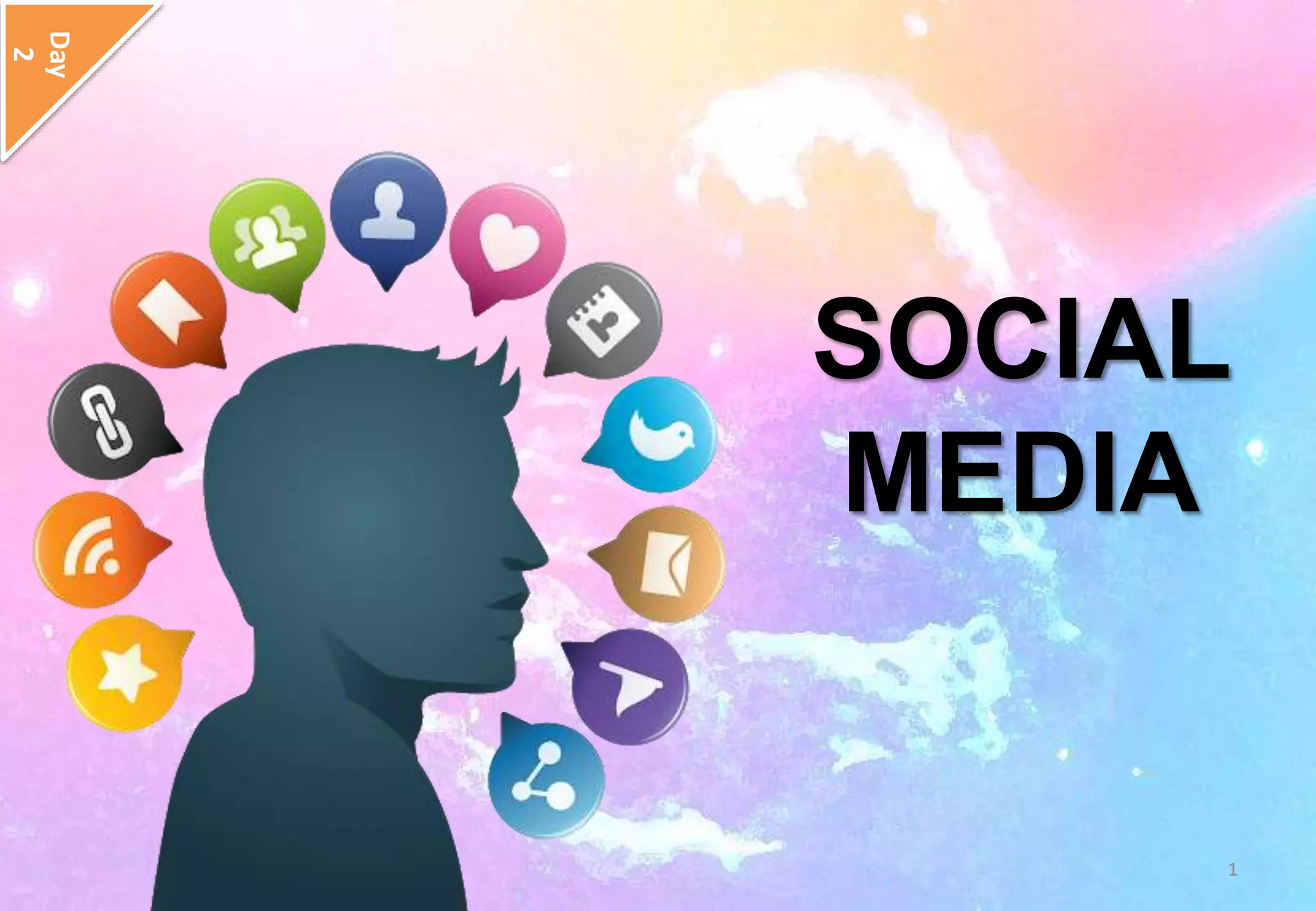
SOCIAL
MEDIA
1
Day
2
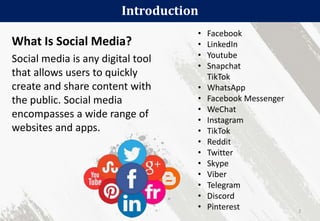
What Is Social Media?
Social media is any digital tool
that allows users to quickly
create and share content with
the public. Social media
encompasses a wide range of
websites and apps.
Introduction
2
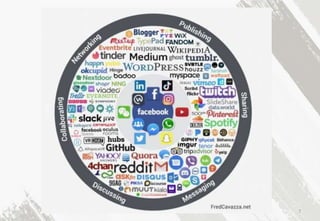
• Facebook
• LinkedIn
• Youtube
• Snapchat
TikTok
• WhatsApp
• Facebook Messenger
• WeChat
• Instagram
• TikTok
• Reddit
• Twitter
• Skype
• Viber
• Telegram
• Discord
• Pinterest
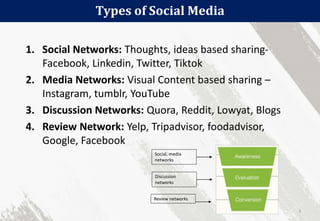
Types of Social Media
3
1. Social Networks: Thoughts, ideas based sharing-
Facebook, Linkedin, Twitter, Tiktok
2. Media Networks: Visual Content based sharing –
Instagram, tumblr, YouTube
3. Discussion Networks: Quora, Reddit, Lowyat, Blogs
4. Review Network: Yelp, Tripadvisor, foodadvisor,
Google, Facebook
Social, media
networks
Discussion
networks
Review networks
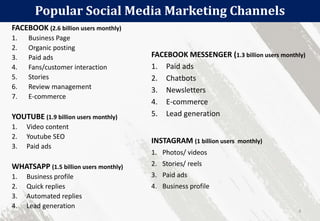
Popular Social Media Marketing Channels
4
FACEBOOK (2.6 billion users monthly)
1. Business Page
2. Organic posting
3. Paid ads
4. Fans/customer interaction
5. Stories
6. Review management
7. E-commerce
YOUTUBE (1.9 billion users monthly)
1. Video content
2. Youtube SEO
3. Paid ads
WHATSAPP (1.5 billion users monthly)
1. Business profile
2. Quick replies
3. Automated replies
4. Lead generation
FACEBOOK MESSENGER (1.3 billion users monthly)
1. Paid ads
2. Chatbots
3. Newsletters
4. E-commerce
5. Lead generation
INSTAGRAM (1 billion users monthly)
1. Photos/ videos
2. Stories/ reels
3. Paid ads
4. Business profile
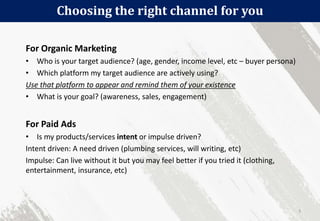
Choosing the right channel for you
5
For Organic Marketing
• Who is your target audience? (age, gender, income level, etc – buyer persona)
• Which platform my target audience are actively using?
Use that platform to appear and remind them of your existence
• What is your goal? (awareness, sales, engagement)
For Paid Ads
• Is my products/services intent or impulse driven?
Intent driven: A need driven (plumbing services, will writing, etc)
Impulse: Can live without it but you may feel better if you tried it (clothing,
entertainment, insurance, etc)
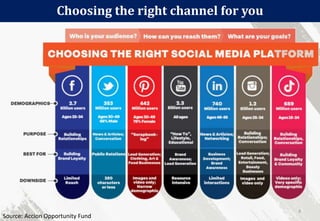
Choosing the right channel for you
6
Source: Accion Opportunity Fund
7
Choosing the right channel for you
8
Facebook
1. To build loyal followers
2. Way to keep in touch
3. Brand recognition
4. B2C lead generation
Twitter
1. To build awareness
2. To hitch a ride on trending topics (by finding out what people are talking about
via hashtags)
3. Real time update to audiences
Pinterest
1. Retail industry
2. To target more female users
YouTube
1. It’s a video based search engine (like google)
2. Service, education, lifestyle industry
3. To build a following with video content (like a blog for text)
Choosing the right channel for you
9
LinkedIn
1. For older audiences (30-49)
2. Easy to narrowly focus
3. Professional networking
4. Alternative to job search platforms (like jobstreet, monster, etc)
5. B2B lead generation
Instagram
1. Better for younger audience
2. Works well for visual based businesses (art, food, retail, beauty, some service
industries, etc)
TikTok
1. Works well for visual based businesses (art, food, retail, beauty, some service
industries, etc)
2. Younger age group (18-24)
3. Building brand awareness
4. Video content marketing (more casual than Youtube)
Integrating Social Media with Other Disciplines
10
1. Fact finding – survey (polls, comments)
2. Customer service (@Netflixhelps on twitter)
3. Referral schemes
4. Increase audience to your blog / website
5. Contests
6. Agent/ staff recruitment for your company (linkedin, facebook)
7. Incentives (Starbucks discounts, etc)
8. Include your social media icons in your emails
9. Pull social followers into your email list
10. Boost content SEO
11. Public relations outreach (PR with news outlets, partner content)
12. Reputation management (by boosting reviews)
13. Live events (link to zoom webinars, current events, conferences, etc.)
14. Influencer marketing
Social Media Marketing - Toolkit
11
1. Logo
2. Digital Service brochure
3. EDMs/ poster
4. Video
5. Reviews / feedback
6. Constant presence
7. Constant interaction
8. Posting schedule & plan
SOCIAL MEDIA
Making the Message Stick and
Spread
12
The Tipping Point by Malcolm Gladwell
13
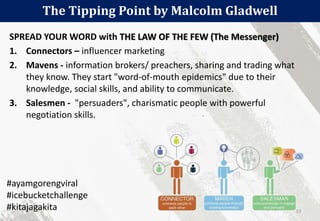
SPREAD YOUR WORD with THE LAW OF THE FEW (The Messenger)
1. Connectors – influencer marketing
2. Mavens - information brokers/ preachers, sharing and trading what
they know. They start "word-of-mouth epidemics" due to their
knowledge, social skills, and ability to communicate.
3. Salesmen - "persuaders", charismatic people with powerful
negotiation skills.
#ayamgorengviral
#icebucketchallenge
#kitajagakita
The Tipping Point by Malcolm Gladwell
14
BUILD A BRAND with THE STICKINESS FACTOR (The Message)
1. Simplicity - Finding the core of an idea (Just Do It – Nike)
2. Unexpectedness: Getting our audience’s attention and
sustaining their interest (Huawei vs Apple)
3. Concreteness: Make the message clear (ice bucket
challenge)
4. Credibility: Make people believe our ideas (ice bucket
challenge)
5. Emotions: Make people care (ice bucket challenge)
6. Stories: Get people to act (ice bucket challenge)
The Tipping Point by Malcolm Gladwell
15
THE POWER OF CONTEXT (Context of the message)
1. Time of day (working hours, resting hours, morning/ night
people)
2. Physical Environment (home, office, driving/enclosed
spaces)
3. Circumstances of Situation (promotion - > luxury items;
recent illness -> insurance)
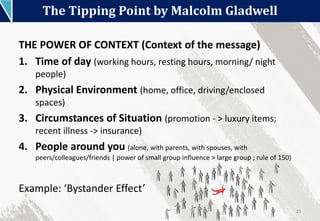
4. People around you (alone, with parents, with spouses, with
peers/colleagues/friends | power of small group influence > large group ; rule of 150)
Example: ‘Bystander Effect’
SOCIAL MEDIA
Listening &
eputation Management
16
Reputation Management
17
BUILD, MONITOR & MANAGE REPUTATION ON
1. Facebook reviews
2. Google reviews
3. Facebook hashtags
4. Website
5. Blogs (lowyat, reddit)
6. Customer feedback
Beginner methods– Google search, monitor reviews & feedback,
Facebook search
Expert level- Brand24, Hootsuite, Hubspot
WHY?
18
1. Immediately detect sensitive wording marketing
(covid, insurance, retrenchment)
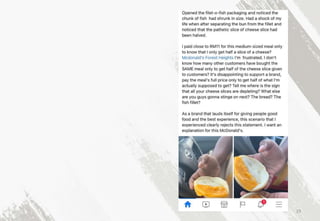
2. Able to spot & console angry/disappointed customers
3. Diffuse negative press (experts may negatively review
your product/ service)
4. Beware brandjacking (stealing brand identity/ fake
social media profiles)
19
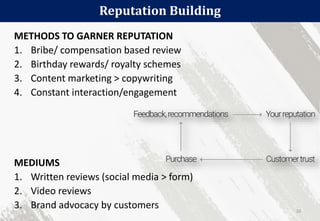
Reputation Building
20
METHODS TO GARNER REPUTATION
1. Bribe/ compensation based review
2. Birthday rewards/ royalty schemes
3. Content marketing > copywriting
4. Constant interaction/engagement
MEDIUMS
1. Written reviews (social media > form)
2. Video reviews
3. Brand advocacy by customers
Social Listening
21
It’s a two step process:
• Step 1- Social Monitoring: Monitor social media channels
for mentions of your brand, competitors, products, and
keywords related to your business.
Metrics:
• Brand mentions
• Relevant hashtags
• Competitor mentions
• Industry trends
• Step 2 – Social Listening: Analyze the information for ways
to put what you learn into action. That can be something as
small as responding to a happy customer, or something as
big as shifting your entire brand positioning.
WHY?
22
1. Customers like when brand respond back
2. Increase customer retention & brand loyalty by
knowing what to say (track & discover the kind of content
they like)
3. Keep track of brand’s growth
4. Discover new opportunities (expansion, continuous
improvement, damage control)
5. Increase organic customer acquisition
6. Find pain points
7. Track competitors
CREATE: Building
Your Content
23
Building your content
24
1. List your features, benefits & objections (FBO)
2. Focus on objections & benefits for your content
3. Source for ideas on topics based on buyer’s persona &
FBO
Brainstorming ideas for topic
25
1. Popular blogs on search engines
2. Competitor most popular posts
3. Online tools (answerthepublic)
4. Popular Youtube videos on topics & comments
5. Auto search bar (youtube, google,bing,yahoo)
6. Popular questions on discussion platforms (quora,
lowyat, reddit)
7. Derive ideas from top courses on e-learning sites
(udemy, coursera, simplilearn, youtube)
8. Existing data (survey, feedback, analytics on existing
posts)
Best practices that we can learn from
26
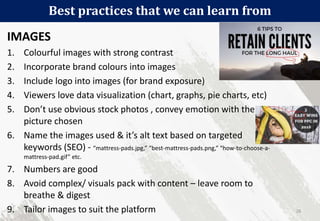
IMAGES
1. Colourful images with strong contrast
2. Incorporate brand colours into images
3. Include logo into images (for brand exposure)
4. Viewers love data visualization (chart, graphs, pie charts, etc)
5. Don’t use obvious stock photos , convey emotion with the
picture chosen
6. Name the images used & it’s alt text based on targeted
keywords (SEO) - “mattress-pads.jpg,” “best-mattress-pads.png,” “how-to-choose-a-
mattress-pad.gif” etc.
7. Numbers are good
8. Avoid complex/ visuals pack with content – leave room to
breathe & digest
9. Tailor images to suit the platform
Best practices that we can learn from
27
VIDEOS
1. Engage & lock attention in the first 5-10 seconds
2. Keep content
within 1.5 minutes for TOFU
1.5 minutes – 2.5 minutes for MOFU (ideally 2 minutes)
2.5 minutes – 5 minutes for BOFU
3. Longer videos for YouTube while shorter for social media
4. Script videos in advance to limit the duration
5. Clear audio & good production quality
6. Avoid fillers in speech
7. Add music to increase impact
8. Integrate the video into all available channels (blog/
website/ social media)
9. Maintain focus in videos ( Eg: “AE/AF Lock” in phones)
10. Keep it simple
Types of Marketing Video
28
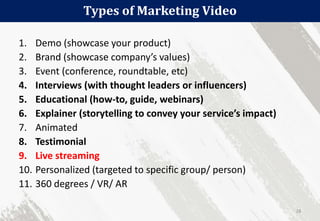
1. Demo (showcase your product)
2. Brand (showcase company’s values)
3. Event (conference, roundtable, etc)
4. Interviews (with thought leaders or influencers)
5. Educational (how-to, guide, webinars)
6. Explainer (storytelling to convey your service’s impact)
7. Animated
8. Testimonial
9. Live streaming
10. Personalized (targeted to specific group/ person)
11. 360 degrees / VR/ AR
Best practices that we can learn from
29
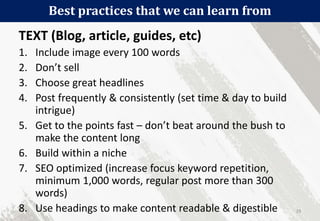
TEXT (Blog, article, guides, etc)
1. Include image every 100 words
2. Don’t sell
3. Choose great headlines
4. Post frequently & consistently (set time & day to build
intrigue)
5. Get to the points fast – don’t beat around the bush to
make the content long
6. Build within a niche
7. SEO optimized (increase focus keyword repetition,
minimum 1,000 words, regular post more than 300
words)
8. Use headings to make content readable & digestible
Tools to create
30
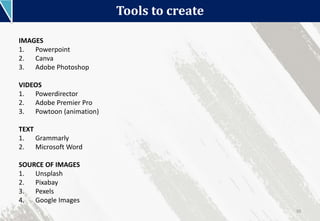
IMAGES
1. Powerpoint
2. Canva
3. Adobe Photoshop
VIDEOS
1. Powerdirector
2. Adobe Premier Pro
3. Powtoon (animation)
TEXT
1. Grammarly
2. Microsoft Word
SOURCE OF IMAGES
1. Unsplash
2. Pixabay
3. Pexels
4. Google Images
PROMOTE: Marketing
your Content
31
Social media marketing best practices
32
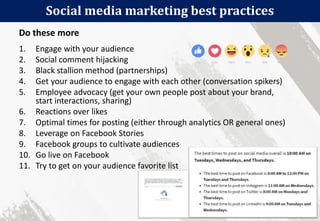
1. Engage with your audience
2. Social comment hijacking
3. Black stallion method (partnerships)
4. Get your audience to engage with each other (conversation spikers)
5. Employee advocacy (get your own people post about your brand,
start interactions, sharing)
6. Reactions over likes
7. Optimal times for posting (either through analytics OR general ones)
8. Leverage on Facebook Stories
9. Facebook groups to cultivate audiences
10. Go live on Facebook
11. Try to get on your audience favorite list
Do these more
Social media marketing best practices
33
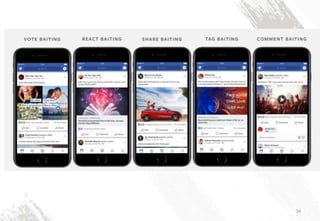
1. Clickbait (posts that ask for clicks or entice users to click with
sensational or false information)
2. Like-baiting (posts that ask for likes, comments, and shares)
3. Posts with abnormal engagement patterns (a like-baiting signal)
4. Posts with spammy links (for example, links with a clickbait title that
lead to a page full of ads)
5. Repeated content
6. Text-only posts
7. Intensely promotional page content prompting readers to make a
purchase
8. Posts that reuse text from existing ads
9. Don’t include external links on post header
Their algorithm is smart to detect pointless content – they focus people to people engagement
to organically boost your posts further so
Avoid these mistakes
34
Facebook ads – How it works
35
Ad Auction
Ads compete to appear in front of the target audience set
How is the winner determined?
Bid: What advertiser willing to pay for the ad
• Spend based
lowest cost – maximize delivery/conversion based on budget
highest value – focus on high value purchases)
• Goal based (cost cap – max cost per conversion set to avoid loss / minimum return on ad spend
(ROAS) – maximize cost to get enough conversions to reach target ROAS)
• Manual bid cap setting
Daily or lifetime budget can be set
Estimated action rates: How high the probability of the ad leading to a desired outcome of the
advertiser (based on goals set)
Ad quality: Measure based on different sources to determine ad’s quality. Sources such as-
• Feedback from audience
• How many hiding the ad
• Bad attribution (withholding key info, too sensational wording, engagement bait)
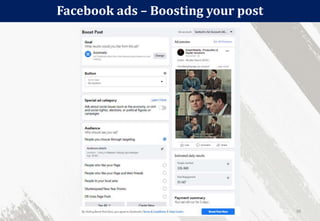
Facebook ads – Boosting your post
36
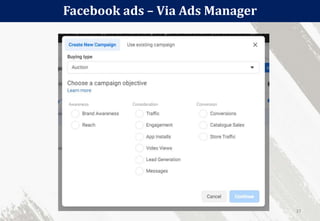
Facebook ads – Via Ads Manager
37
Google ads
38
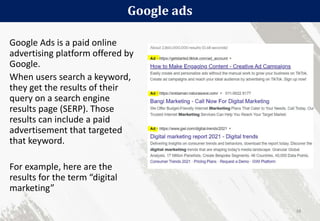
Google Ads is a paid online
advertising platform offered by
Google.
When users search a keyword,
they get the results of their
query on a search engine
results page (SERP). Those
results can include a paid
advertisement that targeted
that keyword.
For example, here are the
results for the term “digital
marketing”
Google ads – How it works
39
Pay-per-click (PPC) Model based on keywords targeted.
How to win? Google pairs -
1. Bid amount &
• Daily budget of your campaign or
• Max cost per action/ conversion
2. Quality Score (1 – 10 : 10 is the best)
Higher the score, higher the rank without paying too much
• Expected clickthrough rate: The likelihood that your ad will be clicked when shown.
• Ad relevance: How closely your ad matches the intent behind a user's search.
• Landing page experience: How relevant and useful your landing page is to people who click your ad.
When a user sees the ad and clicks on it, the marketer pays a small fee for that click (thus pay-per-click).
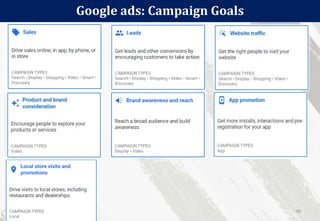
Google ads: Campaign Goals
40
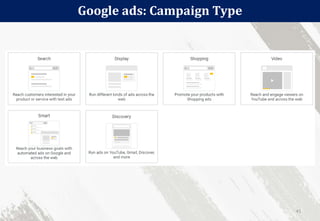
Google ads: Campaign Type
41
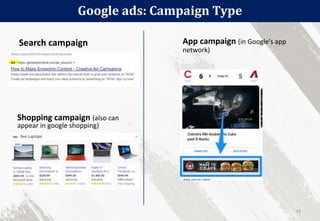
Google ads: Campaign Type
42
Search campaign
Shopping campaign (also can
appear in google shopping)
App campaign (in Google’s app
network)
Google ads: Campaign Type
43
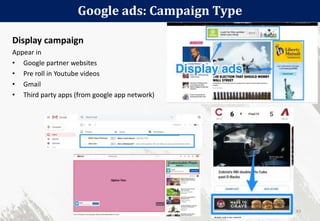
Display campaign
Appear in
• Google partner websites
• Pre roll in Youtube videos
• Gmail
• Third party apps (from google app network)
Google ads: Campaign Type
44
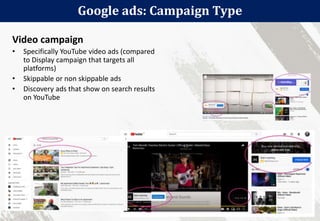
Video campaign
• Specifically YouTube video ads (compared
to Display campaign that targets all
platforms)
• Skippable or non skippable ads
• Discovery ads that show on search results
on YouTube
Choosing the right channel for ads
45
Social media channels
1. impulse driven
2. lower cost
3. Products > services
4. B2C > B2B
5. To increase awareness/ engagement for a product
Search based – google, bing, etc
1. Need based items
2. Service based business
3. B2B > B2C
4. To appeal for those looking to immediately purchase
Messaging tools
46
1. Chatbots (for content marketing or lead capture)
Website
Facebook (Chatfuel, mobilemonkey, manychat)
2. FB Messenger ads (using Ads manager placement setting)
3. “Send a message” boosted ads
4. “Messages” ad objective
5. WhatsApp broadcasting
6. WhatsApp/ Telegram groups
Search Engine Optimization (SEO)
47
What is it?
Practice of increasing the quantity and quality of traffic to your website through
organic search engine results.
• Quality of traffic. You can attract all the visitors in the world, but if they're coming to
your site because Google tells them you're a resource for Apple computers when really
you're a farmer selling apples, that is not quality traffic. Instead, you want to attract
visitors who are genuinely interested in the products that you offer.
• Quantity of traffic. Once you have the right people clicking through from those search
engine results pages (SERPs), more traffic is better.
• Organic results. Ads make up a significant portion of many SERPs. Organic traffic is any
traffic that you don't have to pay for.
Google finds suitable content for a search and builds an index – that index appears as the many links you see
when you search for something (same applies for other search engines like Bing and Yahoo!)
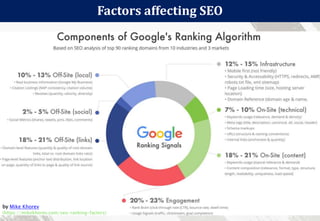
Factors affecting SEO
48
by Mike Khorev
(https://mikekhorev.com/seo-ranking-factors)
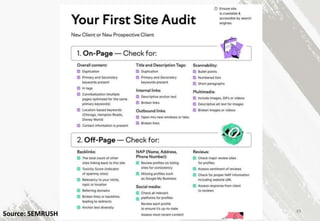
49
Source: SEMRUSH
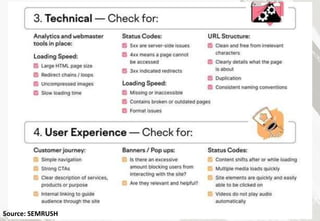
50
Source: SEMRUSH
Building a tribe
51
A tribe only has two requirements: a shared interest and a way to communicate.
How?
1. Mission based groups (book club)
2. Uniting the believes / similar minded people together
3. Constant generous value sharing with your community
4. Be a thought leader, don’t just reiterate existing facts
Communication is key, create the ecosystem for just that
1. Leader to followers
2. Follower to leader
3. Follower to follower
4. Follower to outsider
Platforms
1. Groups (Facebook, WhatsApp, Telegram, LinkedIn)
2. Email or broadcast lists
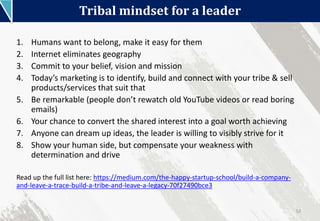
Tribal mindset for a leader
52
1. Humans want to belong, make it easy for them
2. Internet eliminates geography
3. Commit to your belief, vision and mission
4. Today’s marketing is to identify, build and connect with your tribe & sell
products/services that suit that
5. Be remarkable (people don’t rewatch old YouTube videos or read boring
emails)
6. Your chance to convert the shared interest into a goal worth achieving
7. Anyone can dream up ideas, the leader is willing to visibly strive for it
8. Show your human side, but compensate your weakness with
determination and drive
Read up the full list here: https://medium.com/the-happy-startup-school/build-a-company-
and-leave-a-trace-build-a-tribe-and-leave-a-legacy-70f27490bce3

Ccbysantsddosh

  • 1.
  • 2.
    What Is SocialMedia? Social media is any digital tool that allows users to quickly create and share content with the public. Social media encompasses a wide range of websites and apps. Introduction 2 • Facebook • LinkedIn • Youtube • Snapchat TikTok • WhatsApp • Facebook Messenger • WeChat • Instagram • TikTok • Reddit • Twitter • Skype • Viber • Telegram • Discord • Pinterest
  • 3.
    Types of SocialMedia 3 1. Social Networks: Thoughts, ideas based sharing- Facebook, Linkedin, Twitter, Tiktok 2. Media Networks: Visual Content based sharing – Instagram, tumblr, YouTube 3. Discussion Networks: Quora, Reddit, Lowyat, Blogs 4. Review Network: Yelp, Tripadvisor, foodadvisor, Google, Facebook Social, media networks Discussion networks Review networks
  • 4.
    Popular Social MediaMarketing Channels 4 FACEBOOK (2.6 billion users monthly) 1. Business Page 2. Organic posting 3. Paid ads 4. Fans/customer interaction 5. Stories 6. Review management 7. E-commerce YOUTUBE (1.9 billion users monthly) 1. Video content 2. Youtube SEO 3. Paid ads WHATSAPP (1.5 billion users monthly) 1. Business profile 2. Quick replies 3. Automated replies 4. Lead generation FACEBOOK MESSENGER (1.3 billion users monthly) 1. Paid ads 2. Chatbots 3. Newsletters 4. E-commerce 5. Lead generation INSTAGRAM (1 billion users monthly) 1. Photos/ videos 2. Stories/ reels 3. Paid ads 4. Business profile
  • 5.
    Choosing the rightchannel for you 5 For Organic Marketing • Who is your target audience? (age, gender, income level, etc – buyer persona) • Which platform my target audience are actively using? Use that platform to appear and remind them of your existence • What is your goal? (awareness, sales, engagement) For Paid Ads • Is my products/services intent or impulse driven? Intent driven: A need driven (plumbing services, will writing, etc) Impulse: Can live without it but you may feel better if you tried it (clothing, entertainment, insurance, etc)
  • 6.
    Choosing the rightchannel for you 6 Source: Accion Opportunity Fund
  • 7.
  • 8.
    Choosing the rightchannel for you 8 Facebook 1. To build loyal followers 2. Way to keep in touch 3. Brand recognition 4. B2C lead generation Twitter 1. To build awareness 2. To hitch a ride on trending topics (by finding out what people are talking about via hashtags) 3. Real time update to audiences Pinterest 1. Retail industry 2. To target more female users YouTube 1. It’s a video based search engine (like google) 2. Service, education, lifestyle industry 3. To build a following with video content (like a blog for text)
  • 9.
    Choosing the rightchannel for you 9 LinkedIn 1. For older audiences (30-49) 2. Easy to narrowly focus 3. Professional networking 4. Alternative to job search platforms (like jobstreet, monster, etc) 5. B2B lead generation Instagram 1. Better for younger audience 2. Works well for visual based businesses (art, food, retail, beauty, some service industries, etc) TikTok 1. Works well for visual based businesses (art, food, retail, beauty, some service industries, etc) 2. Younger age group (18-24) 3. Building brand awareness 4. Video content marketing (more casual than Youtube)
  • 10.
    Integrating Social Mediawith Other Disciplines 10 1. Fact finding – survey (polls, comments) 2. Customer service (@Netflixhelps on twitter) 3. Referral schemes 4. Increase audience to your blog / website 5. Contests 6. Agent/ staff recruitment for your company (linkedin, facebook) 7. Incentives (Starbucks discounts, etc) 8. Include your social media icons in your emails 9. Pull social followers into your email list 10. Boost content SEO 11. Public relations outreach (PR with news outlets, partner content) 12. Reputation management (by boosting reviews) 13. Live events (link to zoom webinars, current events, conferences, etc.) 14. Influencer marketing
  • 11.
    Social Media Marketing- Toolkit 11 1. Logo 2. Digital Service brochure 3. EDMs/ poster 4. Video 5. Reviews / feedback 6. Constant presence 7. Constant interaction 8. Posting schedule & plan
  • 12.
    SOCIAL MEDIA Making theMessage Stick and Spread 12
  • 13.
    The Tipping Pointby Malcolm Gladwell 13 SPREAD YOUR WORD with THE LAW OF THE FEW (The Messenger) 1. Connectors – influencer marketing 2. Mavens - information brokers/ preachers, sharing and trading what they know. They start "word-of-mouth epidemics" due to their knowledge, social skills, and ability to communicate. 3. Salesmen - "persuaders", charismatic people with powerful negotiation skills. #ayamgorengviral #icebucketchallenge #kitajagakita
  • 14.
    The Tipping Pointby Malcolm Gladwell 14 BUILD A BRAND with THE STICKINESS FACTOR (The Message) 1. Simplicity - Finding the core of an idea (Just Do It – Nike) 2. Unexpectedness: Getting our audience’s attention and sustaining their interest (Huawei vs Apple) 3. Concreteness: Make the message clear (ice bucket challenge) 4. Credibility: Make people believe our ideas (ice bucket challenge) 5. Emotions: Make people care (ice bucket challenge) 6. Stories: Get people to act (ice bucket challenge)
  • 15.
    The Tipping Pointby Malcolm Gladwell 15 THE POWER OF CONTEXT (Context of the message) 1. Time of day (working hours, resting hours, morning/ night people) 2. Physical Environment (home, office, driving/enclosed spaces) 3. Circumstances of Situation (promotion - > luxury items; recent illness -> insurance) 4. People around you (alone, with parents, with spouses, with peers/colleagues/friends | power of small group influence > large group ; rule of 150) Example: ‘Bystander Effect’
  • 16.
  • 17.
    Reputation Management 17 BUILD, MONITOR& MANAGE REPUTATION ON 1. Facebook reviews 2. Google reviews 3. Facebook hashtags 4. Website 5. Blogs (lowyat, reddit) 6. Customer feedback Beginner methods– Google search, monitor reviews & feedback, Facebook search Expert level- Brand24, Hootsuite, Hubspot
  • 18.
    WHY? 18 1. Immediately detectsensitive wording marketing (covid, insurance, retrenchment) 2. Able to spot & console angry/disappointed customers 3. Diffuse negative press (experts may negatively review your product/ service) 4. Beware brandjacking (stealing brand identity/ fake social media profiles)
  • 19.
  • 20.
    Reputation Building 20 METHODS TOGARNER REPUTATION 1. Bribe/ compensation based review 2. Birthday rewards/ royalty schemes 3. Content marketing > copywriting 4. Constant interaction/engagement MEDIUMS 1. Written reviews (social media > form) 2. Video reviews 3. Brand advocacy by customers
  • 21.
    Social Listening 21 It’s atwo step process: • Step 1- Social Monitoring: Monitor social media channels for mentions of your brand, competitors, products, and keywords related to your business. Metrics: • Brand mentions • Relevant hashtags • Competitor mentions • Industry trends • Step 2 – Social Listening: Analyze the information for ways to put what you learn into action. That can be something as small as responding to a happy customer, or something as big as shifting your entire brand positioning.
  • 22.
    WHY? 22 1. Customers likewhen brand respond back 2. Increase customer retention & brand loyalty by knowing what to say (track & discover the kind of content they like) 3. Keep track of brand’s growth 4. Discover new opportunities (expansion, continuous improvement, damage control) 5. Increase organic customer acquisition 6. Find pain points 7. Track competitors
  • 23.
  • 24.
    Building your content 24 1.List your features, benefits & objections (FBO) 2. Focus on objections & benefits for your content 3. Source for ideas on topics based on buyer’s persona & FBO
  • 25.
    Brainstorming ideas fortopic 25 1. Popular blogs on search engines 2. Competitor most popular posts 3. Online tools (answerthepublic) 4. Popular Youtube videos on topics & comments 5. Auto search bar (youtube, google,bing,yahoo) 6. Popular questions on discussion platforms (quora, lowyat, reddit) 7. Derive ideas from top courses on e-learning sites (udemy, coursera, simplilearn, youtube) 8. Existing data (survey, feedback, analytics on existing posts)
  • 26.
    Best practices thatwe can learn from 26 IMAGES 1. Colourful images with strong contrast 2. Incorporate brand colours into images 3. Include logo into images (for brand exposure) 4. Viewers love data visualization (chart, graphs, pie charts, etc) 5. Don’t use obvious stock photos , convey emotion with the picture chosen 6. Name the images used & it’s alt text based on targeted keywords (SEO) - “mattress-pads.jpg,” “best-mattress-pads.png,” “how-to-choose-a- mattress-pad.gif” etc. 7. Numbers are good 8. Avoid complex/ visuals pack with content – leave room to breathe & digest 9. Tailor images to suit the platform
  • 27.
    Best practices thatwe can learn from 27 VIDEOS 1. Engage & lock attention in the first 5-10 seconds 2. Keep content within 1.5 minutes for TOFU 1.5 minutes – 2.5 minutes for MOFU (ideally 2 minutes) 2.5 minutes – 5 minutes for BOFU 3. Longer videos for YouTube while shorter for social media 4. Script videos in advance to limit the duration 5. Clear audio & good production quality 6. Avoid fillers in speech 7. Add music to increase impact 8. Integrate the video into all available channels (blog/ website/ social media) 9. Maintain focus in videos ( Eg: “AE/AF Lock” in phones) 10. Keep it simple
  • 28.
    Types of MarketingVideo 28 1. Demo (showcase your product) 2. Brand (showcase company’s values) 3. Event (conference, roundtable, etc) 4. Interviews (with thought leaders or influencers) 5. Educational (how-to, guide, webinars) 6. Explainer (storytelling to convey your service’s impact) 7. Animated 8. Testimonial 9. Live streaming 10. Personalized (targeted to specific group/ person) 11. 360 degrees / VR/ AR
  • 29.
    Best practices thatwe can learn from 29 TEXT (Blog, article, guides, etc) 1. Include image every 100 words 2. Don’t sell 3. Choose great headlines 4. Post frequently & consistently (set time & day to build intrigue) 5. Get to the points fast – don’t beat around the bush to make the content long 6. Build within a niche 7. SEO optimized (increase focus keyword repetition, minimum 1,000 words, regular post more than 300 words) 8. Use headings to make content readable & digestible
  • 30.
    Tools to create 30 IMAGES 1.Powerpoint 2. Canva 3. Adobe Photoshop VIDEOS 1. Powerdirector 2. Adobe Premier Pro 3. Powtoon (animation) TEXT 1. Grammarly 2. Microsoft Word SOURCE OF IMAGES 1. Unsplash 2. Pixabay 3. Pexels 4. Google Images
  • 31.
  • 32.
    Social media marketingbest practices 32 1. Engage with your audience 2. Social comment hijacking 3. Black stallion method (partnerships) 4. Get your audience to engage with each other (conversation spikers) 5. Employee advocacy (get your own people post about your brand, start interactions, sharing) 6. Reactions over likes 7. Optimal times for posting (either through analytics OR general ones) 8. Leverage on Facebook Stories 9. Facebook groups to cultivate audiences 10. Go live on Facebook 11. Try to get on your audience favorite list Do these more
  • 33.
    Social media marketingbest practices 33 1. Clickbait (posts that ask for clicks or entice users to click with sensational or false information) 2. Like-baiting (posts that ask for likes, comments, and shares) 3. Posts with abnormal engagement patterns (a like-baiting signal) 4. Posts with spammy links (for example, links with a clickbait title that lead to a page full of ads) 5. Repeated content 6. Text-only posts 7. Intensely promotional page content prompting readers to make a purchase 8. Posts that reuse text from existing ads 9. Don’t include external links on post header Their algorithm is smart to detect pointless content – they focus people to people engagement to organically boost your posts further so Avoid these mistakes
  • 34.
  • 35.
    Facebook ads –How it works 35 Ad Auction Ads compete to appear in front of the target audience set How is the winner determined? Bid: What advertiser willing to pay for the ad • Spend based lowest cost – maximize delivery/conversion based on budget highest value – focus on high value purchases) • Goal based (cost cap – max cost per conversion set to avoid loss / minimum return on ad spend (ROAS) – maximize cost to get enough conversions to reach target ROAS) • Manual bid cap setting Daily or lifetime budget can be set Estimated action rates: How high the probability of the ad leading to a desired outcome of the advertiser (based on goals set) Ad quality: Measure based on different sources to determine ad’s quality. Sources such as- • Feedback from audience • How many hiding the ad • Bad attribution (withholding key info, too sensational wording, engagement bait)
  • 36.
    Facebook ads –Boosting your post 36
  • 37.
    Facebook ads –Via Ads Manager 37
  • 38.
    Google ads 38 Google Adsis a paid online advertising platform offered by Google. When users search a keyword, they get the results of their query on a search engine results page (SERP). Those results can include a paid advertisement that targeted that keyword. For example, here are the results for the term “digital marketing”
  • 39.
    Google ads –How it works 39 Pay-per-click (PPC) Model based on keywords targeted. How to win? Google pairs - 1. Bid amount & • Daily budget of your campaign or • Max cost per action/ conversion 2. Quality Score (1 – 10 : 10 is the best) Higher the score, higher the rank without paying too much • Expected clickthrough rate: The likelihood that your ad will be clicked when shown. • Ad relevance: How closely your ad matches the intent behind a user's search. • Landing page experience: How relevant and useful your landing page is to people who click your ad. When a user sees the ad and clicks on it, the marketer pays a small fee for that click (thus pay-per-click).
  • 40.
  • 41.
  • 42.
    Google ads: CampaignType 42 Search campaign Shopping campaign (also can appear in google shopping) App campaign (in Google’s app network)
  • 43.
    Google ads: CampaignType 43 Display campaign Appear in • Google partner websites • Pre roll in Youtube videos • Gmail • Third party apps (from google app network)
  • 44.
    Google ads: CampaignType 44 Video campaign • Specifically YouTube video ads (compared to Display campaign that targets all platforms) • Skippable or non skippable ads • Discovery ads that show on search results on YouTube
  • 45.
    Choosing the rightchannel for ads 45 Social media channels 1. impulse driven 2. lower cost 3. Products > services 4. B2C > B2B 5. To increase awareness/ engagement for a product Search based – google, bing, etc 1. Need based items 2. Service based business 3. B2B > B2C 4. To appeal for those looking to immediately purchase
  • 46.
    Messaging tools 46 1. Chatbots(for content marketing or lead capture) Website Facebook (Chatfuel, mobilemonkey, manychat) 2. FB Messenger ads (using Ads manager placement setting) 3. “Send a message” boosted ads 4. “Messages” ad objective 5. WhatsApp broadcasting 6. WhatsApp/ Telegram groups
  • 47.
    Search Engine Optimization(SEO) 47 What is it? Practice of increasing the quantity and quality of traffic to your website through organic search engine results. • Quality of traffic. You can attract all the visitors in the world, but if they're coming to your site because Google tells them you're a resource for Apple computers when really you're a farmer selling apples, that is not quality traffic. Instead, you want to attract visitors who are genuinely interested in the products that you offer. • Quantity of traffic. Once you have the right people clicking through from those search engine results pages (SERPs), more traffic is better. • Organic results. Ads make up a significant portion of many SERPs. Organic traffic is any traffic that you don't have to pay for. Google finds suitable content for a search and builds an index – that index appears as the many links you see when you search for something (same applies for other search engines like Bing and Yahoo!)
  • 48.
    Factors affecting SEO 48 byMike Khorev (https://mikekhorev.com/seo-ranking-factors)
  • 49.
  • 50.
  • 51.
    Building a tribe 51 Atribe only has two requirements: a shared interest and a way to communicate. How? 1. Mission based groups (book club) 2. Uniting the believes / similar minded people together 3. Constant generous value sharing with your community 4. Be a thought leader, don’t just reiterate existing facts Communication is key, create the ecosystem for just that 1. Leader to followers 2. Follower to leader 3. Follower to follower 4. Follower to outsider Platforms 1. Groups (Facebook, WhatsApp, Telegram, LinkedIn) 2. Email or broadcast lists
  • 52.
    Tribal mindset fora leader 52 1. Humans want to belong, make it easy for them 2. Internet eliminates geography 3. Commit to your belief, vision and mission 4. Today’s marketing is to identify, build and connect with your tribe & sell products/services that suit that 5. Be remarkable (people don’t rewatch old YouTube videos or read boring emails) 6. Your chance to convert the shared interest into a goal worth achieving 7. Anyone can dream up ideas, the leader is willing to visibly strive for it 8. Show your human side, but compensate your weakness with determination and drive Read up the full list here: https://medium.com/the-happy-startup-school/build-a-company- and-leave-a-trace-build-a-tribe-and-leave-a-legacy-70f27490bce3

Editor's Notes

  • #2 -the art of creating lead magnets
  • #13 -the art of creating lead magnets
  • #17 -the art of creating lead magnets
  • #18 Invoke, matrix concepts (fb & blog)
  • #24 -the art of creating lead magnets
  • #32 -the art of creating lead magnets