Effective Social Media to Enhance Your Business


                              Presented by Carla Hale
   Social media manager at The C-3 Group
   Co-founder of CultureMASH
   Board member of New Media Dayton
   Dayton native
   Sinclair/WSU alumn
   Social media goal setting
   Platforms
   3rd party tools
   Blogging
   Content Creation and Calendars
   Response – time and style
   Delegating resources to SM management
   How does SM integrate with the rest of the
    web?
   The use of web-based and mobile
    technologies to turn communication into
    interactive dialogue.
   Social media is:
      collaborative, network, conversation, sharing,
     relationships, multi-dimensional, inclusive,
     information, community, personalized,
     empowering, real-time, content distribution, self-
     expression, unity, dynamic, discover, power of the
     masses
   Decide and commit to participating in the real time
    web.
   Learn all you can.
   Learn the platforms, but also learn the philosophy.
   Listen - To customers, influencers, and
    competitors.
   Develop policies and plans.
   Goal set.
   Track and measure.
   Gain exposure.
   Expand and enhance the brand.
   Gain new customers.
   Make money!
   All of this can be achieved through social
    media.
   Social media fits into the overall business
    or marketing plan. It is not separate.
   The same traditional principles of
    marketing apply, in a new way.
   Social media needs a budget and
    resources assigned to it, just as you would
    any other facet of your marketing.
   A social media plan can exist
    independently, but needs to be factored in.
   Strengthen Your Brand
   Engage Your Audience
   Increase Brand Awareness
   Improve Search Engine Rankings
   Increase Site Traffic
   Improve Customer Service
   Lead Generation
   Monitoring Your Online Presence
   Drive Conversions
    … Just to name a few…
   Started with BBS (Bulletin Board System) in
    the 1970s.
   650 million+ on Facebook.
   200 million+ on Twitter.
   17 million+ on Google Plus…. In three
    weeks
   10 million+ on Foursquare
   Social media revolution
   Nielsen reported 47 percent of Americans
    visit Facebook daily.
   That compares to 55 percent who watch
    TV, 37 percent who listen to radio, and 22
    percent who read newspapers.
   Generating conversation vs. creating
    noise
    • It’s very easy to unlike a page on Facebook, or
        unfollow on Twitter.
    •   You need to have something useful to say.
    •   Online consumers have the WIIFM mentality –
        What’s In It For Me?
    •   What can you provide that is unique and valuable
        to your customers?
    •   Conversation is a 2
        (or more) way street.
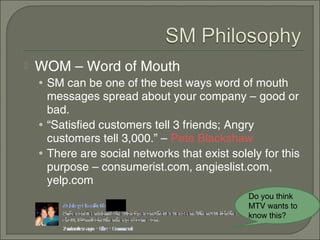
   WOM – Word of Mouth
    • SM can be one of the best ways word of mouth
      messages spread about your company – good or
      bad.
    • “Satisfied customers tell 3 friends; Angry
      customers tell 3,000.” – Pete Blackshaw
    • There are social networks that exist solely for this
      purpose – consumerist.com, angieslist.com,
      yelp.com
                                               Do you think
                                               MTV wants to
                                               know this?
   Transparency
    • Trust is one of the hardest things to gain and the
      quickest things to lose.
    • Individuals in your organization should be
      required to be transparent about their roles on SM
      sites.
    • Easy to get caught – everything on the internet is
      in ink, not pencil.
   Authenticity
    • Be who you are; Be who your brand is.
    • Stay on topic (or related topics).
    • Employees of the brand should stay within the
      brand’s personality.
    • Have disclaimers, disaster plans, guidelines for
      when something goes wrong (it will) –
    • Zappos – Their brand is all about customer
      service and it shows.
   Reciprocity
    • Promote others.
    • Chris Brogan rule – promotes 12 others on
        Tiwtter for every one time he promotes himself.
    •   Interact with similarly-minded biz’s.
    •   This is especially important for local biz.
    •   Social Media PR
    •   Don’t NOT do this, people notice that too.
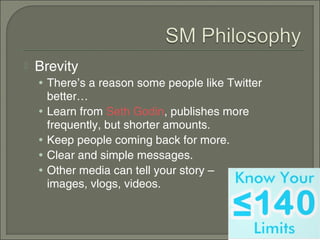
   Brevity
    • There’s a reason some people like Twitter
        better…
    •   Learn from Seth Godin, publishes more
        frequently, but shorter amounts.
    •   Keep people coming back for more.
    •   Clear and simple messages.
    •   Other media can tell your story –
        images, vlogs, videos.
   Find Influencers and Learn
    • Social media is always changing and there will
      always be someone ahead of you. Learn from
      them.
    • Influencers in SM relating to almost every field –
      B2B, B2C, NPOs, pharma, Small biz, restaurants,
      etc.
    • Engage with influencers to help you sell (not in a
      SPAM way!) – social media elite, or twitterati…
      whatever you call it, find them!
   Won’t fix a bad business
    • Social media will always make something that is
      bad from the beginning look worse.
    • Either you will be attracting no one (looks bad) or
      attracting angry, upset people (looks worse).
    • Fix your business, then engage on SM.
   Commitment
    • Social media is a commitment – most of the time
      a daily commitment.
    • Building your community, engaging with
      customers is something the whole company can
      (and probably) should be involved in.
    • Social media success takes time, it does not
      happen over night.
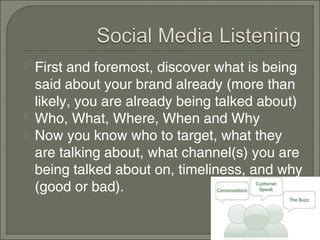
   First and foremost, discover what is being
    said about your brand already (more than
    likely, you are already being talked about)
   Who, What, Where, When and Why
   Now you know who to target, what they
    are talking about, what channel(s) you are
    being talked about on, timeliness, and why
    (good or bad).
   There are free and paid tools available.
   Free:
    •   www.google.com/alerts
    •   www.socialmention.com
    •   www.search.twitter.com
    •   www.topsy.com
    •   www.twazzup.com
    •   www.monitter.com
    •   www.addictomatic.com
    •   www.trendsmap.com
    •   Facebook is not so easily monitored…
   There are free and paid tools available.
   Paid:
    •   www.radian6.com
    •   www.lithium.com
    •   www.collectiveintellect.com
    •   www.sysomos.com
    •   www.attensity.com
    •   www.webtrends.com
    •   www.nmincite.com (Nielsen)
    •   www.brandwatch.com
   First, analyze what you are already using – Email,
    phone, newsletters, print, etc.
   Is this missing your target audience? Do they reflect
    your brand?
   If yes, don’t get rid of them in place of SM.
   If no, consider eliminating.
   Ask yourself what is missing, who are you missing, are
    you active or passive.
   Are you committed?
   Claim your business profile on all Social Media
    channels.
    • www.knowem.com
   Listening (keeps coming up, right?)
   Find what your brand presence currently
    is, online communities you should engage
    in, influencers, and similar companies.
   Decide who in the organization is
    responsible for content generation/posting
    and how often they need to be online
    (Zappos has someone on Twitter 24/7)
   Decide overall topics to discuss.
   Create a content plan/calendar. (more on that in a
    minute…)
   Set goals – relationships, raise awareness,
    increase web traffic, increase sales, etc.
   Decide your core message and stick to it.
   Select the channels best for your brand based on
    where your target is.
   Measure results.
   Reevaluate your overall plan periodically, each
    quarter is suggested.
   Create a content plan/calendar. (more on that in a
    minute…)
   Set goals – relationships, raise awareness,
    increase web traffic, increase sales, etc.
   Decide your core message and stick to it.
   Select the channels best for your brand based on
    where your target is.
   Measure results.
   Reevaluate your overall plan periodically, each
    quarter is suggested.
   Intended for the use of your whole company
    •   Introduce the purpose of social media
    •   Be responsible for what you write
    •   Be authentic
    •   Consider your audience
    •   Exercise good judgment
    •   Understand the concept of community
    •   Respect copyrights
    •   Protect proprietary info
    •   Bring Value
    •   Find balance between social media and work
   Traditional
    • IBM

   Innovative
    • Victoria, Australia Government
   This is necessary, but somewhat tricky.
    • Decide what is important to you overall.
    • Enhancing customer service – Wright State
        Housing
    •   Gaining more sales – difficult to measure if a
        Facebook like will translate to sales
    •   Enhance the brand
    •   More YouTube views
    •   More blog comments
   650 million users
   Average user has 130 friends
   Average user creates 90 pieces of content
    each month
   About 70% of Facebook users are outside the
    United States
   There are more than 250 million active users
    currently accessing Facebook through their
    mobile devices.
   People that use Facebook on their mobile
    devices are twice as active on Facebook than
    non-mobile users.
   Let’s talk specifics about your pages….
   http://www.facebook.com/pages/
   After 25 Likes >
    http://www.facebook.com/username
   Features: Wall, Info, Photos, Reviews
   Iframes
   Apps
   200 million+ users
   In the past year alone, the average number of
    tweets per day has nearly tripled from 50
    million to 140 million.
   For the past month, the average daily sign-up
    rate has been 460,000 new accounts
   182% increase in the number of users tweeting
    from mobile devices in the past year.
   @ Replys
   Trends
   Followers vs. Following
   Direct Messages
   Retweets
   Hashtags
   100 million+ users
   Operates in over 200 countries.
   85% of hiring managers use LinkedIn to find
    candidates.
   61% of users are male, this is different from
    other networks.
   Great for competitive intelligence
   “Answers” forum
   Private messaging
   Who’s viewed your profile
   Paid and free subscriptions
   Groups
   Recommendations
   Can follow companies
   490 unique visitors
   92 billion page views each month
   2.9 billion hours watched each month
   These stats do not include mobile or embedded
    videos
   400 tweets per minute contain a YouTube link
   2nd largest search engine after Google
   Channels – allows viewers to see all of your
    videos
   Can have a branded background
   Viewers can leave comments
   Showcase expertise
   Can aid in customer service
   Google Plus has gained almost 18 million users
    since its inception
   Is not allowing business usage at this time
   “Circles” are lists of friends that you categorize
   Can share photos, links, tag people, etc similar
    to Facebook
   Foursquare just reached 10 million plus
    members
   A location based social network that can be
    integrated with Facebook and Twitter
   Can see where friends are
   Businesses can offer deals to check-ins or
    Mayors
   People can become mayor of a location after
    checking in more than anyone else
   Foursquare awards badges for certain types of
    check-ins
   Location is a top trend of 2011
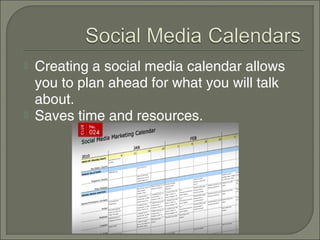
   Creating a social media calendar allows
    you to plan ahead for what you will talk
    about.
   Saves time and resources.
   Tweetdeck
   Hootsuite
   Location Based Networks
   Facebook Social Graph
   Social Commerce
   QR Codes & SnapTags
   Geo-location networks and apps are becoming
    more and more common-place.
    • Foursquare, Gowalla, Loopt, Whrrl are all networks
      specific only to location.
    • Facebook launched Places about a year ago.
    • Google is launching their own Places
   This will be important for businesses to monitor
    who is checking in at their location.
   Businesses who participate in geo-location
    networks can offer incentives for those who
    “check-in”
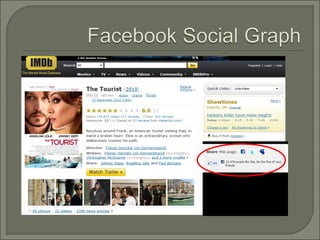
   Social Plug-Ins will become the norm.
   This allows Facebook users to “Like” not
    only business Pages, but also specific
    items.
   The Facebook user can also see which of
    their Facebook Friends have also “Liked”
    that page or object.
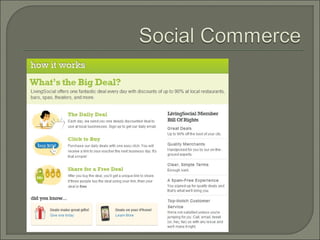
   Social Network users are sharing what
    they are purchasing, direct from an e-
    commerce site.
    • Their friends can weigh in on purchasing
     decisions and “Like” them.
   Groupon and LivingSocial also prompt
    users to share their purchases on Social
    Networks.
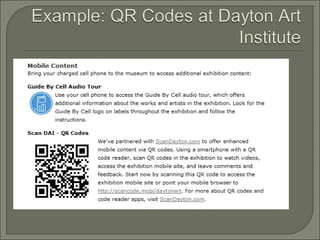
   QR Code – Stands for Quick Response
    Code.
    • Scanned with a smartphone app and can link
     directly to a URL, video, etc.
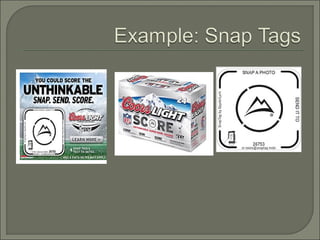
   Snap Tag – Usually a logo, able to be
    used with older phones, as long as they
    have a camera.
    • Consumers can take a picture of the Snap Tag,
     SMS message it to a number and then receive
     promotional text messaging.
   Lastly, social media greatly affects your
    SEO (Search Engine Optimization)
   Be sure to Google yourself often and see
    what is found.
   Ideally, your website should be first,
    followed by your social media channels.
   Scott Stratten
   Chris Brogan
   Liz Strauss
   Julien Smith
   Jason Falls
   Amber Naslund
   Brian Solis
   www.c-3group.com
   Chale@-c3group.com
   937-985-4234
   Twitter.com/carlaweishale
   Facebook/chale1
   Linkedin.com/in/carlaweishale
Effective Social Media to Enhance Your Business


                              Presented by Carla Hale

Sinclair University - Social Sense

  • 1.
    Effective Social Mediato Enhance Your Business Presented by Carla Hale
  • 2.
    Social media manager at The C-3 Group  Co-founder of CultureMASH  Board member of New Media Dayton  Dayton native  Sinclair/WSU alumn
  • 3.
    Social media goal setting  Platforms  3rd party tools  Blogging  Content Creation and Calendars  Response – time and style  Delegating resources to SM management  How does SM integrate with the rest of the web?
  • 4.
    The use of web-based and mobile technologies to turn communication into interactive dialogue.  Social media is: collaborative, network, conversation, sharing, relationships, multi-dimensional, inclusive, information, community, personalized, empowering, real-time, content distribution, self- expression, unity, dynamic, discover, power of the masses
  • 5.
    Decide and commit to participating in the real time web.  Learn all you can.  Learn the platforms, but also learn the philosophy.  Listen - To customers, influencers, and competitors.  Develop policies and plans.  Goal set.  Track and measure.
  • 6.
    Gain exposure.  Expand and enhance the brand.  Gain new customers.  Make money!  All of this can be achieved through social media.  Social media fits into the overall business or marketing plan. It is not separate.
  • 7.
    The same traditional principles of marketing apply, in a new way.  Social media needs a budget and resources assigned to it, just as you would any other facet of your marketing.  A social media plan can exist independently, but needs to be factored in.
  • 8.
    Strengthen Your Brand  Engage Your Audience  Increase Brand Awareness  Improve Search Engine Rankings  Increase Site Traffic  Improve Customer Service  Lead Generation  Monitoring Your Online Presence  Drive Conversions  … Just to name a few…
  • 9.
    Started with BBS (Bulletin Board System) in the 1970s.  650 million+ on Facebook.  200 million+ on Twitter.  17 million+ on Google Plus…. In three weeks  10 million+ on Foursquare
  • 10.
    Social media revolution  Nielsen reported 47 percent of Americans visit Facebook daily.  That compares to 55 percent who watch TV, 37 percent who listen to radio, and 22 percent who read newspapers.
  • 11.
    Generating conversation vs. creating noise • It’s very easy to unlike a page on Facebook, or unfollow on Twitter. • You need to have something useful to say. • Online consumers have the WIIFM mentality – What’s In It For Me? • What can you provide that is unique and valuable to your customers? • Conversation is a 2 (or more) way street.
  • 12.
    WOM – Word of Mouth • SM can be one of the best ways word of mouth messages spread about your company – good or bad. • “Satisfied customers tell 3 friends; Angry customers tell 3,000.” – Pete Blackshaw • There are social networks that exist solely for this purpose – consumerist.com, angieslist.com, yelp.com Do you think MTV wants to know this?
  • 13.
    Transparency • Trust is one of the hardest things to gain and the quickest things to lose. • Individuals in your organization should be required to be transparent about their roles on SM sites. • Easy to get caught – everything on the internet is in ink, not pencil.
  • 14.
    Authenticity • Be who you are; Be who your brand is. • Stay on topic (or related topics). • Employees of the brand should stay within the brand’s personality. • Have disclaimers, disaster plans, guidelines for when something goes wrong (it will) – • Zappos – Their brand is all about customer service and it shows.
  • 15.
    Reciprocity • Promote others. • Chris Brogan rule – promotes 12 others on Tiwtter for every one time he promotes himself. • Interact with similarly-minded biz’s. • This is especially important for local biz. • Social Media PR • Don’t NOT do this, people notice that too.
  • 16.
    Brevity • There’s a reason some people like Twitter better… • Learn from Seth Godin, publishes more frequently, but shorter amounts. • Keep people coming back for more. • Clear and simple messages. • Other media can tell your story – images, vlogs, videos.
  • 17.
    Find Influencers and Learn • Social media is always changing and there will always be someone ahead of you. Learn from them. • Influencers in SM relating to almost every field – B2B, B2C, NPOs, pharma, Small biz, restaurants, etc. • Engage with influencers to help you sell (not in a SPAM way!) – social media elite, or twitterati… whatever you call it, find them!
  • 18.
    Won’t fix a bad business • Social media will always make something that is bad from the beginning look worse. • Either you will be attracting no one (looks bad) or attracting angry, upset people (looks worse). • Fix your business, then engage on SM.
  • 19.
    Commitment • Social media is a commitment – most of the time a daily commitment. • Building your community, engaging with customers is something the whole company can (and probably) should be involved in. • Social media success takes time, it does not happen over night.
  • 20.
    First and foremost, discover what is being said about your brand already (more than likely, you are already being talked about)  Who, What, Where, When and Why  Now you know who to target, what they are talking about, what channel(s) you are being talked about on, timeliness, and why (good or bad).
  • 21.
    There are free and paid tools available.  Free: • www.google.com/alerts • www.socialmention.com • www.search.twitter.com • www.topsy.com • www.twazzup.com • www.monitter.com • www.addictomatic.com • www.trendsmap.com • Facebook is not so easily monitored…
  • 22.
    There are free and paid tools available.  Paid: • www.radian6.com • www.lithium.com • www.collectiveintellect.com • www.sysomos.com • www.attensity.com • www.webtrends.com • www.nmincite.com (Nielsen) • www.brandwatch.com
  • 23.
    First, analyze what you are already using – Email, phone, newsletters, print, etc.  Is this missing your target audience? Do they reflect your brand?  If yes, don’t get rid of them in place of SM.  If no, consider eliminating.  Ask yourself what is missing, who are you missing, are you active or passive.  Are you committed?  Claim your business profile on all Social Media channels. • www.knowem.com
  • 24.
    Listening (keeps coming up, right?)  Find what your brand presence currently is, online communities you should engage in, influencers, and similar companies.  Decide who in the organization is responsible for content generation/posting and how often they need to be online (Zappos has someone on Twitter 24/7)  Decide overall topics to discuss.
  • 25.
    Create a content plan/calendar. (more on that in a minute…)  Set goals – relationships, raise awareness, increase web traffic, increase sales, etc.  Decide your core message and stick to it.  Select the channels best for your brand based on where your target is.  Measure results.  Reevaluate your overall plan periodically, each quarter is suggested.
  • 26.
    Create a content plan/calendar. (more on that in a minute…)  Set goals – relationships, raise awareness, increase web traffic, increase sales, etc.  Decide your core message and stick to it.  Select the channels best for your brand based on where your target is.  Measure results.  Reevaluate your overall plan periodically, each quarter is suggested.
  • 27.
    Intended for the use of your whole company • Introduce the purpose of social media • Be responsible for what you write • Be authentic • Consider your audience • Exercise good judgment • Understand the concept of community • Respect copyrights • Protect proprietary info • Bring Value • Find balance between social media and work
  • 28.
    Traditional • IBM  Innovative • Victoria, Australia Government
  • 29.
    This is necessary, but somewhat tricky. • Decide what is important to you overall. • Enhancing customer service – Wright State Housing • Gaining more sales – difficult to measure if a Facebook like will translate to sales • Enhance the brand • More YouTube views • More blog comments
  • 31.
    650 million users  Average user has 130 friends  Average user creates 90 pieces of content each month  About 70% of Facebook users are outside the United States  There are more than 250 million active users currently accessing Facebook through their mobile devices.  People that use Facebook on their mobile devices are twice as active on Facebook than non-mobile users.
  • 32.
    Let’s talk specifics about your pages….  http://www.facebook.com/pages/  After 25 Likes > http://www.facebook.com/username  Features: Wall, Info, Photos, Reviews  Iframes  Apps
  • 33.
    200 million+ users  In the past year alone, the average number of tweets per day has nearly tripled from 50 million to 140 million.  For the past month, the average daily sign-up rate has been 460,000 new accounts  182% increase in the number of users tweeting from mobile devices in the past year.
  • 34.
    @ Replys  Trends  Followers vs. Following  Direct Messages  Retweets  Hashtags
  • 35.
    100 million+ users  Operates in over 200 countries.  85% of hiring managers use LinkedIn to find candidates.  61% of users are male, this is different from other networks.
  • 36.
    Great for competitive intelligence  “Answers” forum  Private messaging  Who’s viewed your profile  Paid and free subscriptions  Groups  Recommendations  Can follow companies
  • 37.
    490 unique visitors  92 billion page views each month  2.9 billion hours watched each month  These stats do not include mobile or embedded videos  400 tweets per minute contain a YouTube link  2nd largest search engine after Google
  • 38.
    Channels – allows viewers to see all of your videos  Can have a branded background  Viewers can leave comments  Showcase expertise  Can aid in customer service
  • 39.
    Google Plus has gained almost 18 million users since its inception  Is not allowing business usage at this time  “Circles” are lists of friends that you categorize  Can share photos, links, tag people, etc similar to Facebook
  • 40.
    Foursquare just reached 10 million plus members  A location based social network that can be integrated with Facebook and Twitter  Can see where friends are  Businesses can offer deals to check-ins or Mayors  People can become mayor of a location after checking in more than anyone else  Foursquare awards badges for certain types of check-ins  Location is a top trend of 2011
  • 41.
    Creating a social media calendar allows you to plan ahead for what you will talk about.  Saves time and resources.
  • 42.
    Tweetdeck  Hootsuite
  • 43.
    Location Based Networks  Facebook Social Graph  Social Commerce  QR Codes & SnapTags
  • 44.
    Geo-location networks and apps are becoming more and more common-place. • Foursquare, Gowalla, Loopt, Whrrl are all networks specific only to location. • Facebook launched Places about a year ago. • Google is launching their own Places  This will be important for businesses to monitor who is checking in at their location.  Businesses who participate in geo-location networks can offer incentives for those who “check-in”
  • 45.
    Social Plug-Ins will become the norm.  This allows Facebook users to “Like” not only business Pages, but also specific items.  The Facebook user can also see which of their Facebook Friends have also “Liked” that page or object.
  • 47.
    Social Network users are sharing what they are purchasing, direct from an e- commerce site. • Their friends can weigh in on purchasing decisions and “Like” them.  Groupon and LivingSocial also prompt users to share their purchases on Social Networks.
  • 49.
    QR Code – Stands for Quick Response Code. • Scanned with a smartphone app and can link directly to a URL, video, etc.  Snap Tag – Usually a logo, able to be used with older phones, as long as they have a camera. • Consumers can take a picture of the Snap Tag, SMS message it to a number and then receive promotional text messaging.
  • 52.
    Lastly, social media greatly affects your SEO (Search Engine Optimization)  Be sure to Google yourself often and see what is found.  Ideally, your website should be first, followed by your social media channels.
  • 53.
    Scott Stratten  Chris Brogan  Liz Strauss  Julien Smith  Jason Falls  Amber Naslund  Brian Solis
  • 54.
    www.c-3group.com  Chale@-c3group.com  937-985-4234  Twitter.com/carlaweishale  Facebook/chale1  Linkedin.com/in/carlaweishale
  • 55.
    Effective Social Mediato Enhance Your Business Presented by Carla Hale