Virus and its characteristics
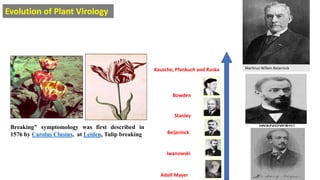
Adolf Mayer
Mosaic disease of tobacco
by infected sap
1886
Beijerinck
Iwanowski
1892
1898
Kausche, Pfankuch and Ruska
Bowden
Stanley
1935
1936
1939
A filterable agent cause
tobacco mosaic
Contagium vivum fluidum
Crystallize TMV
TMV is made up of protein
and NA
Electron microscopy
1955-57
1982
Sequencing of TMV
genome
1955
Evolution of Plant Virology
Martinus Willem Beijerinck
Breaking" symptomology was first described in
1576 by Carolus Clusius, at Leiden, Tulip breaking
Viruses
• Viruses are submicroscopic, intercellular, infectious entities and are composed of nucleic acid & proteins.
• They lack lipid membrane system and energy production
• They are acellular -No cells and do not contain cell organelles
• Too much smaller in comparison to any other microorganism
• Use host machinery for their replication
• Cannot multiply on their own, need to enter a living host cell
• They have genetic information which commands the host cell to produce enzymes
• Lack of Lipman system of energy production
• multiply very rapidly compare to other microorganisms
• Multiply intracellularly within the host cell in presence of ribosomes (specialized obligate parasites)
• No binary fission, multiplication in terms of genetic material, i.e, DNA or RNA.
• On the borderline of living and non living -Mesobiotic
The host protein synthesizing machinery (Ribosome)
Organized from the pools of required material rather than binary fission &
Located at sites which are not separated from the host cell content by lipoprotein
bilayer membrane (Mathews, 1981).
Inside the host, the virus production depends upon
Virion
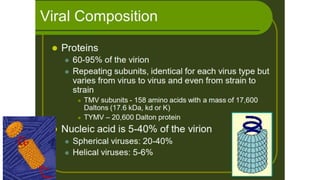
• Virion is a technical term used for the matured virus particle.
• A virion consists of NA surrounded by a protein coat.
• The nucleic acid is called ‘nucleoid’ which may be de-oxyribonucleic acid (DNA) or
ribonucleic acid RNA (mostly RNA in plant viruses) but never both.
• The protein coat is called ‘capsid’.
• It consists of many subunits which are similar and occasionally dissimilar, & are
called capsomeres.
• The combined genome and the capsid are called ‘nucleocapsid’
• Some viruses possess an envelop around the protein coat which is made of virus
proteins and host cell lipids, these viruses are called ‘enveloped viruses’.
Nucleoid
• The nucleoid (NA component) is located internally within a protein coat
• Only one type of nucleic acid -RNA or DNA is found in a virus
• The amount of NA in a virion -5% to 40%.
• Higher % (15–40%) of NA is associated with spherical structured viruses, where as less
percentage (1-6%) of NA found in rod shaped virus particles.
• The NA is infectious part & contains the genetic information for the synthesis of proteins
and its own replication; & their assembly into the virion.
• Most of the plant viruses contain RNA, with exceptions like few DNA-
Nanoviruses, Caulimoviruses, Geminiviruses
Capsid
The capsid is a protein coat surrounding the nucleoid and has the following
functions
• It protects nucleic acid from unfavorable extracellular environment.
• It is antigenic.
• As compared to nucleoid, the protein coat shows a complex structure
and provides shape to the virus particles.
• It determine host specificity and helpful in virus transmission
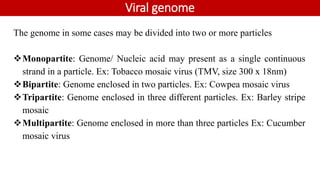
Viral genome
The genome in some cases may be divided into two or more particles
Monopartite: Genome/ Nucleic acid may present as a single continuous
strand in a particle. Ex: Tobacco mosaic virus (TMV, size 300 x 18nm)
Bipartite: Genome enclosed in two particles. Ex: Cowpea mosaic virus
Tripartite: Genome enclosed in three different particles. Ex: Barley stripe
mosaic
Multipartite: Genome enclosed in more than three particles Ex: Cucumber
mosaic virus
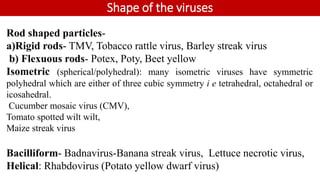
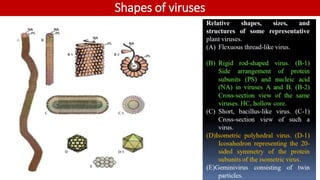
Shape of the viruses
Rod shaped particles-
a)Rigid rods- TMV, Tobacco rattle virus, Barley streak virus
b) Flexuous rods- Potex, Poty, Beet yellow
Isometric (spherical/polyhedral): many isometric viruses have symmetric
polyhedral which are either of three cubic symmetry i e tetrahedral, octahedral or
icosahedral.
Cucumber mosaic virus (CMV),
Tomato spotted wilt wilt,
Maize streak virus
Bacilliform- Badnavirus-Banana streak virus, Lettuce necrotic virus,
Helical: Rhabdovirus (Potato yellow dwarf virus)
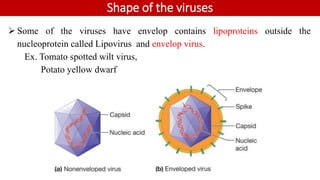
Shape of the viruses
 Some of the viruses have envelop contains lipoproteins outside the
nucleoprotein called Lipovirus and envelop virus.
Ex. Tomato spotted wilt virus,
Potato yellow dwarf
Shapes of viruses
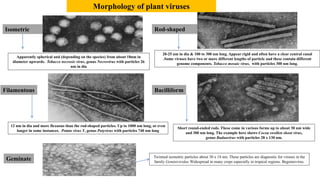
Bacilliform
Isometric Rod-shaped
Morphology of plant viruses
12 nm in dia and more flexuous than the rod-shaped particles. Up to 1000 nm long, or even
longer in some instances. Potato virus Y, genus Potyvirus with particles 740 nm long
Twinned isometric particles about 30 x 18 nm. These particles are diagnostic for viruses in the
family Geminiviridae Widespread in many crops especially in tropical regions. Begomovirus.
Apparently spherical and (depending on the species) from about 18nm in
diameter upwards. Tobacco necrosis virus, genus Necrovirus with particles 26
nm in dia
20-25 nm in dia & 100 to 300 nm long. Appear rigid and often have a clear central canal
.Some viruses have two or more different lengths of particle and these contain different
genome components. Tobacco mosaic virus, with particles 300 nm long.
Filamentous
Short round-ended rods. These come in various forms up to about 30 nm wide
and 300 nm long. The example here shows Cocoa swollen shoot virus,
genus Badnavirus with particles 28 x 130 nm.
Geminate
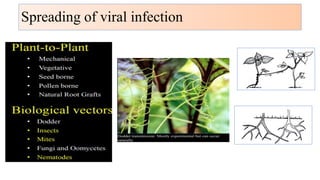
Spreading of viral infection
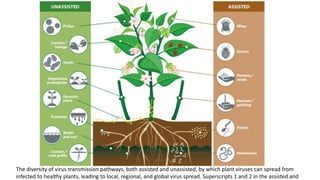
The diversity of virus transmission pathways, both assisted and unassisted, by which plant viruses can spread from
infected to healthy plants, leading to local, regional, and global virus spread. Superscripts 1 and 2 in the assisted and
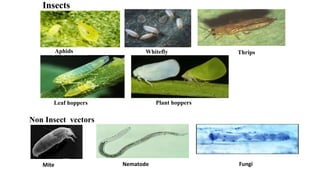
Insects
Aphids Whitefly Thrips
Leaf hoppers Plant hoppers
Mite Nematode Fungi
Non Insect vectors
Spreading of viral infection
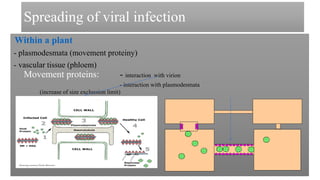
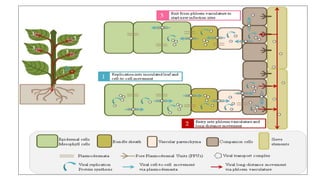
Within a plant
- plasmodesmata (movement proteiny)
- vascular tissue (phloem)
Movement proteins: - interaction with virion
- interaction with plasmodesmata
(increase of size exclussion limit)
Acquisition access period
Time for which a initially virus free vector is allowed to access a virus source and could
if it desire feed on that source.
Acquisition feeding period
Time period necessary for successful acquisition of the virus by its vector which then
become viruliferous
Inoculation access period
Time for which a virus carrying vector is allowed to access a virus free plant and could
feed on it.
Inoculation feeding period
Time period for which a virus carrying vector appears to be feeding on a virus free plant
to transmit it.
Terminology use in virus transmission
Transmission threshold or inoculation threshold or Inoculation access
threshold
The minimum initial time period that a vector need to acquire a virus and
inoculate it to the virus free plant.
Infective capacity or retention period of vector
Time period for which a vector carries/ retain/ transmit the virus to host plant and
remain viruliferous.
Incubation period or latent period
The time period from the start of acquisition feeding period until the vector can
infect the healthy plant with the virus.
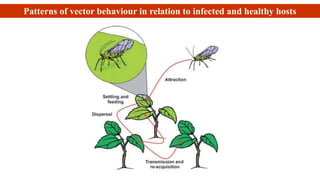
Patterns of vector behaviour in relation to infected and healthy hosts
Steps involved in Virus transmission
• The uptake of virus from an infected source (Acquisition)
• The stable retention of acquired virions at requisite sites within the vector
• The release of bound or retained virions and delivery to a site of infection (Inoculation)
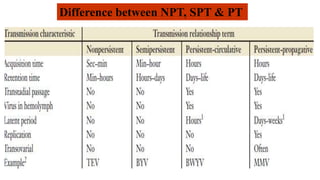
Watson & Roberts (1939) gave the basic concept based on virus retention time by
the vector and gave the terms “ Non-persistent , Persistent and non persistent”
Sylvester (1958) introduced term Semi-persistent
Virus vector relationship is also based on site of retention of the virus in vector
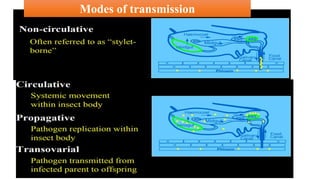
Stylet borne
Circulative
Propagative
Transovarial transmissionon
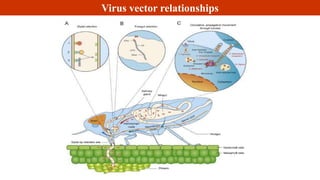
Virus vector relationships
Modes of transmission
Virus vector relationships
• Such viruses are acquired by the vector during probing and feeding on host
parenchyma including epidermal cells
• Probing takes as little as 5 seconds.
• Short AAP and IAP i.e. <5 min
• Short retention time ( maximum 12h)
• Virus lost by the vector during moulting
• No latent period
• Such viruses are mechanically transmissible
• Acquisition fasting increases acquisition of virus and transmission.
E.g. CMV, BCMV, PVY, PRSV
• No Specificity of vectors
Non-persistent Viruses/ Stylet borne viruses
Semi-Persistent viruses
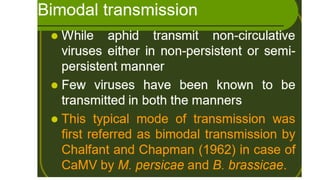
 Non- Circulative and bind to foregut region of the insect (E.g. Beetles /
leafhoppers) or bind to specific portion of stylet (E.g. Cauliflower mosaic virus)
 Longer AAPs and IAPs ( minutes - hrs) than Non persistent
 Virus persist in its vector for 12h to a week
 Acquired from phloem region with long feeding
 No latent period
 Do not circulate and multiply in its vector
 Infectivity lost in moulting
 Particles accumulate at special sites
 High vector specificity E.g. CTV, CaMV
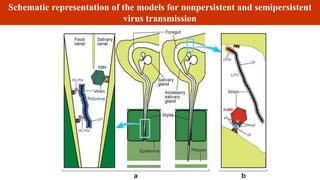
Schematic representation of the models for nonpersistent and semipersistent
virus transmission
Persistent viruses
 Longer AAP and IAP
 Virus persist in their vector for weeks and in some cases for whole life of vector
 Virus multiply in the vector
 Latent period is present
 Moulting has no effect of virus
 After virus uptake > alimentary canal > gut wall > circulate
 In the body fluid (Haemolymph) > salivary glands causing contamination of saliva >
transmission
Persistent viruses
• Persistent Circulative –
Circulate in vector body during latent period and retained in salivary glands
but do not replicate within the vectors
Aphids (Luteoviridae viruses)
• Persistent propagative –
viruses that replicate to varying degrees in both vectors and plants –
Leafhoppers, Thrips, aphids
All enveloped plant viruses – Tospo viruses, Rhabdoviridae, Reoviridae .
Persistent viruses
The movement and or replication of persistent viruses in their insect vectors
requires specific interactions between virus and vector components to
overcome four major transmission barriers .
-Midgut infection barrier
-Dissemination (midgut escape and salivary gland infection) barriers
-Salivary gland escape barriers
-Transovarial transmission barriers
Circulative viruses
Difference between NPT, SPT & PT
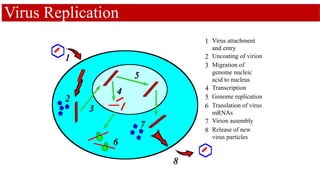
Virus Replication
1 Virus attachment
and entry
1 2 Uncoating of virion
2
3 Migration of
genome nucleic
acid to nucleus
3
4 Transcription
5 Genome replication
4
5
6 Translation of virus
mRNAs
6
7 Virion assembly
7
8 Release of new
virus particles
8
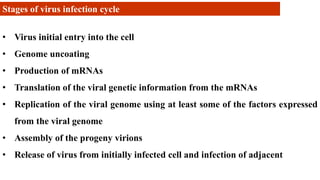
Stages of virus infection cycle
• Virus initial entry into the cell
• Genome uncoating
• Production of mRNAs
• Translation of the viral genetic information from the mRNAs
• Replication of the viral genome using at least some of the factors expressed
from the viral genome
• Assembly of the progeny virions
• Release of virus from initially infected cell and infection of adjacent cells
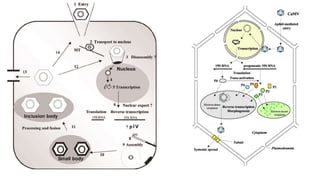
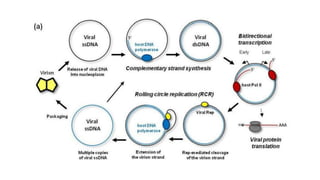
Virus Infection and synthesis
Plant viruses enter cells
only through wounds
made mechanically or
by vectors or by
deposition into an ovule
by an infected pollen
grain.
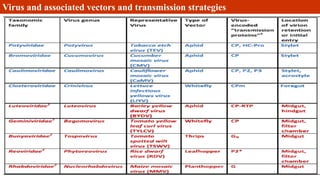
Virus and associated vectors and transmission strategies

Virology-I.pptx

  • 1.
    Virus and itscharacteristics
  • 2.
    Adolf Mayer Mosaic diseaseof tobacco by infected sap 1886 Beijerinck Iwanowski 1892 1898 Kausche, Pfankuch and Ruska Bowden Stanley 1935 1936 1939 A filterable agent cause tobacco mosaic Contagium vivum fluidum Crystallize TMV TMV is made up of protein and NA Electron microscopy 1955-57 1982 Sequencing of TMV genome 1955 Evolution of Plant Virology Martinus Willem Beijerinck Breaking" symptomology was first described in 1576 by Carolus Clusius, at Leiden, Tulip breaking
  • 3.
    Viruses • Viruses aresubmicroscopic, intercellular, infectious entities and are composed of nucleic acid & proteins. • They lack lipid membrane system and energy production • They are acellular -No cells and do not contain cell organelles • Too much smaller in comparison to any other microorganism • Use host machinery for their replication • Cannot multiply on their own, need to enter a living host cell • They have genetic information which commands the host cell to produce enzymes • Lack of Lipman system of energy production • multiply very rapidly compare to other microorganisms • Multiply intracellularly within the host cell in presence of ribosomes (specialized obligate parasites) • No binary fission, multiplication in terms of genetic material, i.e, DNA or RNA. • On the borderline of living and non living -Mesobiotic
  • 4.
    The host proteinsynthesizing machinery (Ribosome) Organized from the pools of required material rather than binary fission & Located at sites which are not separated from the host cell content by lipoprotein bilayer membrane (Mathews, 1981). Inside the host, the virus production depends upon
  • 5.
    Virion • Virion isa technical term used for the matured virus particle. • A virion consists of NA surrounded by a protein coat. • The nucleic acid is called ‘nucleoid’ which may be de-oxyribonucleic acid (DNA) or ribonucleic acid RNA (mostly RNA in plant viruses) but never both. • The protein coat is called ‘capsid’. • It consists of many subunits which are similar and occasionally dissimilar, & are called capsomeres. • The combined genome and the capsid are called ‘nucleocapsid’ • Some viruses possess an envelop around the protein coat which is made of virus proteins and host cell lipids, these viruses are called ‘enveloped viruses’.
  • 6.
    Nucleoid • The nucleoid(NA component) is located internally within a protein coat • Only one type of nucleic acid -RNA or DNA is found in a virus • The amount of NA in a virion -5% to 40%. • Higher % (15–40%) of NA is associated with spherical structured viruses, where as less percentage (1-6%) of NA found in rod shaped virus particles. • The NA is infectious part & contains the genetic information for the synthesis of proteins and its own replication; & their assembly into the virion. • Most of the plant viruses contain RNA, with exceptions like few DNA- Nanoviruses, Caulimoviruses, Geminiviruses
  • 7.
    Capsid The capsid isa protein coat surrounding the nucleoid and has the following functions • It protects nucleic acid from unfavorable extracellular environment. • It is antigenic. • As compared to nucleoid, the protein coat shows a complex structure and provides shape to the virus particles. • It determine host specificity and helpful in virus transmission
  • 10.
    Viral genome The genomein some cases may be divided into two or more particles Monopartite: Genome/ Nucleic acid may present as a single continuous strand in a particle. Ex: Tobacco mosaic virus (TMV, size 300 x 18nm) Bipartite: Genome enclosed in two particles. Ex: Cowpea mosaic virus Tripartite: Genome enclosed in three different particles. Ex: Barley stripe mosaic Multipartite: Genome enclosed in more than three particles Ex: Cucumber mosaic virus
  • 11.
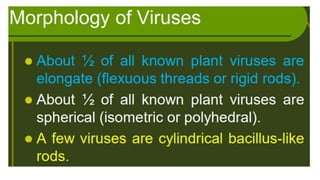
    Shape of theviruses Rod shaped particles- a)Rigid rods- TMV, Tobacco rattle virus, Barley streak virus b) Flexuous rods- Potex, Poty, Beet yellow Isometric (spherical/polyhedral): many isometric viruses have symmetric polyhedral which are either of three cubic symmetry i e tetrahedral, octahedral or icosahedral. Cucumber mosaic virus (CMV), Tomato spotted wilt wilt, Maize streak virus Bacilliform- Badnavirus-Banana streak virus, Lettuce necrotic virus, Helical: Rhabdovirus (Potato yellow dwarf virus)
  • 12.
    Shape of theviruses  Some of the viruses have envelop contains lipoproteins outside the nucleoprotein called Lipovirus and envelop virus. Ex. Tomato spotted wilt virus, Potato yellow dwarf
  • 14.
  • 15.
    Bacilliform Isometric Rod-shaped Morphology ofplant viruses 12 nm in dia and more flexuous than the rod-shaped particles. Up to 1000 nm long, or even longer in some instances. Potato virus Y, genus Potyvirus with particles 740 nm long Twinned isometric particles about 30 x 18 nm. These particles are diagnostic for viruses in the family Geminiviridae Widespread in many crops especially in tropical regions. Begomovirus. Apparently spherical and (depending on the species) from about 18nm in diameter upwards. Tobacco necrosis virus, genus Necrovirus with particles 26 nm in dia 20-25 nm in dia & 100 to 300 nm long. Appear rigid and often have a clear central canal .Some viruses have two or more different lengths of particle and these contain different genome components. Tobacco mosaic virus, with particles 300 nm long. Filamentous Short round-ended rods. These come in various forms up to about 30 nm wide and 300 nm long. The example here shows Cocoa swollen shoot virus, genus Badnavirus with particles 28 x 130 nm. Geminate
  • 16.
  • 17.
    The diversity ofvirus transmission pathways, both assisted and unassisted, by which plant viruses can spread from infected to healthy plants, leading to local, regional, and global virus spread. Superscripts 1 and 2 in the assisted and
  • 19.
    Insects Aphids Whitefly Thrips Leafhoppers Plant hoppers Mite Nematode Fungi Non Insect vectors
  • 20.
    Spreading of viralinfection Within a plant - plasmodesmata (movement proteiny) - vascular tissue (phloem) Movement proteins: - interaction with virion - interaction with plasmodesmata (increase of size exclussion limit)
  • 22.
    Acquisition access period Timefor which a initially virus free vector is allowed to access a virus source and could if it desire feed on that source. Acquisition feeding period Time period necessary for successful acquisition of the virus by its vector which then become viruliferous Inoculation access period Time for which a virus carrying vector is allowed to access a virus free plant and could feed on it. Inoculation feeding period Time period for which a virus carrying vector appears to be feeding on a virus free plant to transmit it. Terminology use in virus transmission
  • 23.
    Transmission threshold orinoculation threshold or Inoculation access threshold The minimum initial time period that a vector need to acquire a virus and inoculate it to the virus free plant. Infective capacity or retention period of vector Time period for which a vector carries/ retain/ transmit the virus to host plant and remain viruliferous. Incubation period or latent period The time period from the start of acquisition feeding period until the vector can infect the healthy plant with the virus.
  • 24.
    Patterns of vectorbehaviour in relation to infected and healthy hosts
  • 25.
    Steps involved inVirus transmission • The uptake of virus from an infected source (Acquisition) • The stable retention of acquired virions at requisite sites within the vector • The release of bound or retained virions and delivery to a site of infection (Inoculation)
  • 26.
    Watson & Roberts(1939) gave the basic concept based on virus retention time by the vector and gave the terms “ Non-persistent , Persistent and non persistent” Sylvester (1958) introduced term Semi-persistent Virus vector relationship is also based on site of retention of the virus in vector Stylet borne Circulative Propagative Transovarial transmissionon Virus vector relationships
  • 27.
  • 28.
  • 29.
    • Such virusesare acquired by the vector during probing and feeding on host parenchyma including epidermal cells • Probing takes as little as 5 seconds. • Short AAP and IAP i.e. <5 min • Short retention time ( maximum 12h) • Virus lost by the vector during moulting • No latent period • Such viruses are mechanically transmissible • Acquisition fasting increases acquisition of virus and transmission. E.g. CMV, BCMV, PVY, PRSV • No Specificity of vectors Non-persistent Viruses/ Stylet borne viruses
  • 30.
    Semi-Persistent viruses  Non-Circulative and bind to foregut region of the insect (E.g. Beetles / leafhoppers) or bind to specific portion of stylet (E.g. Cauliflower mosaic virus)  Longer AAPs and IAPs ( minutes - hrs) than Non persistent  Virus persist in its vector for 12h to a week  Acquired from phloem region with long feeding  No latent period  Do not circulate and multiply in its vector  Infectivity lost in moulting  Particles accumulate at special sites  High vector specificity E.g. CTV, CaMV
  • 31.
    Schematic representation ofthe models for nonpersistent and semipersistent virus transmission
  • 32.
    Persistent viruses  LongerAAP and IAP  Virus persist in their vector for weeks and in some cases for whole life of vector  Virus multiply in the vector  Latent period is present  Moulting has no effect of virus  After virus uptake > alimentary canal > gut wall > circulate  In the body fluid (Haemolymph) > salivary glands causing contamination of saliva > transmission
  • 33.
    Persistent viruses • PersistentCirculative – Circulate in vector body during latent period and retained in salivary glands but do not replicate within the vectors Aphids (Luteoviridae viruses) • Persistent propagative – viruses that replicate to varying degrees in both vectors and plants – Leafhoppers, Thrips, aphids All enveloped plant viruses – Tospo viruses, Rhabdoviridae, Reoviridae .
  • 34.
    Persistent viruses The movementand or replication of persistent viruses in their insect vectors requires specific interactions between virus and vector components to overcome four major transmission barriers . -Midgut infection barrier -Dissemination (midgut escape and salivary gland infection) barriers -Salivary gland escape barriers -Transovarial transmission barriers
  • 35.
  • 36.
  • 40.
    Virus Replication 1 Virusattachment and entry 1 2 Uncoating of virion 2 3 Migration of genome nucleic acid to nucleus 3 4 Transcription 5 Genome replication 4 5 6 Translation of virus mRNAs 6 7 Virion assembly 7 8 Release of new virus particles 8
  • 41.
    Stages of virusinfection cycle • Virus initial entry into the cell • Genome uncoating • Production of mRNAs • Translation of the viral genetic information from the mRNAs • Replication of the viral genome using at least some of the factors expressed from the viral genome • Assembly of the progeny virions • Release of virus from initially infected cell and infection of adjacent cells
  • 42.
    Virus Infection andsynthesis Plant viruses enter cells only through wounds made mechanically or by vectors or by deposition into an ovule by an infected pollen grain.
  • 48.
    Virus and associatedvectors and transmission strategies

Editor's Notes

  • #41 There are many variations on the virus replication and this diagram illustrates some of the basic features of the cycle. 1.             Attachment and entry: viruses recognise specific structures on the cell surface (referred to as virus receptors), which target the virus to specific cell types and tissue. This is one of the primary determinants for which tissues are infected by a particular virus. The receptor is a normal component of the cell, which the virus has hijacked for the infection process. 2.             Uncoating: The virion breaks open and releases the virus genome nucleic acid into the host cell cytoplasm. Further replication may take place in the cytoplasm or the nucleic acid may migrate to the cell’s nucleus. 3.             Transcription: Virus mRNA is produced using either cellular enzymes or virus-coded enzymes. 4.             Genome replication: This stage can take place in either the cytoplasm or nucleus of the infected cell. Depending on the size of the virus genome the enzymes involved in genome replication may be encoded by either the virus itself or the host cell. 5.             Translation: This stage uses the host cell machinery - ribosomes and enzymes etc. Various proteins are synthesised - structural - only in virion - and non-structural - detected only in the virus-infected cell. 6.             Virion Assembly: The newly formed virus proteins and genomic nucleic acid assemble to produce the new virus particles. 7.             Virion release: Various strategies are available for the release of the progeny virus from the infected cell depending on the particular virus group. The virus may bud through the cell membrane at which time it picks up the envelope surrounding the virus particle OR the virus may simply cause lysis of the cell resulting in cell death and the release of progeny virus particles.