Using the Library Catalogue
So, how can I use the Library Catalogue effectively? On the left of the screen there is a list of contents. You can either go through the whole presentation or you can just choose to view the parts you require. You can also STOP or PAUSE the presentation at any time using the controls below
How do you get to the Library Catalogue? http:// www.liv.ac.uk /library/ Go to….
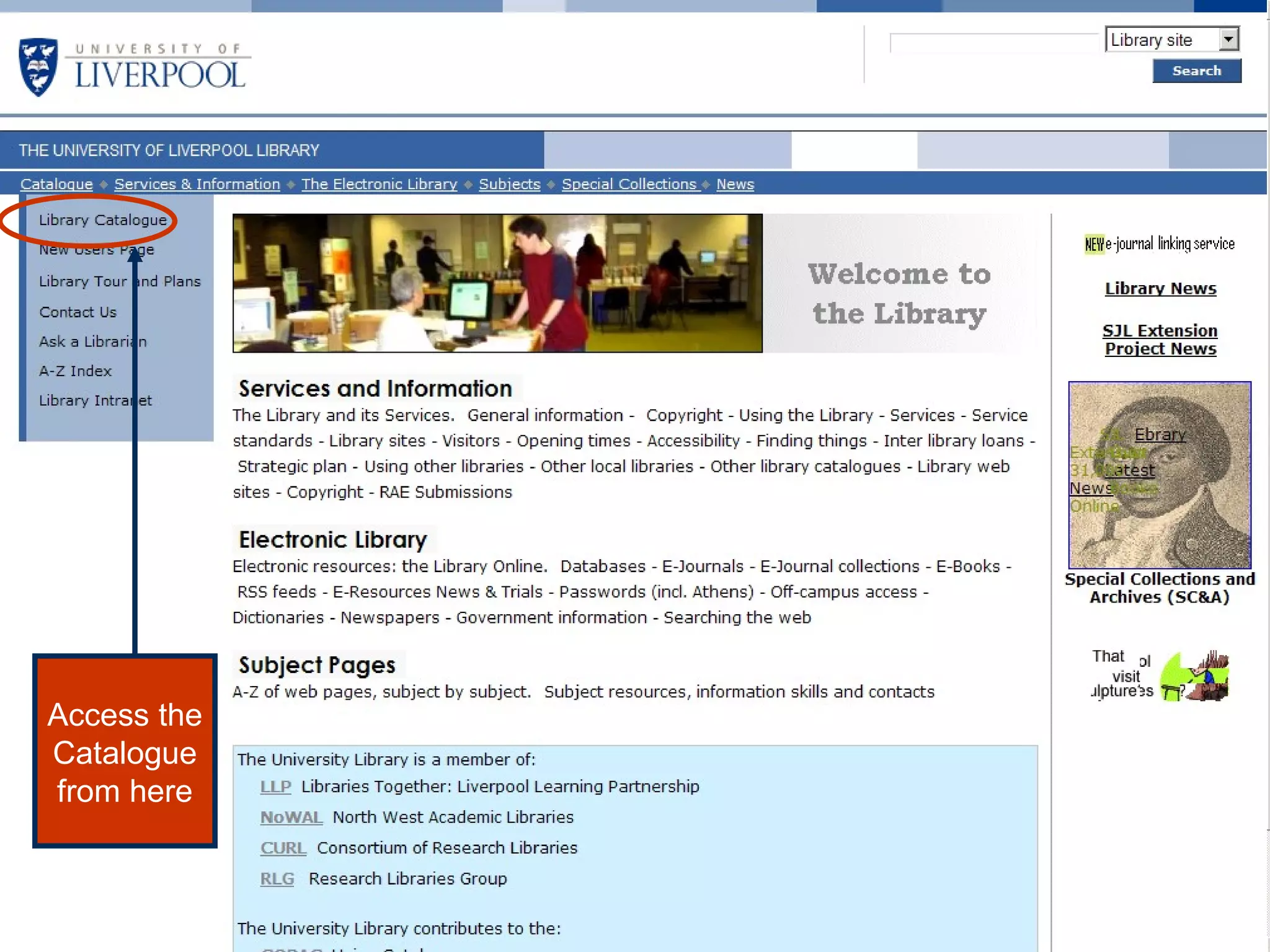
Access the Catalogue from here
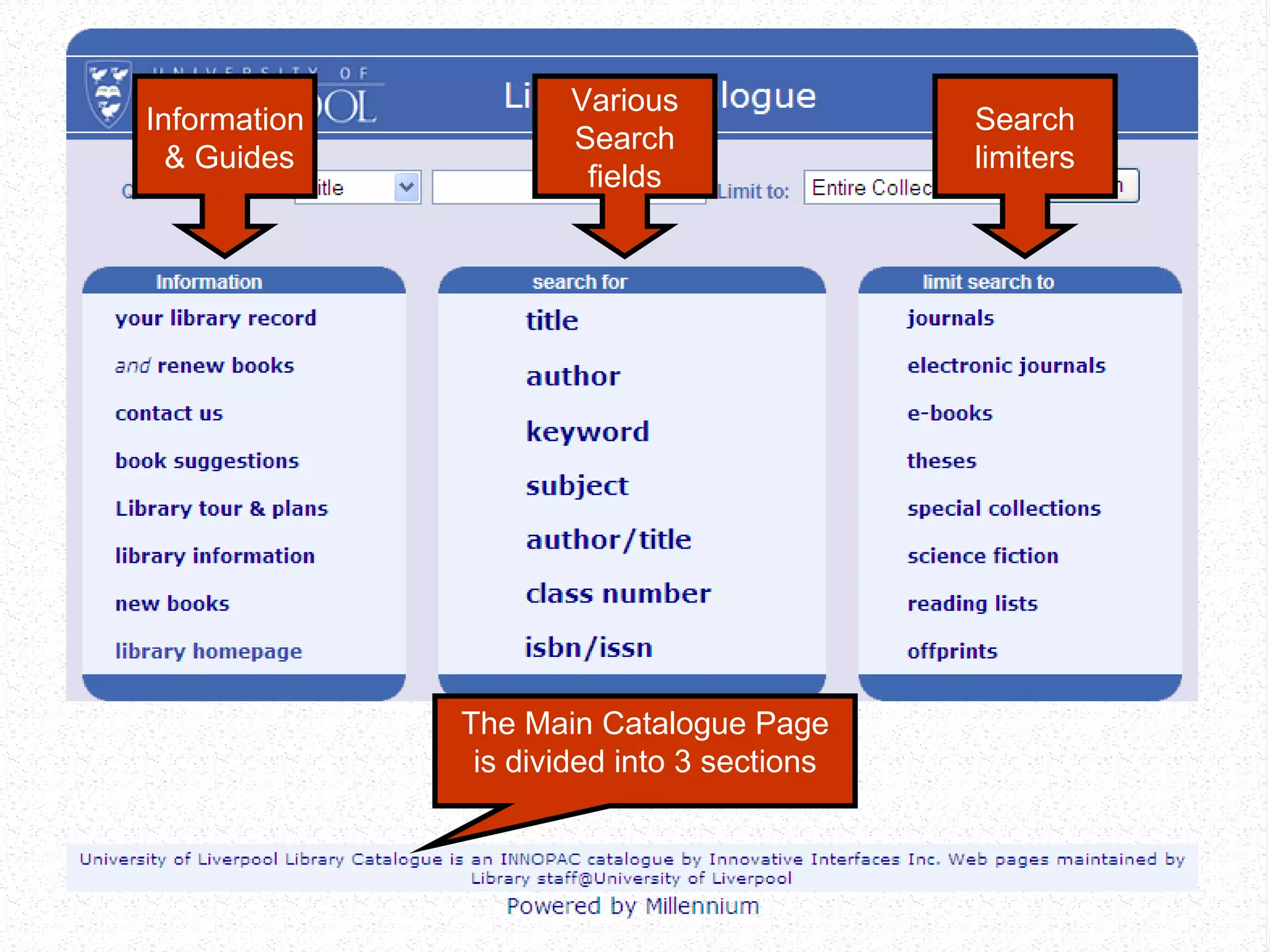
The Main Catalogue Page is divided into 3 sections Information & Guides Various Search fields Search limiters
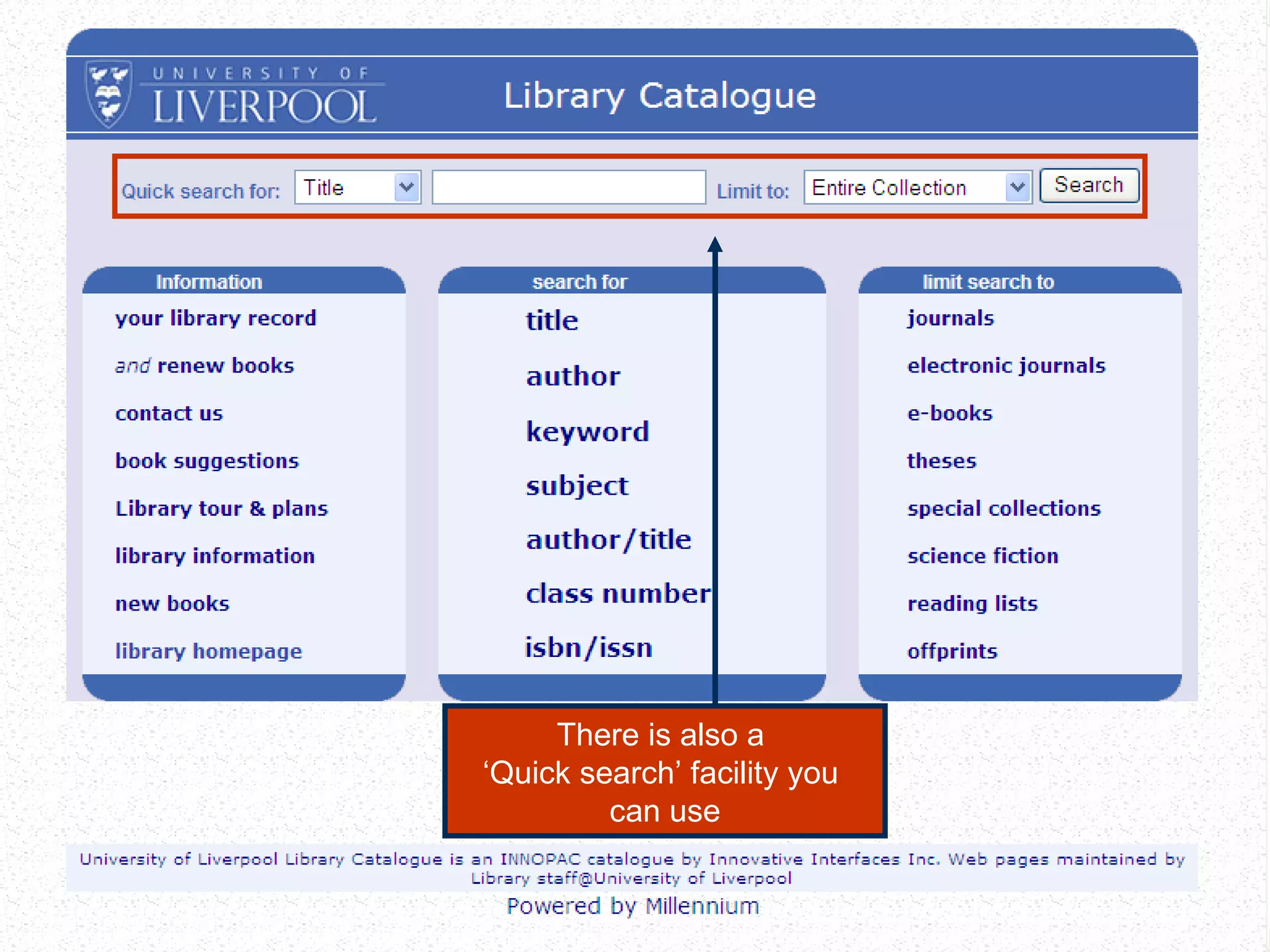
There is also a  ‘Quick search’ facility you  can use
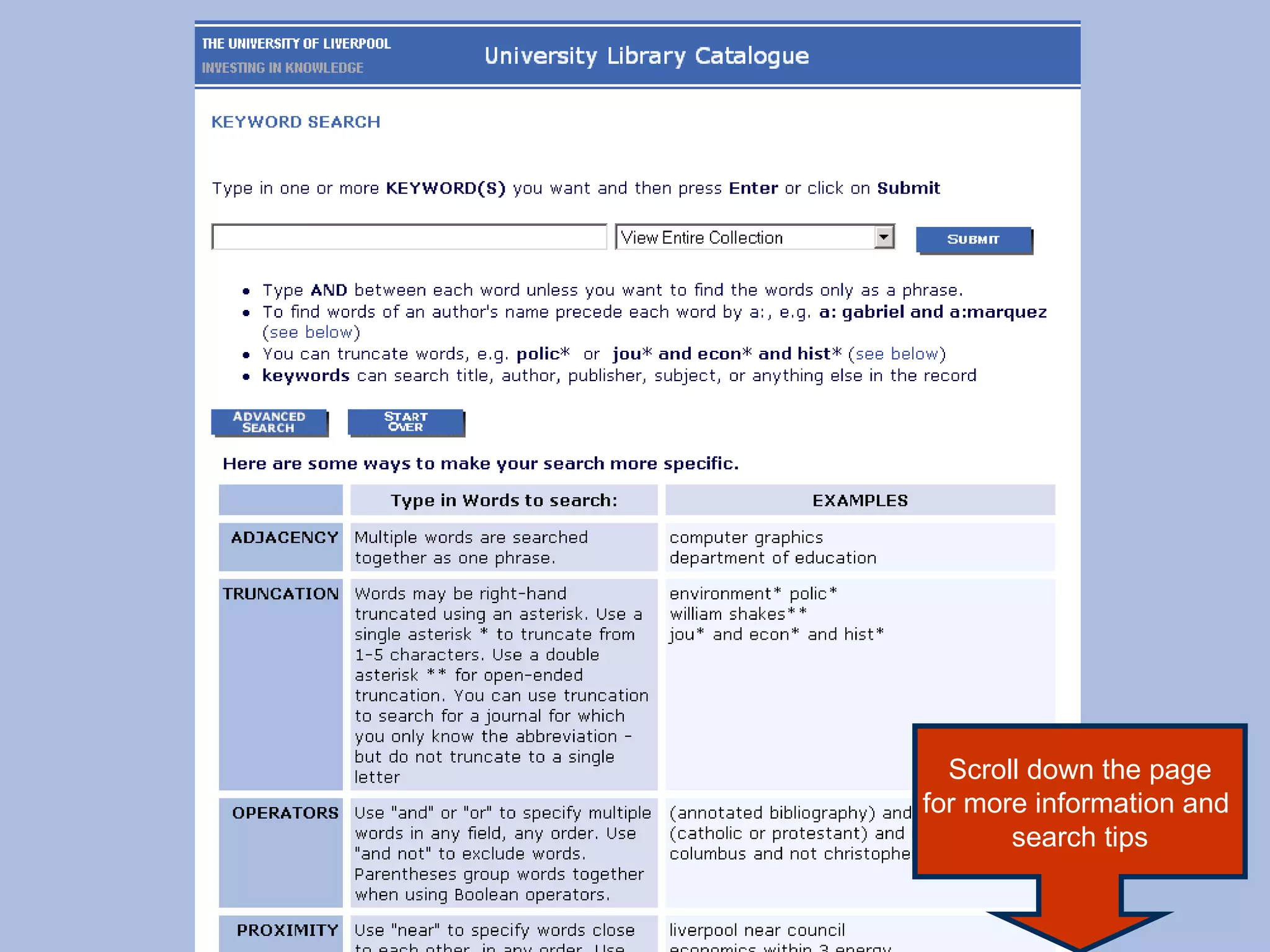
Keyword searching  Using the  Library Catalogue
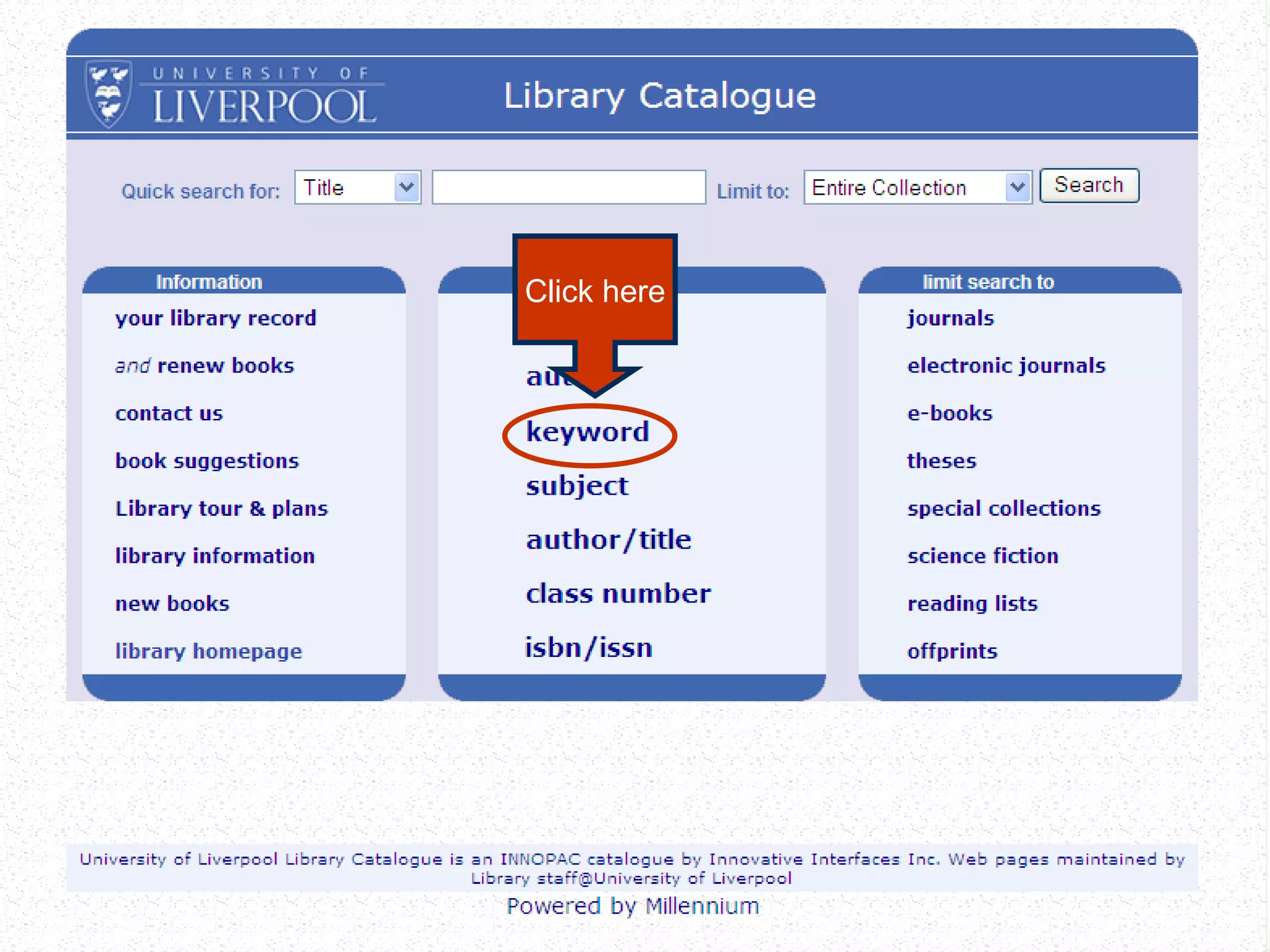
Click here
Scroll down the page for more information and  search tips
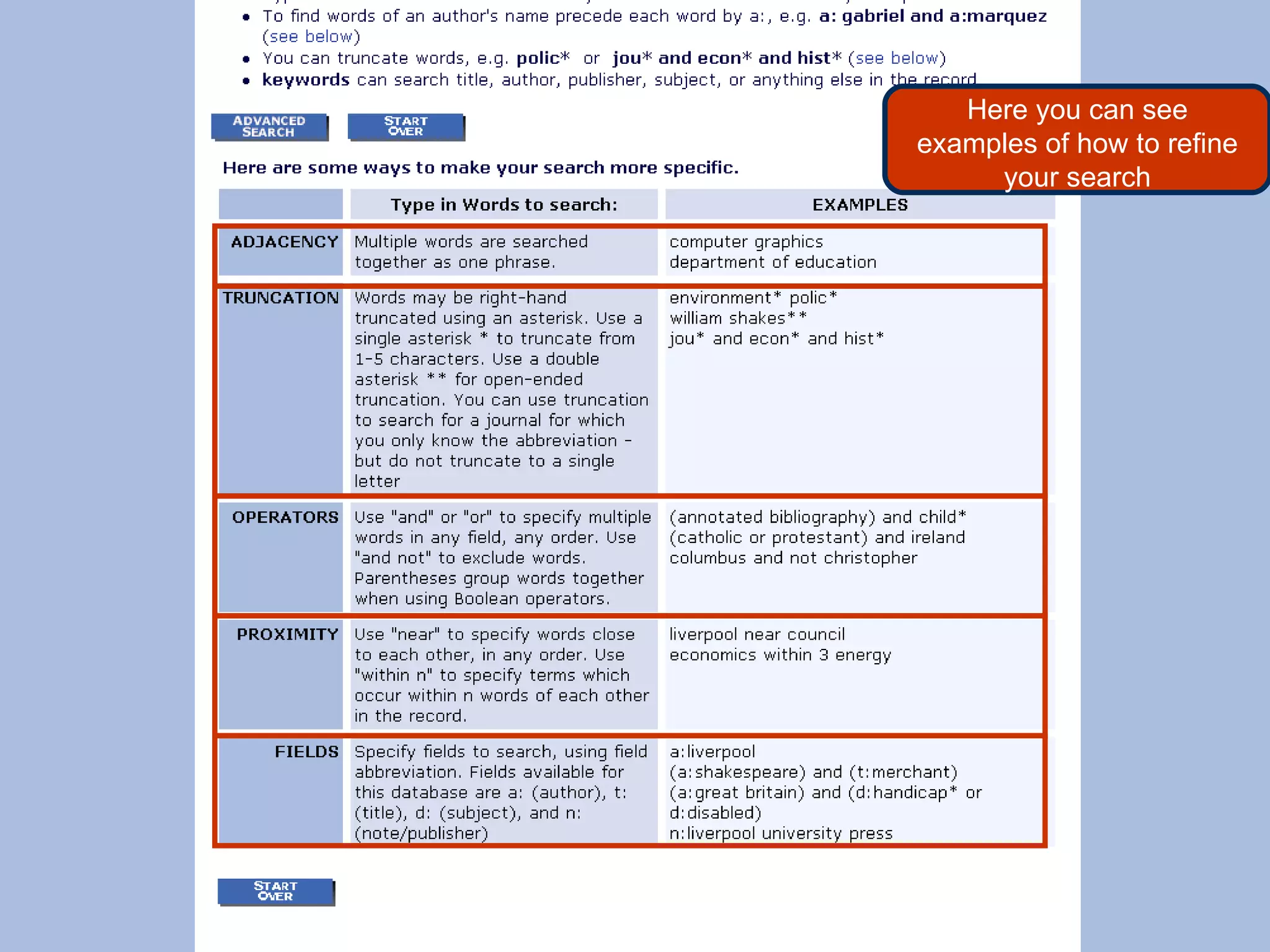
Here you can see examples of how to refine your search
Boolean logic consists of  three logical operators: OR 2. AND 3. NOT
The   OR   operator broadens or widens a search to include documents containing either keyword.   The   OR   search is particularly useful when there are several common synonyms for a concept or variant spellings of a word .   OR
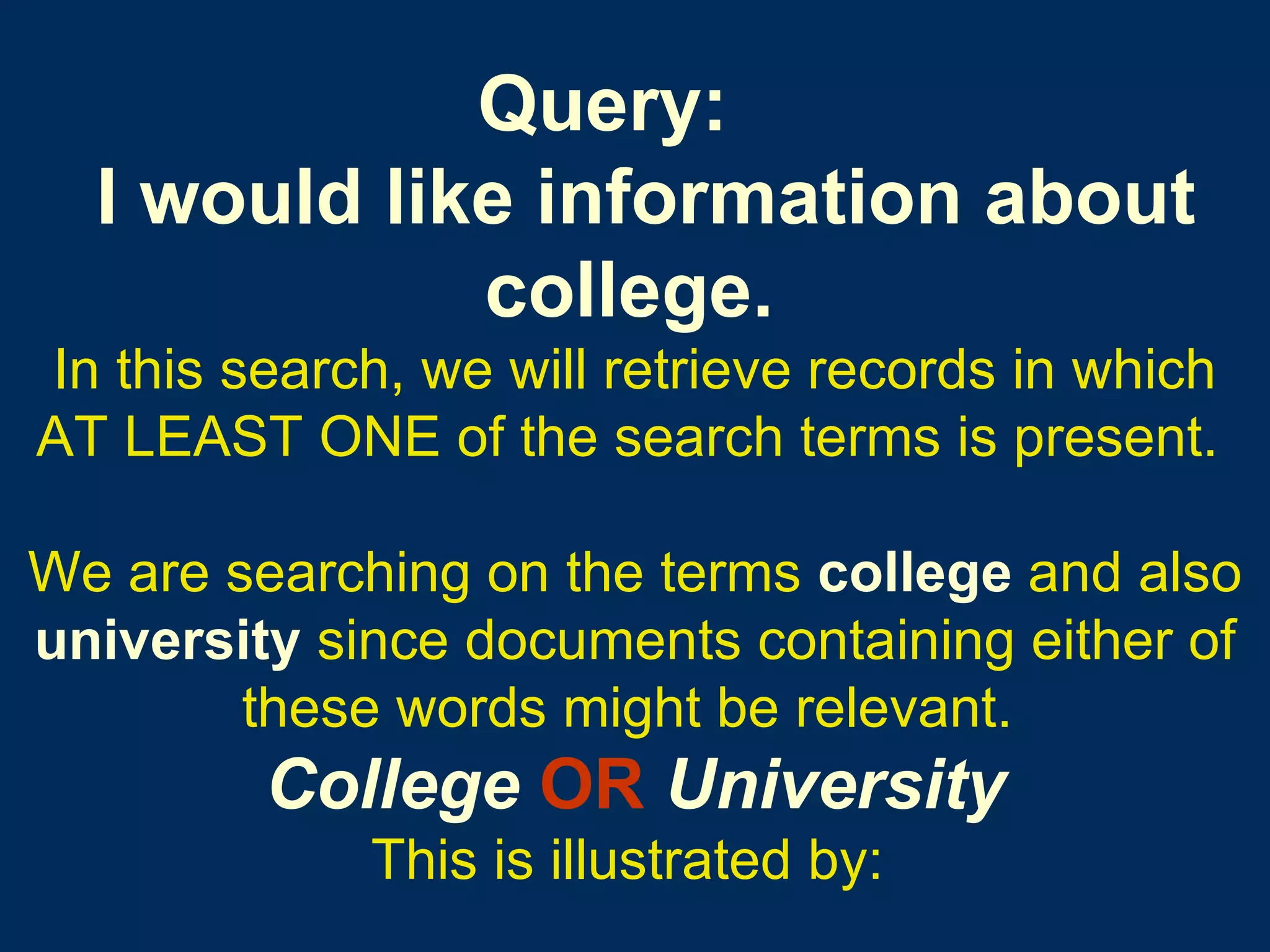
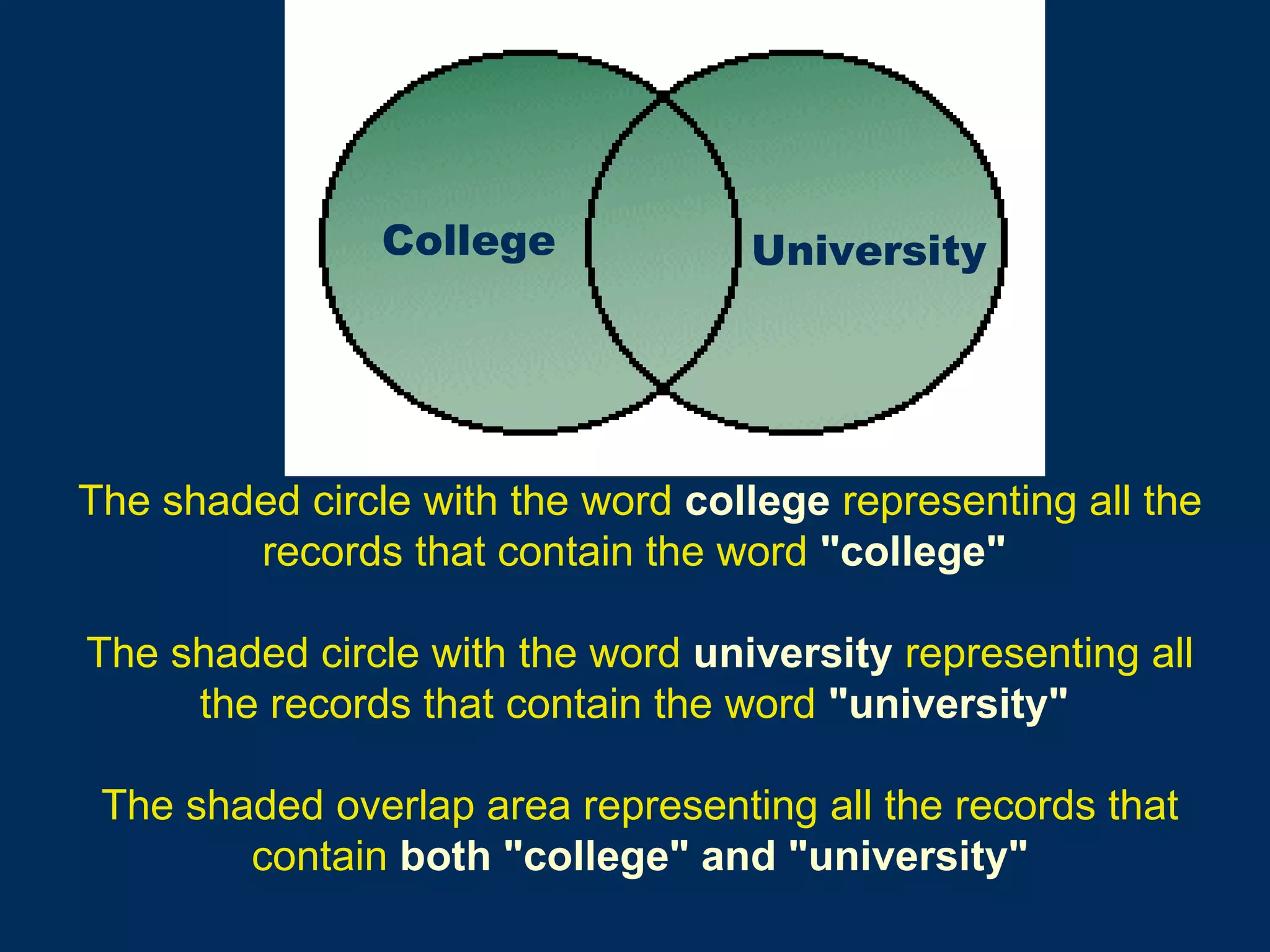
Query:    I would like information about college.   In this search, we will retrieve records in which AT LEAST ONE of the search terms is present.   We are searching on the terms   college   and also   university   since documents containing either of   these words might be relevant.   College   OR   University This is illustrated by:
College University The shaded circle with the word   college   representing all   the records that contain the word   "college"   The shaded circle with the word   university   representing all   the records that contain the word   "university"   The shaded overlap area representing all the records that   contain   both   "college" and   "university"
The operator   AND   narrows a   search by combining terms and retrieves   every document that   contains both of the words   specified.   AND
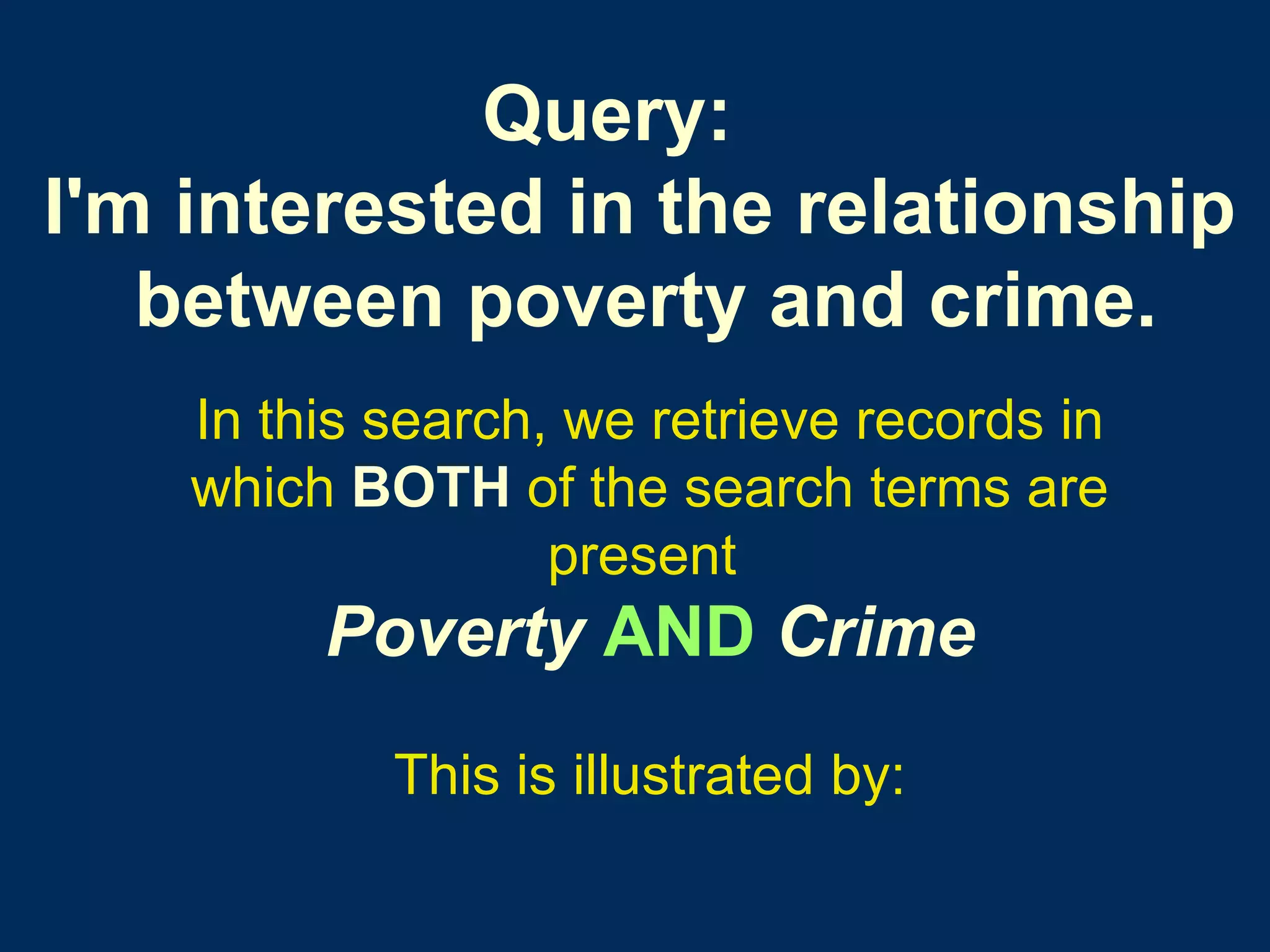
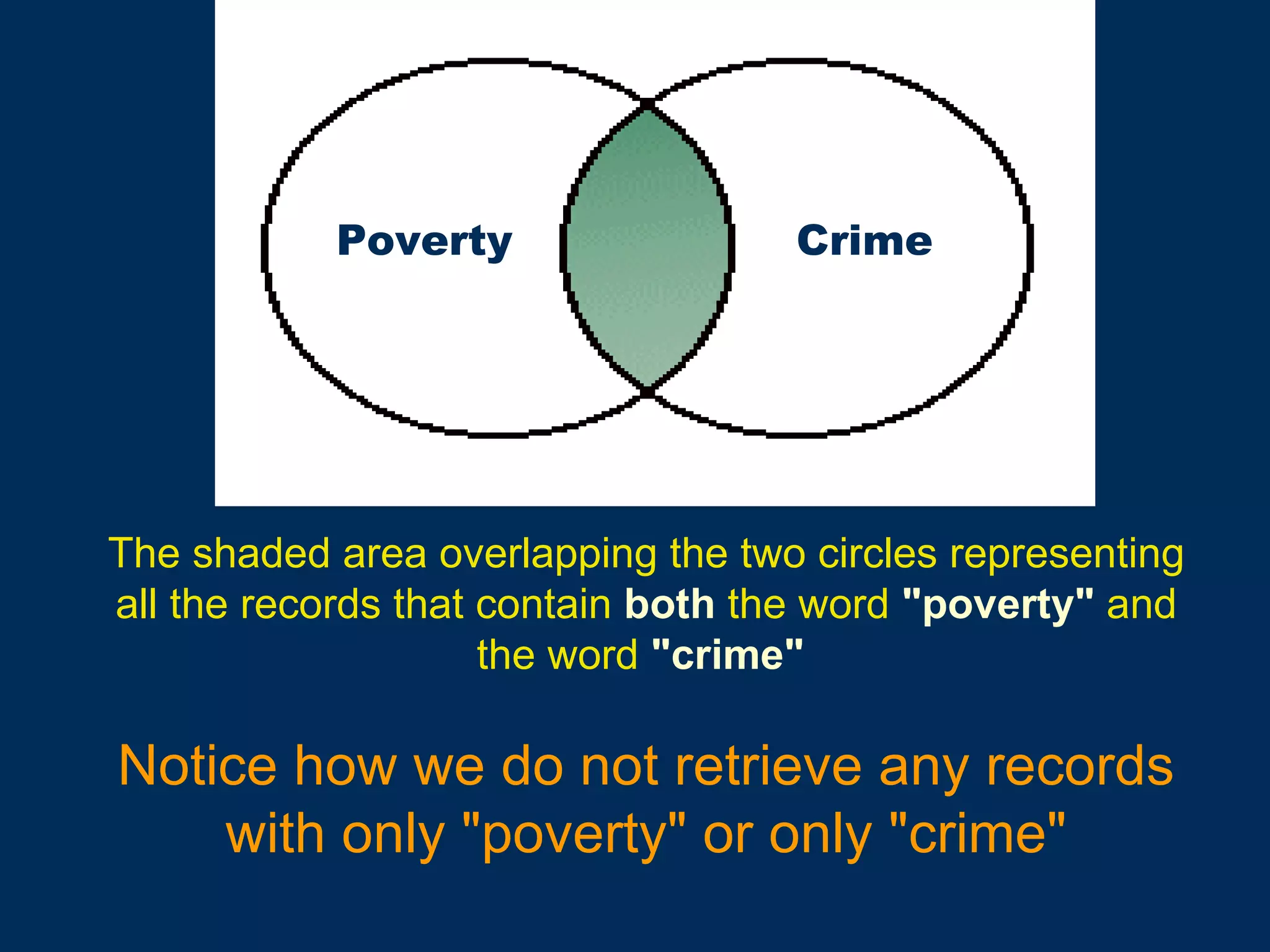
Query:     I'm interested in the relationship  between poverty and crime.   In this search, we retrieve records in which   BOTH   of the search terms are present  Poverty   AND   Crime This is illustrated by:
The shaded area overlapping the two circles representing all the records that contain   both   the word   "poverty"  and   the word   "crime"   Notice how we do not retrieve any records with only "poverty" or only "crime" Poverty Crime
Combining search terms with the   NOT   operator  narrows a search by excluding unwanted terms.   NOT
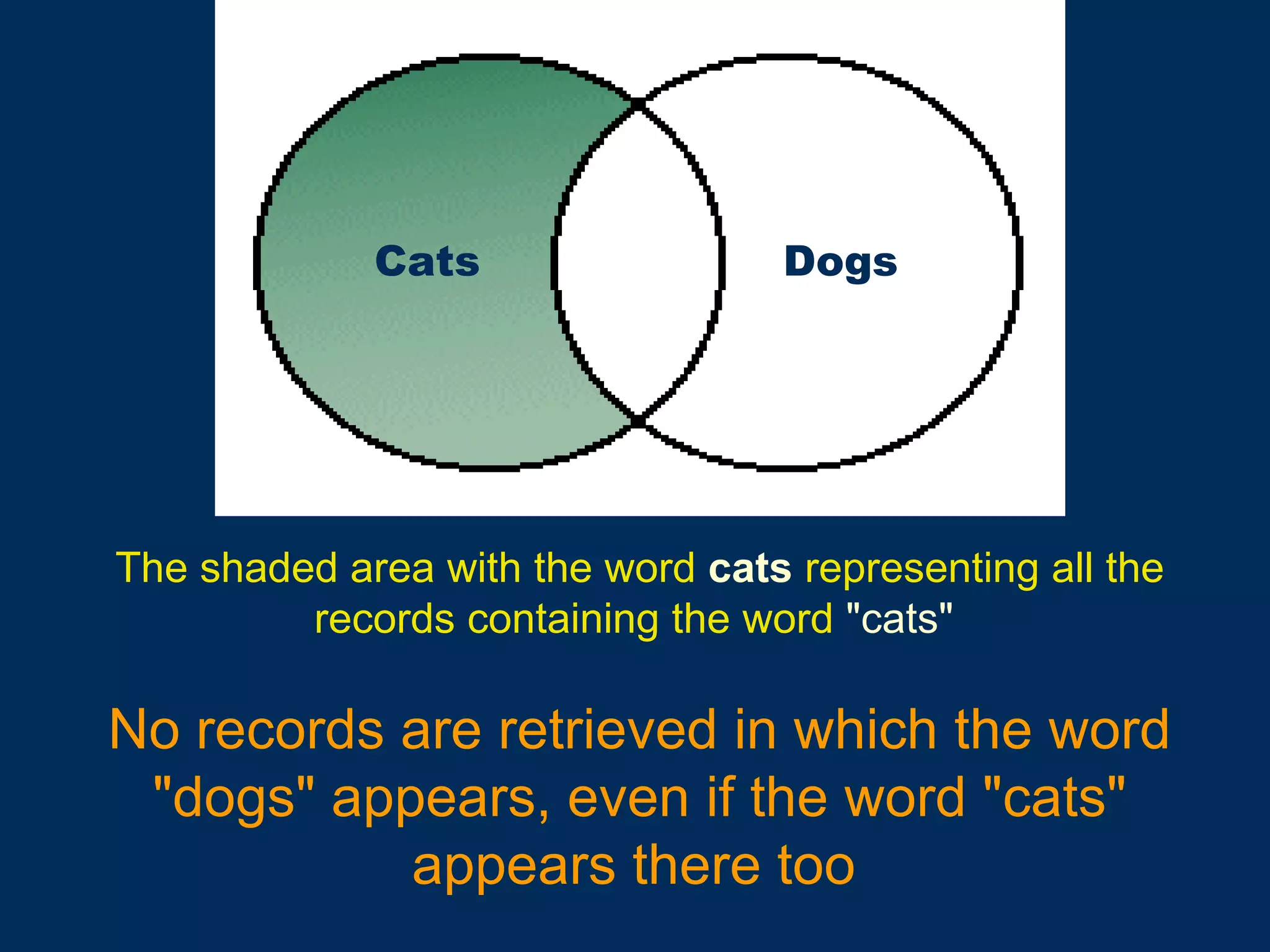
Query:      I want information about cats,  but I want to avoid anything about dogs.   Cats   NOT   Dogs In this search, we retrieve records in   which   ONLY ONE   of the terms is present   This is illustrated by:
The shaded area with the word   cats   representing all the   records containing the word  "cats"   No records are retrieved in which the word "dogs" appears, even if the word "cats" appears there too   Cats Dogs
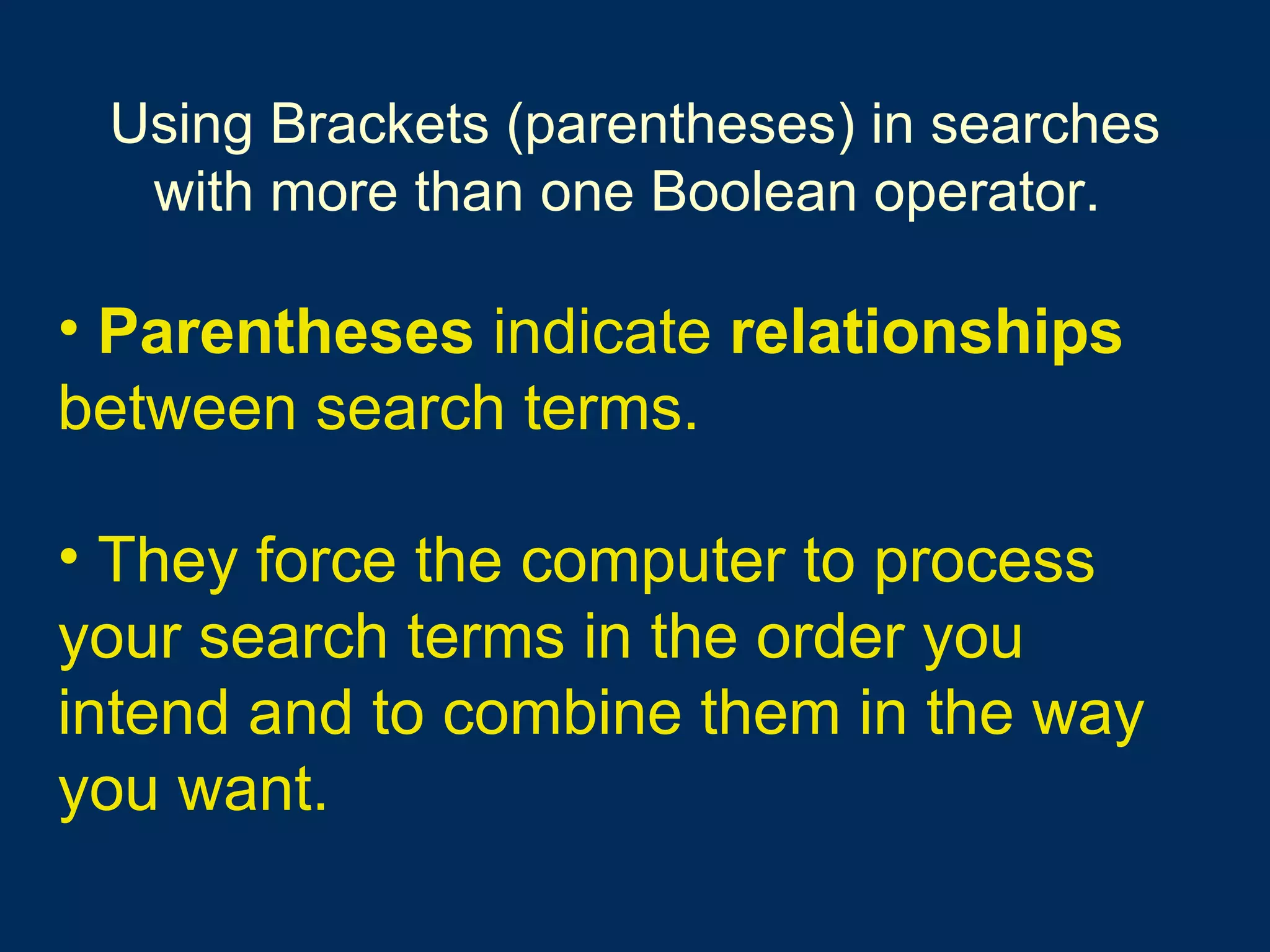
Using Brackets (parentheses) in searches with more than one Boolean operator.   Parentheses  indicate  relationships  between search terms.   They force the computer to process your search terms in the order you intend and to combine them in the way you want.
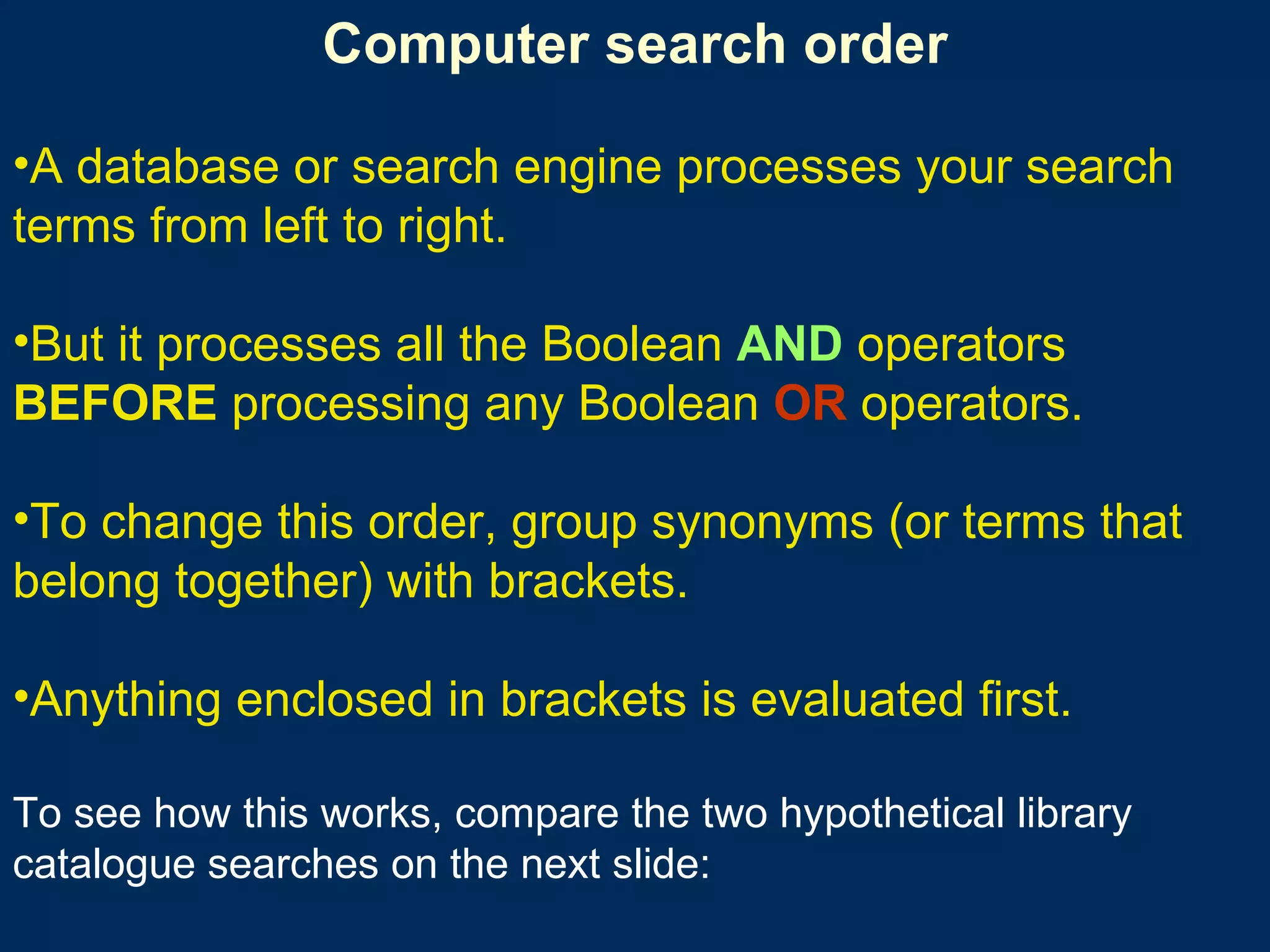
Computer search order A database or search engine processes your search terms from left to right.  But it processes all the Boolean  AND  operators  BEFORE  processing any Boolean  OR  operators.  To change this order, group synonyms (or terms that belong together) with brackets.  Anything enclosed in brackets is evaluated first.  To see how this works, compare the two hypothetical library catalogue searches on the next slide:
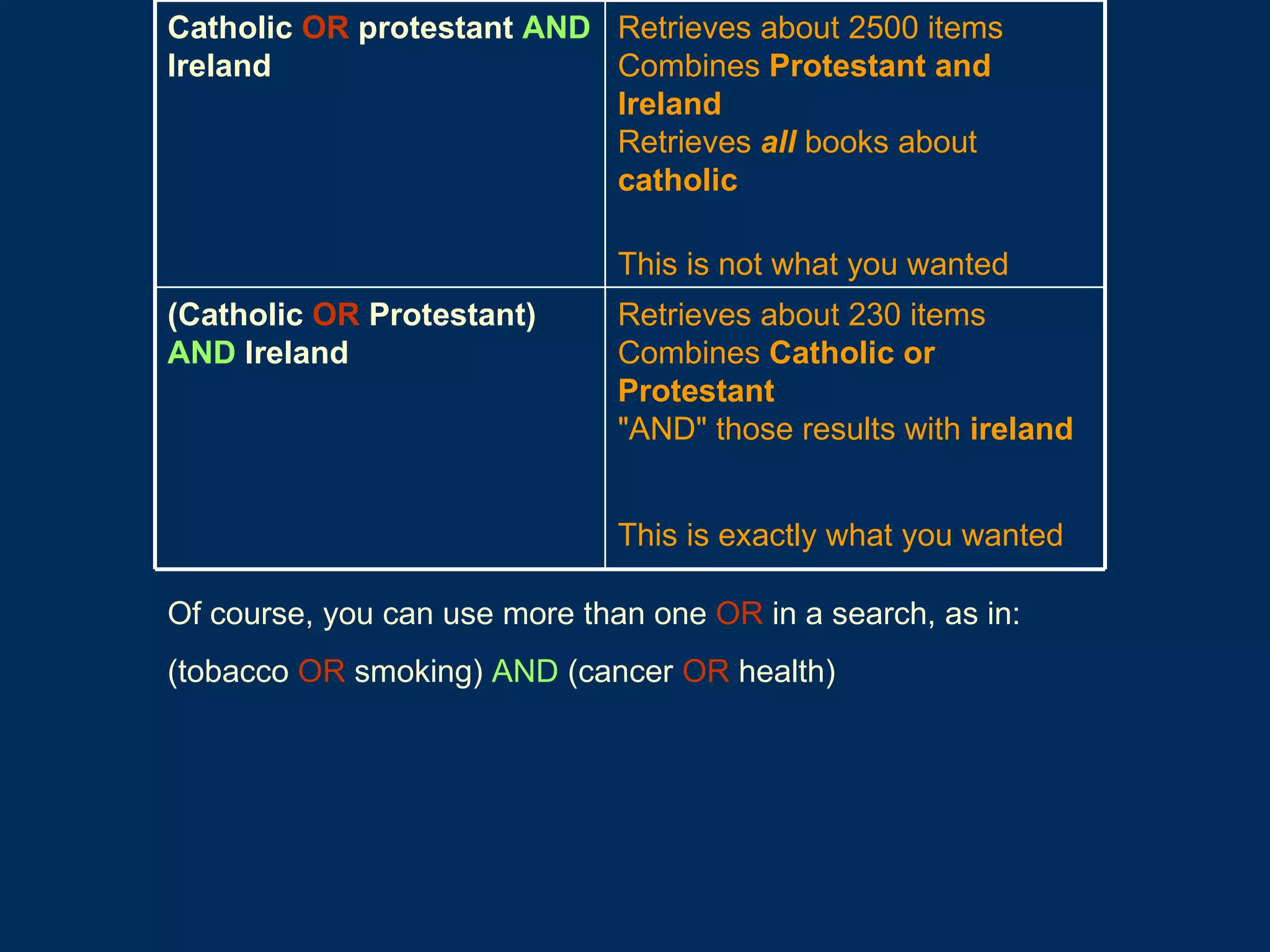
Of course, you can use more than one   OR   in a search, as in: (tobacco   OR   smoking)   AND   (cancer   OR   health) Retrieves about 230 items Combines  Catholic or Protestant "AND" those results with  ireland This is exactly what you wanted   (Catholic   OR   Protestant)   AND   Ireland   Retrieves about 2500 items Combines  Protestant and Ireland Retrieves  all  books about  catholic This is not what you wanted Catholic   OR   protestant   AND   Ireland
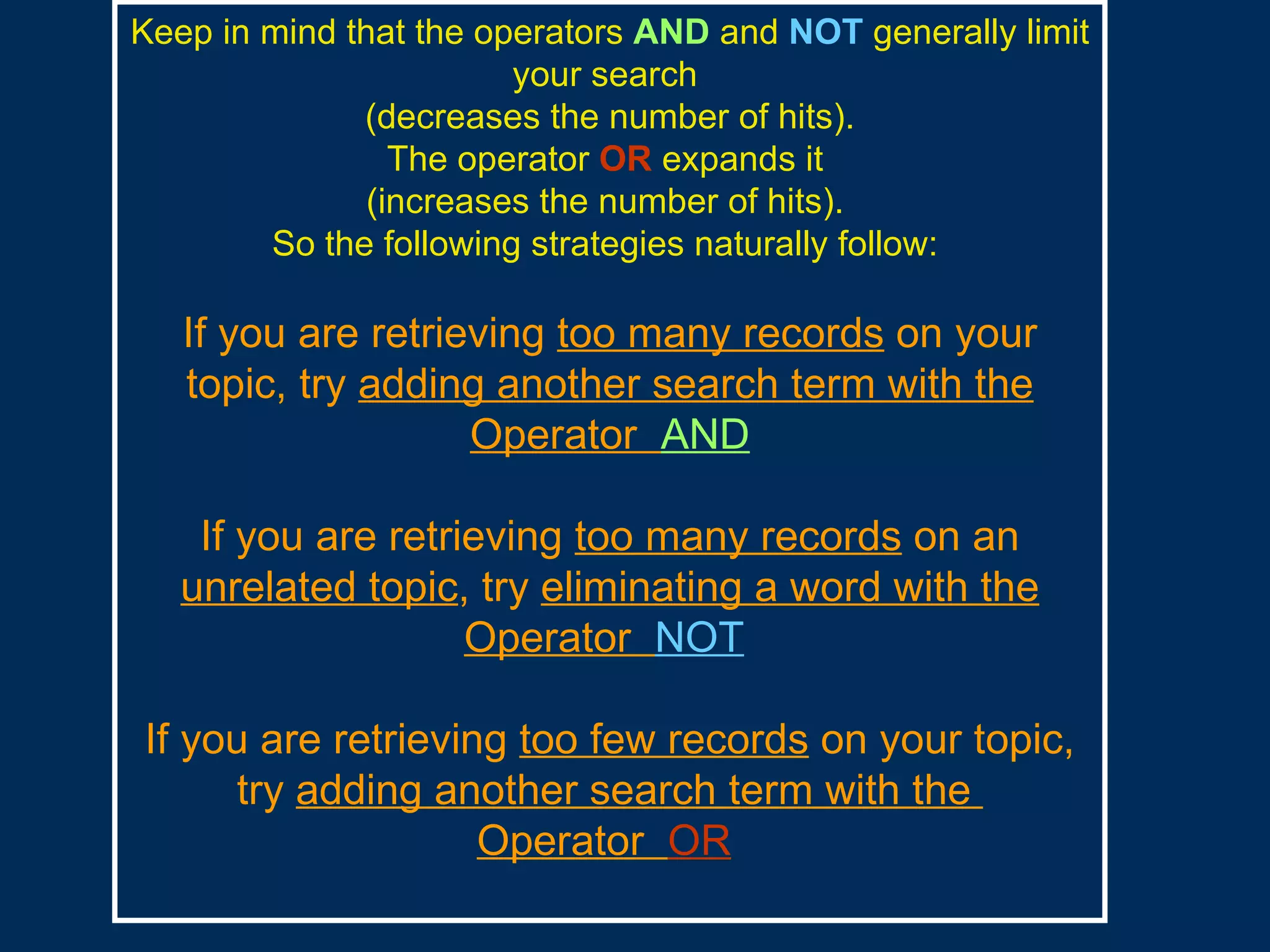
Keep in mind that the operators   AND   and   NOT   generally limit   your search  (decreases the number of hits). The operator   OR   expands it   (increases the number of hits).   So the following strategies naturally follow:  If you are retrieving  too many records  on your topic, try  adding another search term with the Operator  AND If you are retrieving  too many records  on an  unrelated topic , try  eliminating a word with the Operator  NOT   If you are retrieving  too few records  on your topic, try  adding another search term with the  Operator  OR
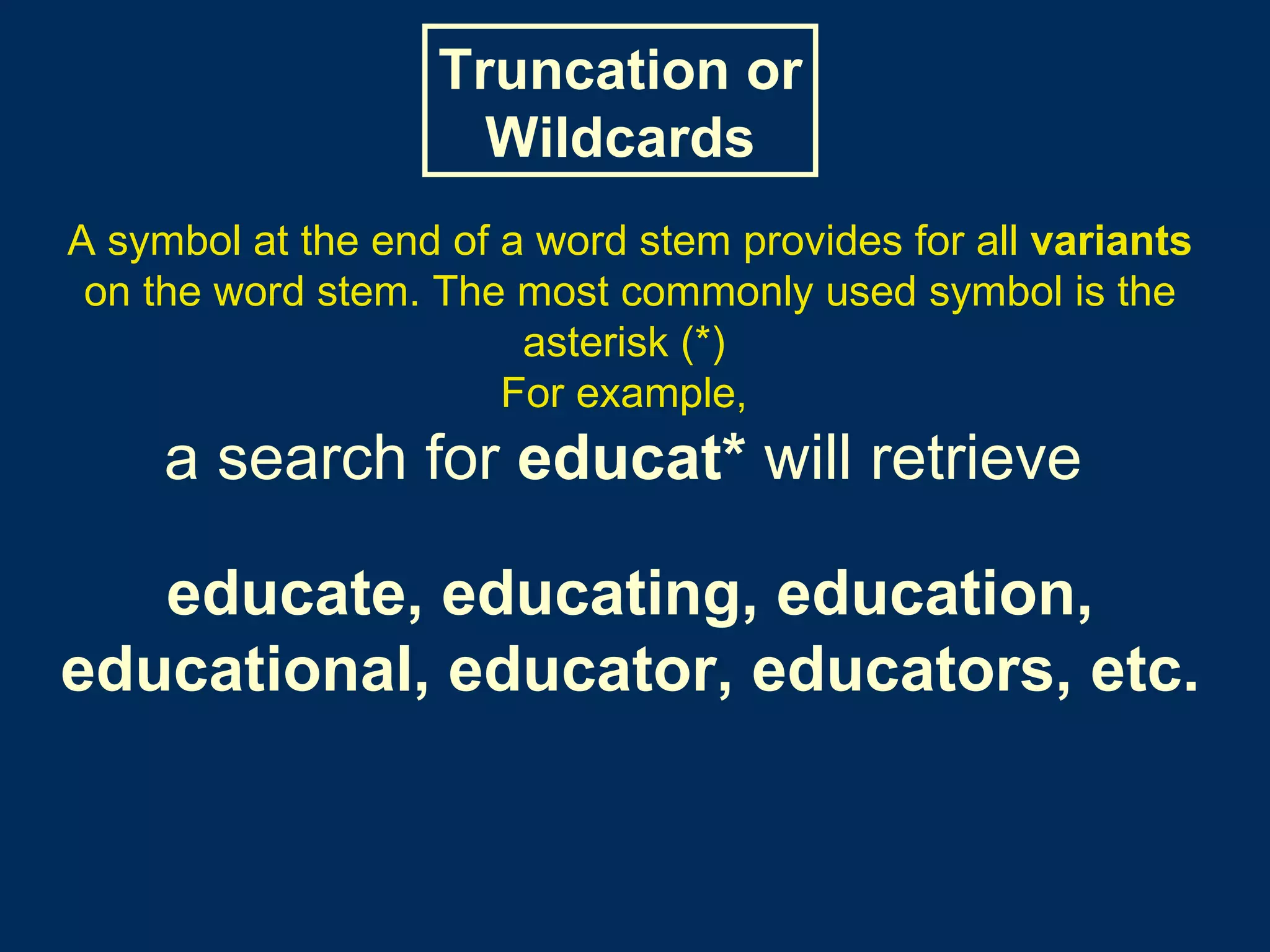
A symbol at the end of a word stem provides for all  variants  on the word stem. The most commonly used symbol is the asterisk (*)  For example,   a search for  educat*  will retrieve   educate, educating, education, educational, educator, educators, etc. Truncation or Wildcards
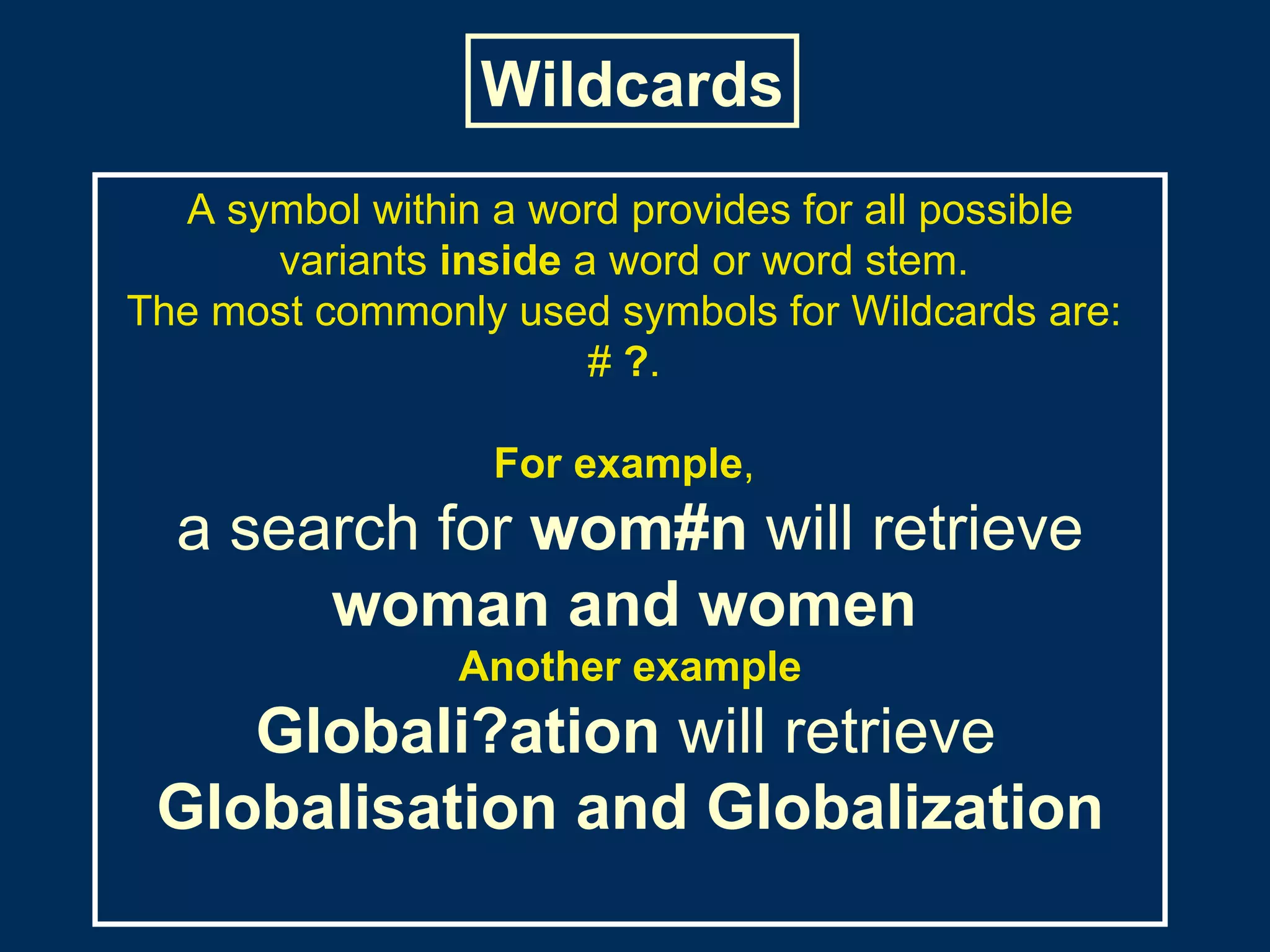
A symbol within a word provides for all possible variants  inside  a word or word stem.  The most commonly used symbols for Wildcards are:  #  ? .  For example ,   a search for  wom#n  will retrieve   woman and women   Another example Globali?ation  will retrieve   Globalisation and Globalization Wildcards
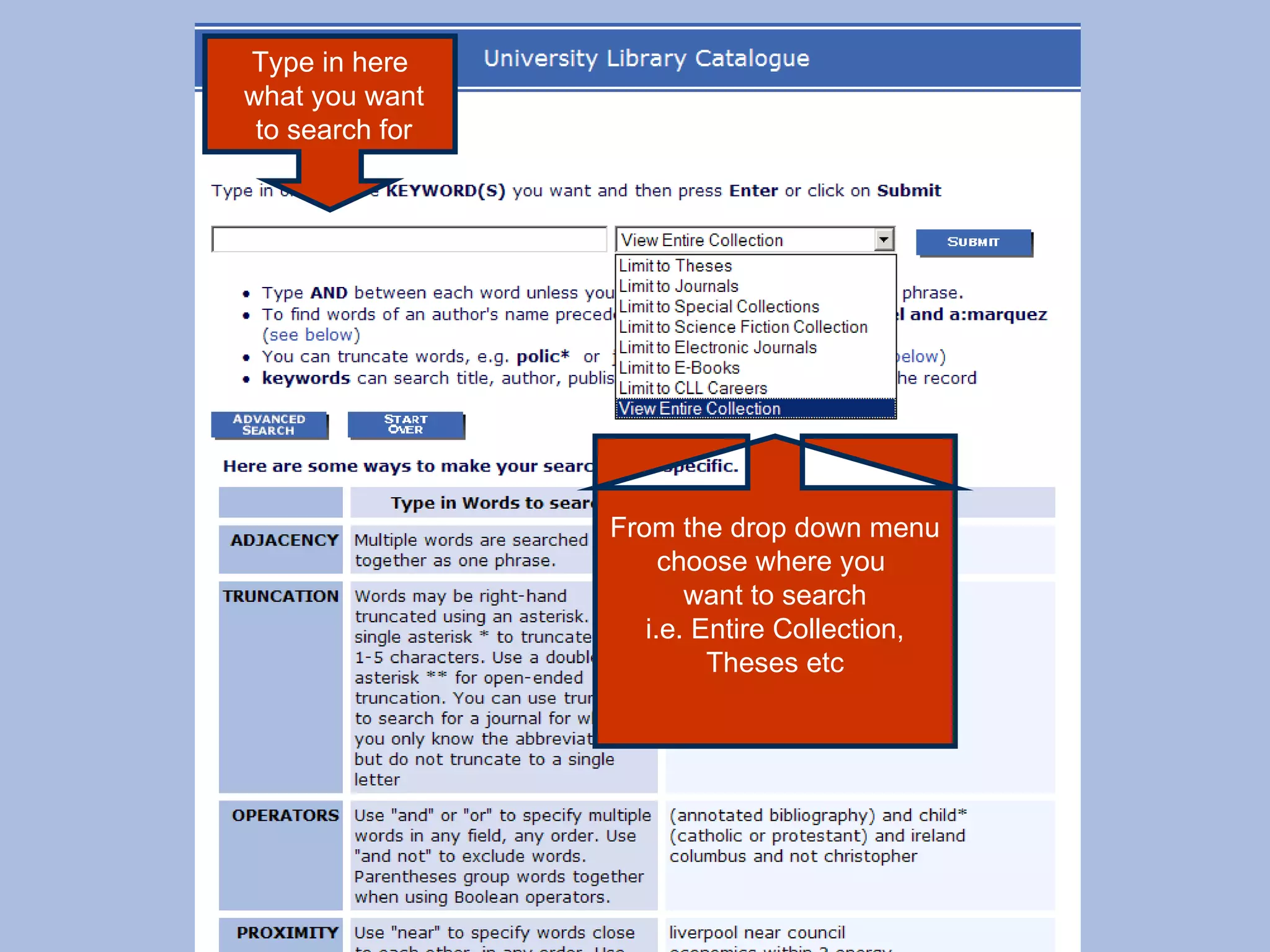
Type in here what you want to search for From the drop down menu choose where you  want to search i.e. Entire Collection, Theses etc
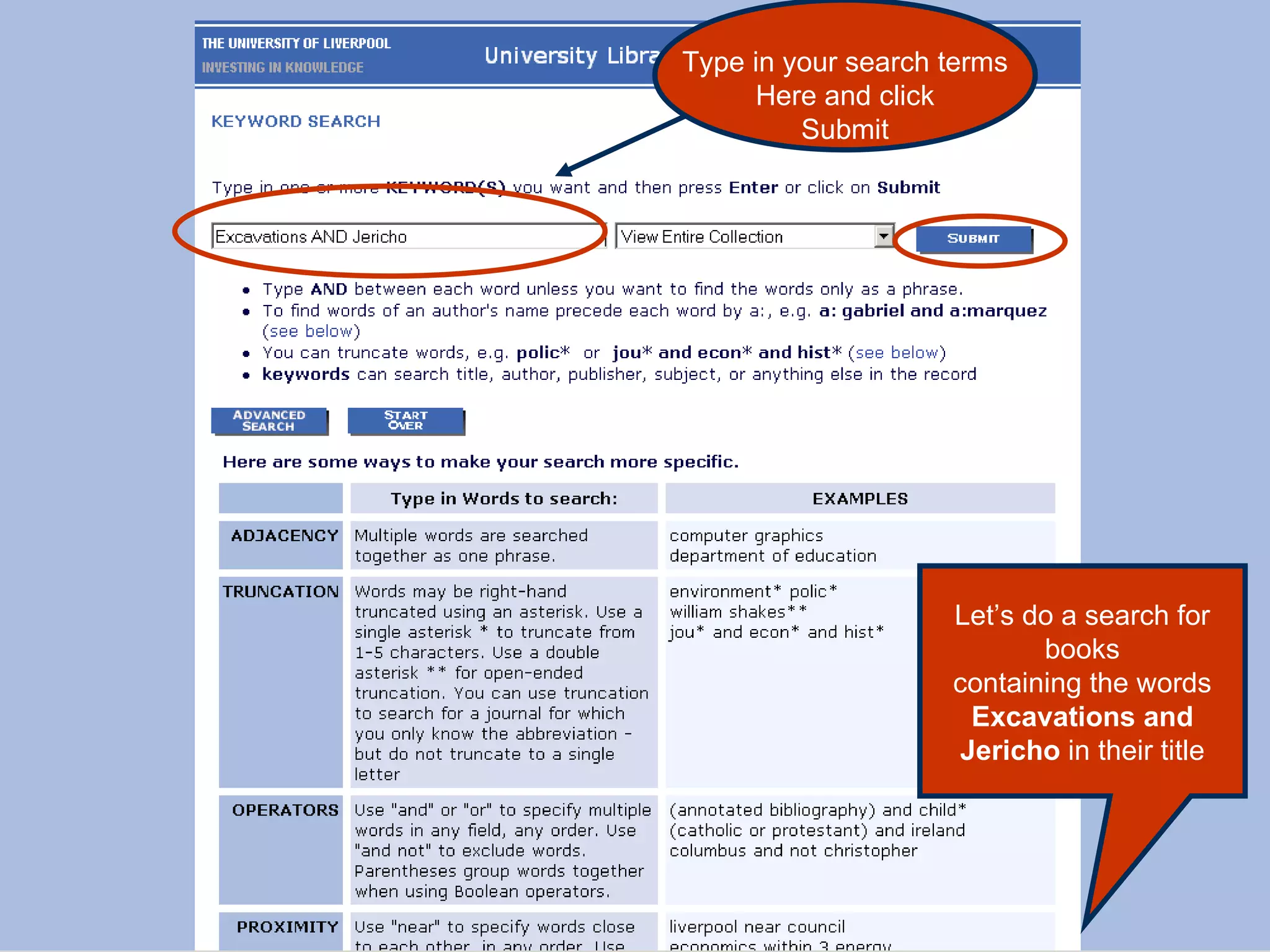
Let’s do a search for books containing the words Excavations and Jericho  in their title Type in your search terms Here and click Submit
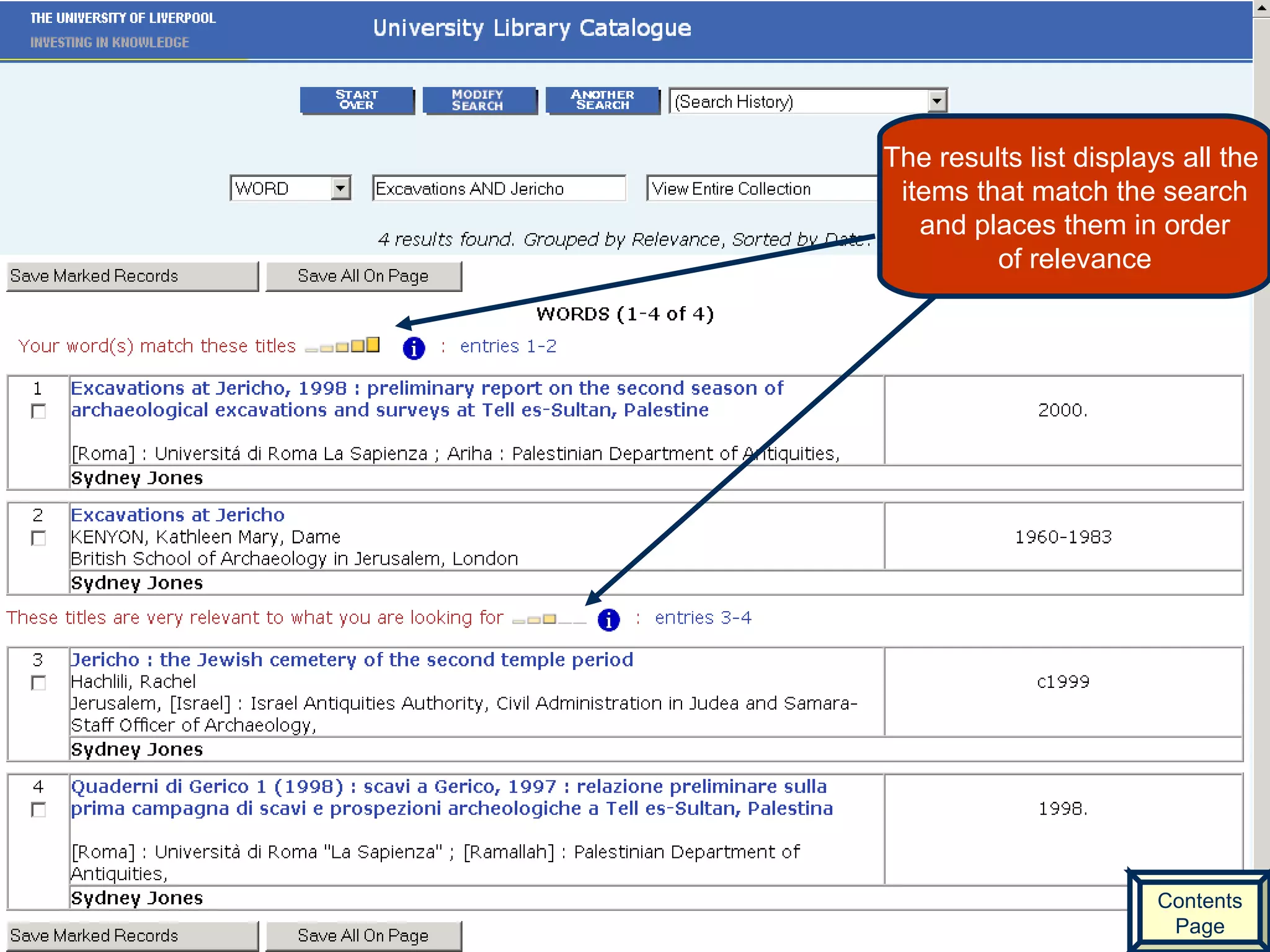
The results list displays all the  items that match the search and places them in order  of relevance Contents Page
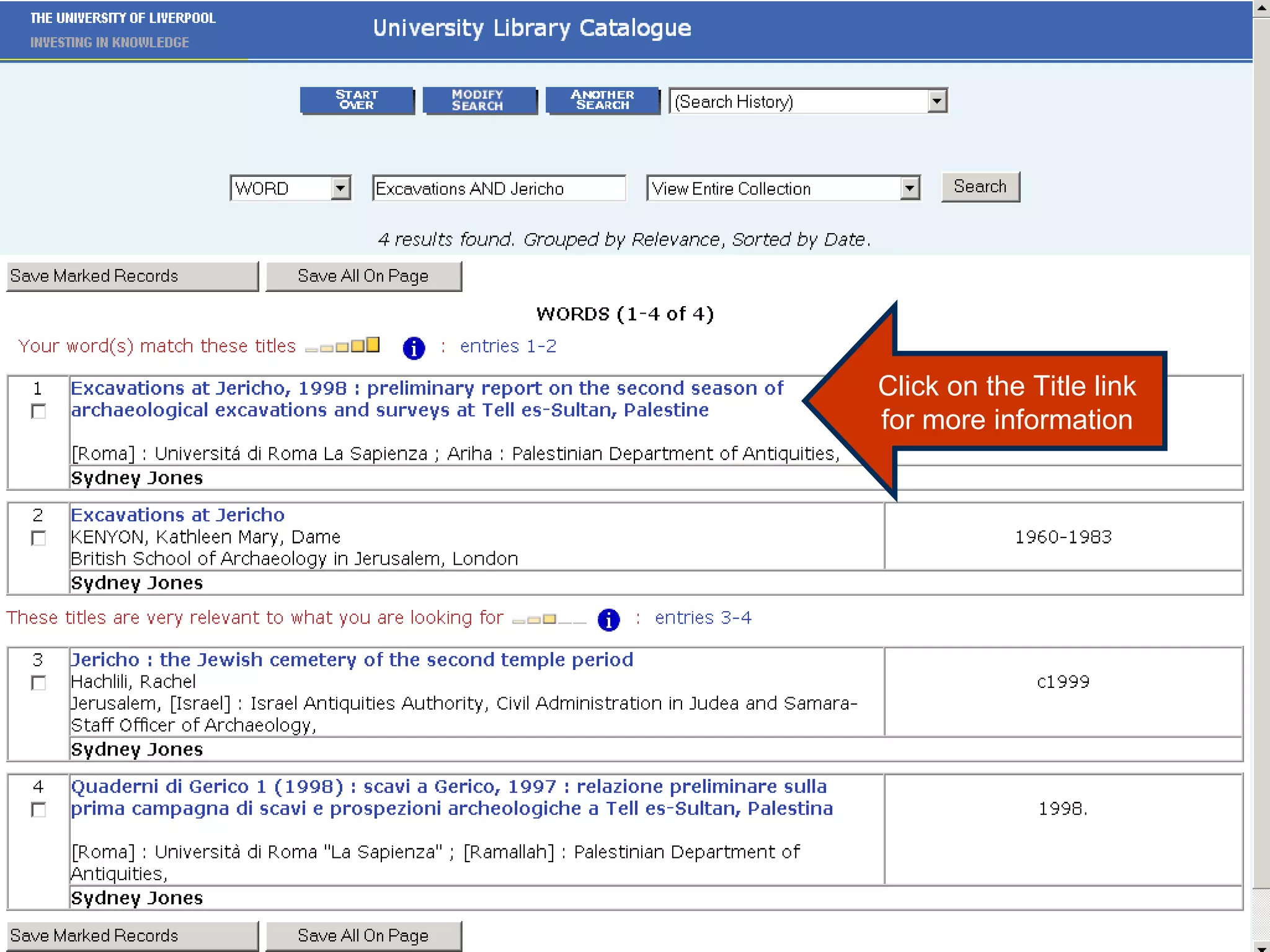
Click on the Title link for more information
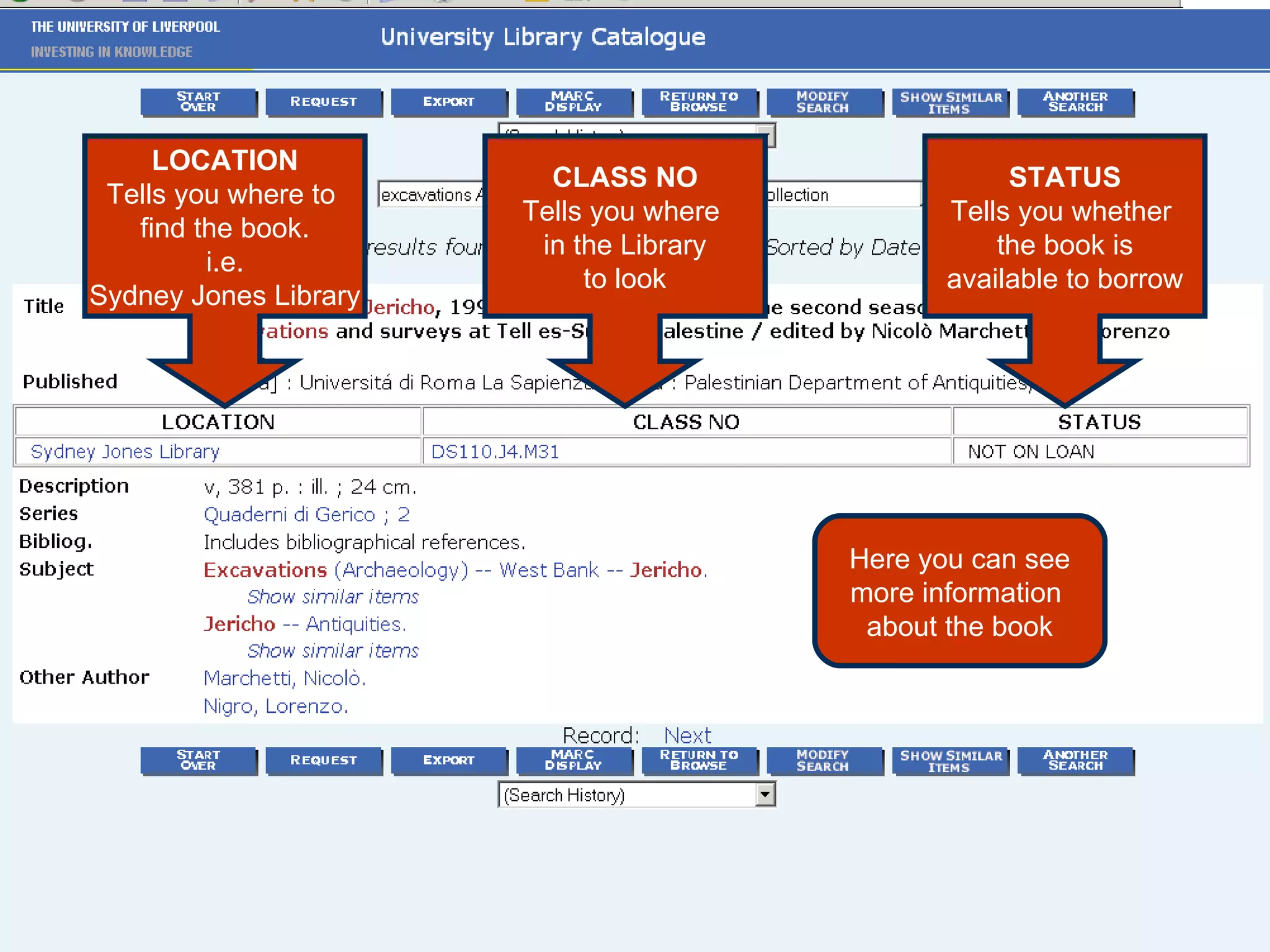
LOCATION Tells you where to  find the book. i.e. Sydney Jones Library Here you can see more information  about the book CLASS NO Tells you where  in the Library to look STATUS Tells you whether  the book is available to borrow
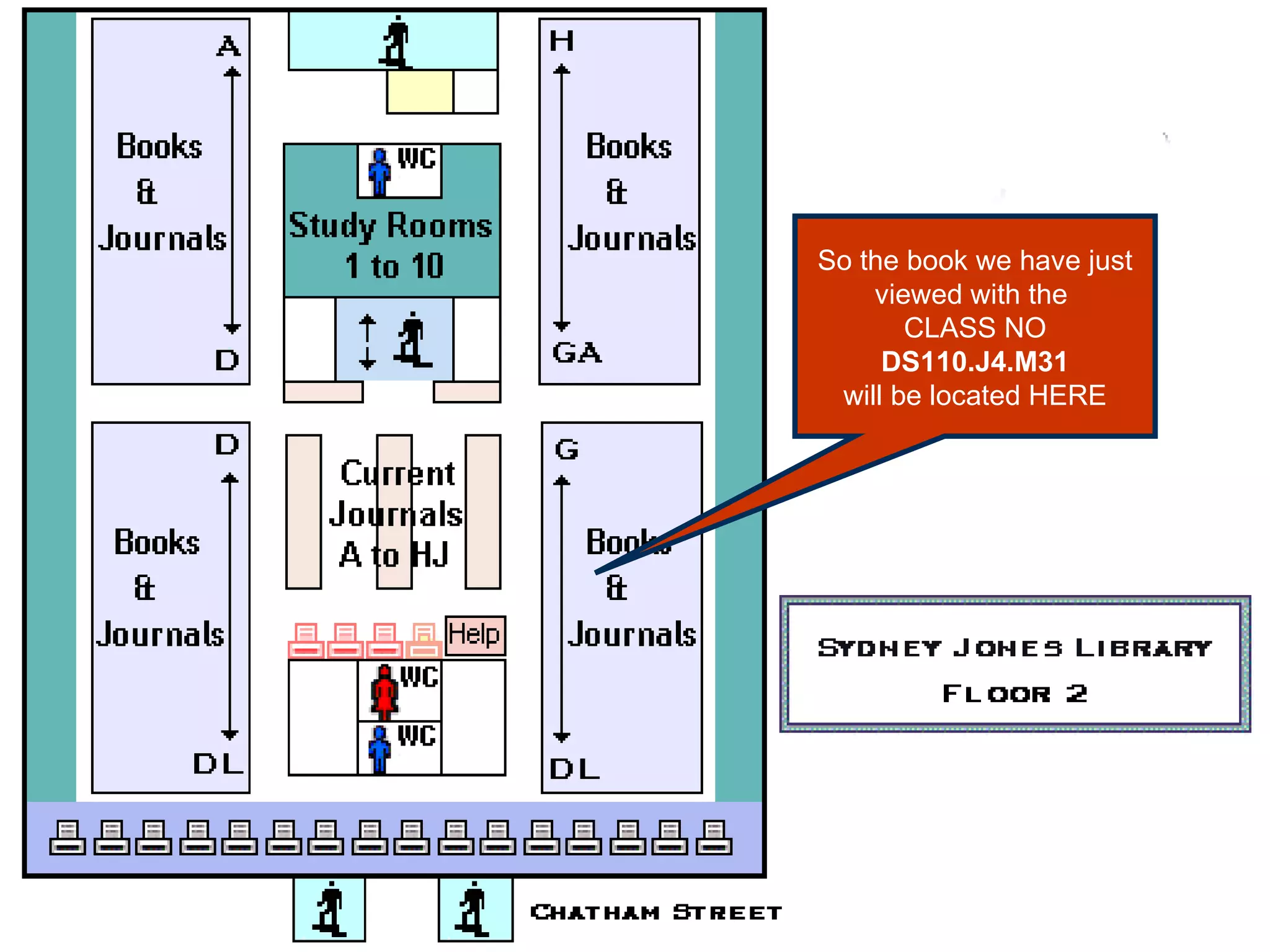
So the book we have just viewed with the  CLASS NO DS110.J4.M31 will be located HERE
Using the  Title search  Facility
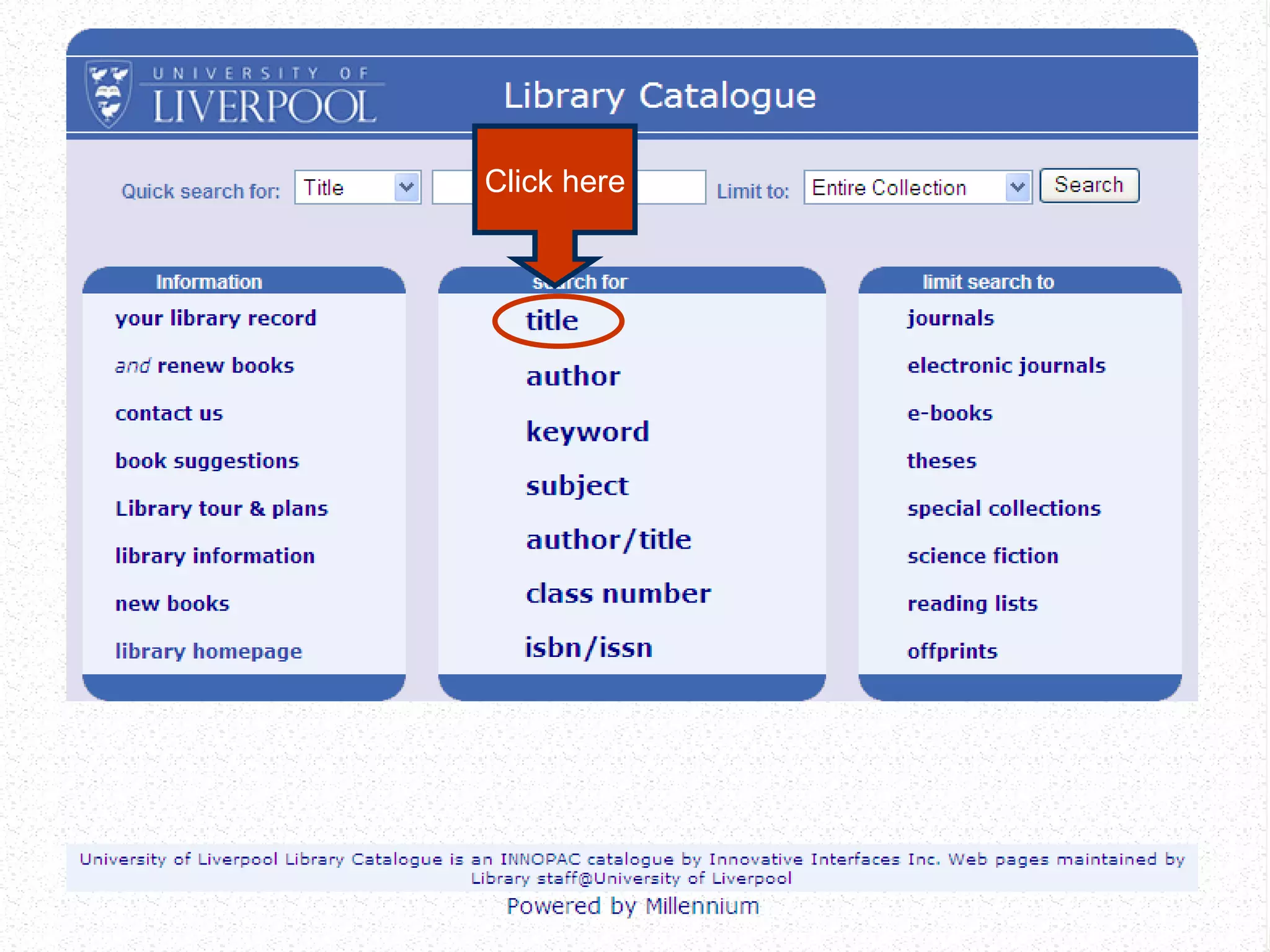
Click here
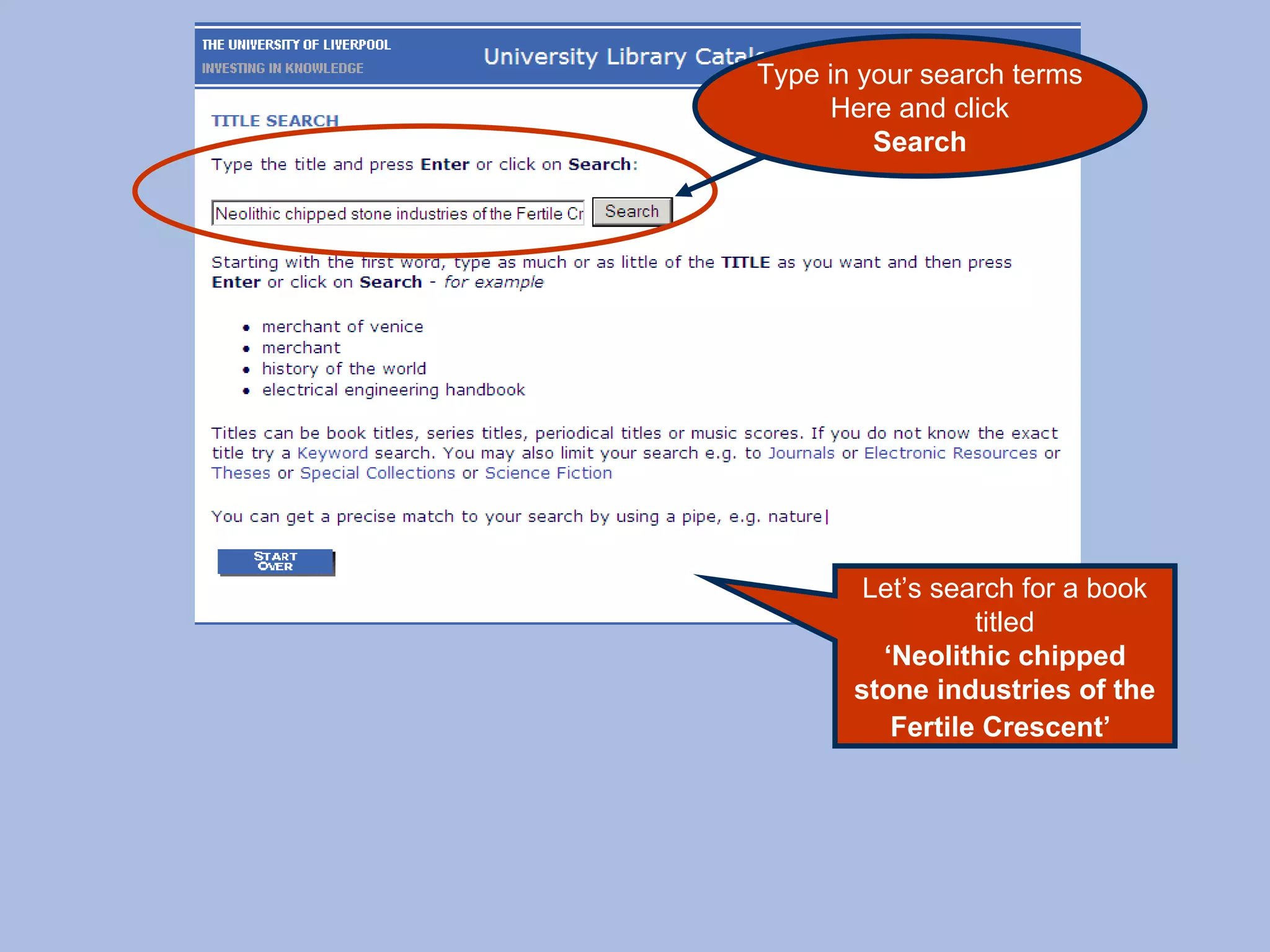
Let’s search for a book titled ‘ Neolithic chipped stone industries of the Fertile Crescent’   Type in your search terms Here and click Search
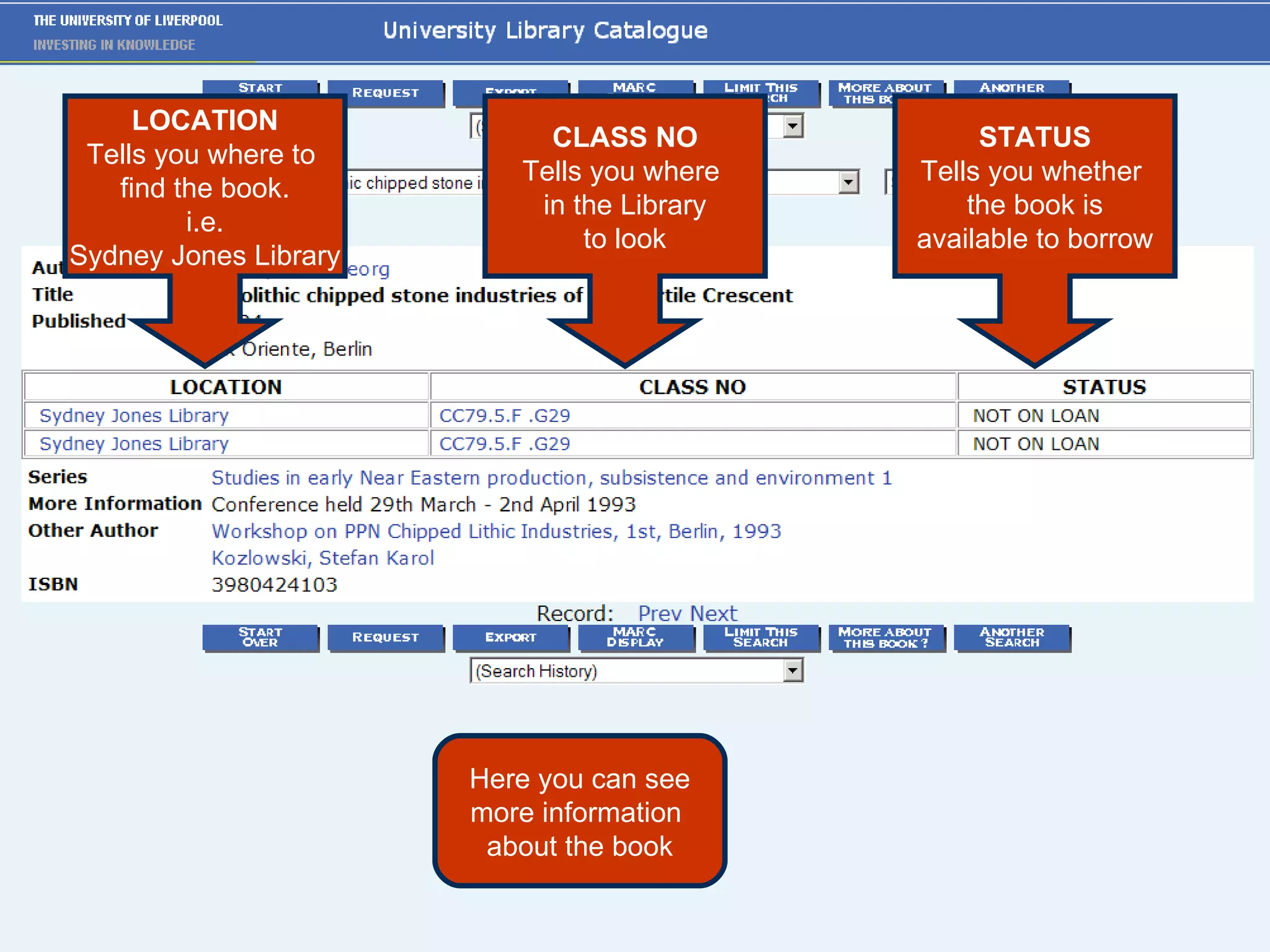
Here you can see more information  about the book LOCATION Tells you where to  find the book. i.e. Sydney Jones Library CLASS NO Tells you where  in the Library to look STATUS Tells you whether  the book is available to borrow
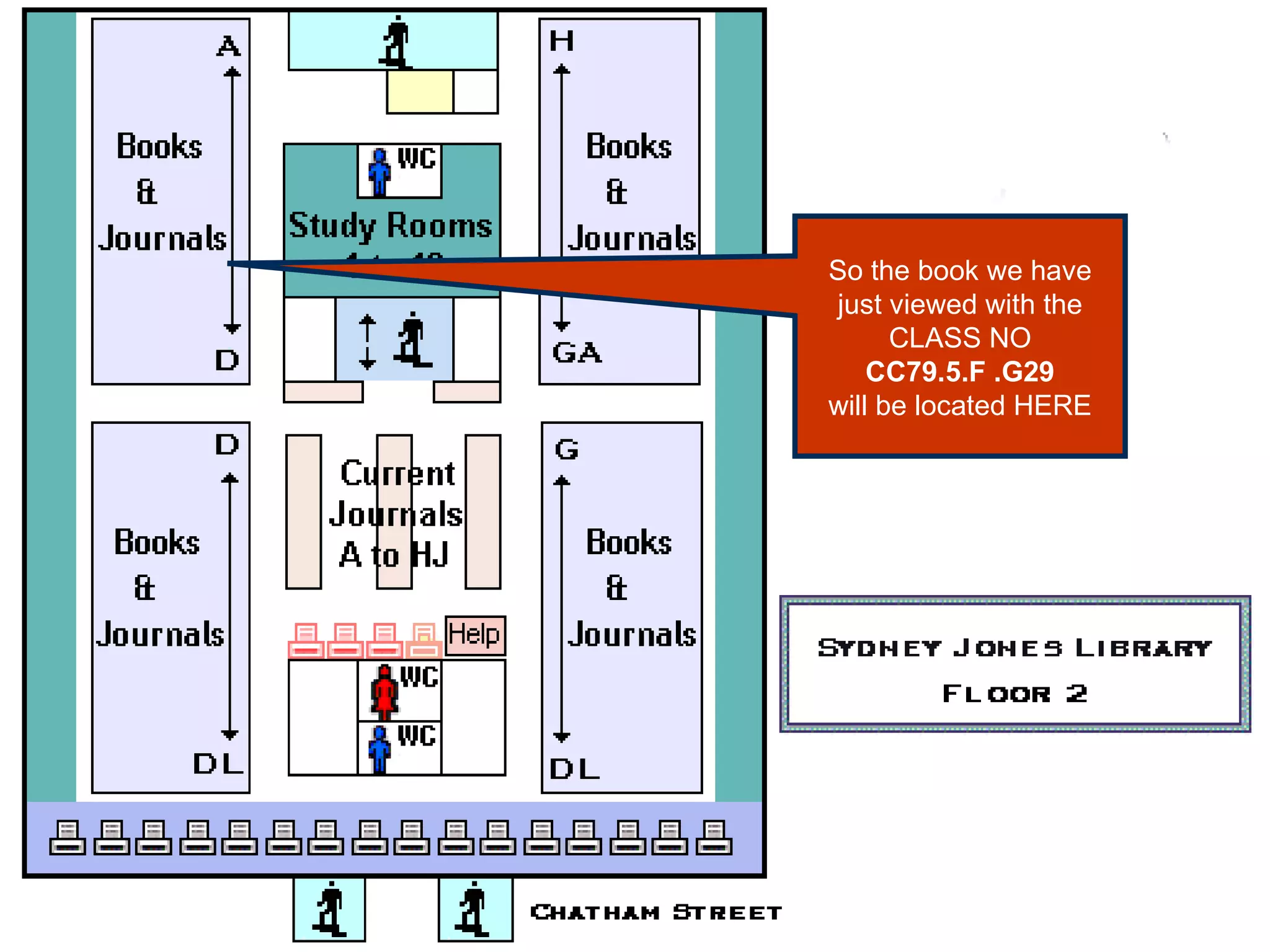
So the book we have just viewed with the CLASS NO CC79.5.F .G29 will be located HERE
Using the  Author search  Facility
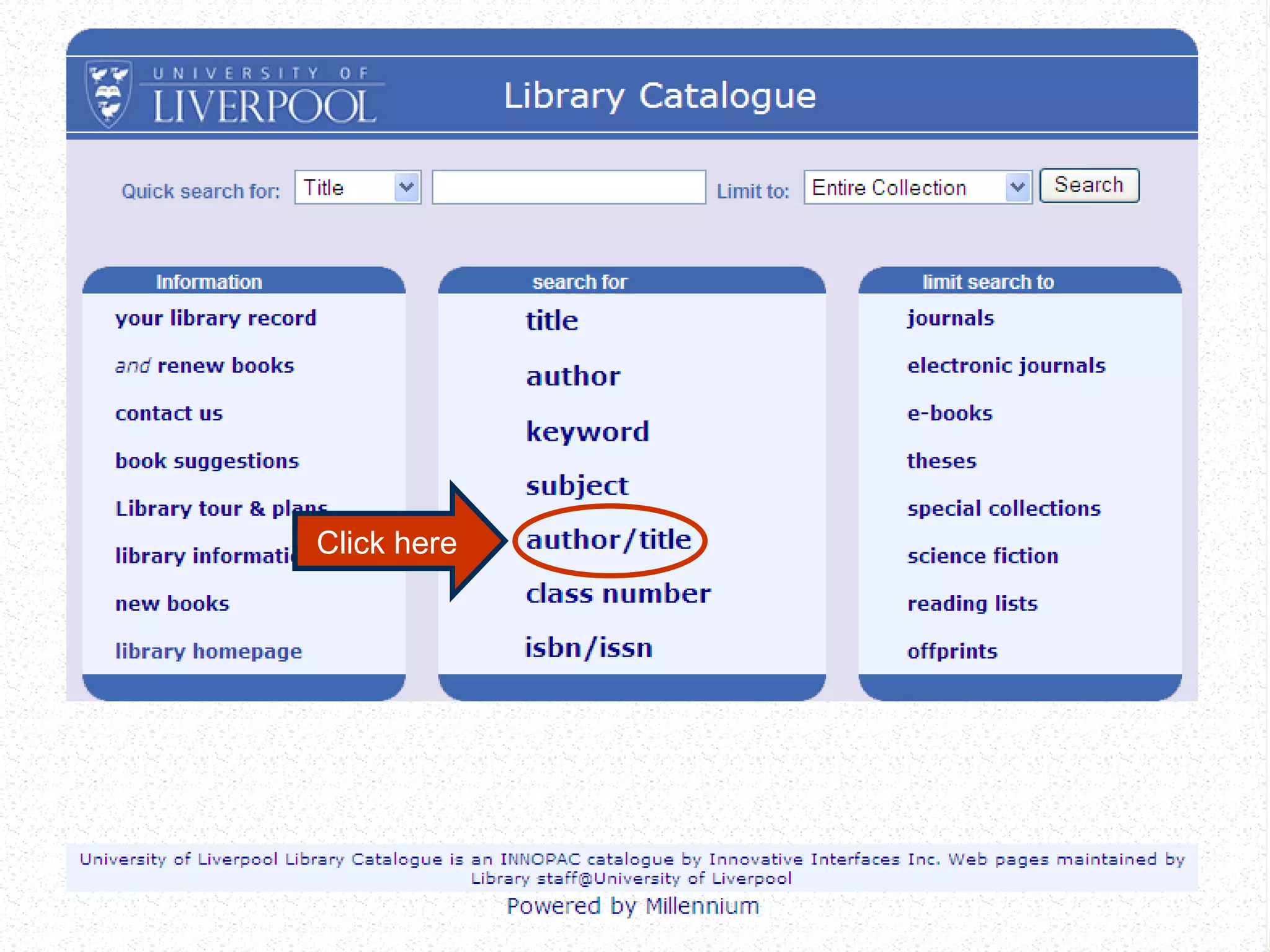
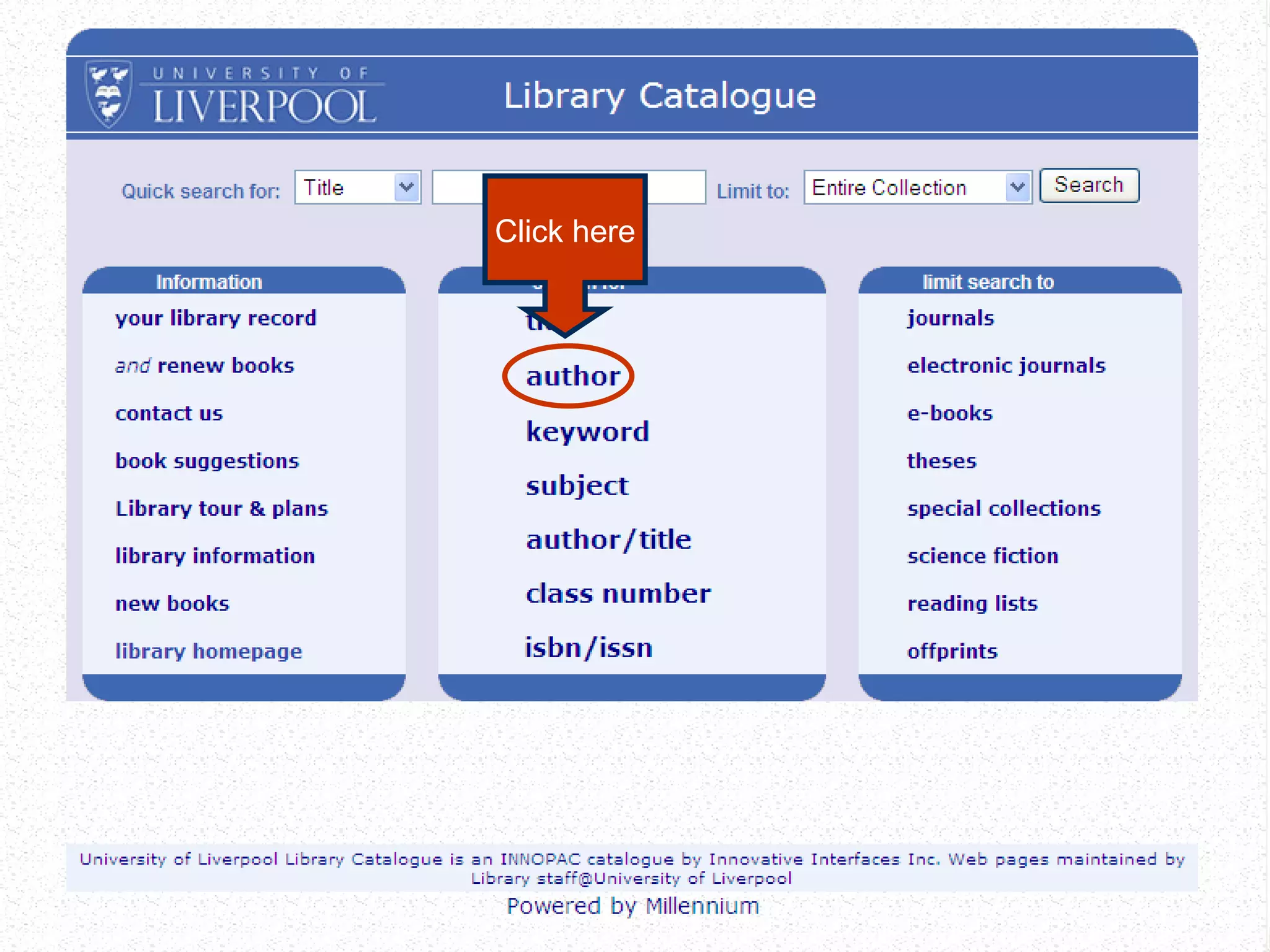
Click here
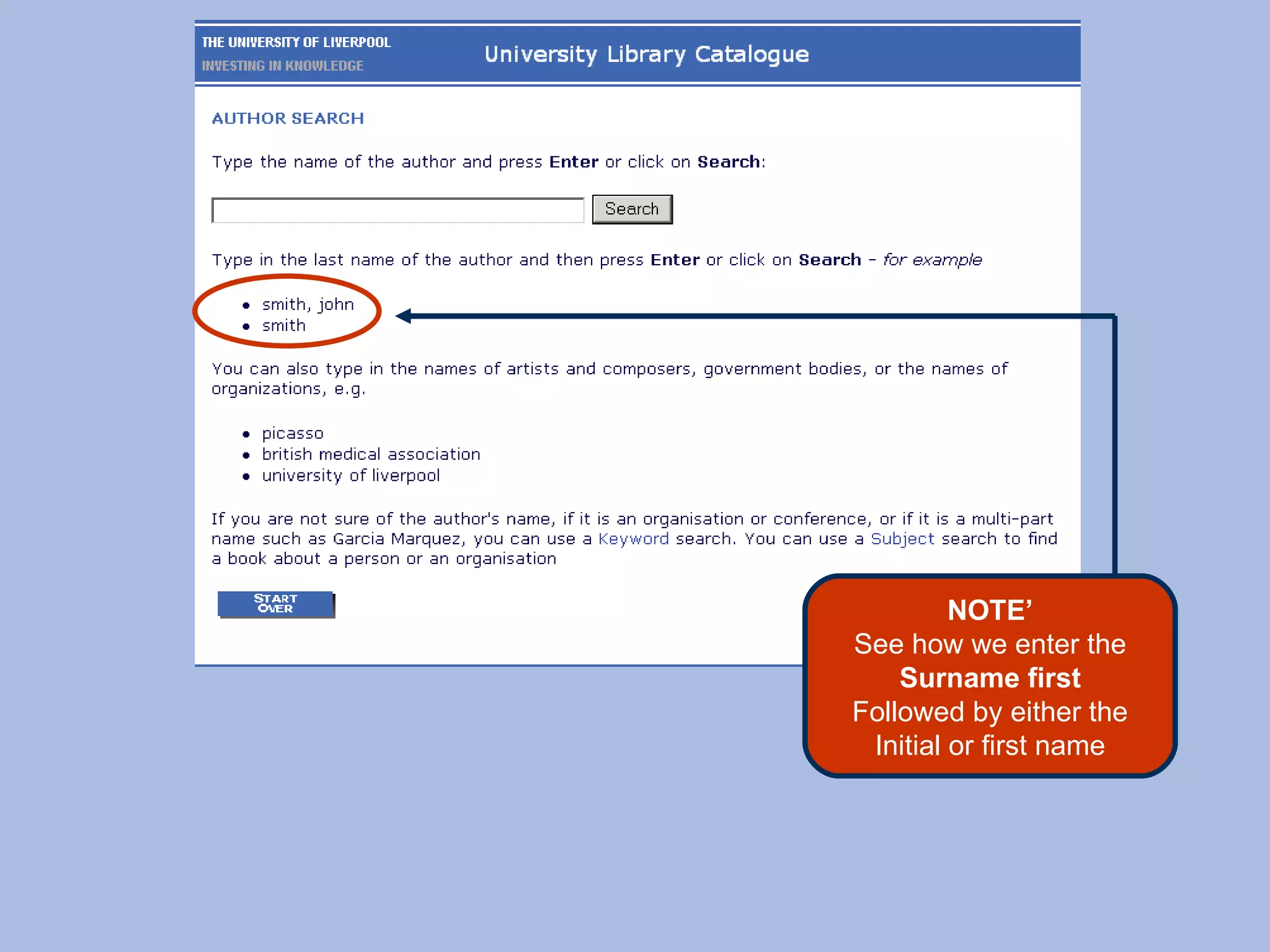
NOTE’ See how we enter the Surname first Followed by either the Initial or first name
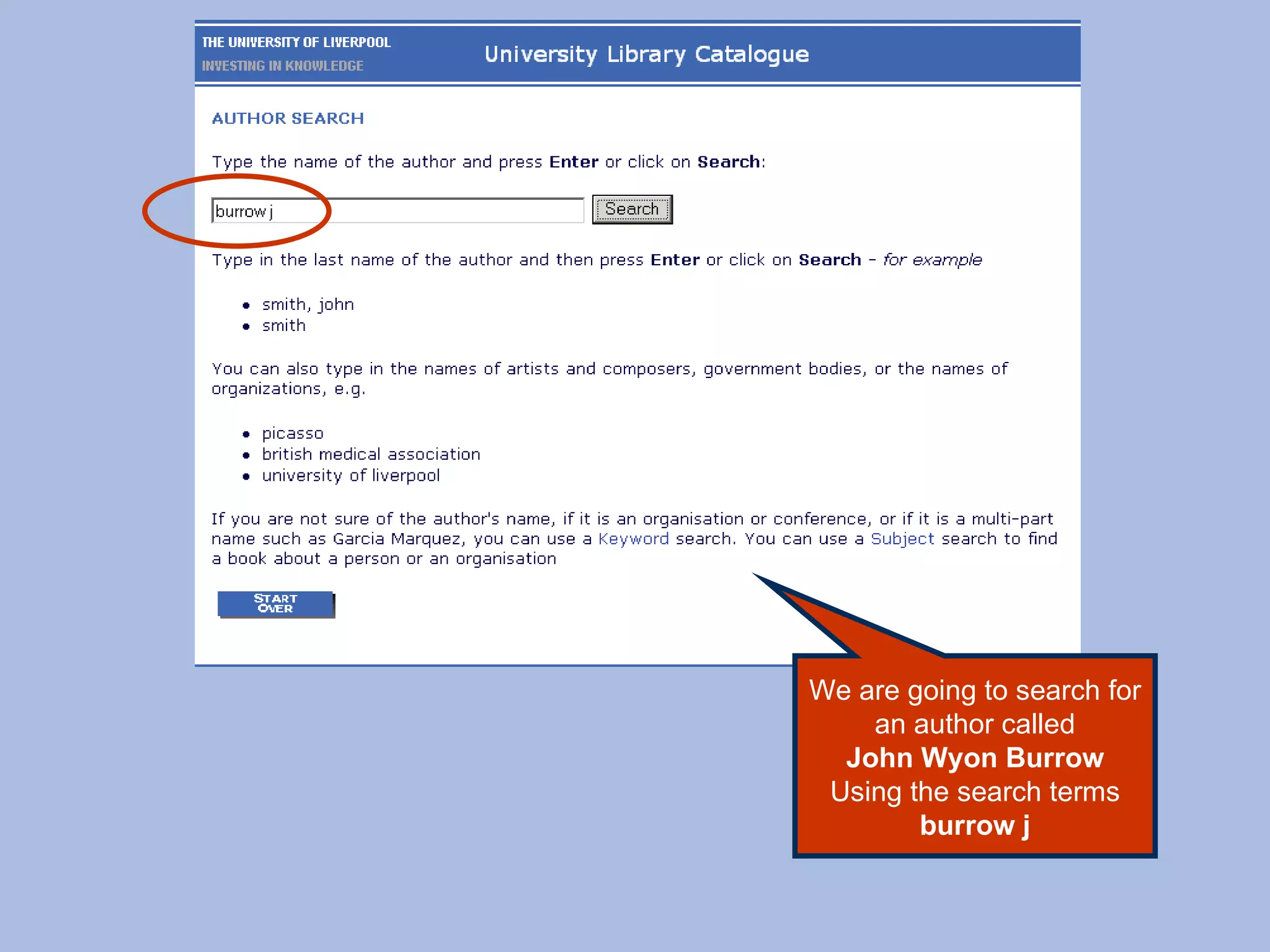
We are going to search for an author called John Wyon Burrow Using the search terms burrow j
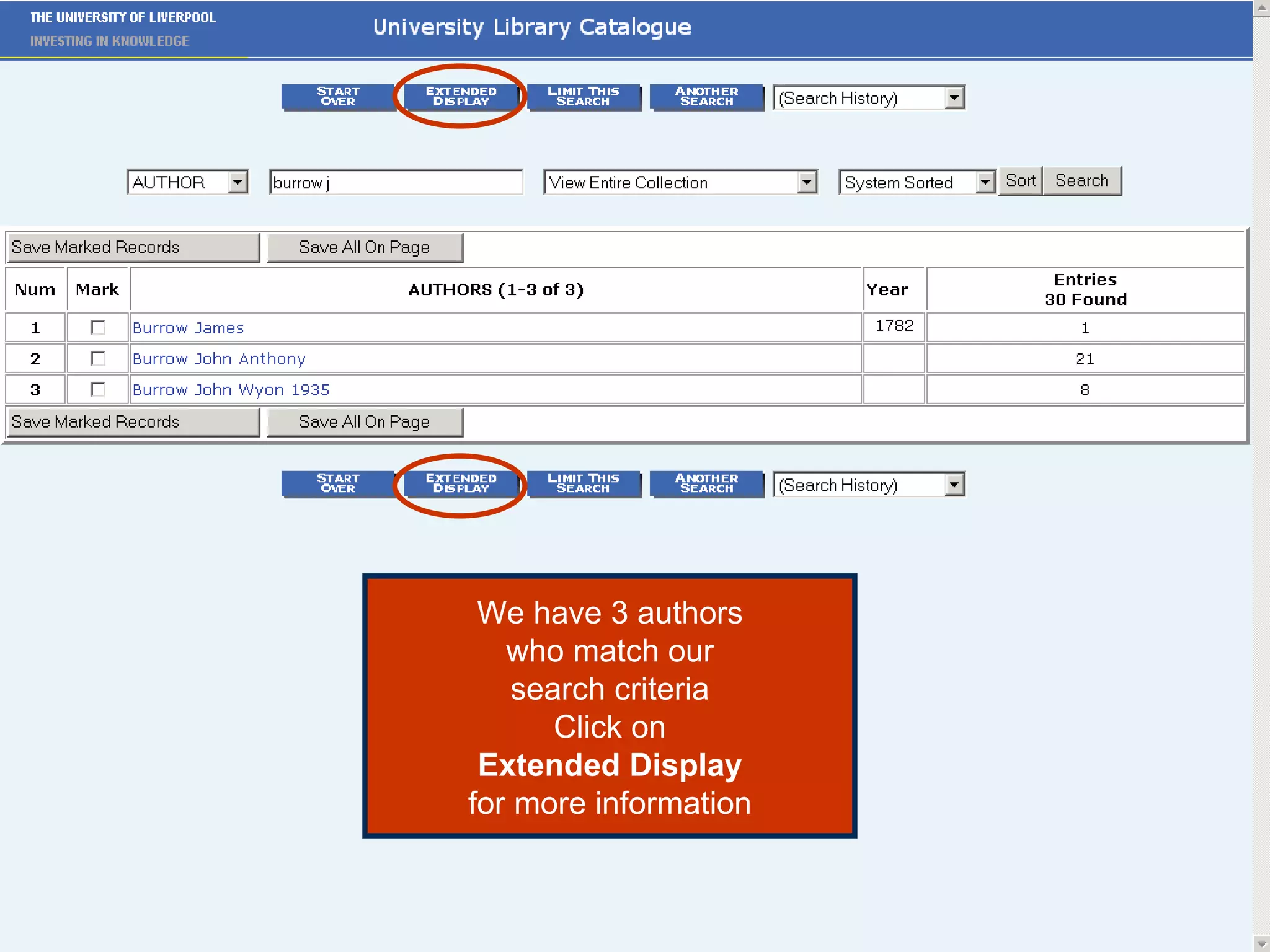
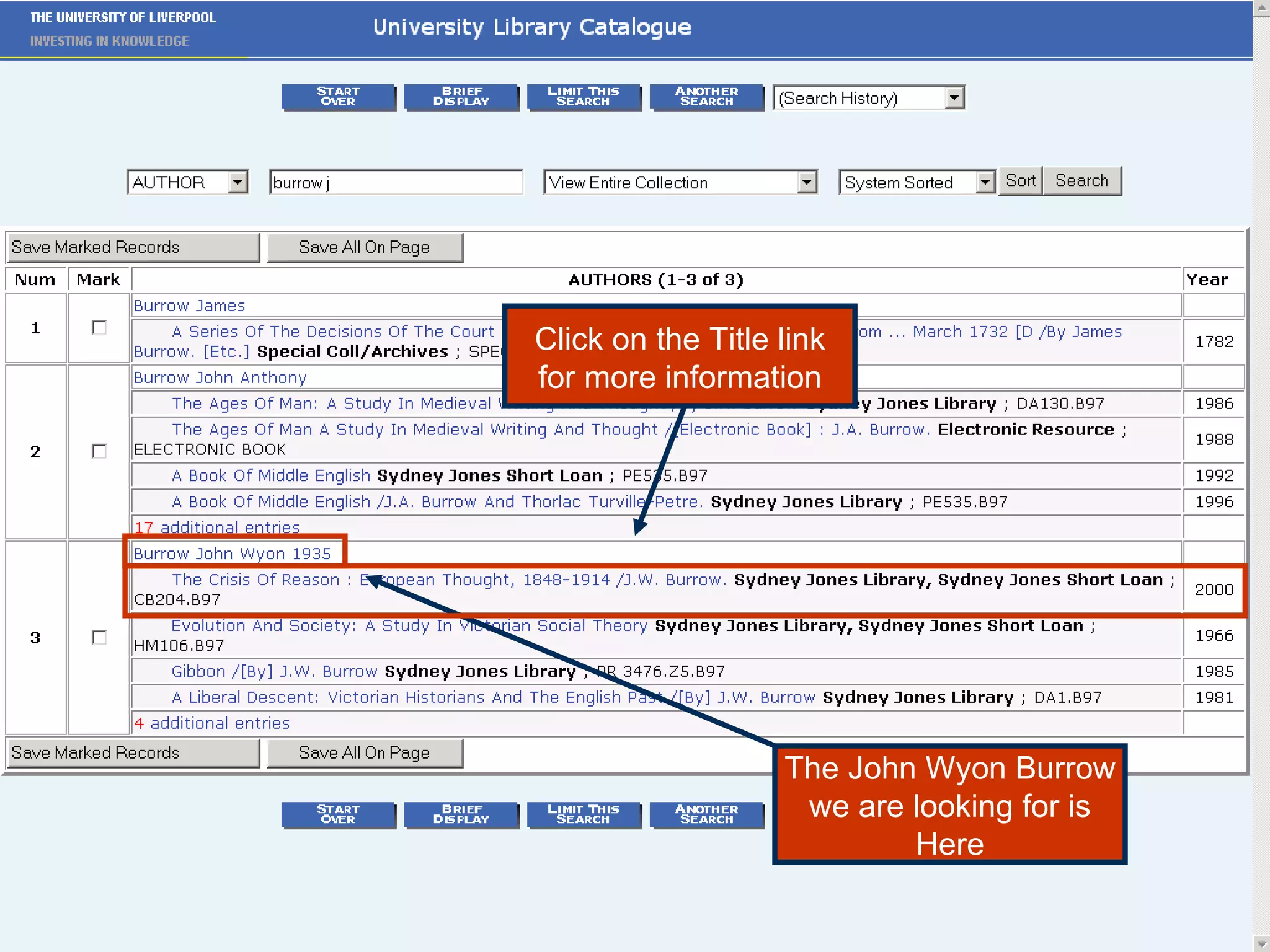
We have 3 authors who match our search criteria Click on Extended Display for more information
The John Wyon Burrow we are looking for is Here Click on the Title link for more information
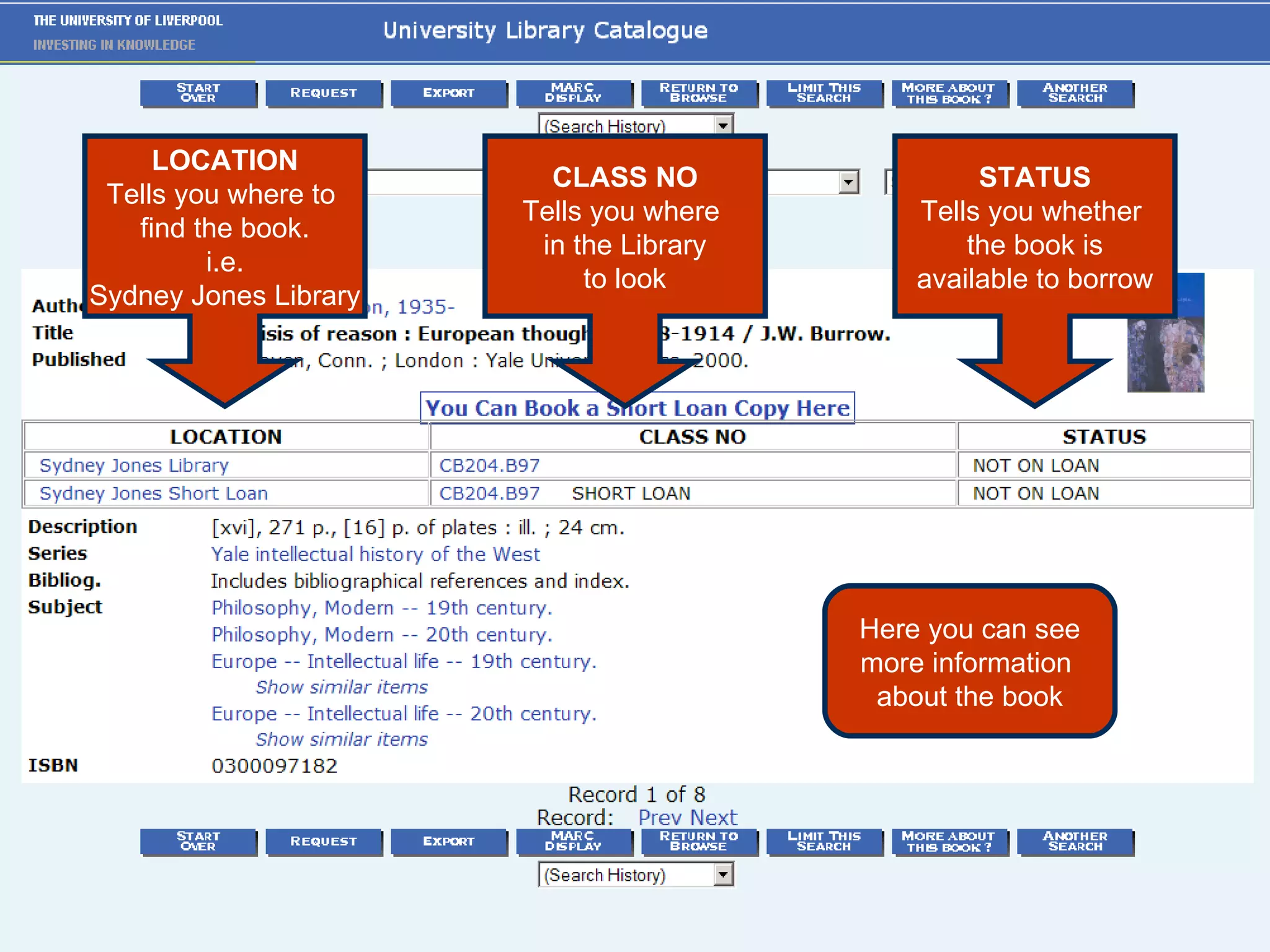
LOCATION Tells you where to  find the book. i.e. Sydney Jones Library CLASS NO Tells you where  in the Library to look STATUS Tells you whether  the book is available to borrow Here you can see more information  about the book
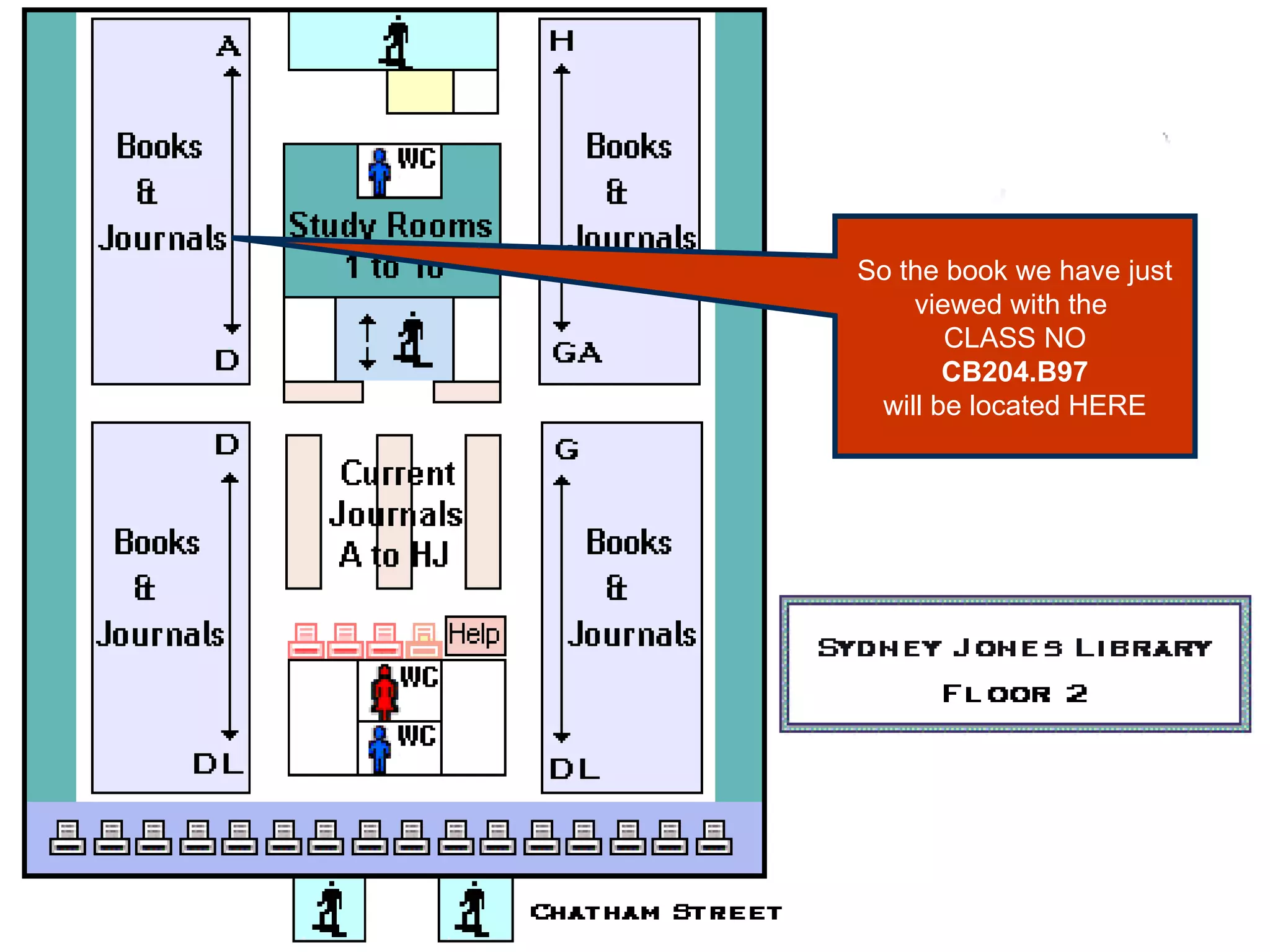
So the book we have just viewed with the  CLASS NO CB204.B97 will be located HERE
Using the  Author/Title search  Facility   Contents Page
Click here
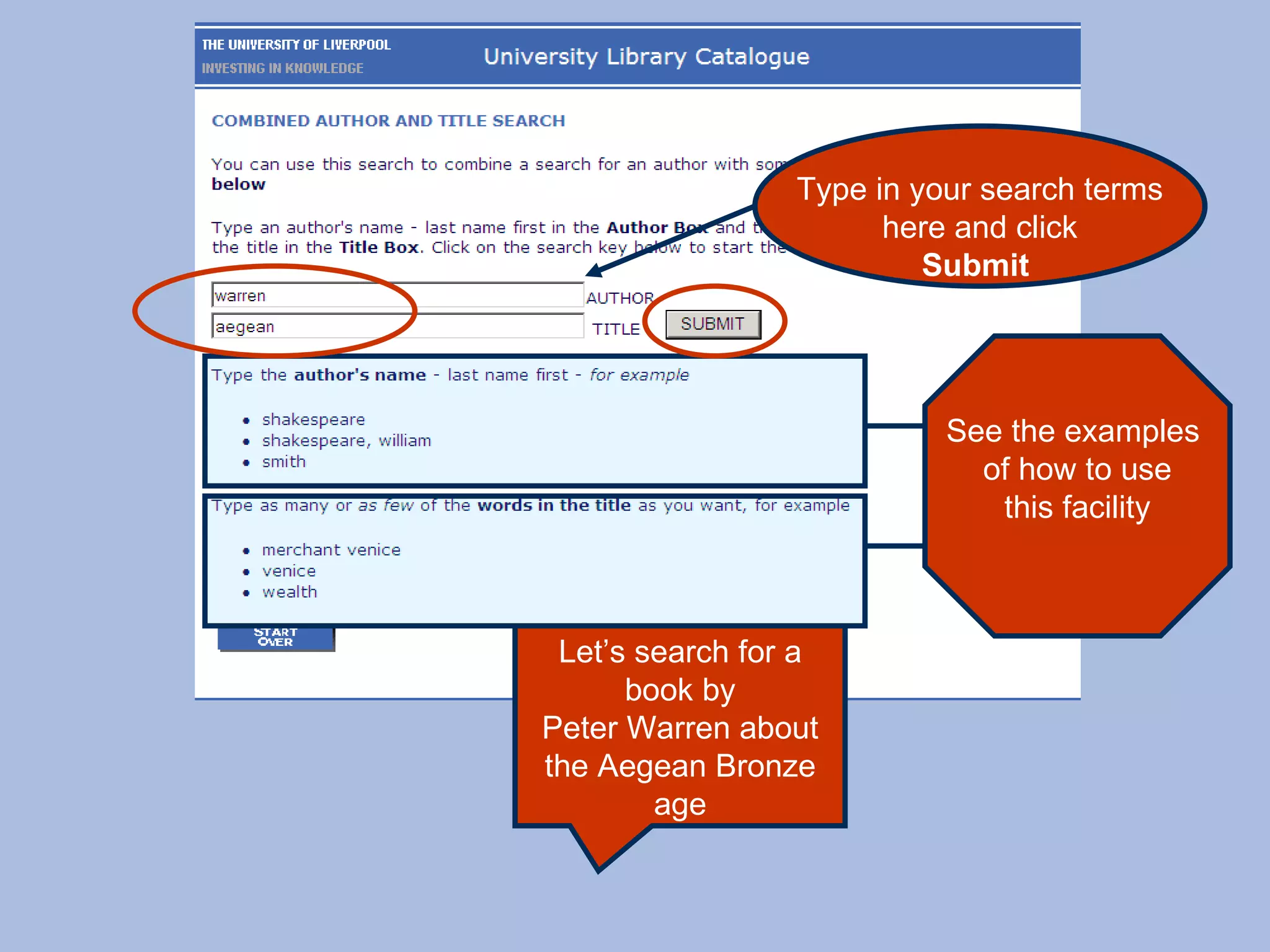
Let’s search for a book by Peter Warren about the Aegean Bronze age See the examples  of how to use this facility Type in your search terms here and click Submit
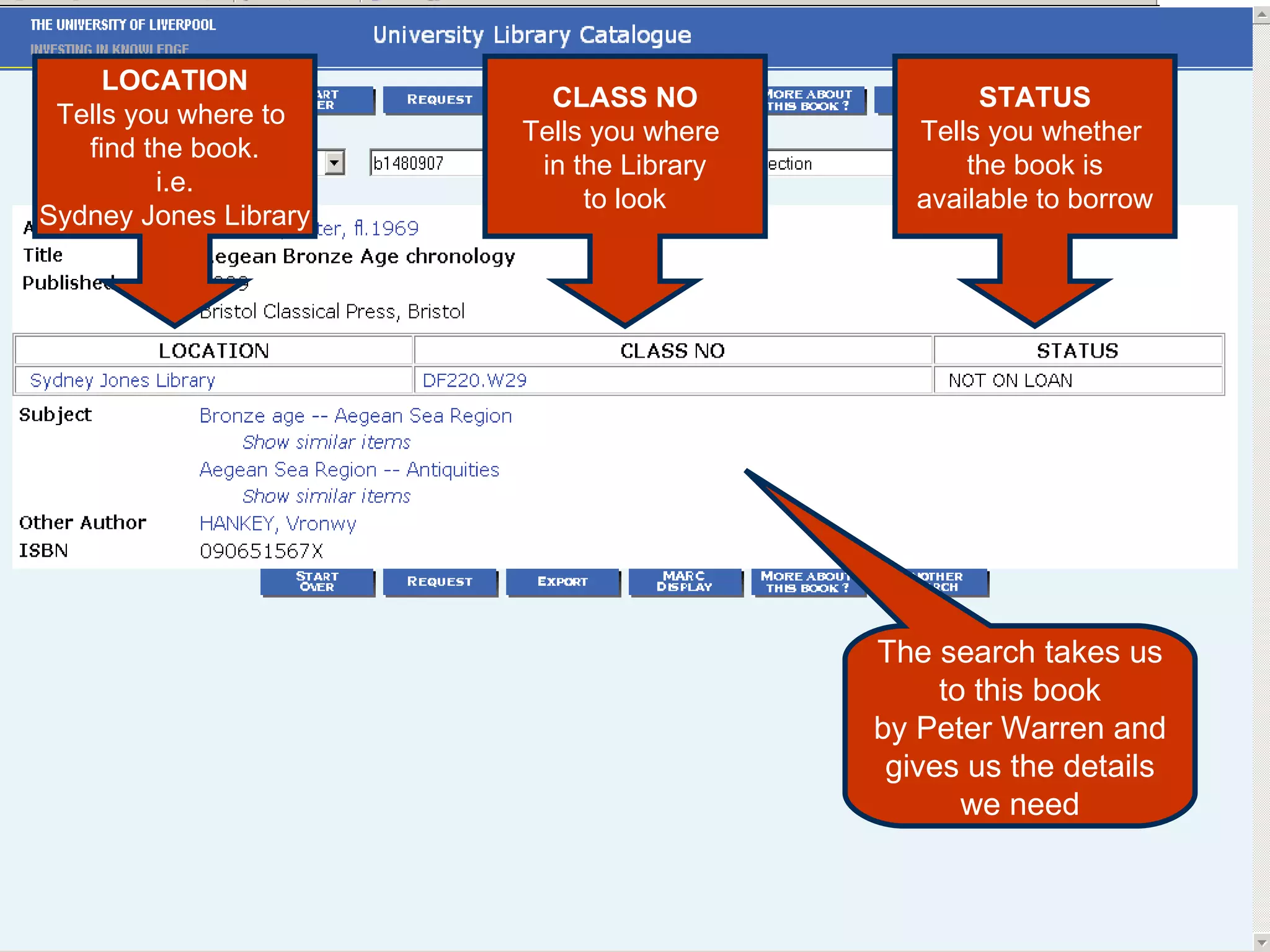
The search takes us to this book by Peter Warren and gives us the details we need LOCATION Tells you where to  find the book. i.e. Sydney Jones Library CLASS NO Tells you where  in the Library to look STATUS Tells you whether  the book is available to borrow
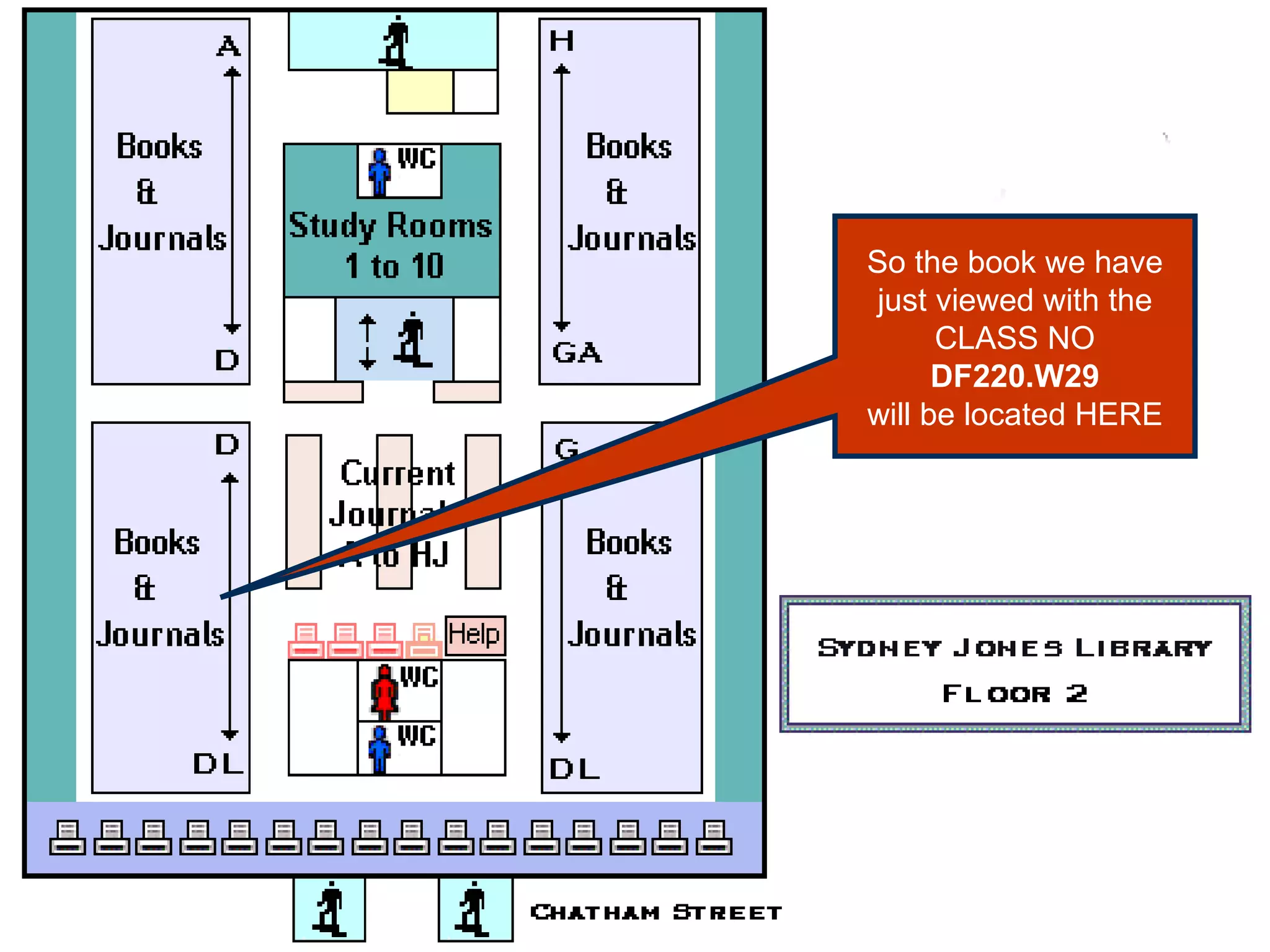
So the book we have just viewed with the CLASS NO DF220.W29 will be located HERE
Searching for Journals  Using the  Library Catalogue
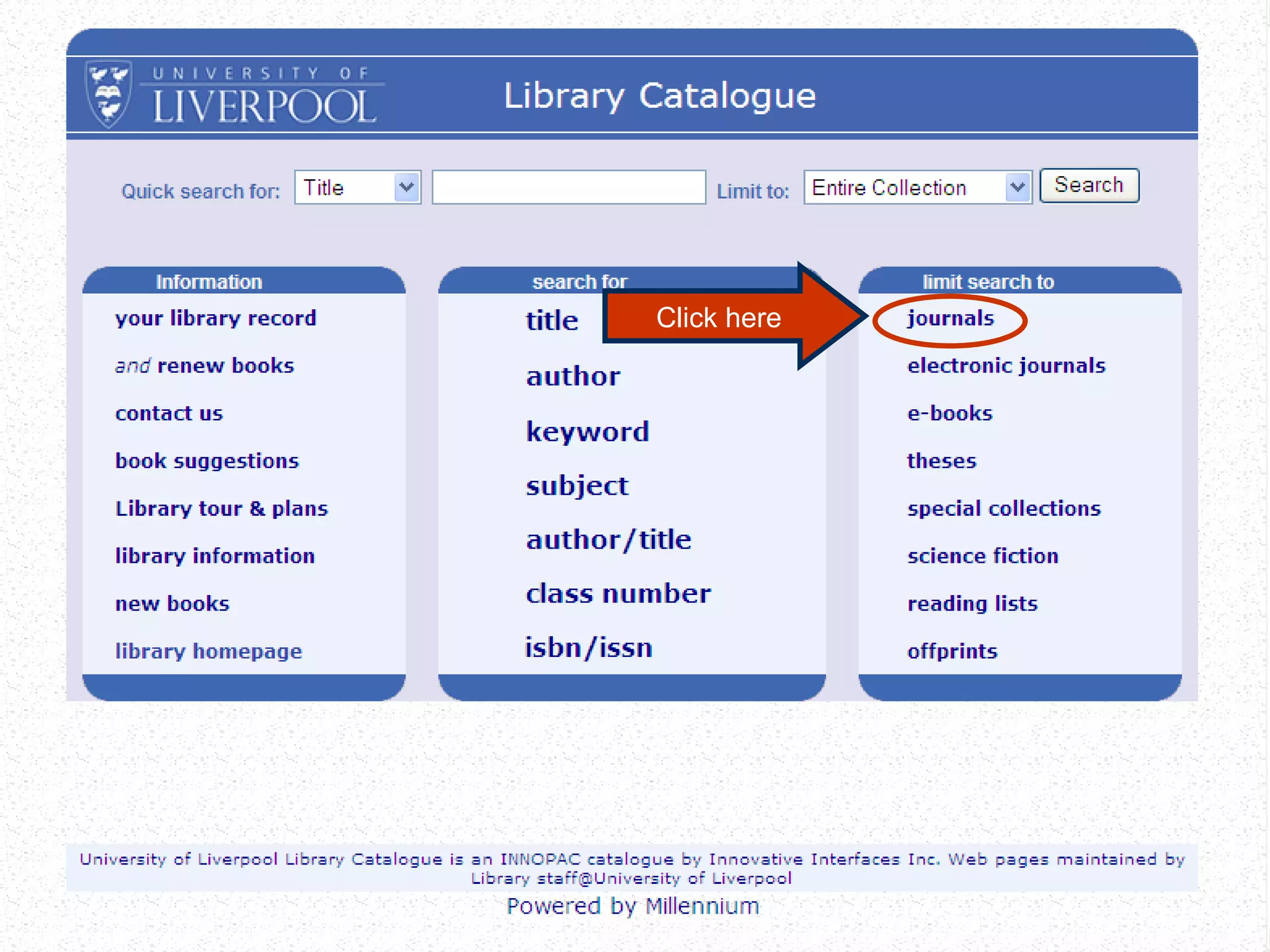
Click here
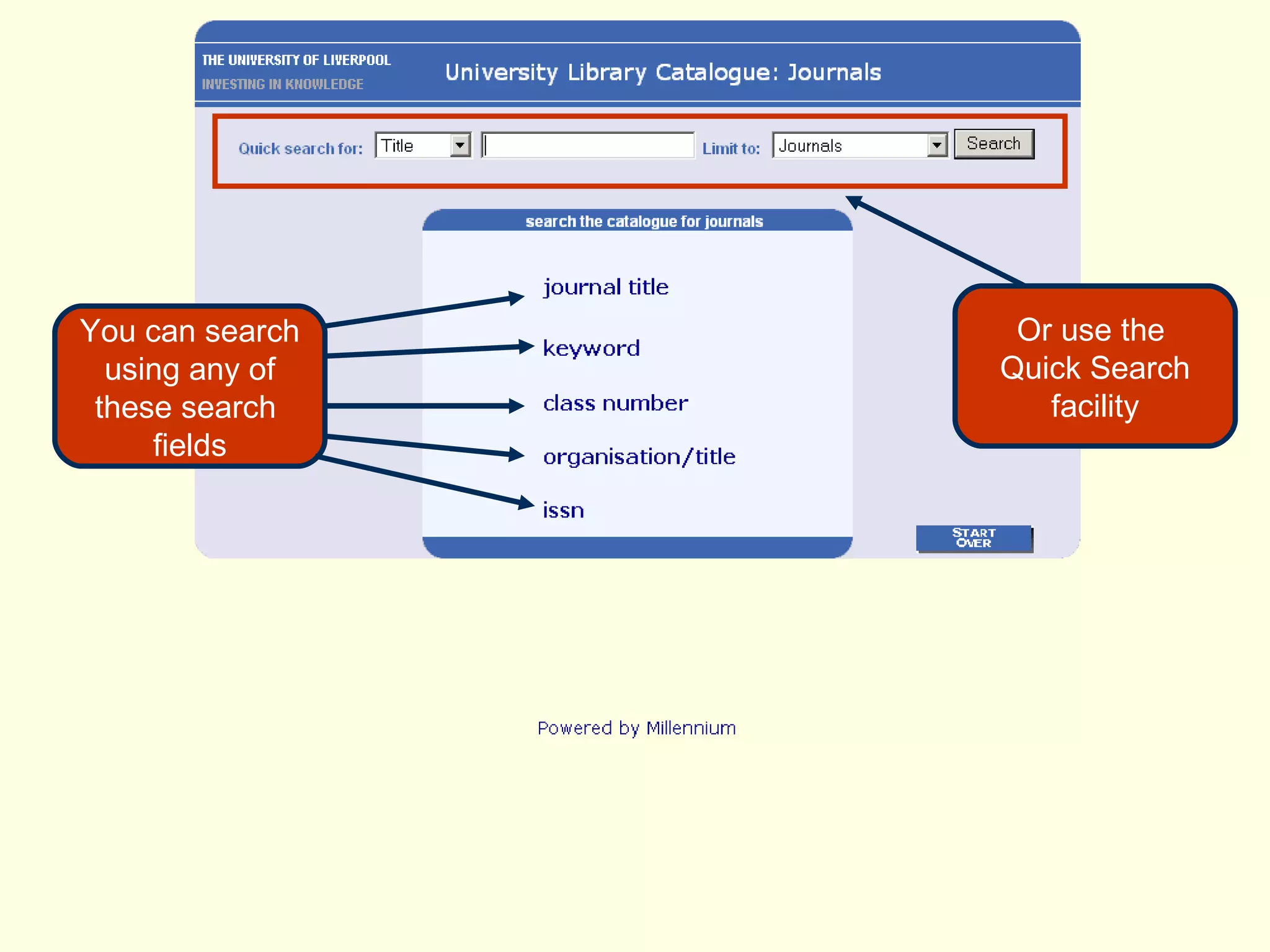
You can search using any of these search  fields Or use the  Quick Search facility
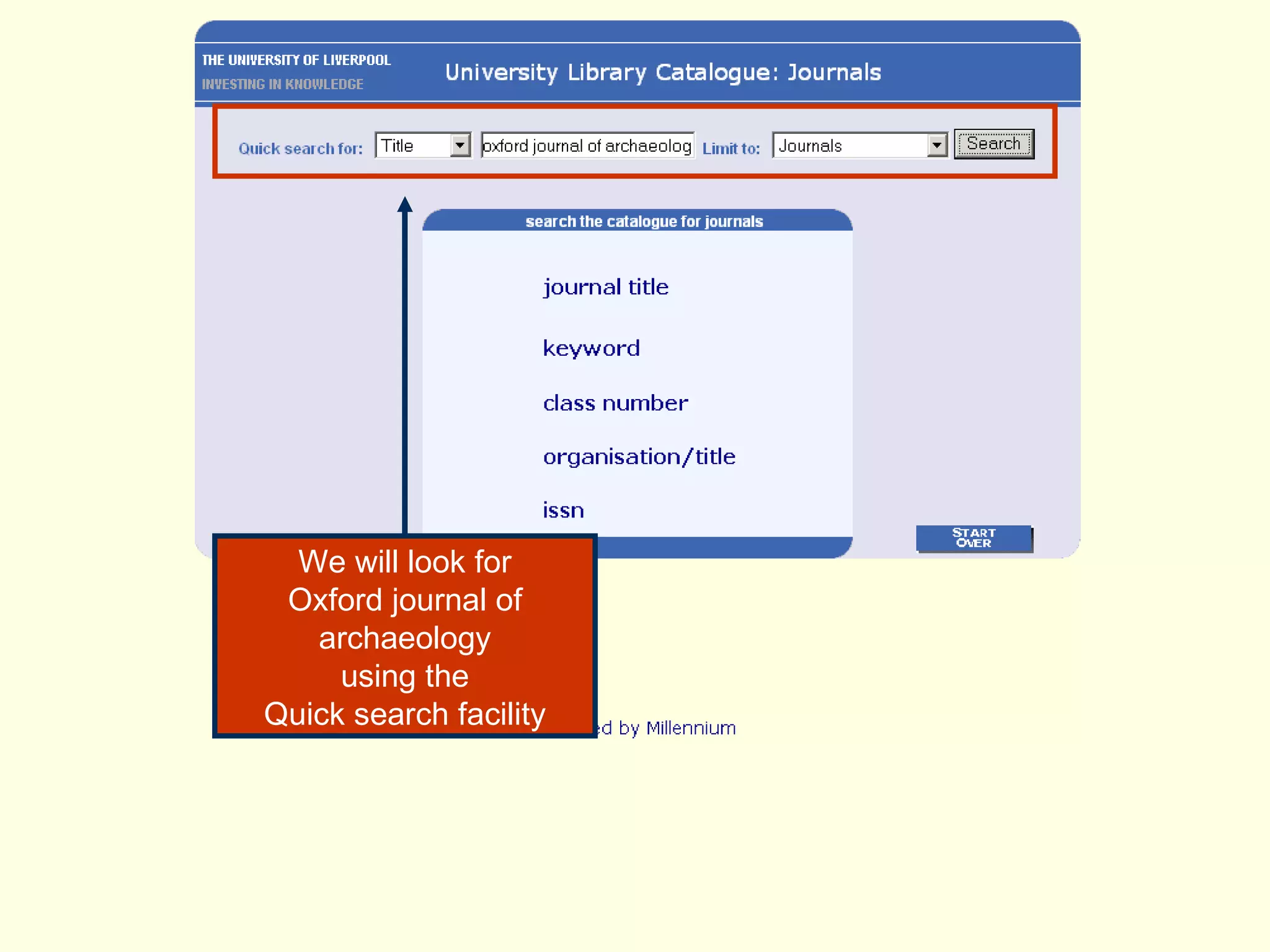
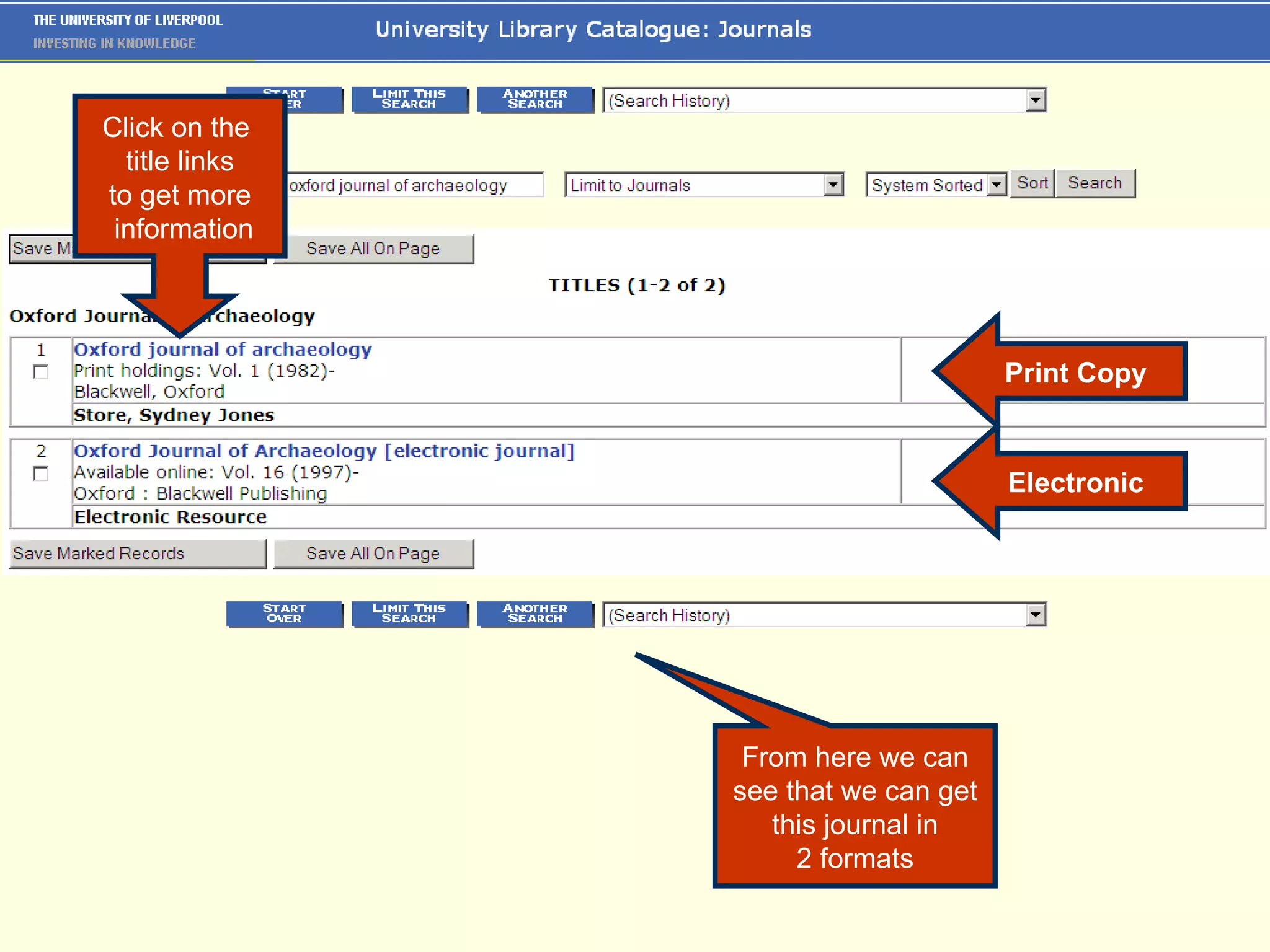
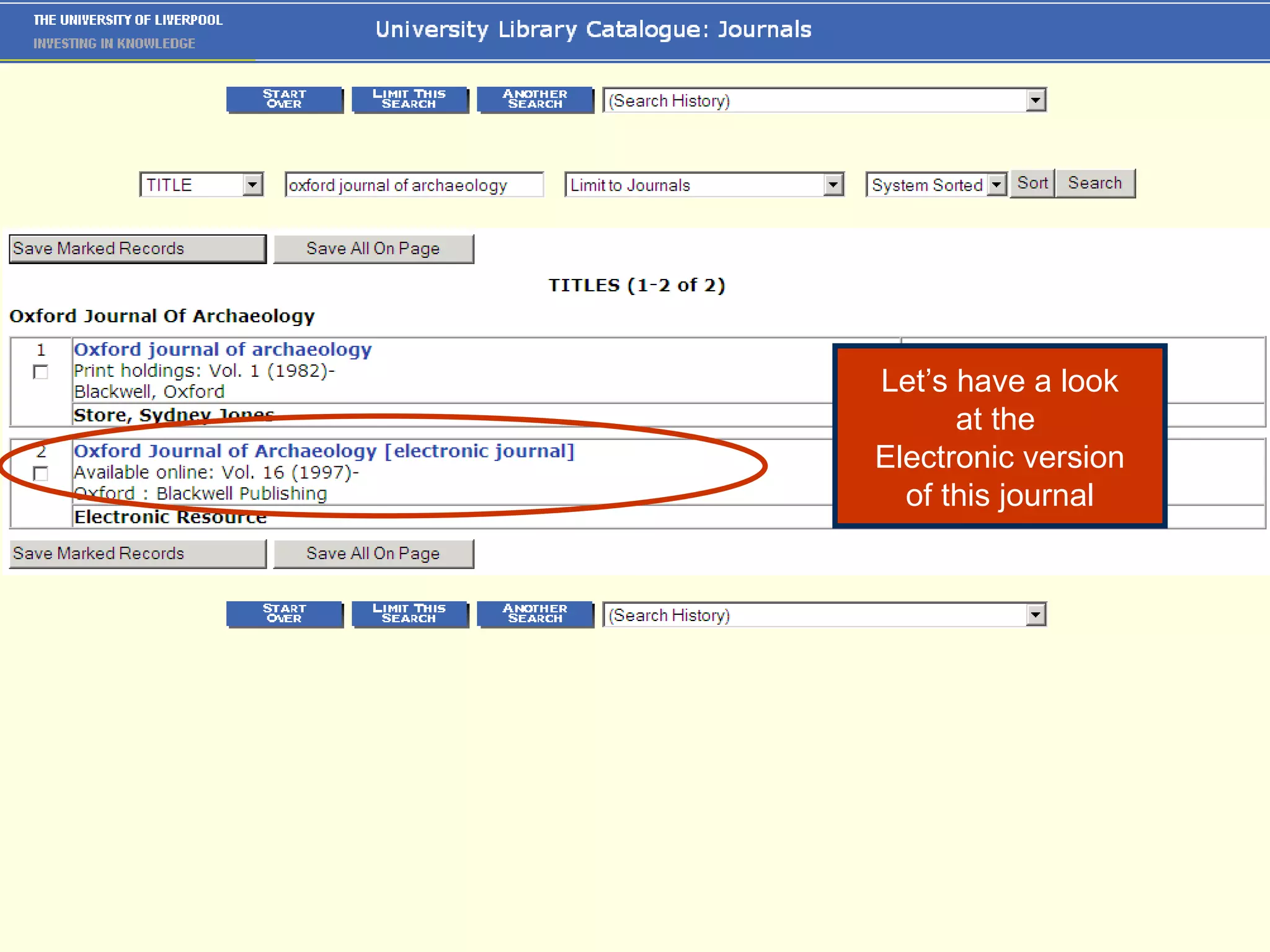
We will look for Oxford journal of archaeology using the Quick search facility
Print Copy Electronic Click on the  title links to get more information From here we can see that we can get this journal in 2 formats
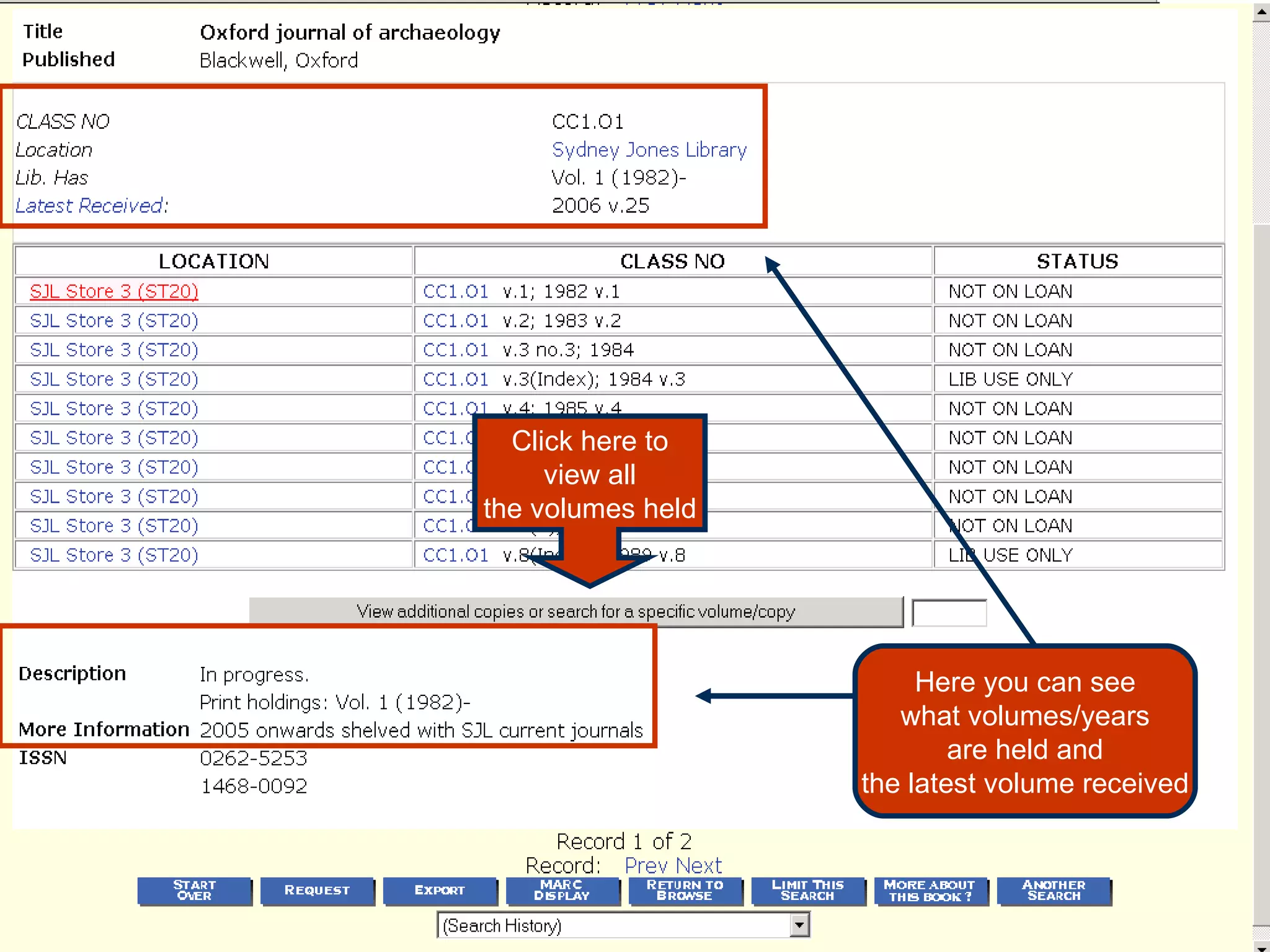
Click here to view all the volumes held Here you can see what volumes/years are held and the latest volume received
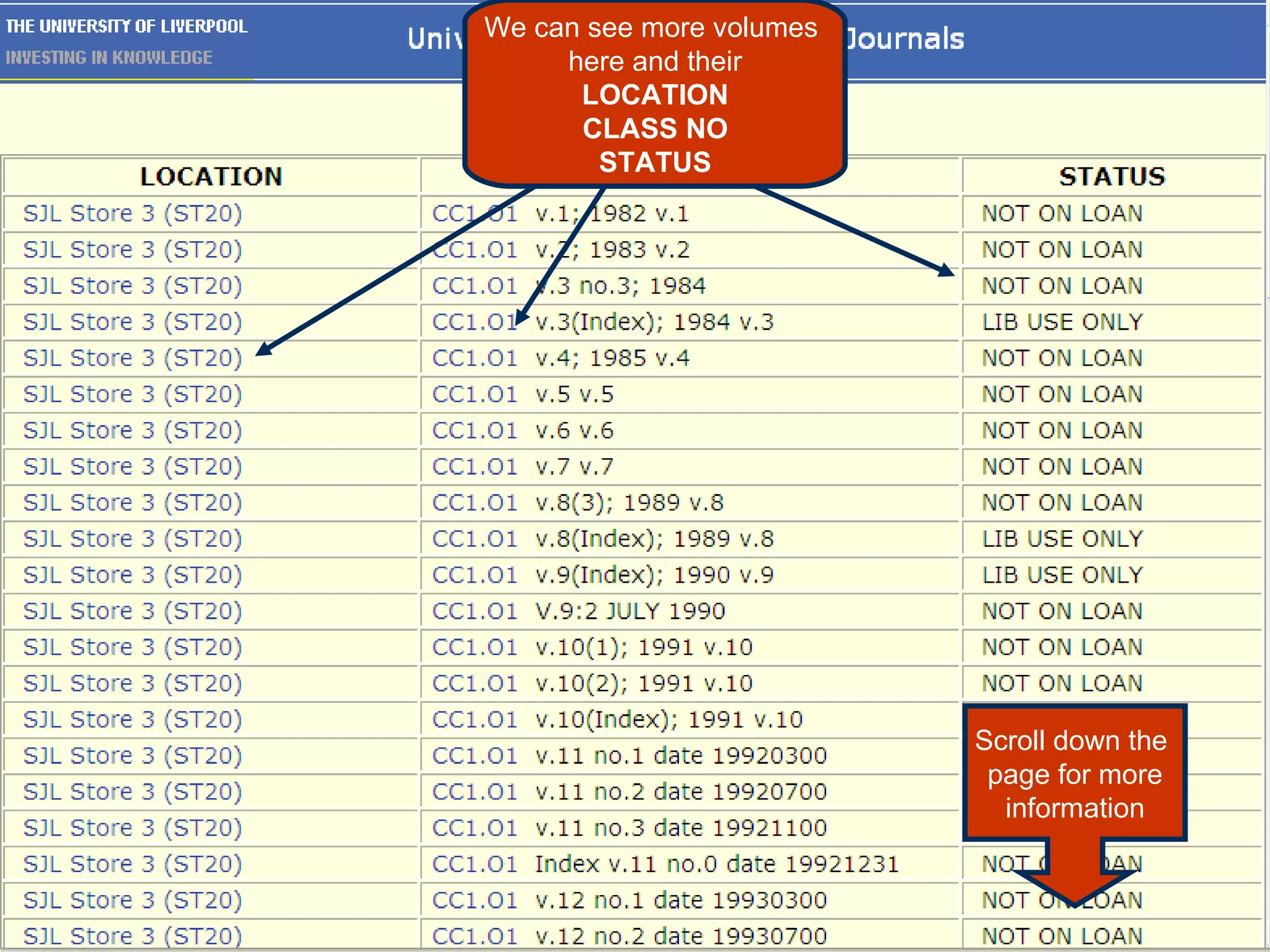
We can see more volumes  here and their LOCATION CLASS NO STATUS Scroll down the  page for more information
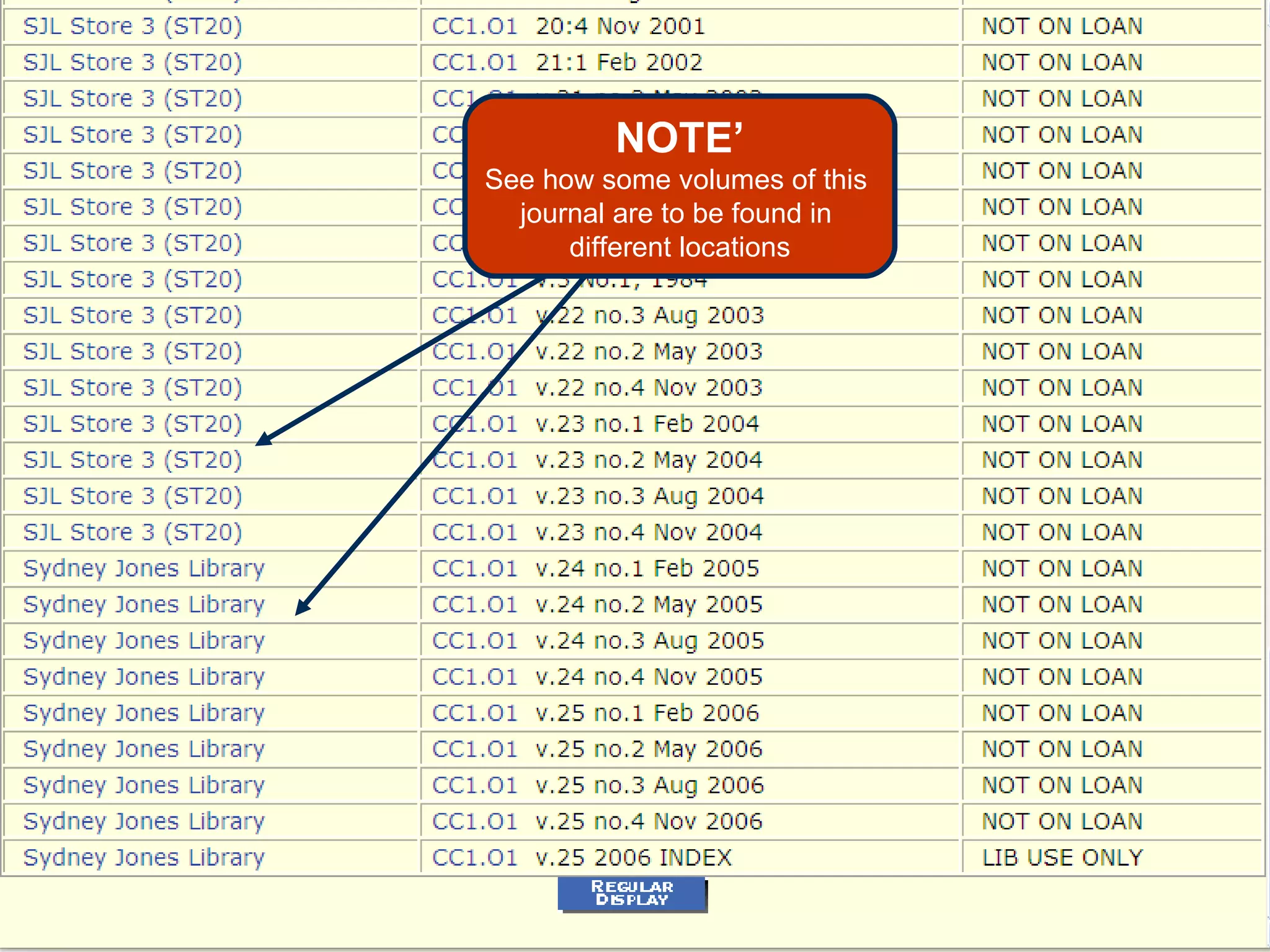
NOTE’ See how some volumes of this  journal are to be found in  different locations
Let’s have a look at the  Electronic version of this journal
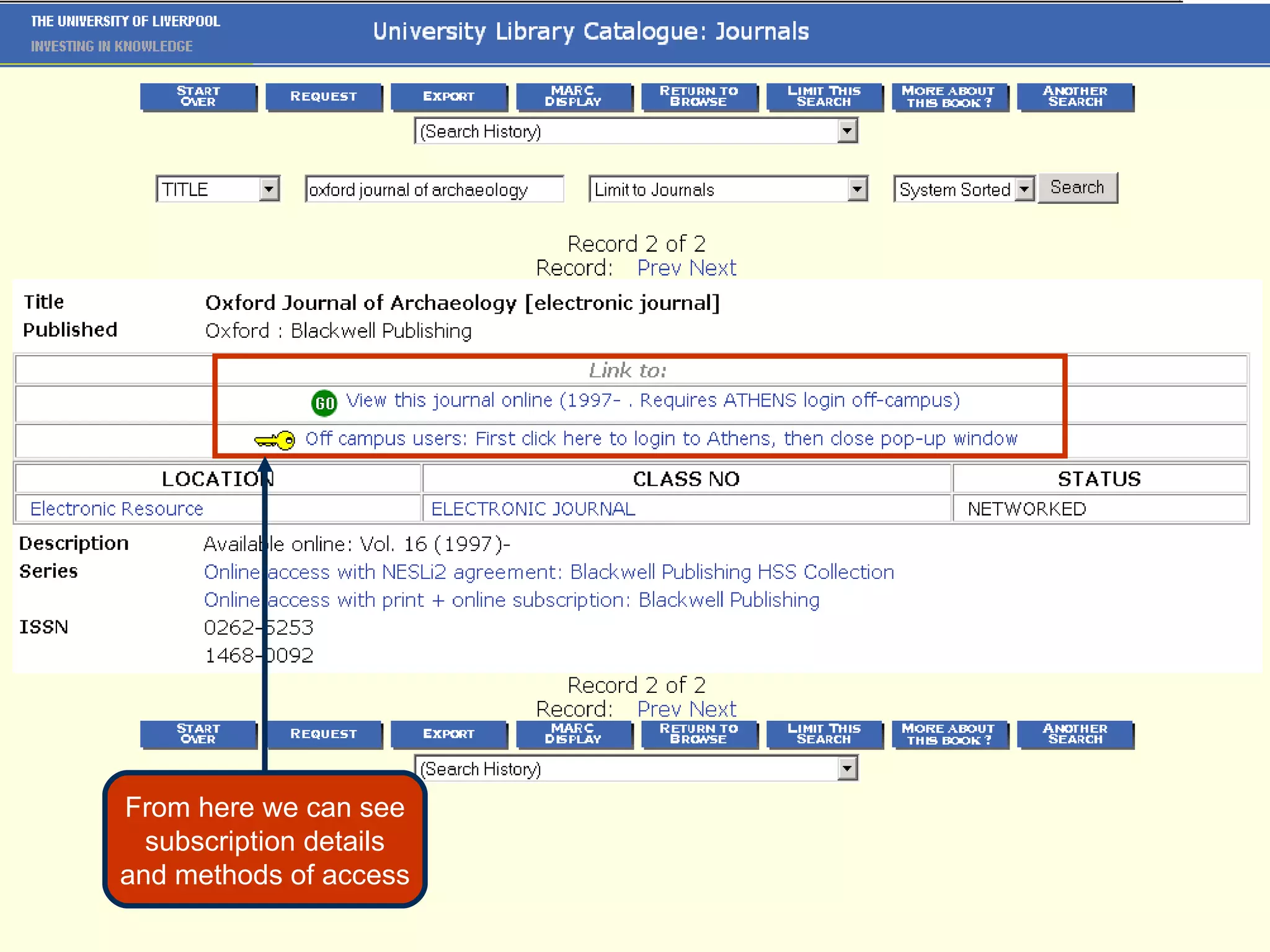
Click on the link To access the  Electronic version From here we can see subscription details and methods of access
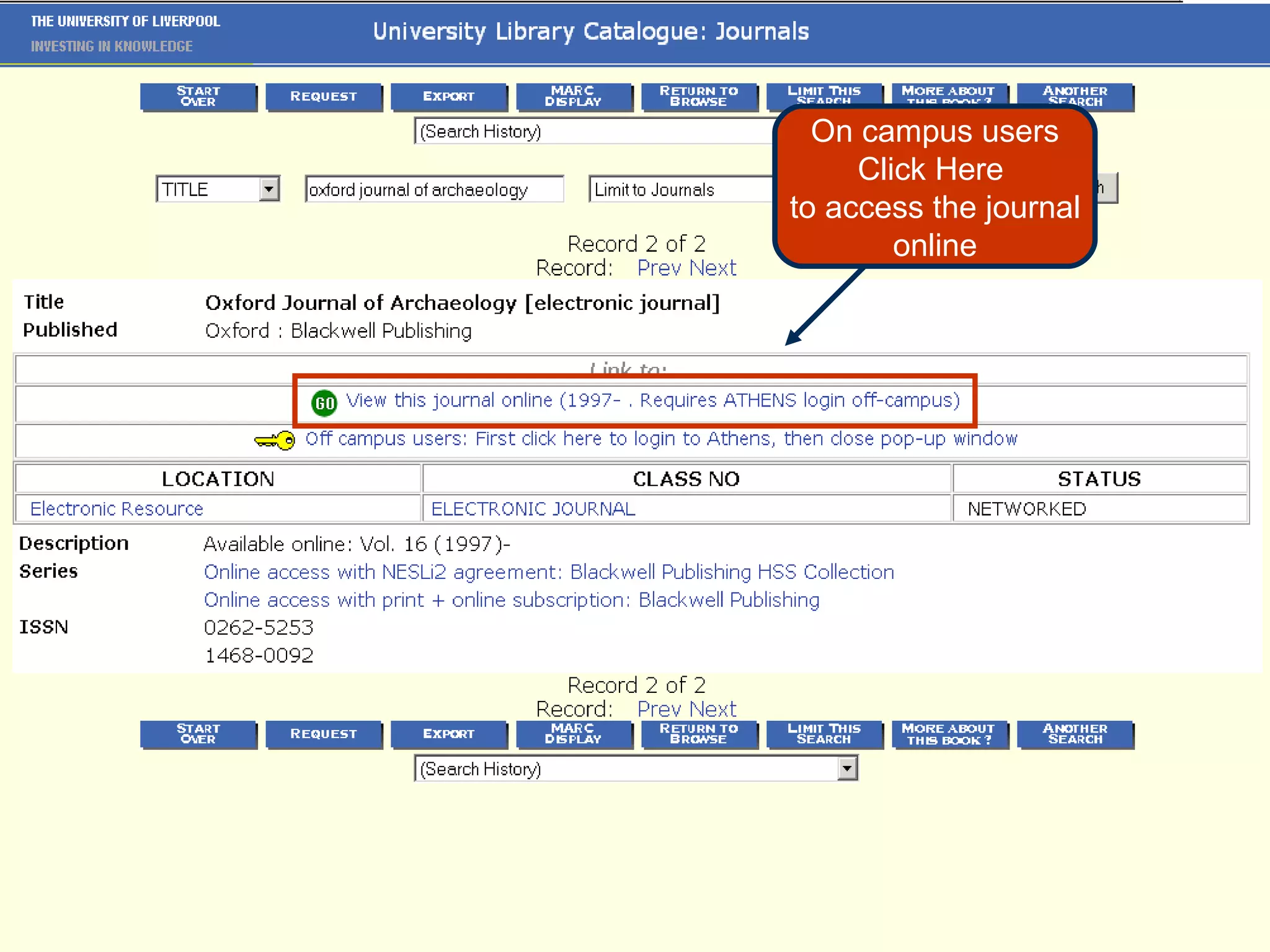
On campus users Click Here  to access the journal online
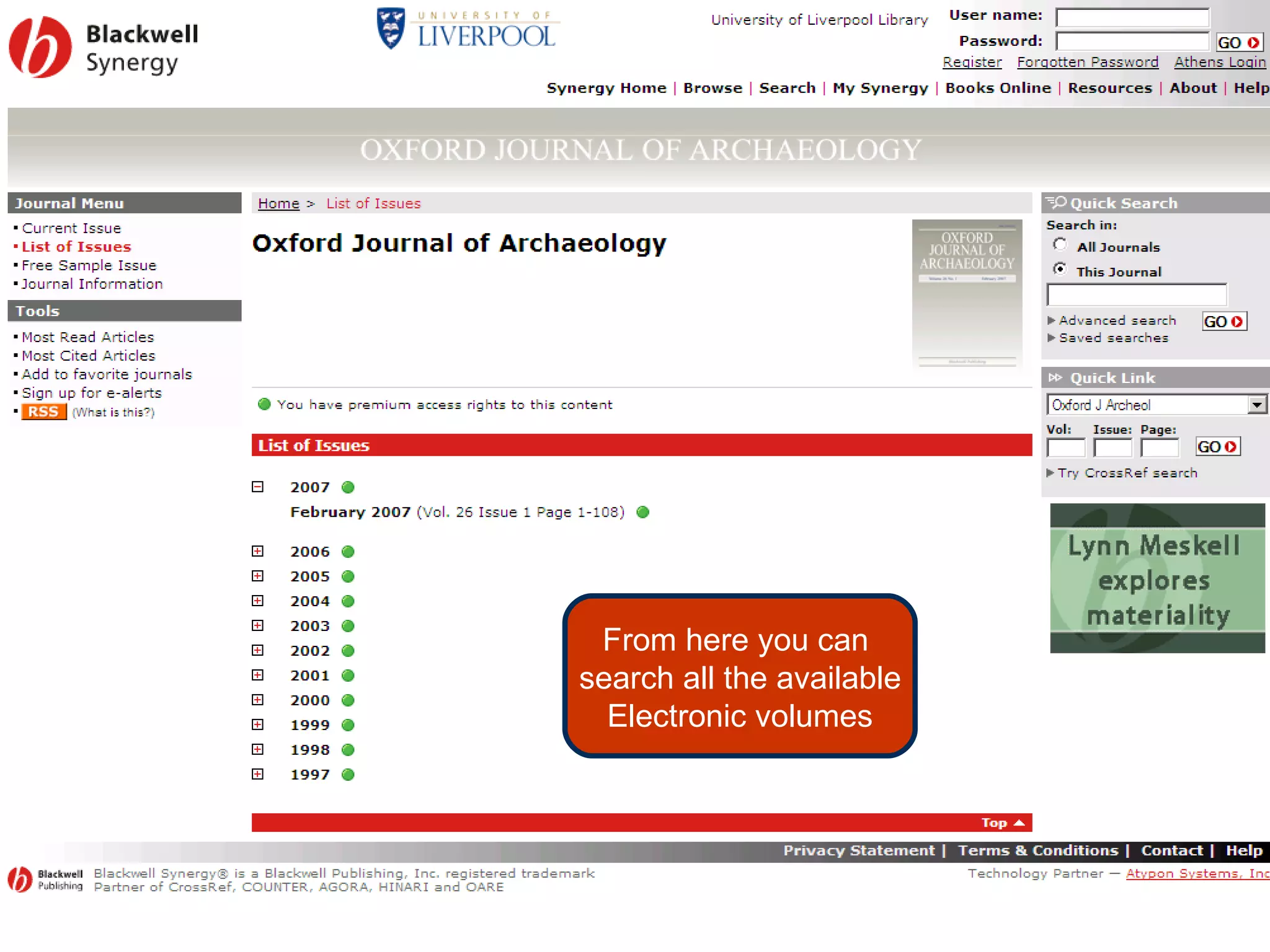
From here you can  search all the available Electronic volumes
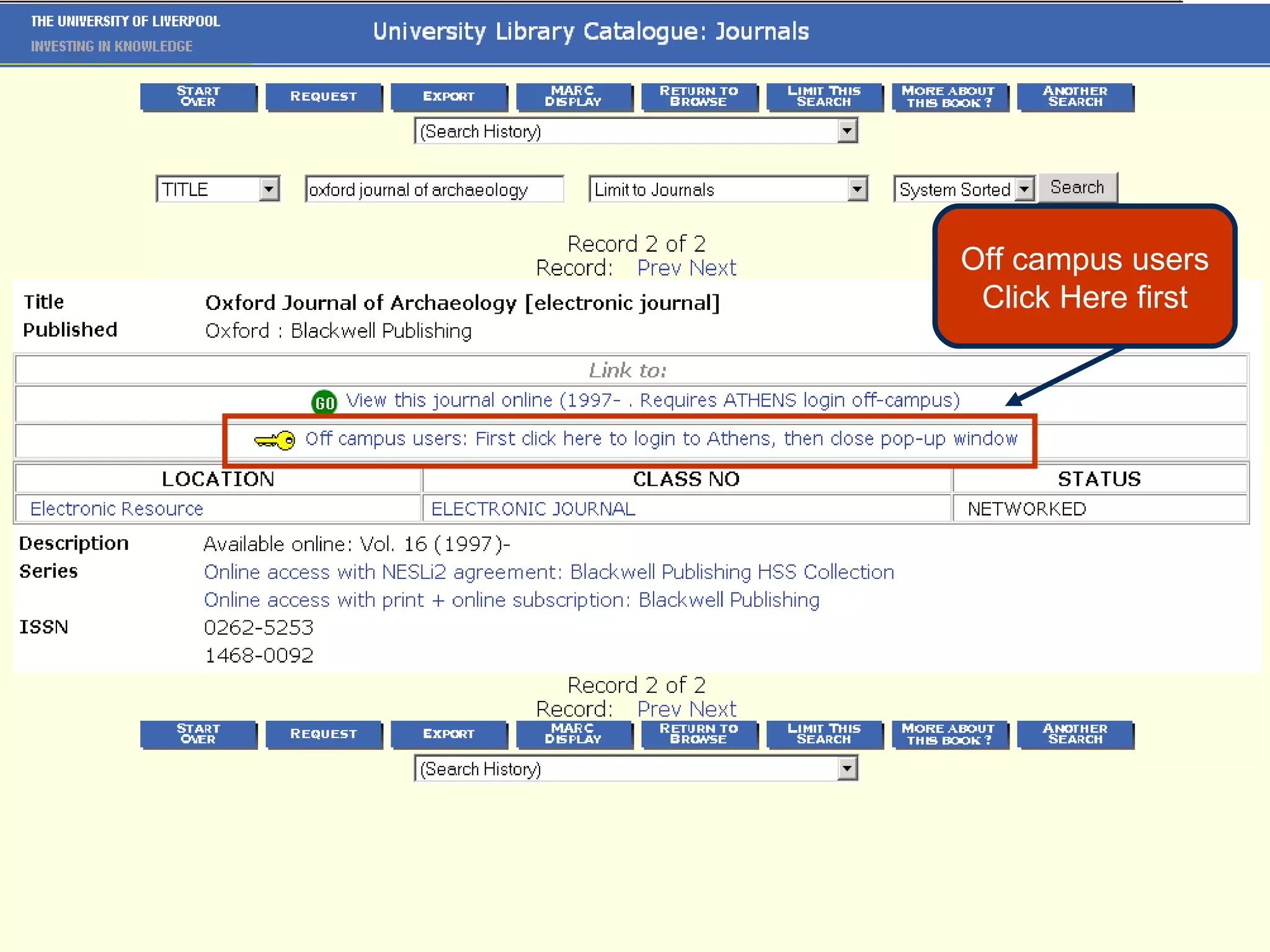
Off campus users Click Here first
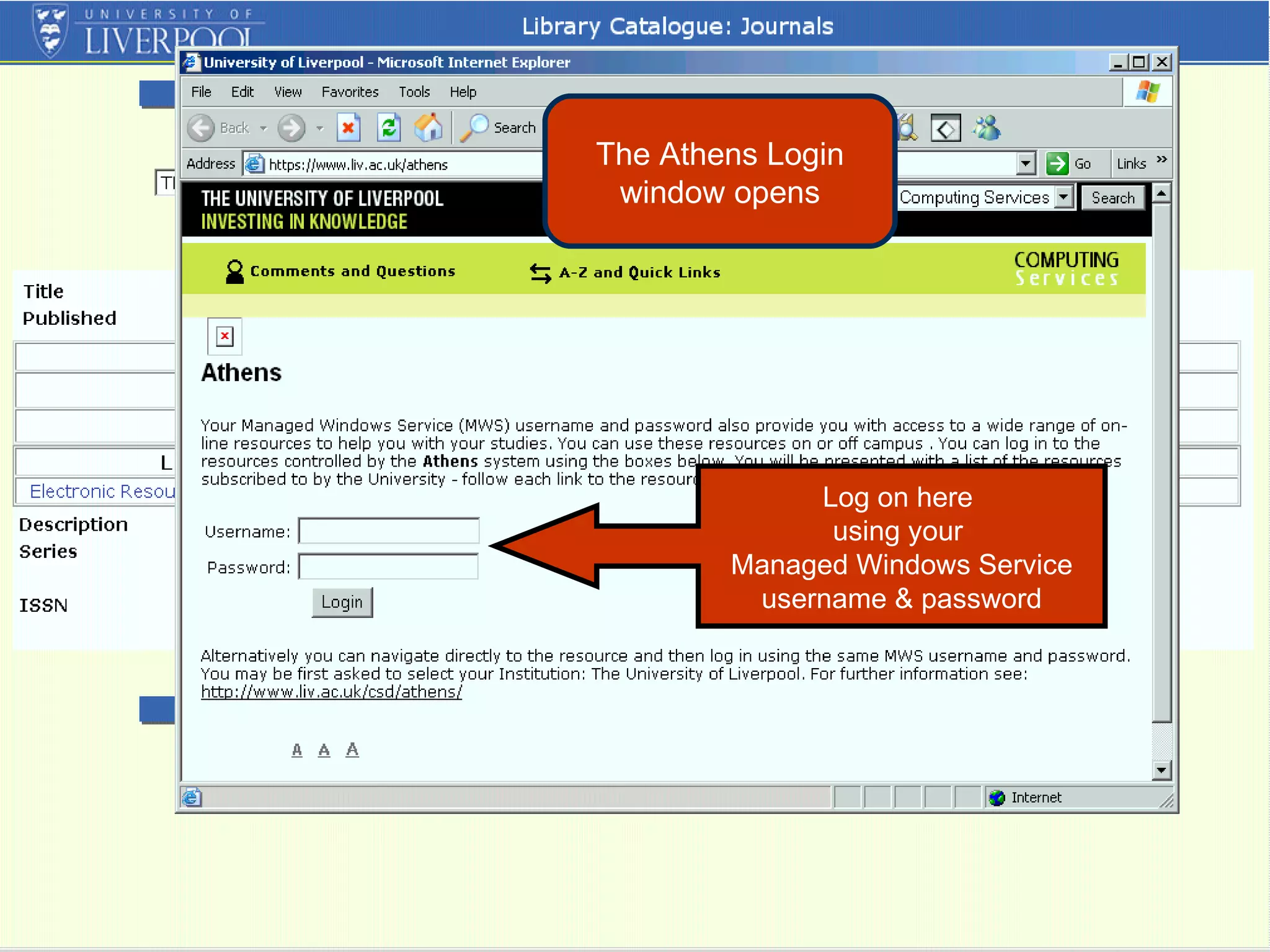
Log on here  using your  Managed Windows Service username & password The Athens Login window opens
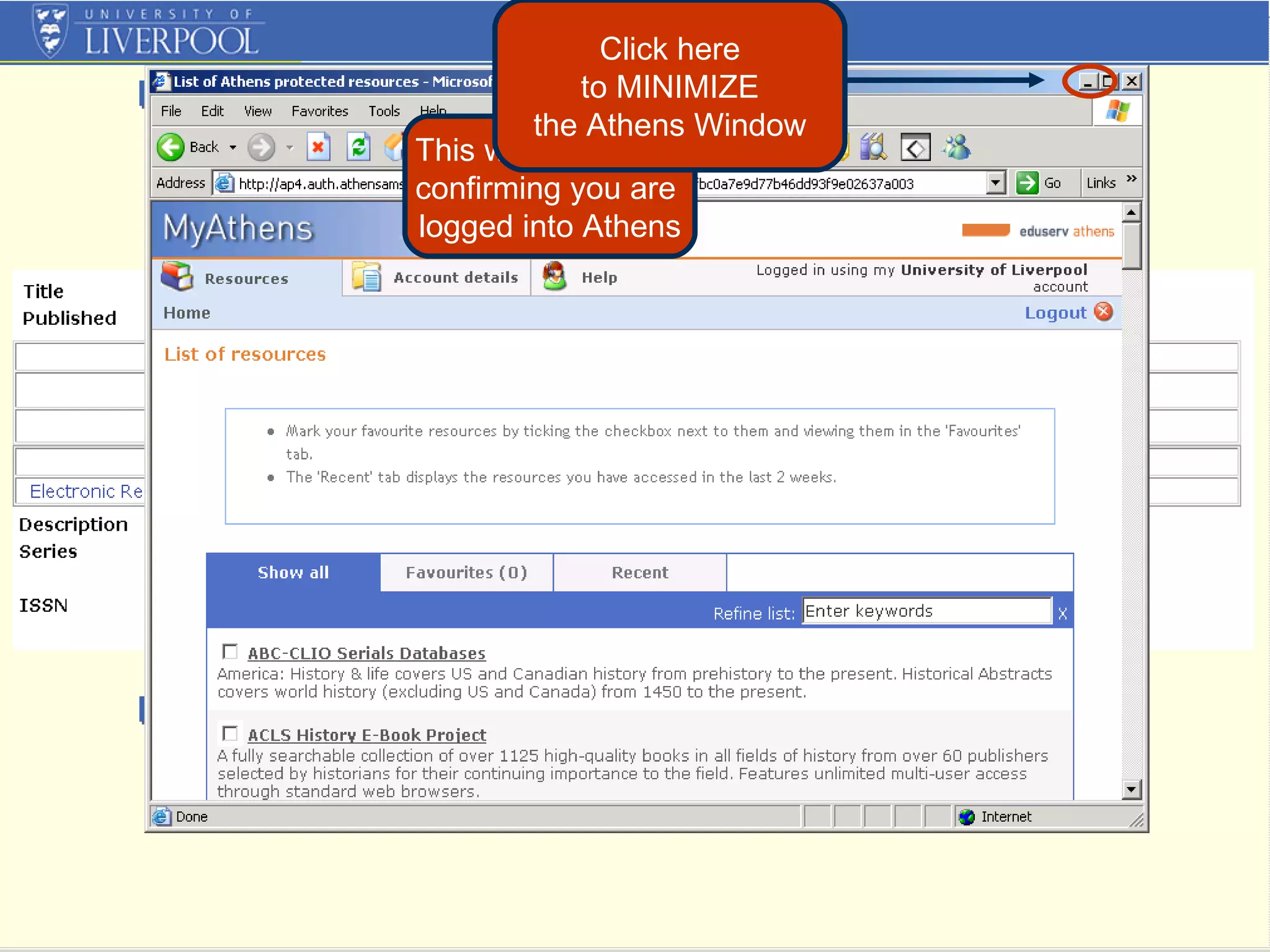
This window opens confirming you are  logged into Athens Click here to MINIMIZE the Athens Window
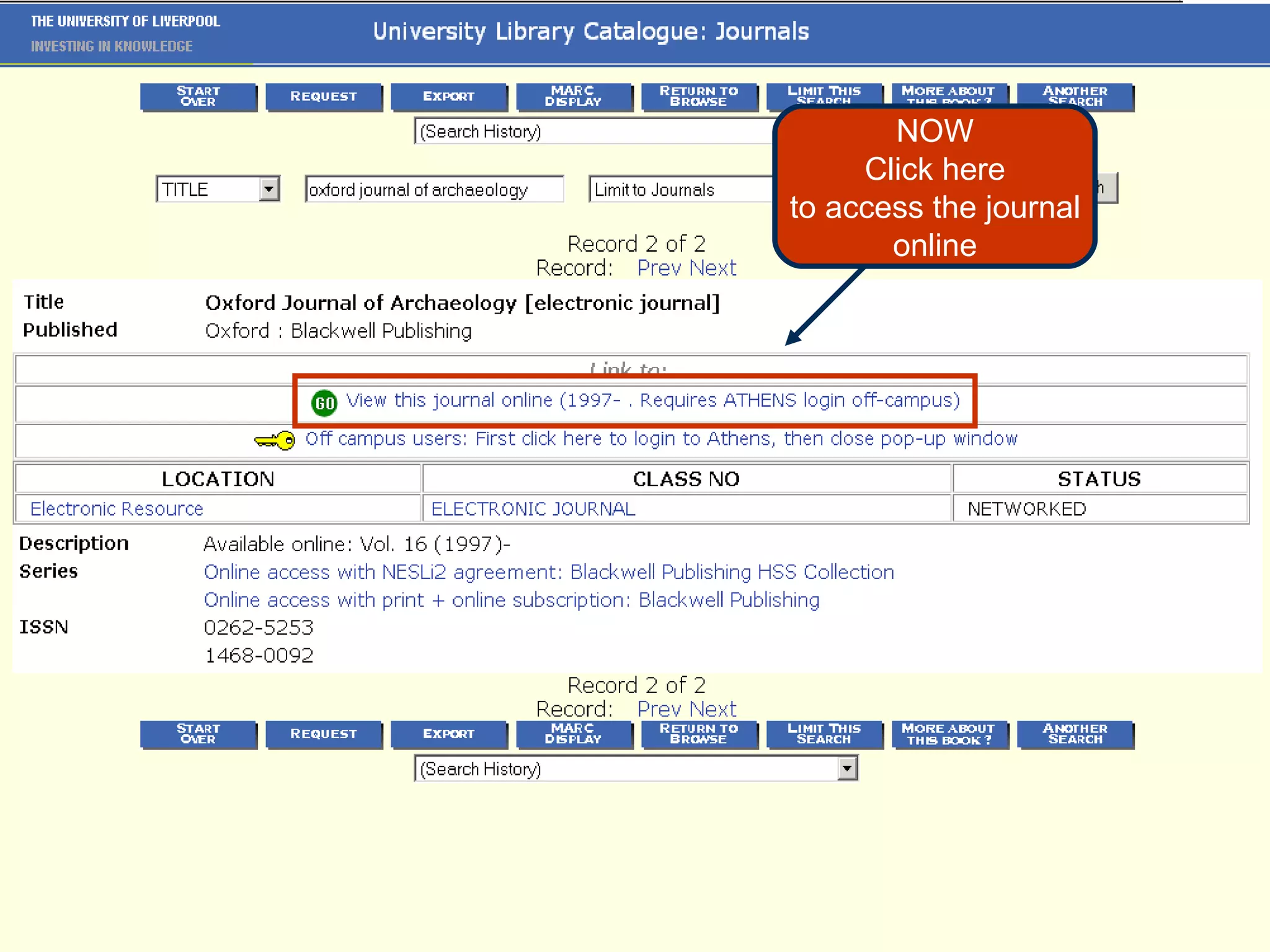
NOW Click here to access the journal online
E-books What? Where?   And How?
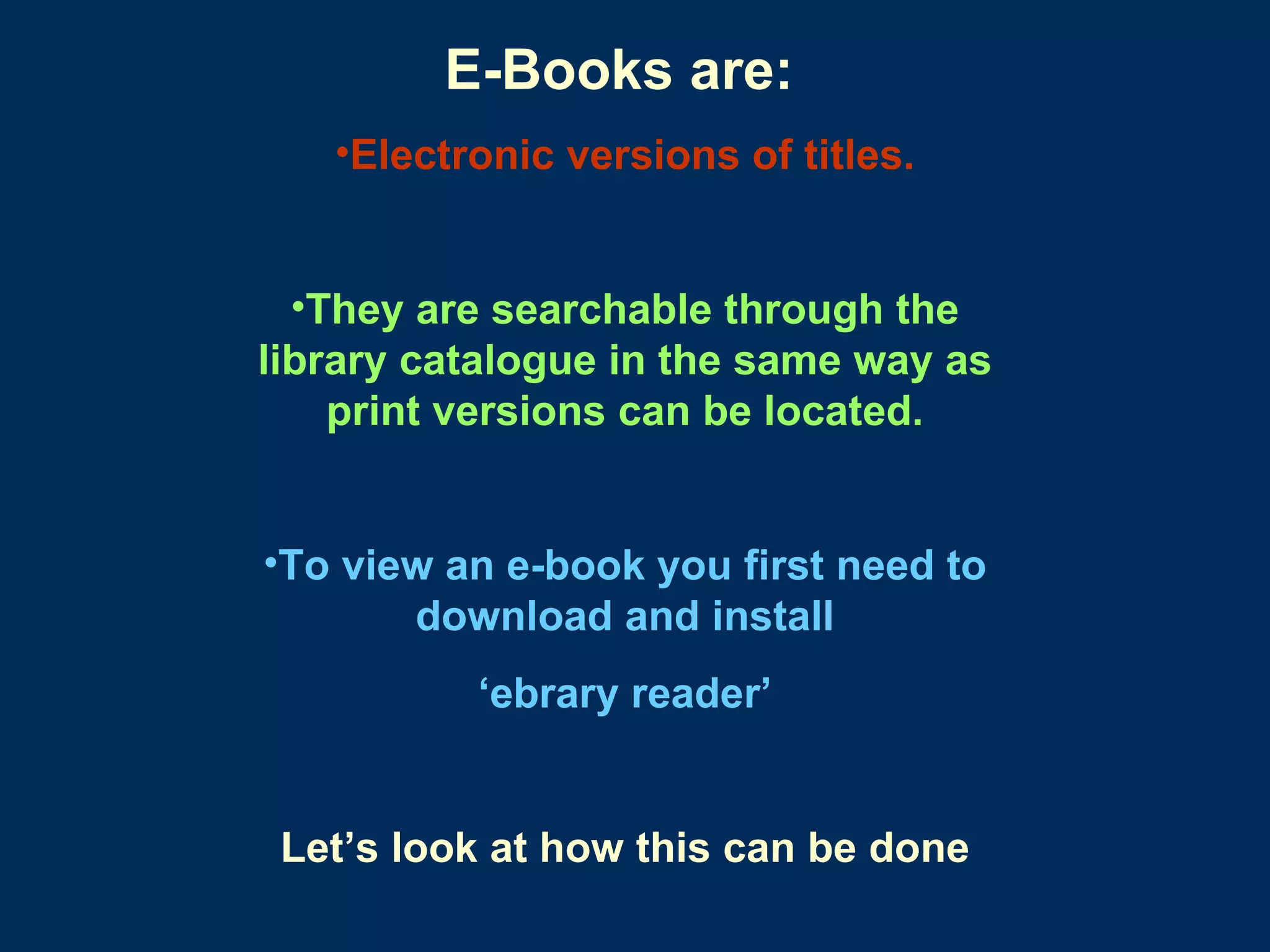
E-Books are:   Electronic versions of titles. They are searchable through the library catalogue in the same way as print versions can be located. To view an e-book you first need to download and install ‘ ebrary reader’ Let’s look at how this can be done
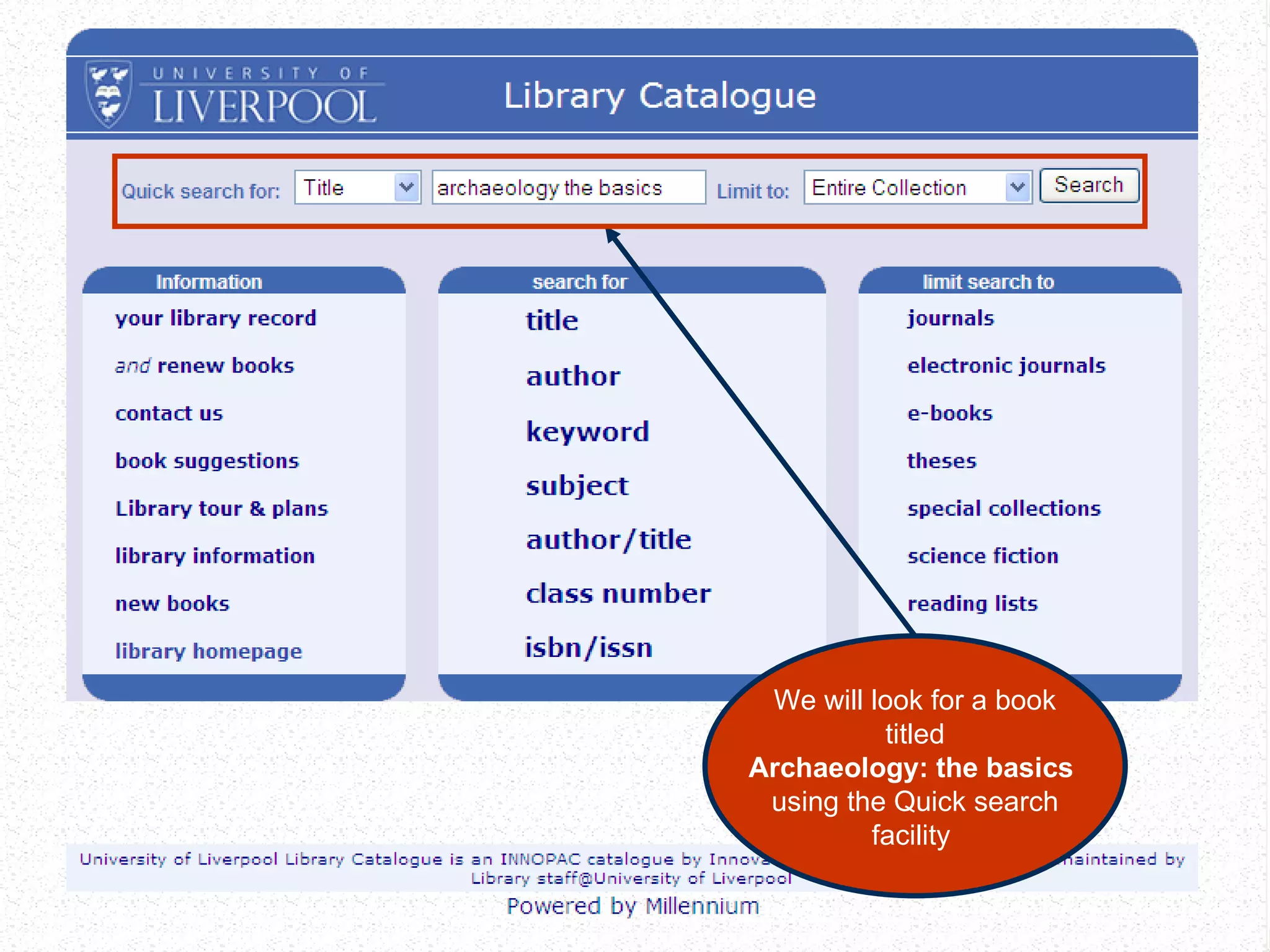
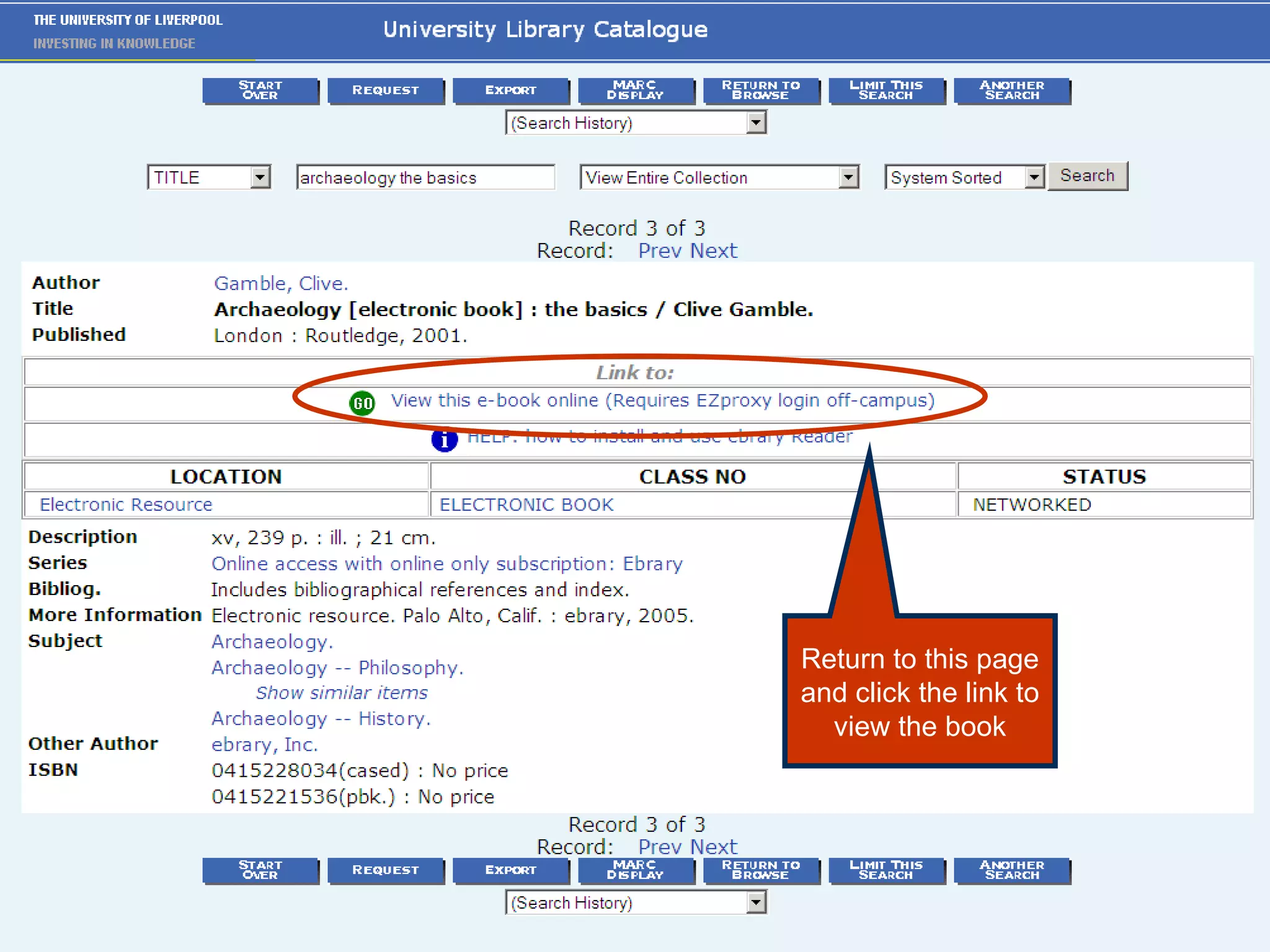
We will look for a book titled Archaeology: the basics   using the Quick search facility
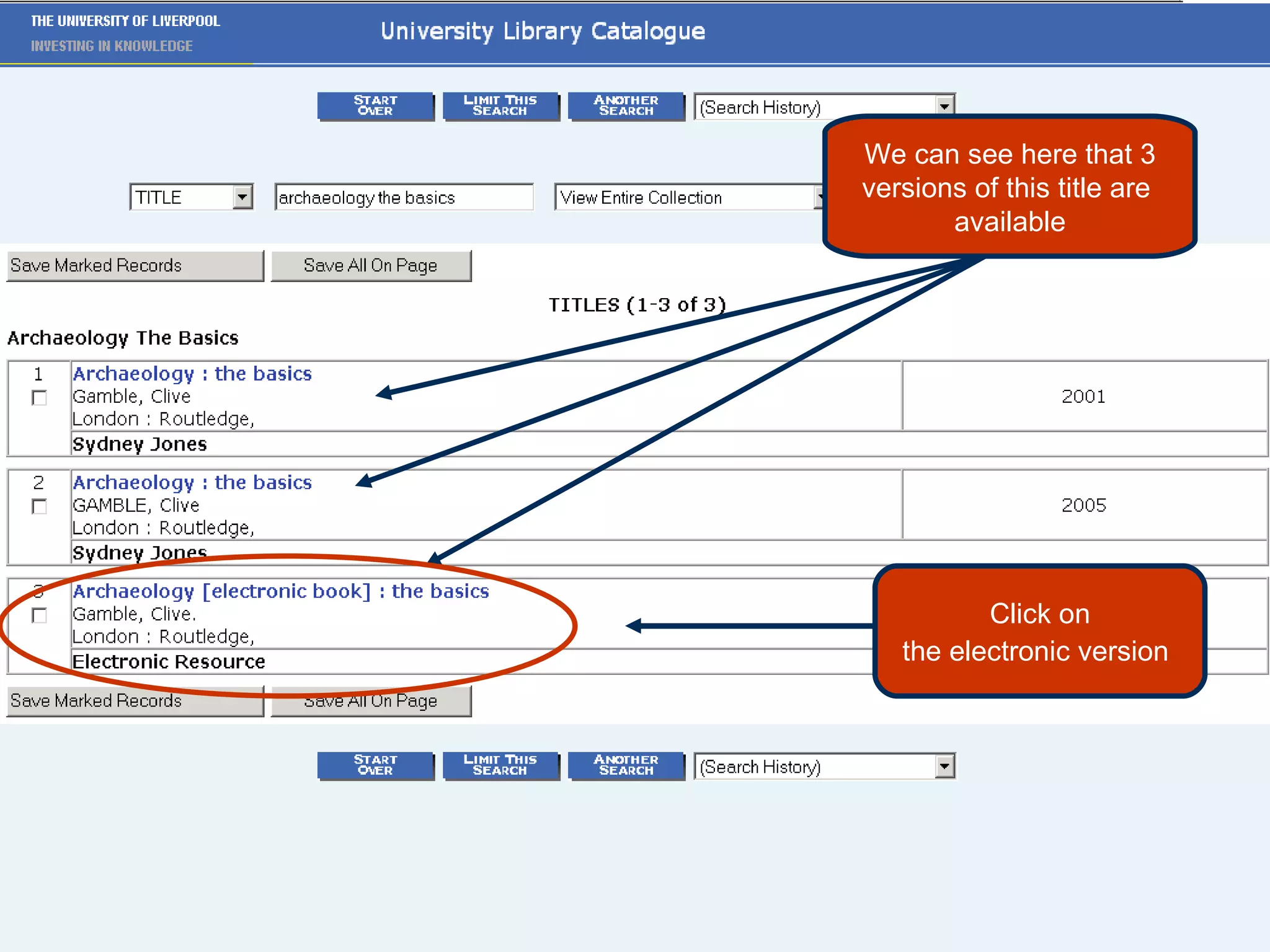
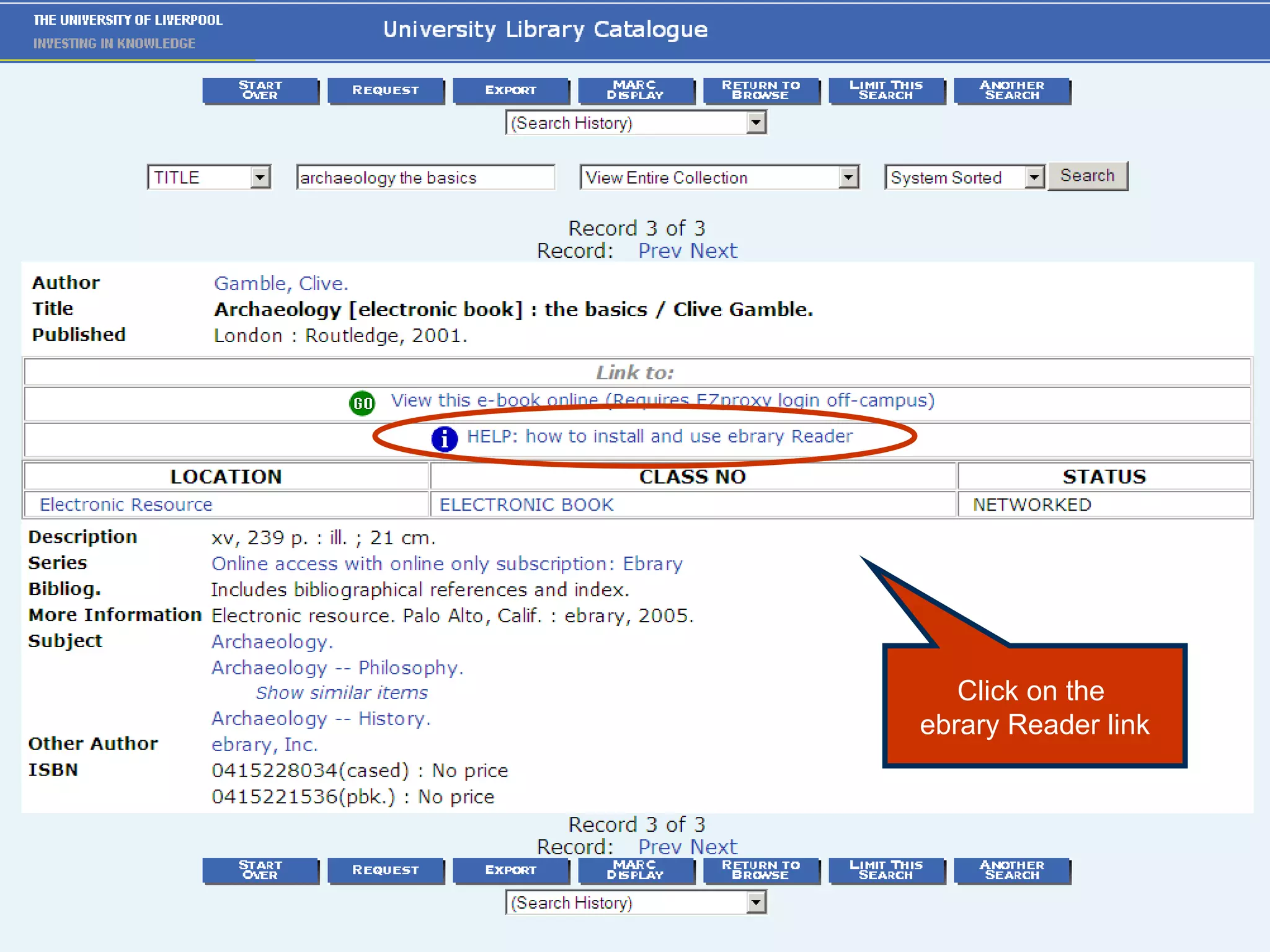
We can see here that 3 versions of this title are  available Click on the electronic version
Click on the  ebrary Reader link
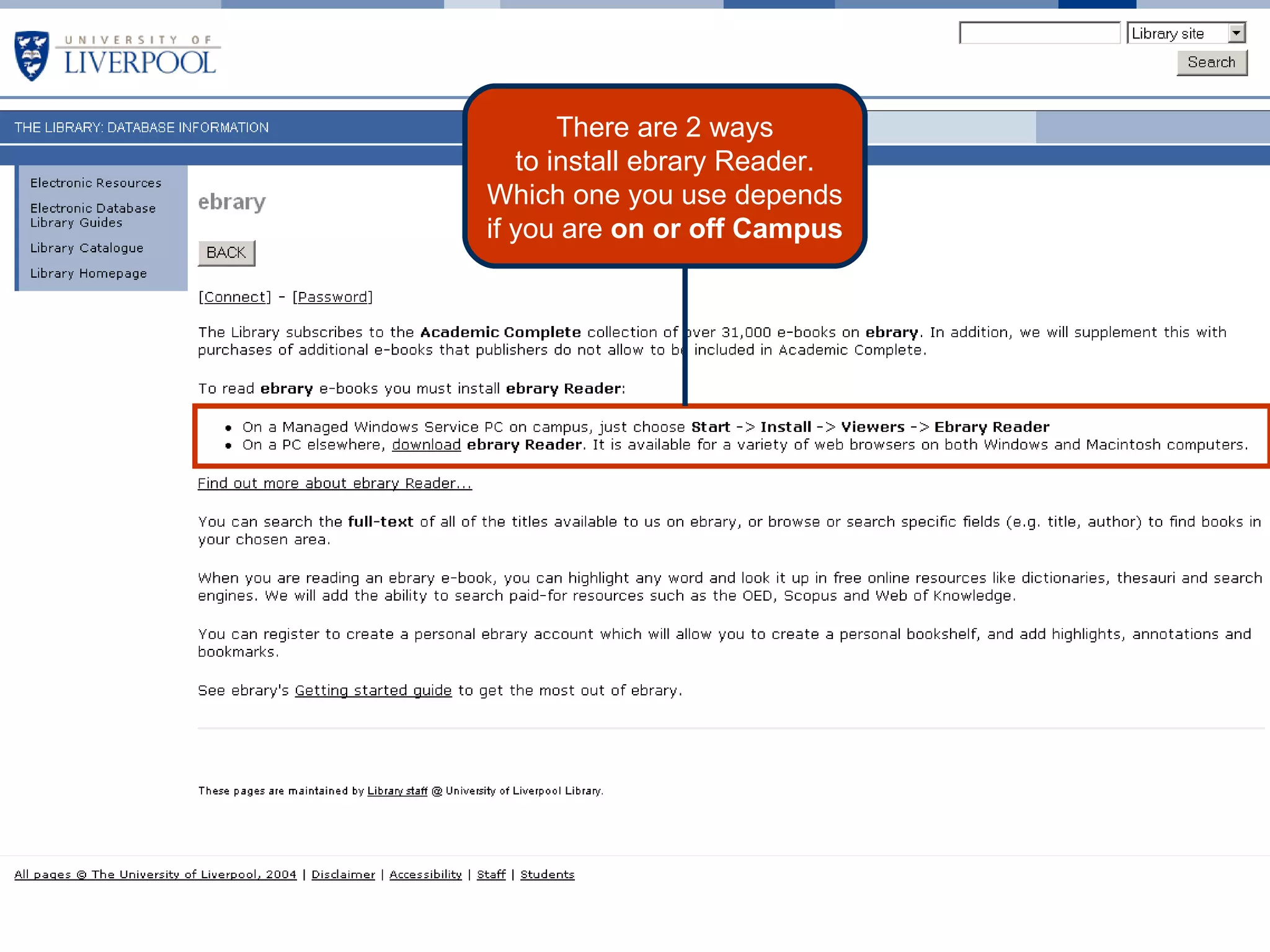
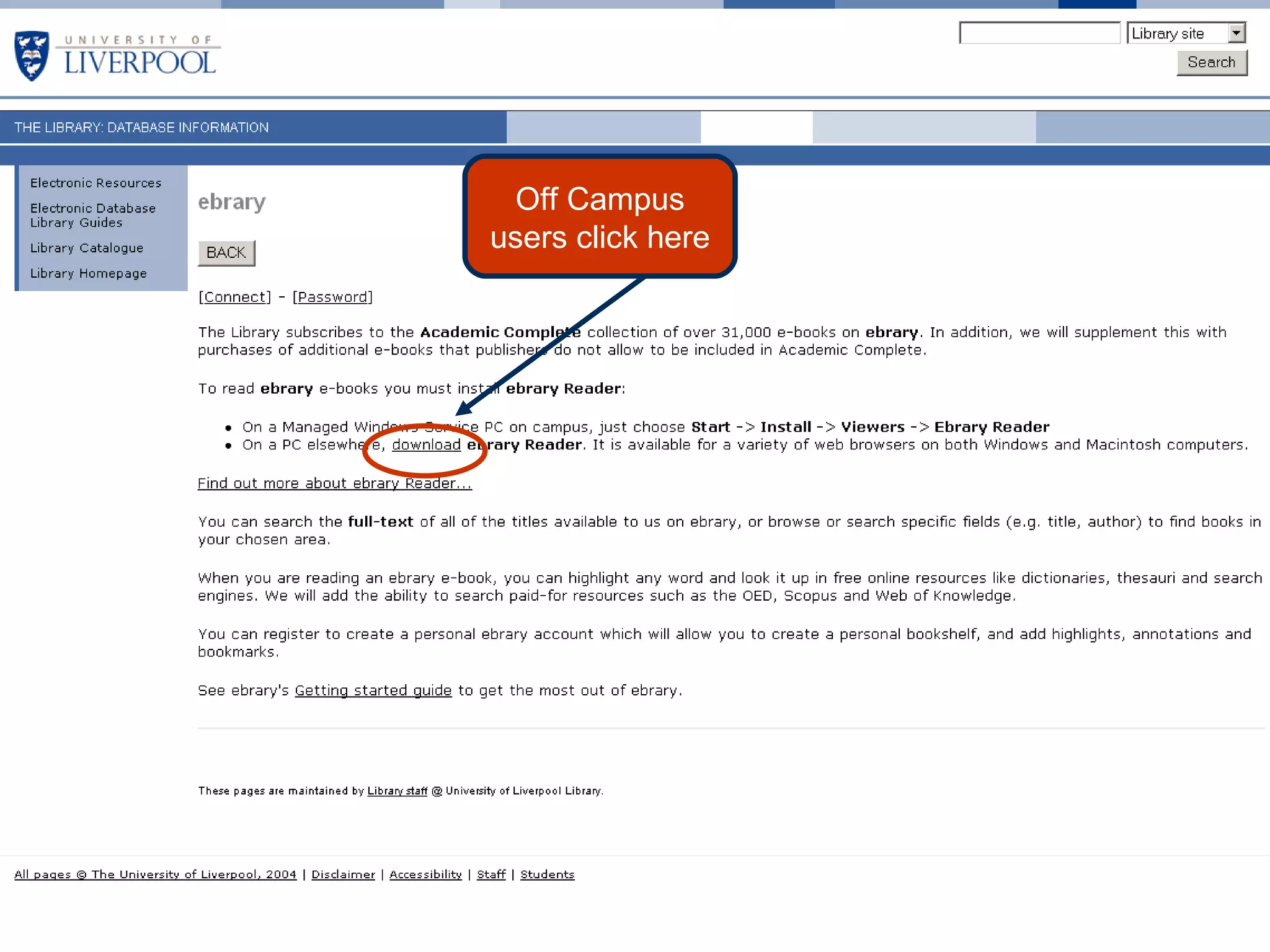
There are 2 ways to install ebrary Reader. Which one you use depends if you are  on or off Campus
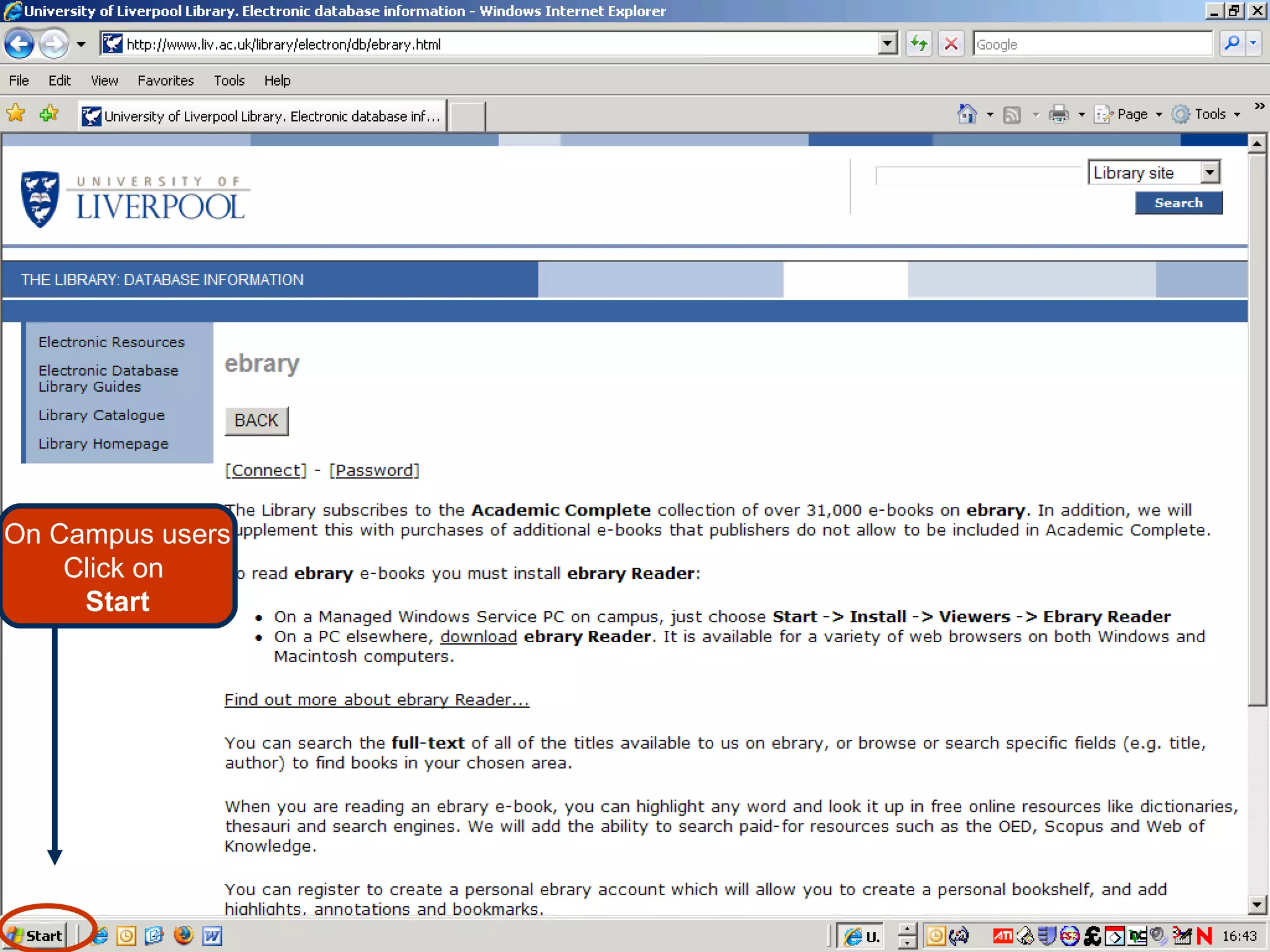
On Campus users Click on  Start
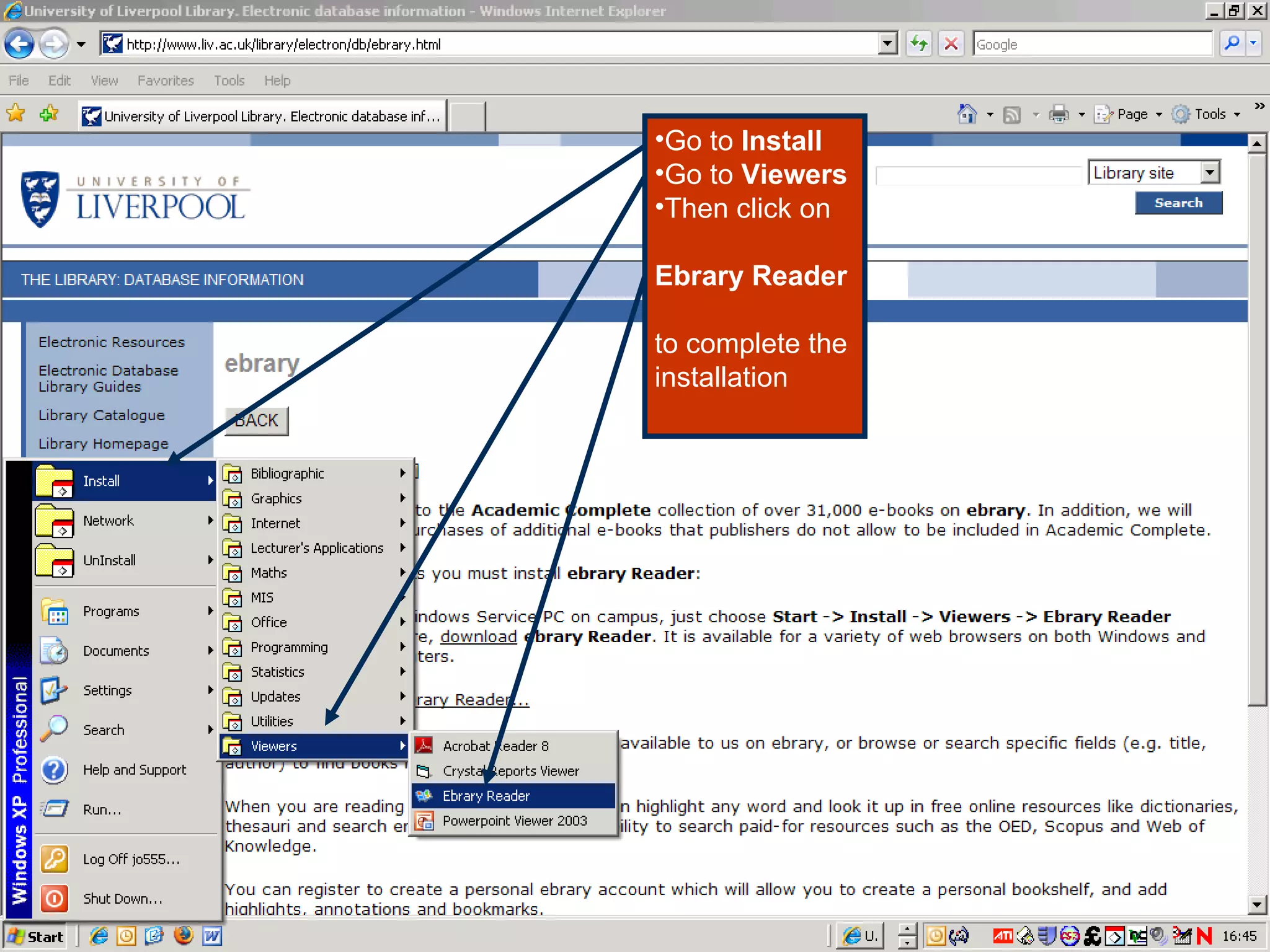
Go to  Install Go to  Viewers Then click on Ebrary Reader   to complete the installation
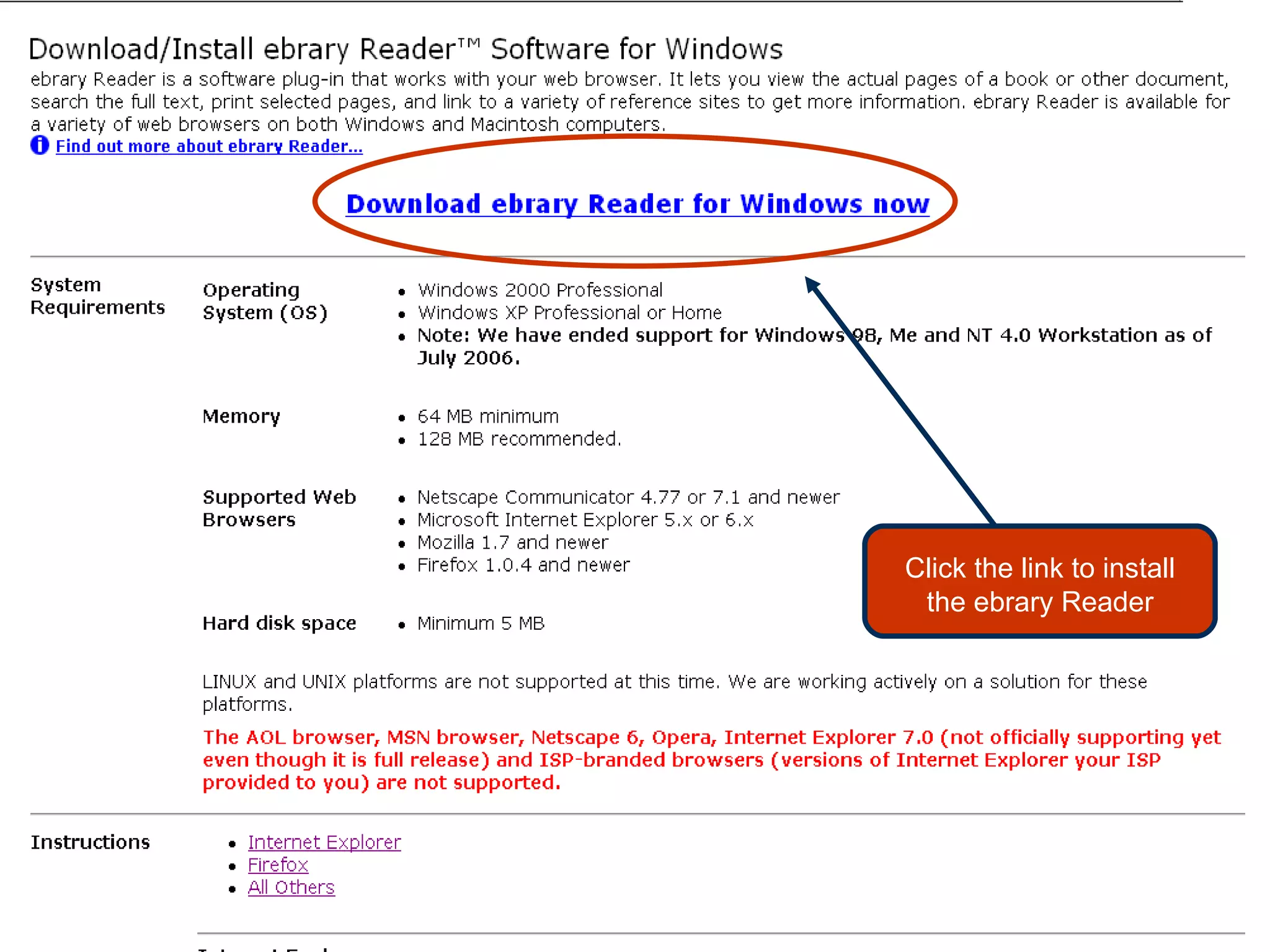
Off Campus users click here
Click the link to install the ebrary Reader
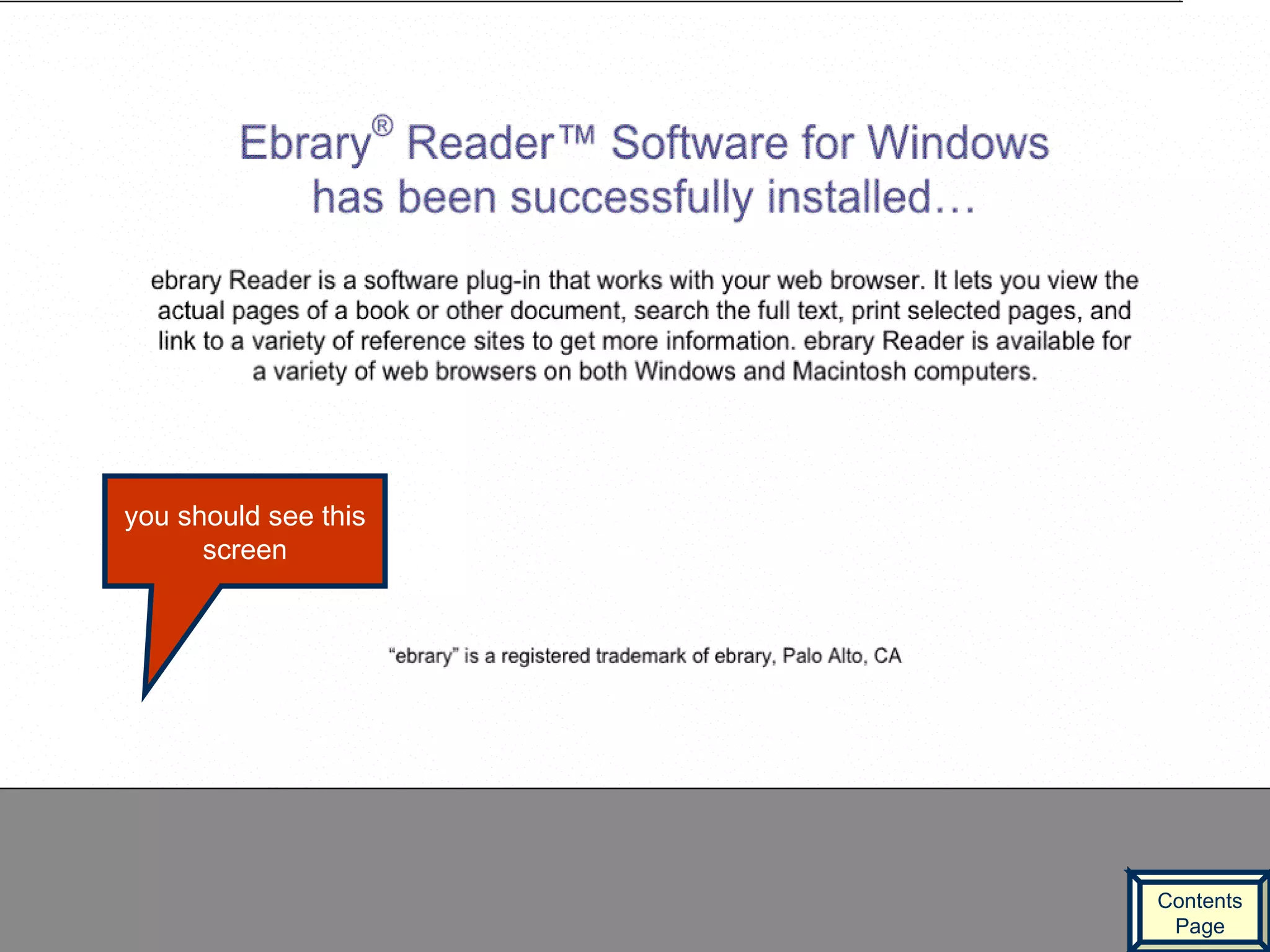
you should see this screen Contents Page
Return to this page and click the link to view the book
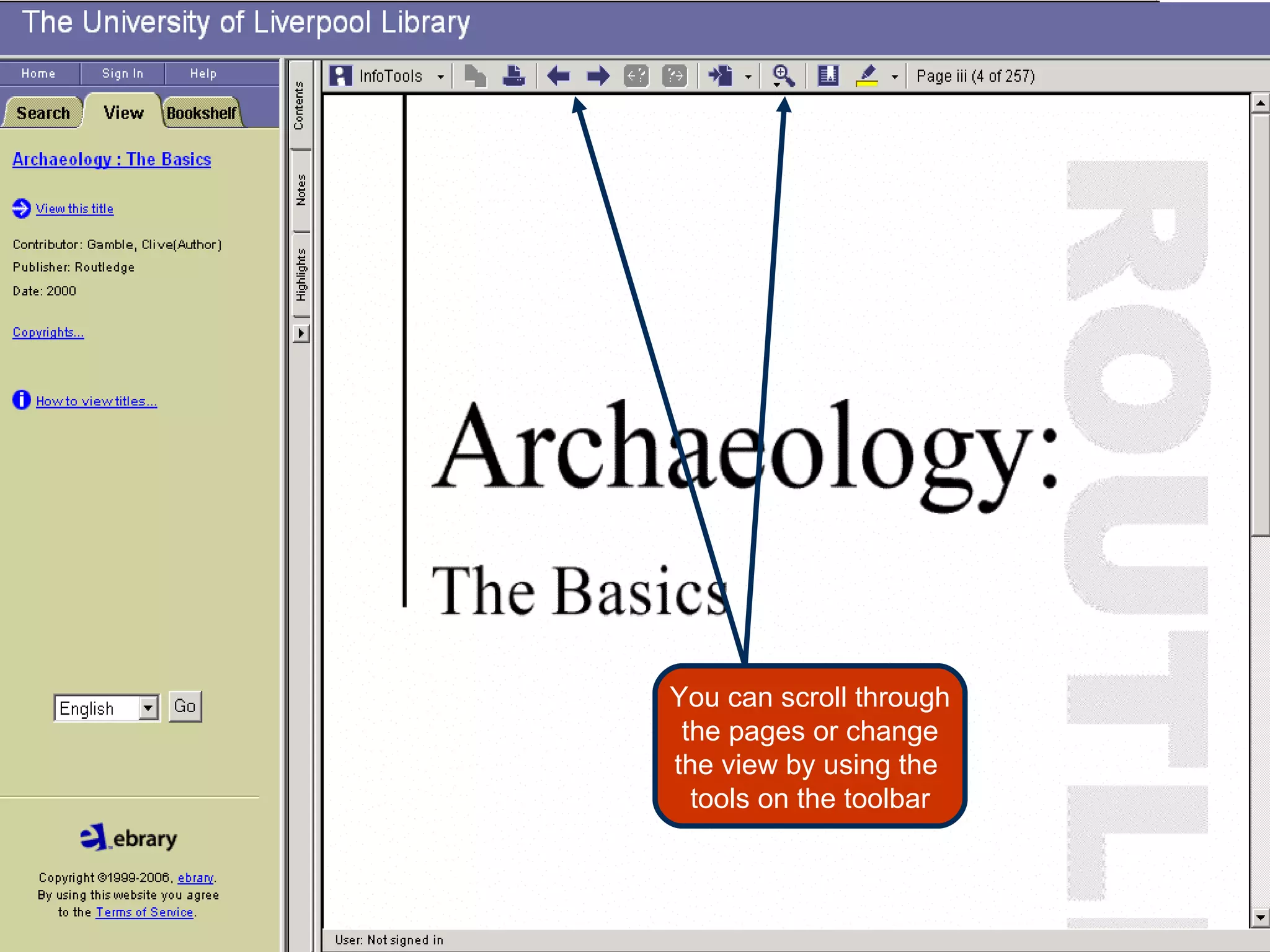
You can scroll through the pages or change  the view by using the  tools on the toolbar
Reserving and recalling books
If the book you require is currently issued to another reader you can   reserve or recall   it by using one of the following methods .
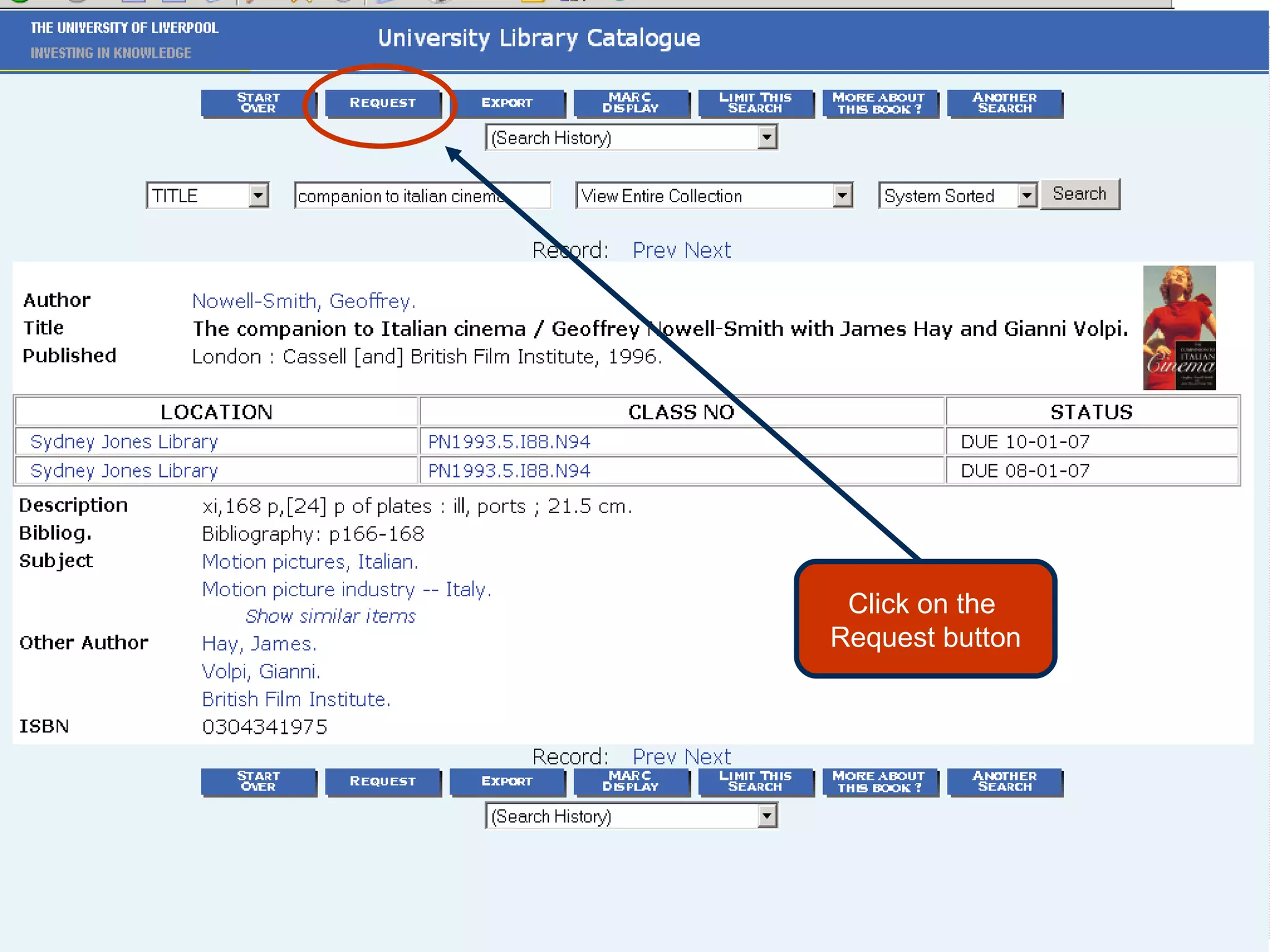
Click on the  Request button
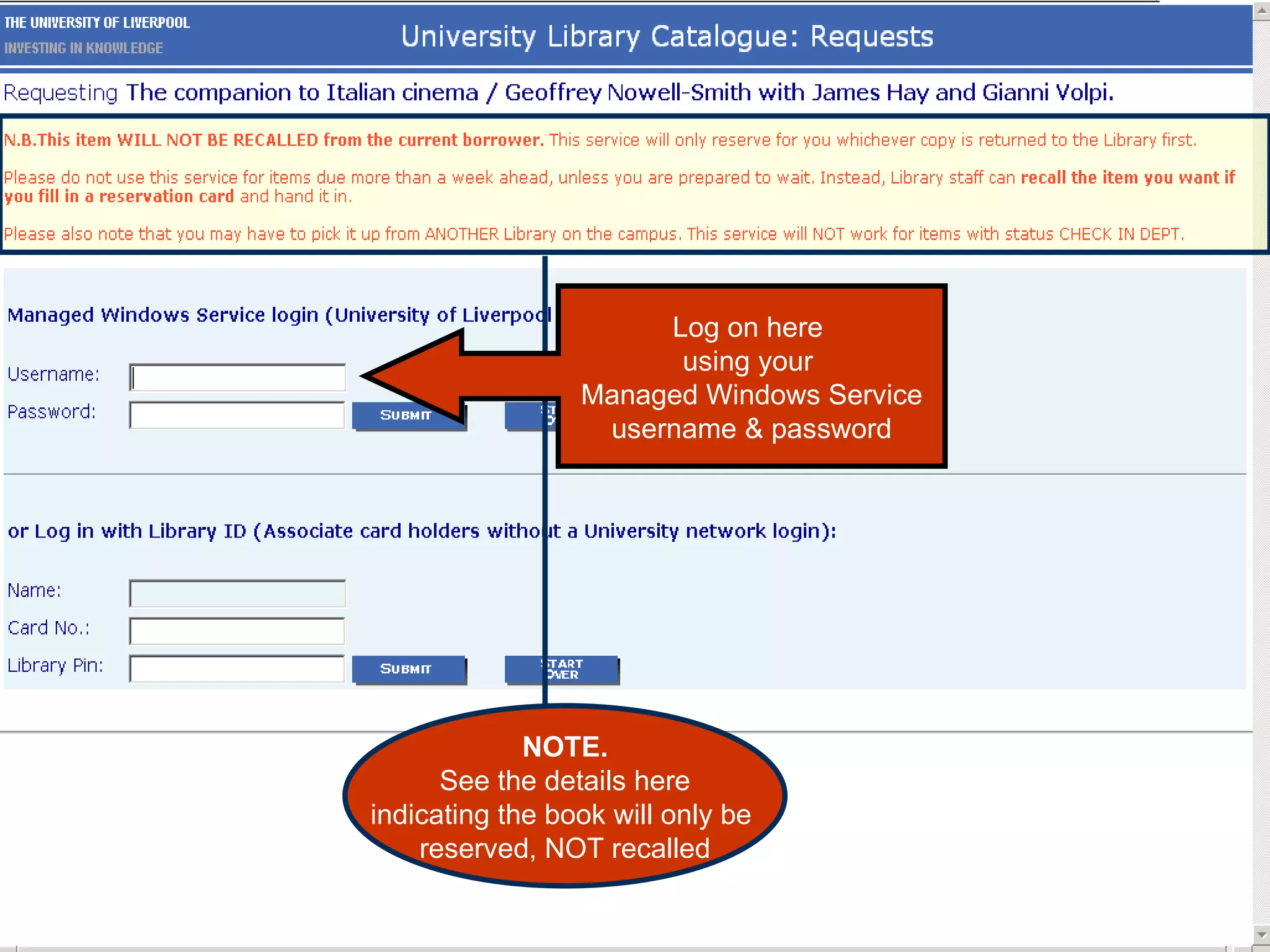
Log on here  using your  Managed Windows Service username & password NOTE. See the details here indicating the book will only be  reserved, NOT recalled
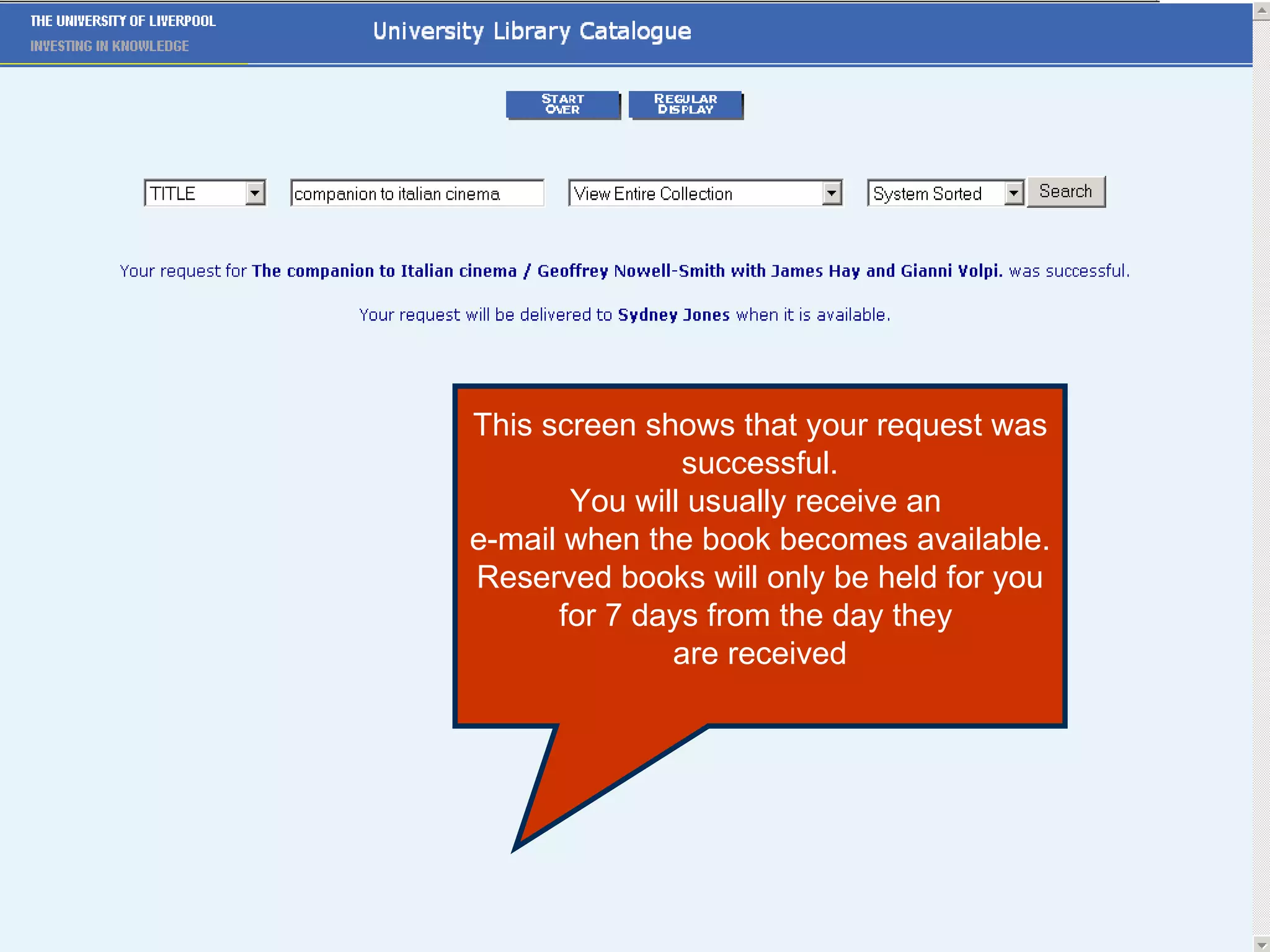
This screen shows that your request was successful. You will usually receive an  e-mail when the book becomes available. Reserved books will only be held for you for 7 days from the day they  are received
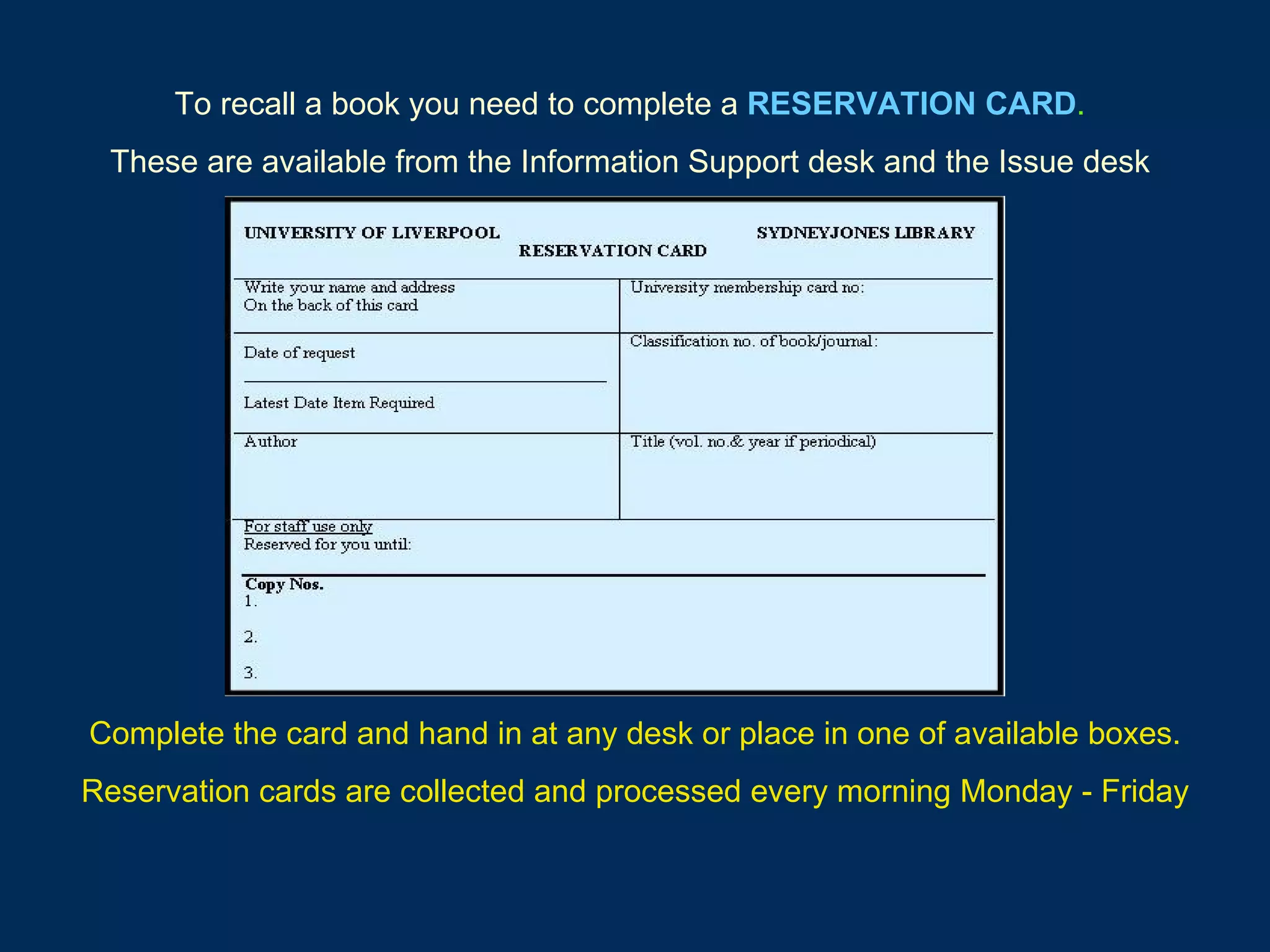
To recall a book you need to complete a   RESERVATION CARD . These are available from the Information Support desk and the Issue desk Complete the card and hand in at any desk or place in one of available boxes. Reservation cards are collected and processed every morning Monday - Friday
Reading Lists? Where to find them. & How to use them.
‘ Reading lists save you so much time because they list all of your Lecturers recommended reading in one place. In other words, YOU don’t have to trawl through the catalogue’ Anon 2006
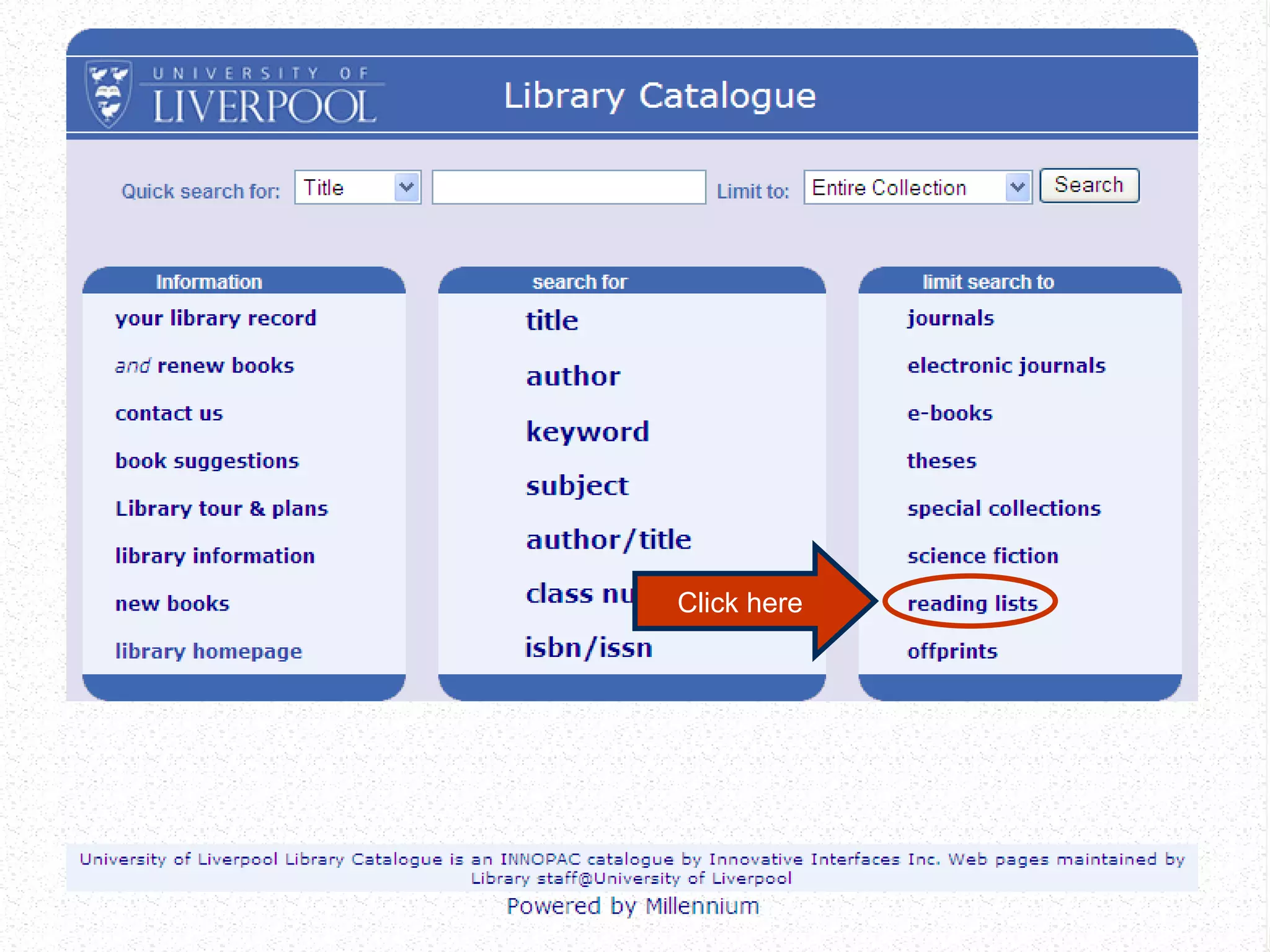
Click here
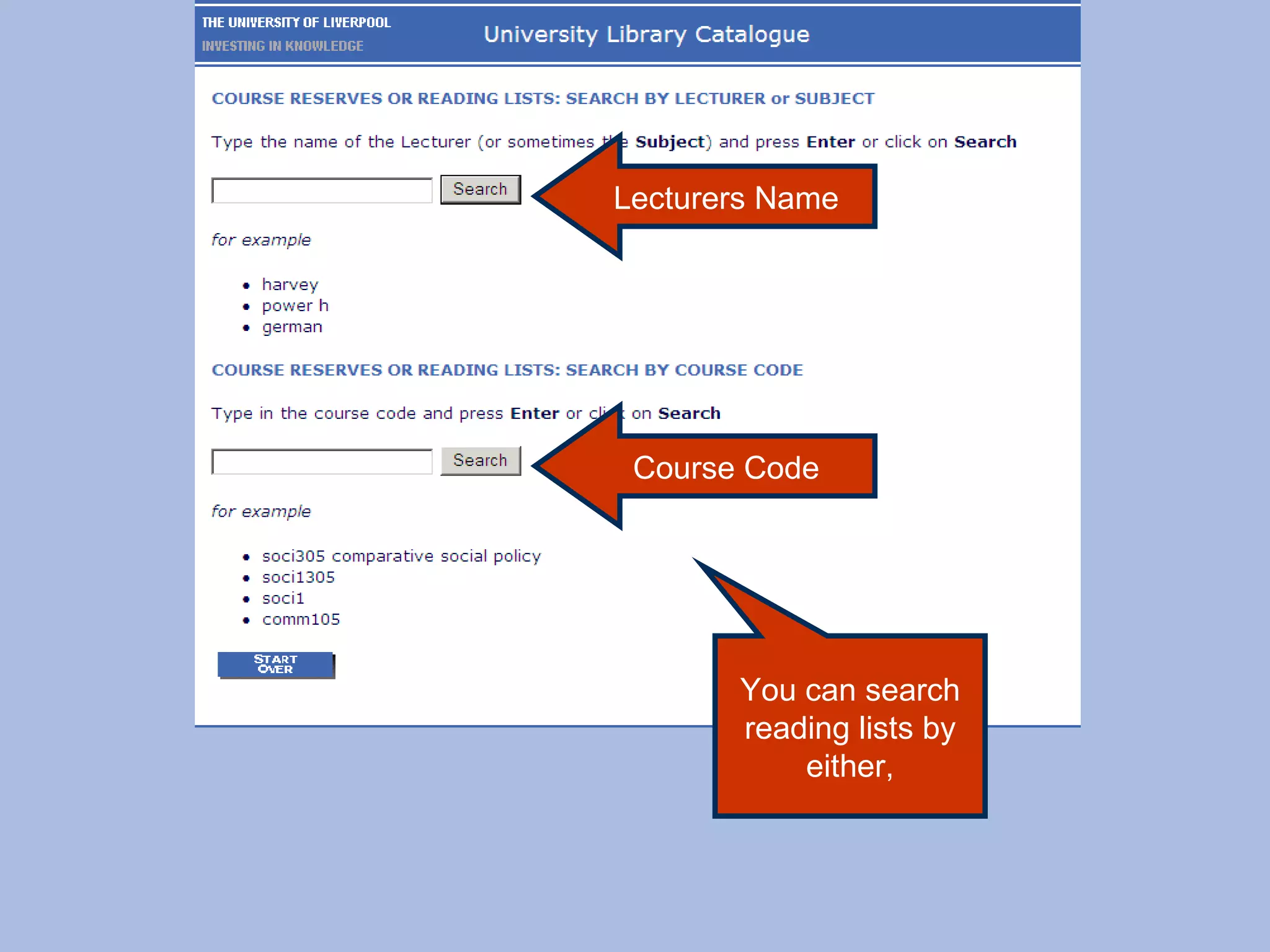
You can search reading lists by either, Lecturers Name Course Code
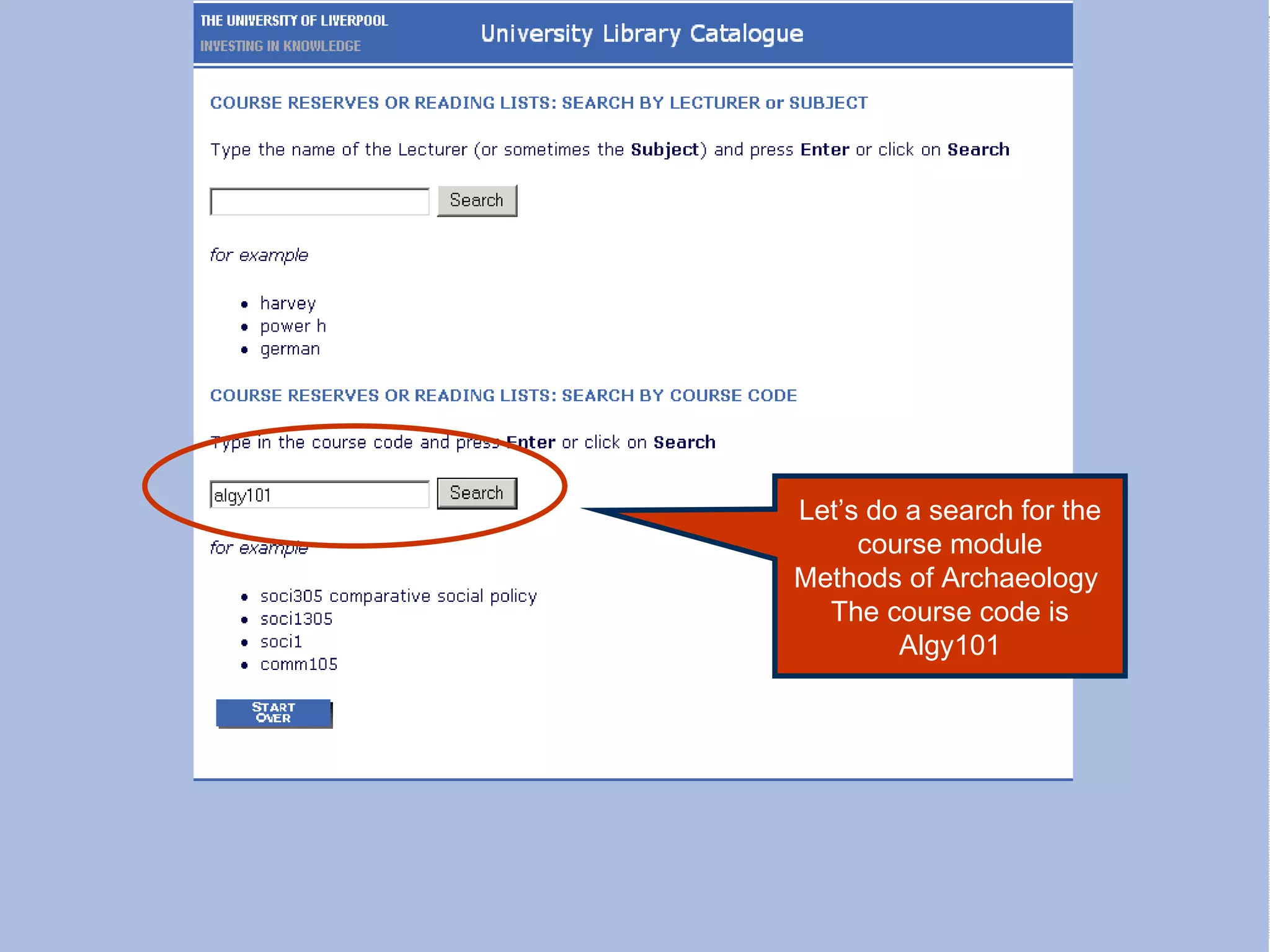
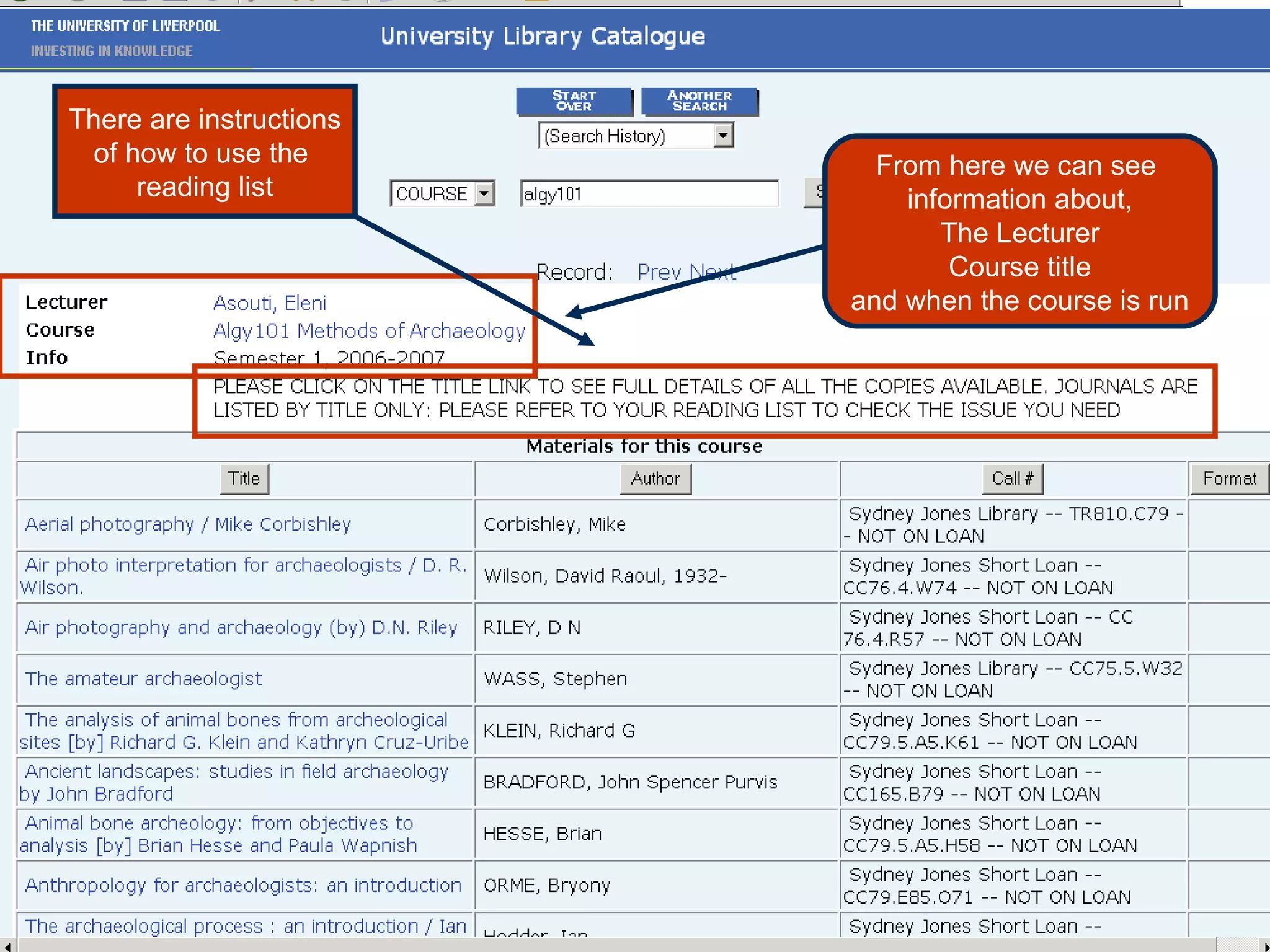
Let’s do a search for the course module Methods of Archaeology  The course code is Algy101
From here we can see  information about, The Lecturer Course title and when the course is run There are instructions of how to use the  reading list
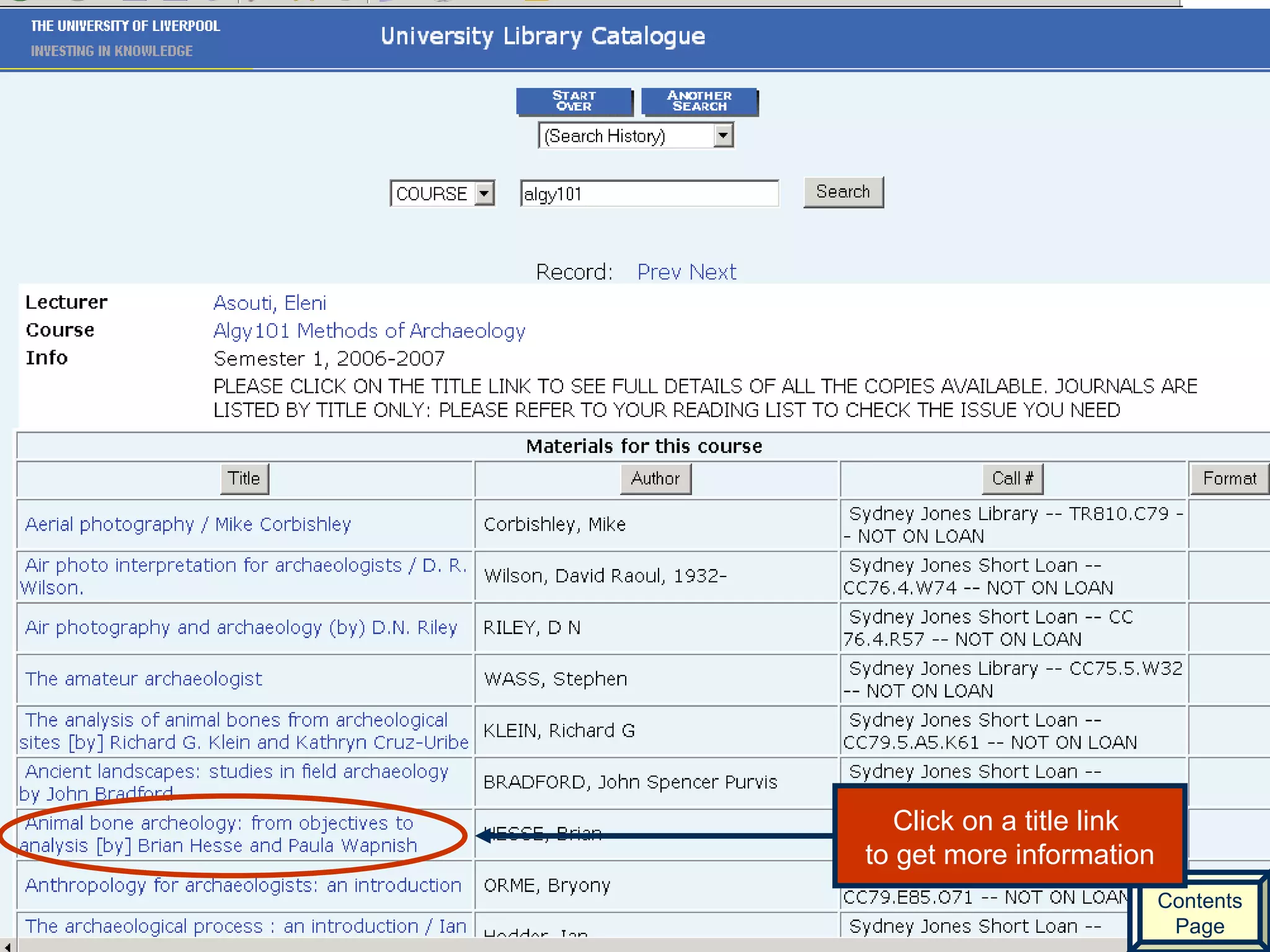
Contents Page Click on a title link  to get more information
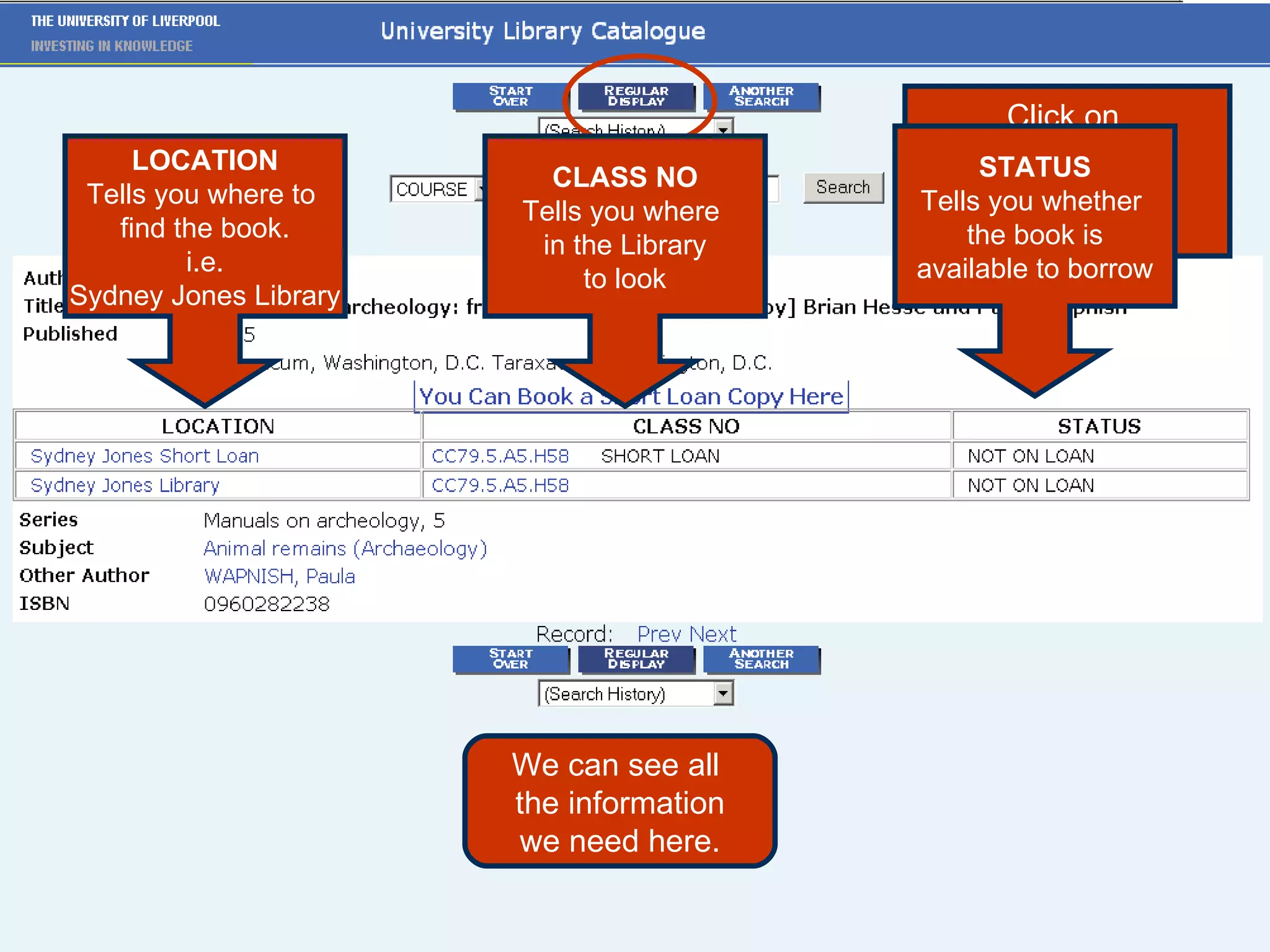
We can see all  the information we need here. LOCATION Tells you where to  find the book. i.e. Sydney Jones Library CLASS NO Tells you where  in the Library to look STATUS Tells you whether  the book is available to borrow Click on  Regular Display  To return to  the reading list
Offprints. What are they? & How do you find them?
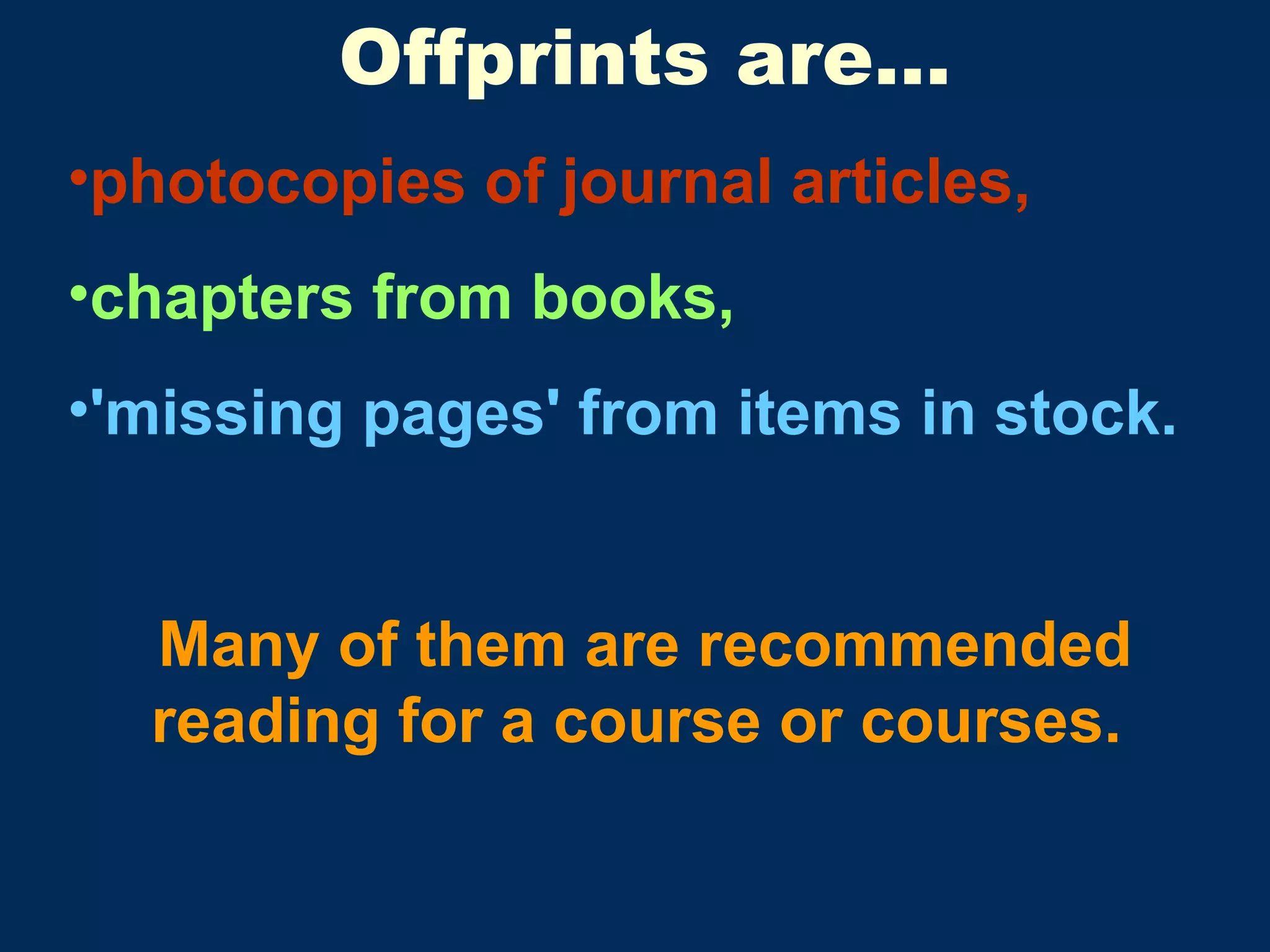
Offprints are… photocopies of journal articles, chapters from books,   'missing pages' from items in stock.  Many of them are recommended reading for a course or courses.
Offprints are only available from the relevant library Issue Desks. Offprints are only available to borrow for the standard short loan period.
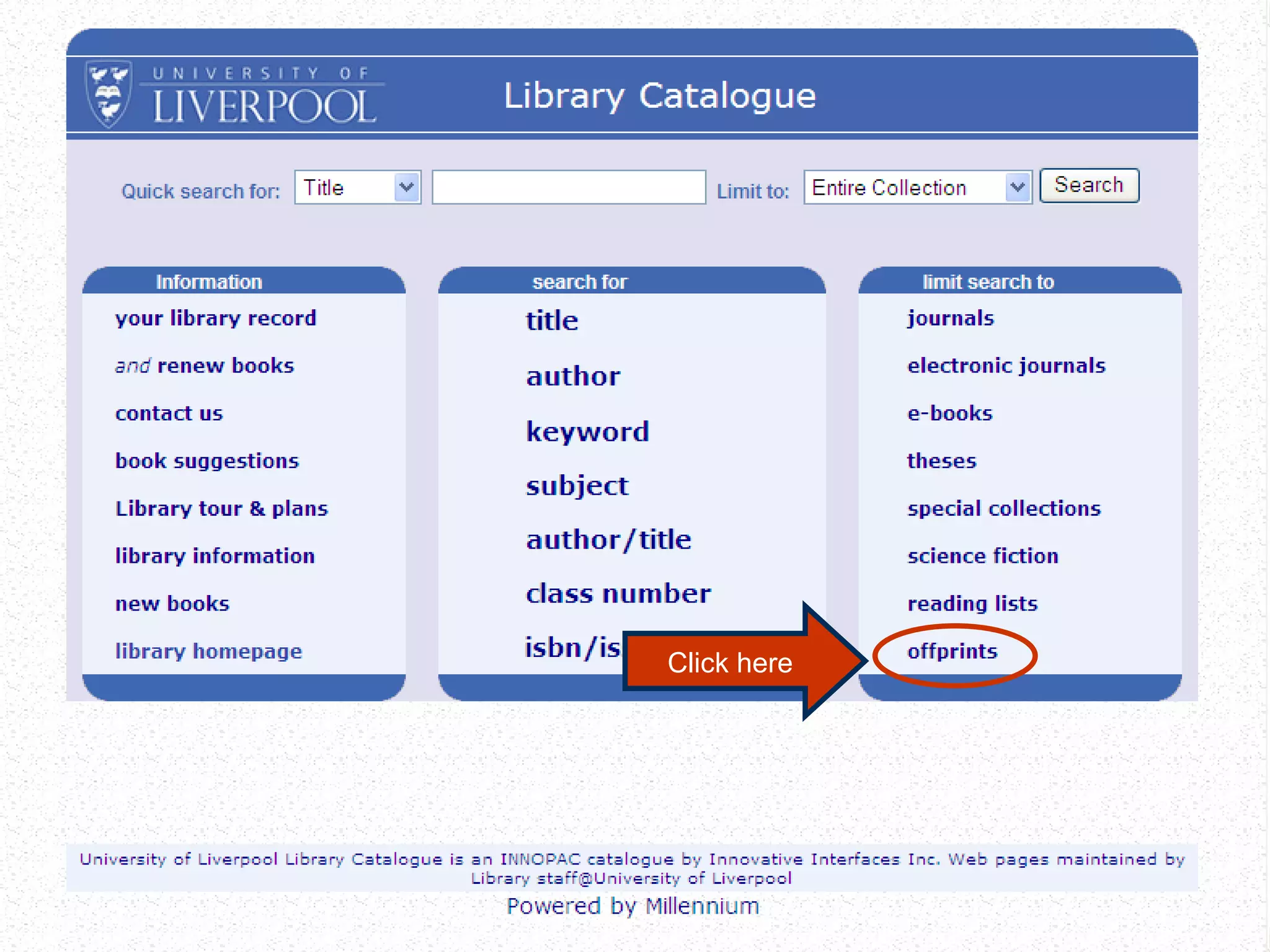
Click here
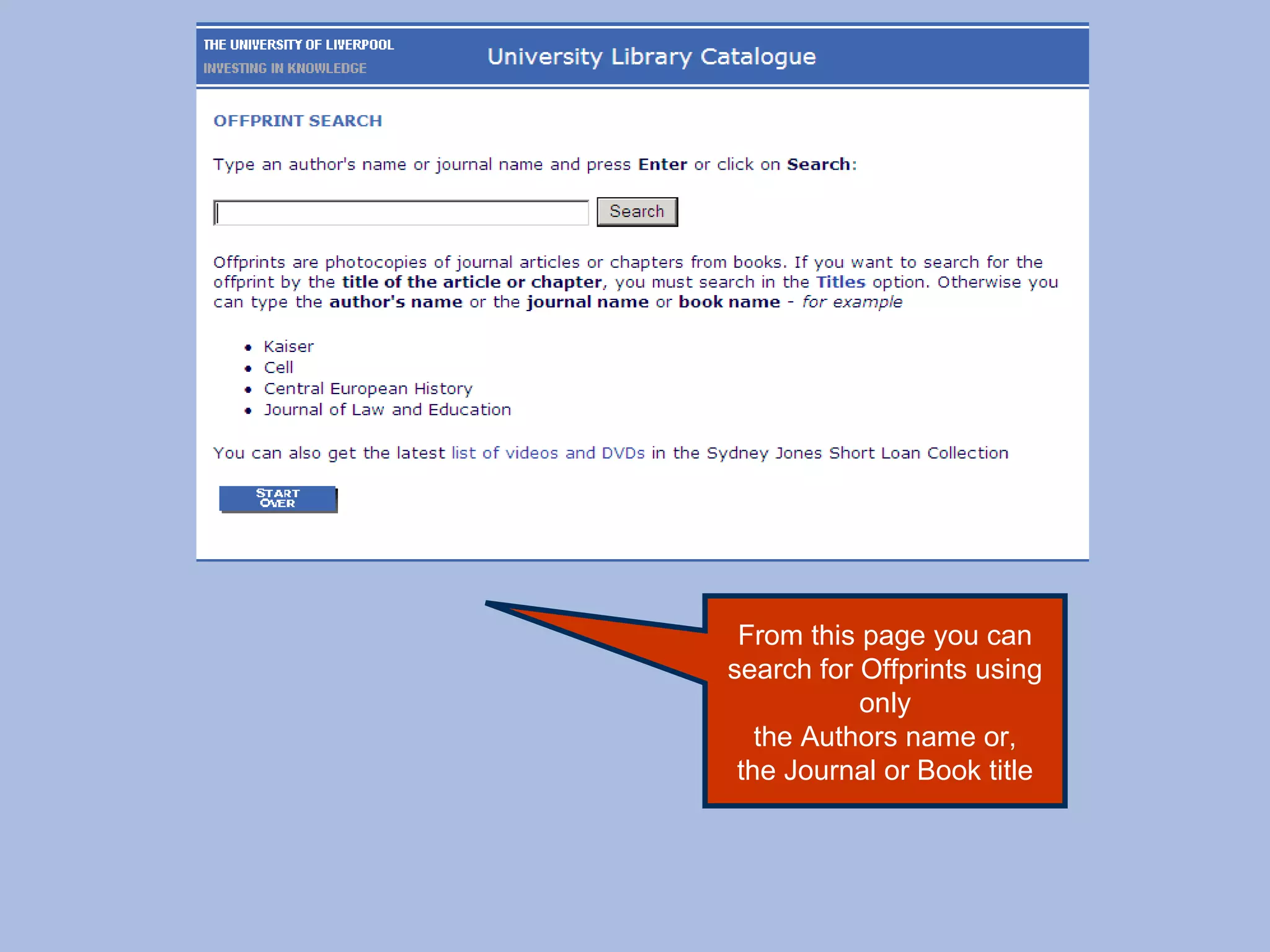
From this page you can search for Offprints using only the Authors name or, the Journal or Book title
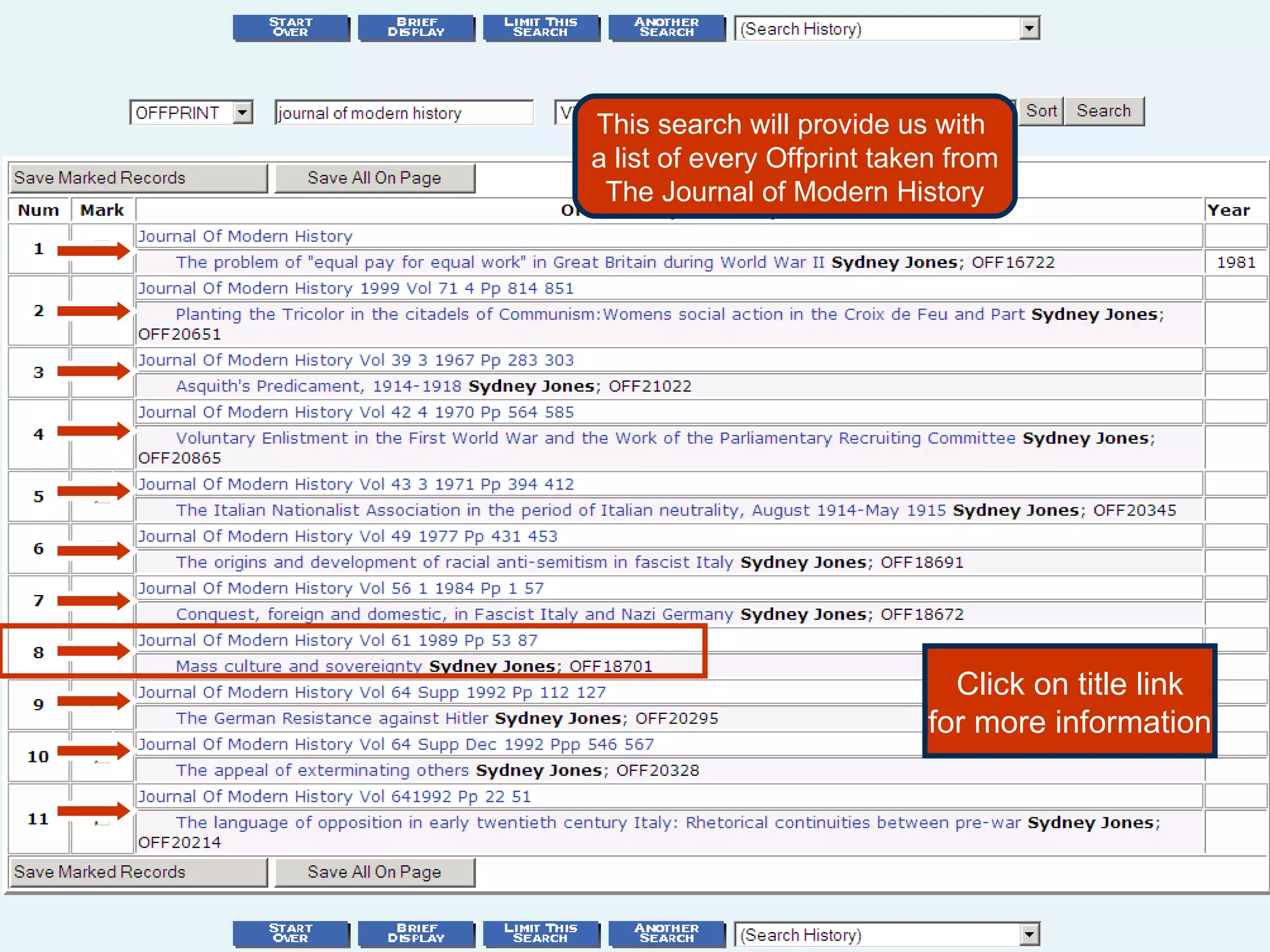
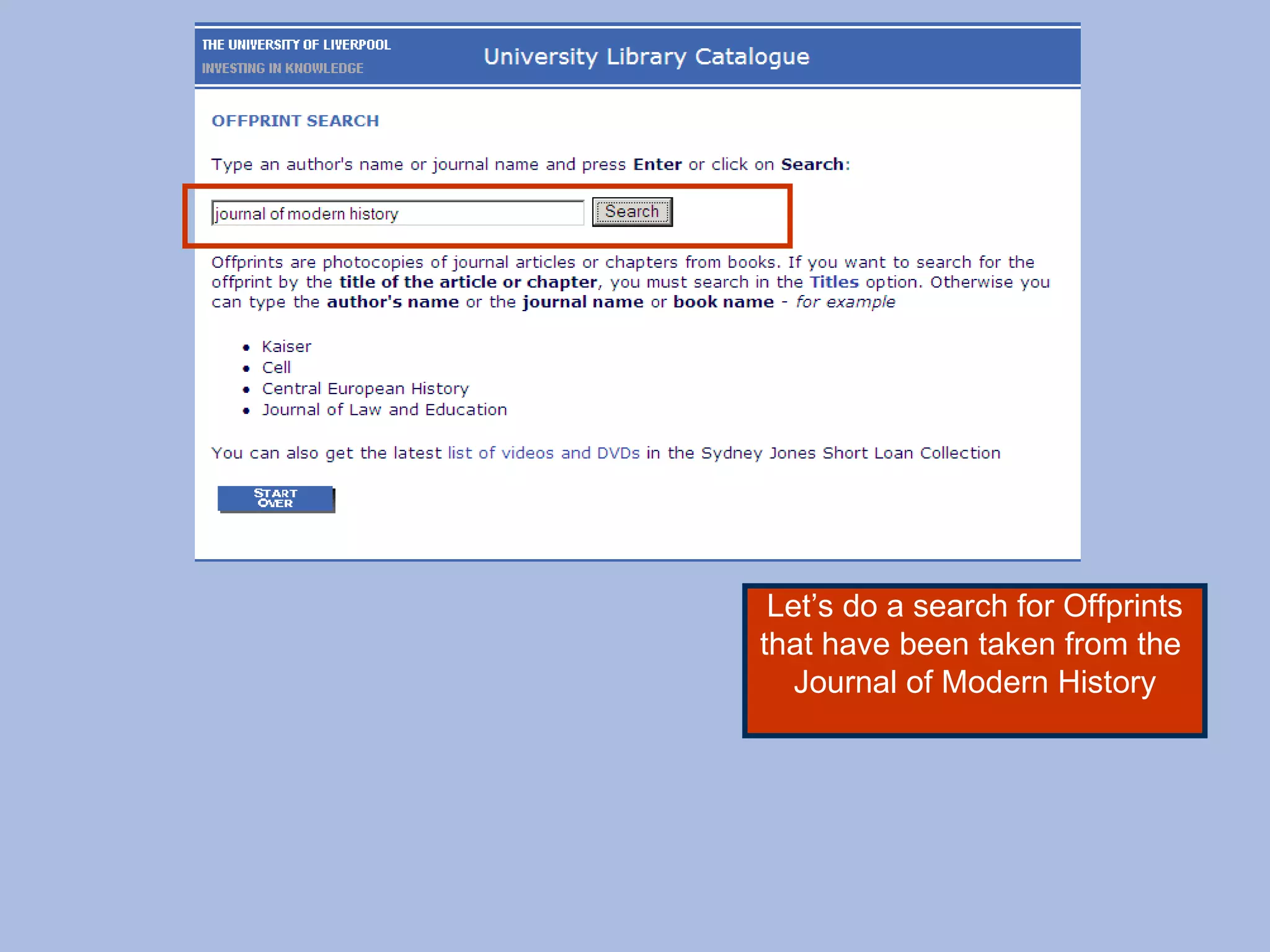
Let’s do a search for Offprints that have been taken from the  Journal of Modern History
This search will provide us with  a list of every Offprint taken from The Journal of Modern History Click on title link for more information
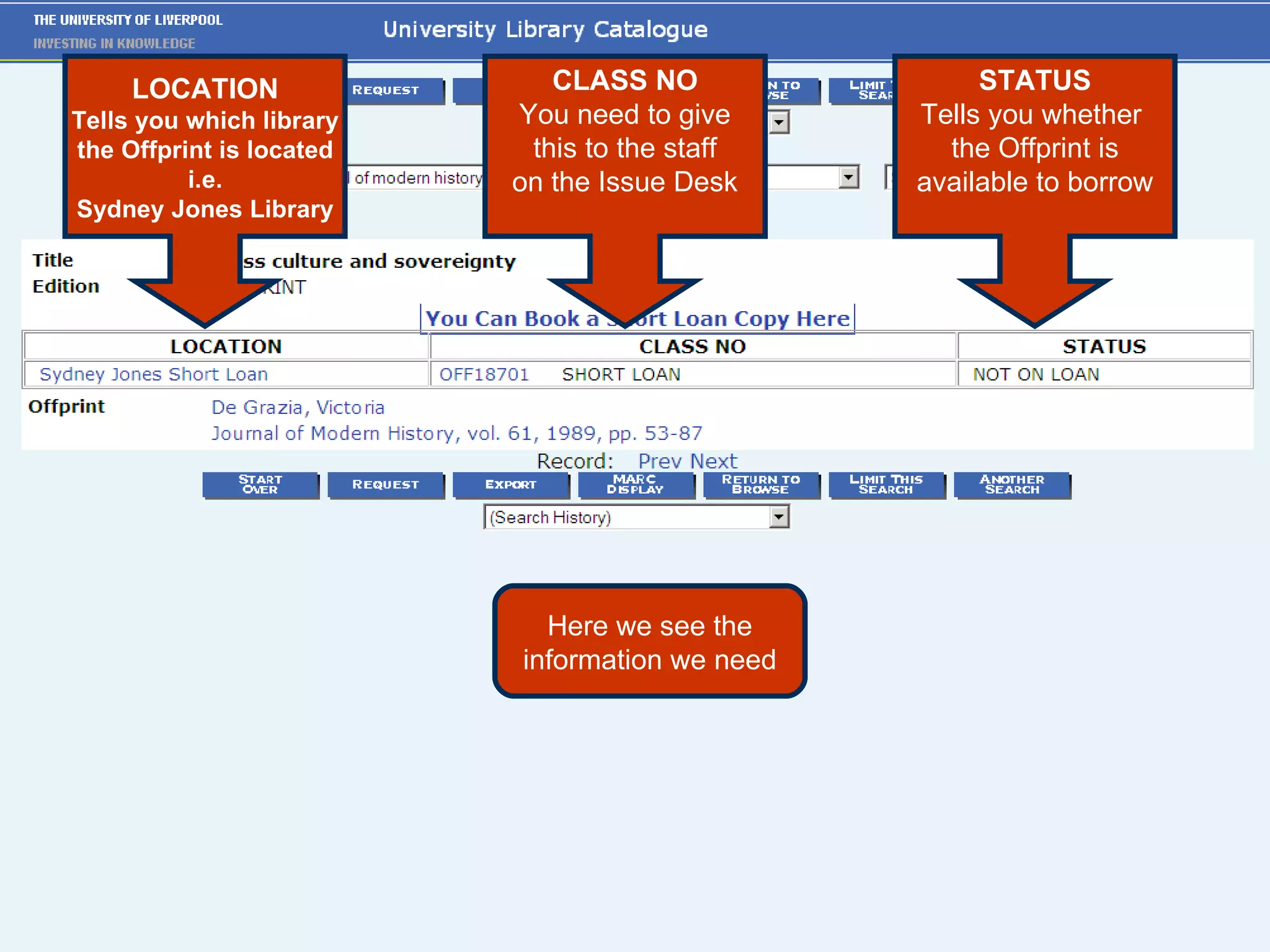
Here we see the information we need LOCATION Tells you which library the Offprint is located i.e. Sydney Jones Library CLASS NO You need to give this to the staff on the Issue Desk STATUS Tells you whether  the Offprint is available to borrow
How can I view and manage MY LIBRARY RECORD?
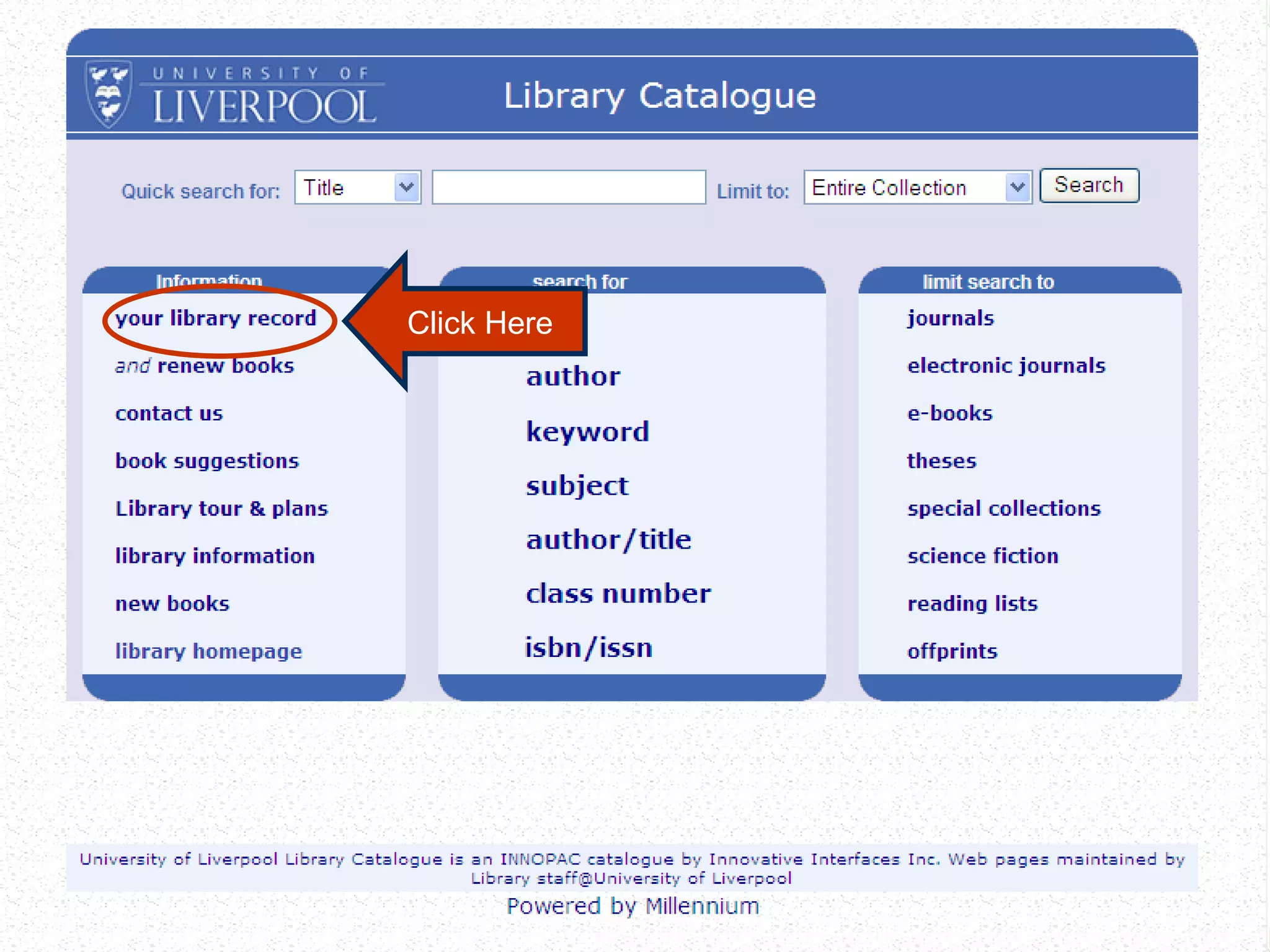
Click Here
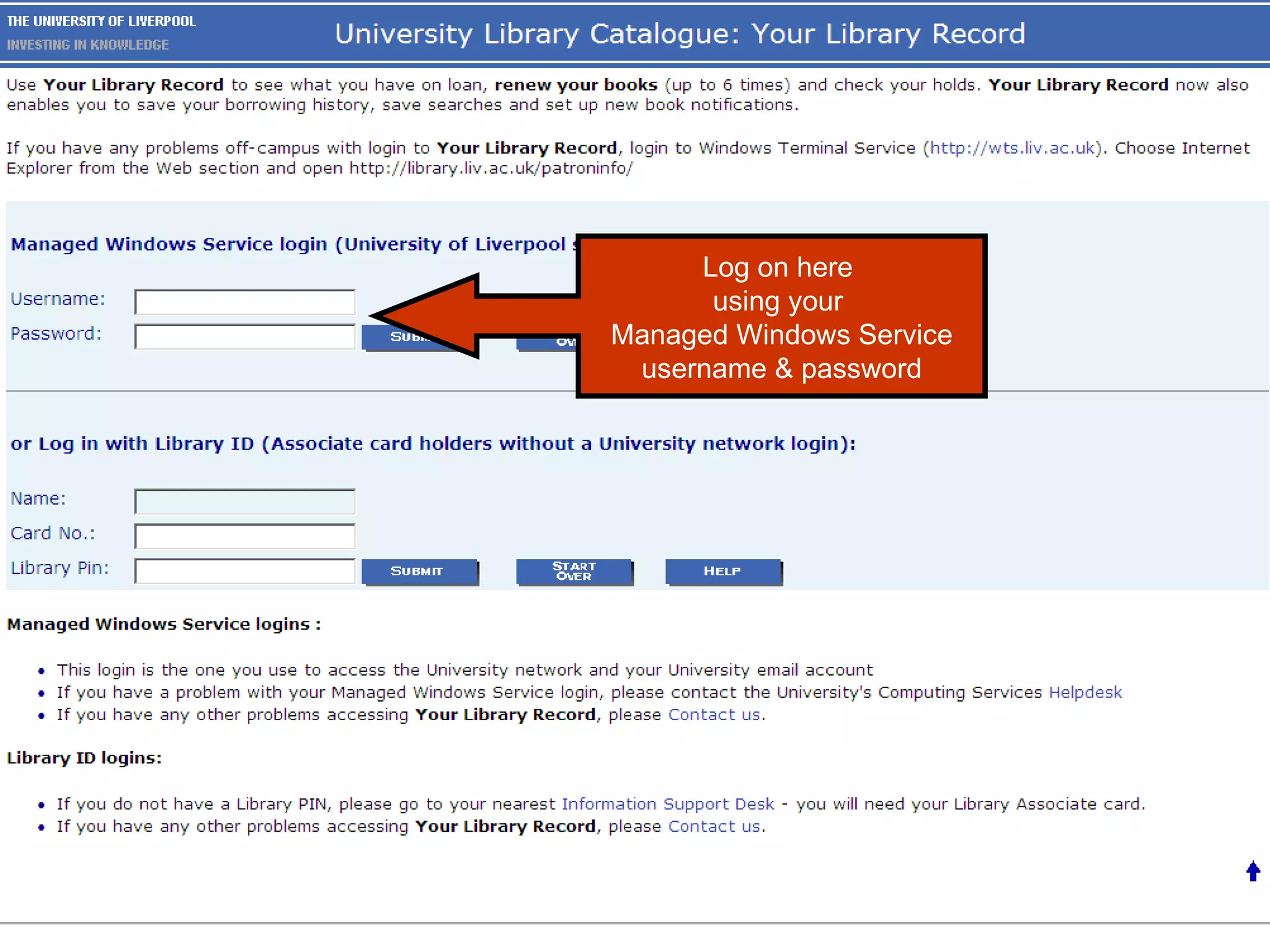
Log on here  using your  Managed Windows Service username & password
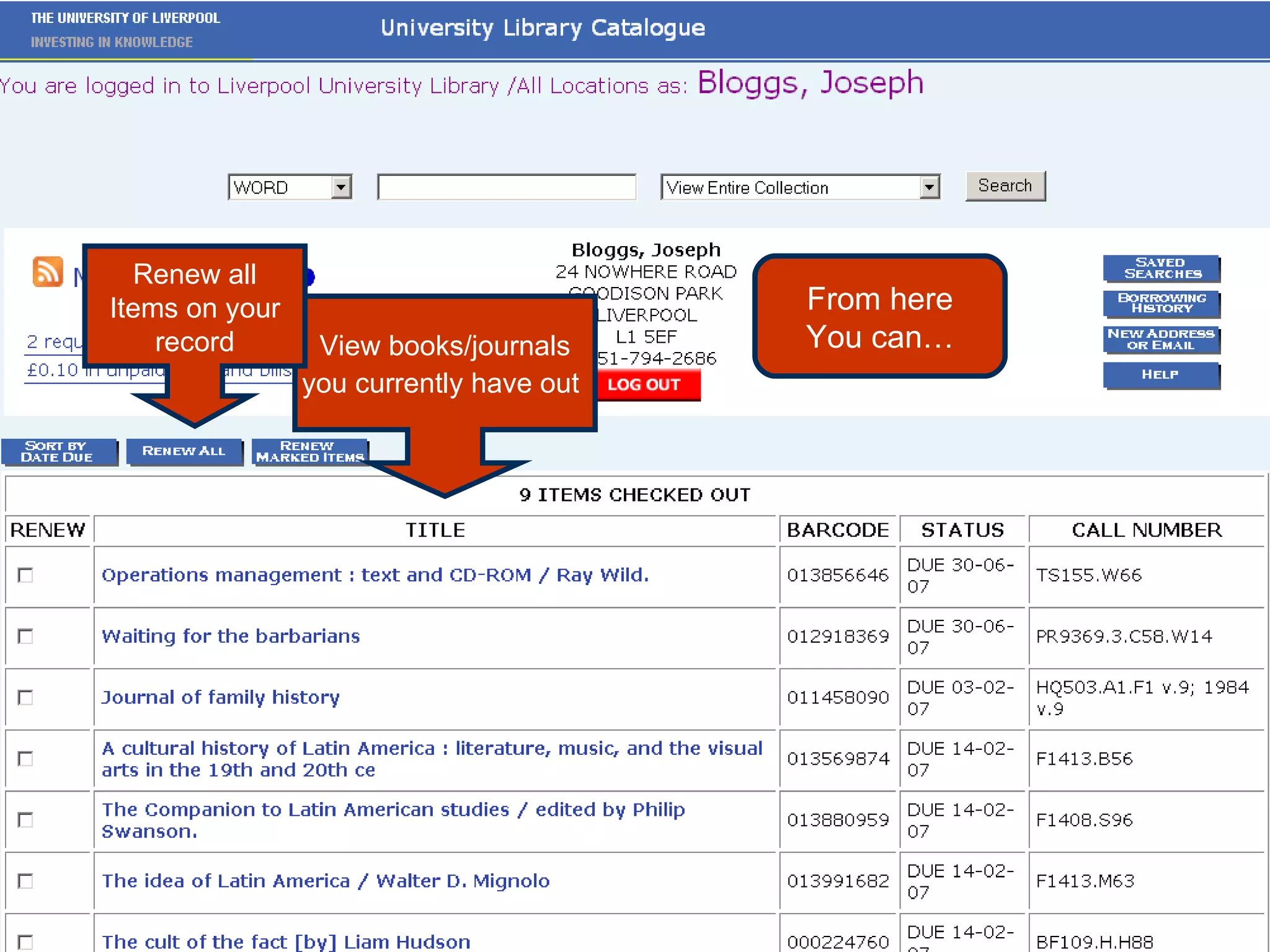
View books/journals you currently have out   From here You can… Renew all Items on your record
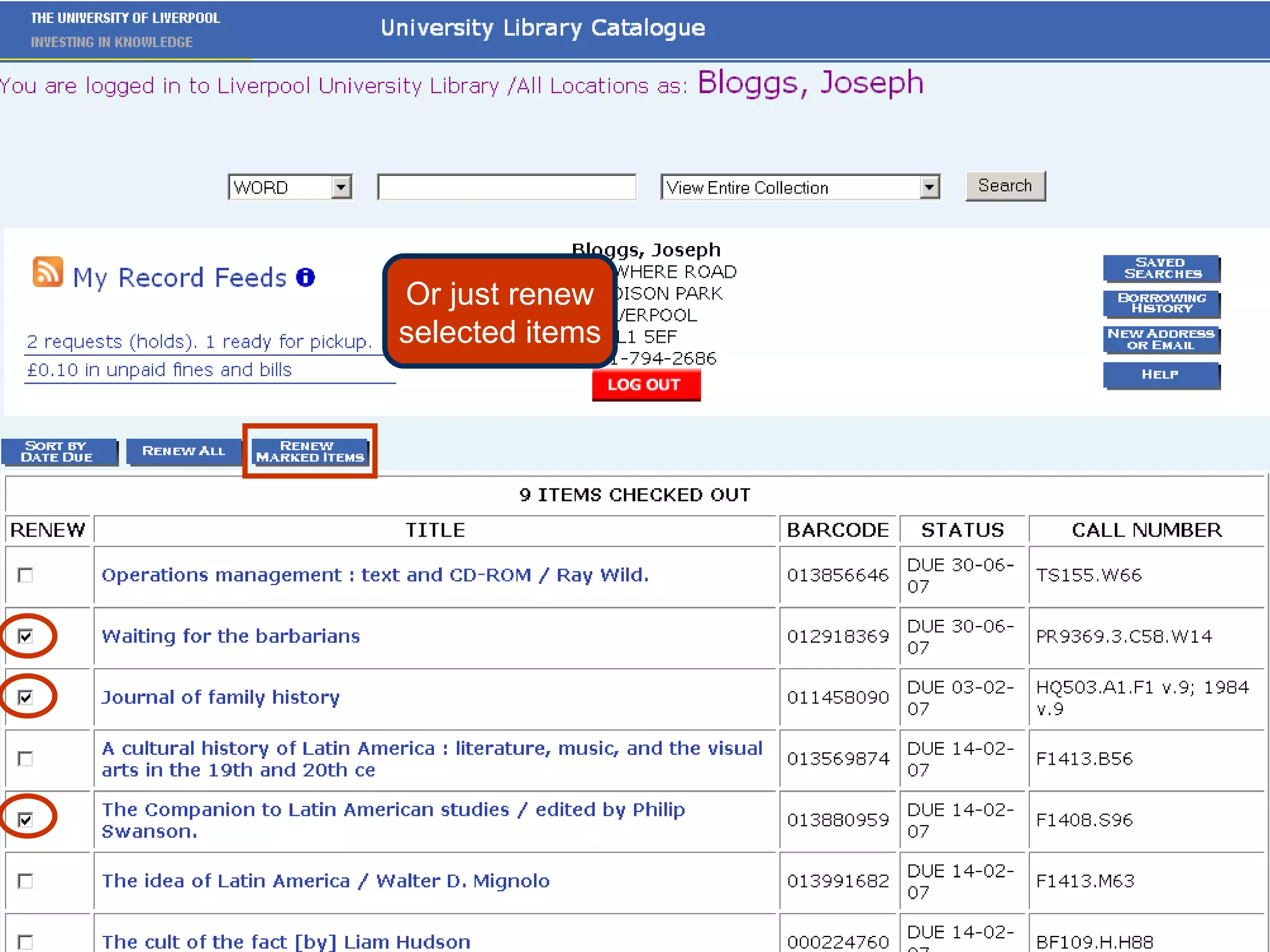
Or just renew selected items
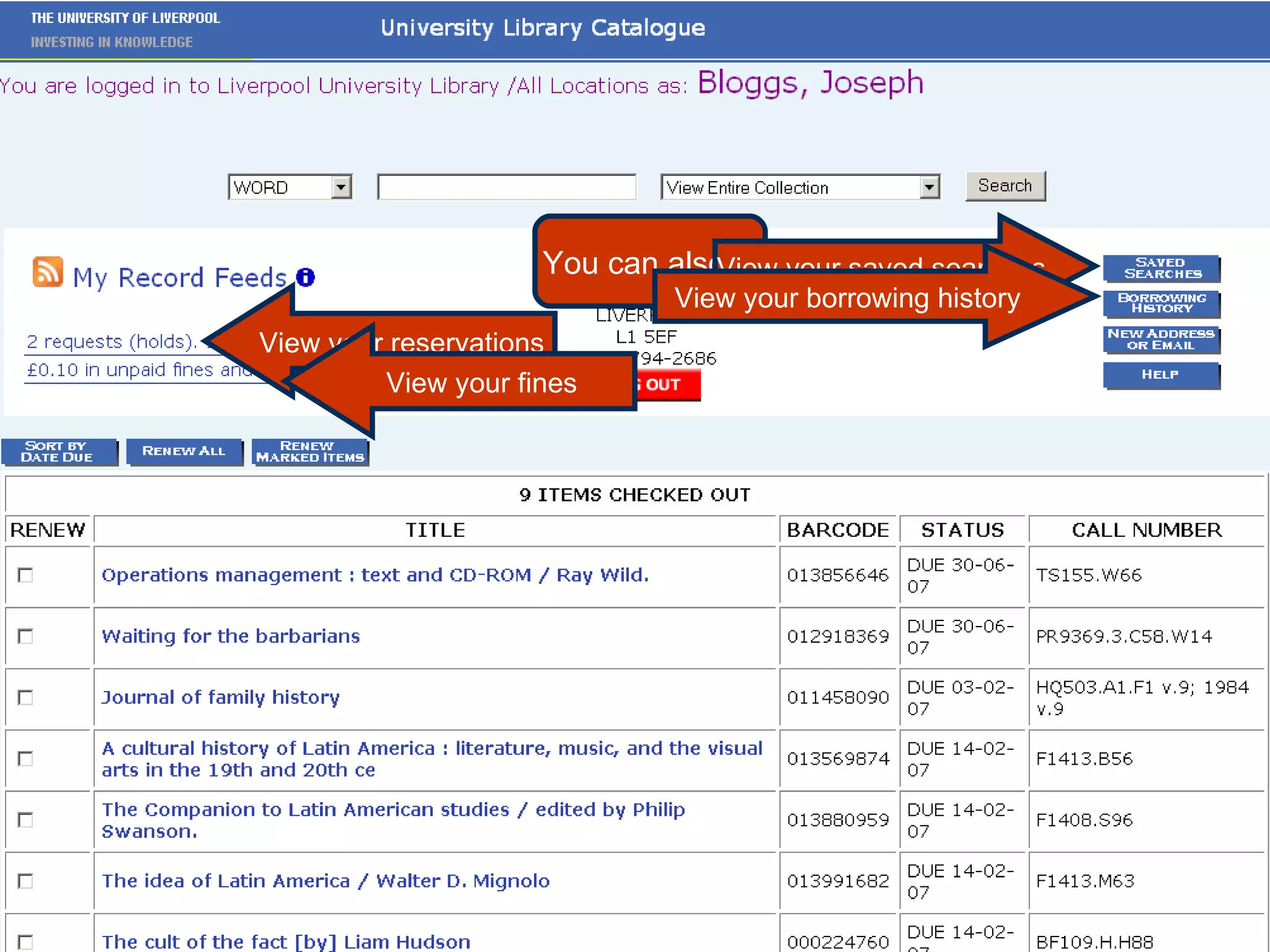
You can also… View your reservations View your fines View your saved searches View your borrowing history
 
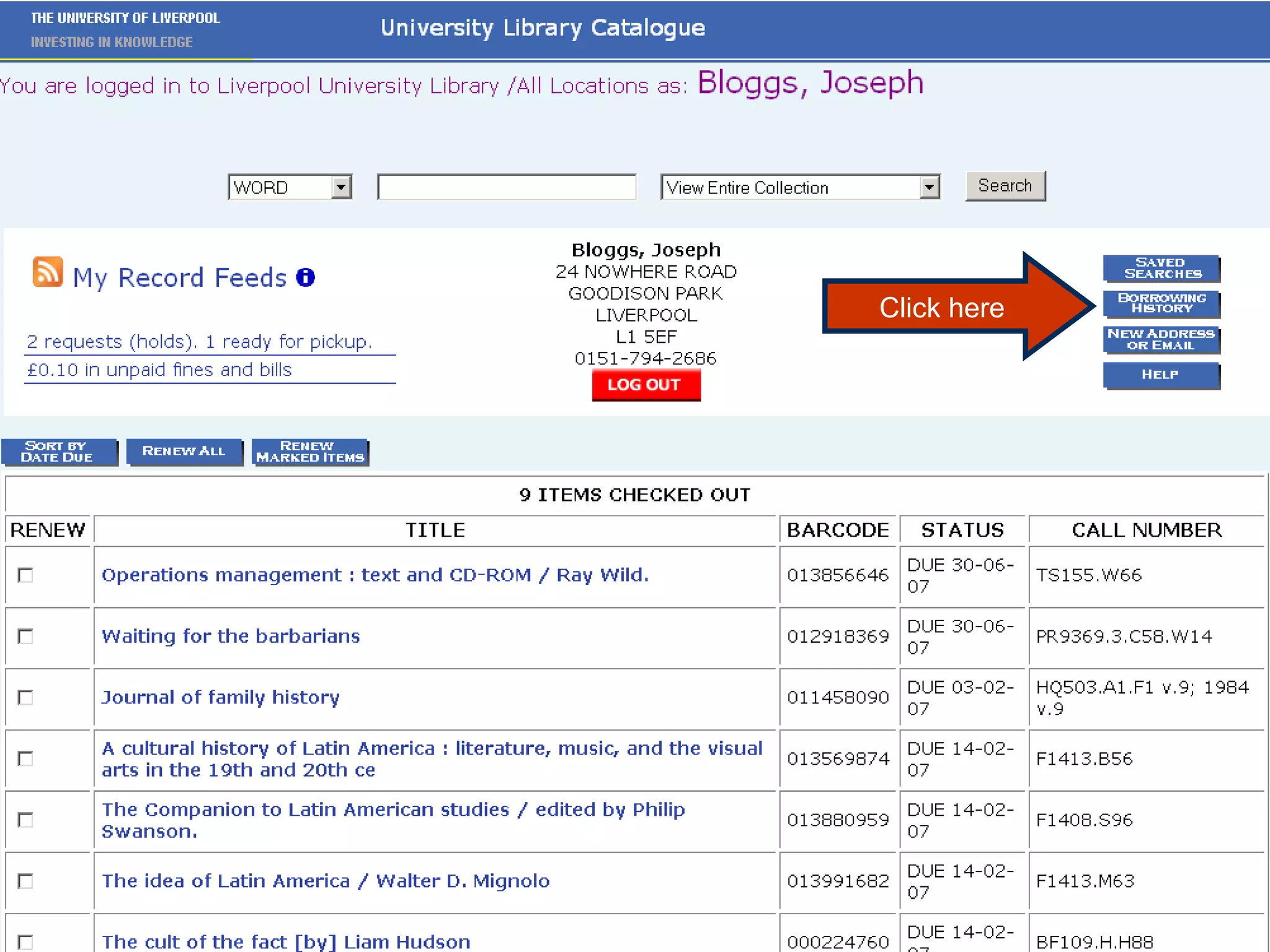
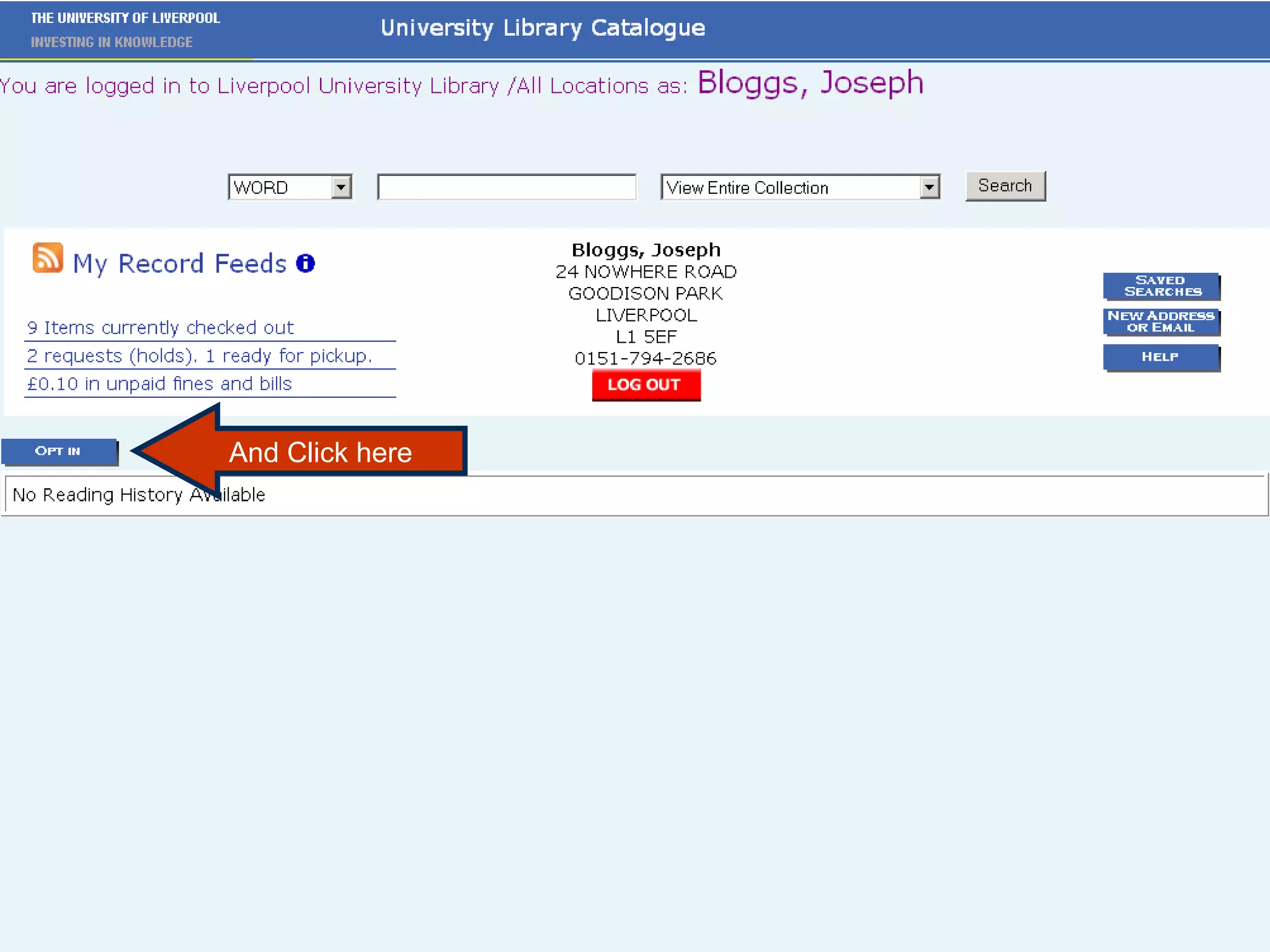
To view   your borrowing history You first need to   ‘ Opt In’ Here’s how to do it:
Click here
And Click here
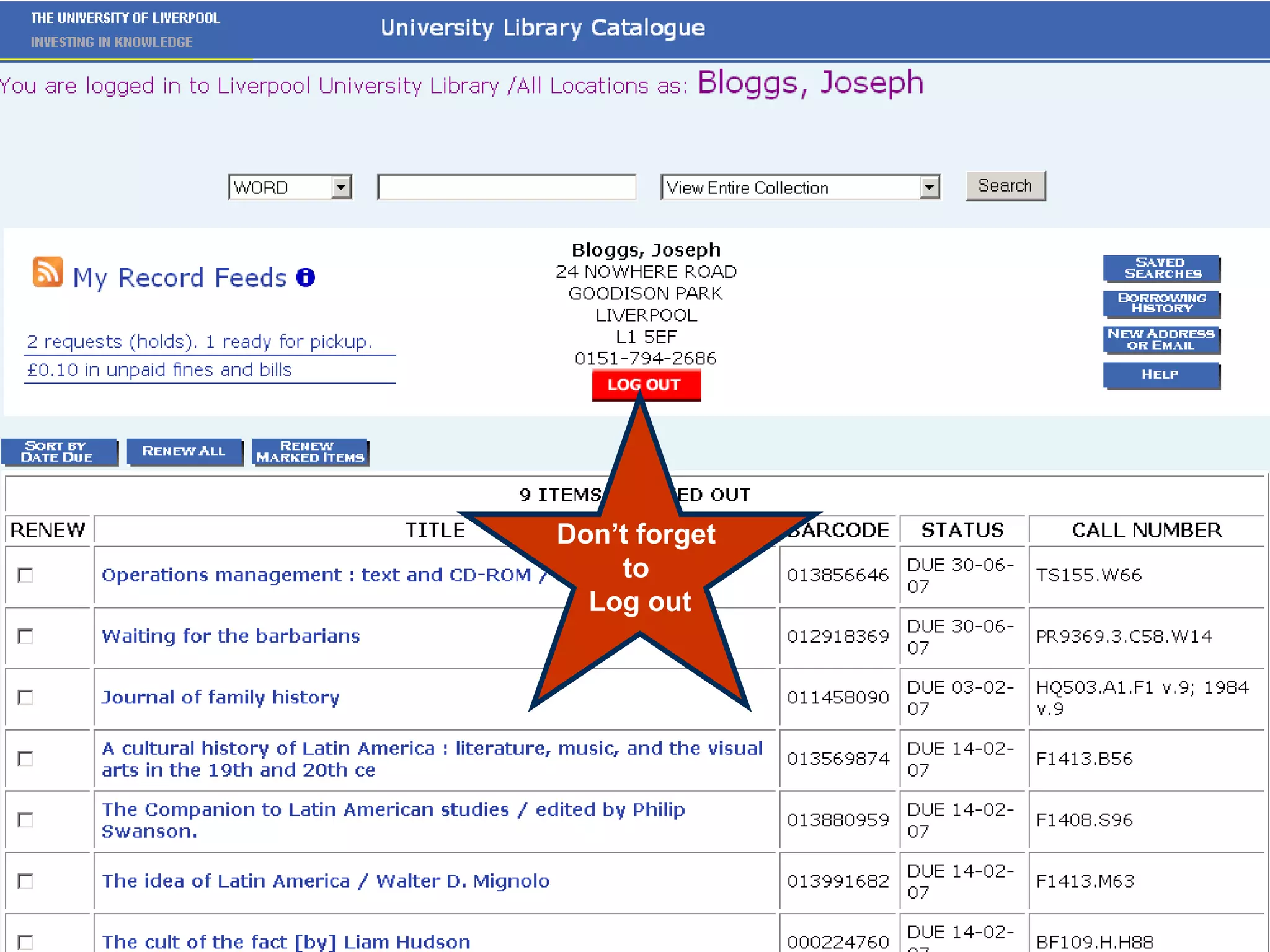
Don’t forget  to  Log out
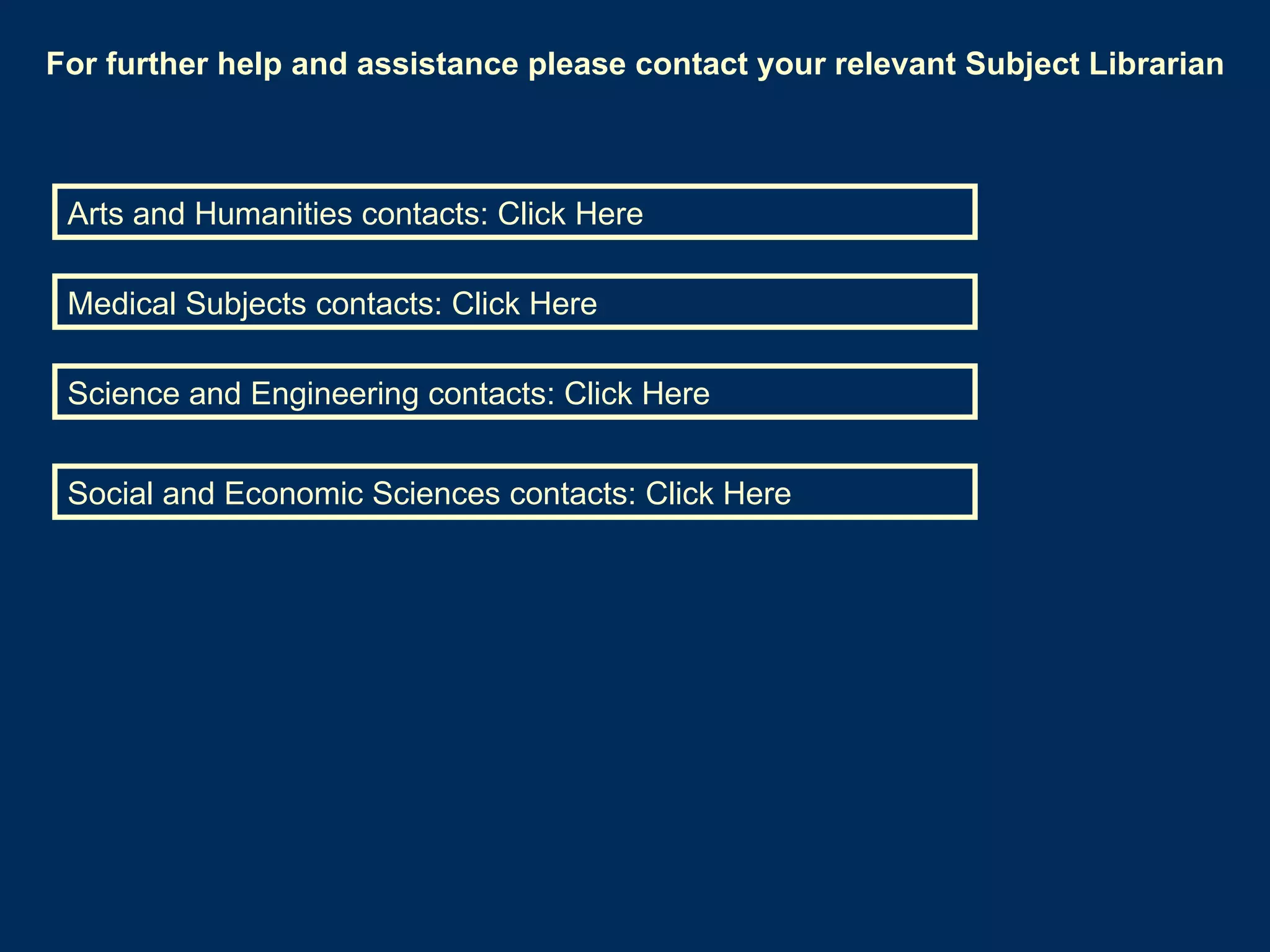
For further help and assistance please contact your relevant Subject Librarian Arts and Humanities contacts: Click Here Social and Economic Sciences contacts: Click Here Science and Engineering contacts: Click Here Medical Subjects contacts: Click Here
Library Contacts for Arts & Humanities   Martin Wolf, Arts Librarian   Martin Wolf is Arts Librarian. Contact Martin (email:  [email_address] ; phone: 0151-794-2684)  for Faculty related Library matters. Martin is subject librarian for History and Archaeology, Classics and Egyptology ,  dealing with subject enquiries, information skills training, integrating resources into VITAL,  book fund balances,  book orders and reading lists in those subject areas. Jackie Pearce, Subject Librarian   Phone: 0151-794-2686  E-mail  [email_address]   Jackie is subject librarian for the School of Music, the Department of Philosophy,  the Institute of Irish Studies and the Institute of Latin American Studies,  dealing with subject enquiries, information skills training, integrating resources into VITAL,  bookfund balances, book orders and reading lists in those subject areas.  Joe Hilton, Acting Subject Librarian   Phone: 0151-794-2686  E-mail  [email_address]   Joe is the acting subject librarian for the School of English and  the School of Modern Languages, dealing with subject enquiries, information skills training,  integrating resources into VITAL, bookfund balances, book orders and reading lists in those subject areas.  Micaela Chandler, Subject Librarian   Phone: 0151-794-2686Micaela is currently on maternity leave.  No picture available No picture available
Library Contacts for Medical Subjects   Penny Street, Faculty Librarian   Phone: 0151-794-5418  Email:  [email_address]   Contact Penny for faculty-related Library matters and any Library issues including  information skills training, book fund balances, book orders, integrating resources into Vital,  and reading lists, relating to  School of Clinical Sciences  School of Cancer Studies  School of Infection Control and Host Defence  School of Reproductive and Developmental Medicine  Zoe Gibbs-Monaghan, Subject Librarian   Phone: 0151-794-5407  Email:  [email_address]   Contact Zoe for Library matters including information skills training, book fund balances,  book orders, integrating resources into Vital, and reading lists, relating to  School of Health Sciences  School of Population, Community and Behavioural Sciences  Ken Linkman, Subject Librarian  Phone: 0151-794-4366  Email:  [email_address]   Contact Ken for Library matters including information skills training, book fund balances,  book orders, integrating resources into Vital, and reading lists, relating to  School of Biomedical Sciences  School of Dental Sciences  School of Medical Education
Library Contacts for Science & Engineering   Carole Rhodes, Engineering Faculty Librarian   Phone: 0151-794-5409  Email:  [email_address]   Contact Carole for Faculty-related Library matters, also any Library issues including  information skills training, book fund balances, book orders, integrating resources into VITAL  and reading lists, relating to  Department of Engineering (covers Aerospace Engineering, Civil Engineering, Design & Manufacturing, Materials Science and Mechanical Engineering)  Carole's normal hours of work are Monday, Tuesday and Wednesday. Zelda Chatten, Subject Librarian   Phone: 0151-794-4343  Email:  [email_address]   Contact Zelda for Library matters including information skills training, book fund balances,  book orders, integrating resources into VITAL and reading lists, relating to  Computer Science Electrical Engineering and Electronics Maths Physics David Clay, Subject Librarian  Phone: 0151-794-3643  Email:  [email_address]   Contact David for Library matters including information skills training, book fund balances,  book orders, integrating resources into VITAL and reading lists, relating to  Psychology Clair Sharpe, Subject Librarian   Phone: 0151-794-5410  Email:  [email_address]   Contact Clair for Library matters including information skills training, book fund balances,  book orders, integrating resources into VITAL and reading lists, relating to  Biological Sciences Chemistry Earth Sciences
Library Contacts for Social and Environmental Studies Linda Crane  Phone: 0151-794-3284/3642  E-mail  [email_address]   Contact Linda for Library matters relating to the School of Politics & Communication Studies, including information skills training, integrating resources into VITAL, bookfund balances, book orders and reading lists.                         Joyce Raynor  Phone: 0151-794-2691  E-mail  [email_address]   Contact Joyce for Library matters relating the School of Architecture, the Department of Civic Design and the Department of Geography, including information skills training, integrating resources into VITAL, book fund balances, book orders and reading lists.   Lisa Bryce, SES Librarian   Phone: 0151-794-2683  E-mail  [email_address]   Contact Lisa for Faculty related Library matters and any Library issues relating  to the Management School  and the School of Sociology & Social Policy,  including information skills training, integrating resources into VITAL,  book fund balances,  book orders and reading lists.
Thank you

Catdemo

  • 1.
  • 2.
    So, how canI use the Library Catalogue effectively? On the left of the screen there is a list of contents. You can either go through the whole presentation or you can just choose to view the parts you require. You can also STOP or PAUSE the presentation at any time using the controls below
  • 3.
    How do youget to the Library Catalogue? http:// www.liv.ac.uk /library/ Go to….
  • 4.
  • 5.
    The Main CataloguePage is divided into 3 sections Information & Guides Various Search fields Search limiters
  • 6.
    There is alsoa ‘Quick search’ facility you can use
  • 7.
    Keyword searching Using the Library Catalogue
  • 8.
  • 9.
    Scroll down thepage for more information and search tips
  • 10.
    Here you cansee examples of how to refine your search
  • 11.
    Boolean logic consistsof three logical operators: OR 2. AND 3. NOT
  • 12.
    The OR operator broadens or widens a search to include documents containing either keyword. The OR search is particularly useful when there are several common synonyms for a concept or variant spellings of a word . OR
  • 13.
    Query:    I wouldlike information about college. In this search, we will retrieve records in which AT LEAST ONE of the search terms is present. We are searching on the terms college and also university since documents containing either of these words might be relevant. College OR University This is illustrated by:
  • 14.
    College University Theshaded circle with the word college representing all the records that contain the word "college" The shaded circle with the word university representing all the records that contain the word "university" The shaded overlap area representing all the records that contain both "college" and "university"
  • 15.
    The operator AND narrows a search by combining terms and retrieves every document that contains both of the words specified. AND
  • 16.
    Query:    I'minterested in the relationship between poverty and crime. In this search, we retrieve records in which BOTH of the search terms are present Poverty AND Crime This is illustrated by:
  • 17.
    The shaded areaoverlapping the two circles representing all the records that contain both the word "poverty" and the word "crime" Notice how we do not retrieve any records with only "poverty" or only "crime" Poverty Crime
  • 18.
    Combining search termswith the NOT operator narrows a search by excluding unwanted terms. NOT
  • 19.
    Query:     I want information about cats, but I want to avoid anything about dogs. Cats NOT Dogs In this search, we retrieve records in which ONLY ONE of the terms is present This is illustrated by:
  • 20.
    The shaded areawith the word cats representing all the records containing the word "cats" No records are retrieved in which the word "dogs" appears, even if the word "cats" appears there too Cats Dogs
  • 21.
    Using Brackets (parentheses)in searches with more than one Boolean operator. Parentheses indicate relationships between search terms. They force the computer to process your search terms in the order you intend and to combine them in the way you want.
  • 22.
    Computer search orderA database or search engine processes your search terms from left to right. But it processes all the Boolean AND operators BEFORE processing any Boolean OR operators. To change this order, group synonyms (or terms that belong together) with brackets. Anything enclosed in brackets is evaluated first. To see how this works, compare the two hypothetical library catalogue searches on the next slide:
  • 23.
    Of course, youcan use more than one OR in a search, as in: (tobacco OR smoking) AND (cancer OR health) Retrieves about 230 items Combines Catholic or Protestant "AND" those results with ireland This is exactly what you wanted (Catholic OR Protestant) AND Ireland Retrieves about 2500 items Combines Protestant and Ireland Retrieves all books about catholic This is not what you wanted Catholic OR protestant AND Ireland
  • 24.
    Keep in mindthat the operators AND and NOT generally limit your search (decreases the number of hits). The operator OR expands it (increases the number of hits). So the following strategies naturally follow: If you are retrieving too many records on your topic, try adding another search term with the Operator AND If you are retrieving too many records on an unrelated topic , try eliminating a word with the Operator NOT If you are retrieving too few records on your topic, try adding another search term with the Operator OR
  • 25.
    A symbol atthe end of a word stem provides for all variants on the word stem. The most commonly used symbol is the asterisk (*) For example, a search for educat* will retrieve educate, educating, education, educational, educator, educators, etc. Truncation or Wildcards
  • 26.
    A symbol withina word provides for all possible variants inside a word or word stem. The most commonly used symbols for Wildcards are: # ? . For example , a search for wom#n will retrieve woman and women Another example Globali?ation will retrieve Globalisation and Globalization Wildcards
  • 27.
    Type in herewhat you want to search for From the drop down menu choose where you want to search i.e. Entire Collection, Theses etc
  • 28.
    Let’s do asearch for books containing the words Excavations and Jericho in their title Type in your search terms Here and click Submit
  • 29.
    The results listdisplays all the items that match the search and places them in order of relevance Contents Page
  • 30.
    Click on theTitle link for more information
  • 31.
    LOCATION Tells youwhere to find the book. i.e. Sydney Jones Library Here you can see more information about the book CLASS NO Tells you where in the Library to look STATUS Tells you whether the book is available to borrow
  • 32.
    So the bookwe have just viewed with the CLASS NO DS110.J4.M31 will be located HERE
  • 33.
    Using the Title search Facility
  • 34.
  • 35.
    Let’s search fora book titled ‘ Neolithic chipped stone industries of the Fertile Crescent’ Type in your search terms Here and click Search
  • 36.
    Here you cansee more information about the book LOCATION Tells you where to find the book. i.e. Sydney Jones Library CLASS NO Tells you where in the Library to look STATUS Tells you whether the book is available to borrow
  • 37.
    So the bookwe have just viewed with the CLASS NO CC79.5.F .G29 will be located HERE
  • 38.
    Using the Author search Facility
  • 39.
  • 40.
    NOTE’ See howwe enter the Surname first Followed by either the Initial or first name
  • 41.
    We are goingto search for an author called John Wyon Burrow Using the search terms burrow j
  • 42.
    We have 3authors who match our search criteria Click on Extended Display for more information
  • 43.
    The John WyonBurrow we are looking for is Here Click on the Title link for more information
  • 44.
    LOCATION Tells youwhere to find the book. i.e. Sydney Jones Library CLASS NO Tells you where in the Library to look STATUS Tells you whether the book is available to borrow Here you can see more information about the book
  • 45.
    So the bookwe have just viewed with the CLASS NO CB204.B97 will be located HERE
  • 46.
    Using the Author/Title search Facility Contents Page
  • 47.
  • 48.
    Let’s search fora book by Peter Warren about the Aegean Bronze age See the examples of how to use this facility Type in your search terms here and click Submit
  • 49.
    The search takesus to this book by Peter Warren and gives us the details we need LOCATION Tells you where to find the book. i.e. Sydney Jones Library CLASS NO Tells you where in the Library to look STATUS Tells you whether the book is available to borrow
  • 50.
    So the bookwe have just viewed with the CLASS NO DF220.W29 will be located HERE
  • 51.
    Searching for Journals Using the Library Catalogue
  • 52.
  • 53.
    You can searchusing any of these search fields Or use the Quick Search facility
  • 54.
    We will lookfor Oxford journal of archaeology using the Quick search facility
  • 55.
    Print Copy ElectronicClick on the title links to get more information From here we can see that we can get this journal in 2 formats
  • 56.
    Click here toview all the volumes held Here you can see what volumes/years are held and the latest volume received
  • 57.
    We can seemore volumes here and their LOCATION CLASS NO STATUS Scroll down the page for more information
  • 58.
    NOTE’ See howsome volumes of this journal are to be found in different locations
  • 59.
    Let’s have alook at the Electronic version of this journal
  • 60.
    Click on thelink To access the Electronic version From here we can see subscription details and methods of access
  • 61.
    On campus usersClick Here to access the journal online
  • 62.
    From here youcan search all the available Electronic volumes
  • 63.
    Off campus usersClick Here first
  • 64.
    Log on here using your Managed Windows Service username & password The Athens Login window opens
  • 65.
    This window opensconfirming you are logged into Athens Click here to MINIMIZE the Athens Window
  • 66.
    NOW Click hereto access the journal online
  • 67.
  • 68.
    E-Books are: Electronic versions of titles. They are searchable through the library catalogue in the same way as print versions can be located. To view an e-book you first need to download and install ‘ ebrary reader’ Let’s look at how this can be done
  • 69.
    We will lookfor a book titled Archaeology: the basics using the Quick search facility
  • 70.
    We can seehere that 3 versions of this title are available Click on the electronic version
  • 71.
    Click on the ebrary Reader link
  • 72.
    There are 2ways to install ebrary Reader. Which one you use depends if you are on or off Campus
  • 73.
    On Campus usersClick on Start
  • 74.
    Go to Install Go to Viewers Then click on Ebrary Reader to complete the installation
  • 75.
    Off Campus usersclick here
  • 76.
    Click the linkto install the ebrary Reader
  • 77.
    you should seethis screen Contents Page
  • 78.
    Return to thispage and click the link to view the book
  • 79.
    You can scrollthrough the pages or change the view by using the tools on the toolbar
  • 80.
  • 81.
    If the bookyou require is currently issued to another reader you can reserve or recall it by using one of the following methods .
  • 82.
    Click on the Request button
  • 83.
    Log on here using your Managed Windows Service username & password NOTE. See the details here indicating the book will only be reserved, NOT recalled
  • 84.
    This screen showsthat your request was successful. You will usually receive an e-mail when the book becomes available. Reserved books will only be held for you for 7 days from the day they are received
  • 85.
    To recall abook you need to complete a RESERVATION CARD . These are available from the Information Support desk and the Issue desk Complete the card and hand in at any desk or place in one of available boxes. Reservation cards are collected and processed every morning Monday - Friday
  • 86.
    Reading Lists? Whereto find them. & How to use them.
  • 87.
    ‘ Reading listssave you so much time because they list all of your Lecturers recommended reading in one place. In other words, YOU don’t have to trawl through the catalogue’ Anon 2006
  • 88.
  • 89.
    You can searchreading lists by either, Lecturers Name Course Code
  • 90.
    Let’s do asearch for the course module Methods of Archaeology The course code is Algy101
  • 91.
    From here wecan see information about, The Lecturer Course title and when the course is run There are instructions of how to use the reading list
  • 92.
    Contents Page Clickon a title link to get more information
  • 93.
    We can seeall the information we need here. LOCATION Tells you where to find the book. i.e. Sydney Jones Library CLASS NO Tells you where in the Library to look STATUS Tells you whether the book is available to borrow Click on Regular Display To return to the reading list
  • 94.
    Offprints. What arethey? & How do you find them?
  • 95.
    Offprints are… photocopiesof journal articles, chapters from books, 'missing pages' from items in stock. Many of them are recommended reading for a course or courses.
  • 96.
    Offprints are onlyavailable from the relevant library Issue Desks. Offprints are only available to borrow for the standard short loan period.
  • 97.
  • 98.
    From this pageyou can search for Offprints using only the Authors name or, the Journal or Book title
  • 99.
    Let’s do asearch for Offprints that have been taken from the Journal of Modern History
  • 100.
    This search willprovide us with a list of every Offprint taken from The Journal of Modern History Click on title link for more information
  • 101.
    Here we seethe information we need LOCATION Tells you which library the Offprint is located i.e. Sydney Jones Library CLASS NO You need to give this to the staff on the Issue Desk STATUS Tells you whether the Offprint is available to borrow
  • 102.
    How can Iview and manage MY LIBRARY RECORD?
  • 103.
  • 104.
    Log on here using your Managed Windows Service username & password
  • 105.
    View books/journals youcurrently have out From here You can… Renew all Items on your record
  • 106.
    Or just renewselected items
  • 107.
    You can also…View your reservations View your fines View your saved searches View your borrowing history
  • 108.
  • 109.
    To view your borrowing history You first need to ‘ Opt In’ Here’s how to do it:
  • 110.
  • 111.
  • 112.
    Don’t forget to Log out
  • 113.
    For further helpand assistance please contact your relevant Subject Librarian Arts and Humanities contacts: Click Here Social and Economic Sciences contacts: Click Here Science and Engineering contacts: Click Here Medical Subjects contacts: Click Here
  • 114.
    Library Contacts forArts & Humanities Martin Wolf, Arts Librarian Martin Wolf is Arts Librarian. Contact Martin (email: [email_address] ; phone: 0151-794-2684) for Faculty related Library matters. Martin is subject librarian for History and Archaeology, Classics and Egyptology , dealing with subject enquiries, information skills training, integrating resources into VITAL, book fund balances, book orders and reading lists in those subject areas. Jackie Pearce, Subject Librarian Phone: 0151-794-2686 E-mail [email_address] Jackie is subject librarian for the School of Music, the Department of Philosophy, the Institute of Irish Studies and the Institute of Latin American Studies, dealing with subject enquiries, information skills training, integrating resources into VITAL, bookfund balances, book orders and reading lists in those subject areas. Joe Hilton, Acting Subject Librarian Phone: 0151-794-2686 E-mail [email_address] Joe is the acting subject librarian for the School of English and the School of Modern Languages, dealing with subject enquiries, information skills training, integrating resources into VITAL, bookfund balances, book orders and reading lists in those subject areas. Micaela Chandler, Subject Librarian Phone: 0151-794-2686Micaela is currently on maternity leave. No picture available No picture available
  • 115.
    Library Contacts forMedical Subjects Penny Street, Faculty Librarian Phone: 0151-794-5418 Email: [email_address] Contact Penny for faculty-related Library matters and any Library issues including information skills training, book fund balances, book orders, integrating resources into Vital, and reading lists, relating to School of Clinical Sciences School of Cancer Studies School of Infection Control and Host Defence School of Reproductive and Developmental Medicine Zoe Gibbs-Monaghan, Subject Librarian Phone: 0151-794-5407 Email: [email_address] Contact Zoe for Library matters including information skills training, book fund balances, book orders, integrating resources into Vital, and reading lists, relating to School of Health Sciences School of Population, Community and Behavioural Sciences Ken Linkman, Subject Librarian Phone: 0151-794-4366 Email: [email_address] Contact Ken for Library matters including information skills training, book fund balances, book orders, integrating resources into Vital, and reading lists, relating to School of Biomedical Sciences School of Dental Sciences School of Medical Education
  • 116.
    Library Contacts forScience & Engineering Carole Rhodes, Engineering Faculty Librarian Phone: 0151-794-5409 Email: [email_address] Contact Carole for Faculty-related Library matters, also any Library issues including information skills training, book fund balances, book orders, integrating resources into VITAL and reading lists, relating to Department of Engineering (covers Aerospace Engineering, Civil Engineering, Design & Manufacturing, Materials Science and Mechanical Engineering) Carole's normal hours of work are Monday, Tuesday and Wednesday. Zelda Chatten, Subject Librarian Phone: 0151-794-4343 Email: [email_address] Contact Zelda for Library matters including information skills training, book fund balances, book orders, integrating resources into VITAL and reading lists, relating to Computer Science Electrical Engineering and Electronics Maths Physics David Clay, Subject Librarian Phone: 0151-794-3643 Email: [email_address] Contact David for Library matters including information skills training, book fund balances, book orders, integrating resources into VITAL and reading lists, relating to Psychology Clair Sharpe, Subject Librarian Phone: 0151-794-5410 Email: [email_address] Contact Clair for Library matters including information skills training, book fund balances, book orders, integrating resources into VITAL and reading lists, relating to Biological Sciences Chemistry Earth Sciences
  • 117.
    Library Contacts forSocial and Environmental Studies Linda Crane Phone: 0151-794-3284/3642 E-mail [email_address] Contact Linda for Library matters relating to the School of Politics & Communication Studies, including information skills training, integrating resources into VITAL, bookfund balances, book orders and reading lists.                       Joyce Raynor Phone: 0151-794-2691 E-mail [email_address] Contact Joyce for Library matters relating the School of Architecture, the Department of Civic Design and the Department of Geography, including information skills training, integrating resources into VITAL, book fund balances, book orders and reading lists. Lisa Bryce, SES Librarian Phone: 0151-794-2683 E-mail [email_address] Contact Lisa for Faculty related Library matters and any Library issues relating to the Management School and the School of Sociology & Social Policy, including information skills training, integrating resources into VITAL, book fund balances, book orders and reading lists.
  • 118.