www.contentteam.com
1
Cassandra User Group Cologne
19:00 - Reception
19:20 - Cassandra libraries for Java developers

DuyHai Doan, Cassandra Evangelist at DataStax
20:20 - Apache Cassandra 3.0
Robert Stupp, Committer to Apache Cassandra, CIO contentteam AG
21:00 - Finish & Networking
WELCOME !
www.contentteam.com
2
APACHE CASSANDRA 3.0
CASSANDRA USER GROUP COLOGNE
24.03.2015
www.contentteam.com
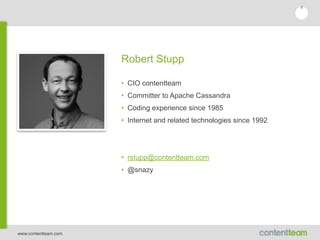
Robert Stupp

• CIO contentteam
• Committer to Apache Cassandra
• Coding experience since 1985
• Internet and related technologies since 1992
• rstupp@contentteam.com
• @snazy
4
www.contentteam.com
&

contentteam is a DataStax Solutions Partner
contentteam is active in Apache Cassandra community
5
www.contentteam.com
AGENDA
1.Cassandra history (short)
2.Cassandra 3.0
3.Cassandra community
4.Apache Cassandra vs.
DataStax Enterprise
5.One more thing :)
6
www.contentteam.com
APACHE CASSANDRA
HISTORY
7
www.contentteam.com
CASSANDRA HISTORY
• Initially developed at Facebook to

build a ”continuously available” database
• Replication
• Globally distributed
• Masterless architecture
• Influenced by BigTable and Dynamo
• Today:

Huge amount of working installation -

few nodes up to 1000+ globally distributed nodes
8
www.contentteam.com
CASSANDRA HISTORY
• Open sourced in 2008
• Version 0.3 - July 2009
• Version 0.6 - June 2010
• Version 0.7 - 2011
• Version 1.0 - October 2011 - introduction of DSE
• Version 1.2 - December 2012
• Version 2.0 - August 2013
• Version 2.1 - September 2014
9
www.contentteam.com
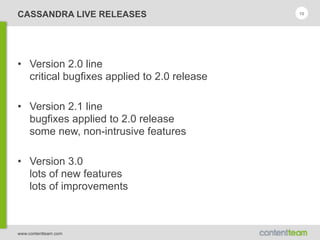
CASSANDRA LIVE RELEASES
• Version 2.0 line

critical bugfixes applied to 2.0 release
• Version 2.1 line

bugfixes applied to 2.0 release

some new, non-intrusive features
• Version 3.0

lots of new features

lots of improvements
10
www.contentteam.com
APACHE CASSANDRA
3.0
11
www.contentteam.com
CASSANDRA 3.0
DISCLAIMER
• Apache Cassandra 3.0 is still in development
• Features might be changed / revoked until 3.0 release
12
www.contentteam.com
CASSANDRA 3.0
RELEASE DATE
• Apache Cassandra 3.0 will be released

when it is finished
• Don’t ask for a release date - we don’t know it yet ;)
13
www.contentteam.com
CASSANDRA 3.0

FEATURES
14
www.contentteam.com
CASSANDRA 3.0 NEW FEATURES SUMMARY
• JSON support
• User-Defined-Functions + User-Defined-Aggregates
• Role based access control
• New row cache
• Lots of (small) performance improvements

summing up to a huge improvement
• Altogether approx >100 tickets for 3.0
• Plus changes merged from 2.0 via 2.1 to 3.0

and 2.1 to 3.0
15
www.contentteam.com
CASSANDRA 3.0 REMOVED FEATURES
• cassandra-cli is removed (as announced)
16
www.contentteam.com
CASSANDRA 3.0
JSON Support
17
www.contentteam.com
JSON SUPPORT
• Allows you to do INSERT and SELECT data using JSON
data format
• Format your data to insert using JSON - can save a step
to transform data
• Ease web application development -

less transformation to/from Cassandra to the browser
• Also nice when using NodeJS
18
www.contentteam.com
JSON SUPPORT - EXAMPLE
CREATE TYPE address (
street text,
city text,
zip_code int,
phones set<text>
);
CREATE TABLE users (
id uuid PRIMARY KEY,
name text,
addresses frozen<map<text, address>>
);
INSERT INTO users JSON
'{"id": "4b856557-7153",
"name": "snazy",
"addresses": {"work": {"street": "Im Mediapark 6",
"city": "Köln",
"zip_code": 50670,
"phones": ["+492214546200"]}}}';
19
this is JSON
www.contentteam.com
JSON SUPPORT
cqlsh> SELECT JSON * FROM users;
[json]
-----------------------------------------------------------
{"id": "4b856557-7153",
"name": "snazy",
"addresses": {"work": {"street": "Im Mediapark 6",
"city": "Köln",
"zip_code": 50670,
"phones": ["+492214546200"]}}}
(1 rows)
20
this is JSON
www.contentteam.com
JSON SUPPORT
• JSON support does not introduce schema-free tables!!
• http://rustyrazorblade.com/2014/07/the-myth-of-schema-
less/
• https://blog.compose.io/schema-less-is-usually-a-lie/
21
www.contentteam.com
CASSANDRA 3.0
User-Defined-Functions (UDFs)
User-Defined-Aggregates (UDAs)
22
www.contentteam.com
UDF
• UDF means User Defined Function
• You write the code that’s executed on
Cassandra nodes
• Functions are distributed transparently
to the whole cluster
• You may not have to wait for a new
release for new functionality :)
23
www.contentteam.com
UDF CHARACTERISTICS
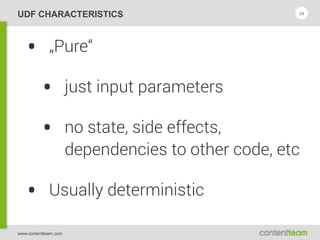
• „Pure“
• just input parameters
• no state, side effects,
dependencies to other code, etc
• Usually deterministic
24
www.contentteam.com
UDF 25
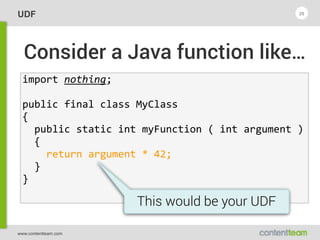
Consider a Java function like…
import  nothing;

public  final  class  MyClass  
{  
    public  static  int  myFunction  (  int  argument  )  
    {  
        return  argument  *  42;  
    }  
}
This would be your UDF
www.contentteam.com
UDF EXAMPLE 26
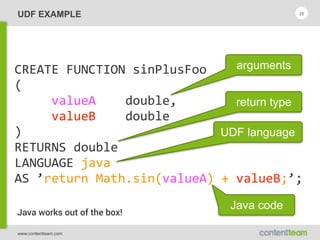
CREATE  FUNCTION  sinPlusFoo

(

          valueA        double,

          valueB        double

)

RETURNS  double

LANGUAGE  java

AS  ’return  Math.sin(valueA)  +  valueB;’;
arguments
return type
UDF language
Java code
Java works out of the box!
www.contentteam.com
UDF/UDA 27
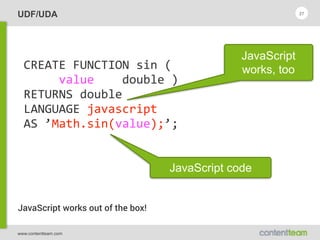
CREATE  FUNCTION  sin  (

          value        double  )

RETURNS  double

LANGUAGE  javascript

AS  ’Math.sin(value);’;
JavaScript
works, too
JavaScript code
JavaScript works out of the box!
www.contentteam.com
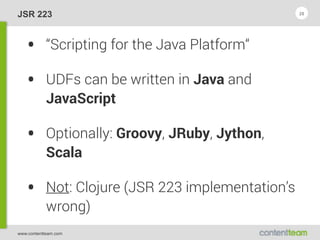
JSR 223
• “Scripting for the Java Platform“
• UDFs can be written in Java and
JavaScript
• Optionally: Groovy, JRuby, Jython,
Scala
• Not: Clojure (JSR 223 implementation’s
wrong)
28
www.contentteam.com
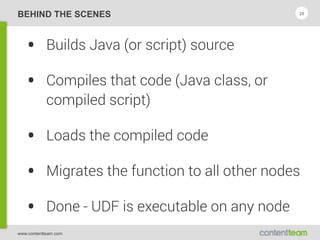
BEHIND THE SCENES
• Builds Java (or script) source
• Compiles that code (Java class, or
compiled script)
• Loads the compiled code
• Migrates the function to all other nodes
• Done - UDF is executable on any node
29
www.contentteam.com
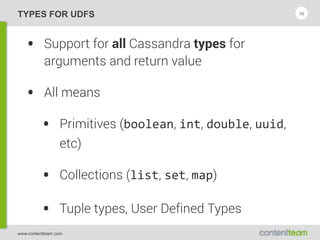
TYPES FOR UDFS
• Support for all Cassandra types for
arguments and return value
• All means
• Primitives (boolean, int, double, uuid,
etc)
• Collections (list, set, map)
• Tuple types, User Defined Types
30
www.contentteam.com
UDF/UDA
UDF -
For what?
31
www.contentteam.com
UDF INVOCATION 32
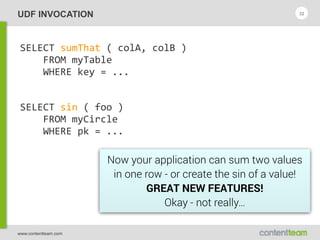
SELECT  sumThat  (  colA,  colB  )

        FROM  myTable

        WHERE  key  =  ...

SELECT  sin  (  foo  )

        FROM  myCircle

        WHERE  pk  =  ...
Now your application can sum two values
in one row - or create the sin of a value!

GREAT NEW FEATURES!
Okay - not really…
www.contentteam.com
UDFS ARE GOOD FOR…
• UDFs on their own are
just „nice to have“
• Nothing you couldn’t do
better in your application
33
www.contentteam.com
User Defined Aggregates !
34
www.contentteam.com
USER DEFINED AGGREGATES
Use UDFs to code your own
aggregation functions
(Aggregates are things like SUM, AVG,
MIN, MAX, etc)

Aggregates :

consume values from multiple rows &

produce a single result
35
www.contentteam.com
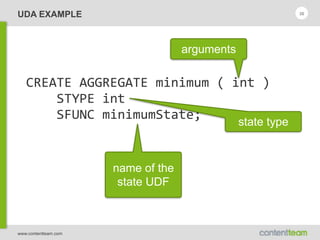
UDA EXAMPLE 36
CREATE  AGGREGATE  minimum  (  int  )

        STYPE  int

        SFUNC  minimumState;
arguments
state type
name of the
state UDF
www.contentteam.com
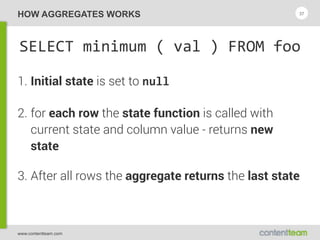
HOW AGGREGATES WORKS
SELECT  minimum  (  val  )  FROM  foo
1. Initial state is set to null
2. for each row the state function is called with

current state and column value - returns new
state
3. After all rows the aggregate returns the last state
37
www.contentteam.com
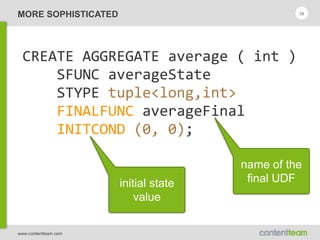
MORE SOPHISTICATED 38
CREATE  AGGREGATE  average  (  int  )

        SFUNC  averageState

        STYPE  tuple<long,int>

        FINALFUNC  averageFinal

        INITCOND  (0,  0);
name of the
final UDFinitial state
value
www.contentteam.com
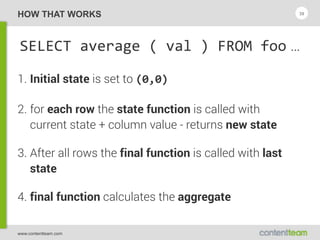
HOW THAT WORKS
SELECT  average  (  val  )  FROM  foo …
1. Initial state is set to (0,0)
2. for each row the state function is called with

current state + column value - returns new state
3. After all rows the final function is called with last
state
4. final function calculates the aggregate
39
www.contentteam.com
UDF/UDA
Now everybody
can execute evil
code on your
cluster :)
40
www.contentteam.com
PERMISSIONS ON UDFS
• There will be permissions to restrict (allow)
• UDF creation (DDL)
• UDF execution (DML)
41
www.contentteam.com
SOME FINAL WORDS…
Keep in mind:
• JSR-223 has overhead - Java UDFs are much
faster
• Do not allow everyone to create UDFs (in
production)
• Keep your UDFs “pure“
• Test your UDFs and user defined aggregates
thoroughly
42
www.contentteam.com
MORE FINAL WORDS…
• UDFs and user defined aggregates are
executed on the coordinator node
• Prefer to use Java-UDFs for
performance reasons
43
www.contentteam.com
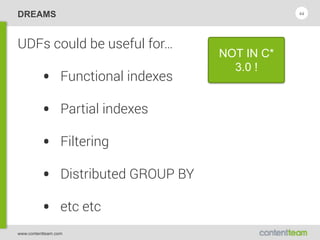
DREAMS
UDFs could be useful for…
• Functional indexes
• Partial indexes
• Filtering
• Distributed GROUP BY
• etc etc
44
NOT IN C*
3.0 !
www.contentteam.com
CASSANDRA 3.0
Role based access control
45
www.contentteam.com
ROLE BASED ACCESS CONTROL
• Grant/revoke permissions to/from roles
• Grant roles to users
46
www.contentteam.com
ROLE BASED ACCESS CONTROL
GRANT <permission> ON <resource>

TO [[USER] <username> | ROLE <rolename>]
REVOKE <permission> ON <resource>

FROM [[USER] <username> | ROLE <rolename>]
LIST <permissionOrAll> [ON <resource>]

[OF [[USER] <username> | ROLE <rolename>]
[NORECURSIVE]
47
www.contentteam.com
MORE NEW AUTHENTICATION/AUTHORIZATION FEATURES
• Authentication/authorization has been reworked for
Cassandra 3.0
• Much more options and possibilities
• See CASSANDRA-8394 for more information
48
www.contentteam.com
CASSANDRA 3.0
New row cache
49
www.contentteam.com
MOTIVATION NEW ROW CACHE
• Old row cache recommendation:

"don't use it"
• Old row cache had data in off-heap,

but management data in Java heap
• Resulted in a lot of additional GC pressure
50
www.contentteam.com
NEW ROW CACHE
• All data (whole concurrent hash map) is off-heap
• Uses APL2 licensed https://github.com/snazy/ohc
• Works with really big row cache
• Works on really big machines
• But don’t expect a huge performance improvement
• Serialization of data to/from off-heap is still a bottleneck
• Will work on that bottleneck in future versions
51
www.contentteam.com
CASSANDRA 3.0
More improvements
52
www.contentteam.com
INTERNAL MODERNIZATION IN CASSANDRA 3.0
• Refactor and modernize storage engine
(CASSANDRA-8099)
• Modernize schema tables (CASSANDRA-6717)
• CQL row read optimization
• Reduce GC pressure
• Make internal nomenclature intuitive
53
www.contentteam.com
MORE PERFORMANCE IMPROVEMENTS IN CASSANDRA 3.0
Memory related
• Support direct buffer decompression for reads
(CASSANDRA-8464)
• Avoid memory allocation when searching index summary
(CASSANDRA-8793)
• Use preloaded jemalloc w/ Unsafe (CASSANDRA-8714)
Throughput/CPU related
• Improve concurrency of repair (CASSANDRA-6455, 8208)
• Select optimal CRC32 implementation at runtime
(CASSANDRA-8614)
• plus many more
54
www.contentteam.com
SOMETHING ELSE
Windows
• Cassandra 3.0 is tested on Windows
• 3.0 works definitely better on Windows that 2.1
• But still some issues to solve
My personal recommendation
• Use Cassandra on Linux
55
www.contentteam.com
CASSANDRA >= 3.1

FEATURES
56
www.contentteam.com
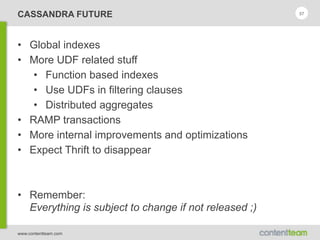
CASSANDRA FUTURE
• Global indexes
• More UDF related stuff
• Function based indexes
• Use UDFs in filtering clauses
• Distributed aggregates
• RAMP transactions
• More internal improvements and optimizations
• Expect Thrift to disappear
• Remember:

Everything is subject to change if not released ;)
57
www.contentteam.com
CASSANDRA COMMUNITY
58
www.contentteam.com
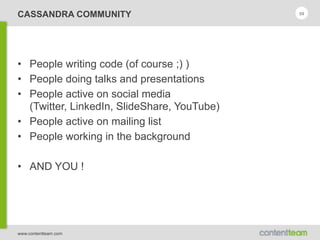
CASSANDRA COMMUNITY
• People writing code (of course ;) )
• People doing talks and presentations
• People active on social media

(Twitter, LinkedIn, SlideShare, YouTube)
• People active on mailing list
• People working in the background
• AND YOU !
59
www.contentteam.com
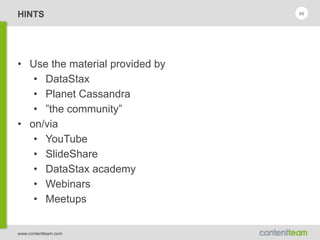
HINTS
• Use the material provided by
• DataStax
• Planet Cassandra
• ”the community”
• on/via
• YouTube
• SlideShare
• DataStax academy
• Webinars
• Meetups
60
www.contentteam.com
APACHE CASSANDRA

"VS." DATASTAX ENTERPRISE
61
www.contentteam.com
APACHE CASSANDRA VS. DATASTAX ENTERPRISE 62
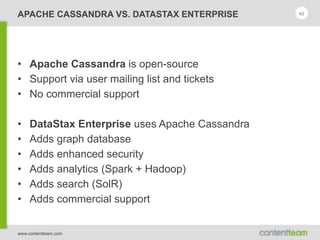
• Apache Cassandra is open-source
• Support via user mailing list and tickets
• No commercial support
• DataStax Enterprise uses Apache Cassandra
• Adds graph database
• Adds enhanced security
• Adds analytics (Spark + Hadoop)
• Adds search (SolR)
• Adds commercial support
www.contentteam.com
ONE

MORE

THING…
:)
63
www.contentteam.com
CASSANDRA-ON-MESOS
64
www.contentteam.com
APACHE MESOS
Program against your datacenter like it’s a single pool of
resources
Apache Mesos abstracts CPU, memory, storage, and other
compute resources away from machines (physical or
virtual), enabling fault-tolerant and elastic distributed
systems to easily be built and run effectively.
65
www.contentteam.com
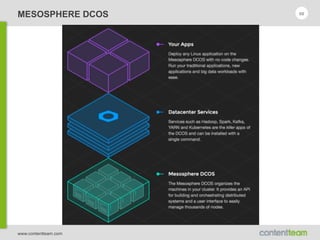
MESOSPHERE DCOS 66
www.contentteam.com
APACHE MESOS 67
• Run killer applications and services like Spark, Kafka and
Cassandra
• In your own data center
• On Amazon EC2
• On Google GCE
www.contentteam.com
CASSANDRA-ON-MESOS 68
• Allows to run Apache Cassandra on Apache Mesos
• Developed by 

and
• Allows to spawn your Cassandra Cluster with a single
command on Mesos
• Expect a first release-candidate this week !
www.contentteam.com
Q & A
Robert Stupp

rstupp@contentteam.com

@snazy
69

Cassandra 3.0