Confidential
Apache Cassandra & Java
Caroline George
DataStax Solutions Engineer
June 30, 2014
1
Agenda
2
• Cassandra Overview
• Cassandra Architecture
• Cassandra Query Language
• Interacting with Cassandra using Java
• About DataStax
CASSANDRA OVERVIEW
3
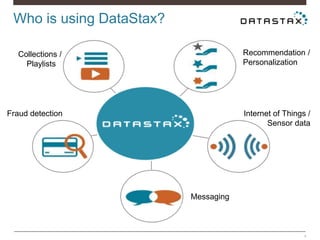
Who is using DataStax?
4
Collections /
Playlists
Recommendation /
Personalization
Fraud detection
Messaging
Internet of Things /
Sensor data
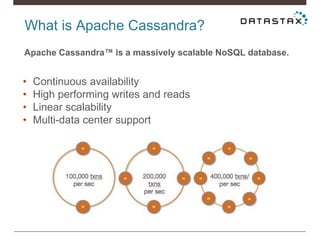
What is Apache Cassandra?
Apache Cassandra™ is a massively scalable NoSQL database.
• Continuous availability
• High performing writes and reads
• Linear scalability
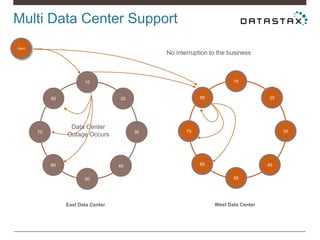
• Multi-data center support
6
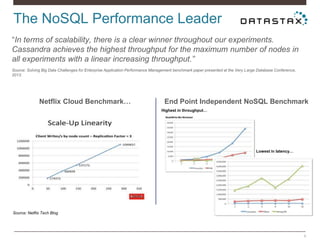
The NoSQL Performance Leader
Source: Netflix Tech Blog
Netflix Cloud Benchmark…
“In terms of scalability, there is a clear winner throughout our experiments.
Cassandra achieves the highest throughput for the maximum number of nodes in
all experiments with a linear increasing throughput.”
Source: Solving Big Data Challenges for Enterprise Application Performance Management benchmark paper presented at the Very Large Database Conference,
2013.
End Point Independent NoSQL Benchmark
Highest in throughput…
Lowest in latency…
10
50
3070
80
40
20
60
Client
Client
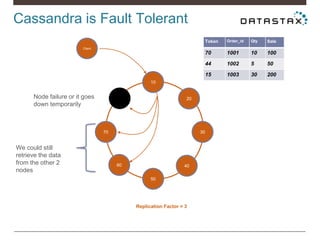
Replication Factor = 3
We could still
retrieve the data
from the other 2
nodes
Token Order_id Qty Sale
70 1001 10 100
44 1002 5 50
15 1003 30 200
Node failure or it goes
down temporarily
Cassandra is Fault Tolerant
Client
10
50
3070
80
40
20
60
Client
15
55
3575
85
45
25
65
West Data CenterEast Data Center
10
50
3070
80
40
20
60
Data Center
Outage Occurs
No interruption to the business
Multi Data Center Support
9
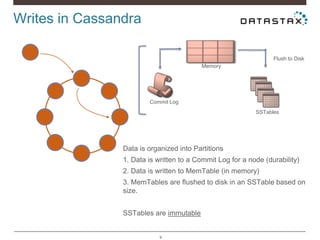
Writes in Cassandra
Data is organized into Partitions
1. Data is written to a Commit Log for a node (durability)
2. Data is written to MemTable (in memory)
3. MemTables are flushed to disk in an SSTable based on
size.
SSTables are immutable
Client
Memory
SSTables
Commit Log
Flush to Disk
10
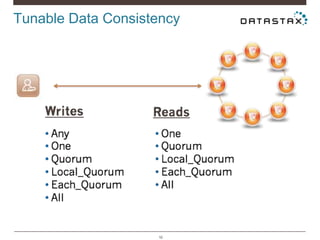
Tunable Data Consistency
11
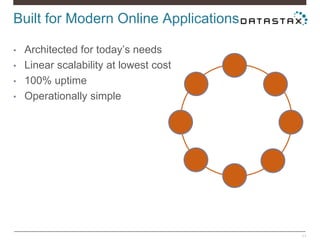
Built for Modern Online Applications
• Architected for today’s needs
• Linear scalability at lowest cost
• 100% uptime
• Operationally simple
Cassandra Query Language
12
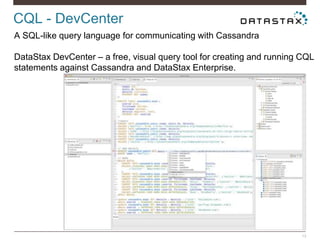
CQL - DevCenter
13
A SQL-like query language for communicating with Cassandra
DataStax DevCenter – a free, visual query tool for creating and running CQL
statements against Cassandra and DataStax Enterprise.
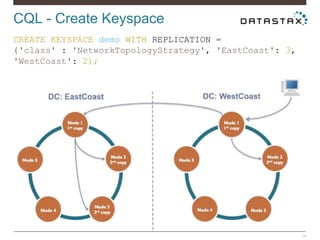
CQL - Create Keyspace
14
CREATE KEYSPACE demo WITH REPLICATION =
{'class' : 'NetworkTopologyStrategy', 'EastCoast': 3,
'WestCoast': 2);
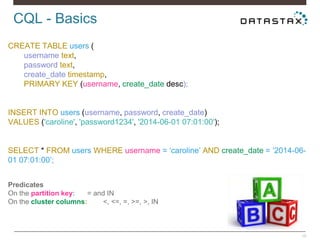
CQL - Basics
15
CREATE TABLE users (
username text,
password text,
create_date timestamp,
PRIMARY KEY (username, create_date desc);
INSERT INTO users (username, password, create_date)
VALUES ('caroline', 'password1234', '2014-06-01 07:01:00');
SELECT * FROM users WHERE username = ‘caroline’ AND create_date = ‘2014-06-
01 07:01:00’;
Predicates
On the partition key: = and IN
On the cluster columns: <, <=, =, >=, >, IN
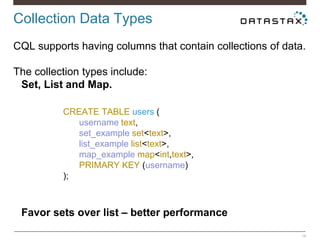
Collection Data Types
16
CQL supports having columns that contain collections of data.

The collection types include:
Set, List and Map.
Favor sets over list – better performance
CREATE TABLE users (
username text,
set_example set<text>,
list_example list<text>,
map_example map<int,text>,
PRIMARY KEY (username)
);
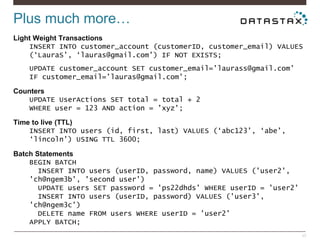
Plus much more…
17
Light Weight Transactions
INSERT INTO customer_account (customerID, customer_email) VALUES
(‘LauraS’, ‘lauras@gmail.com’) IF NOT EXISTS;
UPDATE customer_account SET customer_email=’laurass@gmail.com’
IF customer_email=’lauras@gmail.com’;
Counters
UPDATE UserActions SET total = total + 2
WHERE user = 123 AND action = ’xyz';
Time to live (TTL)
INSERT INTO users (id, first, last) VALUES (‘abc123’, ‘abe’,
‘lincoln’) USING TTL 3600;
Batch Statements
BEGIN BATCH
INSERT INTO users (userID, password, name) VALUES ('user2',
'ch@ngem3b', 'second user')
UPDATE users SET password = 'ps22dhds' WHERE userID = 'user2'
INSERT INTO users (userID, password) VALUES ('user3',
'ch@ngem3c')
DELETE name FROM users WHERE userID = 'user2’
APPLY BATCH;
JAVA CODE EXAMPLES
18
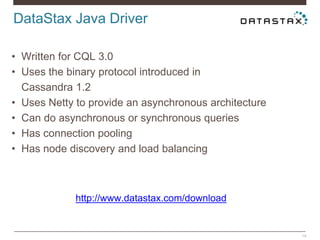
DataStax Java Driver
19
• Written for CQL 3.0
• Uses the binary protocol introduced in
Cassandra 1.2
• Uses Netty to provide an asynchronous architecture
• Can do asynchronous or synchronous queries
• Has connection pooling
• Has node discovery and load balancing
http://www.datastax.com/download
Add .JAR Files to Project
20
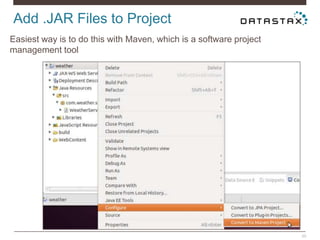
Easiest way is to do this with Maven, which is a software project
management tool
Add .JAR Files to Project
21
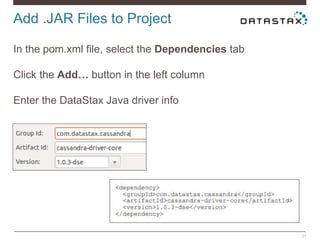
In the pom.xml file, select the Dependencies tab
Click the Add… button in the left column
Enter the DataStax Java driver info
Connect & Write
22
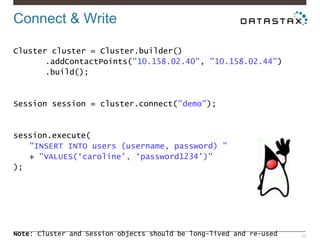
Cluster cluster = Cluster.builder()
.addContactPoints("10.158.02.40", "10.158.02.44")
.build();
Session session = cluster.connect("demo");
session.execute(
"INSERT INTO users (username, password) ”
+ "VALUES(‘caroline’, ‘password1234’)"
);
Note: Cluster and Session objects should be long-lived and re-used
Read from Table
23
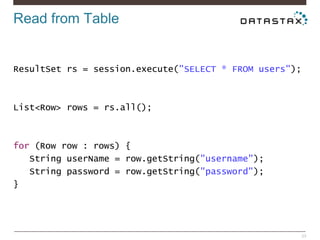
ResultSet rs = session.execute("SELECT * FROM users");
List<Row> rows = rs.all();
for (Row row : rows) {
String userName = row.getString("username");
String password = row.getString("password");
}
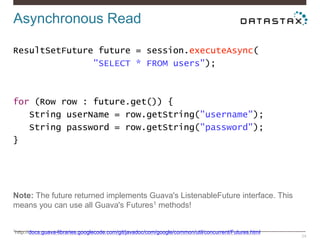
Asynchronous Read
24
ResultSetFuture future = session.executeAsync(
"SELECT * FROM users");
for (Row row : future.get()) {
String userName = row.getString("username");
String password = row.getString("password");
}
Note: The future returned implements Guava's ListenableFuture interface. This
means you can use all Guava's Futures1 methods!
1http://docs.guava-libraries.googlecode.com/git/javadoc/com/google/common/util/concurrent/Futures.html
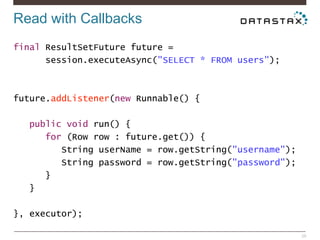
Read with Callbacks
25
final ResultSetFuture future =
session.executeAsync("SELECT * FROM users");
future.addListener(new Runnable() {
public void run() {
for (Row row : future.get()) {
String userName = row.getString("username");
String password = row.getString("password");
}
}
}, executor);
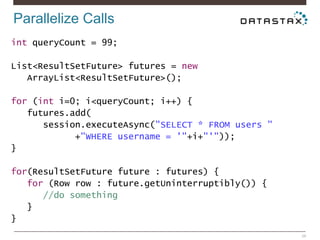
Parallelize Calls
26
int queryCount = 99;
List<ResultSetFuture> futures = new
ArrayList<ResultSetFuture>();
for (int i=0; i<queryCount; i++) {
futures.add(
session.executeAsync("SELECT * FROM users "
+"WHERE username = '"+i+"'"));
}
for(ResultSetFuture future : futures) {
for (Row row : future.getUninterruptibly()) {
//do something
}
}
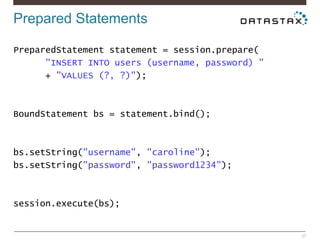
Prepared Statements
27
PreparedStatement statement = session.prepare(
"INSERT INTO users (username, password) "
+ "VALUES (?, ?)");
BoundStatement bs = statement.bind();
bs.setString("username", "caroline");
bs.setString("password", "password1234");
session.execute(bs);
Query Builder
28
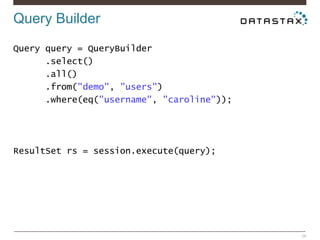
Query query = QueryBuilder
.select()
.all()
.from("demo", "users")
.where(eq("username", "caroline"));
ResultSet rs = session.execute(query);
Load Balancing
29
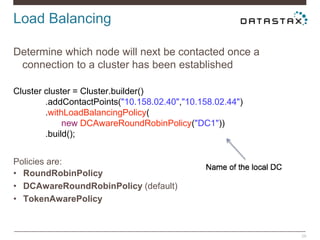
Determine which node will next be contacted once a
connection to a cluster has been established
Cluster cluster = Cluster.builder()
.addContactPoints("10.158.02.40","10.158.02.44")
.withLoadBalancingPolicy(
new DCAwareRoundRobinPolicy("DC1"))
.build();
Policies are:
• RoundRobinPolicy
• DCAwareRoundRobinPolicy (default)
• TokenAwarePolicy
RoundRobinPolicy
30
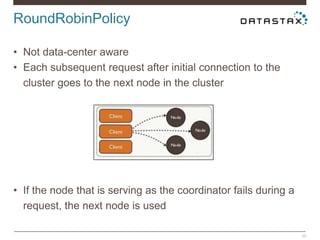
• Not data-center aware
• Each subsequent request after initial connection to the
cluster goes to the next node in the cluster
• If the node that is serving as the coordinator fails during a
request, the next node is used
DCAwareRoundRobinPolicy
31
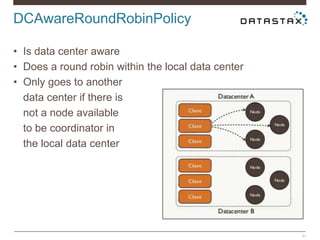
• Is data center aware
• Does a round robin within the local data center
• Only goes to another
data center if there is
not a node available
to be coordinator in
the local data center
TokenAwarePolicy
32
• Is aware of where the replicas for a given token live
• Instead of round robin, the client chooses the node that
contains the primary replica to be the chosen coordinator
• Avoids unnecessary time taken to go to any node to have it
serve as coordinator to then contact the nodes with the
replicas
Additional Information & Support
33
• Community Site
(http://planetcassandra.org)
• Documentation
(http://www.datastax.com/docs)
• Downloads
(http://www.datastax.com/download)
• Getting Started
(http://www.datastax.com/documentation/gettingstarted/index.html)
• DataStax
(http://www.datastax.com)
ABOUT DATASTAX
34
About DataStax
35
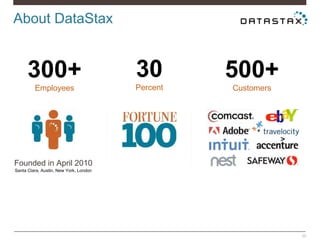
Founded in April 2010
30
Percent
500+
Customers
Santa Clara, Austin, New York, London
300+
Employees
Confidential
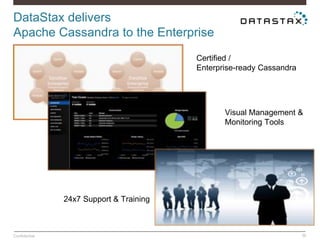
DataStax delivers
Apache Cassandra to the Enterprise
36
Certified /
Enterprise-ready Cassandra
Visual Management &
Monitoring Tools
24x7 Support & Training
37
DSE 4.5
38
Thank You!
caroline.george@datastax.com
https://www.linkedin.com/in/carolinerg
@carolinerg
Follow for more updates all the time: @PatrickMcFadin

DataStax NYC Java Meetup: Cassandra with Java

  • 1.
    Confidential Apache Cassandra &Java Caroline George DataStax Solutions Engineer June 30, 2014 1
  • 2.
    Agenda 2 • Cassandra Overview •Cassandra Architecture • Cassandra Query Language • Interacting with Cassandra using Java • About DataStax
  • 3.
  • 4.
    Who is usingDataStax? 4 Collections / Playlists Recommendation / Personalization Fraud detection Messaging Internet of Things / Sensor data
  • 5.
    What is ApacheCassandra? Apache Cassandra™ is a massively scalable NoSQL database. • Continuous availability • High performing writes and reads • Linear scalability • Multi-data center support
  • 6.
    6 The NoSQL PerformanceLeader Source: Netflix Tech Blog Netflix Cloud Benchmark… “In terms of scalability, there is a clear winner throughout our experiments. Cassandra achieves the highest throughput for the maximum number of nodes in all experiments with a linear increasing throughput.” Source: Solving Big Data Challenges for Enterprise Application Performance Management benchmark paper presented at the Very Large Database Conference, 2013. End Point Independent NoSQL Benchmark Highest in throughput… Lowest in latency…
  • 7.
    10 50 3070 80 40 20 60 Client Client Replication Factor =3 We could still retrieve the data from the other 2 nodes Token Order_id Qty Sale 70 1001 10 100 44 1002 5 50 15 1003 30 200 Node failure or it goes down temporarily Cassandra is Fault Tolerant
  • 8.
    Client 10 50 3070 80 40 20 60 Client 15 55 3575 85 45 25 65 West Data CenterEastData Center 10 50 3070 80 40 20 60 Data Center Outage Occurs No interruption to the business Multi Data Center Support
  • 9.
    9 Writes in Cassandra Datais organized into Partitions 1. Data is written to a Commit Log for a node (durability) 2. Data is written to MemTable (in memory) 3. MemTables are flushed to disk in an SSTable based on size. SSTables are immutable Client Memory SSTables Commit Log Flush to Disk
  • 10.
  • 11.
    11 Built for ModernOnline Applications • Architected for today’s needs • Linear scalability at lowest cost • 100% uptime • Operationally simple
  • 12.
  • 13.
    CQL - DevCenter 13 ASQL-like query language for communicating with Cassandra DataStax DevCenter – a free, visual query tool for creating and running CQL statements against Cassandra and DataStax Enterprise.
  • 14.
    CQL - CreateKeyspace 14 CREATE KEYSPACE demo WITH REPLICATION = {'class' : 'NetworkTopologyStrategy', 'EastCoast': 3, 'WestCoast': 2);
  • 15.
    CQL - Basics 15 CREATETABLE users ( username text, password text, create_date timestamp, PRIMARY KEY (username, create_date desc); INSERT INTO users (username, password, create_date) VALUES ('caroline', 'password1234', '2014-06-01 07:01:00'); SELECT * FROM users WHERE username = ‘caroline’ AND create_date = ‘2014-06- 01 07:01:00’; Predicates On the partition key: = and IN On the cluster columns: <, <=, =, >=, >, IN
  • 16.
    Collection Data Types 16 CQLsupports having columns that contain collections of data. The collection types include: Set, List and Map. Favor sets over list – better performance CREATE TABLE users ( username text, set_example set<text>, list_example list<text>, map_example map<int,text>, PRIMARY KEY (username) );
  • 17.
    Plus much more… 17 LightWeight Transactions INSERT INTO customer_account (customerID, customer_email) VALUES (‘LauraS’, ‘lauras@gmail.com’) IF NOT EXISTS; UPDATE customer_account SET customer_email=’laurass@gmail.com’ IF customer_email=’lauras@gmail.com’; Counters UPDATE UserActions SET total = total + 2 WHERE user = 123 AND action = ’xyz'; Time to live (TTL) INSERT INTO users (id, first, last) VALUES (‘abc123’, ‘abe’, ‘lincoln’) USING TTL 3600; Batch Statements BEGIN BATCH INSERT INTO users (userID, password, name) VALUES ('user2', 'ch@ngem3b', 'second user') UPDATE users SET password = 'ps22dhds' WHERE userID = 'user2' INSERT INTO users (userID, password) VALUES ('user3', 'ch@ngem3c') DELETE name FROM users WHERE userID = 'user2’ APPLY BATCH;
  • 18.
  • 19.
    DataStax Java Driver 19 •Written for CQL 3.0 • Uses the binary protocol introduced in Cassandra 1.2 • Uses Netty to provide an asynchronous architecture • Can do asynchronous or synchronous queries • Has connection pooling • Has node discovery and load balancing http://www.datastax.com/download
  • 20.
    Add .JAR Filesto Project 20 Easiest way is to do this with Maven, which is a software project management tool
  • 21.
    Add .JAR Filesto Project 21 In the pom.xml file, select the Dependencies tab Click the Add… button in the left column Enter the DataStax Java driver info
  • 22.
    Connect & Write 22 Clustercluster = Cluster.builder() .addContactPoints("10.158.02.40", "10.158.02.44") .build(); Session session = cluster.connect("demo"); session.execute( "INSERT INTO users (username, password) ” + "VALUES(‘caroline’, ‘password1234’)" ); Note: Cluster and Session objects should be long-lived and re-used
  • 23.
    Read from Table 23 ResultSetrs = session.execute("SELECT * FROM users"); List<Row> rows = rs.all(); for (Row row : rows) { String userName = row.getString("username"); String password = row.getString("password"); }
  • 24.
    Asynchronous Read 24 ResultSetFuture future= session.executeAsync( "SELECT * FROM users"); for (Row row : future.get()) { String userName = row.getString("username"); String password = row.getString("password"); } Note: The future returned implements Guava's ListenableFuture interface. This means you can use all Guava's Futures1 methods! 1http://docs.guava-libraries.googlecode.com/git/javadoc/com/google/common/util/concurrent/Futures.html
  • 25.
    Read with Callbacks 25 finalResultSetFuture future = session.executeAsync("SELECT * FROM users"); future.addListener(new Runnable() { public void run() { for (Row row : future.get()) { String userName = row.getString("username"); String password = row.getString("password"); } } }, executor);
  • 26.
    Parallelize Calls 26 int queryCount= 99; List<ResultSetFuture> futures = new ArrayList<ResultSetFuture>(); for (int i=0; i<queryCount; i++) { futures.add( session.executeAsync("SELECT * FROM users " +"WHERE username = '"+i+"'")); } for(ResultSetFuture future : futures) { for (Row row : future.getUninterruptibly()) { //do something } }
  • 27.
    Prepared Statements 27 PreparedStatement statement= session.prepare( "INSERT INTO users (username, password) " + "VALUES (?, ?)"); BoundStatement bs = statement.bind(); bs.setString("username", "caroline"); bs.setString("password", "password1234"); session.execute(bs);
  • 28.
    Query Builder 28 Query query= QueryBuilder .select() .all() .from("demo", "users") .where(eq("username", "caroline")); ResultSet rs = session.execute(query);
  • 29.
    Load Balancing 29 Determine whichnode will next be contacted once a connection to a cluster has been established Cluster cluster = Cluster.builder() .addContactPoints("10.158.02.40","10.158.02.44") .withLoadBalancingPolicy( new DCAwareRoundRobinPolicy("DC1")) .build(); Policies are: • RoundRobinPolicy • DCAwareRoundRobinPolicy (default) • TokenAwarePolicy
  • 30.
    RoundRobinPolicy 30 • Not data-centeraware • Each subsequent request after initial connection to the cluster goes to the next node in the cluster • If the node that is serving as the coordinator fails during a request, the next node is used
  • 31.
    DCAwareRoundRobinPolicy 31 • Is datacenter aware • Does a round robin within the local data center • Only goes to another data center if there is not a node available to be coordinator in the local data center
  • 32.
    TokenAwarePolicy 32 • Is awareof where the replicas for a given token live • Instead of round robin, the client chooses the node that contains the primary replica to be the chosen coordinator • Avoids unnecessary time taken to go to any node to have it serve as coordinator to then contact the nodes with the replicas
  • 33.
    Additional Information &Support 33 • Community Site (http://planetcassandra.org) • Documentation (http://www.datastax.com/docs) • Downloads (http://www.datastax.com/download) • Getting Started (http://www.datastax.com/documentation/gettingstarted/index.html) • DataStax (http://www.datastax.com)
  • 34.
  • 35.
    About DataStax 35 Founded inApril 2010 30 Percent 500+ Customers Santa Clara, Austin, New York, London 300+ Employees
  • 36.
    Confidential DataStax delivers Apache Cassandrato the Enterprise 36 Certified / Enterprise-ready Cassandra Visual Management & Monitoring Tools 24x7 Support & Training
  • 37.
  • 38.
  • 39.

Editor's Notes

  • #2 DSE C* Architecture Integration w Java Q&A
  • #5 collections / playlist: Spotify Fraud: financial services Recommendations / personalization: EBay IoT - smart devices: nest Messaging: Instagram
  • #6 Massively scalable NoSQL database/Netflix example: 10 million/sec; 1 trillion/day; 3000 nodes Q: kilo, mega, giga, tera, peta, exabyte, zetta, yotta
  • #8 Always on: Peer to peer architecture – all nodes are equal; each node is responsible for an assigned range (or ranges) of data Clients can write (or read0 data to any node in the ring – native drivers can round robin across a DC and distribute load to a coordinator node Coordinate node writes (or reads) copies of data to nodes which own each copy In the case of a failure (such as a drive going down), 2 out of the 3 nodes are still on, so the ability to write and read data still works for the majority of nodes and therefore C* is always on
  • #9 Multi-DC is very, very easy to configure with Cassandra Datacenters are active – active: write to either DC and the other one will get a copy In the case of a datacenter outage, applications can carry on a retry policy which flips over to the other datacenter which also has a copy of the data; Outbrain story – Hurricane Sandy Rack-aware What is Quorum? i.e. 10 nodes, rf = 6 (q=4 -> can tolerate 2 down nodes)
  • #14 similar to sql but does not have all sql options DevCenter / cqlsh
  • #15 keyspace = db instance simple strategy vs NetworkTopologyStrategy replication factor
  • #16 data types primary key / partition key
  • #17 set: ordered alphabetically. ex: preferences: email subscriptions list: specific order. ex: search engine: google, yahoo, bing map: phone & phone type
  • #18 user defined types batch -> all or nothing - atomic
  • #20 Asynchronous: Netty is an asynchronous event-driven network application framework. Not blocking threads -> can scale It greatly simplifies and streamlines network programming such as TCP and UDP socket server / support request pipeline Other drivers: C#, Python, ODBC + community drivers high frequency / multi threaded get push requests back from C* i.e., topology changes, node status changes, schema changes
  • #21 v2.0.2
  • #23 contact points = discover cluster. not connect to these nodes Retrieves metadata from the cluster, including: Name of the cluster , IP address, rack, and data center for each node Session instances are thread-safe and normally a single session instance is all you need per application per keyspace schemaless -> no create date
  • #25 exectureAsync => returns future implementing Guavas futures => large scale > execute long query > callbacks Execute async to get a future on your resultset - which means from a single thread you can push a bunch of requests to be execute in paralell - look at futures in Java
  • #26 example: read w callback break into small queries, execute as many in C* -> send as much as C* can take
  • #27 fire ton of select, get futures back & iterate & do … breaking into small queries -> better latency, easier to retry small query
  • #28 prepared, compiled, execute for CQL statements executed multiple times for performance: precompiled & cached on server. C* parses once & exec multiple times use ? as placeholder for literal values gets passed as BoundStatement object BS gets executed by Session object
  • #29 programmatically build query When you need to generate queries dynamically, quite easy Or if your just familiar with it Note: the default consistency level of ConsistencyLevel.ONE
  • #30 Round Robin: not DC aware; request goes to next node in cluster DCAwareRoundRobin: goes to next node in next DC
  • #33 client connects to node where data resides. performance advantage
  • #36 HIRING HQ: SF offices in Austin, London, Paris delivering Apache C* to the enterprise
  • #37 DataStax is the company that delivers Cassandra to the enterprise. First, we take the open source software and put it through rigorous quality assurance tests including a 1000 node scalability test. We certify it and provide the worlds most comprehensive support, training and consulting for Cassandra so that you can get up and running quickly. But that isn’t all DataStax does. We also build additional software features on top of DataStax including security, search, analytics as well as provide in memory capabilities that don’t come with the open source Cassandra product. We also provide management services to help visualize your nodes, plan your capacity and repair issues automatically. Finally, we also provide developer tools and drivers as well as monitoring tools. DataStax is the commercial company behind Apache Cassandra plus a whole host of additional software and services.
  • #39 Spark integration - 100x faster analytics - integrated real-time analytics performance tuning - supply diagnostic info on how cluster is doing byoh