Policies & Regulations:

       Of Technology
In a Pre-Kindergarten School
INTRODUCTION


Policies and regulations shape and
guide everything within our society
and within our lives. . . . including pre-
kindergarten education
Pre-K Regulation
Pre-K Schools face an array of state mandated
regulations and policies; and a number of others
that are strongly suggested. These cover:

 •   Licensure & Permitting   •   Teacher Credentialing
 •   Safety                   •   Student Density per Instructor
 •   Health                   •   Reporting
 •   Record Keeping           •   Physical Facilities
Pre-K Technology
                    Standards
• Guidelines also extend to the technology used
  and taught in the Pre-K school environment.
   “Providing access to a variety of technologies is critical in
    the development of 21st century skills that young children
    need to learn and grow.
   “They develop techniques for handling and controlling
    various devices, becoming increasingly confident and
    independent users of age‐appropriate technologies.”
                                       TEA Revised Pre-Kindergarten Guidelines, 2008
Technological Protocol
              for Schools & Teachers
• Schools should have and use a
  protocol of policies & regulations
  for guiding the use of technology
  for:
       Standards of use
       Professional ethics
       Copyright protection & fair use
       Utilization, application, & integration
       Distance delivery
       Internet use
       Reconsideration of challenged
        materials
       School library media programs
Technological Protocol
                  (Continued)
• These protocols ensure:

    a high level of professional ethics
    assure design, utilization, and
     implementation of new software
     and resource applications


   All meeting state policies and
   regulations within a Pre-K
   environment
Background Info About
    Forever Growing Pre-K School
• Forever Growing
  Founded in 1990 in Alvin, Texas by Denise West
  Originally operated as an in-home daycare and
   after school program
  Curriculum designed to integrate academic skills
   as well as social interactions in children ages 2-5.
  Teaches academic and reading readiness through
   situational problem solving, phonological and
   phonemic awareness, and social dialogue.
Specific Area of Interest

• School Code of Conduct
• Stewardship Protocols for technology
AnAlysis of the school’s
            History & Growth
• Embraced an optimistic vision     • 1990 - Began with 5 students and
  and a determined outlook.           grew to 12 students in just a
• Experienced many challenges and     couple of months.
  numerous triumphs.                • 1991 - School overcrowding
• Learned from the obstacles and      caused children to be turned
  victories                           away.
• Believe that the school can       • 1994 - After-school program
  overcome any adversity in order     abandoned order to better assist
  to achieve success                  the future progress of the school.
                                    • Currently – Supports a wonderful
                                      staff, a great facility and a
                                      prominent curriculum. Enrolls
                                      almost 100 full and part time
                                      students each year in their pre-
                                      kindergarten program.
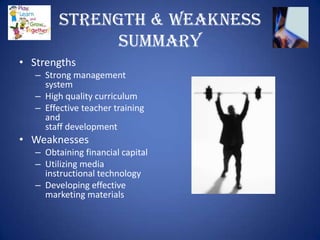
Strength & Weakness
               Summary
• Strengths
   – Strong management
     system
   – High quality curriculum
   – Effective teacher training
     and
     staff development
• Weaknesses
   – Obtaining financial capital
   – Utilizing media
     instructional technology
   – Developing effective
     marketing materials
Responses & Results of the
             school’s current strAtegy

•   Largest challenge is obtaining the            •   In spite of everything, there is not
    financial capital which                           sufficient capital to acquire additional
     – Maintains the operations                       educational resources (technology
     – Supports the acquisition and                   implementation, training)
       implementation of resources                •   Additional resources are needed
     – Improves the educational quality of its         – to support the school’s over-all efforts
       programs
                                                       – to help students especially from lower
•   Addressing these challenges                          socio-economic family environments
     – Implements a mixture of initiatives to     •   These additional resources will be
       both raise funds and avoid costs.
                                                      leveraged to overcome the
     – Obtains full and partial scholarships          knowledge gap which many students
       from local businesses to help off-set
       tuition costs                                  possess when they first enroll in
     – Receives assistance with fund raising          Forever Growing.
       activities and donation matching from
       the community
     – Acquires one time financial gifts
     – Teachers have voluntarily given up their
       pay raises
The Specific Problem
Ensuring the Forever Growing
School has policies,
regulations, and procedures in
place to:
• Meet state compliance
  requirements
• Meet professional ethics
• Facilitate media utilization
  and diffusion of technology.
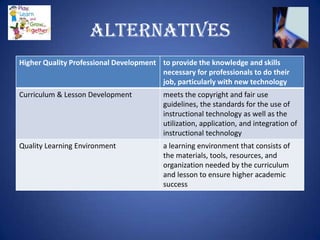
Alternatives
Higher Quality Professional Development to provide the knowledge and skills
                                        necessary for professionals to do their
                                        job, particularly with new technology
Curriculum & Lesson Development           meets the copyright and fair use
                                          guidelines, the standards for the use of
                                          instructional technology as well as the
                                          utilization, application, and integration of
                                          instructional technology
Quality Learning Environment              a learning environment that consists of
                                          the materials, tools, resources, and
                                          organization needed by the curriculum
                                          and lesson to ensure higher academic
                                          success
Recommendations for
        Future Strategies
Implement all of the alternatives noted. This
provides:
  Flexibility for adapting to future technology
   diffusion within the school
  A stronger base for ethical performance and
   conduct
How Alternatives &
                Recommendations Relate
                  to AECT Standards
AECT 3.4.1       The design, adoption, utilization and implementation process
                 complies with the standards for using instructional technology.
AECT 3.4.2       The Code of Conduct currently used by Forever Growing as well as the rewritten code
                 directly addresses this standard.
AECT 3.4.3       Forever Growing’s Code of Conduct within the learning environment alternative includes
                 the procedures and professional behaviors guiding behaviors with copyright and fair use
                 policy.
AECT 3.4.4       The professional development alternative and the learning environment alternative directly
                 address this standard.
AECT 3.4.5       Forever Growing does not use distance delivery technologies. Therefore, this standard
                 would not be applicable.
AECT 3.4.7       Forever Growing does not have a school library media program. Therefore, this standard
                 would not be applicable.
AECT 3.4.8       Forever Growing’s Code of Conduct includes an internet acceptable use policy for both the
                 teachers and the students in order to maintain a safe and secure learning environment.
AECT 3.4.10      Forever Growing does not have any challenged materials or a local
                 school district. Therefore, this standard would not be applicable.
    AECT 3.4.6 & 3.4.9 were not noted in the rubric
Conclusion
• Compliance requirements for Pre-K programs
  does not cause an extensive or complex problem
  for the Forever Growing School.
• The existing compliance structure within the
  school already meets most of these
  requirements.
• Adopting the alternatives and recommendations
  will further assist the school in preparing for the
  technology rich future.

Case Study PowerPoint Unit 5

  • 1.
    Policies & Regulations: Of Technology In a Pre-Kindergarten School
  • 2.
    INTRODUCTION Policies and regulationsshape and guide everything within our society and within our lives. . . . including pre- kindergarten education
  • 3.
    Pre-K Regulation Pre-K Schoolsface an array of state mandated regulations and policies; and a number of others that are strongly suggested. These cover: • Licensure & Permitting • Teacher Credentialing • Safety • Student Density per Instructor • Health • Reporting • Record Keeping • Physical Facilities
  • 4.
    Pre-K Technology Standards • Guidelines also extend to the technology used and taught in the Pre-K school environment.  “Providing access to a variety of technologies is critical in the development of 21st century skills that young children need to learn and grow.  “They develop techniques for handling and controlling various devices, becoming increasingly confident and independent users of age‐appropriate technologies.” TEA Revised Pre-Kindergarten Guidelines, 2008
  • 5.
    Technological Protocol for Schools & Teachers • Schools should have and use a protocol of policies & regulations for guiding the use of technology for:  Standards of use  Professional ethics  Copyright protection & fair use  Utilization, application, & integration  Distance delivery  Internet use  Reconsideration of challenged materials  School library media programs
  • 6.
    Technological Protocol (Continued) • These protocols ensure:  a high level of professional ethics  assure design, utilization, and implementation of new software and resource applications All meeting state policies and regulations within a Pre-K environment
  • 7.
    Background Info About Forever Growing Pre-K School • Forever Growing Founded in 1990 in Alvin, Texas by Denise West Originally operated as an in-home daycare and after school program Curriculum designed to integrate academic skills as well as social interactions in children ages 2-5. Teaches academic and reading readiness through situational problem solving, phonological and phonemic awareness, and social dialogue.
  • 8.
    Specific Area ofInterest • School Code of Conduct • Stewardship Protocols for technology
  • 9.
    AnAlysis of theschool’s History & Growth • Embraced an optimistic vision • 1990 - Began with 5 students and and a determined outlook. grew to 12 students in just a • Experienced many challenges and couple of months. numerous triumphs. • 1991 - School overcrowding • Learned from the obstacles and caused children to be turned victories away. • Believe that the school can • 1994 - After-school program overcome any adversity in order abandoned order to better assist to achieve success the future progress of the school. • Currently – Supports a wonderful staff, a great facility and a prominent curriculum. Enrolls almost 100 full and part time students each year in their pre- kindergarten program.
  • 10.
    Strength & Weakness Summary • Strengths – Strong management system – High quality curriculum – Effective teacher training and staff development • Weaknesses – Obtaining financial capital – Utilizing media instructional technology – Developing effective marketing materials
  • 11.
    Responses & Resultsof the school’s current strAtegy • Largest challenge is obtaining the • In spite of everything, there is not financial capital which sufficient capital to acquire additional – Maintains the operations educational resources (technology – Supports the acquisition and implementation, training) implementation of resources • Additional resources are needed – Improves the educational quality of its – to support the school’s over-all efforts programs – to help students especially from lower • Addressing these challenges socio-economic family environments – Implements a mixture of initiatives to • These additional resources will be both raise funds and avoid costs. leveraged to overcome the – Obtains full and partial scholarships knowledge gap which many students from local businesses to help off-set tuition costs possess when they first enroll in – Receives assistance with fund raising Forever Growing. activities and donation matching from the community – Acquires one time financial gifts – Teachers have voluntarily given up their pay raises
  • 12.
    The Specific Problem Ensuringthe Forever Growing School has policies, regulations, and procedures in place to: • Meet state compliance requirements • Meet professional ethics • Facilitate media utilization and diffusion of technology.
  • 13.
    Alternatives Higher Quality ProfessionalDevelopment to provide the knowledge and skills necessary for professionals to do their job, particularly with new technology Curriculum & Lesson Development meets the copyright and fair use guidelines, the standards for the use of instructional technology as well as the utilization, application, and integration of instructional technology Quality Learning Environment a learning environment that consists of the materials, tools, resources, and organization needed by the curriculum and lesson to ensure higher academic success
  • 14.
    Recommendations for Future Strategies Implement all of the alternatives noted. This provides: Flexibility for adapting to future technology diffusion within the school A stronger base for ethical performance and conduct
  • 15.
    How Alternatives & Recommendations Relate to AECT Standards AECT 3.4.1 The design, adoption, utilization and implementation process complies with the standards for using instructional technology. AECT 3.4.2 The Code of Conduct currently used by Forever Growing as well as the rewritten code directly addresses this standard. AECT 3.4.3 Forever Growing’s Code of Conduct within the learning environment alternative includes the procedures and professional behaviors guiding behaviors with copyright and fair use policy. AECT 3.4.4 The professional development alternative and the learning environment alternative directly address this standard. AECT 3.4.5 Forever Growing does not use distance delivery technologies. Therefore, this standard would not be applicable. AECT 3.4.7 Forever Growing does not have a school library media program. Therefore, this standard would not be applicable. AECT 3.4.8 Forever Growing’s Code of Conduct includes an internet acceptable use policy for both the teachers and the students in order to maintain a safe and secure learning environment. AECT 3.4.10 Forever Growing does not have any challenged materials or a local school district. Therefore, this standard would not be applicable. AECT 3.4.6 & 3.4.9 were not noted in the rubric
  • 16.
    Conclusion • Compliance requirementsfor Pre-K programs does not cause an extensive or complex problem for the Forever Growing School. • The existing compliance structure within the school already meets most of these requirements. • Adopting the alternatives and recommendations will further assist the school in preparing for the technology rich future.