Benchmarking your capacity for 
technology enhanced learning: 
Helping you take the reins 
Associate Professor Michael Sankey 
Director, Learning Environments and Media 
University of Southern Queensland 
Member ACODE Executive 
Presented at the University of South Africa, Thursday 18 September 2014
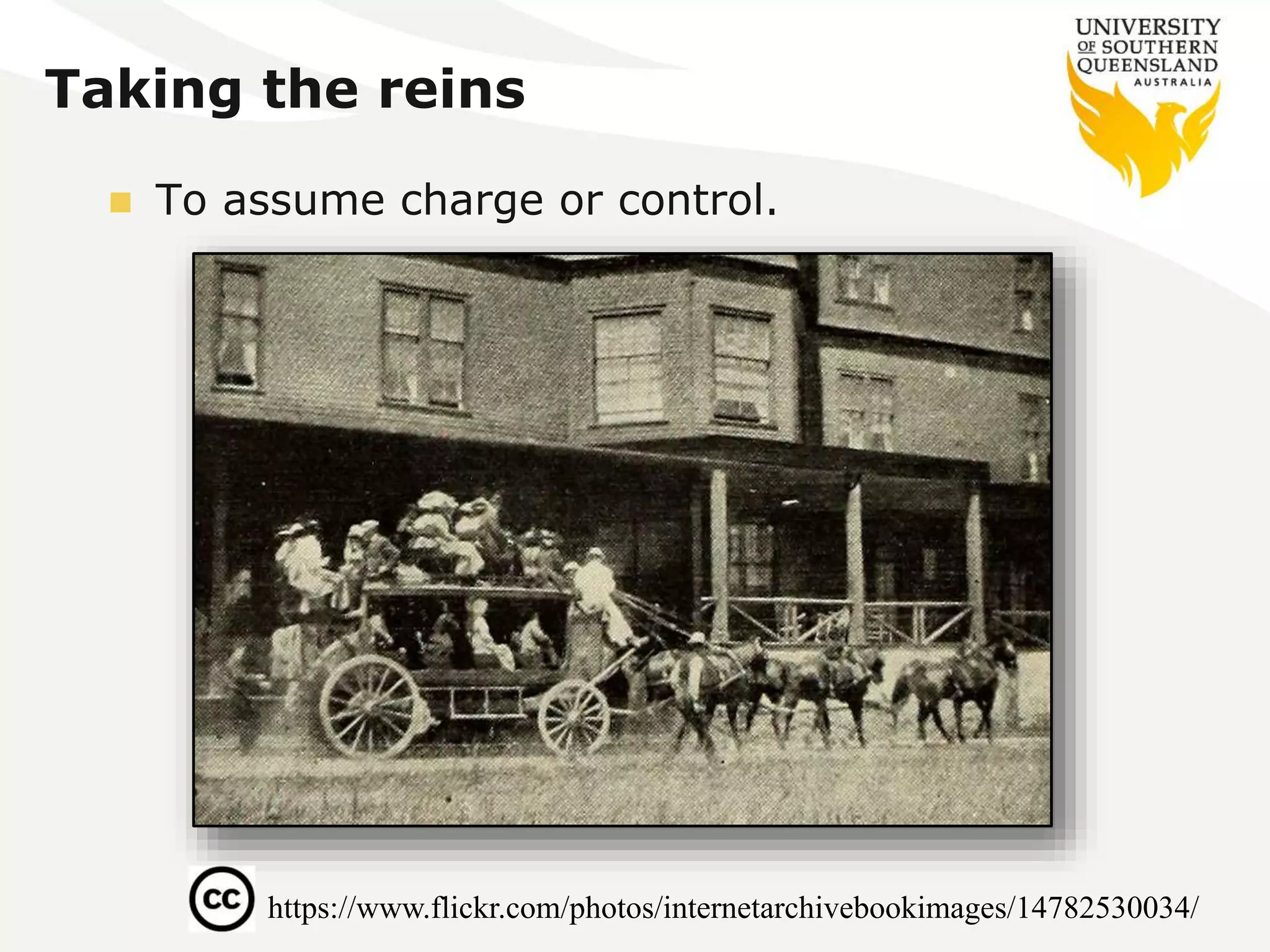
Taking the reins 
 To assume charge or control. 
https://www.flickr.com/photos/internetarchivebookimages/14782530034/
Introduction 
 To understand where we need to go with 
technology enhanced learning (TEL) we also need 
to understand where we currently stand. 
 One approach that has helped many institutions do 
just this is the regular use of benchmarking. 
 More particularly using the Australasian Council on 
Online, Distance and E-Learning (ACODE) 
Benchmarks. 
 This tool allows institutions to: 
 Self-assess their capacity in TEL 
 Share this with other like-minded institutions 
 Incorporate this into their ongoing QA/QI processes 
www.acode.edu.au
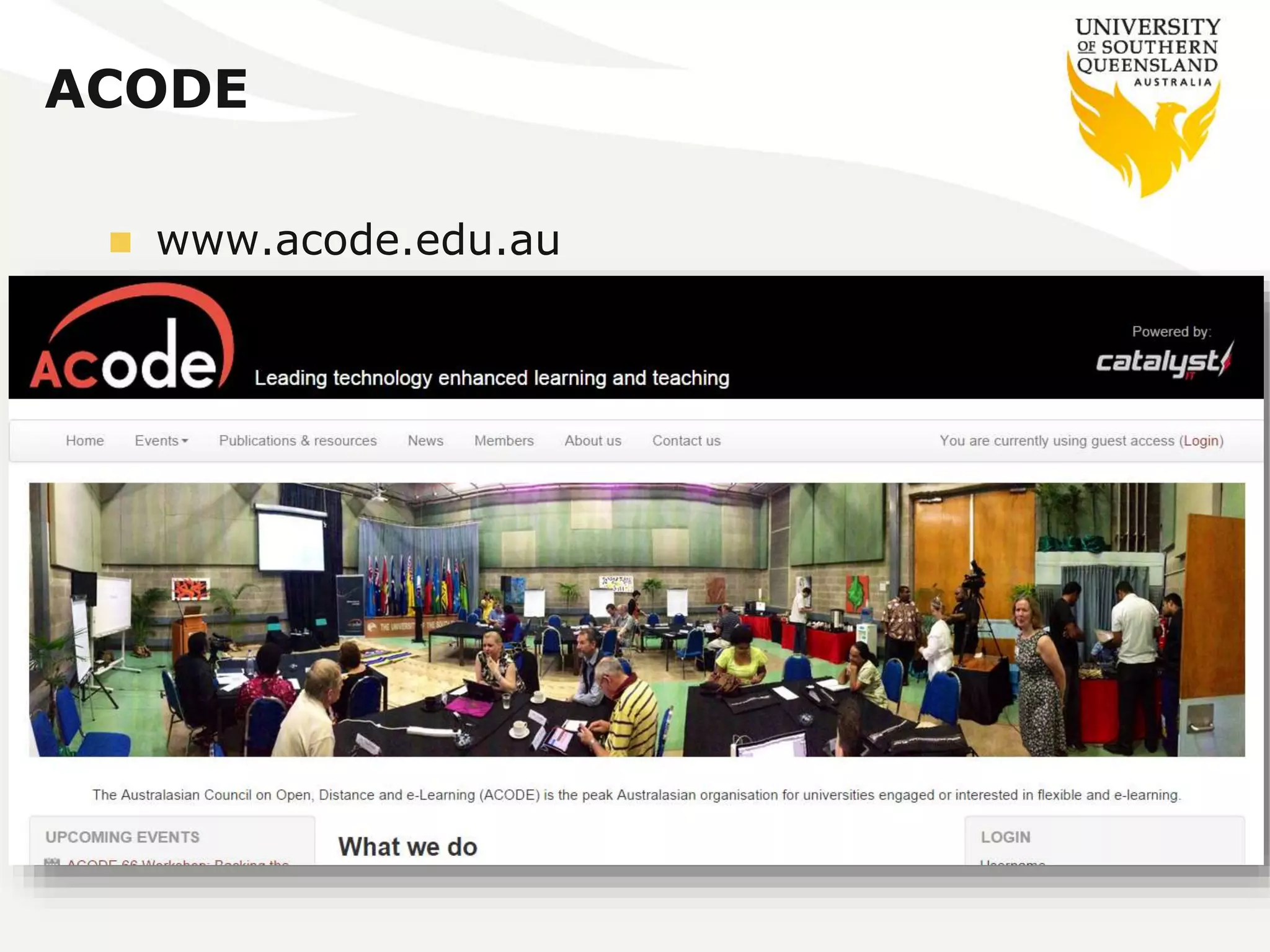
ACODE 
 www.acode.edu.au
What is ACODE 
 ACODE's mission is to enhance policy and practice 
in open, distance and e-learning in Australasian 
higher education by: 
 disseminating and sharing knowledge and expertise; 
 supporting professional development and providing 
networking opportunities; 
 investigating, developing and evaluating new 
approaches; 
 advising and influencing key bodies in higher 
education; and 
 promoting best practice..
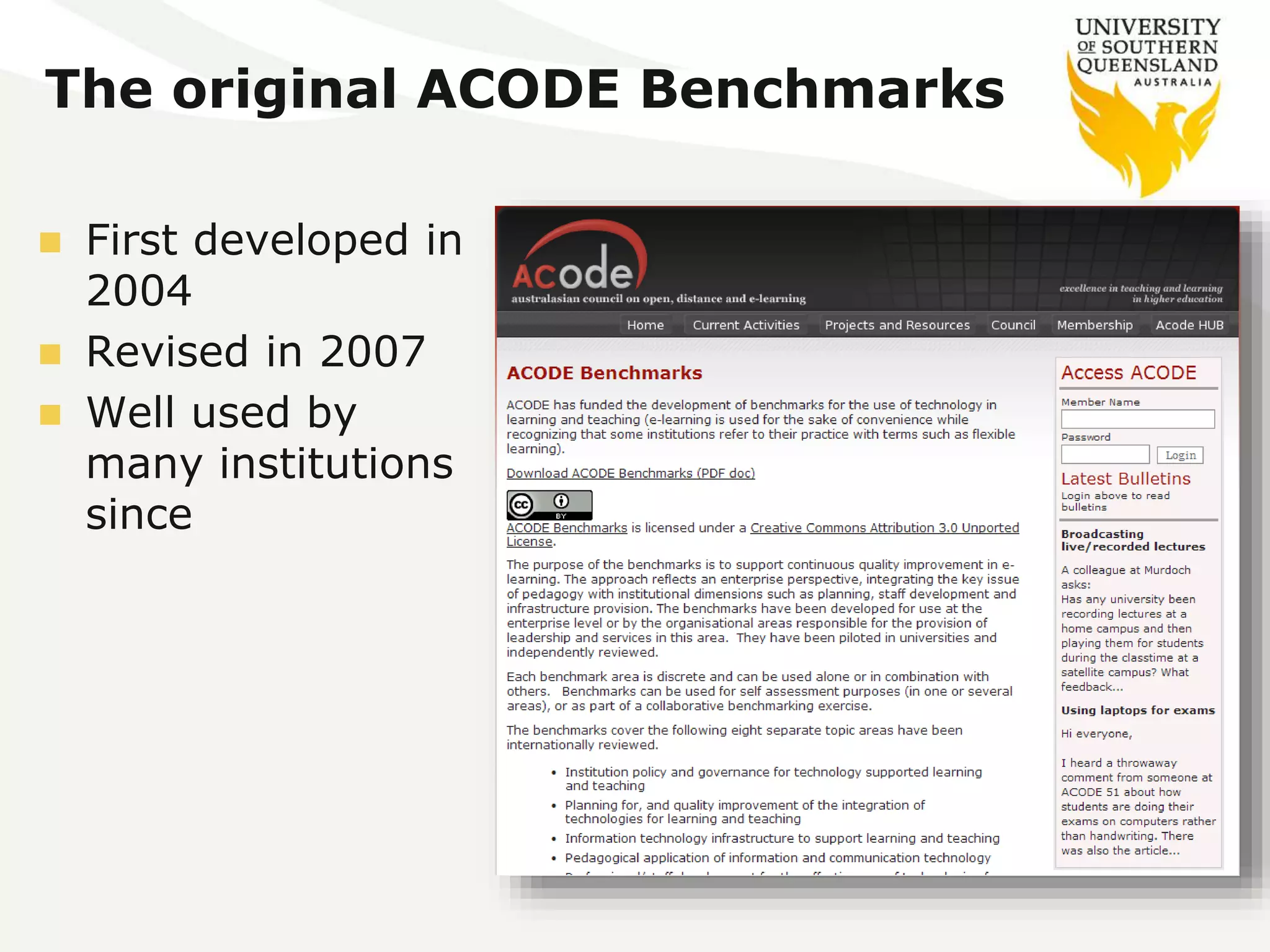
The original ACODE Benchmarks 
 First developed in 
2004 
 Revised in 2007 
 Well used by 
many institutions 
since
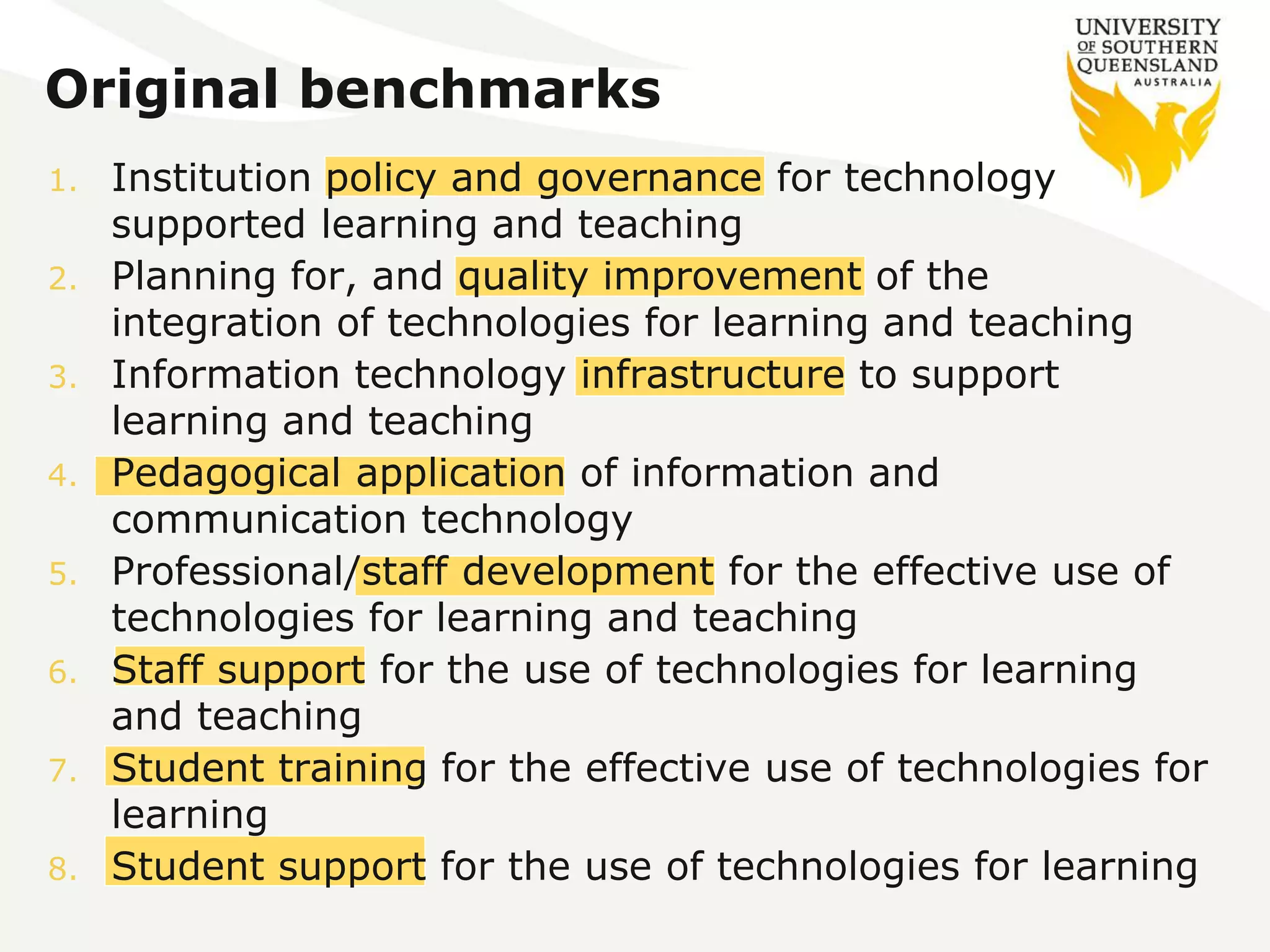
Original benchmarks 
1. Institution policy and governance for technology 
supported learning and teaching 
2. Planning for, and quality improvement of the 
integration of technologies for learning and teaching 
3. Information technology infrastructure to support 
learning and teaching 
4. Pedagogical application of information and 
communication technology 
5. Professional/staff development for the effective use of 
technologies for learning and teaching 
6. Staff support for the use of technologies for learning 
and teaching 
7. Student training for the effective use of technologies for 
learning 
8. Student support for the use of technologies for learning
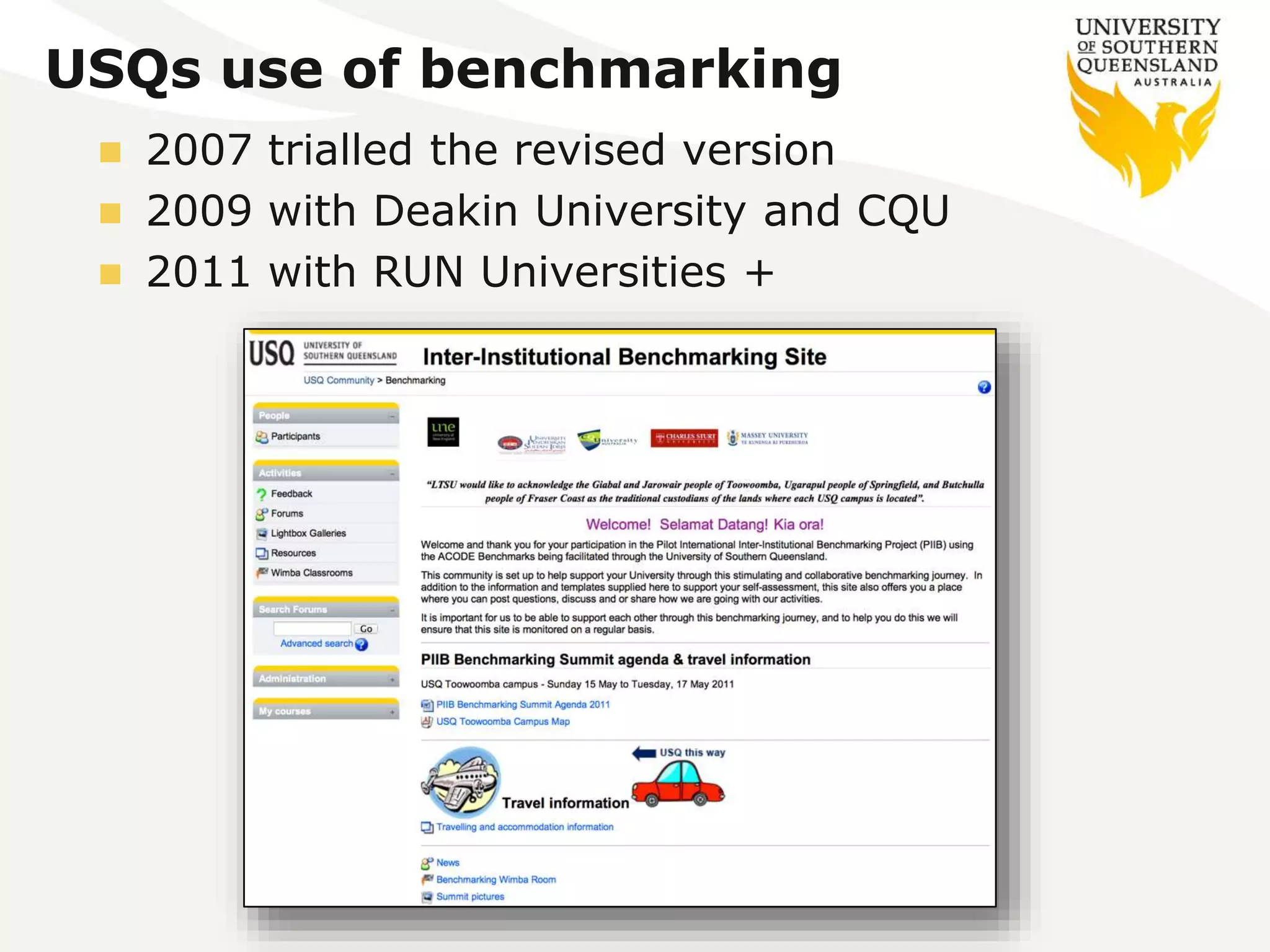
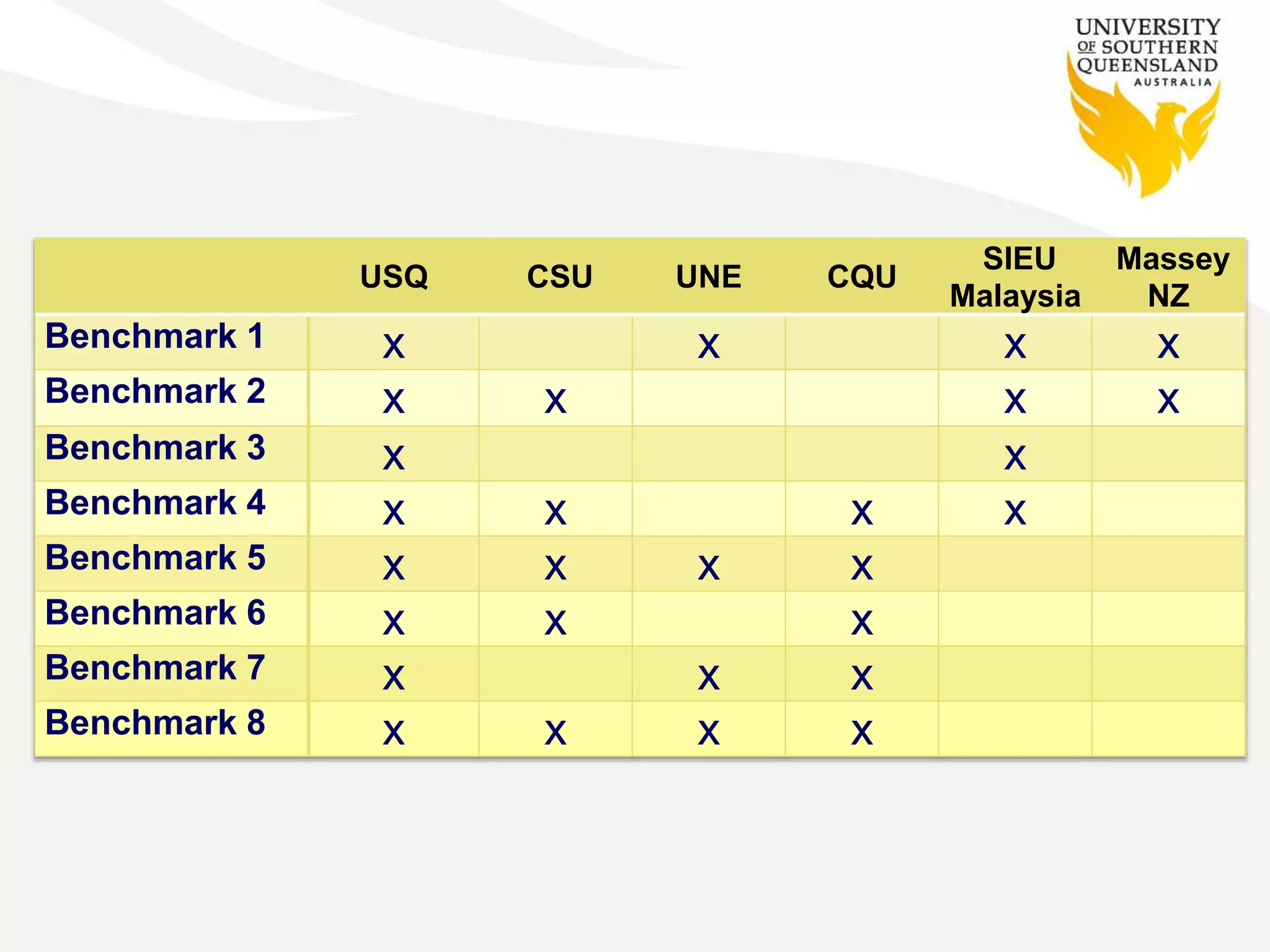
USQs use of benchmarking 
 2007 trialled the revised version 
 2009 with Deakin University and CQU 
 2011 with RUN Universities +
USQ CSU UNE CQU 
SIEU 
Malaysia 
Massey 
NZ 
Benchmark 1 x x x x 
Benchmark 2 x x x x 
Benchmark 3 x x 
Benchmark 4 x x x x 
Benchmark 5 x x x x 
Benchmark 6 x x x 
Benchmark 7 x x x 
Benchmark 8 x x x x
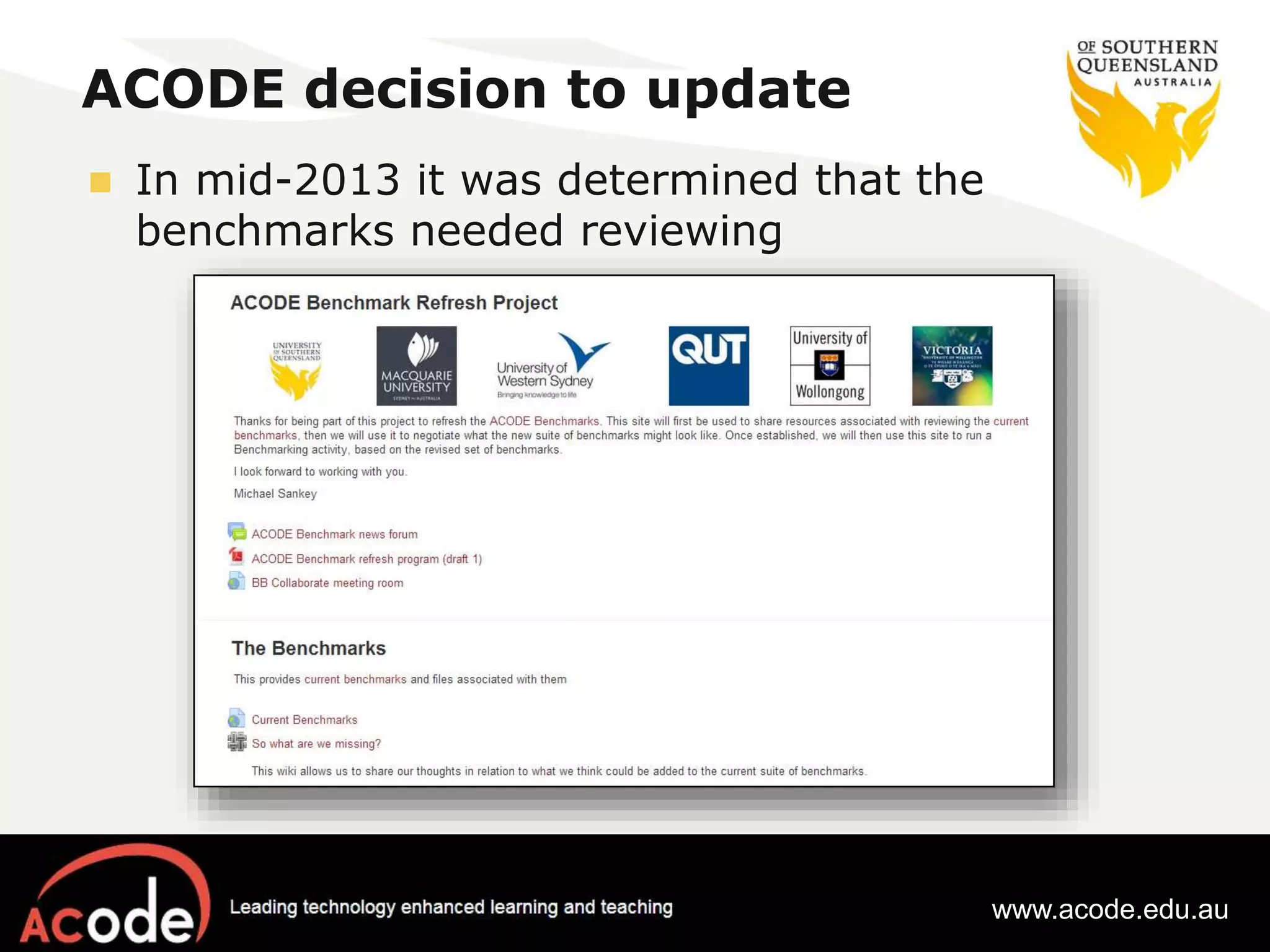
ACODE decision to update 
 In mid-2013 it was determined that the 
benchmarks needed reviewing 
www.acode.edu.au
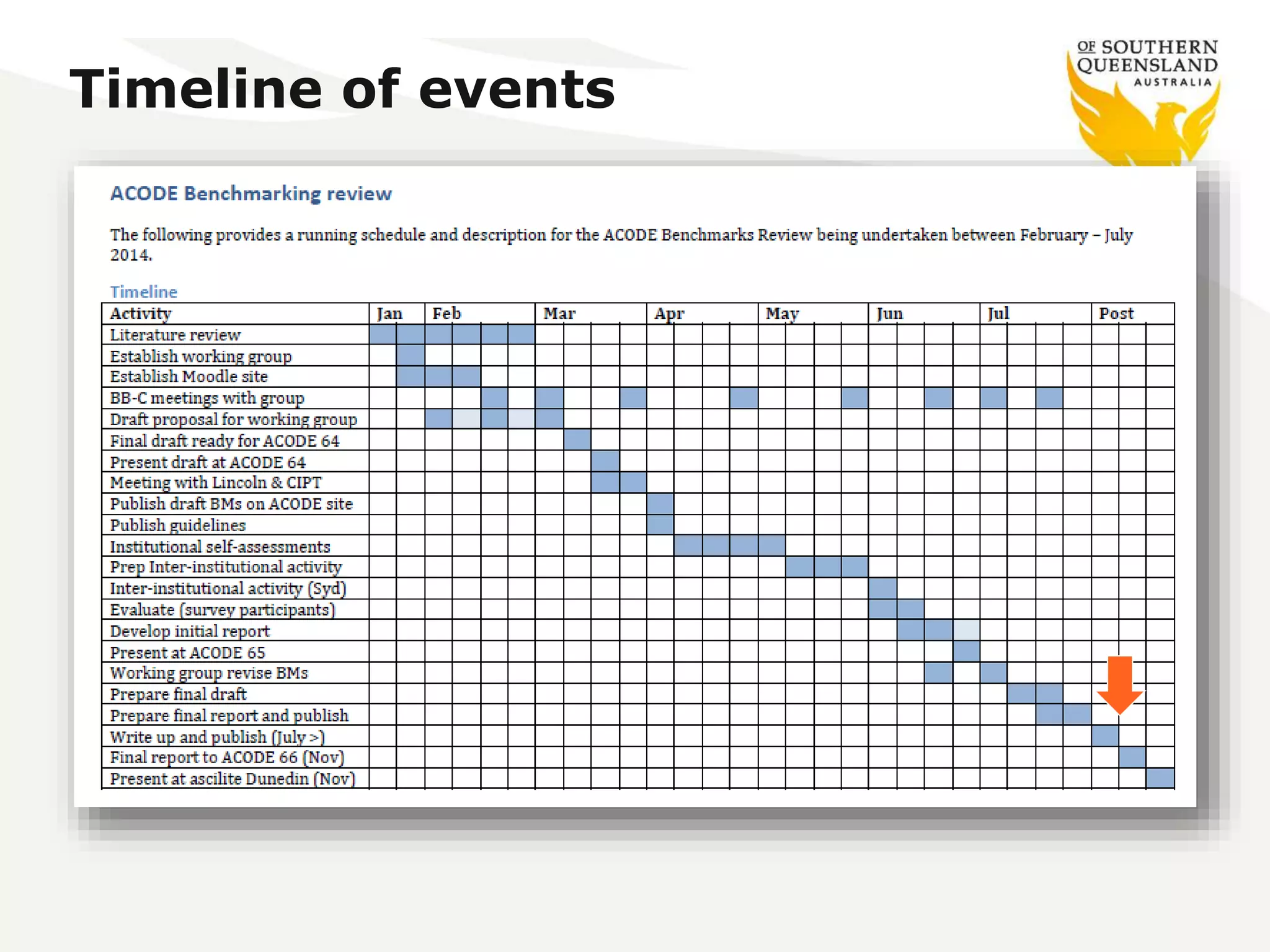
Timeline of events
 Reframed them away from e-Learning to TEL. 
 The boundaries around e-Learning have become 
quite blurred (if they weren’t before). 
 Previously mostly used the main DE institutions. 
 F2F institutions, entering late into the use of the 
LMS, have now seen the business drivers behind 
providing many of their offerings more flexibly. 
 Many of the hallmarks of the first major wave of 
online learning have shifted, e.g. the advent of 
MOOCS, open source software’s, open educational 
resources, App-based online interaction, the rise in 
cloud-based hosting of major institutional system. 
 We have complex mash-ups of internally/externally 
hosted environments, to meet the demand.
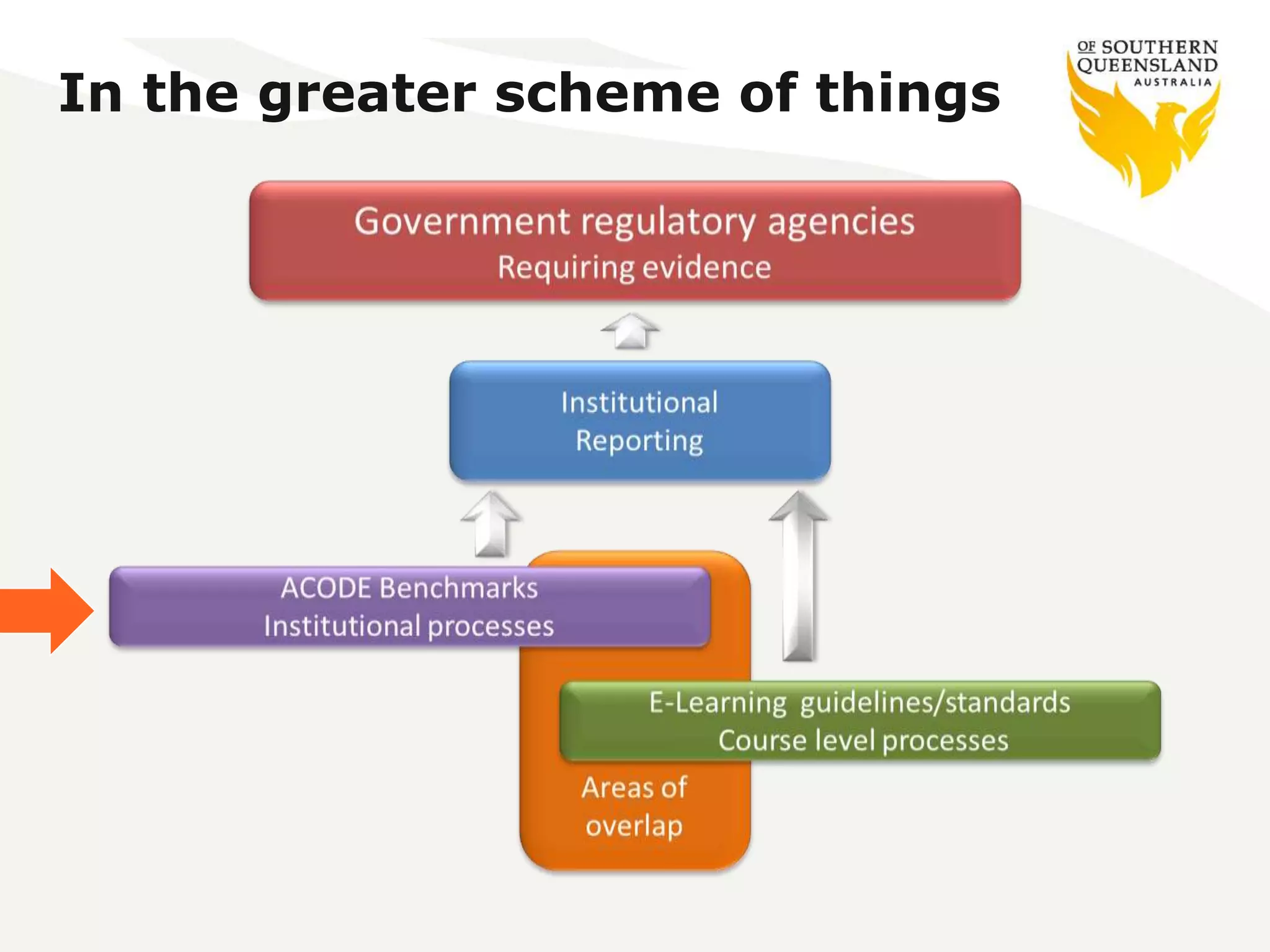
In the greater scheme of things
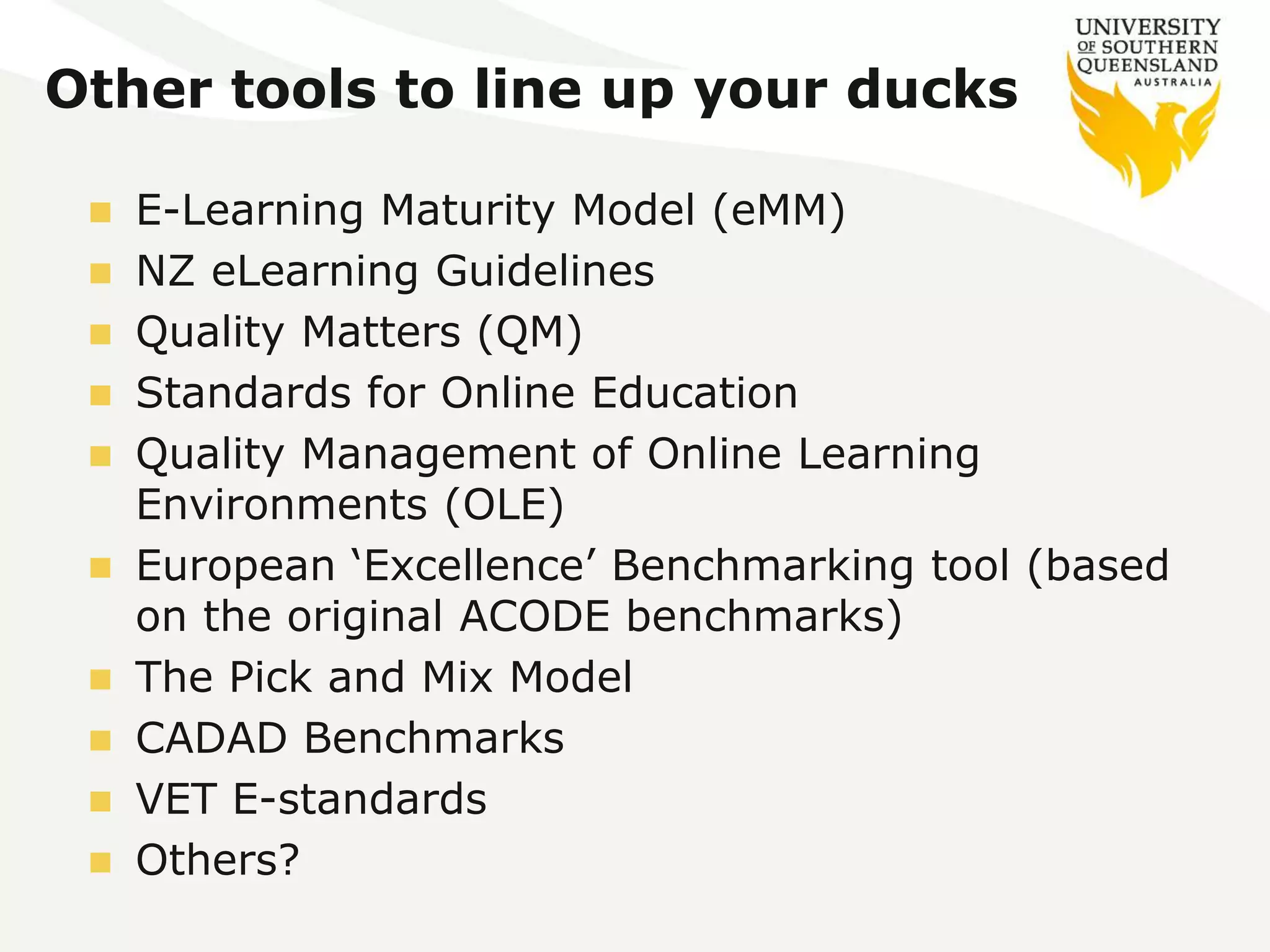
Other tools to line up your ducks 
 E-Learning Maturity Model (eMM) 
 NZ eLearning Guidelines 
 Quality Matters (QM) 
 Standards for Online Education 
 Quality Management of Online Learning 
Environments (OLE) 
 European ‘Excellence’ Benchmarking tool (based 
on the original ACODE benchmarks) 
 The Pick and Mix Model 
 CADAD Benchmarks 
 VET E-standards 
 Others?
Other tools to line up your ducks 
 The Pick and Mix Model 
 E-Learning Maturity Model (eMM) 
 CADAD Benchmarks 
 Others?
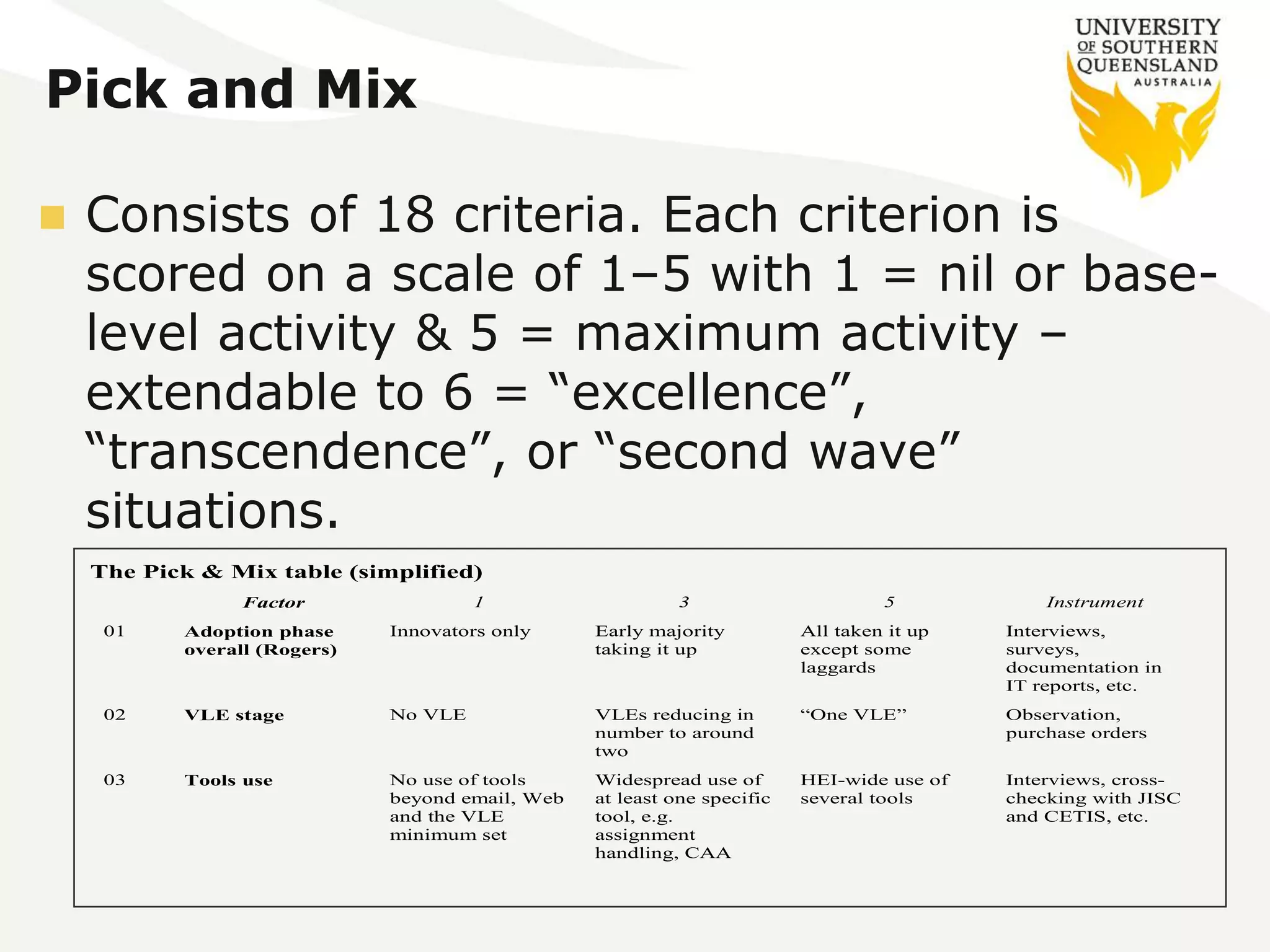
Pick and Mix 
 Consists of 18 criteria. Each criterion is 
scored on a scale of 1–5 with 1 = nil or base-level 
activity & 5 = maximum activity – 
extendable to 6 = “excellence”, 
“transcendence”, or “second wave” 
situations. 
The Pick & Mix table (simplified) 
Factor 1 3 5 Instrument 
01 Adoption phase 
overall (Rogers) 
Innovators only Early majority 
taking it up 
All taken it up 
except some 
laggards 
Interviews, 
surveys, 
documentation in 
IT reports, etc. 
02 VLE stage No VLE VLEs reducing in 
number to around 
two 
“One VLE” Observation, 
purchase orders 
03 Tools use No use of tools 
beyond email, Web 
and the VLE 
minimum set 
Widespread use of 
at least one specific 
tool, e.g. 
assignment 
handling, CAA 
HEI-wide use of 
several tools 
Interviews, cross-checking 
with JISC 
and CETIS, etc.
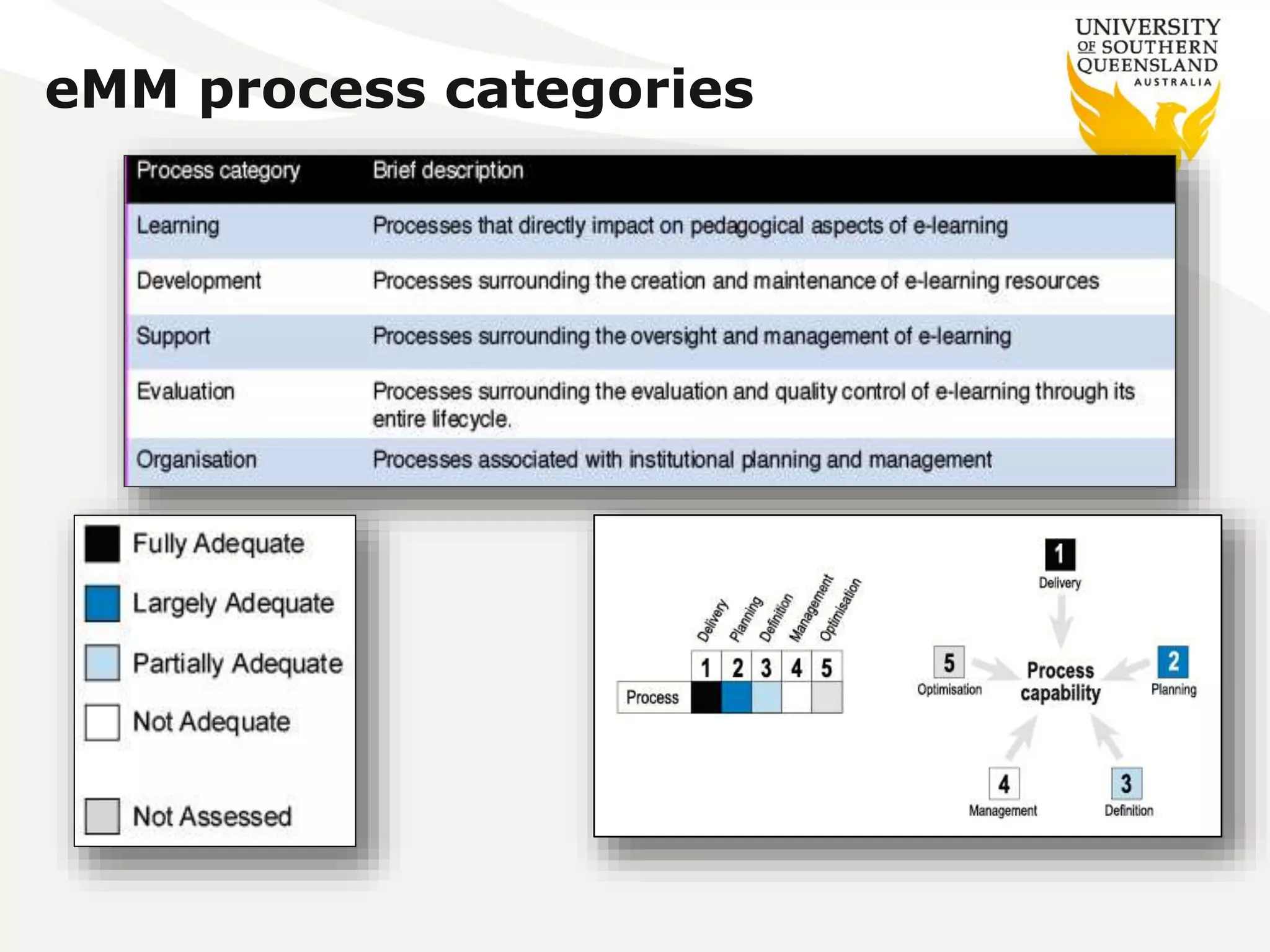
eMM process categories
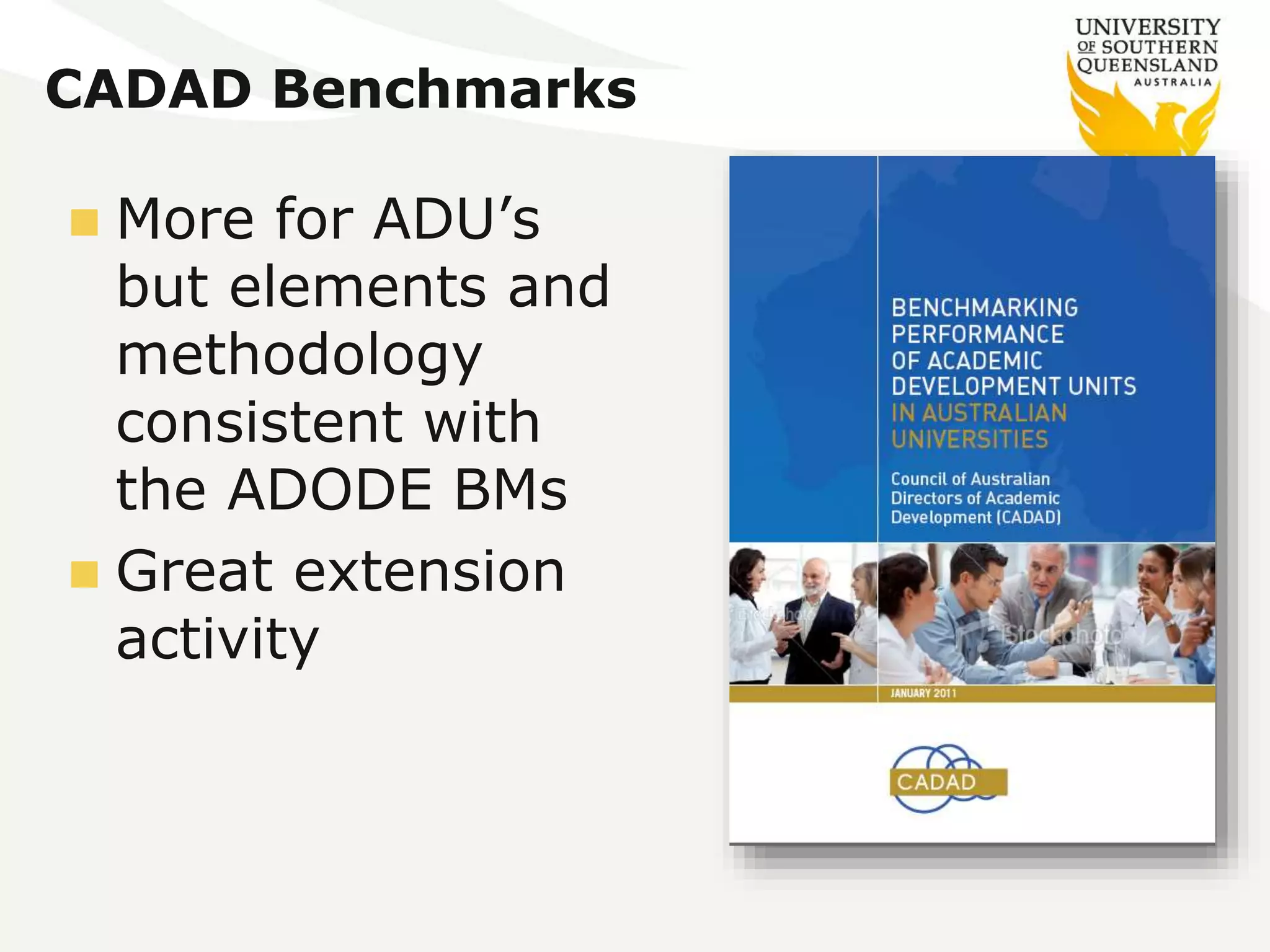
CADAD Benchmarks 
 More for ADU’s 
but elements and 
methodology 
consistent with 
the ADODE BMs 
 Great extension 
activity
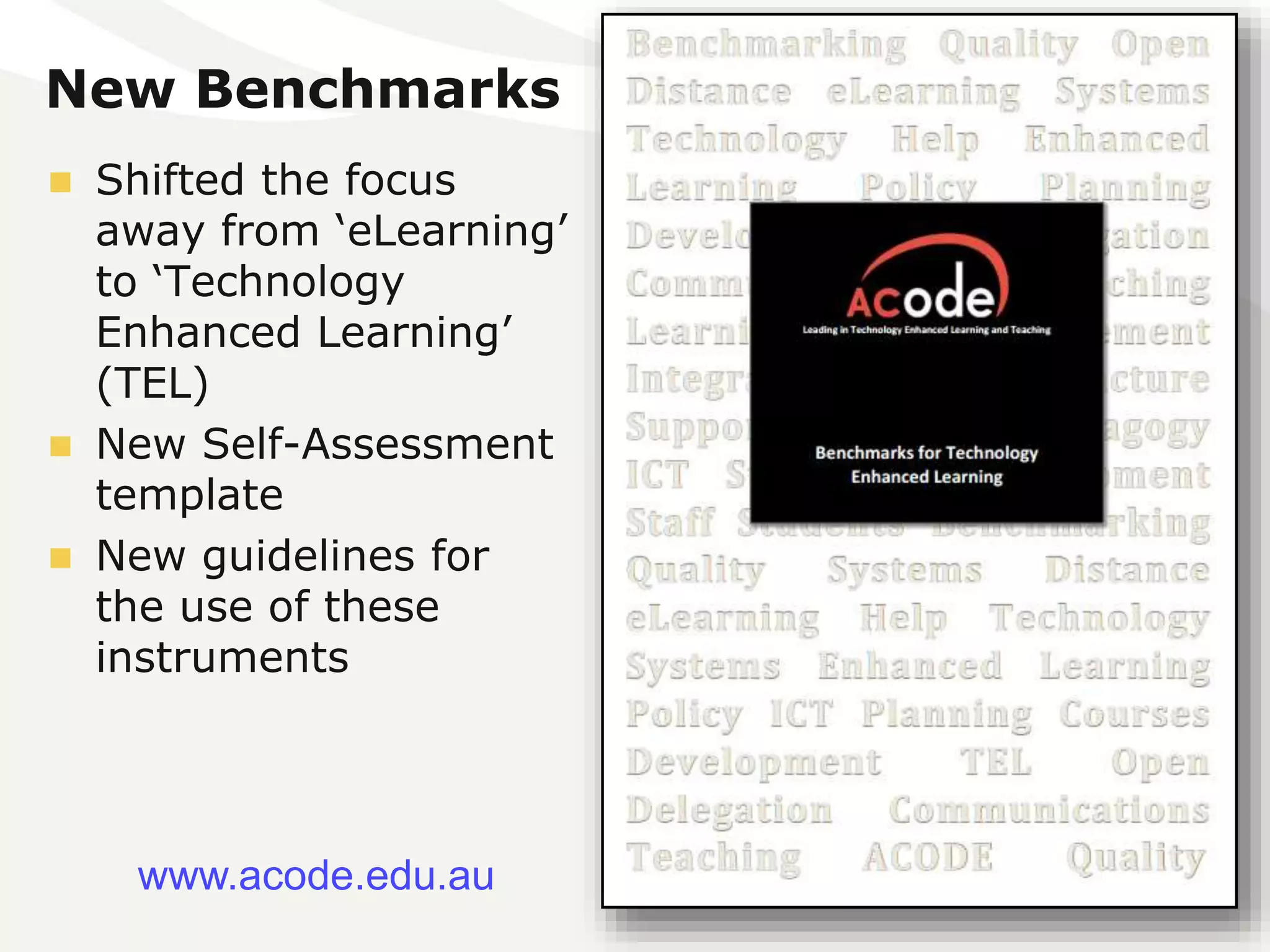
New Benchmarks 
 Shifted the focus 
away from ‘eLearning’ 
to ‘Technology 
Enhanced Learning’ 
(TEL) 
 New Self-Assessment 
template 
 New guidelines for 
the use of these 
instruments 
www.acode.edu.au
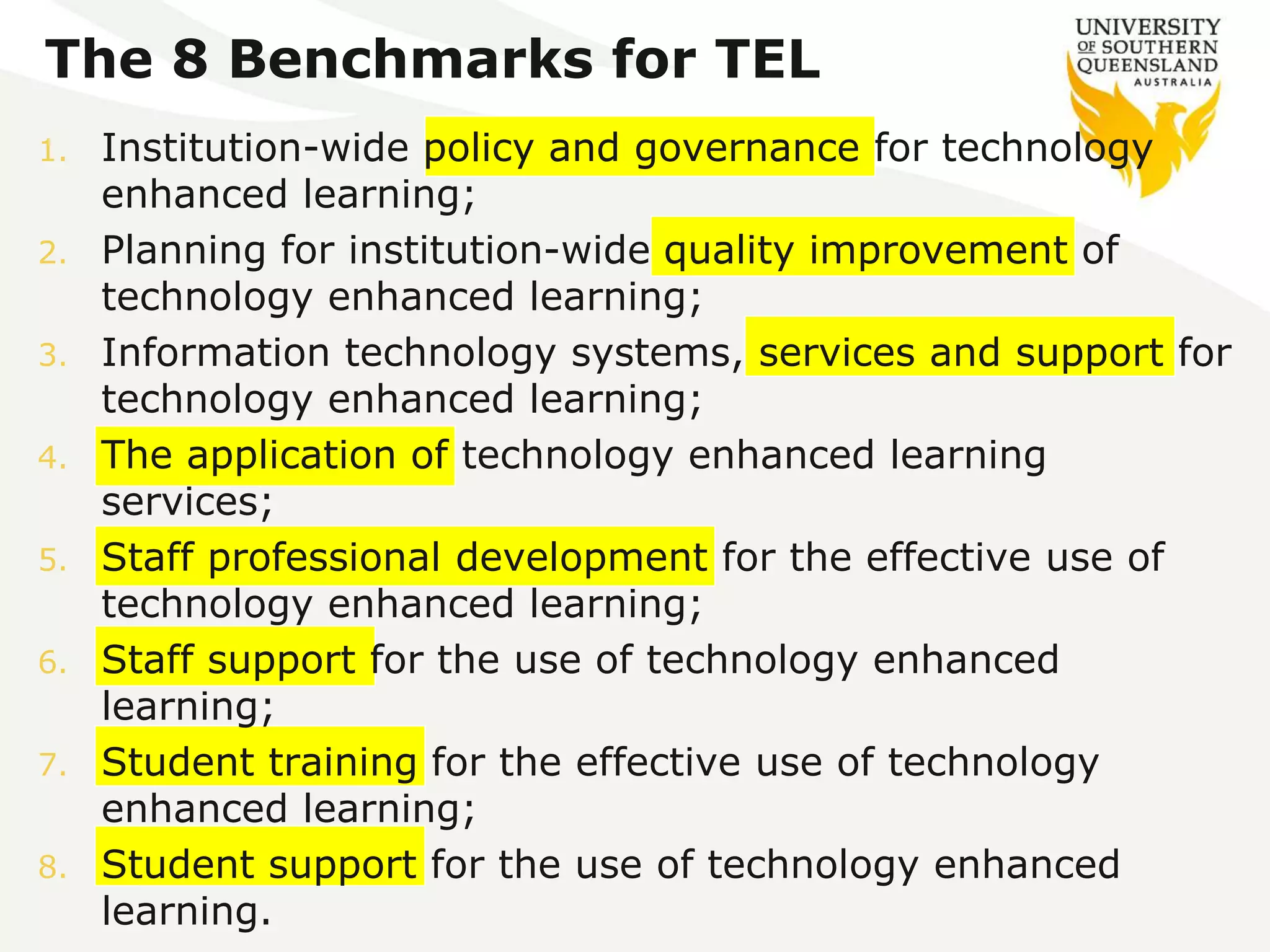
The 8 Benchmarks for TEL 
1. Institution-wide policy and governance for technology 
enhanced learning; 
2. Planning for institution-wide quality improvement of 
technology enhanced learning; 
3. Information technology systems, services and support for 
technology enhanced learning; 
4. The application of technology enhanced learning 
services; 
5. Staff professional development for the effective use of 
technology enhanced learning; 
6. Staff support for the use of technology enhanced 
learning; 
7. Student training for the effective use of technology 
enhanced learning; 
8. Student support for the use of technology enhanced 
learning.
Some fundamental changes 
 The introduction of a much stronger alignment 
with L&T standards and assuming there is in 
existence a way to measure the quality of an 
individual course/unit/subject. 
 A greater emphasis on emerging technologies and 
innovation, particularly in planning and 
budgeting. 
 A new measure around open education practices 
and the sustainable use of resources, 
 A measure on how institutions are assuring a 
level of quality in their externally hosted services.
Extension 
 We also developed a methodology to: 
1. Provide institutions with a platform to self-access 
their standing against some/all of the 8 
benchmarks, and to stimulate meaningful 
conversations, at a local level, around how they 
are using technology to support their L&T. 
2. Provide institutions with an opportunity to share 
& learn from each other, based on their 
individual institutions responses (via an inter-institutional 
event).
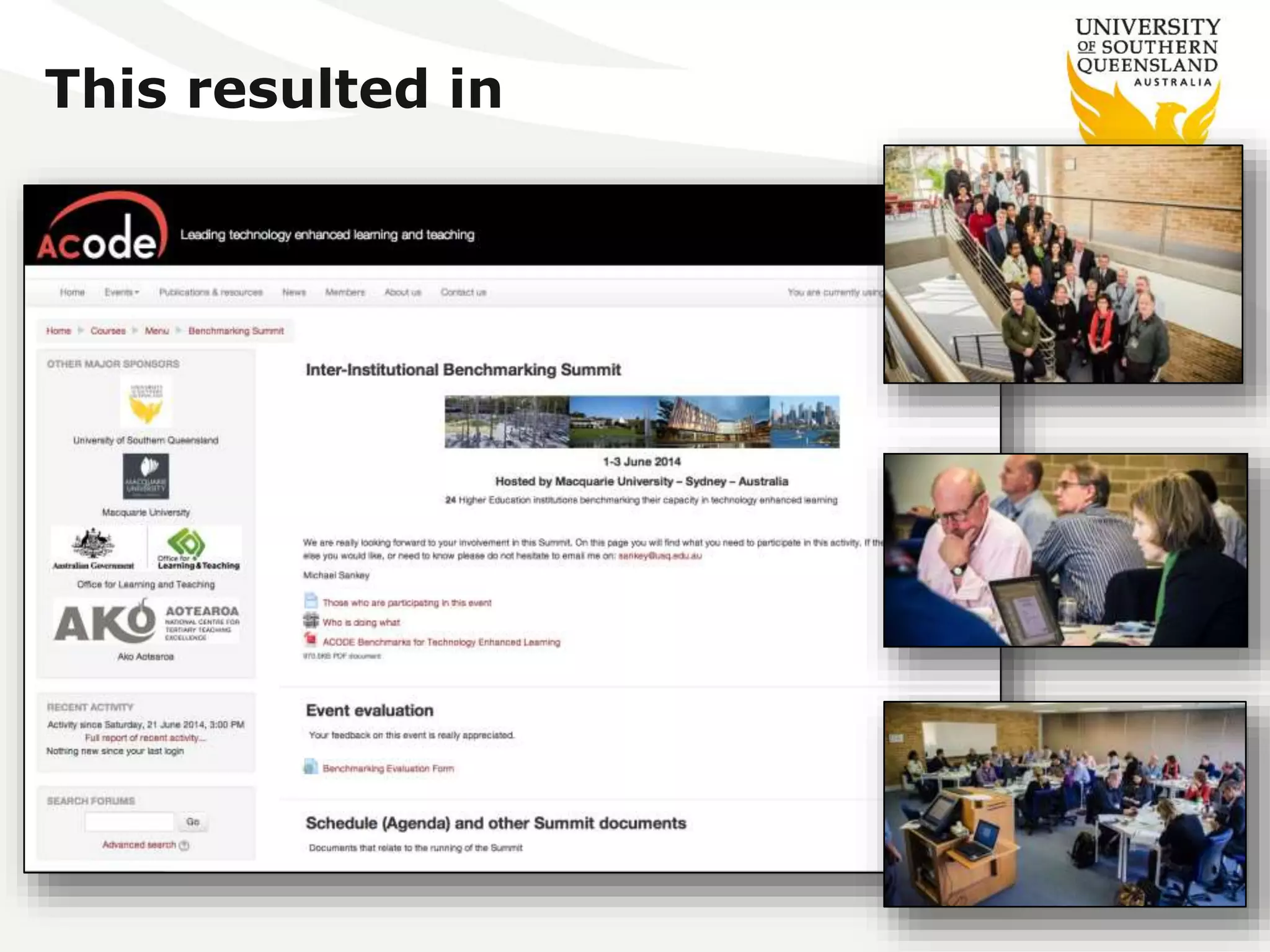
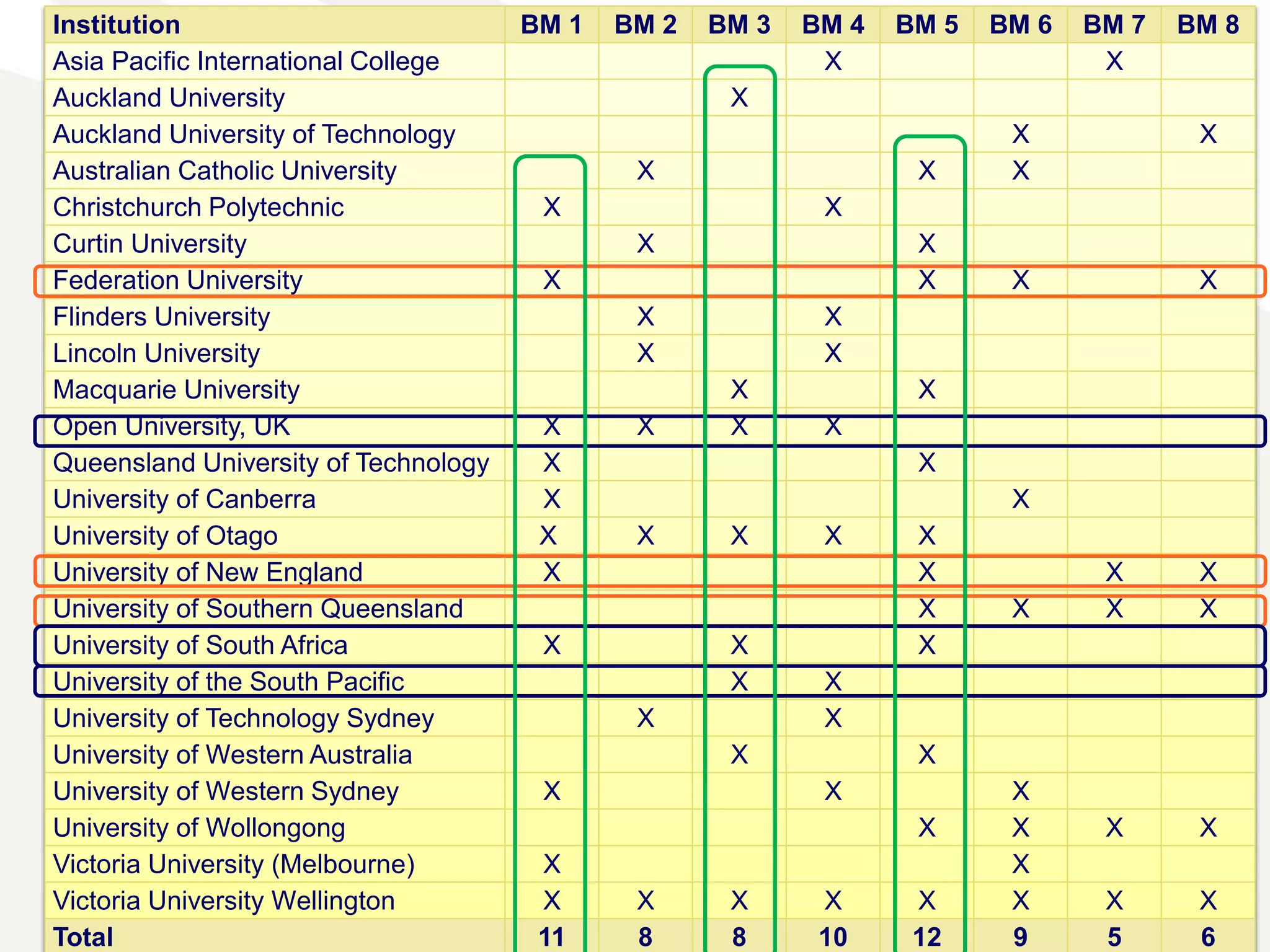
This resulted in
Institution BM 1 BM 2 BM 3 BM 4 BM 5 BM 6 BM 7 BM 8 
Asia Pacific International College X X 
Auckland University X 
Auckland University of Technology X X 
Australian Catholic University X X X 
Christchurch Polytechnic X X 
Curtin University X X 
Federation University X X X X 
Flinders University X X 
Lincoln University X X 
Macquarie University X X 
Open University, UK X X X X 
Queensland University of Technology X X 
University of Canberra X X 
University of Otago X X X X X 
University of New England X X X X 
University of Southern Queensland X X X X 
University of South Africa X X X 
University of the South Pacific X X 
University of Technology Sydney X X 
University of Western Australia X X 
University of Western Sydney X X X 
University of Wollongong X X X X 
Victoria University (Melbourne) X X 
Victoria University Wellington X X X X X X X X 
Total 11 8 8 10 12 9 5 6
But to get to this point… 
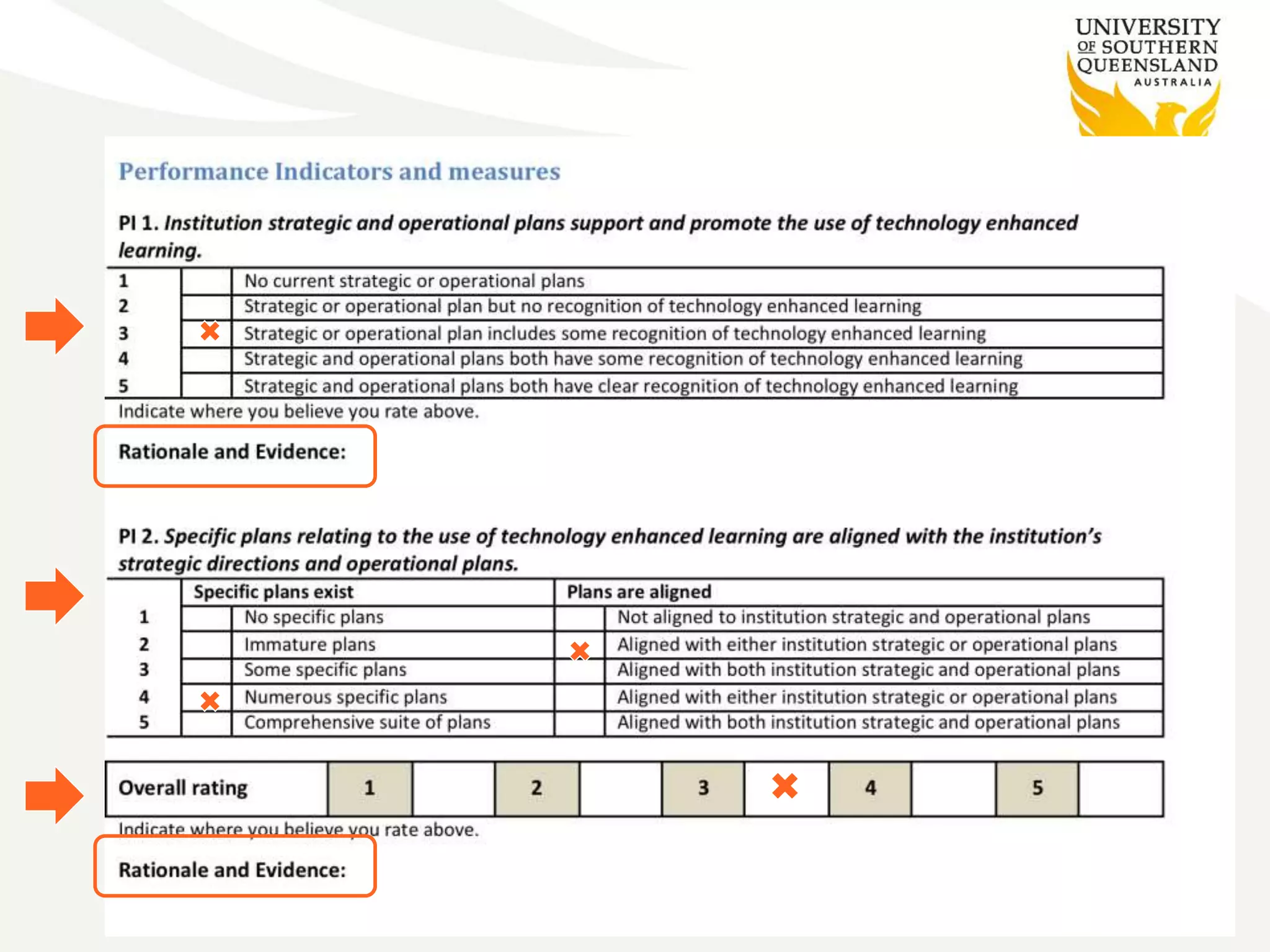
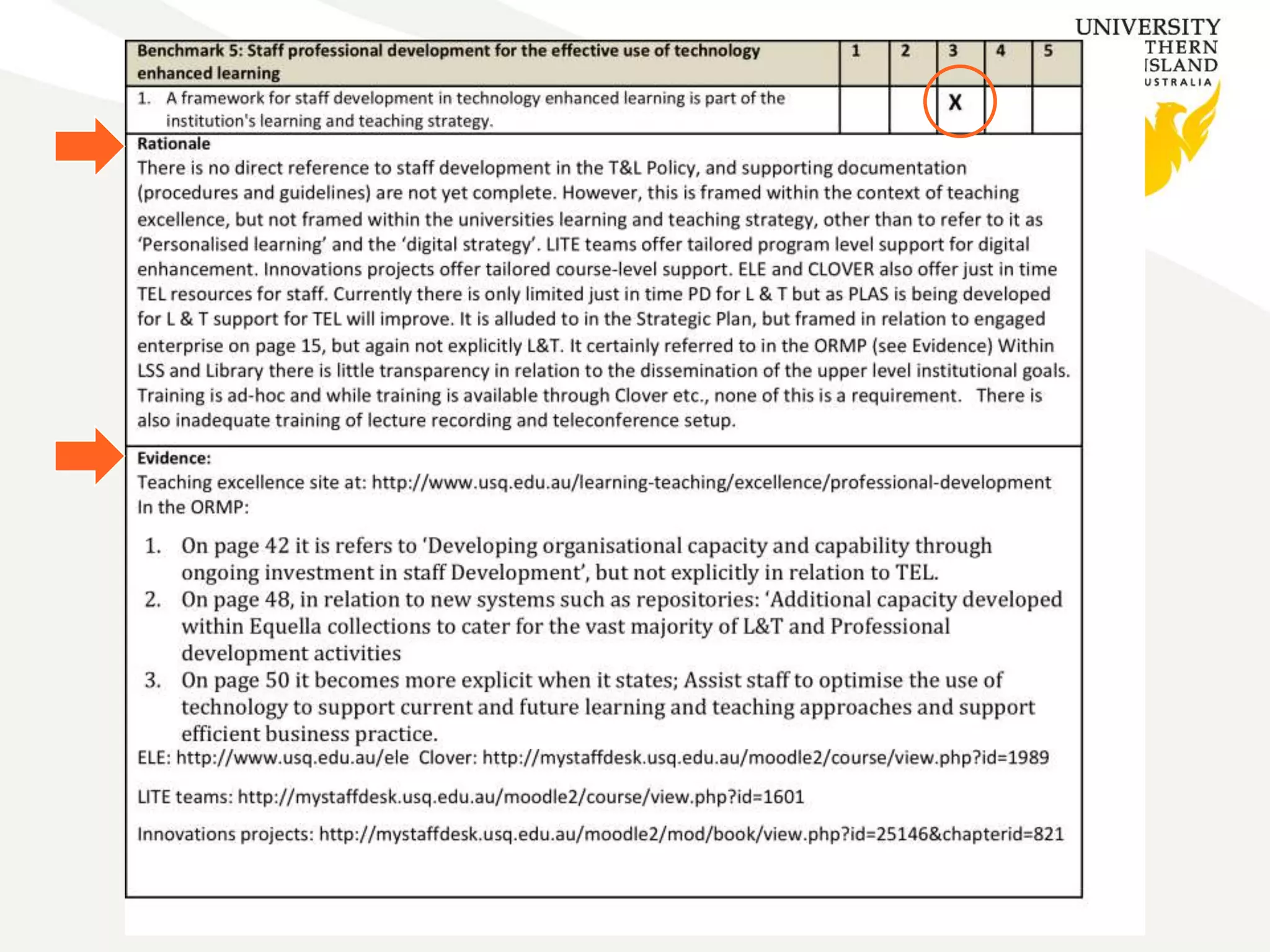
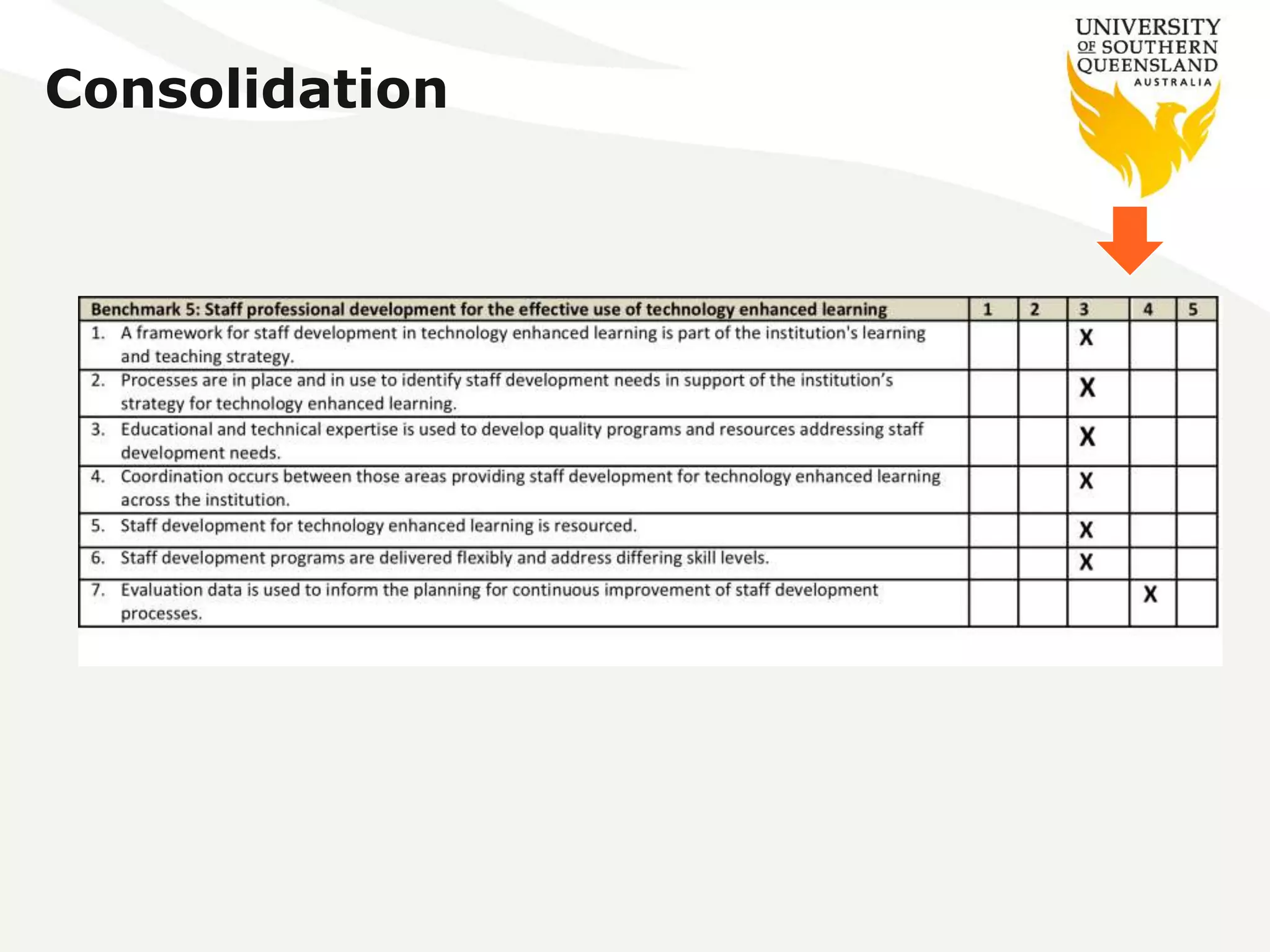
 We first had to do a self assessment 
 Pull people together from different sections 
 Agree on where we stood 
 Provide a rationale and evidence as to why
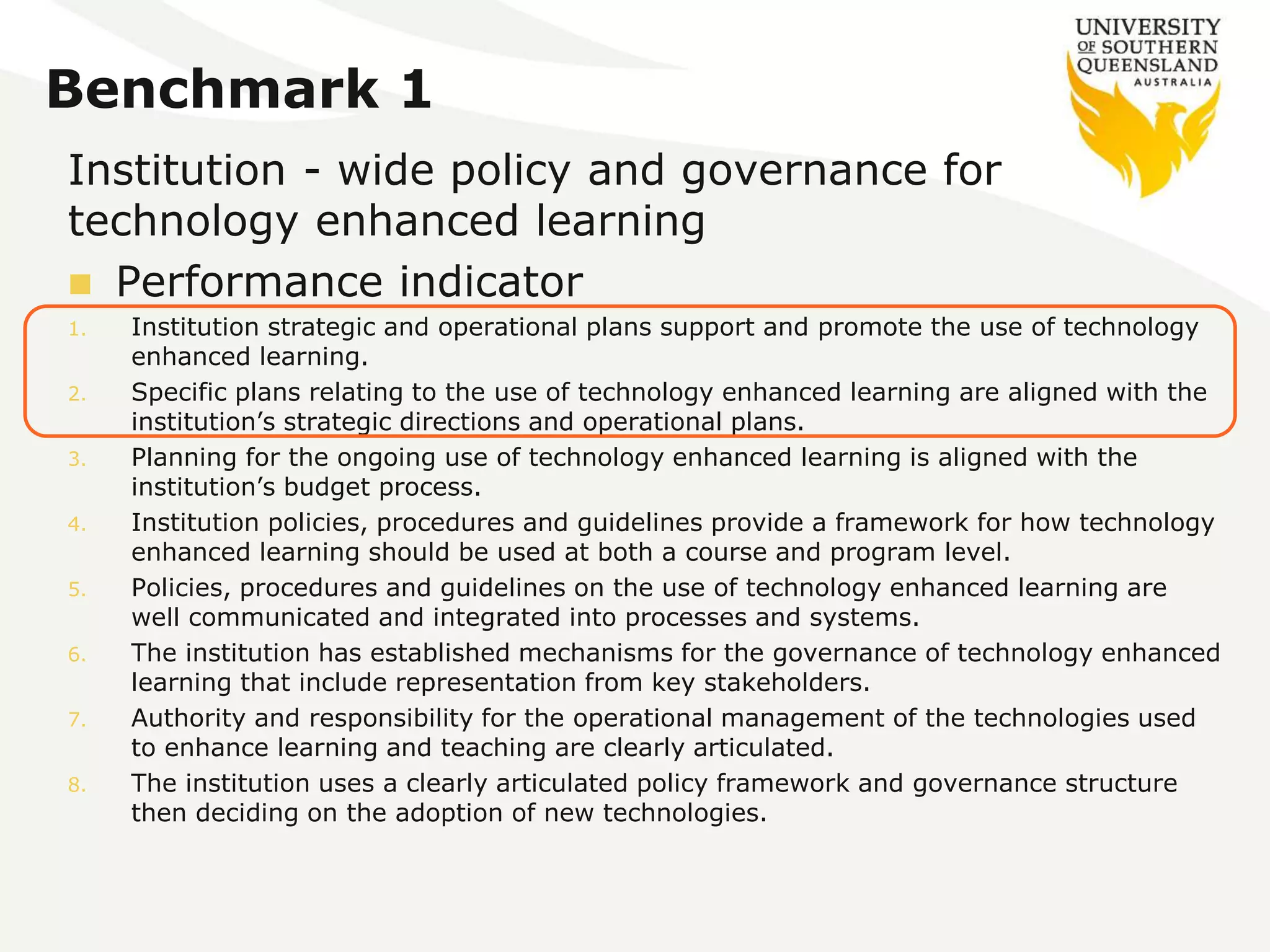
Benchmark 1 
Institution - wide policy and governance for 
technology enhanced learning 
 Performance indicator 
1. Institution strategic and operational plans support and promote the use of technology 
enhanced learning. 
2. Specific plans relating to the use of technology enhanced learning are aligned with the 
institution’s strategic directions and operational plans. 
3. Planning for the ongoing use of technology enhanced learning is aligned with the 
institution’s budget process. 
4. Institution policies, procedures and guidelines provide a framework for how technology 
enhanced learning should be used at both a course and program level. 
5. Policies, procedures and guidelines on the use of technology enhanced learning are 
well communicated and integrated into processes and systems. 
6. The institution has established mechanisms for the governance of technology enhanced 
learning that include representation from key stakeholders. 
7. Authority and responsibility for the operational management of the technologies used 
to enhance learning and teaching are clearly articulated. 
8. The institution uses a clearly articulated policy framework and governance structure 
then deciding on the adoption of new technologies.
Consolidation
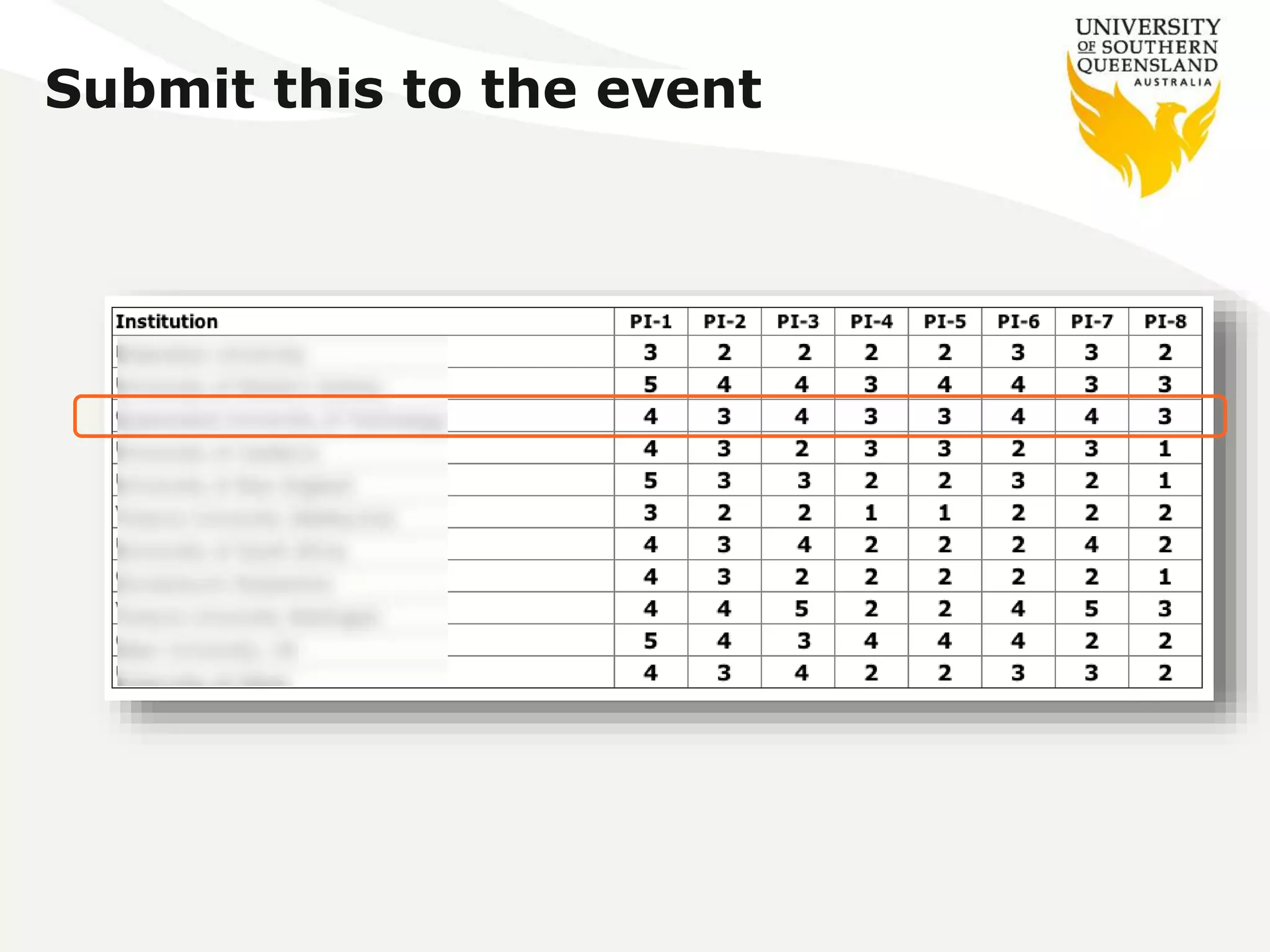
Submit this to the event
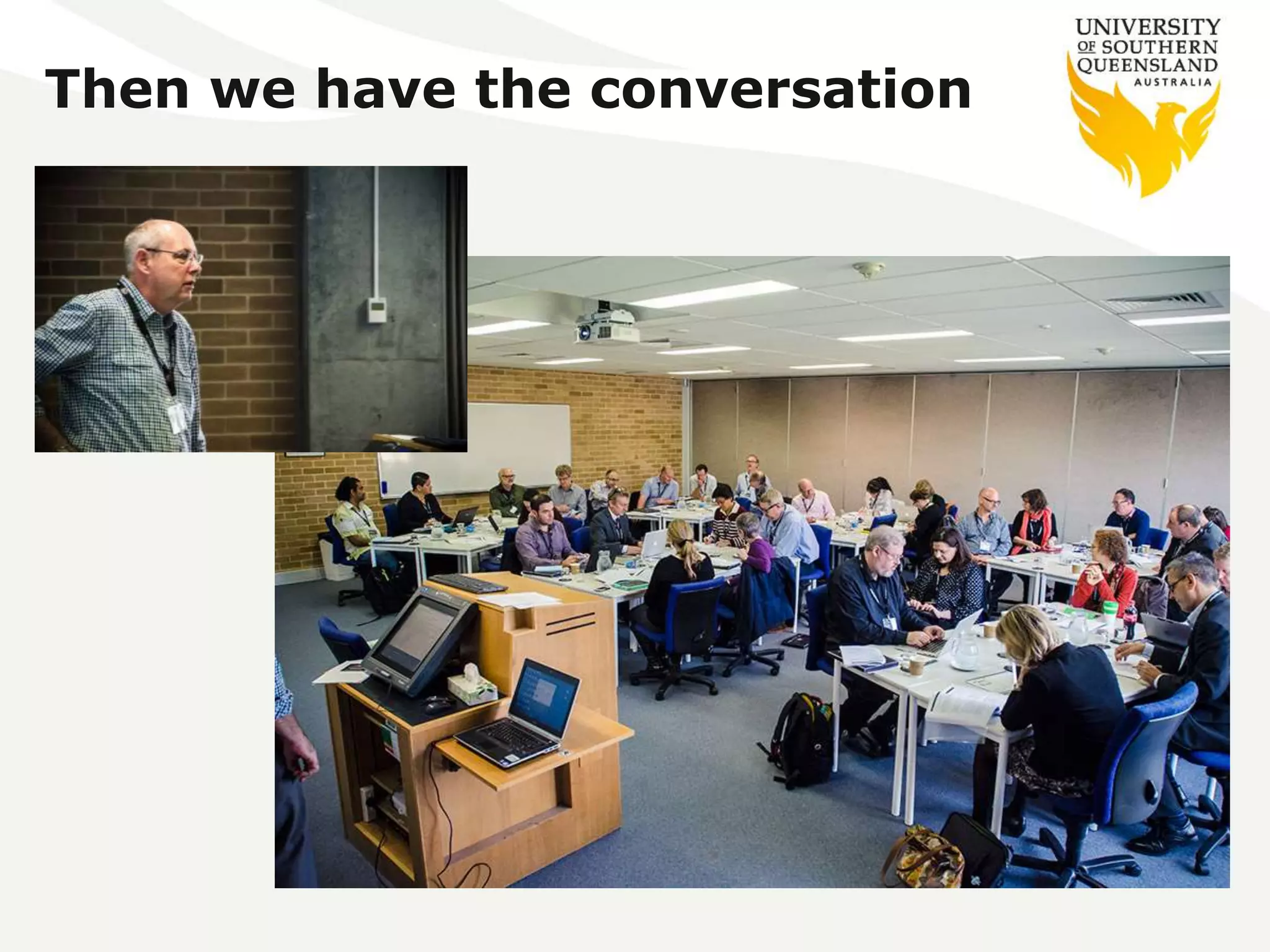
Then we have the conversation
The beauty of the beast 
 The beauty of benchmarking is not around 
which tool or set of standards you are 
using, it's more about the dialogue that 
emerges and the sharing of practice that is 
the real winner for all concerned. 
 It opens the door for further collaboration. 
 It serves as a mechanism to facilitate 
discussion at senior leadership level.
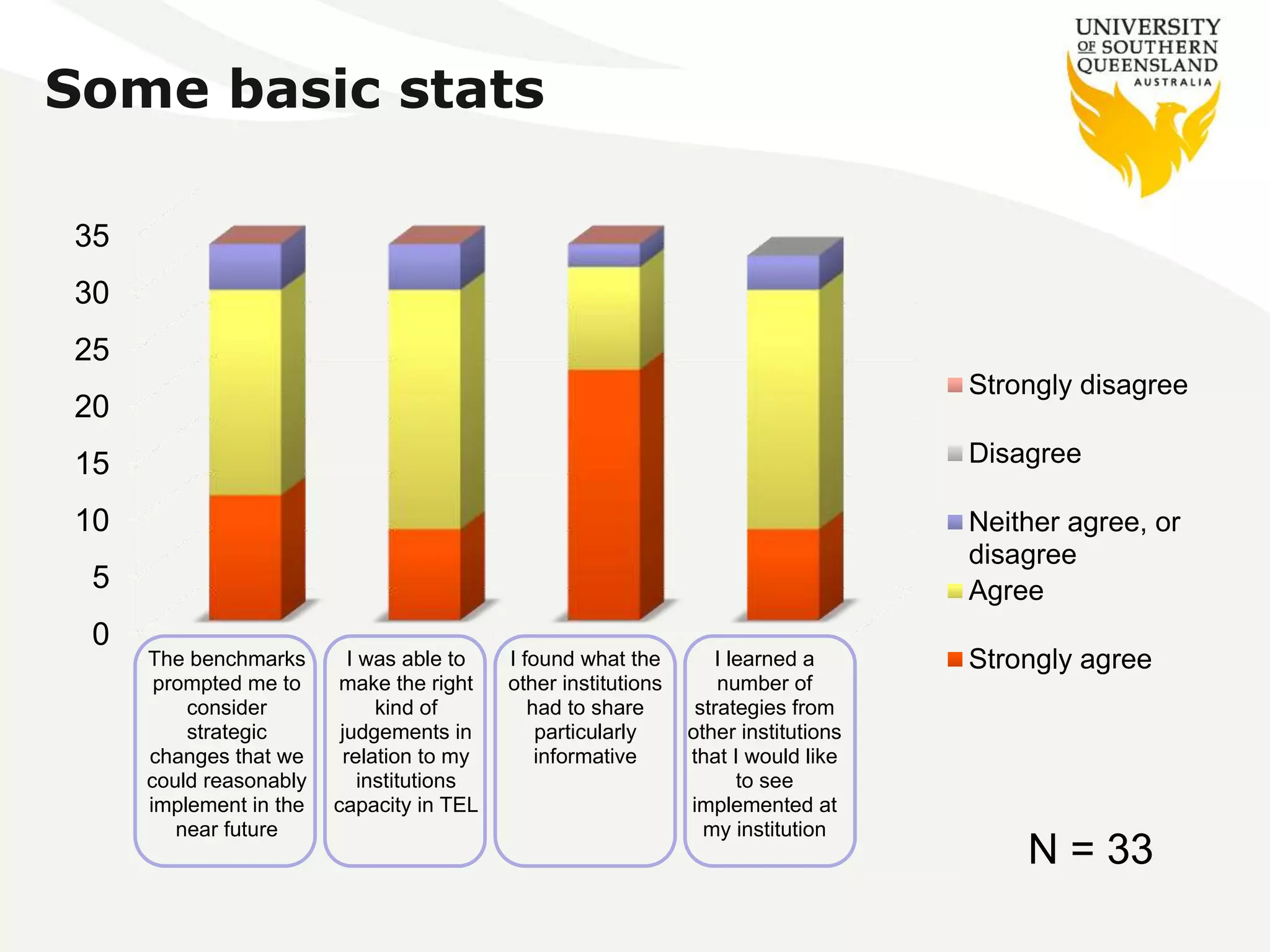
Some basic stats 
35 
30 
25 
20 
15 
10 
5 
0 
The benchmarks 
prompted me to 
consider 
strategic 
changes that we 
could reasonably 
implement in the 
near future 
I was able to 
make the right 
kind of 
judgements in 
relation to my 
institutions 
capacity in TEL 
I found what the 
other institutions 
had to share 
particularly 
informative 
I learned a 
number of 
strategies from 
other institutions 
that I would like 
to see 
implemented at 
my institution 
Strongly disagree 
Disagree 
Neither agree, or 
disagree 
Agree 
Strongly agree 
N = 33
A couple of comments 
 “Great opportunity to meet and share where 
everyone is at. The benchmarking exercise is a 
great self reflective practice that is reinforced 
through the feedback and deliberation from other 
institutions” 
 “I really enjoyed this Benchmarking Summit, I 
have learned a lot from the inter-institutional 
activity and will definitely be sharing and pushing 
for these benchmarks to be accepted at our 
institution. Thank you for facilitating this and look 
forward to the institution following up with the 
benchmarks in the future.”
What does this mean for DE 
 Dealing with this specific demographic requires 
institutions to ensure their processes and systems 
are regularly reviewed, to remain agile and act 
responsibly toward this unique client base, that is 
somewhat different to metropolitan institutions. 
 E.G. There are a number of common issues faced 
by institutions with a strong DE focus. 
 Students who rarely, or never, come on campus require more 
holistic support mechanisms and follow-up 
 Student training (online) and induction is more important 
 Staff need to be trained to deal with distance students (specifically) 
 Staff support needs a broader focus
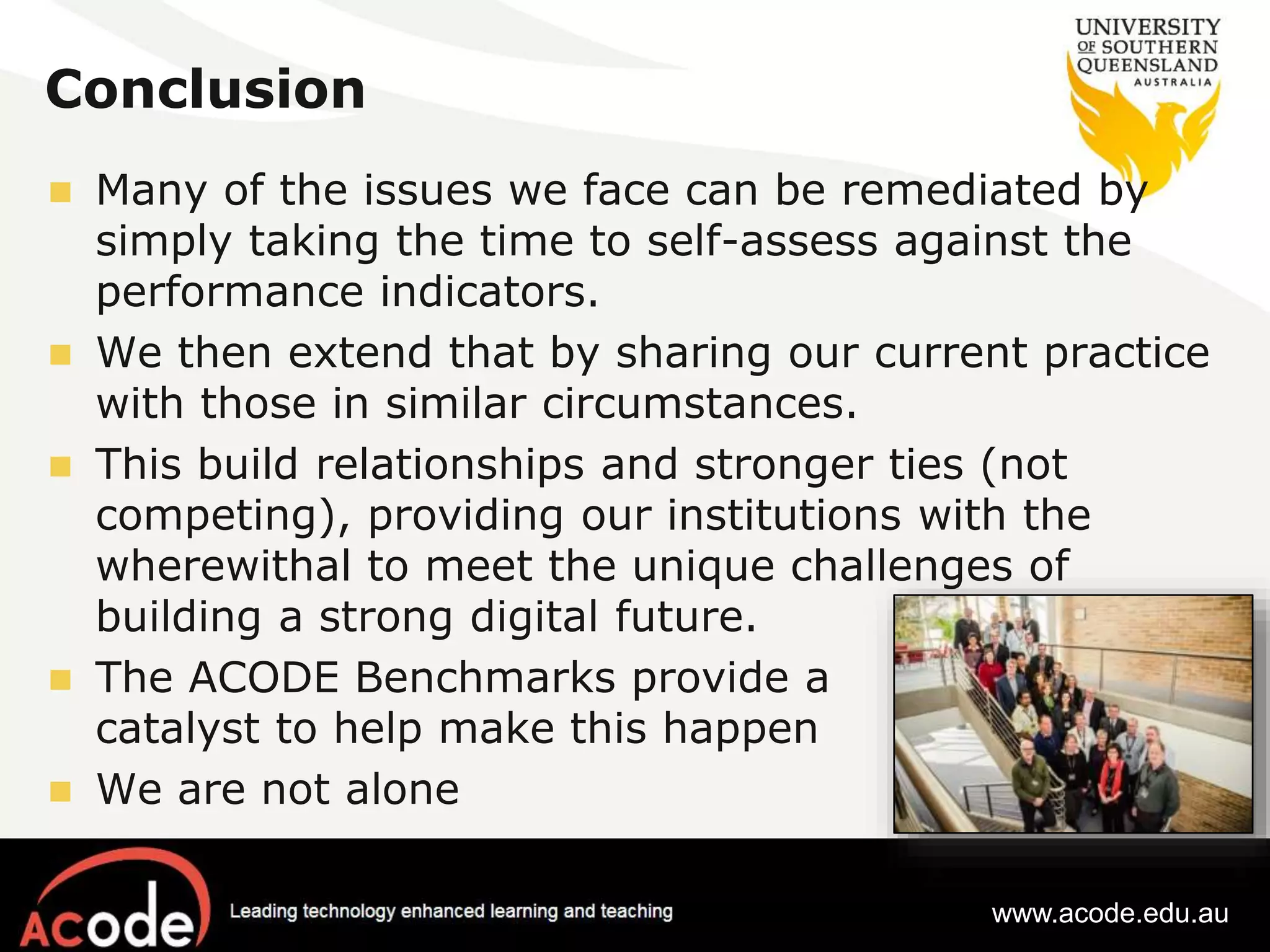
Conclusion 
 Many of the issues we face can be remediated by 
simply taking the time to self-assess against the 
performance indicators. 
 We then extend that by sharing our current practice 
with those in similar circumstances. 
 This build relationships and stronger ties (not 
competing), providing our institutions with the 
wherewithal to meet the unique challenges of 
building a strong digital future. 
 The ACODE Benchmarks provide a 
catalyst to help make this happen 
 We are not alone 
www.acode.edu.au

Benchmarking your capacity for technology enhanced learning

  • 1.
    Benchmarking your capacityfor technology enhanced learning: Helping you take the reins Associate Professor Michael Sankey Director, Learning Environments and Media University of Southern Queensland Member ACODE Executive Presented at the University of South Africa, Thursday 18 September 2014
  • 2.
    Taking the reins  To assume charge or control. https://www.flickr.com/photos/internetarchivebookimages/14782530034/
  • 3.
    Introduction  Tounderstand where we need to go with technology enhanced learning (TEL) we also need to understand where we currently stand.  One approach that has helped many institutions do just this is the regular use of benchmarking.  More particularly using the Australasian Council on Online, Distance and E-Learning (ACODE) Benchmarks.  This tool allows institutions to:  Self-assess their capacity in TEL  Share this with other like-minded institutions  Incorporate this into their ongoing QA/QI processes www.acode.edu.au
  • 4.
  • 5.
    What is ACODE  ACODE's mission is to enhance policy and practice in open, distance and e-learning in Australasian higher education by:  disseminating and sharing knowledge and expertise;  supporting professional development and providing networking opportunities;  investigating, developing and evaluating new approaches;  advising and influencing key bodies in higher education; and  promoting best practice..
  • 6.
    The original ACODEBenchmarks  First developed in 2004  Revised in 2007  Well used by many institutions since
  • 7.
    Original benchmarks 1.Institution policy and governance for technology supported learning and teaching 2. Planning for, and quality improvement of the integration of technologies for learning and teaching 3. Information technology infrastructure to support learning and teaching 4. Pedagogical application of information and communication technology 5. Professional/staff development for the effective use of technologies for learning and teaching 6. Staff support for the use of technologies for learning and teaching 7. Student training for the effective use of technologies for learning 8. Student support for the use of technologies for learning
  • 8.
    USQs use ofbenchmarking  2007 trialled the revised version  2009 with Deakin University and CQU  2011 with RUN Universities +
  • 9.
    USQ CSU UNECQU SIEU Malaysia Massey NZ Benchmark 1 x x x x Benchmark 2 x x x x Benchmark 3 x x Benchmark 4 x x x x Benchmark 5 x x x x Benchmark 6 x x x Benchmark 7 x x x Benchmark 8 x x x x
  • 10.
    ACODE decision toupdate  In mid-2013 it was determined that the benchmarks needed reviewing www.acode.edu.au
  • 11.
  • 12.
     Reframed themaway from e-Learning to TEL.  The boundaries around e-Learning have become quite blurred (if they weren’t before).  Previously mostly used the main DE institutions.  F2F institutions, entering late into the use of the LMS, have now seen the business drivers behind providing many of their offerings more flexibly.  Many of the hallmarks of the first major wave of online learning have shifted, e.g. the advent of MOOCS, open source software’s, open educational resources, App-based online interaction, the rise in cloud-based hosting of major institutional system.  We have complex mash-ups of internally/externally hosted environments, to meet the demand.
  • 13.
    In the greaterscheme of things
  • 14.
    Other tools toline up your ducks  E-Learning Maturity Model (eMM)  NZ eLearning Guidelines  Quality Matters (QM)  Standards for Online Education  Quality Management of Online Learning Environments (OLE)  European ‘Excellence’ Benchmarking tool (based on the original ACODE benchmarks)  The Pick and Mix Model  CADAD Benchmarks  VET E-standards  Others?
  • 15.
    Other tools toline up your ducks  The Pick and Mix Model  E-Learning Maturity Model (eMM)  CADAD Benchmarks  Others?
  • 16.
    Pick and Mix  Consists of 18 criteria. Each criterion is scored on a scale of 1–5 with 1 = nil or base-level activity & 5 = maximum activity – extendable to 6 = “excellence”, “transcendence”, or “second wave” situations. The Pick & Mix table (simplified) Factor 1 3 5 Instrument 01 Adoption phase overall (Rogers) Innovators only Early majority taking it up All taken it up except some laggards Interviews, surveys, documentation in IT reports, etc. 02 VLE stage No VLE VLEs reducing in number to around two “One VLE” Observation, purchase orders 03 Tools use No use of tools beyond email, Web and the VLE minimum set Widespread use of at least one specific tool, e.g. assignment handling, CAA HEI-wide use of several tools Interviews, cross-checking with JISC and CETIS, etc.
  • 17.
  • 18.
    CADAD Benchmarks More for ADU’s but elements and methodology consistent with the ADODE BMs  Great extension activity
  • 19.
    New Benchmarks Shifted the focus away from ‘eLearning’ to ‘Technology Enhanced Learning’ (TEL)  New Self-Assessment template  New guidelines for the use of these instruments www.acode.edu.au
  • 20.
    The 8 Benchmarksfor TEL 1. Institution-wide policy and governance for technology enhanced learning; 2. Planning for institution-wide quality improvement of technology enhanced learning; 3. Information technology systems, services and support for technology enhanced learning; 4. The application of technology enhanced learning services; 5. Staff professional development for the effective use of technology enhanced learning; 6. Staff support for the use of technology enhanced learning; 7. Student training for the effective use of technology enhanced learning; 8. Student support for the use of technology enhanced learning.
  • 21.
    Some fundamental changes  The introduction of a much stronger alignment with L&T standards and assuming there is in existence a way to measure the quality of an individual course/unit/subject.  A greater emphasis on emerging technologies and innovation, particularly in planning and budgeting.  A new measure around open education practices and the sustainable use of resources,  A measure on how institutions are assuring a level of quality in their externally hosted services.
  • 22.
    Extension  Wealso developed a methodology to: 1. Provide institutions with a platform to self-access their standing against some/all of the 8 benchmarks, and to stimulate meaningful conversations, at a local level, around how they are using technology to support their L&T. 2. Provide institutions with an opportunity to share & learn from each other, based on their individual institutions responses (via an inter-institutional event).
  • 23.
  • 24.
    Institution BM 1BM 2 BM 3 BM 4 BM 5 BM 6 BM 7 BM 8 Asia Pacific International College X X Auckland University X Auckland University of Technology X X Australian Catholic University X X X Christchurch Polytechnic X X Curtin University X X Federation University X X X X Flinders University X X Lincoln University X X Macquarie University X X Open University, UK X X X X Queensland University of Technology X X University of Canberra X X University of Otago X X X X X University of New England X X X X University of Southern Queensland X X X X University of South Africa X X X University of the South Pacific X X University of Technology Sydney X X University of Western Australia X X University of Western Sydney X X X University of Wollongong X X X X Victoria University (Melbourne) X X Victoria University Wellington X X X X X X X X Total 11 8 8 10 12 9 5 6
  • 25.
    But to getto this point…  We first had to do a self assessment  Pull people together from different sections  Agree on where we stood  Provide a rationale and evidence as to why
  • 26.
    Benchmark 1 Institution- wide policy and governance for technology enhanced learning  Performance indicator 1. Institution strategic and operational plans support and promote the use of technology enhanced learning. 2. Specific plans relating to the use of technology enhanced learning are aligned with the institution’s strategic directions and operational plans. 3. Planning for the ongoing use of technology enhanced learning is aligned with the institution’s budget process. 4. Institution policies, procedures and guidelines provide a framework for how technology enhanced learning should be used at both a course and program level. 5. Policies, procedures and guidelines on the use of technology enhanced learning are well communicated and integrated into processes and systems. 6. The institution has established mechanisms for the governance of technology enhanced learning that include representation from key stakeholders. 7. Authority and responsibility for the operational management of the technologies used to enhance learning and teaching are clearly articulated. 8. The institution uses a clearly articulated policy framework and governance structure then deciding on the adoption of new technologies.
  • 29.
  • 30.
    Submit this tothe event
  • 31.
    Then we havethe conversation
  • 32.
    The beauty ofthe beast  The beauty of benchmarking is not around which tool or set of standards you are using, it's more about the dialogue that emerges and the sharing of practice that is the real winner for all concerned.  It opens the door for further collaboration.  It serves as a mechanism to facilitate discussion at senior leadership level.
  • 33.
    Some basic stats 35 30 25 20 15 10 5 0 The benchmarks prompted me to consider strategic changes that we could reasonably implement in the near future I was able to make the right kind of judgements in relation to my institutions capacity in TEL I found what the other institutions had to share particularly informative I learned a number of strategies from other institutions that I would like to see implemented at my institution Strongly disagree Disagree Neither agree, or disagree Agree Strongly agree N = 33
  • 34.
    A couple ofcomments  “Great opportunity to meet and share where everyone is at. The benchmarking exercise is a great self reflective practice that is reinforced through the feedback and deliberation from other institutions”  “I really enjoyed this Benchmarking Summit, I have learned a lot from the inter-institutional activity and will definitely be sharing and pushing for these benchmarks to be accepted at our institution. Thank you for facilitating this and look forward to the institution following up with the benchmarks in the future.”
  • 35.
    What does thismean for DE  Dealing with this specific demographic requires institutions to ensure their processes and systems are regularly reviewed, to remain agile and act responsibly toward this unique client base, that is somewhat different to metropolitan institutions.  E.G. There are a number of common issues faced by institutions with a strong DE focus.  Students who rarely, or never, come on campus require more holistic support mechanisms and follow-up  Student training (online) and induction is more important  Staff need to be trained to deal with distance students (specifically)  Staff support needs a broader focus
  • 36.
    Conclusion  Manyof the issues we face can be remediated by simply taking the time to self-assess against the performance indicators.  We then extend that by sharing our current practice with those in similar circumstances.  This build relationships and stronger ties (not competing), providing our institutions with the wherewithal to meet the unique challenges of building a strong digital future.  The ACODE Benchmarks provide a catalyst to help make this happen  We are not alone www.acode.edu.au