SNJB’s Late Sau K. B. Jain COE, Chandwad
Department of Computer Engineering
Academic Year 2020-21
Subject: HPC
Case Study on Cray T3E Architecture
BY
NAME: DIVYA PRAFULL WANI
ROLL NO: 41
CLASS: BE COMPUTER
DATE: 16-08-2020
Cray T3E Architecture
Cray T3E architecture are microprocessor for super-computing system.
Cray T3E is a RISC(Reduced Instruction Set Computer) architecture which is
very powerful microprocessors.
T3E systems contain a large number of processing elements (PE). Each PE
consists of a DEC Alpha EV5 RISC microprocessor.
Design features
The CRAY T3E is a scalable shared-memory multiprocessor
The system architecture is designed to tolerate latency and enhance scalability.
The T3E system was fully self-hosted and ran the UNICOS/mk distributed
operating system.
Cray T3E scalability can handle added processors and memory as well as larger
I/O and interconnection bandwidths.
Broad range implementation
Cray T3E system has their own local memory.
Cray T3E Architecture:
1. Memory :
T3E has its own local memory with capacity from 64 megabytes to 2 gigabytes.All
address are represented using bytes. Two consecutive bytes form a word, four bytes
form a longword, eight bytes form a quadword.
2. Register :
The Alpha architecture includes 32 general-purpose register from R0 to R31. R31
always contain the value zero. Each general-purpose register in Alpha architecture of
Cray T3E system is 64-bit long Other than 32 general-purpose register there are also 32
floating-point registers from F0 to F31 and F31 always contain zero value. Each
floating-point register have 64-bit length.
Continued…
3. Data Formats:
◦ Integers are stored as longwords or quadwords.
◦ Characters are represented using 8-bit ASCII codes.
◦ Floating points are represented using two different floating-point formats.
4. Instruction Formats:
In Cray T3E architecture there are basically five instruction formats.All of these
formats are 32 bit long and first 6 bits of the instruction word represents the opcode.
Some instruction formats also have an “functional” field in which function of different
registers are specified.
Continued…..
5. Addressing Modes:
Just like in most of the RISC architectures, the only instructions that deals with
memory are load, store and branch instructions.
There are two modes to address operands in memory:
Register indirect with displacement mode is used for load, store and subroutine
jumps operations.
PC-relative mode is used for conditional and unconditional branches.
6. Instruction Set:
Cray T3E architecture has approximately 130 machine instructions. Cray T3E
architecture uses a large number of instructions to do the implementation of
operations as fast as possible.
Continued…
7. Input and Output:
Cray T3E architecture uses multiple ports to perform I/O. These multiple ports have
one or more I/O channels, which are integrated into the network that interconnects
the processing nodes. All these channels are controllable and accessible from all PE’s
(Processing Elements).
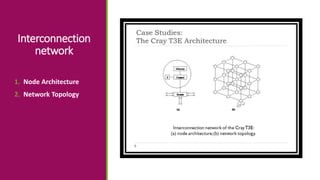
Interconnection
network
1. Node Architecture
2. Network Topology

Case Study on Cray T3E Architecture

  • 1.
    SNJB’s Late SauK. B. Jain COE, Chandwad Department of Computer Engineering Academic Year 2020-21 Subject: HPC Case Study on Cray T3E Architecture BY NAME: DIVYA PRAFULL WANI ROLL NO: 41 CLASS: BE COMPUTER DATE: 16-08-2020
  • 2.
    Cray T3E Architecture CrayT3E architecture are microprocessor for super-computing system. Cray T3E is a RISC(Reduced Instruction Set Computer) architecture which is very powerful microprocessors. T3E systems contain a large number of processing elements (PE). Each PE consists of a DEC Alpha EV5 RISC microprocessor.
  • 3.
    Design features The CRAYT3E is a scalable shared-memory multiprocessor The system architecture is designed to tolerate latency and enhance scalability. The T3E system was fully self-hosted and ran the UNICOS/mk distributed operating system. Cray T3E scalability can handle added processors and memory as well as larger I/O and interconnection bandwidths. Broad range implementation Cray T3E system has their own local memory.
  • 4.
    Cray T3E Architecture: 1.Memory : T3E has its own local memory with capacity from 64 megabytes to 2 gigabytes.All address are represented using bytes. Two consecutive bytes form a word, four bytes form a longword, eight bytes form a quadword. 2. Register : The Alpha architecture includes 32 general-purpose register from R0 to R31. R31 always contain the value zero. Each general-purpose register in Alpha architecture of Cray T3E system is 64-bit long Other than 32 general-purpose register there are also 32 floating-point registers from F0 to F31 and F31 always contain zero value. Each floating-point register have 64-bit length.
  • 5.
    Continued… 3. Data Formats: ◦Integers are stored as longwords or quadwords. ◦ Characters are represented using 8-bit ASCII codes. ◦ Floating points are represented using two different floating-point formats. 4. Instruction Formats: In Cray T3E architecture there are basically five instruction formats.All of these formats are 32 bit long and first 6 bits of the instruction word represents the opcode. Some instruction formats also have an “functional” field in which function of different registers are specified.
  • 6.
    Continued….. 5. Addressing Modes: Justlike in most of the RISC architectures, the only instructions that deals with memory are load, store and branch instructions. There are two modes to address operands in memory: Register indirect with displacement mode is used for load, store and subroutine jumps operations. PC-relative mode is used for conditional and unconditional branches. 6. Instruction Set: Cray T3E architecture has approximately 130 machine instructions. Cray T3E architecture uses a large number of instructions to do the implementation of operations as fast as possible.
  • 7.
    Continued… 7. Input andOutput: Cray T3E architecture uses multiple ports to perform I/O. These multiple ports have one or more I/O channels, which are integrated into the network that interconnects the processing nodes. All these channels are controllable and accessible from all PE’s (Processing Elements).
  • 8.