Disney Consumer Products: Marketing Nutrition
to Children
Harvard Business School Case
DISNEY ‘S POPULAR
CHARACTERS
 HISTORY OF WALT DISNEY COMPANY.
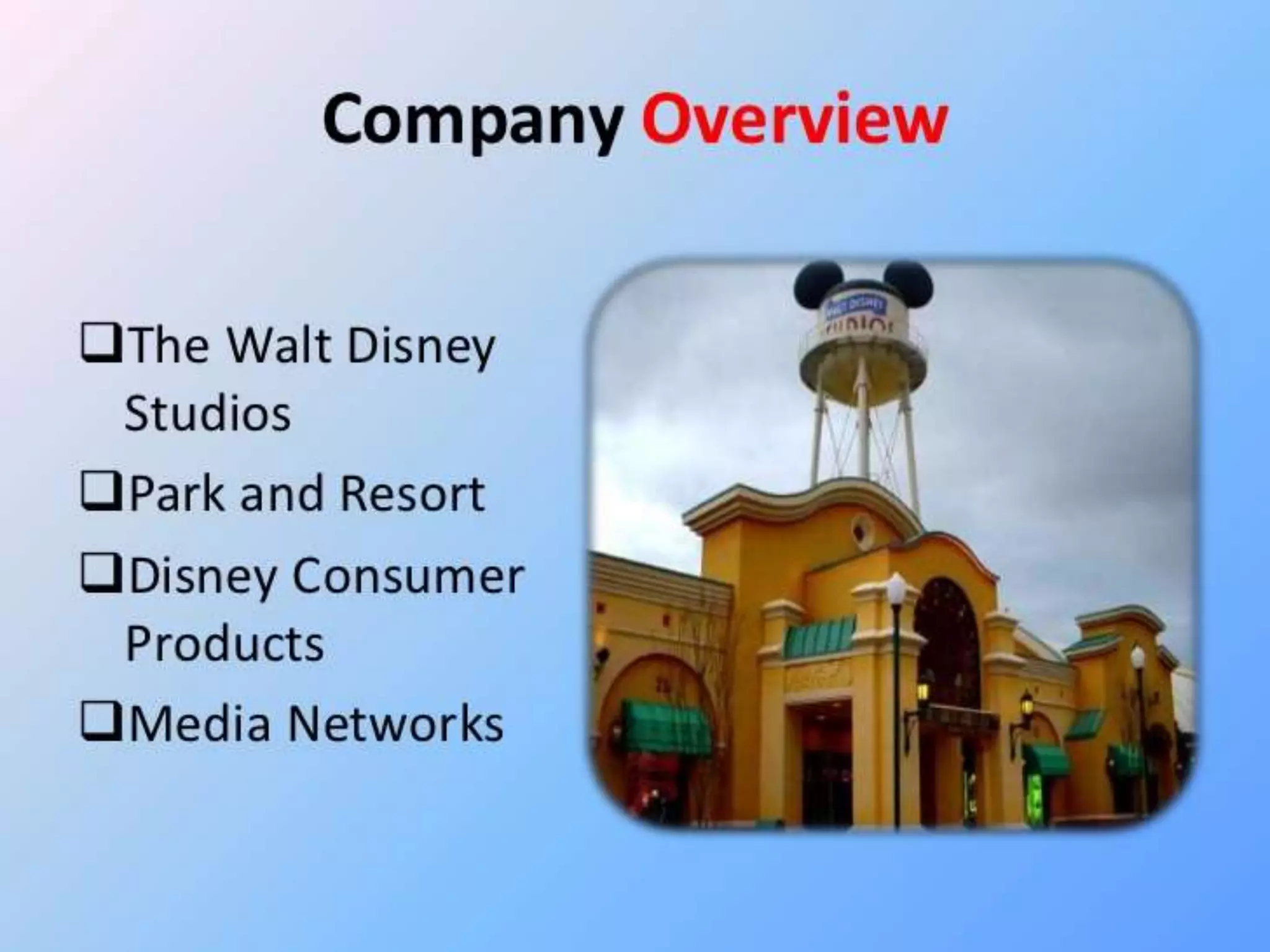
 COMPANY OVERVIEW.
 PROBLEMS FACED AND CHALLENGES.
 BUSINESS STRATEGIES.
 ALTERNATIVE STRATEGIES.
 CONCLUSION.
 FUTURE VISION.
Walter Elias Disney and his brother, Roy, founded
Disney Brothers Cartoon Studio, later renamed it as
“The Walt Disney Company”.
1923 - Debut of Mickey Mouse.
1932 - Licensing became a formal business unit.
1950 – Expansion beyond film and television.
1955 - Opened Disneyland in Anaheim, California.
2004 - The obesity epidemic.
2006 - DCP launches offering of fresh fruits.
Studio Entertainment created animated and live
action films.
Walt Disney Parks and Resorts operated or licensed 10 theme parks in
North America, Europe and Asia as well as 35 Disney Vacation Club
resorts and two luxury cruise ships.
DISNEY CONSUMER PRODUCT CATEGORIES
Soft lines (apparel, footwear, etc.)
Buena Vista Games
Home & infant
Hard lines(food, health & beauty, etc.)
Publishing
Toys
REASONS !!!!
Some industry experts pointed to progressive increases
in portion sizes from 1977 to 1998 as a significant factor in
rising obesity rates.
 Other experts described television advertising as a
primary factor.
 Intake of high calorie, high fat foods and beverages such
as candy, fast food etc. by children.
Eating out more often, increased consumption of sugar-
sweetened foods and lack of exercise were major
contributing factors.
DISNEY CURRENT OFFERING CONTRIBUTED TOWARD
GROWING OBESITY AMONG CHILDREN & ADULTS.
Create food product standards and nutritional guidelines that
would apply to both licensed and proprietary products.
Develop “a quality range of Disney integrated foods that
answers children’s daily needs in an entertaining way—in
short, good food, great fun.
Disney arrayed its portfolio of products into five categories:
main meal, side dish, snacks, drinks and treats. Next, calories
were allocated to each category. Disney’s goal was to balance
its portfolio so that 85% of its products could be classified as
main meal, side dish, snack or beverage and only 15% could be
categorized as treats.
The first challenge was to make the products they already
love healthier?
The second was to take products that were already healthy
and make them more “fun.”
The third was to use packaging to inspire product sampling,
such as making water bottles in the shape of characters.
 The key to getting children to eat healthier was to provide
plenty of choices.
IMAGINATION FARMS
It started marketing fresh fruits and vegetables by
licensing its characters to Imagination Farms, a national
fresh produce marketing company.
It used three-pronged product development strategy:
differentiate commodity produce through promotion,
create value-added products through product
preparation or packaging, and develop exclusive produce
varieties that would yield more child-friendly foods.
 Disney Farms produce was sold in major supermarket
chains, including Albertsons, Safeway, Supervalu and
Wal-Mart, though the assortment varied significantly
from one retailer to the next.
DISNEY BELIEVED THAT IT CAN BEAT COMPETITION BECAUSE
OF ITS HIGH NUTRITIONAL STANDARDS AND ITS UNIQUE
DISNEY AND THE KROGER
In addition to licensing produce through Imagination Farms,
DCP developed a broad range of products with Cincinnati-
based Kroger Supermarkets, the largest pure grocery
retailer in the United States.
WE CAN CLEARLY SEE THAT KROGER HAD A LARGEST MARKET
SHARE EVEN GREATER THAN WAL-MART.
ALTERNATIVE STRATEGIES
 IT COULD HAVE USED ITS FILMS & TV SHOWS TO
PERSUADE CHILDREN TO EAT HEALTHY FOODS.
 IT COULD HAVE ADVERTISED THE NEED TO EAT
NUTRITIONAL FOOD IN ITS MEDIA NETWORK AND DISNEY
PARKS & RESORTS.
 IT COULD HAVE SPECIFICALLY DEVELOPED ANIMATED
CHARACTERS THAT PROMOTED THE NEED TO EAT
HEALTHY FOOD.
PRICING AND VALUE
 Though Kroger’s DMS products were priced similarly
to private brands and Imagination Farms’ Disney
Gardens products were priced competitively within
the produce department, DCP managers understood
that its products had to be affordable.
 Some DCP managers wondered if the public and
particularly the media would embrace the new food
products.
 Products were healthful, child friendly & fun & they
had a “DISNEY MAGIC” in them. So they were
accepted by consumers & media.
LEGACY
 DCP managers believed that the combination of a
broad product line, wide distribution and the Disney
brand would win over Moms.
 They could beat the competition because even if they
develop and match our nutritional standards, they
cannot access “Disney magic”.
DIFFERENCIATION & COMPETITION
 Disney wanted to license or develop additional lines.
DCP managers believed that the company could
differentiate additional lines using characters, brand
and price.
 Retailers won’t turn their products down because of
the Kroger relationship. The chief concern is that our
products must be profitable for retailers.
GROWTH & DISTRIBUTION
Managers envisioned publishing cookbooks, televising cooking
shows for children, and linking its nutritional efforts with
exercise programs.
Extending its offerings from retail supermarket products to
food service (school lunch programs) and out-of-home
consumption in restaurants is also under consideration.
CREATED BY
ANUGRAH NIMAVAT
BTECH (ELECTRONICS &
COMMUNICATION)
NIT – SURAT
DURING MARKETING
INTERNSHIP UNDER THE
GUIDANCE OF
PROF. SAMEER MATHUR
IIM - LUCKNOW
DISCLAIMER
Disney Case Study

Disney Case Study

  • 1.
    Disney Consumer Products:Marketing Nutrition to Children Harvard Business School Case
  • 2.
  • 3.
     HISTORY OFWALT DISNEY COMPANY.  COMPANY OVERVIEW.  PROBLEMS FACED AND CHALLENGES.  BUSINESS STRATEGIES.  ALTERNATIVE STRATEGIES.  CONCLUSION.  FUTURE VISION.
  • 5.
    Walter Elias Disneyand his brother, Roy, founded Disney Brothers Cartoon Studio, later renamed it as “The Walt Disney Company”.
  • 7.
    1923 - Debutof Mickey Mouse. 1932 - Licensing became a formal business unit. 1950 – Expansion beyond film and television. 1955 - Opened Disneyland in Anaheim, California. 2004 - The obesity epidemic. 2006 - DCP launches offering of fresh fruits.
  • 9.
    Studio Entertainment createdanimated and live action films.
  • 10.
    Walt Disney Parksand Resorts operated or licensed 10 theme parks in North America, Europe and Asia as well as 35 Disney Vacation Club resorts and two luxury cruise ships.
  • 13.
    DISNEY CONSUMER PRODUCTCATEGORIES Soft lines (apparel, footwear, etc.) Buena Vista Games Home & infant Hard lines(food, health & beauty, etc.) Publishing Toys
  • 17.
    REASONS !!!! Some industryexperts pointed to progressive increases in portion sizes from 1977 to 1998 as a significant factor in rising obesity rates.  Other experts described television advertising as a primary factor.  Intake of high calorie, high fat foods and beverages such as candy, fast food etc. by children. Eating out more often, increased consumption of sugar- sweetened foods and lack of exercise were major contributing factors.
  • 18.
    DISNEY CURRENT OFFERINGCONTRIBUTED TOWARD GROWING OBESITY AMONG CHILDREN & ADULTS.
  • 19.
    Create food productstandards and nutritional guidelines that would apply to both licensed and proprietary products. Develop “a quality range of Disney integrated foods that answers children’s daily needs in an entertaining way—in short, good food, great fun. Disney arrayed its portfolio of products into five categories: main meal, side dish, snacks, drinks and treats. Next, calories were allocated to each category. Disney’s goal was to balance its portfolio so that 85% of its products could be classified as main meal, side dish, snack or beverage and only 15% could be categorized as treats.
  • 21.
    The first challengewas to make the products they already love healthier? The second was to take products that were already healthy and make them more “fun.” The third was to use packaging to inspire product sampling, such as making water bottles in the shape of characters.  The key to getting children to eat healthier was to provide plenty of choices.
  • 22.
  • 23.
    It started marketingfresh fruits and vegetables by licensing its characters to Imagination Farms, a national fresh produce marketing company. It used three-pronged product development strategy: differentiate commodity produce through promotion, create value-added products through product preparation or packaging, and develop exclusive produce varieties that would yield more child-friendly foods.  Disney Farms produce was sold in major supermarket chains, including Albertsons, Safeway, Supervalu and Wal-Mart, though the assortment varied significantly from one retailer to the next.
  • 24.
    DISNEY BELIEVED THATIT CAN BEAT COMPETITION BECAUSE OF ITS HIGH NUTRITIONAL STANDARDS AND ITS UNIQUE
  • 26.
    DISNEY AND THEKROGER In addition to licensing produce through Imagination Farms, DCP developed a broad range of products with Cincinnati- based Kroger Supermarkets, the largest pure grocery retailer in the United States.
  • 27.
    WE CAN CLEARLYSEE THAT KROGER HAD A LARGEST MARKET SHARE EVEN GREATER THAN WAL-MART.
  • 28.
    ALTERNATIVE STRATEGIES  ITCOULD HAVE USED ITS FILMS & TV SHOWS TO PERSUADE CHILDREN TO EAT HEALTHY FOODS.  IT COULD HAVE ADVERTISED THE NEED TO EAT NUTRITIONAL FOOD IN ITS MEDIA NETWORK AND DISNEY PARKS & RESORTS.  IT COULD HAVE SPECIFICALLY DEVELOPED ANIMATED CHARACTERS THAT PROMOTED THE NEED TO EAT HEALTHY FOOD.
  • 30.
    PRICING AND VALUE Though Kroger’s DMS products were priced similarly to private brands and Imagination Farms’ Disney Gardens products were priced competitively within the produce department, DCP managers understood that its products had to be affordable.
  • 31.
     Some DCPmanagers wondered if the public and particularly the media would embrace the new food products.  Products were healthful, child friendly & fun & they had a “DISNEY MAGIC” in them. So they were accepted by consumers & media. LEGACY
  • 32.
     DCP managersbelieved that the combination of a broad product line, wide distribution and the Disney brand would win over Moms.  They could beat the competition because even if they develop and match our nutritional standards, they cannot access “Disney magic”. DIFFERENCIATION & COMPETITION
  • 33.
     Disney wantedto license or develop additional lines. DCP managers believed that the company could differentiate additional lines using characters, brand and price.  Retailers won’t turn their products down because of the Kroger relationship. The chief concern is that our products must be profitable for retailers. GROWTH & DISTRIBUTION
  • 34.
    Managers envisioned publishingcookbooks, televising cooking shows for children, and linking its nutritional efforts with exercise programs. Extending its offerings from retail supermarket products to food service (school lunch programs) and out-of-home consumption in restaurants is also under consideration.
  • 37.
    CREATED BY ANUGRAH NIMAVAT BTECH(ELECTRONICS & COMMUNICATION) NIT – SURAT DURING MARKETING INTERNSHIP UNDER THE GUIDANCE OF PROF. SAMEER MATHUR IIM - LUCKNOW DISCLAIMER