Some historical clues…
 Founded by Walt Disney
 Established in 1923
 Headquartered in California, USA
 Currently world’s largest conglomerate in terms of
revenue.
Walt Disney Vision
“To make people happy ”
Walt Disney Mission
Statement 2013
“The Walt Disney Company's objective is to be one of the
world's leading producers and providers of entertainment and
information, using its portfolio of brands to differentiate its
content, services and consumer products. The company's
primary financial goals are to maximize earnings and cash flow,
and to allocate capital toward growth initiatives that will drive
long-term shareholder value.”
Walt Disney
Mission Statement’s
Evaluation
 Product oriented
statement
 Focus on what
products to sell
and what services
to offer rather
than on how to
satisfy customer
needs
Lack of 5 essential
components:
1. Customers
2. Technology
3. Philosophy
4. Concern for
public image
5. Employees
Walt Disney
Recommended Vision
“To make entertainment the wheel of life”
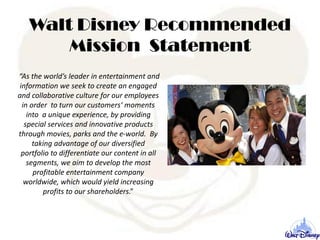
Walt Disney Recommended
Mission Statement
“As the world’s leader in entertainment and
information we seek to create an engaged
and collaborative culture for our employees
in order to turn our customers‘ moments
into a unique experience, by providing
special services and innovative products
through movies, parks and the e-world. By
taking advantage of our diversified
portfolio to differentiate our content in all
segments, we aim to develop the most
profitable entertainment company
worldwide, which would yield increasing
profits to our shareholders.”
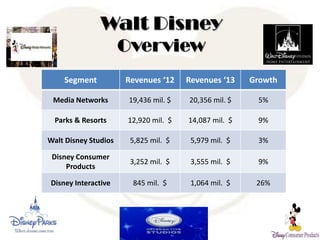
Walt Disney
Overview
Segment Revenues ‘12 Revenues ‘13 Growth
Media Networks 19,436 mil. $ 20,356 mil. $ 5%
Parks & Resorts 12,920 mil. $ 14,087 mil. $ 9%
Walt Disney Studios 5,825 mil. $ 5,979 mil. $ 3%
Disney Consumer
Products
3,252 mil. $ 3,555 mil. $ 9%
Disney Interactive 845 mil. $ 1,064 mil. $ 26%
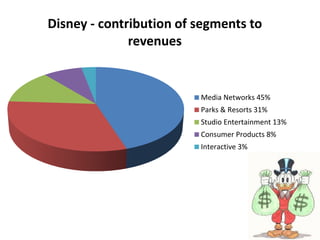
Disney - contribution of segments to
revenues
Media Networks 45%
Parks & Resorts 31%
Studio Entertainment 13%
Consumer Products 8%
Interactive 3%
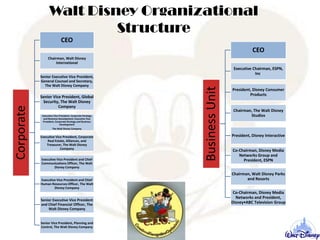
Corporate
CEO
Chairman, Walt Disney
International
Senior Executive Vice President,
General Counsel and Secretary,
The Walt Disney Company
Senior Vice President, Global
Security, The Walt Disney
Company
Executive Vice President, Corporate Strategy
and Business Development, Executive Vice
President, Corporate Strategy and Business
Development
The Walt Disney Company
Executive Vice President, Corporate
Real Estate, Alliances, and
Treasurer, The Walt Disney
Company
Executive Vice President and Chief
Communications Officer, The Walt
Disney Company
Executive Vice President and Chief
Human Resources Officer, The Walt
Disney Company
Senior Executive Vice President
and Chief Financial Officer, The
Walt Disney Company
Senior Vice President, Planning and
Control, The Walt Disney Company
BusinessUnit
CEO
Executive Chairman, ESPN,
Inc.
President, Disney Consumer
Products
Chairman, The Walt Disney
Studios
President, Disney Interactive
Co-Chairman, Disney Media
Networks Group and
President, ESPN
Chairman, Walt Disney Parks
and Resorts
Co-Chairman, Disney Media
Networks and President,
Disney•ABC Television Group
Walt Disney Organizational
Structure
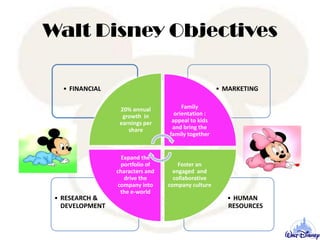
• HUMAN
RESOURCES
• RESEARCH &
DEVELOPMENT
• MARKETING• FINANCIAL
20% annual
growth in
earnings per
share
Family
orientation :
appeal to kids
and bring the
family together
Foster an
engaged and
collaborative
company culture
Expand the
portfolio of
characters and
drive the
company into
the e-world
Walt Disney Objectives
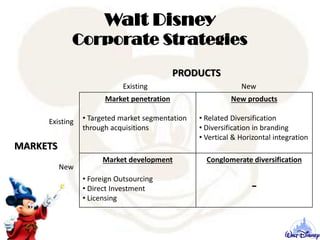
Market penetration
• Targeted market segmentation
through acquisitions
New products
• Related Diversification
• Diversification in branding
• Vertical & Horizontal integration
Market development
• Foreign Outsourcing
• Direct Investment
• Licensing
Conglomerate diversification
-
Existing
New
Existing New
PRODUCTS
MARKETS
Walt Disney
Corporate Strategies
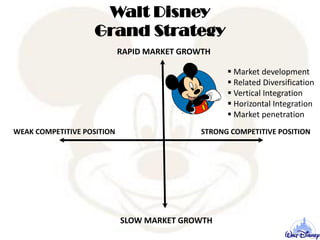
RAPID MARKET GROWTH
SLOW MARKET GROWTH
Walt Disney
Grand Strategy
STRONG COMPETITIVE POSITIONWEAK COMPETITIVE POSITION
 Market development
 Related Diversification
 Vertical Integration
 Horizontal Integration
 Market penetration
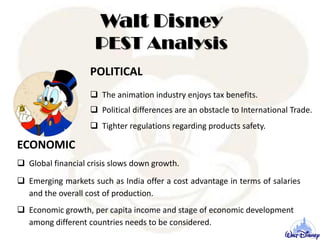
Walt Disney
PEST Analysis
POLITICAL
 The animation industry enjoys tax benefits.
 Political differences are an obstacle to International Trade.
 Tighter regulations regarding products safety.
ECONOMIC
 Global financial crisis slows down growth.
 Emerging markets such as India offer a cost advantage in terms of salaries
and the overall cost of production.
 Economic growth, per capita income and stage of economic development
among different countries needs to be considered.
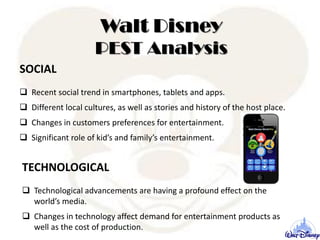
SOCIAL
 Recent social trend in smartphones, tablets and apps.
 Different local cultures, as well as stories and history of the host place.
 Changes in customers preferences for entertainment.
 Significant role of kid’s and family’s entertainment.
TECHNOLOGICAL
 Technological advancements are having a profound effect on the
world’s media.
 Changes in technology affect demand for entertainment products as
well as the cost of production.
Walt Disney
PEST Analysis
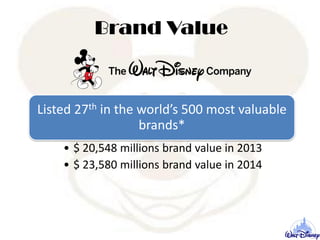
Brand Value
Listed 27th in the world’s 500 most valuable
brands*
• $ 20,548 millions brand value in 2013
• $ 23,580 millions brand value in 2014
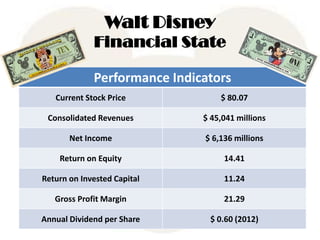
Walt Disney
Financial State
Performance Indicators
Current Stock Price $ 80.07
Consolidated Revenues $ 45,041 millions
Net Income $ 6,136 millions
Return on Equity 14.41
Return on Invested Capital 11.24
Gross Profit Margin 21.29
Annual Dividend per Share $ 0.60 (2012)
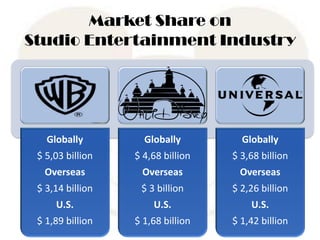
Market Share on
Studio Entertainment Industry
Globally
$ 5,03 billion
Overseas
$ 3,14 billion
U.S.
$ 1,89 billion
Globally
$ 4,68 billion
Overseas
$ 3 billion
U.S.
$ 1,68 billion
Globally
$ 3,68 billion
Overseas
$ 2,26 billion
U.S.
$ 1,42 billion
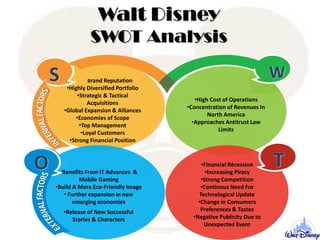
Brand Reputation
•Highly Diversified Portfolio
•Strategic & Tactical
Acquisitions
•Global Expansion & Alliances
•Economies of Scope
•Top Management
•Loyal Customers
•Strong Financial Position
•High Cost of Operations
•Concentration of Revenues In
North America
•Approaches Antitrust Law
Limits
•Benefits From IT Advances &
Mobile Gaming
•Build A More Eco-Friendly Image
• Further expansion in new
emerging economies
•Release of New Successful
Stories & Characters
•Financial Récession
•Increasing Piracy
•Strong Competition
•Continous Need For
Technological Update
•Change in Consumers
Preferences & Tastes
•Negative Publicity Due to
Unexpected Event
S W
TO
Walt Disney
SWOT Analysis
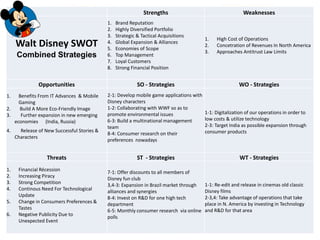
Strengths Weaknesses
Walt Disney SWOT
Combined Strategies
1. Brand Reputation
2. Highly Diversified Portfolio
3. Strategic & Tactical Acquisitions
4. Global Expansion & Alliances
5. Economies of Scope
6. Top Management
7. Loyal Customers
8. Strong Financial Position
1. High Cost of Operations
2. Concetration of Revenues In North America
3. Approaches Antitrust Law Limits
Opportunities SO - Strategies WO - Strategies
1. Benefits From IT Advances & Mobile
Gaming
2. Build A More Eco-Friendly Image
3. Further expansion in new emerging
economies (India, Russia)
4. Release of New Successful Stories &
Characters
2-1: Develop mobile game applications with
Disney characters
1-2: Collaborating with WWF so as to
promote environmental issues
6-3: Build a multinational management
team
8-4: Consumer research on their
preferences nowadays
1-1: Digitalization of our operations in order to
low costs & utilize technology
2-3: Target India as possible expansion through
consumer products
Threats ST - Strategies WT - Strategies
1. Financial Récession
2. Increasing Piracy
3. Strong Competition
4. Continous Need For Technological
Update
5. Change in Consumers Preferences &
Tastes
6. Negative Publicity Due to
Unexpected Event
7-1: Offer discounts to all members of
Disney fun club
3,4-3: Expansion in Brazil market through
alliances and synergies
8-4: Invest on R&D for one high tech
department
6-5: Monthly consumer research via online
polls
1-1: Re-edit and release in cinemas old classic
Disney films
2-3,4: Take advantage of operations that take
place in N. America by investing in Technology
and R&D for that area
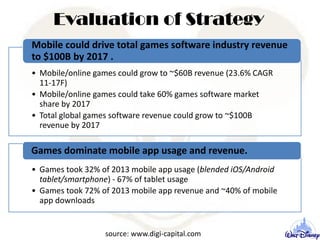
Evaluation of Strategy
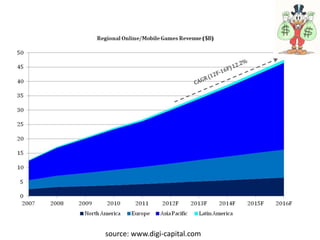
• Mobile/online games could grow to ~$60B revenue (23.6% CAGR
11-17F)
• Mobile/online games could take 60% games software market
share by 2017
• Total global games software revenue could grow to ~$100B
revenue by 2017
Mobile could drive total games software industry revenue
to $100B by 2017 .
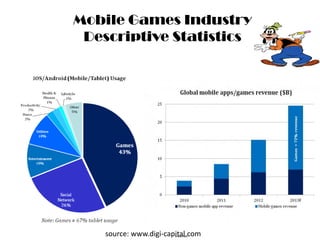
• Games took 32% of 2013 mobile app usage (blended iOS/Android
tablet/smartphone) - 67% of tablet usage
• Games took 72% of 2013 mobile app revenue and ~40% of mobile
app downloads
Games dominate mobile app usage and revenue.
source: www.digi-capital.com
Mobile Games Industry
Descriptive Statistics
source: www.digi-capital.com
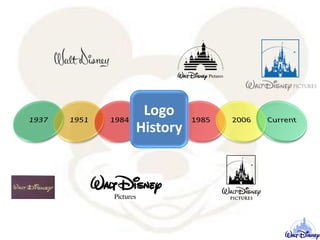
Logo
History
Sourcing & Procurement
Retail Sourcing
Logistics
Product Integrity
Customs Trade Management
International Labor Standards
Supplier Diversity
presentation

presentation

  • 2.
    Some historical clues… Founded by Walt Disney  Established in 1923  Headquartered in California, USA  Currently world’s largest conglomerate in terms of revenue.
  • 4.
    Walt Disney Vision “Tomake people happy ”
  • 5.
    Walt Disney Mission Statement2013 “The Walt Disney Company's objective is to be one of the world's leading producers and providers of entertainment and information, using its portfolio of brands to differentiate its content, services and consumer products. The company's primary financial goals are to maximize earnings and cash flow, and to allocate capital toward growth initiatives that will drive long-term shareholder value.”
  • 6.
    Walt Disney Mission Statement’s Evaluation Product oriented statement  Focus on what products to sell and what services to offer rather than on how to satisfy customer needs Lack of 5 essential components: 1. Customers 2. Technology 3. Philosophy 4. Concern for public image 5. Employees
  • 7.
    Walt Disney Recommended Vision “Tomake entertainment the wheel of life”
  • 8.
    Walt Disney Recommended MissionStatement “As the world’s leader in entertainment and information we seek to create an engaged and collaborative culture for our employees in order to turn our customers‘ moments into a unique experience, by providing special services and innovative products through movies, parks and the e-world. By taking advantage of our diversified portfolio to differentiate our content in all segments, we aim to develop the most profitable entertainment company worldwide, which would yield increasing profits to our shareholders.”
  • 9.
    Walt Disney Overview Segment Revenues‘12 Revenues ‘13 Growth Media Networks 19,436 mil. $ 20,356 mil. $ 5% Parks & Resorts 12,920 mil. $ 14,087 mil. $ 9% Walt Disney Studios 5,825 mil. $ 5,979 mil. $ 3% Disney Consumer Products 3,252 mil. $ 3,555 mil. $ 9% Disney Interactive 845 mil. $ 1,064 mil. $ 26%
  • 10.
    Disney - contributionof segments to revenues Media Networks 45% Parks & Resorts 31% Studio Entertainment 13% Consumer Products 8% Interactive 3%
  • 11.
    Corporate CEO Chairman, Walt Disney International SeniorExecutive Vice President, General Counsel and Secretary, The Walt Disney Company Senior Vice President, Global Security, The Walt Disney Company Executive Vice President, Corporate Strategy and Business Development, Executive Vice President, Corporate Strategy and Business Development The Walt Disney Company Executive Vice President, Corporate Real Estate, Alliances, and Treasurer, The Walt Disney Company Executive Vice President and Chief Communications Officer, The Walt Disney Company Executive Vice President and Chief Human Resources Officer, The Walt Disney Company Senior Executive Vice President and Chief Financial Officer, The Walt Disney Company Senior Vice President, Planning and Control, The Walt Disney Company BusinessUnit CEO Executive Chairman, ESPN, Inc. President, Disney Consumer Products Chairman, The Walt Disney Studios President, Disney Interactive Co-Chairman, Disney Media Networks Group and President, ESPN Chairman, Walt Disney Parks and Resorts Co-Chairman, Disney Media Networks and President, Disney•ABC Television Group Walt Disney Organizational Structure
  • 12.
    • HUMAN RESOURCES • RESEARCH& DEVELOPMENT • MARKETING• FINANCIAL 20% annual growth in earnings per share Family orientation : appeal to kids and bring the family together Foster an engaged and collaborative company culture Expand the portfolio of characters and drive the company into the e-world Walt Disney Objectives
  • 13.
    Market penetration • Targetedmarket segmentation through acquisitions New products • Related Diversification • Diversification in branding • Vertical & Horizontal integration Market development • Foreign Outsourcing • Direct Investment • Licensing Conglomerate diversification - Existing New Existing New PRODUCTS MARKETS Walt Disney Corporate Strategies
  • 14.
    RAPID MARKET GROWTH SLOWMARKET GROWTH Walt Disney Grand Strategy STRONG COMPETITIVE POSITIONWEAK COMPETITIVE POSITION  Market development  Related Diversification  Vertical Integration  Horizontal Integration  Market penetration
  • 15.
    Walt Disney PEST Analysis POLITICAL The animation industry enjoys tax benefits.  Political differences are an obstacle to International Trade.  Tighter regulations regarding products safety. ECONOMIC  Global financial crisis slows down growth.  Emerging markets such as India offer a cost advantage in terms of salaries and the overall cost of production.  Economic growth, per capita income and stage of economic development among different countries needs to be considered.
  • 16.
    SOCIAL  Recent socialtrend in smartphones, tablets and apps.  Different local cultures, as well as stories and history of the host place.  Changes in customers preferences for entertainment.  Significant role of kid’s and family’s entertainment. TECHNOLOGICAL  Technological advancements are having a profound effect on the world’s media.  Changes in technology affect demand for entertainment products as well as the cost of production. Walt Disney PEST Analysis
  • 17.
    Brand Value Listed 27thin the world’s 500 most valuable brands* • $ 20,548 millions brand value in 2013 • $ 23,580 millions brand value in 2014
  • 18.
    Walt Disney Financial State PerformanceIndicators Current Stock Price $ 80.07 Consolidated Revenues $ 45,041 millions Net Income $ 6,136 millions Return on Equity 14.41 Return on Invested Capital 11.24 Gross Profit Margin 21.29 Annual Dividend per Share $ 0.60 (2012)
  • 19.
    Market Share on StudioEntertainment Industry Globally $ 5,03 billion Overseas $ 3,14 billion U.S. $ 1,89 billion Globally $ 4,68 billion Overseas $ 3 billion U.S. $ 1,68 billion Globally $ 3,68 billion Overseas $ 2,26 billion U.S. $ 1,42 billion
  • 20.
    Brand Reputation •Highly DiversifiedPortfolio •Strategic & Tactical Acquisitions •Global Expansion & Alliances •Economies of Scope •Top Management •Loyal Customers •Strong Financial Position •High Cost of Operations •Concentration of Revenues In North America •Approaches Antitrust Law Limits •Benefits From IT Advances & Mobile Gaming •Build A More Eco-Friendly Image • Further expansion in new emerging economies •Release of New Successful Stories & Characters •Financial Récession •Increasing Piracy •Strong Competition •Continous Need For Technological Update •Change in Consumers Preferences & Tastes •Negative Publicity Due to Unexpected Event S W TO Walt Disney SWOT Analysis
  • 21.
    Strengths Weaknesses Walt DisneySWOT Combined Strategies 1. Brand Reputation 2. Highly Diversified Portfolio 3. Strategic & Tactical Acquisitions 4. Global Expansion & Alliances 5. Economies of Scope 6. Top Management 7. Loyal Customers 8. Strong Financial Position 1. High Cost of Operations 2. Concetration of Revenues In North America 3. Approaches Antitrust Law Limits Opportunities SO - Strategies WO - Strategies 1. Benefits From IT Advances & Mobile Gaming 2. Build A More Eco-Friendly Image 3. Further expansion in new emerging economies (India, Russia) 4. Release of New Successful Stories & Characters 2-1: Develop mobile game applications with Disney characters 1-2: Collaborating with WWF so as to promote environmental issues 6-3: Build a multinational management team 8-4: Consumer research on their preferences nowadays 1-1: Digitalization of our operations in order to low costs & utilize technology 2-3: Target India as possible expansion through consumer products Threats ST - Strategies WT - Strategies 1. Financial Récession 2. Increasing Piracy 3. Strong Competition 4. Continous Need For Technological Update 5. Change in Consumers Preferences & Tastes 6. Negative Publicity Due to Unexpected Event 7-1: Offer discounts to all members of Disney fun club 3,4-3: Expansion in Brazil market through alliances and synergies 8-4: Invest on R&D for one high tech department 6-5: Monthly consumer research via online polls 1-1: Re-edit and release in cinemas old classic Disney films 2-3,4: Take advantage of operations that take place in N. America by investing in Technology and R&D for that area
  • 22.
    Evaluation of Strategy •Mobile/online games could grow to ~$60B revenue (23.6% CAGR 11-17F) • Mobile/online games could take 60% games software market share by 2017 • Total global games software revenue could grow to ~$100B revenue by 2017 Mobile could drive total games software industry revenue to $100B by 2017 . • Games took 32% of 2013 mobile app usage (blended iOS/Android tablet/smartphone) - 67% of tablet usage • Games took 72% of 2013 mobile app revenue and ~40% of mobile app downloads Games dominate mobile app usage and revenue. source: www.digi-capital.com
  • 23.
  • 24.
    Mobile Games Industry DescriptiveStatistics source: www.digi-capital.com
  • 25.
  • 26.
    Sourcing & Procurement RetailSourcing Logistics Product Integrity Customs Trade Management International Labor Standards Supplier Diversity