



Aakash Gupta
Roll No: 008
Batch: SMBA-2
Presented by:
Objectives of case
 To construct Value Chain Analysis
 To use value chain as a power tool
 To implement strategic plans in
accordance with the value chain
Dairy Pak is Ohio based international company.
 Dairy Pak began their operations in 1947 as one of the
original license of the Pure-Pak Technology.
 They focused on producing polyethylene coated paper
carton for milk and orange juice.
 Due to growing demand, it expanded its operations and
built converting plants in different states.
 During the early 1960's through 1988 Champion steadily
produced 2,50,000 tons of polyethylene coated boards
annually.
 During this period, the paper board industry was
threatened by the intrusion of plastic containers
but Champion did not falter and continued with its
existing operations without changes in strategy or
equipment.
 At this point, the company decided to have the
harvest strategy.
 Incidentally, the paper carton did not die, and
since there were no major changes in Champion
its infrastructure got old and technologically
outdated.
 In the early 1980's the sudden increase of the
juice market created opportunities which
Champion did not expect.
 In 1988 however, Champion successfully
managed to retain its share in the declining
market while losing almost half of its share in
the fastest-growing segment, the branded
juices.
 Champion strategy was to be the low cost
producer in commodity dairy segment.
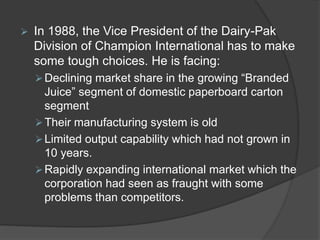
 In 1988, the Vice President of the Dairy-Pak
Division of Champion International has to make
some tough choices. He is facing:
Declining market share in the growing “Branded
Juice” segment of domestic paperboard carton
segment
Their manufacturing system is old
Limited output capability which had not grown in
10 years.
Rapidly expanding international market which the
corporation had seen as fraught with some
problems than competitors.
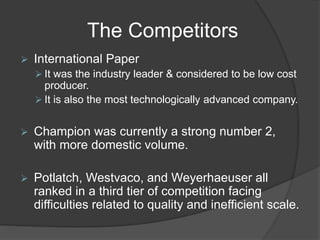
The Competitors
 International Paper
 It was the industry leader & considered to be low cost
producer.
 It is also the most technologically advanced company.
 Champion was currently a strong number 2,
with more domestic volume.
 Potlatch, Westvaco, and Weyerhaeuser all
ranked in a third tier of competition facing
difficulties related to quality and inefficient scale.
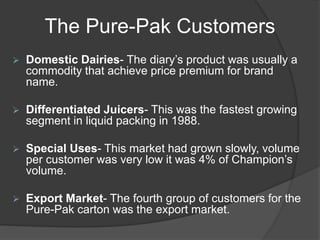
The Pure-Pak Customers
 Domestic Dairies- The diary’s product was usually a
commodity that achieve price premium for brand
name.
 Differentiated Juicers- This was the fastest growing
segment in liquid packing in 1988.
 Special Uses- This market had grown slowly, volume
per customer was very low it was 4% of Champion’s
volume.
 Export Market- The fourth group of customers for the
Pure-Pak carton was the export market.
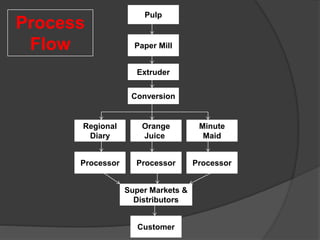
Pulp
Paper Mill
Extruder
Conversion
Regional
Diary
Minute
Maid
Orange
Juice
Processor Processor Processor
Super Markets &
Distributors
Customer
Process
Flow
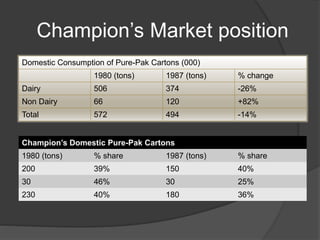
Champion’s Market position
Domestic Consumption of Pure-Pak Cartons (000)
1980 (tons) 1987 (tons) % change
Dairy 506 374 -26%
Non Dairy 66 120 +82%
Total 572 494 -14%
Champion’s Domestic Pure-Pak Cartons
1980 (tons) % share 1987 (tons) % share
200 39% 150 40%
30 46% 30 25%
230 40% 180 36%
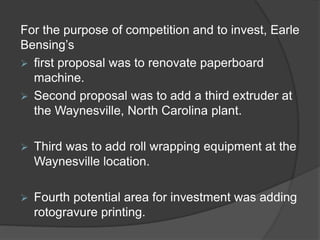
For the purpose of competition and to invest, Earle
Bensing’s
 first proposal was to renovate paperboard
machine.
 Second proposal was to add a third extruder at
the Waynesville, North Carolina plant.
 Third was to add roll wrapping equipment at the
Waynesville location.
 Fourth potential area for investment was adding
rotogravure printing.
TOWS
Analysis
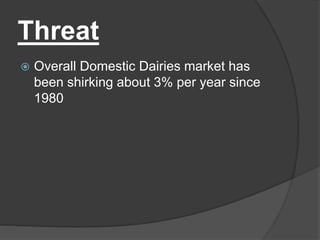
Threat
 Overall Domestic Dairies market has
been shirking about 3% per year since
1980
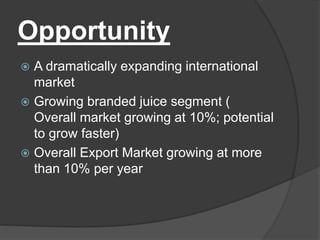
Opportunity
 A dramatically expanding international
market
 Growing branded juice segment (
Overall market growing at 10%; potential
to grow faster)
 Overall Export Market growing at more
than 10% per year
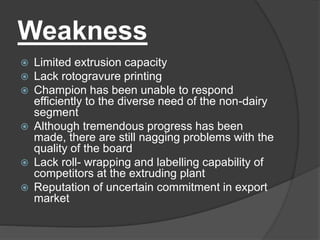
Weakness
 Limited extrusion capacity
 Lack rotogravure printing
 Champion has been unable to respond
efficiently to the diverse need of the non-dairy
segment
 Although tremendous progress has been
made, there are still nagging problems with the
quality of the board
 Lack roll- wrapping and labelling capability of
competitors at the extruding plant
 Reputation of uncertain commitment in export
market
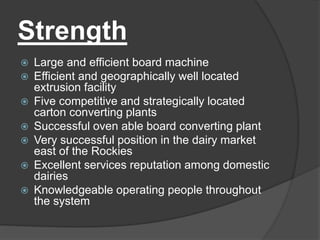
Strength
 Large and efficient board machine
 Efficient and geographically well located
extrusion facility
 Five competitive and strategically located
carton converting plants
 Successful oven able board converting plant
 Very successful position in the dairy market
east of the Rockies
 Excellent services reputation among domestic
dairies
 Knowledgeable operating people throughout
the system
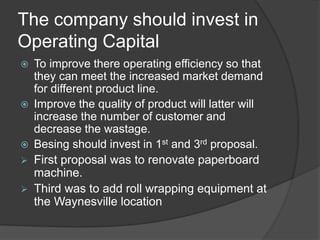
The company should invest in
Operating Capital
 To improve there operating efficiency so that
they can meet the increased market demand
for different product line.
 Improve the quality of product will latter will
increase the number of customer and
decrease the wastage.
 Besing should invest in 1st and 3rd proposal.
 First proposal was to renovate paperboard
machine.
 Third was to add roll wrapping equipment at
the Waynesville location

Case study. dairy pak by aakash gupta (smba2)

  • 1.
    Aakash Gupta Roll No:008 Batch: SMBA-2 Presented by:
  • 3.
    Objectives of case To construct Value Chain Analysis  To use value chain as a power tool  To implement strategic plans in accordance with the value chain
  • 4.
    Dairy Pak isOhio based international company.  Dairy Pak began their operations in 1947 as one of the original license of the Pure-Pak Technology.  They focused on producing polyethylene coated paper carton for milk and orange juice.  Due to growing demand, it expanded its operations and built converting plants in different states.  During the early 1960's through 1988 Champion steadily produced 2,50,000 tons of polyethylene coated boards annually.
  • 5.
     During thisperiod, the paper board industry was threatened by the intrusion of plastic containers but Champion did not falter and continued with its existing operations without changes in strategy or equipment.  At this point, the company decided to have the harvest strategy.  Incidentally, the paper carton did not die, and since there were no major changes in Champion its infrastructure got old and technologically outdated.
  • 6.
     In theearly 1980's the sudden increase of the juice market created opportunities which Champion did not expect.  In 1988 however, Champion successfully managed to retain its share in the declining market while losing almost half of its share in the fastest-growing segment, the branded juices.  Champion strategy was to be the low cost producer in commodity dairy segment.
  • 7.
     In 1988,the Vice President of the Dairy-Pak Division of Champion International has to make some tough choices. He is facing: Declining market share in the growing “Branded Juice” segment of domestic paperboard carton segment Their manufacturing system is old Limited output capability which had not grown in 10 years. Rapidly expanding international market which the corporation had seen as fraught with some problems than competitors.
  • 8.
    The Competitors  InternationalPaper  It was the industry leader & considered to be low cost producer.  It is also the most technologically advanced company.  Champion was currently a strong number 2, with more domestic volume.  Potlatch, Westvaco, and Weyerhaeuser all ranked in a third tier of competition facing difficulties related to quality and inefficient scale.
  • 9.
    The Pure-Pak Customers Domestic Dairies- The diary’s product was usually a commodity that achieve price premium for brand name.  Differentiated Juicers- This was the fastest growing segment in liquid packing in 1988.  Special Uses- This market had grown slowly, volume per customer was very low it was 4% of Champion’s volume.  Export Market- The fourth group of customers for the Pure-Pak carton was the export market.
  • 10.
  • 11.
    Champion’s Market position DomesticConsumption of Pure-Pak Cartons (000) 1980 (tons) 1987 (tons) % change Dairy 506 374 -26% Non Dairy 66 120 +82% Total 572 494 -14% Champion’s Domestic Pure-Pak Cartons 1980 (tons) % share 1987 (tons) % share 200 39% 150 40% 30 46% 30 25% 230 40% 180 36%
  • 12.
    For the purposeof competition and to invest, Earle Bensing’s  first proposal was to renovate paperboard machine.  Second proposal was to add a third extruder at the Waynesville, North Carolina plant.  Third was to add roll wrapping equipment at the Waynesville location.  Fourth potential area for investment was adding rotogravure printing.
  • 13.
  • 14.
    Threat  Overall DomesticDairies market has been shirking about 3% per year since 1980
  • 15.
    Opportunity  A dramaticallyexpanding international market  Growing branded juice segment ( Overall market growing at 10%; potential to grow faster)  Overall Export Market growing at more than 10% per year
  • 16.
    Weakness  Limited extrusioncapacity  Lack rotogravure printing  Champion has been unable to respond efficiently to the diverse need of the non-dairy segment  Although tremendous progress has been made, there are still nagging problems with the quality of the board  Lack roll- wrapping and labelling capability of competitors at the extruding plant  Reputation of uncertain commitment in export market
  • 17.
    Strength  Large andefficient board machine  Efficient and geographically well located extrusion facility  Five competitive and strategically located carton converting plants  Successful oven able board converting plant  Very successful position in the dairy market east of the Rockies  Excellent services reputation among domestic dairies  Knowledgeable operating people throughout the system
  • 18.
    The company shouldinvest in Operating Capital  To improve there operating efficiency so that they can meet the increased market demand for different product line.  Improve the quality of product will latter will increase the number of customer and decrease the wastage.  Besing should invest in 1st and 3rd proposal.  First proposal was to renovate paperboard machine.  Third was to add roll wrapping equipment at the Waynesville location