exporting as pdf


           Centre Georges Pompidou

                   Presentation By: Natasha Reising
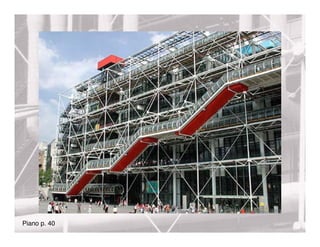
Piano p. 40
Architects:
   Renzo Piano
Richard Rogers
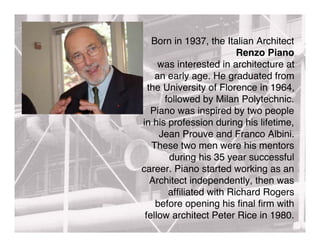
Born in 1937, the Italian Architect
                        Renzo Piano
     was interested in architecture at
    an early age. He graduated from
  the University of Florence in 1964,
      followed by Milan Polytechnic.
   Piano was inspired by two people
in his profession during his lifetime,
     Jean Prouve and Franco Albini.
   These two men were his mentors
       during his 35 year successful
career. Piano started working as an
   Architect independently, then was
       affiliated with Richard Rogers
    before opening his final firm with
 fellow architect Peter Rice in 1980.
The Building:
Centre Georges Pompidou
            Paris, France
                     1976
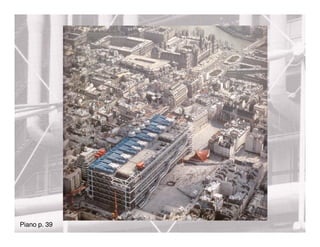
Piano p. 39
An active and accessible machine
in which the arts could interact with
 each other and all social strata.1


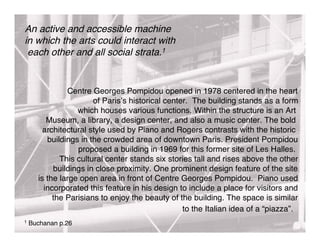
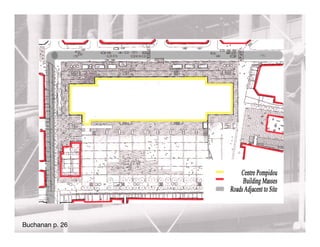
               Centre Georges Pompidou opened in 1978 centered in the heart
                       of Paris s historical center. The building stands as a form
                  which houses various functions. Within the structure is an Art
         Museum, a library, a design center, and also a music center. The bold
        architectural style used by Piano and Rogers contrasts with the historic
         buildings in the crowded area of downtown Paris. President Pompidou
                  proposed a building in 1969 for this former site of Les Halles.
             This cultural center stands six stories tall and rises above the other
           buildings in close proximity. One prominent design feature of the site
      is the large open area in front of Centre Georges Pompidou. Piano used
        incorporated this feature in his design to include a place for visitors and
           the Parisians to enjoy the beauty of the building. The space is similar
                                                  to the Italian idea of a “piazza”.
1   Buchanan p.26
Buchanan p. 26
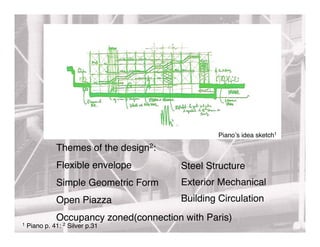
Piano s idea sketch1

              Themes of the design2:
              Flexible envelope         Steel Structure
              Simple Geometric Form     Exterior Mechanical
              Open Piazza               Building Circulation
              Occupancy zoned(connection with Paris)
1   Piano p. 41: 2 Silver p.31
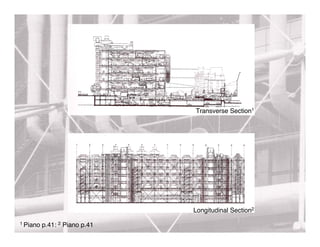
Transverse Section1


                               Longitudinal Section2
1 Piano   p.41: 2 Piano p.41
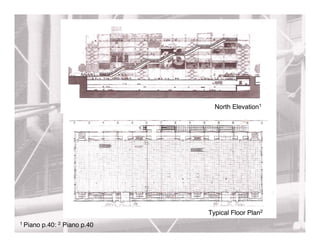
North Elevation1


                               Typical Floor Plan2
1 Piano   p.40: 2 Piano p.40
The Facts:
Design Competition Winners: Renzo Piano and Richard Rogers
Construction Time: 7 years (1971-1978)
Location: Paris France (Beaubourg)
Structure: Steel and Concrete Slabs
Floor Area1: 65,000 m2
Cost2: $363,858,691(over budget by 11.7%)
Height: 45.5 meters


1   Silver p. 23: 2 Silver p. 170
The Structure:
  Cast Steel Columns
Exterior Steel Bracing
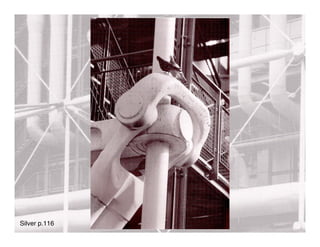
       The Gerberette
Concrete Floor Panels
Silver p.116
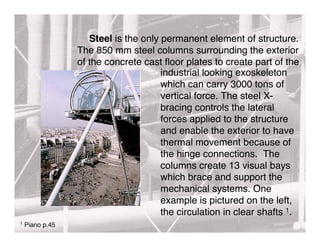
Steel is the only permanent element of structure.
                 The 850 mm steel columns surrounding the exterior
                 of the concrete cast floor plates to create part of the
                                      industrial looking exoskeleton
                                      which can carry 3000 tons of
                                      vertical force. The steel X-
                                      bracing controls the lateral
                                      forces applied to the structure
                                      and enable the exterior to have
                                      thermal movement because of
                                      the hinge connections. The
                                      columns create 13 visual bays
                                      which brace and support the
                                      mechanical systems. One
                                      example is pictured on the left,
                                      the circulation in clear shafts 1.
1   Piano p.45
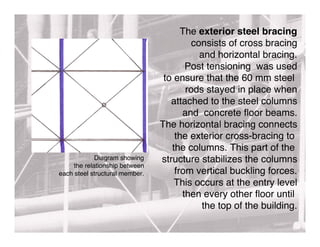
The exterior steel bracing
                                        consists of cross bracing
                                          and horizontal bracing.
                                       Post tensioning was used
                                 to ensure that the 60 mm steel
                                       rods stayed in place when
                                   attached to the steel columns
                                      and concrete floor beams.
                                The horizontal bracing connects
                                    the exterior cross-bracing to
                                   the columns. This part of the
             Diagram showing    structure stabilizes the columns
     the relationship between
each steel structural member.       from vertical buckling forces.
                                    This occurs at the entry level
                                      then every other floor until
                                           the top of the building.
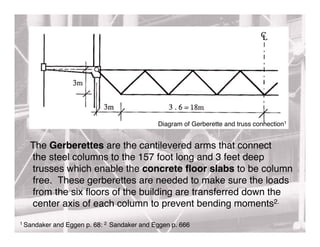
Diagram of Gerberette and truss connection1


   The Gerberettes are the cantilevered arms that connect
   the steel columns to the 157 foot long and 3 feet deep
   trusses which enable the concrete floor slabs to be column
   free. These gerberettes are needed to make sure the loads
   from the six floors of the building are transferred down the
   center axis of each column to prevent bending moments2.
1 Sandaker   and Eggen p. 68: 2 Sandaker and Eggen p. 666
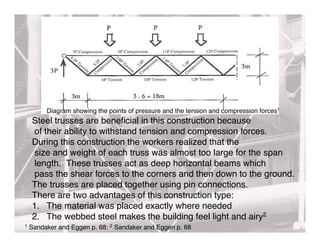
Diagram showing the points of pressure and the tension and compression forces1
    Steel trusses are beneficial in this construction because
    of their ability to withstand tension and compression forces.
    During this construction the workers realized that the
    size and weight of each truss was almost too large for the span
    length. These trusses act as deep horizontal beams which
    pass the shear forces to the corners and then down to the ground.
    The trusses are placed together using pin connections.
    There are two advantages of this construction type:
    1. The material was placed exactly where needed
    2. The webbed steel makes the building feel light and airy2
1   Sandaker and Eggen p. 68: 2 Sandaker and Eggen p. 68
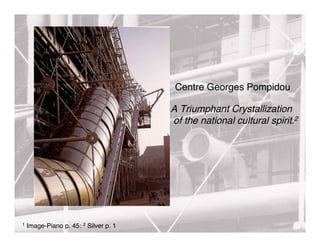
Centre Georges Pompidou

                                       A Triumphant Crystallization
                                       of the national cultural spirit.2


1   Image-Piano p. 45: 2 Silver p. 1
Works Cited:

Buchanan, Peter. Renzo Piano Building Workshop. London;
                         Phaidon Press Limited, 2000.

Piano, Renzo. Renzo Piano: Logbook. Paris; The Monicelli
                        Press Inc.,1997.

Sandaker and Eggen. The Structural Basis of Architecture.
                       NY; Sandaker and Eggen, 1992.

Silver, Nathan. The Making of Beaubourg. London; The
                         MIT Press, 1994.

Piano pompid

  • 1.
    exporting as pdf Centre Georges Pompidou Presentation By: Natasha Reising
  • 2.
  • 3.
    Architects: Renzo Piano Richard Rogers
  • 4.
    Born in 1937,the Italian Architect Renzo Piano was interested in architecture at an early age. He graduated from the University of Florence in 1964, followed by Milan Polytechnic. Piano was inspired by two people in his profession during his lifetime, Jean Prouve and Franco Albini. These two men were his mentors during his 35 year successful career. Piano started working as an Architect independently, then was affiliated with Richard Rogers before opening his final firm with fellow architect Peter Rice in 1980.
  • 5.
    The Building: Centre GeorgesPompidou Paris, France 1976
  • 6.
  • 7.
    An active andaccessible machine in which the arts could interact with each other and all social strata.1 Centre Georges Pompidou opened in 1978 centered in the heart of Paris s historical center. The building stands as a form which houses various functions. Within the structure is an Art Museum, a library, a design center, and also a music center. The bold architectural style used by Piano and Rogers contrasts with the historic buildings in the crowded area of downtown Paris. President Pompidou proposed a building in 1969 for this former site of Les Halles. This cultural center stands six stories tall and rises above the other buildings in close proximity. One prominent design feature of the site is the large open area in front of Centre Georges Pompidou. Piano used incorporated this feature in his design to include a place for visitors and the Parisians to enjoy the beauty of the building. The space is similar to the Italian idea of a “piazza”. 1 Buchanan p.26
  • 8.
  • 9.
    Piano s ideasketch1 Themes of the design2: Flexible envelope Steel Structure Simple Geometric Form Exterior Mechanical Open Piazza Building Circulation Occupancy zoned(connection with Paris) 1 Piano p. 41: 2 Silver p.31
  • 10.
    Transverse Section1 Longitudinal Section2 1 Piano p.41: 2 Piano p.41
  • 11.
    North Elevation1 Typical Floor Plan2 1 Piano p.40: 2 Piano p.40
  • 12.
    The Facts: Design CompetitionWinners: Renzo Piano and Richard Rogers Construction Time: 7 years (1971-1978) Location: Paris France (Beaubourg) Structure: Steel and Concrete Slabs Floor Area1: 65,000 m2 Cost2: $363,858,691(over budget by 11.7%) Height: 45.5 meters 1 Silver p. 23: 2 Silver p. 170
  • 13.
    The Structure: Cast Steel Columns Exterior Steel Bracing The Gerberette Concrete Floor Panels
  • 14.
  • 15.
    Steel is theonly permanent element of structure. The 850 mm steel columns surrounding the exterior of the concrete cast floor plates to create part of the industrial looking exoskeleton which can carry 3000 tons of vertical force. The steel X- bracing controls the lateral forces applied to the structure and enable the exterior to have thermal movement because of the hinge connections. The columns create 13 visual bays which brace and support the mechanical systems. One example is pictured on the left, the circulation in clear shafts 1. 1 Piano p.45
  • 16.
    The exterior steelbracing consists of cross bracing and horizontal bracing. Post tensioning was used to ensure that the 60 mm steel rods stayed in place when attached to the steel columns and concrete floor beams. The horizontal bracing connects the exterior cross-bracing to the columns. This part of the Diagram showing structure stabilizes the columns the relationship between each steel structural member. from vertical buckling forces. This occurs at the entry level then every other floor until the top of the building.
  • 17.
    Diagram of Gerberetteand truss connection1 The Gerberettes are the cantilevered arms that connect the steel columns to the 157 foot long and 3 feet deep trusses which enable the concrete floor slabs to be column free. These gerberettes are needed to make sure the loads from the six floors of the building are transferred down the center axis of each column to prevent bending moments2. 1 Sandaker and Eggen p. 68: 2 Sandaker and Eggen p. 666
  • 18.
    Diagram showing thepoints of pressure and the tension and compression forces1 Steel trusses are beneficial in this construction because of their ability to withstand tension and compression forces. During this construction the workers realized that the size and weight of each truss was almost too large for the span length. These trusses act as deep horizontal beams which pass the shear forces to the corners and then down to the ground. The trusses are placed together using pin connections. There are two advantages of this construction type: 1. The material was placed exactly where needed 2. The webbed steel makes the building feel light and airy2 1 Sandaker and Eggen p. 68: 2 Sandaker and Eggen p. 68
  • 19.
    Centre Georges Pompidou A Triumphant Crystallization of the national cultural spirit.2 1 Image-Piano p. 45: 2 Silver p. 1
  • 20.
    Works Cited: Buchanan, Peter.Renzo Piano Building Workshop. London; Phaidon Press Limited, 2000. Piano, Renzo. Renzo Piano: Logbook. Paris; The Monicelli Press Inc.,1997. Sandaker and Eggen. The Structural Basis of Architecture. NY; Sandaker and Eggen, 1992. Silver, Nathan. The Making of Beaubourg. London; The MIT Press, 1994.