General Introduction
of the Module I
Artificial Intelligence (AI) in Smart Grids
Kaunas University of Technology
Dresden University of Technology
2020-11-24, Train the trainers Workshop, antanas.verikas@ktu.lt
olga.zyabkina@tu-dresden.de
sascha.mueller@tu-dresden.de
General Introduction of the Module I
Brief Description of the
Topic
General Introduction of the Module I
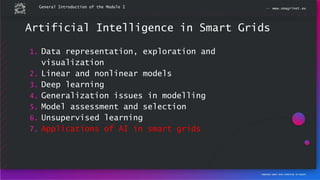
1. Data representation, exploration and
visualization
2. Linear and nonlinear models
3. Deep learning
4. Generalization issues in modelling
5. Model assessment and selection
6. Unsupervised learning
7. Applications of AI in smart grids
Artificial Intelligence in Smart Grids
General Introduction of the Module I
1. Energy demand management
2. Load and power prediction
3. Consumer and consumption insights
4. Energy trading
5. Energy management systems
6. Predictive maintenance
7. Cyber security, power system protection
Applications of AI in smart grids
General Introduction of the Module I
Kaunas University of
Technology
Department of electrical power systems
General Introduction of the Module I
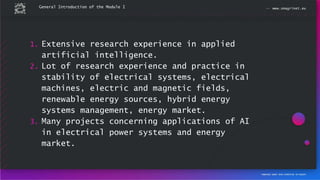
1. Extensive research experience in applied
artificial intelligence.
2. Lot of research experience and practice in
stability of electrical systems, electrical
machines, electric and magnetic fields,
renewable energy sources, hybrid energy
systems management, energy market.
3. Many projects concerning applications of AI
in electrical power systems and energy
market.
General Introduction of the Module I
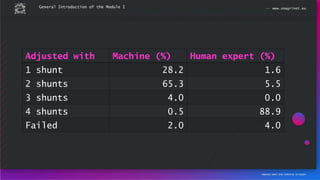
AI application example: Adjusting magnetic
field of CR
General Introduction of the Module I
Adjusted with Machine (%) Human expert (%)
1 shunt 28.2 1.6
2 shunts 65.3 5.5
3 shunts 4.0 0.0
4 shunts 0.5 88.9
Failed 2.0 4.0
General Introduction of the Module I
ML-based forecasting of floating PV
power generation
Forecast
model
t+n weather parameters
PV
generation
forecast
t-n actual data (generation)
Kruonis pumped storage
plant
General Introduction of the Module I
Efficient control of energy flows in hybrid
energy system
Technical parameters
380 kW solar power plant
The accumulator of thermal energy in water
 380 kW solar power plant;
 150 kW heat pump system “primer-water”
 Accumulator of thermal energy in water;
Supplies
 20 % of the needed electric power;
 2/3 of the necessary thermal power (heating area > 14,000 m2);
 Reduces the CO2 emission by 6,000 t/year;
 Payback period 8.4 years.
General Introduction of the Module I
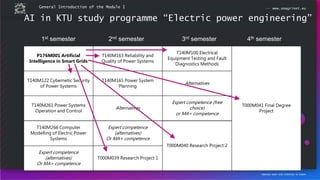
AI in KTU study programme “Electric power engineering”
P176M001 Artificial
Intelligence in Smart Grids
T140M163 Reliability and
Quality of Power Systems
T140M100 Electrical
Equipment Testing and Fault
Diagnostics Methods
T000M041 Final Degree
Project
T140M122 Cybernetic Security
of Power Systems
T140M165 Power System
Planning
Alternatives
T140M261 Power Systems
Operation and Control
Alternatives
Expert competence (free
choice)
or MA+ competence
T140M266 Computer
Modelling of Electric Power
Systems
Expert competence
(alternatives)
Or MA+ competence
Expert competence
(alternatives)
Or MA+ competence
T000M039 Research Project 1
T000M040 Research Project 2
1st semester 2nd semester 3rd semester 4th semester
General Introduction of the Module I
Why is AI an Important
Part of the Smart Grid?
General Introduction of the Module I
“State of the art of machine learning models
in energy systems, a systematic review“,
Energies.
The growth in the number of articles
related to ML in energy systems during
the past two decades
1.Growing penetration of renewable
energy sources requires accurate
forecasting and efficient decision
making.
2.Smart sensors, and IoT technologies
have enabled big data and brought
new challenges and opportunities.
3.AI and big data-based techniques
allow finding efficient solutions
to these tasks (see the graph).
General Introduction of the Module I
Knowledge the Module Provides
General Introduction of the Module I
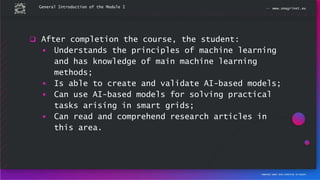
 After completion the course, the student:
 Understands the principles of machine learning
and has knowledge of main machine learning
methods;
 Is able to create and validate AI-based models;
 Can use AI-based models for solving practical
tasks arising in smart grids;
 Can read and comprehend research articles in
this area.
General Introduction of the Module I
Dresden University of
Technology
Chair of Electrical Power Supply
General Introduction of the Module I
The Chair of Electrical Power Supply includes
five research groups:
1. Energy converters and instrument transformers
2. Planning and operation of grids
3. Protection and control technology
4. Smart Grid
5. Power Quality (PQ)
General Introduction of the Module I
Data mining in Power Quality data:
1. Time dependent variation detection (trend,
seasonally, daily|weekly cycles)
2. Pattern recognition for different consumer
types
3. PQ index system
4. Abnormal behavior detection in continuous
PQ parameters
5. PQ event detection and classification
6. Correlation analysis
7. Other
General Introduction of the Module I
Why is AI an Important
Part of the Smart Grid?
General Introduction of the Module I
Motivation
• High penetration of renewable energy sources
• Fast development of digital technology and cloud computing
• Extensive measurement campaigns and permanent monitoring (smart meters)
• Exponential growth of data (“Big data”)
A novel framework and techniques (AI) to excavate useful information in
fast and comprehensive way are required
New vision for engineers to perceive and control the traditional
electrical system and makes it smart
General Introduction of the Module I
Application examples:
• Customer behavior analysis
• Demand forecasting
• Renewable energy forecasting
• Electric device state estimation
• Power quality
• And many other
Data analysis is basis for discovering valuable information and
supporting the decision-making.
Data analysis concepts:
• Statistics
• Data mining
• Artificial intelligence
• Machine learning
• Deep learning
Data analysis and application examples
General Introduction of the Module I
Knowledge the Module Provides
General Introduction of the Module I
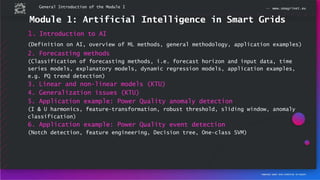
1. Introduction to AI
(Definition on AI, overview of ML methods, general methodology, application examples)
2. Forecasting methods
(Classification of forecasting methods, i.e. forecast horizon and input data, time
series models, explanatory models, dynamic regression models, application examples,
e.g. PQ trend detection)
3. Linear and non-linear models (KTU)
4. Generalization issues (KTU)
5. Application example: Power Quality anomaly detection
(I & U harmonics, feature-transformation, robust threshold, sliding window, anomaly
classification)
6. Application example: Power Quality event detection
(Notch detection, feature engineering, Decision tree, One-class SVM)
Module 1: Artificial Intelligence in Smart Grids
General Introduction of the Module I

Module 1 - vol.1.pdf

  • 1.
    General Introduction of theModule I Artificial Intelligence (AI) in Smart Grids Kaunas University of Technology Dresden University of Technology 2020-11-24, Train the trainers Workshop, antanas.verikas@ktu.lt olga.zyabkina@tu-dresden.de sascha.mueller@tu-dresden.de
  • 2.
    General Introduction ofthe Module I Brief Description of the Topic
  • 3.
    General Introduction ofthe Module I 1. Data representation, exploration and visualization 2. Linear and nonlinear models 3. Deep learning 4. Generalization issues in modelling 5. Model assessment and selection 6. Unsupervised learning 7. Applications of AI in smart grids Artificial Intelligence in Smart Grids
  • 4.
    General Introduction ofthe Module I 1. Energy demand management 2. Load and power prediction 3. Consumer and consumption insights 4. Energy trading 5. Energy management systems 6. Predictive maintenance 7. Cyber security, power system protection Applications of AI in smart grids
  • 5.
    General Introduction ofthe Module I Kaunas University of Technology Department of electrical power systems
  • 6.
    General Introduction ofthe Module I 1. Extensive research experience in applied artificial intelligence. 2. Lot of research experience and practice in stability of electrical systems, electrical machines, electric and magnetic fields, renewable energy sources, hybrid energy systems management, energy market. 3. Many projects concerning applications of AI in electrical power systems and energy market.
  • 7.
    General Introduction ofthe Module I AI application example: Adjusting magnetic field of CR
  • 8.
    General Introduction ofthe Module I Adjusted with Machine (%) Human expert (%) 1 shunt 28.2 1.6 2 shunts 65.3 5.5 3 shunts 4.0 0.0 4 shunts 0.5 88.9 Failed 2.0 4.0
  • 9.
    General Introduction ofthe Module I ML-based forecasting of floating PV power generation Forecast model t+n weather parameters PV generation forecast t-n actual data (generation) Kruonis pumped storage plant
  • 10.
    General Introduction ofthe Module I Efficient control of energy flows in hybrid energy system Technical parameters 380 kW solar power plant The accumulator of thermal energy in water  380 kW solar power plant;  150 kW heat pump system “primer-water”  Accumulator of thermal energy in water; Supplies  20 % of the needed electric power;  2/3 of the necessary thermal power (heating area > 14,000 m2);  Reduces the CO2 emission by 6,000 t/year;  Payback period 8.4 years.
  • 11.
    General Introduction ofthe Module I AI in KTU study programme “Electric power engineering” P176M001 Artificial Intelligence in Smart Grids T140M163 Reliability and Quality of Power Systems T140M100 Electrical Equipment Testing and Fault Diagnostics Methods T000M041 Final Degree Project T140M122 Cybernetic Security of Power Systems T140M165 Power System Planning Alternatives T140M261 Power Systems Operation and Control Alternatives Expert competence (free choice) or MA+ competence T140M266 Computer Modelling of Electric Power Systems Expert competence (alternatives) Or MA+ competence Expert competence (alternatives) Or MA+ competence T000M039 Research Project 1 T000M040 Research Project 2 1st semester 2nd semester 3rd semester 4th semester
  • 12.
    General Introduction ofthe Module I Why is AI an Important Part of the Smart Grid?
  • 13.
    General Introduction ofthe Module I “State of the art of machine learning models in energy systems, a systematic review“, Energies. The growth in the number of articles related to ML in energy systems during the past two decades 1.Growing penetration of renewable energy sources requires accurate forecasting and efficient decision making. 2.Smart sensors, and IoT technologies have enabled big data and brought new challenges and opportunities. 3.AI and big data-based techniques allow finding efficient solutions to these tasks (see the graph).
  • 14.
    General Introduction ofthe Module I Knowledge the Module Provides
  • 15.
    General Introduction ofthe Module I  After completion the course, the student:  Understands the principles of machine learning and has knowledge of main machine learning methods;  Is able to create and validate AI-based models;  Can use AI-based models for solving practical tasks arising in smart grids;  Can read and comprehend research articles in this area.
  • 16.
    General Introduction ofthe Module I Dresden University of Technology Chair of Electrical Power Supply
  • 17.
    General Introduction ofthe Module I The Chair of Electrical Power Supply includes five research groups: 1. Energy converters and instrument transformers 2. Planning and operation of grids 3. Protection and control technology 4. Smart Grid 5. Power Quality (PQ)
  • 18.
    General Introduction ofthe Module I Data mining in Power Quality data: 1. Time dependent variation detection (trend, seasonally, daily|weekly cycles) 2. Pattern recognition for different consumer types 3. PQ index system 4. Abnormal behavior detection in continuous PQ parameters 5. PQ event detection and classification 6. Correlation analysis 7. Other
  • 19.
    General Introduction ofthe Module I Why is AI an Important Part of the Smart Grid?
  • 20.
    General Introduction ofthe Module I Motivation • High penetration of renewable energy sources • Fast development of digital technology and cloud computing • Extensive measurement campaigns and permanent monitoring (smart meters) • Exponential growth of data (“Big data”) A novel framework and techniques (AI) to excavate useful information in fast and comprehensive way are required New vision for engineers to perceive and control the traditional electrical system and makes it smart
  • 21.
    General Introduction ofthe Module I Application examples: • Customer behavior analysis • Demand forecasting • Renewable energy forecasting • Electric device state estimation • Power quality • And many other Data analysis is basis for discovering valuable information and supporting the decision-making. Data analysis concepts: • Statistics • Data mining • Artificial intelligence • Machine learning • Deep learning Data analysis and application examples
  • 22.
    General Introduction ofthe Module I Knowledge the Module Provides
  • 23.
    General Introduction ofthe Module I 1. Introduction to AI (Definition on AI, overview of ML methods, general methodology, application examples) 2. Forecasting methods (Classification of forecasting methods, i.e. forecast horizon and input data, time series models, explanatory models, dynamic regression models, application examples, e.g. PQ trend detection) 3. Linear and non-linear models (KTU) 4. Generalization issues (KTU) 5. Application example: Power Quality anomaly detection (I & U harmonics, feature-transformation, robust threshold, sliding window, anomaly classification) 6. Application example: Power Quality event detection (Notch detection, feature engineering, Decision tree, One-class SVM) Module 1: Artificial Intelligence in Smart Grids
  • 24.