CLOUD COMPUTING AND
ARTIFICIAL
INTELLEGENCE
By
Syed Furqan Haider Shah
BSE-8(A)
FA14-176
Things to understand
 What is Artificial Intelligence
 Cloud Computing and AI
 What’s parallel processing and how it work in cloud
 How AI uses big data
 ML algorithms for Cloud Applications
 Conclusion
What is artificial intelligence
AI stands for Artificial Intelligence. A.I. generally refers to the ability of
machines to perform intellectual tasks.
Its defined as:
“the theory and development of computer systems able to perform
tasks normally requiring human intelligence, such as visual perception,
speech recognition, decision-making, and translation between
languages.”
Cloud computing and AI
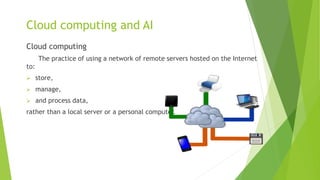
Cloud computing
The practice of using a network of remote servers hosted on the Internet
to:
 store,
 manage,
 and process data,
rather than a local server or a personal computer.
Cloud computing and AI(contd.)
Cloud computing and AI
While artificial intelligence (A.I.) has struggled to gain footholds in other
niches, it is finding its place in the world of cloud computing, a sort of
revolution within the revolution that could rapidly change the face of
businesses using cloud computing solutions over the next few years.
Cloud computing and AI(contd.)
In three areas of cloud computing, A.I. is taking long strides.
Those areas are
 Parallel processing
 Machine Learning-ML Algorithms
 Big Data
What’s parallel processing and how it work in
cloud
Parallel processing means more than one microprocessor handling
parts of the same overall task. Parallel processing essentially
means that multiple processors shoulder the load. To have
multiple processors working on the same problem at the same
time, there are two big things you need:
 Latency
 Bandwidth
What’s parallel processing and how it
work in cloud(contd.)
Latency
it refers to the amount of time it takes for a processor to send results back to
the system. The longer the wait, the longer it will take the entire system to
process the problem.
Bandwidth
Bandwidth is a more common term, referring to how much data a processor can
send in a given length of time.
ML algorithms for cloud applications
Machine learning (ML) is a type of artificial
intelligence (AI) that allows software applications to
become more accurate in predicting outcomes without
being explicitly programmed
For cloud applications Machine Learning algorithms are
built
ML algorithms for cloud
applications(contd.)
ML algorithms for cloud applications involve:
 Cognitive computing(to combine different patterns together; i.e. voice,
imagery or other such data; for mimicking human behavior)
 Chatbots and virtual assistants (they are getting smarter every time they
have a conversation)
 Internet of things-IoT (It connects every potentially “smart” machine in the
world to the cloud and add that massive amount of data to the conversation)
How AI uses big data
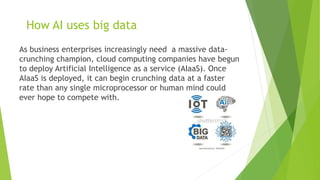
As business enterprises increasingly need a massive data-
crunching champion, cloud computing companies have begun
to deploy Artificial Intelligence as a service (AIaaS). Once
AIaaS is deployed, it can begin crunching data at a faster
rate than any single microprocessor or human mind could
ever hope to compete with.
Conclusion
A.I. has not come to take over our world, but to improve
the way we harness technology to make everything better.
Consider the surface of A.I. finally scratched. ??

Cloud computing and artificial intelligence

  • 1.
    CLOUD COMPUTING AND ARTIFICIAL INTELLEGENCE By SyedFurqan Haider Shah BSE-8(A) FA14-176
  • 2.
    Things to understand What is Artificial Intelligence  Cloud Computing and AI  What’s parallel processing and how it work in cloud  How AI uses big data  ML algorithms for Cloud Applications  Conclusion
  • 3.
    What is artificialintelligence AI stands for Artificial Intelligence. A.I. generally refers to the ability of machines to perform intellectual tasks. Its defined as: “the theory and development of computer systems able to perform tasks normally requiring human intelligence, such as visual perception, speech recognition, decision-making, and translation between languages.”
  • 4.
    Cloud computing andAI Cloud computing The practice of using a network of remote servers hosted on the Internet to:  store,  manage,  and process data, rather than a local server or a personal computer.
  • 5.
    Cloud computing andAI(contd.) Cloud computing and AI While artificial intelligence (A.I.) has struggled to gain footholds in other niches, it is finding its place in the world of cloud computing, a sort of revolution within the revolution that could rapidly change the face of businesses using cloud computing solutions over the next few years.
  • 6.
    Cloud computing andAI(contd.) In three areas of cloud computing, A.I. is taking long strides. Those areas are  Parallel processing  Machine Learning-ML Algorithms  Big Data
  • 7.
    What’s parallel processingand how it work in cloud Parallel processing means more than one microprocessor handling parts of the same overall task. Parallel processing essentially means that multiple processors shoulder the load. To have multiple processors working on the same problem at the same time, there are two big things you need:  Latency  Bandwidth
  • 8.
    What’s parallel processingand how it work in cloud(contd.) Latency it refers to the amount of time it takes for a processor to send results back to the system. The longer the wait, the longer it will take the entire system to process the problem. Bandwidth Bandwidth is a more common term, referring to how much data a processor can send in a given length of time.
  • 9.
    ML algorithms forcloud applications Machine learning (ML) is a type of artificial intelligence (AI) that allows software applications to become more accurate in predicting outcomes without being explicitly programmed For cloud applications Machine Learning algorithms are built
  • 10.
    ML algorithms forcloud applications(contd.) ML algorithms for cloud applications involve:  Cognitive computing(to combine different patterns together; i.e. voice, imagery or other such data; for mimicking human behavior)  Chatbots and virtual assistants (they are getting smarter every time they have a conversation)  Internet of things-IoT (It connects every potentially “smart” machine in the world to the cloud and add that massive amount of data to the conversation)
  • 11.
    How AI usesbig data As business enterprises increasingly need a massive data- crunching champion, cloud computing companies have begun to deploy Artificial Intelligence as a service (AIaaS). Once AIaaS is deployed, it can begin crunching data at a faster rate than any single microprocessor or human mind could ever hope to compete with.
  • 12.
    Conclusion A.I. has notcome to take over our world, but to improve the way we harness technology to make everything better. Consider the surface of A.I. finally scratched. ??