




Case Report Writing:
What is special about it in traditional medicine?
Prof ( Dr ) Sanjeev Rastogi
State Ayurveda College, Lucknow University
A physician may have many
moods
These are my
Observations
Thinking
Experimenting
Questioning
Celebrating
Reporting
Am I the first to Do This ?
 Thinking about a new treatment plan
 Has anybody thought of this before ?
 Experimenting for a new intervention or technique
 Has anybody experimented like this before ?
 Celebrating the success of an intervention
 Has anybody succeed in this before ?
 Questioning about the failures
 Has anybody failed earlier also doing so ?
 Reporting to what is observed
 Has anybody reported it before?
Wanted to be
sure if you are
following the
trend or
Is setting the
trend
You are
following
the trend
if similar
instances
are
available
in the
literature
You are setting the trend if no one has done it earlier
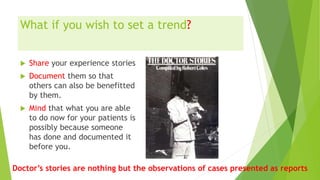
What if you wish to set a trend?
 Share your experience stories
 Document them so that
others can also be benefitted
by them.
 Mind that what you are able
to do now for your patients is
possibly because someone
has done and documented it
before you.
Doctor’s stories are nothing but the observations of cases presented as reports
Writing the case reports?
What are the Case Reports ?
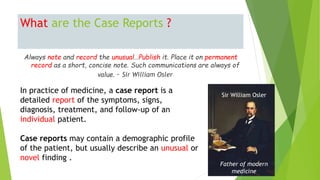
Always note and record the unusual…Publish it. Place it on permanent
record as a short, concise note. Such communications are always of
value. – Sir William Osler
In practice of medicine, a case report is a
detailed report of the symptoms, signs,
diagnosis, treatment, and follow-up of an
individual patient.
Case reports may contain a demographic profile
of the patient, but usually describe an unusual or
novel finding .
Father of modern
medicine
Sir William Osler
What a case report may contain ?
 Any thing unusually positive or negative relating to
 A clinical presentation
 Outcome of an intervention
 Outcome of a diagnostic procedure
 Prognosis of a disease
 Clinical course of a disease
 Adversity of otherwise safe intervention
What a Case report may contain?
 Findings shedding new light on possible pathogenesis of a disease or an adverse effect
 Learning from errors
 Myth exploded
 Adversity due to heavy metals versus using heavy metal compounds in critical conditions
 New Disease
 Not available in literature
 Novel Diagnostic procedure
 Newly developed or old device used for new indication
 Novel treatment ( new drug / intervention; established drug / procedure in new situation)
 Rare disease
 Reminder of important clinical lesson
 Importance of clinical examination, clinical signs and symptoms
 Unexpected outcome ( positive or negative ) including adverse drug reaction
 Unusual association of disease / symptoms
 Combination of diseases/ symptoms occurring together
 Unusual presentation of a common disease/ injury
Why Case Reports?
 To place on Record the uncommon / rare observations
related to
 A clinical finding / presentation
 A clinical incidence
 The effects of intervention either positive or negative
 The outcome of a disease
 For
 Either one’s own use as a clinical record
 Or for common benefit of the peers
Benefits of Case Reporting
Immediate
Prompts the peers to get benefits from the experiences of others
Helps patients of untreatable conditions finding a hope
Remote
Generates a better understanding about variability in human
population
Works as a clue to plan more serious systematic studies in the
target areas
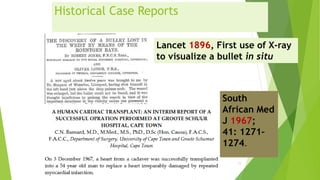
Historical Case Reports
11
Lancet 1896, First use of X-ray
to visualize a bullet in situ
South
African Med
J 1967;
41: 1271–
1274.
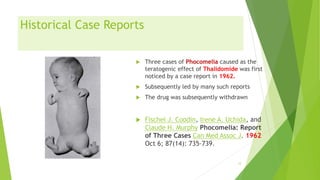
Historical Case Reports
 Three cases of Phocomelia caused as the
teratogenic effect of Thalidomide was first
noticed by a case report in 1962.
 Subsequently led by many such reports
 The drug was subsequently withdrawn
 Fischel J. Coodin, Irene A. Uchida, and
Claude H. Murphy Phocomelia: Report
of Three Cases Can Med Assoc J. 1962
Oct 6; 87(14): 735–739.
12
Beginning of Research on AIDS
 Begun after the publication of a case report in 1981 of Kaposi’s sarcoma
in a young homosexual man .
 This case report followed by 103 similar case reports published in Lancet
in next 5 years.
 24 randomized control trials followed subsequently.
Gottleib GJ, Rogoz A, Vogel JV et al. A preliminary communication
on extensively disseminated Kaposi’s sarcoma in a young
homosexual man. Am J Dermatopathol. 1981; 3:111-4.
13
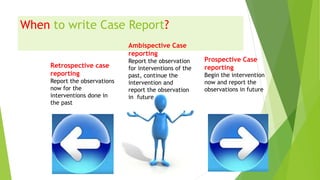
When to write Case Report?
Prospective Case
reporting
Begin the intervention
now and report the
observations in future
Retrospective case
reporting
Report the observations
now for the
interventions done in
the past
Ambispective Case
reporting
Report the observation
for interventions of the
past, continue the
intervention and
report the observation
in future
Who can write a case report ?
 Any one who is related directly to the health care delivery
 Physician
 Clinical aspects of a disease
 Results of a drug intervention
 Nursing staff
 About a drug adversity
 About unusual developments in a clinical condition
 Pharmacist
 About undue results of a drug combination and dosage
 Medical students, interns and PG scholars
 About the causes of the disease , unusual signs and symptoms of a clinical condition
 Specialists involved in pharmaceutics
 Special observation made during the drug processing which are clinically relevant
How to write the case report?
 Content
 Novelty of the case
 Rarity or uncommonness
 Prospective future implications
 Honesty in reporting
 Unbiased inferences
 Transparency of reporting
 Proof of findings
 Orderly and logical presentation
 Frame work of a case report
 Essential components of a case report as per CARE guideline
 available at https://www.care-statement.org
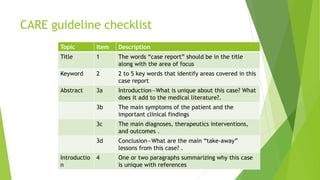
CARE guideline checklist
Topic Item Description
Title 1 The words “case report” should be in the title
along with the area of focus
Keyword 2 2 to 5 key words that identify areas covered in this
case report
Abstract 3a Introduction—What is unique about this case? What
does it add to the medical literature?.
3b The main symptoms of the patient and the
important clinical findings
3c The main diagnoses, therapeutics interventions,
and outcomes .
3d Conclusion—What are the main “take-away”
lessons from this case? .
Introductio
n
4 One or two paragraphs summarizing why this case
is unique with references
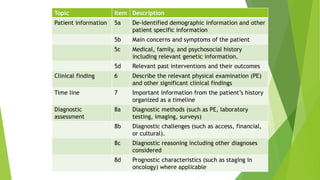
Topic Item Description
Patient information 5a De-identified demographic information and other
patient specific information
5b Main concerns and symptoms of the patient
5c Medical, family, and psychosocial history
including relevant genetic information.
5d Relevant past interventions and their outcomes
Clinical finding 6 Describe the relevant physical examination (PE)
and other significant clinical findings
Time line 7 Important information from the patient’s history
organized as a timeline
Diagnostic
assessment
8a Diagnostic methods (such as PE, laboratory
testing, imaging, surveys)
8b Diagnostic challenges (such as access, financial,
or cultural).
8c Diagnostic reasoning including other diagnoses
considered
8d Prognostic characteristics (such as staging in
oncology) where applicable
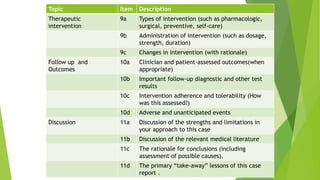
Topic Item Description
Therapeutic
intervention
9a Types of intervention (such as pharmacologic,
surgical, preventive, self-care)
9b Administration of intervention (such as dosage,
strength, duration)
9c Changes in intervention (with rationale)
Follow up and
Outcomes
10a Clinician and patient-assessed outcomes(when
appropriate)
10b Important follow-up diagnostic and other test
results
10c Intervention adherence and tolerability (How
was this assessed?)
10d Adverse and unanticipated events
Discussion 11a Discussion of the strengths and limitations in
your approach to this case
11b Discussion of the relevant medical literature
11c The rationale for conclusions (including
assessment of possible causes).
11d The primary “take-away” lessons of this case
report .
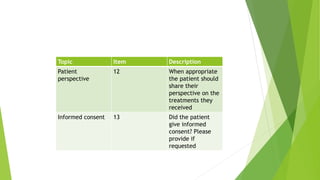
Topic Item Description
Patient
perspective
12 When appropriate
the patient should
share their
perspective on the
treatments they
received
Informed consent 13 Did the patient
give informed
consent? Please
provide if
requested
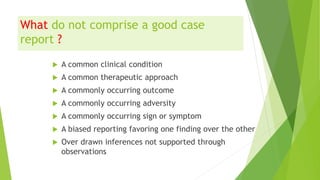
What do not comprise a good case
report ?
 A common clinical condition
 A common therapeutic approach
 A commonly occurring outcome
 A commonly occurring adversity
 A commonly occurring sign or symptom
 A biased reporting favoring one finding over the other
 Over drawn inferences not supported through
observations
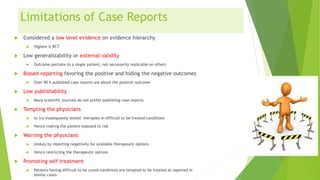
Limitations of Case Reports
 Considered a low level evidence on evidence hierarchy
 Highest is RCT
 Low generalizability or external validity
 Outcome pertains to a single patient, not necessarily replicable on others
 Biased reporting favoring the positive and hiding the negative outcomes
 Over 90 % published case reports are about the positive outcome
 Low publishability
 Many scientific journals do not prefer publishing case reports
 Tempting the physicians
 to try inadequately tested therapies in difficult to be treated conditions
 Hence making the patient exposed to risk
 Warning the physicians
 Unduly by reporting negatively for available therapeutic options
 Hence restricting the therapeutic options
 Promoting self treatment
 Patients having difficult to be cured conditions are tempted to be treated as reported in
similar cases
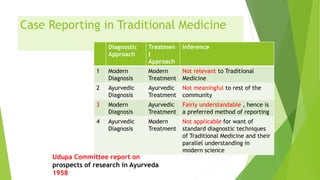
Case Reporting in Traditional Medicine
Diagnostic
Approach
Treatmen
t
Approach
Inference
1 Modern
Diagnosis
Modern
Treatment
Not relevant to Traditional
Medicine
2 Ayurvedic
Diagnosis
Ayurvedic
Treatment
Not meaningful to rest of the
community
3 Modern
Diagnosis
Ayurvedic
Treatment
Fairly understandable , hence is
a preferred method of reporting
4 Ayurvedic
Diagnosis
Modern
Treatment
Not applicable for want of
standard diagnostic techniques
of Traditional Medicine and their
parallel understanding in
modern science
Udupa Committee report on
prospects of research in Ayurveda
1958
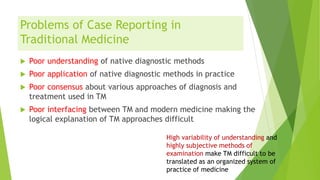
Problems of Case Reporting in
Traditional Medicine
 Poor understanding of native diagnostic methods
 Poor application of native diagnostic methods in practice
 Poor consensus about various approaches of diagnosis and
treatment used in TM
 Poor interfacing between TM and modern medicine making the
logical explanation of TM approaches difficult
High variability of understanding and
highly subjective methods of
examination make TM difficult to be
translated as an organized system of
practice of medicine
Case Reporting : Moving forward Pragmatically
 Examine the patient to the utmost details
 Examine all the available records of patient
 Keep a note of everything you observe
 Make a logical plan of interventions
 Keep a close follow-up of the patient for any
positive /negative changes
 Try to understand logically the reasons for any
change observed
 Linkup the observation with scientific logic
wherever you can
 Repeat the same approach to more of similar cases
coming to you to identify the trends and to see
the variability of responses
 Publish the observations once you are convinced
that these observations may help others in making
the therapeutic choices.
Case Report Writing

Case Report Writing

  • 1.
    Case Report Writing: Whatis special about it in traditional medicine? Prof ( Dr ) Sanjeev Rastogi State Ayurveda College, Lucknow University
  • 2.
    A physician mayhave many moods These are my Observations Thinking Experimenting Questioning Celebrating Reporting
  • 3.
    Am I thefirst to Do This ?  Thinking about a new treatment plan  Has anybody thought of this before ?  Experimenting for a new intervention or technique  Has anybody experimented like this before ?  Celebrating the success of an intervention  Has anybody succeed in this before ?  Questioning about the failures  Has anybody failed earlier also doing so ?  Reporting to what is observed  Has anybody reported it before? Wanted to be sure if you are following the trend or Is setting the trend You are following the trend if similar instances are available in the literature You are setting the trend if no one has done it earlier
  • 4.
    What if youwish to set a trend?  Share your experience stories  Document them so that others can also be benefitted by them.  Mind that what you are able to do now for your patients is possibly because someone has done and documented it before you. Doctor’s stories are nothing but the observations of cases presented as reports
  • 5.
  • 6.
    What are theCase Reports ? Always note and record the unusual…Publish it. Place it on permanent record as a short, concise note. Such communications are always of value. – Sir William Osler In practice of medicine, a case report is a detailed report of the symptoms, signs, diagnosis, treatment, and follow-up of an individual patient. Case reports may contain a demographic profile of the patient, but usually describe an unusual or novel finding . Father of modern medicine Sir William Osler
  • 7.
    What a casereport may contain ?  Any thing unusually positive or negative relating to  A clinical presentation  Outcome of an intervention  Outcome of a diagnostic procedure  Prognosis of a disease  Clinical course of a disease  Adversity of otherwise safe intervention
  • 8.
    What a Casereport may contain?  Findings shedding new light on possible pathogenesis of a disease or an adverse effect  Learning from errors  Myth exploded  Adversity due to heavy metals versus using heavy metal compounds in critical conditions  New Disease  Not available in literature  Novel Diagnostic procedure  Newly developed or old device used for new indication  Novel treatment ( new drug / intervention; established drug / procedure in new situation)  Rare disease  Reminder of important clinical lesson  Importance of clinical examination, clinical signs and symptoms  Unexpected outcome ( positive or negative ) including adverse drug reaction  Unusual association of disease / symptoms  Combination of diseases/ symptoms occurring together  Unusual presentation of a common disease/ injury
  • 9.
    Why Case Reports? To place on Record the uncommon / rare observations related to  A clinical finding / presentation  A clinical incidence  The effects of intervention either positive or negative  The outcome of a disease  For  Either one’s own use as a clinical record  Or for common benefit of the peers
  • 10.
    Benefits of CaseReporting Immediate Prompts the peers to get benefits from the experiences of others Helps patients of untreatable conditions finding a hope Remote Generates a better understanding about variability in human population Works as a clue to plan more serious systematic studies in the target areas
  • 11.
    Historical Case Reports 11 Lancet1896, First use of X-ray to visualize a bullet in situ South African Med J 1967; 41: 1271– 1274.
  • 12.
    Historical Case Reports Three cases of Phocomelia caused as the teratogenic effect of Thalidomide was first noticed by a case report in 1962.  Subsequently led by many such reports  The drug was subsequently withdrawn  Fischel J. Coodin, Irene A. Uchida, and Claude H. Murphy Phocomelia: Report of Three Cases Can Med Assoc J. 1962 Oct 6; 87(14): 735–739. 12
  • 13.
    Beginning of Researchon AIDS  Begun after the publication of a case report in 1981 of Kaposi’s sarcoma in a young homosexual man .  This case report followed by 103 similar case reports published in Lancet in next 5 years.  24 randomized control trials followed subsequently. Gottleib GJ, Rogoz A, Vogel JV et al. A preliminary communication on extensively disseminated Kaposi’s sarcoma in a young homosexual man. Am J Dermatopathol. 1981; 3:111-4. 13
  • 14.
    When to writeCase Report? Prospective Case reporting Begin the intervention now and report the observations in future Retrospective case reporting Report the observations now for the interventions done in the past Ambispective Case reporting Report the observation for interventions of the past, continue the intervention and report the observation in future
  • 15.
    Who can writea case report ?  Any one who is related directly to the health care delivery  Physician  Clinical aspects of a disease  Results of a drug intervention  Nursing staff  About a drug adversity  About unusual developments in a clinical condition  Pharmacist  About undue results of a drug combination and dosage  Medical students, interns and PG scholars  About the causes of the disease , unusual signs and symptoms of a clinical condition  Specialists involved in pharmaceutics  Special observation made during the drug processing which are clinically relevant
  • 16.
    How to writethe case report?  Content  Novelty of the case  Rarity or uncommonness  Prospective future implications  Honesty in reporting  Unbiased inferences  Transparency of reporting  Proof of findings  Orderly and logical presentation  Frame work of a case report  Essential components of a case report as per CARE guideline  available at https://www.care-statement.org
  • 17.
    CARE guideline checklist TopicItem Description Title 1 The words “case report” should be in the title along with the area of focus Keyword 2 2 to 5 key words that identify areas covered in this case report Abstract 3a Introduction—What is unique about this case? What does it add to the medical literature?. 3b The main symptoms of the patient and the important clinical findings 3c The main diagnoses, therapeutics interventions, and outcomes . 3d Conclusion—What are the main “take-away” lessons from this case? . Introductio n 4 One or two paragraphs summarizing why this case is unique with references
  • 18.
    Topic Item Description Patientinformation 5a De-identified demographic information and other patient specific information 5b Main concerns and symptoms of the patient 5c Medical, family, and psychosocial history including relevant genetic information. 5d Relevant past interventions and their outcomes Clinical finding 6 Describe the relevant physical examination (PE) and other significant clinical findings Time line 7 Important information from the patient’s history organized as a timeline Diagnostic assessment 8a Diagnostic methods (such as PE, laboratory testing, imaging, surveys) 8b Diagnostic challenges (such as access, financial, or cultural). 8c Diagnostic reasoning including other diagnoses considered 8d Prognostic characteristics (such as staging in oncology) where applicable
  • 19.
    Topic Item Description Therapeutic intervention 9aTypes of intervention (such as pharmacologic, surgical, preventive, self-care) 9b Administration of intervention (such as dosage, strength, duration) 9c Changes in intervention (with rationale) Follow up and Outcomes 10a Clinician and patient-assessed outcomes(when appropriate) 10b Important follow-up diagnostic and other test results 10c Intervention adherence and tolerability (How was this assessed?) 10d Adverse and unanticipated events Discussion 11a Discussion of the strengths and limitations in your approach to this case 11b Discussion of the relevant medical literature 11c The rationale for conclusions (including assessment of possible causes). 11d The primary “take-away” lessons of this case report .
  • 20.
    Topic Item Description Patient perspective 12When appropriate the patient should share their perspective on the treatments they received Informed consent 13 Did the patient give informed consent? Please provide if requested
  • 21.
    What do notcomprise a good case report ?  A common clinical condition  A common therapeutic approach  A commonly occurring outcome  A commonly occurring adversity  A commonly occurring sign or symptom  A biased reporting favoring one finding over the other  Over drawn inferences not supported through observations
  • 22.
    Limitations of CaseReports  Considered a low level evidence on evidence hierarchy  Highest is RCT  Low generalizability or external validity  Outcome pertains to a single patient, not necessarily replicable on others  Biased reporting favoring the positive and hiding the negative outcomes  Over 90 % published case reports are about the positive outcome  Low publishability  Many scientific journals do not prefer publishing case reports  Tempting the physicians  to try inadequately tested therapies in difficult to be treated conditions  Hence making the patient exposed to risk  Warning the physicians  Unduly by reporting negatively for available therapeutic options  Hence restricting the therapeutic options  Promoting self treatment  Patients having difficult to be cured conditions are tempted to be treated as reported in similar cases
  • 23.
    Case Reporting inTraditional Medicine Diagnostic Approach Treatmen t Approach Inference 1 Modern Diagnosis Modern Treatment Not relevant to Traditional Medicine 2 Ayurvedic Diagnosis Ayurvedic Treatment Not meaningful to rest of the community 3 Modern Diagnosis Ayurvedic Treatment Fairly understandable , hence is a preferred method of reporting 4 Ayurvedic Diagnosis Modern Treatment Not applicable for want of standard diagnostic techniques of Traditional Medicine and their parallel understanding in modern science Udupa Committee report on prospects of research in Ayurveda 1958
  • 24.
    Problems of CaseReporting in Traditional Medicine  Poor understanding of native diagnostic methods  Poor application of native diagnostic methods in practice  Poor consensus about various approaches of diagnosis and treatment used in TM  Poor interfacing between TM and modern medicine making the logical explanation of TM approaches difficult High variability of understanding and highly subjective methods of examination make TM difficult to be translated as an organized system of practice of medicine
  • 25.
    Case Reporting :Moving forward Pragmatically  Examine the patient to the utmost details  Examine all the available records of patient  Keep a note of everything you observe  Make a logical plan of interventions  Keep a close follow-up of the patient for any positive /negative changes  Try to understand logically the reasons for any change observed  Linkup the observation with scientific logic wherever you can  Repeat the same approach to more of similar cases coming to you to identify the trends and to see the variability of responses  Publish the observations once you are convinced that these observations may help others in making the therapeutic choices.