Celestin Bilong M.J, medical student
Faculty of Medicine and Biomedical Sciences
University of Yaounde I
Cameroon
OBJECTIVES
1. State the importance of case reports
2. Know when and why to write a case report
3. Know how to write a case report
4. Identify common pitfalls associated with case report
writing
02
PLAN
I. INTRODUCTION
II. HOW TO WRITE A CASE REPORT
III. PUBLISHING A CASE REPORT
IV. COMMON BARRIERS AND PITFALLS
V. CASE REPORT EXAMPLE
VI. CONCLUSION
VII. REFERENCES
03
Definition, When to write and why?
I. INTRODUCTION
04
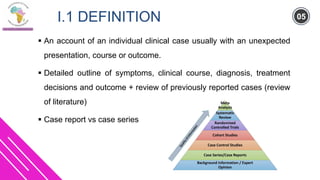
I.1 DEFINITION
▪ An account of an individual clinical case usually with an unexpected
presentation, course or outcome.
▪ Detailed outline of symptoms, clinical course, diagnosis, treatment
decisions and outcome + review of previously reported cases (review
of literature)
▪ Case report vs case series
05
I. 2 WHEN TO WRITE 06
Bavdekar SB, Save S. Writing Case Reports: Contributing to Practice and Research, J Apr 2015
I.3 WHY WE SHOULD WRITE
▪ Generation of new hypotheses (science is rooted in observations)
▪ Improve medical education
▪ Offer early signals of benefits, harms and value
▪ Authors learn to perform a focused literature research, explain
history, demonstrate analytical skills,…become better at writing
and research.
07
II. HOW TO WRITE
A CASE REPORT
Preliminaries, Order vs Sequence, Components proper
08
II.1 PRELIMINARIES
▪ Discuss with medical team
▪ Background research
▪ Extensive literature search needed
▪ Avoid ‘me too’ cases
▪ Getting permission and consent
▪ Information gathering
▪ Documentation of clinical presentation on admission and along the disease
course
▪ Clear results from diagnostic tests
▪ Detailed overview of treatment given and response
▪ Formulate up to 3 bullet point messages on what you want to communicate
09
II.2 ORDER VS SEQUENCE
▪ Title
▪ Abstract
▪ Introduction
▪ Case description
▪ Discussion
▪ References
10
▪ WHAT: Working title, case
description
▪ WHY: Introduction, Discussion,
Conclusion
▪ Abstract, key words, references,
acknowledgement, informed
consent
Order Writing Sequence
II.3 COMPONENTS PROPER (1/9) 11
▪ Title
▪ The words ‘case report’ (or ‘case study’) should appear in the title
along with phenomenon of greatest interest (eg, symptom, diagnosis,
test, intervention)
▪ Concise, informative, relevant, attractive
II.3 COMPONENTS PROPER (2/9) 12
▪ Abstract
▪ Introduction/Background: what is known and what does this case
add?
▪ Case description: main symptoms, main diagnoses and interventions
and main outcomes
▪ Conclusion: Take home message
▪ Usual characteristics (word limit, structured/unstructured)
II.3 COMPONENTS PROPER (3/9) 13
▪ Introduction
▪ Background information: describe the context (rarity, disease
incidence, mortality, morbidity)
▪ Refer to cases reported earlier
▪ Define terminologies used
▪ Explain the purpose of reporting the case
▪ DON’T provide an extensive overview of each aspect of the disease
the patient has, leave that for the case description
▪ Usual characteristics (brief, clear, catchy)
II.3 COMPONENTS PROPER (4/9) 14
▪ Case description/case presentation
▪ Patient information
▪ Ethics and reporting guidelines
▪ Demographic information (e.g age, gender, ethnicity, occupation)
▪ Main symptoms (chief complaints)
▪ Relevant past history
▪ Clinical findings
▪ Relevant PE findings
▪ Diagnostic assessment
▪ Dx methods (PE, lab testing, imaging, questionnaires)
▪ Dx challenges (financial, language/cultural)
▪ Dx reasoning including other Dx considered
▪ Prognostic charactersitics (e.g staging when applicable)
01
02
03
04
05
II.3 COMPONENTS PROPER (5/9) 15
▪ Case description/case presentation
▪ Initial therapeutic intervention and evolution
▪ Type of intervention (pharmacological, surgical, preventive, self care)
▪ Evolution under the intervention
▪ Changes in intervention with rationale
▪ Follow-up and outcomes
▪ Summarise the clinical course of all follow up visits/remarkable findings
▪ Important follow up results (positive or negative)
▪ Intervention adherence and tolerability (and how it was assessed)
▪ Adverse and unanticipated events
II.3 COMPONENTS PROPER (6/9) 16
▪ Discussion
▪ Aim: evaluate the case for accuracy, validity and uniqueness
▪ Strengths and limitations in the management of the case
▪ Relevant medical literature
▪ Rationale for conclusions (including assessment of cause and
effect)
▪ Patient perspective
▪ « Take home messages » for this case report
▪ Use figures and tables where needed.
II.3 COMPONENTS PROPER (7/9) 17
▪ References
▪ Less than15 references are adequate (consult author’s guidelines)
▪ References should be drawn from peer review journals and credible
online sources
▪ Cite as per the style and methods required by the journal
II.3 COMPONENTS PROPER (8/9)
NB: Informed consent
▪ Inform patient that the case will be published
▪ Discuss potential images, especially if they show the patient
▪ Ask for written consent
18
II.3 COMPONENTS PROPER (9/9)
▪ Special circumstances
▪ Patient deceased (relatives), pediatric (parents)
▪ Patient unavailable
▪ Institutional general consent required from all patients (upon admission to
hospital)
▪ Publish without informed consent (exceptions)
▪ Important public health message
▪ Impossible to obtain informed consent despite all efforts
▪ Benefit of publication outweighs potential harm
19
Wager E, Kleinert S; Committee on Publication Ethics (COPE). Cooperation between
research institutions and journals on research integrity cases, 2012
20
Journal to select, some lists
III. PUBLISHING A
CASE REPORT
21
III. PUBLISHING A CASE REPORT (1/2)
Which journal to select?
▪ Clinical medicine journals
▪ Case report journals
22
High reputation, Impact Factor
Case Reports unwanted, high chances of rejection
Often relatively long review processes
Specialized in publishing case reports, no default rejection
Often faster review process
No impact factor, reduced visibility of individual report
*Open access
III. PUBLISHING A CASE REPORT (2/2)
Some lists
www.care-statement.org/s/CaseReports-Journals-2017.pdf
https://www.sites.google.com/site/casereportpubjournals/
23
Barriers, Pitfalls
IV. COMMON
BARRIERS AND
PITFALLS
24
IV. COMMON BARRIERS AND PITFALLS (1/2)
▪ Inexperience
▪ Read reports in literature, seek help from mentors and experienced colleagues
▪ Insufficient Documentation
▪ Ensure rigorous documentation availability
▪ Inappopriate format
▪ Read guide/instructions to authors (submitology)
▪ Ineffective illustrations
▪ If necessary, get professional help and submit illustrations of standard quality
and clarity
25
IV. COMMON BARRIERS AND PITFALLS (2/2)
▪ Poor writing
▪ Consult published sources and request experienced colleagues to offer
comments and critique before the draft is finalized
▪ Authorship
▪ Agree before writing of the case report begins, should be restricted to
those who have made substantial intellectual contributions to the
manuscript
▪ Lack of motivation
26
ntSDH in a 3rd trimester gravid patient: a
case report
V. EXAMPLE
27
V. CASE REPORT EXAMPLE 28
VI. CONCLUSION
29
VI. CONCLUSION 30
▪ Despite low level of evidence, case reports are pivotal to medical
progress
▪ Great beginning in a research carrier
▪ Always read instructions to authors in every journal you intend to
publish a case report
▪ Always go through the CARE guidelines checklist
VII. REFERENCES (1/2)
1. Gagnier JJ, Kienle G, Altman DG, Moher D, Sox H, Riley D, et al. The CARE
guidelines: consensus-based clinical case reporting guideline development. Case
Rep. 2013 Oct 23;2013(oct23 :bcr2013201554–bcr2013201554.
2. Ortega-Loubon C, Culquichicón C, Correa R. The Importance of Writing and
Publishing Case Reports During Medical Training. Cureus [Internet]. 2017 Dec 19
[cited 2021 Jan 16]; Available from: https://www.cureus.com/articles/9429-the-
importance-of-writing-and-publishing-case-reports-during-medical-training
3. Bavdekar SB, Save S. Writing Case Reports: Contributing to Practice and
Research. J Assoc Physicians India. 2015 Apr;63(4):44-8. PMID: 26591170.
4. Kenzaka T, Kamada M. Barriers to preparation of case reports among Japanese
general practitioners. Saudi J Med Med Sci. 2020;8(3):239.
31
VII. REFERENCES (2/2)
5. Tetinou F, Kanmounye US, Jibia A, Ntsama PM, Chewa G, Nlend AEN. Non-
traumatic subdural hematoma in a third-trimester gravid patient: A case report.
Interdiscip Neurosurg. 2021 Mar;23:100967.
6. Mbanga CM, Ombaku KS, Fai KN, Agbor VN. Small bowel obstruction
complicating an Ascaris lumbricoides infestation in a 4-year-old male: a case
report. J Med Case Reports. 2019 Dec;13(1):155.
7. https://researcheracademy.elsevier.com/writing-research/technical-writing-
skills/write-case-reports
32
Case reports

Case reports

  • 1.
    Celestin Bilong M.J,medical student Faculty of Medicine and Biomedical Sciences University of Yaounde I Cameroon
  • 2.
    OBJECTIVES 1. State theimportance of case reports 2. Know when and why to write a case report 3. Know how to write a case report 4. Identify common pitfalls associated with case report writing 02
  • 3.
    PLAN I. INTRODUCTION II. HOWTO WRITE A CASE REPORT III. PUBLISHING A CASE REPORT IV. COMMON BARRIERS AND PITFALLS V. CASE REPORT EXAMPLE VI. CONCLUSION VII. REFERENCES 03
  • 4.
    Definition, When towrite and why? I. INTRODUCTION 04
  • 5.
    I.1 DEFINITION ▪ Anaccount of an individual clinical case usually with an unexpected presentation, course or outcome. ▪ Detailed outline of symptoms, clinical course, diagnosis, treatment decisions and outcome + review of previously reported cases (review of literature) ▪ Case report vs case series 05
  • 6.
    I. 2 WHENTO WRITE 06 Bavdekar SB, Save S. Writing Case Reports: Contributing to Practice and Research, J Apr 2015
  • 7.
    I.3 WHY WESHOULD WRITE ▪ Generation of new hypotheses (science is rooted in observations) ▪ Improve medical education ▪ Offer early signals of benefits, harms and value ▪ Authors learn to perform a focused literature research, explain history, demonstrate analytical skills,…become better at writing and research. 07
  • 8.
    II. HOW TOWRITE A CASE REPORT Preliminaries, Order vs Sequence, Components proper 08
  • 9.
    II.1 PRELIMINARIES ▪ Discusswith medical team ▪ Background research ▪ Extensive literature search needed ▪ Avoid ‘me too’ cases ▪ Getting permission and consent ▪ Information gathering ▪ Documentation of clinical presentation on admission and along the disease course ▪ Clear results from diagnostic tests ▪ Detailed overview of treatment given and response ▪ Formulate up to 3 bullet point messages on what you want to communicate 09
  • 10.
    II.2 ORDER VSSEQUENCE ▪ Title ▪ Abstract ▪ Introduction ▪ Case description ▪ Discussion ▪ References 10 ▪ WHAT: Working title, case description ▪ WHY: Introduction, Discussion, Conclusion ▪ Abstract, key words, references, acknowledgement, informed consent Order Writing Sequence
  • 11.
    II.3 COMPONENTS PROPER(1/9) 11 ▪ Title ▪ The words ‘case report’ (or ‘case study’) should appear in the title along with phenomenon of greatest interest (eg, symptom, diagnosis, test, intervention) ▪ Concise, informative, relevant, attractive
  • 12.
    II.3 COMPONENTS PROPER(2/9) 12 ▪ Abstract ▪ Introduction/Background: what is known and what does this case add? ▪ Case description: main symptoms, main diagnoses and interventions and main outcomes ▪ Conclusion: Take home message ▪ Usual characteristics (word limit, structured/unstructured)
  • 13.
    II.3 COMPONENTS PROPER(3/9) 13 ▪ Introduction ▪ Background information: describe the context (rarity, disease incidence, mortality, morbidity) ▪ Refer to cases reported earlier ▪ Define terminologies used ▪ Explain the purpose of reporting the case ▪ DON’T provide an extensive overview of each aspect of the disease the patient has, leave that for the case description ▪ Usual characteristics (brief, clear, catchy)
  • 14.
    II.3 COMPONENTS PROPER(4/9) 14 ▪ Case description/case presentation ▪ Patient information ▪ Ethics and reporting guidelines ▪ Demographic information (e.g age, gender, ethnicity, occupation) ▪ Main symptoms (chief complaints) ▪ Relevant past history ▪ Clinical findings ▪ Relevant PE findings ▪ Diagnostic assessment ▪ Dx methods (PE, lab testing, imaging, questionnaires) ▪ Dx challenges (financial, language/cultural) ▪ Dx reasoning including other Dx considered ▪ Prognostic charactersitics (e.g staging when applicable) 01 02 03 04 05
  • 15.
    II.3 COMPONENTS PROPER(5/9) 15 ▪ Case description/case presentation ▪ Initial therapeutic intervention and evolution ▪ Type of intervention (pharmacological, surgical, preventive, self care) ▪ Evolution under the intervention ▪ Changes in intervention with rationale ▪ Follow-up and outcomes ▪ Summarise the clinical course of all follow up visits/remarkable findings ▪ Important follow up results (positive or negative) ▪ Intervention adherence and tolerability (and how it was assessed) ▪ Adverse and unanticipated events
  • 16.
    II.3 COMPONENTS PROPER(6/9) 16 ▪ Discussion ▪ Aim: evaluate the case for accuracy, validity and uniqueness ▪ Strengths and limitations in the management of the case ▪ Relevant medical literature ▪ Rationale for conclusions (including assessment of cause and effect) ▪ Patient perspective ▪ « Take home messages » for this case report ▪ Use figures and tables where needed.
  • 17.
    II.3 COMPONENTS PROPER(7/9) 17 ▪ References ▪ Less than15 references are adequate (consult author’s guidelines) ▪ References should be drawn from peer review journals and credible online sources ▪ Cite as per the style and methods required by the journal
  • 18.
    II.3 COMPONENTS PROPER(8/9) NB: Informed consent ▪ Inform patient that the case will be published ▪ Discuss potential images, especially if they show the patient ▪ Ask for written consent 18
  • 19.
    II.3 COMPONENTS PROPER(9/9) ▪ Special circumstances ▪ Patient deceased (relatives), pediatric (parents) ▪ Patient unavailable ▪ Institutional general consent required from all patients (upon admission to hospital) ▪ Publish without informed consent (exceptions) ▪ Important public health message ▪ Impossible to obtain informed consent despite all efforts ▪ Benefit of publication outweighs potential harm 19 Wager E, Kleinert S; Committee on Publication Ethics (COPE). Cooperation between research institutions and journals on research integrity cases, 2012
  • 20.
  • 21.
    Journal to select,some lists III. PUBLISHING A CASE REPORT 21
  • 22.
    III. PUBLISHING ACASE REPORT (1/2) Which journal to select? ▪ Clinical medicine journals ▪ Case report journals 22 High reputation, Impact Factor Case Reports unwanted, high chances of rejection Often relatively long review processes Specialized in publishing case reports, no default rejection Often faster review process No impact factor, reduced visibility of individual report *Open access
  • 23.
    III. PUBLISHING ACASE REPORT (2/2) Some lists www.care-statement.org/s/CaseReports-Journals-2017.pdf https://www.sites.google.com/site/casereportpubjournals/ 23
  • 24.
  • 25.
    IV. COMMON BARRIERSAND PITFALLS (1/2) ▪ Inexperience ▪ Read reports in literature, seek help from mentors and experienced colleagues ▪ Insufficient Documentation ▪ Ensure rigorous documentation availability ▪ Inappopriate format ▪ Read guide/instructions to authors (submitology) ▪ Ineffective illustrations ▪ If necessary, get professional help and submit illustrations of standard quality and clarity 25
  • 26.
    IV. COMMON BARRIERSAND PITFALLS (2/2) ▪ Poor writing ▪ Consult published sources and request experienced colleagues to offer comments and critique before the draft is finalized ▪ Authorship ▪ Agree before writing of the case report begins, should be restricted to those who have made substantial intellectual contributions to the manuscript ▪ Lack of motivation 26
  • 27.
    ntSDH in a3rd trimester gravid patient: a case report V. EXAMPLE 27
  • 28.
    V. CASE REPORTEXAMPLE 28
  • 29.
  • 30.
    VI. CONCLUSION 30 ▪Despite low level of evidence, case reports are pivotal to medical progress ▪ Great beginning in a research carrier ▪ Always read instructions to authors in every journal you intend to publish a case report ▪ Always go through the CARE guidelines checklist
  • 31.
    VII. REFERENCES (1/2) 1.Gagnier JJ, Kienle G, Altman DG, Moher D, Sox H, Riley D, et al. The CARE guidelines: consensus-based clinical case reporting guideline development. Case Rep. 2013 Oct 23;2013(oct23 :bcr2013201554–bcr2013201554. 2. Ortega-Loubon C, Culquichicón C, Correa R. The Importance of Writing and Publishing Case Reports During Medical Training. Cureus [Internet]. 2017 Dec 19 [cited 2021 Jan 16]; Available from: https://www.cureus.com/articles/9429-the- importance-of-writing-and-publishing-case-reports-during-medical-training 3. Bavdekar SB, Save S. Writing Case Reports: Contributing to Practice and Research. J Assoc Physicians India. 2015 Apr;63(4):44-8. PMID: 26591170. 4. Kenzaka T, Kamada M. Barriers to preparation of case reports among Japanese general practitioners. Saudi J Med Med Sci. 2020;8(3):239. 31
  • 32.
    VII. REFERENCES (2/2) 5.Tetinou F, Kanmounye US, Jibia A, Ntsama PM, Chewa G, Nlend AEN. Non- traumatic subdural hematoma in a third-trimester gravid patient: A case report. Interdiscip Neurosurg. 2021 Mar;23:100967. 6. Mbanga CM, Ombaku KS, Fai KN, Agbor VN. Small bowel obstruction complicating an Ascaris lumbricoides infestation in a 4-year-old male: a case report. J Med Case Reports. 2019 Dec;13(1):155. 7. https://researcheracademy.elsevier.com/writing-research/technical-writing- skills/write-case-reports 32