How to write a case report
… a brief guide for writing case reports
28 February 2019
Prof. Oliver Kurzai, M.D., Editor in Chief Medical Mycology Case Reports
Prof. Adilia Warris, M.D., Editor Medical Mycology Case Reports
| 2
About the speakers
Oliver Kurzai, M.D.
University of Würzburg, Germany
Editor in Chief, Medical Mycology Case
Reports
Chair for Medical Microbiology and Mycology,
Specialist recognition for Microbiology,
Virology and Infection Epidemiology.
Adilia Warris, M.D.
University of Aberdeen, Scotland
Editor, Medical Mycology Case Reports
Paediatric infectious diseases specialist,
Co-director of the MRC Centre for Medical
Mycology, Chair of the European
Paediatric Mycology Network (EPMyN).
| 3
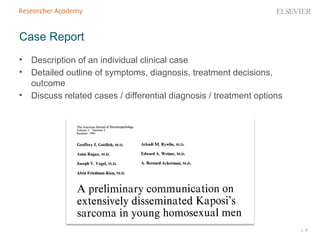
• Description of an individual clinical case
• Detailed outline of symptoms, diagnosis, treatment decisions,
outcome
• Discuss related cases / differential diagnosis / treatment options
Case Report
| 4
• In past, journals often asked for unique features, first descriptions of
new entities or significant contribution to medical knowledge, some
journals still do…
• Nowadays: specialized case reports journals (like MMCR) with focus
on the educational value of a case.
Can other MDs learn something important from your case? – If so:
Write it up!
Which case should I publish?
| 5
What makes a case-report interesting for publication?
A unique case with either……
– an unusual, rare, perplexing presentation,
– identification of a causative fungus not being reported before
– a remarkable finding during the diagnostic work-up
– the use of a new treatment modality
– a surprising follow-up and/or outcome
– unexpected complications
– therapeutic challenges or dilemmas
……which is of interest and relevant for the rest of the
medical (mycology) world with respect to lifelong learning
aimed at improving recognition and management of
consecutive patients.
| 6
The very first steps
• Discuss with your medical team
• Background research
– Extensive literature search needed
– ‘me too’ cases are not of interest
• Getting permission and consent
• Information gathering
– Documentation of clinical presentation (signs & symptoms) and along the disease
course
– Clear results from diagnostic tests, including identification of fungus and
susceptibility pattern
– Detailed overview of treatment given and response
– Formulate up to 3 bullet point messages on what you want to communicate
| 7
Tell a story
• Chronological order of events
– She came in very ill......., we were afraid for……., therefore we
tested if she had….., the test was positive…….., we changed our
management approach…….., but unfortunately……., we had to
amend……..
• Differential diagnostic considerations
– Tell the reader the reasons for performing specific diagnostic tests
• Clinical decision making process
– Support for conditions considered
– Support for additional investigations
– Clear interpretation of diagnostic test results
• Follow-up
– End of story can range from ‘Full Recovery’ to ‘Death’
| 8
MMCR style:
• Define a day 0 (e.g. day of hospital admission, first symptoms, etc.)
• Give all other important dates in relation to this:
• Sample taken on day 1
• Lab result reported on day 3
• Treatment initiated on day 4 / ceased on day 9
• History of travel abroad day-28 to -21
• …
• Consider a graphical representation of the events on a time-line for
complex cases
How to prepare a case report
| 9
Get the details right
• Describe the activating signs and symptoms which have resulted
in the differential diagnosis.
– both positive and negative signs and symptoms
• Describe actual values for blood test results if relevant for the
next step in the decision making process
– differentiate, not each test result need to be presented
• Detail dosing of medications prescribed
– variable to take into account with respect to outcome and
complications
| 10
What about figures?
• We all like pictures!
• Pictures tell you more than a thousand words!
• But it needs to have a function!
– macroscopic and microscopic images if a new causative
microorganism is identified
– radiological images if activating sign in the diagnostic and
therapeutic management of the patient
– photographs of the patient (anonymized) when mucocutaneous
disease, skin rashes, dysmorphologies, visible abnormalities during
physical exam (e.g. severe inguinal lymphadenopathy; a red and
swollen joint)
| 11
Attract attention
• Title
– Concise
– Informative
– Relevant
– Attractive!
| 12
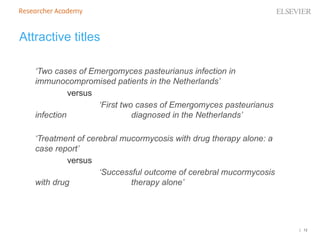
Attractive titles
‘Two cases of Emergomyces pasteurianus infection in
immunocompromised patients in the Netherlands’
versus
‘First two cases of Emergomyces pasteurianus
infection diagnosed in the Netherlands’
‘Treatment of cerebral mucormycosis with drug therapy alone: a
case report’
versus
‘Successful outcome of cerebral mucormycosis
with drug therapy alone’
| 13
Introduction
DO
• Set the scene
DON’T
• Don’t provide an extensive overview of each aspect of the
disease your patient is suffering from
– the reader will get bored before the actual part starts of
| 14
Discussion
DO
• Start with the main points why this case report is of importance
• Summarize the aspects to be discussed
• Stay focussed
DON’T
• Don’t summarize the case report as such
• Don’t provide an extensive overview of all aspects of the disease
your patient is suffering from
| 15
A case report is a detailed description of an individual patients clinical
course – due to its very nature it will likely almost always contain
information that could be traced back to the patient!
Consent:
• Inform patient that the case will be published.
• Discuss potential images, especially if they show the patient.
• Ask for written consent.
What else do I need to consider?
| 16
Do I need informed consent of the patient?
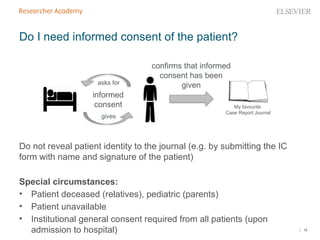
Do not reveal patient identity to the journal (e.g. by submitting the IC
form with name and signature of the patient)
Special circumstances:
• Patient deceased (relatives), pediatric (parents)
• Patient unavailable
• Institutional general consent required from all patients (upon
admission to hospital)
My favourite
Case Report Journal
asks for
gives
informed
consent
confirms that informed
consent has been
given
| 17
Any case were I can publish without informed consent?
• Important public health message
• Impossible to obtain informed consent despite all efforts
• Benefit of publication outweighs potential harm
(Kleinert and Wagner, Committee on Publication Ethics 2012)
| 18
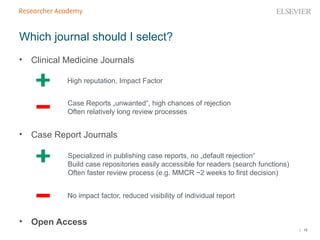
• Clinical Medicine Journals
• Case Report Journals
• Open Access
Which journal should I select?
High reputation, Impact Factor
Case Reports „unwanted“, high chances of rejection
Often relatively long review processes
Specialized in publishing case reports, no „default rejection“
Build case repositories easily accessible for readers (search functions)
Often faster review process (e.g. MMCR ~2 weeks to first decision)
No impact factor, reduced visibility of individual report
| 19
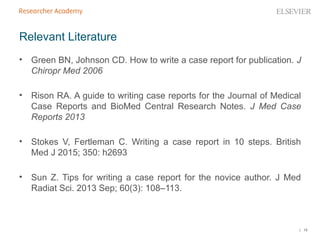
• Green BN, Johnson CD. How to write a case report for publication. J
Chiropr Med 2006
• Rison RA. A guide to writing case reports for the Journal of Medical
Case Reports and BioMed Central Research Notes. J Med Case
Reports 2013
• Stokes V, Fertleman C. Writing a case report in 10 steps. British
Med J 2015; 350: h2693
• Sun Z. Tips for writing a case report for the novice author. J Med
Radiat Sci. 2013 Sep; 60(3): 108–113.
Relevant Literature
Thank you.
Ask your questions on:
Researcher Academy Mendeley group
Follow us on Twitter

how to write a case report12345678901234

  • 1.
    How to writea case report … a brief guide for writing case reports 28 February 2019 Prof. Oliver Kurzai, M.D., Editor in Chief Medical Mycology Case Reports Prof. Adilia Warris, M.D., Editor Medical Mycology Case Reports
  • 2.
    | 2 About thespeakers Oliver Kurzai, M.D. University of Würzburg, Germany Editor in Chief, Medical Mycology Case Reports Chair for Medical Microbiology and Mycology, Specialist recognition for Microbiology, Virology and Infection Epidemiology. Adilia Warris, M.D. University of Aberdeen, Scotland Editor, Medical Mycology Case Reports Paediatric infectious diseases specialist, Co-director of the MRC Centre for Medical Mycology, Chair of the European Paediatric Mycology Network (EPMyN).
  • 3.
    | 3 • Descriptionof an individual clinical case • Detailed outline of symptoms, diagnosis, treatment decisions, outcome • Discuss related cases / differential diagnosis / treatment options Case Report
  • 4.
    | 4 • Inpast, journals often asked for unique features, first descriptions of new entities or significant contribution to medical knowledge, some journals still do… • Nowadays: specialized case reports journals (like MMCR) with focus on the educational value of a case. Can other MDs learn something important from your case? – If so: Write it up! Which case should I publish?
  • 5.
    | 5 What makesa case-report interesting for publication? A unique case with either…… – an unusual, rare, perplexing presentation, – identification of a causative fungus not being reported before – a remarkable finding during the diagnostic work-up – the use of a new treatment modality – a surprising follow-up and/or outcome – unexpected complications – therapeutic challenges or dilemmas ……which is of interest and relevant for the rest of the medical (mycology) world with respect to lifelong learning aimed at improving recognition and management of consecutive patients.
  • 6.
    | 6 The veryfirst steps • Discuss with your medical team • Background research – Extensive literature search needed – ‘me too’ cases are not of interest • Getting permission and consent • Information gathering – Documentation of clinical presentation (signs & symptoms) and along the disease course – Clear results from diagnostic tests, including identification of fungus and susceptibility pattern – Detailed overview of treatment given and response – Formulate up to 3 bullet point messages on what you want to communicate
  • 7.
    | 7 Tell astory • Chronological order of events – She came in very ill......., we were afraid for……., therefore we tested if she had….., the test was positive…….., we changed our management approach…….., but unfortunately……., we had to amend…….. • Differential diagnostic considerations – Tell the reader the reasons for performing specific diagnostic tests • Clinical decision making process – Support for conditions considered – Support for additional investigations – Clear interpretation of diagnostic test results • Follow-up – End of story can range from ‘Full Recovery’ to ‘Death’
  • 8.
    | 8 MMCR style: •Define a day 0 (e.g. day of hospital admission, first symptoms, etc.) • Give all other important dates in relation to this: • Sample taken on day 1 • Lab result reported on day 3 • Treatment initiated on day 4 / ceased on day 9 • History of travel abroad day-28 to -21 • … • Consider a graphical representation of the events on a time-line for complex cases How to prepare a case report
  • 9.
    | 9 Get thedetails right • Describe the activating signs and symptoms which have resulted in the differential diagnosis. – both positive and negative signs and symptoms • Describe actual values for blood test results if relevant for the next step in the decision making process – differentiate, not each test result need to be presented • Detail dosing of medications prescribed – variable to take into account with respect to outcome and complications
  • 10.
    | 10 What aboutfigures? • We all like pictures! • Pictures tell you more than a thousand words! • But it needs to have a function! – macroscopic and microscopic images if a new causative microorganism is identified – radiological images if activating sign in the diagnostic and therapeutic management of the patient – photographs of the patient (anonymized) when mucocutaneous disease, skin rashes, dysmorphologies, visible abnormalities during physical exam (e.g. severe inguinal lymphadenopathy; a red and swollen joint)
  • 11.
    | 11 Attract attention •Title – Concise – Informative – Relevant – Attractive!
  • 12.
    | 12 Attractive titles ‘Twocases of Emergomyces pasteurianus infection in immunocompromised patients in the Netherlands’ versus ‘First two cases of Emergomyces pasteurianus infection diagnosed in the Netherlands’ ‘Treatment of cerebral mucormycosis with drug therapy alone: a case report’ versus ‘Successful outcome of cerebral mucormycosis with drug therapy alone’
  • 13.
    | 13 Introduction DO • Setthe scene DON’T • Don’t provide an extensive overview of each aspect of the disease your patient is suffering from – the reader will get bored before the actual part starts of
  • 14.
    | 14 Discussion DO • Startwith the main points why this case report is of importance • Summarize the aspects to be discussed • Stay focussed DON’T • Don’t summarize the case report as such • Don’t provide an extensive overview of all aspects of the disease your patient is suffering from
  • 15.
    | 15 A casereport is a detailed description of an individual patients clinical course – due to its very nature it will likely almost always contain information that could be traced back to the patient! Consent: • Inform patient that the case will be published. • Discuss potential images, especially if they show the patient. • Ask for written consent. What else do I need to consider?
  • 16.
    | 16 Do Ineed informed consent of the patient? Do not reveal patient identity to the journal (e.g. by submitting the IC form with name and signature of the patient) Special circumstances: • Patient deceased (relatives), pediatric (parents) • Patient unavailable • Institutional general consent required from all patients (upon admission to hospital) My favourite Case Report Journal asks for gives informed consent confirms that informed consent has been given
  • 17.
    | 17 Any casewere I can publish without informed consent? • Important public health message • Impossible to obtain informed consent despite all efforts • Benefit of publication outweighs potential harm (Kleinert and Wagner, Committee on Publication Ethics 2012)
  • 18.
    | 18 • ClinicalMedicine Journals • Case Report Journals • Open Access Which journal should I select? High reputation, Impact Factor Case Reports „unwanted“, high chances of rejection Often relatively long review processes Specialized in publishing case reports, no „default rejection“ Build case repositories easily accessible for readers (search functions) Often faster review process (e.g. MMCR ~2 weeks to first decision) No impact factor, reduced visibility of individual report
  • 19.
    | 19 • GreenBN, Johnson CD. How to write a case report for publication. J Chiropr Med 2006 • Rison RA. A guide to writing case reports for the Journal of Medical Case Reports and BioMed Central Research Notes. J Med Case Reports 2013 • Stokes V, Fertleman C. Writing a case report in 10 steps. British Med J 2015; 350: h2693 • Sun Z. Tips for writing a case report for the novice author. J Med Radiat Sci. 2013 Sep; 60(3): 108–113. Relevant Literature
  • 20.
    Thank you. Ask yourquestions on: Researcher Academy Mendeley group Follow us on Twitter