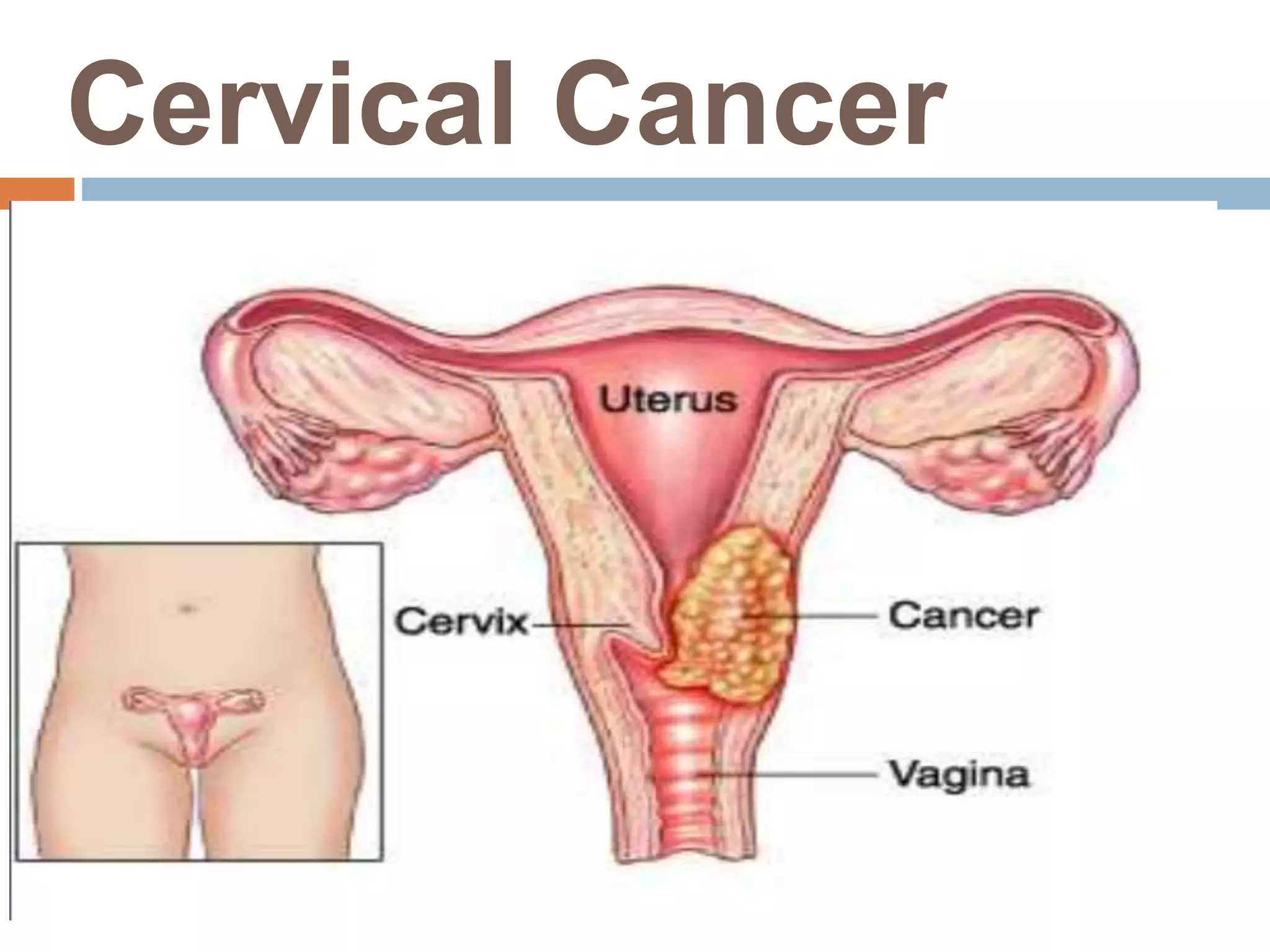
Cervical Cancer
Introduction
 Carcinoma of cervix is the commonest form of female
genital cancer in developing countries.
 Though common, it is preventable and curable if
detected early.
 In developed countries, the incidence of this disease
has fallen considerably owing to regular screening
procedures using the Pap smear and vaccination.
Introduction……
 In the absence of an effective screening system in
Ethiopia, most cases seek clinical care very late and
thus the only modality of treatment left for these
patients is radiation and chemotherapy.
 Approximately:
 70% of invasive cervical ca are squamous cell
tumors
 20–25% is adenocarcinomas and
 2–5% is adenosquamous
Etiology
 Sexual transmission of Human papilloma virus
(HPV) is the most common factor associated with
cervical Ca.
 Over 66 types of HPVs have been isolated, and many are
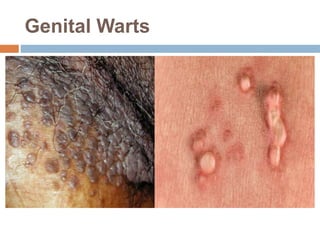
associated with genital warts.
 Though, there are more than 18 high oncogenic types
of HPV, those types commonly associated with
cervical carcinoma are 16, 18, 31, 33, 52, and 58.
 But 70% of cases are caused by HPV-16 and -18.
Genital Warts
Etiology……
 Associated risk factors:
 Sexual promiscuity
 First coitus at early age, multiple child births
 Infections with Herpes Simplex type II, HIV
 Smoking
 Family history
 Immunosuppression
Screening and prevention
Case 1:
 M.M., a 44 -year-old woman, asks you about vaccines
to prevent cervical cancer. She heard that a vaccine is
now available.
 Should M.M. consider this vaccine for her daughter?
 Would this substitute for Pap smear screening for her
daughter?
Screening
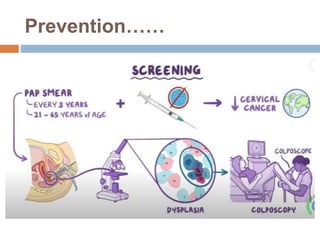
 Screening is done commonly by Papanicolaou (PAP)
smear and prevention is through vaccination.
 Uncomplicated HPV infection in the lower genital tract
can progress to cervical intraepithelial neoplasia
(CIN).
 Premalignant condition of the uterine cervix
 This lesion precedes invasive cervical carcinoma
and is classified as low-grade squamous
Screening
 Carcinoma in situ demonstrates cytologic evidence
of neoplasia without invasion through the basement
membrane and can persist unchanged for 10–20
years, but most of these eventually progress to
invasive carcinoma.
 The Pap smear is 90–95% accurate in detecting
early lesions such as CIN but is less sensitive in
detecting cancer when frankly invasive cancer
Screening
 Inflammation, necrosis, and hemorrhage may
produce false-positive smears, and colposcopic-
directed biopsy is required when any lesion is
visible on the cervix, regardless of Pap smear
findings.
Prevention
 Vaccination against pathologic HPV appears to be an
effective cervical cancer prevention strategy.
 Vaccines are made with inactivated virus-like
particles that are non-infectious but highly
immunogenic.
 Quadrivalent vaccine against HPV strains 16,18, 6
& 11(Gardasil)
 Bivalent vaccine against HPV strains 16 &18
(Cervarix)
Prevention
 Since it is difficult to show a vaccine prevent cancer, key
surrogate markers, such as CIN, are used to assess
efficacy in cervical Ca.
 CINs are premalignant lesions that may develop into
cancers.
 Hence, use of HPV vaccines, which decrease the
formation of precancerous lesions, will ultimately lead to a
reduction in the incidence of cervical ca.
 Efficacy has not been established in women older than 26
years of age.
Prevention……
 HPV screening (Pap smears) should continue for all
vaccinated women because the vaccine does not
prevent all serotypes of HPV and the duration of
vaccine-induced anti-HPV immunity is unknown.
Prevention……
Prevention…..
 Gardasil is approved for prevention of genital warts
caused by HPV types 6 and 11.
 Additionally, Gardasil is approved to prevent HPV-related
anal cancer in men; however, not routinely
recommended.
 There are no data to support using these vaccines to
prevent other cancers associated with HPV (penile
cancers or head and neck cancers).
Guideline of vaccination
 It is recommended to take vaccine before HPV
infection.
 Usually it is started at age 11 or 12 but can be given
0.5 ml from 9-26 years in 3 doses.
 For Gardasil at 0, 2 and 6 months
 For Cervarix at 0, 1 and 6 months
Screening and prevention case
 M.M. should consider HPV vaccination for her
daughter.
 The vaccines are indicated in women 9 to 26 years of
age, but the vaccine is most effective if initiated before
sexual activity.
 Whether or not M.M.’s daughter is vaccinated, she
should still receive Pap smear screening according
to current guidelines.
 Although Gardasil has been approval to prevent HPV-
related anal cancer and genital warts, vaccination of
males to prevent spread of HPV and to prevent other
HPV-related cancers and diseases is more
Clinical presentation
 Case 2: H.B. is a 66-year woman presented to the
emergency department with complaints of vaginal
bleeding and passing of large clots with abdominal
pain.
 On examination she was found to have a large
cervical mass, which was biopsied and confirmed as
invasive, well-differentiated carcinoma.
 She noticed increased vaginal bleeding, abdominal
Clinical presentation
 She also complained of poor appetite, dyspareunia, and
constipation. She denied fever and chills. She was noted
to be severely anemic with a HCT of 23% and received 3
units of packed RBCs. CT scan showed an 8.6 x 6.0 cm
cervical mass with no evidence of hydronephrosis or
lymphadenopathy.
 The patient underwent a pelvic examination for clinical
staging.
 The final diagnosis received was stage IIB cervical ca.
Clinical presentation…..
 Patients with cervical cancer generally are
asymptomatic, and the disease is detected on
routine pelvic examination such as antenatal care,
family planning etc.
 Others present with abnormal bleeding or post-coital
spotting or post menopausal bleeding.
 Yellowish vaginal discharge, lumbosacral back pain,
lower-extremity edema, and urinary symptoms may
Clinical presentation…..
 In early cases there will be erosion of cervix or
changes of chronic cervicitis but in advanced
cases ulcerative or fungating cervical lesion is
observed on speculum examination.
Diagnosis
 Investigations include:
 Cervical biopsy
 CBC
 Renal function test
 Serum uric acid
 Chest radiograph
 CT Scan and/or MRI
 Examination under anesthesia for clinical staging
Staging
 The staging of cervical carcinoma is clinical and
generally completed with a pelvic examination under
anesthesia with cystoscopy and proctoscopy.
 Stage 0 is carcinoma in situ
 Stage I (Early Stage) is disease confined to the cervix.
 Stage IAI (depth of stromal invasive less than 3mm
with horizontal expansion of 7mm)
 Stage IA2 (depth of invasion 3-5mm with 7mm
horizontal spread)
Staging…..
 Stage II disease invades beyond the cervix but not to
the pelvic wall or lower third of the vagina
 Stage III disease extends to the pelvic wall or lower
third of the vagina or causes hydronephrosis, and
 Stage IV is present when the tumor invades the
mucosa of bladder or rectum or extends beyond the
true pelvis.
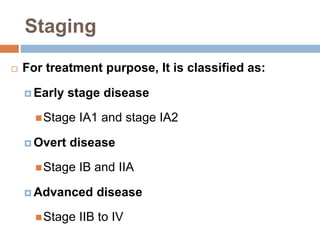
Staging
 For treatment purpose, It is classified as:
 Early stage disease
Stage IA1 and stage IA2
 Overt disease
Stage IB and IIA
 Advanced disease
Stage IIB to IV
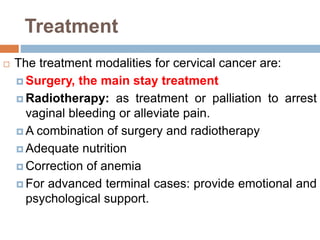
Treatment
 The treatment modalities for cervical cancer are:
 Surgery, the main stay treatment
 Radiotherapy: as treatment or palliation to arrest
vaginal bleeding or alleviate pain.
 A combination of surgery and radiotherapy
 Adequate nutrition
 Correction of anemia
 For advanced terminal cases: provide emotional and
psychological support.
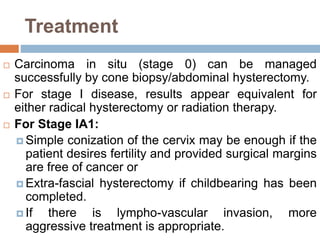
Treatment
 Carcinoma in situ (stage 0) can be managed
successfully by cone biopsy/abdominal hysterectomy.
 For stage I disease, results appear equivalent for
either radical hysterectomy or radiation therapy.
 For Stage IA1:
 Simple conization of the cervix may be enough if the
patient desires fertility and provided surgical margins
are free of cancer or
 Extra-fascial hysterectomy if childbearing has been
completed.
 If there is lympho-vascular invasion, more
aggressive treatment is appropriate.
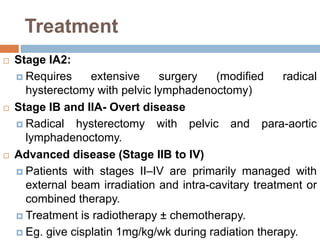
Treatment
 Stage IA2:
 Requires extensive surgery (modified radical
hysterectomy with pelvic lymphadenoctomy)
 Stage IB and IIA- Overt disease
 Radical hysterectomy with pelvic and para-aortic
lymphadenoctomy.
 Advanced disease (Stage IIB to IV)
 Patients with stages II–IV are primarily managed with
external beam irradiation and intra-cavitary treatment or
combined therapy.
 Treatment is radiotherapy ± chemotherapy.
 Eg. give cisplatin 1mg/kg/wk during radiation therapy.
Treatment……
Neoadjuvant chemotherapy:
 Cisplatin, 1mg/kg, IV, diluted in 1Lt N/S over 24
hours weekly for 3 weeks.
 If given before surgery or radiation, patient will have
better survival rate.
Treatment…..
 Palliative treatment:
 End-stage cervical cancer patients may present with
pain from bony metastasis, respiratory distress from lung
metastasis and renal failure secondary to tumor growth.
 Palliative chemotherapy: A combination of cisplatin
and paclitaxel has a better response rate
 Pain management: Follow the WHO ladder approach.
 Respiratory distress: Oxygen support and withhold
toxic medicines.
The End!

Cervical Cancer.pptx

  • 1.
  • 2.
    Introduction  Carcinoma ofcervix is the commonest form of female genital cancer in developing countries.  Though common, it is preventable and curable if detected early.  In developed countries, the incidence of this disease has fallen considerably owing to regular screening procedures using the Pap smear and vaccination.
  • 3.
    Introduction……  In theabsence of an effective screening system in Ethiopia, most cases seek clinical care very late and thus the only modality of treatment left for these patients is radiation and chemotherapy.  Approximately:  70% of invasive cervical ca are squamous cell tumors  20–25% is adenocarcinomas and  2–5% is adenosquamous
  • 4.
    Etiology  Sexual transmissionof Human papilloma virus (HPV) is the most common factor associated with cervical Ca.  Over 66 types of HPVs have been isolated, and many are associated with genital warts.  Though, there are more than 18 high oncogenic types of HPV, those types commonly associated with cervical carcinoma are 16, 18, 31, 33, 52, and 58.  But 70% of cases are caused by HPV-16 and -18.
  • 5.
  • 6.
    Etiology……  Associated riskfactors:  Sexual promiscuity  First coitus at early age, multiple child births  Infections with Herpes Simplex type II, HIV  Smoking  Family history  Immunosuppression
  • 7.
    Screening and prevention Case1:  M.M., a 44 -year-old woman, asks you about vaccines to prevent cervical cancer. She heard that a vaccine is now available.  Should M.M. consider this vaccine for her daughter?  Would this substitute for Pap smear screening for her daughter?
  • 8.
    Screening  Screening isdone commonly by Papanicolaou (PAP) smear and prevention is through vaccination.  Uncomplicated HPV infection in the lower genital tract can progress to cervical intraepithelial neoplasia (CIN).  Premalignant condition of the uterine cervix  This lesion precedes invasive cervical carcinoma and is classified as low-grade squamous
  • 9.
    Screening  Carcinoma insitu demonstrates cytologic evidence of neoplasia without invasion through the basement membrane and can persist unchanged for 10–20 years, but most of these eventually progress to invasive carcinoma.  The Pap smear is 90–95% accurate in detecting early lesions such as CIN but is less sensitive in detecting cancer when frankly invasive cancer
  • 10.
    Screening  Inflammation, necrosis,and hemorrhage may produce false-positive smears, and colposcopic- directed biopsy is required when any lesion is visible on the cervix, regardless of Pap smear findings.
  • 11.
    Prevention  Vaccination againstpathologic HPV appears to be an effective cervical cancer prevention strategy.  Vaccines are made with inactivated virus-like particles that are non-infectious but highly immunogenic.  Quadrivalent vaccine against HPV strains 16,18, 6 & 11(Gardasil)  Bivalent vaccine against HPV strains 16 &18 (Cervarix)
  • 12.
    Prevention  Since itis difficult to show a vaccine prevent cancer, key surrogate markers, such as CIN, are used to assess efficacy in cervical Ca.  CINs are premalignant lesions that may develop into cancers.  Hence, use of HPV vaccines, which decrease the formation of precancerous lesions, will ultimately lead to a reduction in the incidence of cervical ca.  Efficacy has not been established in women older than 26 years of age.
  • 13.
    Prevention……  HPV screening(Pap smears) should continue for all vaccinated women because the vaccine does not prevent all serotypes of HPV and the duration of vaccine-induced anti-HPV immunity is unknown.
  • 14.
  • 15.
    Prevention…..  Gardasil isapproved for prevention of genital warts caused by HPV types 6 and 11.  Additionally, Gardasil is approved to prevent HPV-related anal cancer in men; however, not routinely recommended.  There are no data to support using these vaccines to prevent other cancers associated with HPV (penile cancers or head and neck cancers).
  • 16.
    Guideline of vaccination It is recommended to take vaccine before HPV infection.  Usually it is started at age 11 or 12 but can be given 0.5 ml from 9-26 years in 3 doses.  For Gardasil at 0, 2 and 6 months  For Cervarix at 0, 1 and 6 months
  • 17.
    Screening and preventioncase  M.M. should consider HPV vaccination for her daughter.  The vaccines are indicated in women 9 to 26 years of age, but the vaccine is most effective if initiated before sexual activity.  Whether or not M.M.’s daughter is vaccinated, she should still receive Pap smear screening according to current guidelines.  Although Gardasil has been approval to prevent HPV- related anal cancer and genital warts, vaccination of males to prevent spread of HPV and to prevent other HPV-related cancers and diseases is more
  • 18.
    Clinical presentation  Case2: H.B. is a 66-year woman presented to the emergency department with complaints of vaginal bleeding and passing of large clots with abdominal pain.  On examination she was found to have a large cervical mass, which was biopsied and confirmed as invasive, well-differentiated carcinoma.  She noticed increased vaginal bleeding, abdominal
  • 19.
    Clinical presentation  Shealso complained of poor appetite, dyspareunia, and constipation. She denied fever and chills. She was noted to be severely anemic with a HCT of 23% and received 3 units of packed RBCs. CT scan showed an 8.6 x 6.0 cm cervical mass with no evidence of hydronephrosis or lymphadenopathy.  The patient underwent a pelvic examination for clinical staging.  The final diagnosis received was stage IIB cervical ca.
  • 20.
    Clinical presentation…..  Patientswith cervical cancer generally are asymptomatic, and the disease is detected on routine pelvic examination such as antenatal care, family planning etc.  Others present with abnormal bleeding or post-coital spotting or post menopausal bleeding.  Yellowish vaginal discharge, lumbosacral back pain, lower-extremity edema, and urinary symptoms may
  • 21.
    Clinical presentation…..  Inearly cases there will be erosion of cervix or changes of chronic cervicitis but in advanced cases ulcerative or fungating cervical lesion is observed on speculum examination.
  • 22.
    Diagnosis  Investigations include: Cervical biopsy  CBC  Renal function test  Serum uric acid  Chest radiograph  CT Scan and/or MRI  Examination under anesthesia for clinical staging
  • 23.
    Staging  The stagingof cervical carcinoma is clinical and generally completed with a pelvic examination under anesthesia with cystoscopy and proctoscopy.  Stage 0 is carcinoma in situ  Stage I (Early Stage) is disease confined to the cervix.  Stage IAI (depth of stromal invasive less than 3mm with horizontal expansion of 7mm)  Stage IA2 (depth of invasion 3-5mm with 7mm horizontal spread)
  • 24.
    Staging…..  Stage IIdisease invades beyond the cervix but not to the pelvic wall or lower third of the vagina  Stage III disease extends to the pelvic wall or lower third of the vagina or causes hydronephrosis, and  Stage IV is present when the tumor invades the mucosa of bladder or rectum or extends beyond the true pelvis.
  • 25.
    Staging  For treatmentpurpose, It is classified as:  Early stage disease Stage IA1 and stage IA2  Overt disease Stage IB and IIA  Advanced disease Stage IIB to IV
  • 26.
    Treatment  The treatmentmodalities for cervical cancer are:  Surgery, the main stay treatment  Radiotherapy: as treatment or palliation to arrest vaginal bleeding or alleviate pain.  A combination of surgery and radiotherapy  Adequate nutrition  Correction of anemia  For advanced terminal cases: provide emotional and psychological support.
  • 27.
    Treatment  Carcinoma insitu (stage 0) can be managed successfully by cone biopsy/abdominal hysterectomy.  For stage I disease, results appear equivalent for either radical hysterectomy or radiation therapy.  For Stage IA1:  Simple conization of the cervix may be enough if the patient desires fertility and provided surgical margins are free of cancer or  Extra-fascial hysterectomy if childbearing has been completed.  If there is lympho-vascular invasion, more aggressive treatment is appropriate.
  • 28.
    Treatment  Stage IA2: Requires extensive surgery (modified radical hysterectomy with pelvic lymphadenoctomy)  Stage IB and IIA- Overt disease  Radical hysterectomy with pelvic and para-aortic lymphadenoctomy.  Advanced disease (Stage IIB to IV)  Patients with stages II–IV are primarily managed with external beam irradiation and intra-cavitary treatment or combined therapy.  Treatment is radiotherapy ± chemotherapy.  Eg. give cisplatin 1mg/kg/wk during radiation therapy.
  • 29.
    Treatment…… Neoadjuvant chemotherapy:  Cisplatin,1mg/kg, IV, diluted in 1Lt N/S over 24 hours weekly for 3 weeks.  If given before surgery or radiation, patient will have better survival rate.
  • 30.
    Treatment…..  Palliative treatment: End-stage cervical cancer patients may present with pain from bony metastasis, respiratory distress from lung metastasis and renal failure secondary to tumor growth.  Palliative chemotherapy: A combination of cisplatin and paclitaxel has a better response rate  Pain management: Follow the WHO ladder approach.  Respiratory distress: Oxygen support and withhold toxic medicines.
  • 31.

Editor's Notes

  • #7 the practice of engaging in sexual activity frequently with different partners
  • #12 Cervarix has tested on 15-25 years age women Gardasil has tested on 15-26 years age women