Dr NANDITHA KISHORE
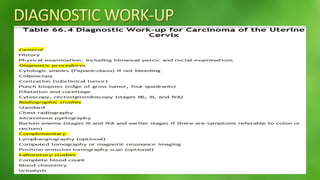
Diagnostic work-up 
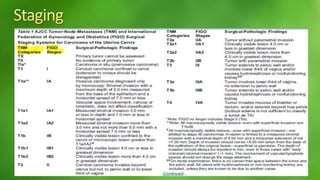
Staging 
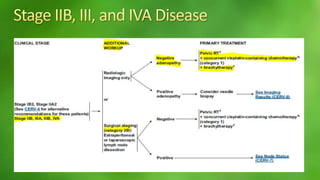
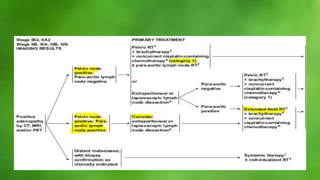
Stage wise Management
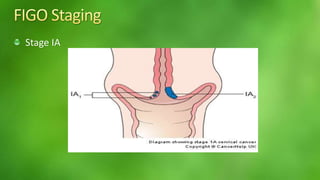
Stage IA
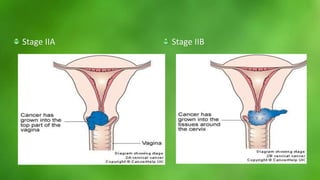
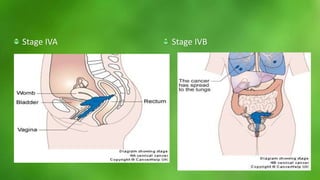
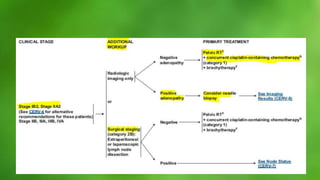
Stage IIA Stage IIB
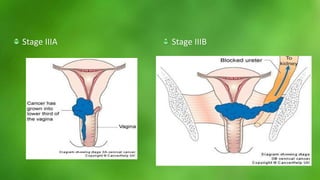
Stage IIIA Stage IIIB
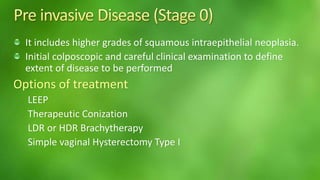
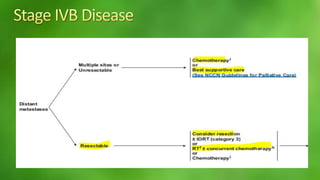
Stage IVA Stage IVB
Factors influencing the choice of local treatment 
• Tumor size 
• Stage 
• Histologic features 
• Evidence of lymph node metastasis 
• Risk factors for complications of surgery or radiotherapy 
• Patient preference
It includes higher grades of squamous intraepithelial neoplasia. 
Initial colposcopic and careful clinical examination to define 
extent of disease to be performed 
Options of treatment 
LEEP 
Therapeutic Conization 
LDR or HDR Brachytherapy 
Simple vaginal Hysterectomy Type I
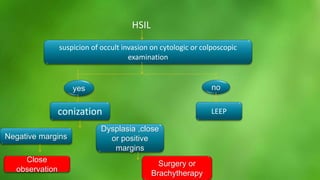
HSIL 
suspicion of occult invasion on cytologic or colposcopic 
examination 
yes no 
conization LEEP 
Negative margins 
Dysplasia ,close 
or positive 
margins 
Close 
observation 
Surgery or 
Brachytherapy
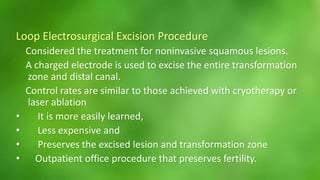
Loop Electrosurgical Excision Procedure 
Considered the treatment for noninvasive squamous lesions. 
A charged electrode is used to excise the entire transformation 
zone and distal canal. 
Control rates are similar to those achieved with cryotherapy or 
laser ablation 
• It is more easily learned, 
• Less expensive and 
• Preserves the excised lesion and transformation zone 
• Outpatient office procedure that preserves fertility.
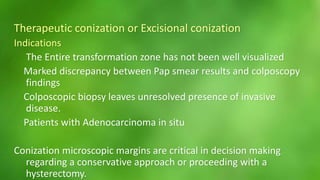
Therapeutic conization or Excisional conization 
Indications 
The Entire transformation zone has not been well visualized 
Marked discrepancy between Pap smear results and colposcopy 
findings 
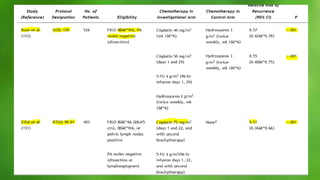
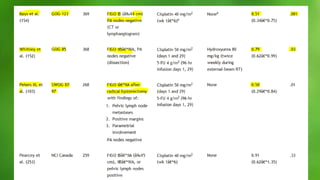
Colposcopic biopsy leaves unresolved presence of invasive 
disease. 
Patients with Adenocarcinoma in situ 
Conization microscopic margins are critical in decision making 
regarding a conservative approach or proceeding with a 
hysterectomy.
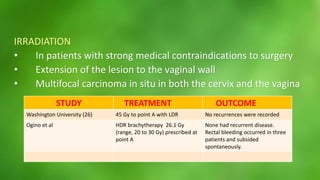
IRRADIATION 
• In patients with strong medical contraindications to surgery 
• Extension of the lesion to the vaginal wall 
• Multifocal carcinoma in situ in both the cervix and the vagina 
STUDY TREATMENT OUTCOME 
Washington University (26) 45 Gy to point A with LDR No recurrences were recorded 
Ogino et al HDR brachytherapy 26.1 Gy 
(range, 20 to 30 Gy) prescribed at 
point A 
None had recurrent disease. 
Rectal bleeding occurred in three 
patients and subsided 
spontaneously.
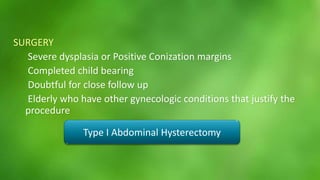
SURGERY 
Severe dysplasia or Positive Conization margins 
Completed child bearing 
Doubtful for close follow up 
Elderly who have other gynecologic conditions that justify the 
procedure 
Type I Abdominal Hysterectomy
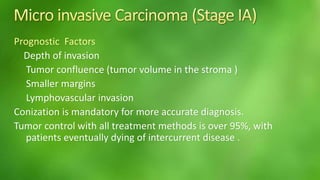
Prognostic Factors 
Depth of invasion 
Tumor confluence (tumor volume in the stroma ) 
Smaller margins 
Lymphovascular invasion 
Conization is mandatory for more accurate diagnosis. 
Tumor control with all treatment methods is over 95%, with 
patients eventually dying of intercurrent disease .
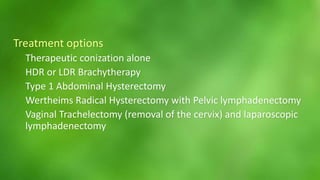
Treatment options 
Therapeutic conization alone 
HDR or LDR Brachytherapy 
Type 1 Abdominal Hysterectomy 
Wertheims Radical Hysterectomy with Pelvic lymphadenectomy 
Vaginal Trachelectomy (removal of the cervix) and laparoscopic 
lymphadenectomy
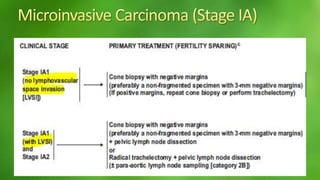
Stage IA1 
Therapeutic conization 
Therapeutic conization for microinvasive disease is usually 
performed with a scalpel while the patient is under general or 
spinal anesthesia 
Indications 
Lesions <1 mm in depth without LVSI 
All margins are tumor free 
who wish to maintain fertility 
Continued careful follow-up
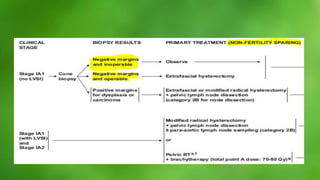
Total Abdominal (type I) or vaginal hysterectomy. 
Depth of penetration of the stroma by tumor is <3 mm, the 
incidence of lymph node metastasis is 1% or less. 
lymph node dissection not required 
Pelvic external irradiation is not warranted
surgical treatment is standard for in situ and micro invasive cancer 
The risk of nodal metastases is approximately 5%. 
Modified Radical (Type II) Hysterectomy with pelvic 
lymphadenectomy 
less extensive procedure 
significant urinary tract complications are rare 
Wertheim Radical (Type III) hysterectomy with pelvic 
lymphadenectomy 
Preferred technique for more extensive lesions
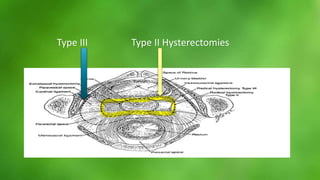
Type III Type II Hysterectomies
Radiotherapy 
Indications 
severe medical problems 
contraindications to surgical treatment 
Technique and Dose 
IntraCavitary Brachytherapy alone 
LDR 60 to 75 Gy to point A, in 2 insertions. 
HDR 36 to 45 Gy in 6 to 8 fractions
Grigsby and Perez 
21 patients with carcinoma in situ and 34 patients with 
microinvasive carcinoma treated with radiation alone 
Results 
10-year progression-free survival rate of 100% 
Hamberger et al 
93 patients with stage IA disease and small stage IB tumors 
(less than one cervical quadrant involved) treated with 
intracavitary irradiation alone. 
Results 
89 (96%) of 93 patients were disease-free at 5 years .
Early stage IB1 cervical carcinoma 
Treatment Options 
• Combined EBRT and Brachytherapy 
• Radical Hysterectomy and bilateral Pelvic lymphadenectomy 
Overall survival rates for patients with stage IB cervical cancer 
treated with surgery or radiation usually range between 80% and 
90%, suggesting that the two treatments are equally effective.
Choice of treatment depends upon following factors 
Patient preference 
• Anesthetic and surgical risks 
• Physician preference 
• An understanding of the nature and incidence of complications 
Patients with similar tumors 
Surgical treatment associated with urinary tract complications 
Radiotherapy associated with bowel complications
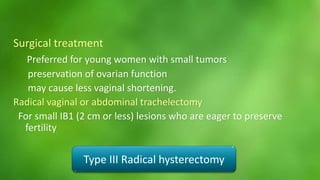
Surgical treatment 
Preferred for young women with small tumors 
preservation of ovarian function 
may cause less vaginal shortening. 
Radical vaginal or abdominal trachelectomy 
For small IB1 (2 cm or less) lesions who are eager to preserve 
fertility 
Type III Radical hysterectomy
Radiotherapy 
• Older women morbid for a major surgical procedure 
• Postmenopausal women 
Patients without evidence of regional involvement have 
excellent pelvic control rates (about 97% at 5 years) with 
radiotherapy alone . 
Probably do not require Concurrent chemotherapy 
EBRT +Brachytherapy
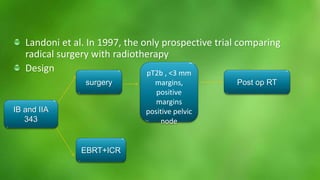
Landoni et al. In 1997, the only prospective trial comparing 
radical surgery with radiotherapy 
Design 
surgery 
EBRT+ICR 
pT2b , <3 mm 
margins, 
positive 
margins 
positive pelvic 
node 
Post op RT 
IB and IIA 
343
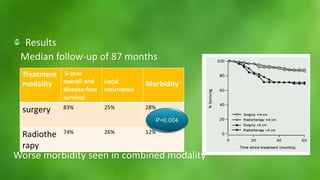
Results 
Median follow-up of 87 months 
Treatment 
modality 
5-year 
overall and 
disease-free 
survival 
Morbidity 
Local 
recurrence 
surgery 83% 25% 28% 
Radiothe 
rapy 
P=0.004 
74% 26% 12% 
Worse morbidity seen in combined modality
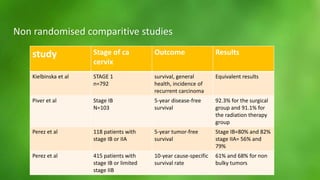
Non randomised comparitive studies 
study Stage of ca 
cervix 
Outcome Results 
Kielbinska et al STAGE 1 
n=792 
survival, general 
health, incidence of 
recurrent carcinoma 
Equivalent results 
Piver et al Stage IB 
N=103 
5-year disease-free 
survival 
92.3% for the surgical 
group and 91.1% for 
the radiation therapy 
group 
Perez et al 118 patients with 
stage IB or IIA 
5-year tumor-free 
survival 
Stage IB=80% and 82% 
stage IIA= 56% and 
79% 
Perez et al 415 patients with 
stage IB or limited 
stage IIB 
10-year cause-specific 
survival rate 
61% and 68% for non 
bulky tumors
Bulky stage IB2 and IIA Tumors 
Treatment options 
Primary concurrent Chemoradiation 
Type III Radical Hysterectomy Alone 
Post operative radiation alone 
Post operative Chemoradiation
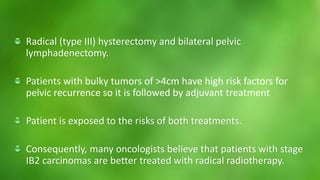
Radical (type III) hysterectomy and bilateral pelvic 
lymphadenectomy. 
Patients with bulky tumors of >4cm have high risk factors for 
pelvic recurrence so it is followed by adjuvant treatment 
Patient is exposed to the risks of both treatments. 
Consequently, many oncologists believe that patients with stage 
IB2 carcinomas are better treated with radical radiotherapy.
Radiotherapy After Radical Hysterectomy 
HIGH-RISK FEATURES 
Lymph node metastasis 
Deep stromal invasion 
Positive or close operative 
margins 
Parametrial involvement 
Intermediate Risk Features 
least two of : 
Greater than one-third 
stromal invasion 
LVSI 
Clinical tumor diameter of at 
least 4 cm
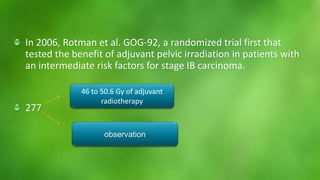
In 2006, Rotman et al. GOG-92, a randomized trial first that 
tested the benefit of adjuvant pelvic irradiation in patients with 
an intermediate risk factors for stage IB carcinoma. 
277 
46 to 50.6 Gy of adjuvant 
radiotherapy 
observation
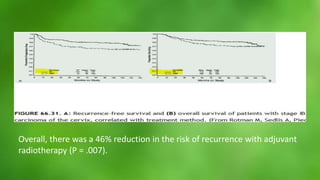
Overall, there was a 46% reduction in the risk of recurrence with adjuvant 
radiotherapy (P = .007).
Retrospective and prospective studies clearly demonstrate that 
irradiation decreases the risk of pelvic recurrence in patients 
whose tumors have high-risk features 
The risk of pelvic and distant recurrence remains high for these 
women even with adjuvant radiation
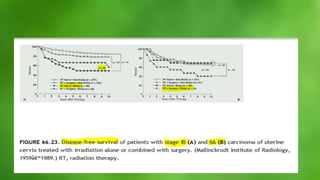
Early studies from M. D. Anderson Cancer Center suggested that 
local recurrence rates for patients with bulky stage IB cancers 
were decreased when radiotherapy was followed by adjuvant 
hysterectomy. 
Extrafascial (type I) hysterectomy is usually performed. 
Radical hysterectomy is avoided after high-dose irradiation 
because of an increased risk of urinary tract complications
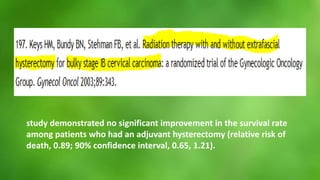
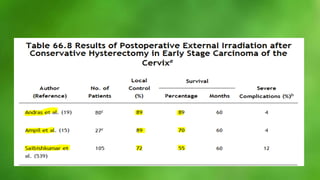
study demonstrated no significant improvement in the survival rate 
among patients who had an adjuvant hysterectomy (relative risk of 
death, 0.89; 90% confidence interval, 0.65, 1.21).
Neoadjuvant chemotherapy has usually included cisplatin and 
bleomycin plus one or two other drugs 
GOG prospective trail 
compared radical hysterectomy followed by postoperative 
radiotherapy with chemotherapy followed by hysterectomy and 
irradiation. 
it showed no difference in recurrence rates,death rates 
Patients requiring post operative for high risk features are also 
equal in both arms.
Patients having high risk factors are considered for concurrent 
chemoradiation. 
Whether to add concurrent chemotherapy to post op radiation is 
being tested in an accuring randomised trail. 
Many institutions routinely implement chemo RT for 
intermediate risk patients 
Song et al 
20 yrs experience in stage IB to IIA ca cervix with intermediate 
risk factors found that Chemoradiation significantly decreased 
pelvic recurrence and distant metastases.
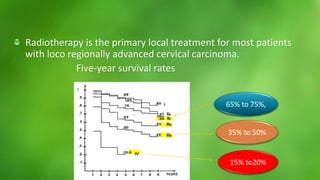
Radiotherapy is the primary local treatment for most patients 
with loco regionally advanced cervical carcinoma. 
Five-year survival rates 
65% to 75%, 
35% to 50% 
15% to20%
Results from several cooperative oncology groups demonstrated 
that cisplatin based chemotherapy when given concurrently with 
radiation prolongs survival in locally advanced cervical 
carcinoma. 
GOG 123 Keys et al 
GOG 85 Whitney et al 
GOG 120 Rose et al 
GOG 109/SWOG 87 97 Peters et al 
RTOG 90 01 Eifil et al
Treatment Options 
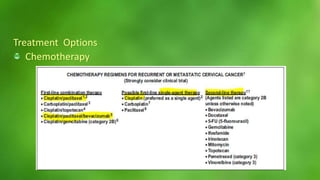
Chemotherapy
Palliative Radiotherapy 
Localized radiotherapy can provide effective relief of pain caused 
by metastases in bone, brain, lymph nodes, or other sites. 
A rapid course of pelvic radiotherapy can also provide excellent 
relief of pain and bleeding for patients who present with 
incurable disseminated disease. 
10Gya per fraction with gap of 3 weeks for 3 fractions has 
proved in several studies to control heavy bleeding and pain.
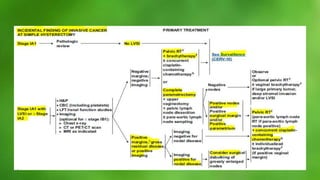
Occasionally, a simple or total abdominal hysterectomy is 
performed, and invasive carcinoma of the cervix is incidentally 
found in the surgical specimen. 
Extra fascial abdominal hysterectomy is not curative. 
Technically difficult to perform an adequate radical operation 
after previous simple hysterectomy
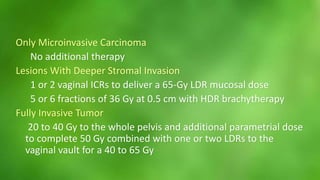
Only Microinvasive Carcinoma 
No additional therapy 
Lesions With Deeper Stromal Invasion 
1 or 2 vaginal ICRs to deliver a 65-Gy LDR mucosal dose 
5 or 6 fractions of 36 Gy at 0.5 cm with HDR brachytherapy 
Fully Invasive Tumor 
20 to 40 Gy to the whole pelvis and additional parametrial dose 
to complete 50 Gy combined with one or two LDRs to the 
vaginal vault for a 40 to 65 Gy
Gross Tumor Present In The Vaginal Vault Or Parametrium 
whole pelvis dose should be 40 Gy with an additional 
parametrial dose of 10 to 20 Gy. An intracavitary insertion with 
two LDRs to the vaginal vault for a 40 to 65 Gy or equivalent 
HDR 
Residual Tumor 
interstitial implant should be carried out to selectively increase 
the dose to this volume.
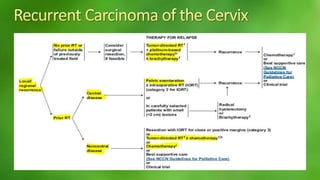
After Previous Surgery 
Radiation may salvage 50% with localized pelvic recurrences 
after surgery alone 
A combination of Whole Pelvis EBRT (40-50Gy)+chemo followed 
by ICR is recomended. 
Total mucosal dose from external and brachytherapy can 
approach 140Gy to upper vagina and 95Gy to distal vagina.
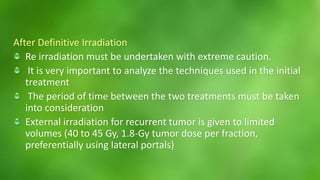
After Definitive Irradiation 
Re irradiation must be undertaken with extreme caution. 
It is very important to analyze the techniques used in the initial 
treatment 
The period of time between the two treatments must be taken 
into consideration 
External irradiation for recurrent tumor is given to limited 
volumes (40 to 45 Gy, 1.8-Gy tumor dose per fraction, 
preferentially using lateral portals)
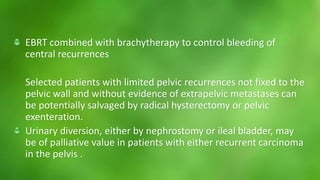
EBRT combined with brachytherapy to control bleeding of 
central recurrences 

Selected patients with limited pelvic recurrences not fixed to the 
pelvic wall and without evidence of extrapelvic metastases can 
be potentially salvaged by radical hysterectomy or pelvic 
exenteration. 
Urinary diversion, either by nephrostomy or ileal bladder, may 
be of palliative value in patients with either recurrent carcinoma 
in the pelvis .
Management of ca cervix

Management of ca cervix

  • 1.
  • 2.
    Diagnostic work-up Staging Stage wise Management
  • 6.
  • 7.
  • 8.
  • 9.
  • 10.
    Factors influencing thechoice of local treatment • Tumor size • Stage • Histologic features • Evidence of lymph node metastasis • Risk factors for complications of surgery or radiotherapy • Patient preference
  • 11.
    It includes highergrades of squamous intraepithelial neoplasia. Initial colposcopic and careful clinical examination to define extent of disease to be performed Options of treatment LEEP Therapeutic Conization LDR or HDR Brachytherapy Simple vaginal Hysterectomy Type I
  • 12.
    HSIL suspicion ofoccult invasion on cytologic or colposcopic examination yes no conization LEEP Negative margins Dysplasia ,close or positive margins Close observation Surgery or Brachytherapy
  • 13.
    Loop Electrosurgical ExcisionProcedure Considered the treatment for noninvasive squamous lesions. A charged electrode is used to excise the entire transformation zone and distal canal. Control rates are similar to those achieved with cryotherapy or laser ablation • It is more easily learned, • Less expensive and • Preserves the excised lesion and transformation zone • Outpatient office procedure that preserves fertility.
  • 14.
    Therapeutic conization orExcisional conization Indications The Entire transformation zone has not been well visualized Marked discrepancy between Pap smear results and colposcopy findings Colposcopic biopsy leaves unresolved presence of invasive disease. Patients with Adenocarcinoma in situ Conization microscopic margins are critical in decision making regarding a conservative approach or proceeding with a hysterectomy.
  • 15.
    IRRADIATION • Inpatients with strong medical contraindications to surgery • Extension of the lesion to the vaginal wall • Multifocal carcinoma in situ in both the cervix and the vagina STUDY TREATMENT OUTCOME Washington University (26) 45 Gy to point A with LDR No recurrences were recorded Ogino et al HDR brachytherapy 26.1 Gy (range, 20 to 30 Gy) prescribed at point A None had recurrent disease. Rectal bleeding occurred in three patients and subsided spontaneously.
  • 16.
    SURGERY Severe dysplasiaor Positive Conization margins Completed child bearing Doubtful for close follow up Elderly who have other gynecologic conditions that justify the procedure Type I Abdominal Hysterectomy
  • 17.
    Prognostic Factors Depthof invasion Tumor confluence (tumor volume in the stroma ) Smaller margins Lymphovascular invasion Conization is mandatory for more accurate diagnosis. Tumor control with all treatment methods is over 95%, with patients eventually dying of intercurrent disease .
  • 18.
    Treatment options Therapeuticconization alone HDR or LDR Brachytherapy Type 1 Abdominal Hysterectomy Wertheims Radical Hysterectomy with Pelvic lymphadenectomy Vaginal Trachelectomy (removal of the cervix) and laparoscopic lymphadenectomy
  • 21.
    Stage IA1 Therapeuticconization Therapeutic conization for microinvasive disease is usually performed with a scalpel while the patient is under general or spinal anesthesia Indications Lesions <1 mm in depth without LVSI All margins are tumor free who wish to maintain fertility Continued careful follow-up
  • 22.
    Total Abdominal (typeI) or vaginal hysterectomy. Depth of penetration of the stroma by tumor is <3 mm, the incidence of lymph node metastasis is 1% or less. lymph node dissection not required Pelvic external irradiation is not warranted
  • 23.
    surgical treatment isstandard for in situ and micro invasive cancer The risk of nodal metastases is approximately 5%. Modified Radical (Type II) Hysterectomy with pelvic lymphadenectomy less extensive procedure significant urinary tract complications are rare Wertheim Radical (Type III) hysterectomy with pelvic lymphadenectomy Preferred technique for more extensive lesions
  • 24.
    Type III TypeII Hysterectomies
  • 25.
    Radiotherapy Indications severemedical problems contraindications to surgical treatment Technique and Dose IntraCavitary Brachytherapy alone LDR 60 to 75 Gy to point A, in 2 insertions. HDR 36 to 45 Gy in 6 to 8 fractions
  • 26.
    Grigsby and Perez 21 patients with carcinoma in situ and 34 patients with microinvasive carcinoma treated with radiation alone Results 10-year progression-free survival rate of 100% Hamberger et al 93 patients with stage IA disease and small stage IB tumors (less than one cervical quadrant involved) treated with intracavitary irradiation alone. Results 89 (96%) of 93 patients were disease-free at 5 years .
  • 28.
    Early stage IB1cervical carcinoma Treatment Options • Combined EBRT and Brachytherapy • Radical Hysterectomy and bilateral Pelvic lymphadenectomy Overall survival rates for patients with stage IB cervical cancer treated with surgery or radiation usually range between 80% and 90%, suggesting that the two treatments are equally effective.
  • 29.
    Choice of treatmentdepends upon following factors Patient preference • Anesthetic and surgical risks • Physician preference • An understanding of the nature and incidence of complications Patients with similar tumors Surgical treatment associated with urinary tract complications Radiotherapy associated with bowel complications
  • 30.
    Surgical treatment Preferredfor young women with small tumors preservation of ovarian function may cause less vaginal shortening. Radical vaginal or abdominal trachelectomy For small IB1 (2 cm or less) lesions who are eager to preserve fertility Type III Radical hysterectomy
  • 31.
    Radiotherapy • Olderwomen morbid for a major surgical procedure • Postmenopausal women Patients without evidence of regional involvement have excellent pelvic control rates (about 97% at 5 years) with radiotherapy alone . Probably do not require Concurrent chemotherapy EBRT +Brachytherapy
  • 32.
    Landoni et al.In 1997, the only prospective trial comparing radical surgery with radiotherapy Design surgery EBRT+ICR pT2b , <3 mm margins, positive margins positive pelvic node Post op RT IB and IIA 343
  • 33.
    Results Median follow-upof 87 months Treatment modality 5-year overall and disease-free survival Morbidity Local recurrence surgery 83% 25% 28% Radiothe rapy P=0.004 74% 26% 12% Worse morbidity seen in combined modality
  • 34.
    Non randomised comparitivestudies study Stage of ca cervix Outcome Results Kielbinska et al STAGE 1 n=792 survival, general health, incidence of recurrent carcinoma Equivalent results Piver et al Stage IB N=103 5-year disease-free survival 92.3% for the surgical group and 91.1% for the radiation therapy group Perez et al 118 patients with stage IB or IIA 5-year tumor-free survival Stage IB=80% and 82% stage IIA= 56% and 79% Perez et al 415 patients with stage IB or limited stage IIB 10-year cause-specific survival rate 61% and 68% for non bulky tumors
  • 35.
    Bulky stage IB2and IIA Tumors Treatment options Primary concurrent Chemoradiation Type III Radical Hysterectomy Alone Post operative radiation alone Post operative Chemoradiation
  • 38.
    Radical (type III)hysterectomy and bilateral pelvic lymphadenectomy. Patients with bulky tumors of >4cm have high risk factors for pelvic recurrence so it is followed by adjuvant treatment Patient is exposed to the risks of both treatments. Consequently, many oncologists believe that patients with stage IB2 carcinomas are better treated with radical radiotherapy.
  • 39.
    Radiotherapy After RadicalHysterectomy HIGH-RISK FEATURES Lymph node metastasis Deep stromal invasion Positive or close operative margins Parametrial involvement Intermediate Risk Features least two of : Greater than one-third stromal invasion LVSI Clinical tumor diameter of at least 4 cm
  • 40.
    In 2006, Rotmanet al. GOG-92, a randomized trial first that tested the benefit of adjuvant pelvic irradiation in patients with an intermediate risk factors for stage IB carcinoma. 277 46 to 50.6 Gy of adjuvant radiotherapy observation
  • 41.
    Overall, there wasa 46% reduction in the risk of recurrence with adjuvant radiotherapy (P = .007).
  • 42.
    Retrospective and prospectivestudies clearly demonstrate that irradiation decreases the risk of pelvic recurrence in patients whose tumors have high-risk features The risk of pelvic and distant recurrence remains high for these women even with adjuvant radiation
  • 43.
    Early studies fromM. D. Anderson Cancer Center suggested that local recurrence rates for patients with bulky stage IB cancers were decreased when radiotherapy was followed by adjuvant hysterectomy. Extrafascial (type I) hysterectomy is usually performed. Radical hysterectomy is avoided after high-dose irradiation because of an increased risk of urinary tract complications
  • 44.
    study demonstrated nosignificant improvement in the survival rate among patients who had an adjuvant hysterectomy (relative risk of death, 0.89; 90% confidence interval, 0.65, 1.21).
  • 46.
    Neoadjuvant chemotherapy hasusually included cisplatin and bleomycin plus one or two other drugs GOG prospective trail compared radical hysterectomy followed by postoperative radiotherapy with chemotherapy followed by hysterectomy and irradiation. it showed no difference in recurrence rates,death rates Patients requiring post operative for high risk features are also equal in both arms.
  • 47.
    Patients having highrisk factors are considered for concurrent chemoradiation. Whether to add concurrent chemotherapy to post op radiation is being tested in an accuring randomised trail. Many institutions routinely implement chemo RT for intermediate risk patients Song et al 20 yrs experience in stage IB to IIA ca cervix with intermediate risk factors found that Chemoradiation significantly decreased pelvic recurrence and distant metastases.
  • 50.
    Radiotherapy is theprimary local treatment for most patients with loco regionally advanced cervical carcinoma. Five-year survival rates 65% to 75%, 35% to 50% 15% to20%
  • 51.
    Results from severalcooperative oncology groups demonstrated that cisplatin based chemotherapy when given concurrently with radiation prolongs survival in locally advanced cervical carcinoma. GOG 123 Keys et al GOG 85 Whitney et al GOG 120 Rose et al GOG 109/SWOG 87 97 Peters et al RTOG 90 01 Eifil et al
  • 55.
  • 56.
    Palliative Radiotherapy Localizedradiotherapy can provide effective relief of pain caused by metastases in bone, brain, lymph nodes, or other sites. A rapid course of pelvic radiotherapy can also provide excellent relief of pain and bleeding for patients who present with incurable disseminated disease. 10Gya per fraction with gap of 3 weeks for 3 fractions has proved in several studies to control heavy bleeding and pain.
  • 57.
    Occasionally, a simpleor total abdominal hysterectomy is performed, and invasive carcinoma of the cervix is incidentally found in the surgical specimen. Extra fascial abdominal hysterectomy is not curative. Technically difficult to perform an adequate radical operation after previous simple hysterectomy
  • 59.
    Only Microinvasive Carcinoma No additional therapy Lesions With Deeper Stromal Invasion 1 or 2 vaginal ICRs to deliver a 65-Gy LDR mucosal dose 5 or 6 fractions of 36 Gy at 0.5 cm with HDR brachytherapy Fully Invasive Tumor 20 to 40 Gy to the whole pelvis and additional parametrial dose to complete 50 Gy combined with one or two LDRs to the vaginal vault for a 40 to 65 Gy
  • 60.
    Gross Tumor PresentIn The Vaginal Vault Or Parametrium whole pelvis dose should be 40 Gy with an additional parametrial dose of 10 to 20 Gy. An intracavitary insertion with two LDRs to the vaginal vault for a 40 to 65 Gy or equivalent HDR Residual Tumor interstitial implant should be carried out to selectively increase the dose to this volume.
  • 63.
    After Previous Surgery Radiation may salvage 50% with localized pelvic recurrences after surgery alone A combination of Whole Pelvis EBRT (40-50Gy)+chemo followed by ICR is recomended. Total mucosal dose from external and brachytherapy can approach 140Gy to upper vagina and 95Gy to distal vagina.
  • 64.
    After Definitive Irradiation Re irradiation must be undertaken with extreme caution. It is very important to analyze the techniques used in the initial treatment The period of time between the two treatments must be taken into consideration External irradiation for recurrent tumor is given to limited volumes (40 to 45 Gy, 1.8-Gy tumor dose per fraction, preferentially using lateral portals)
  • 65.
    EBRT combined withbrachytherapy to control bleeding of central recurrences Selected patients with limited pelvic recurrences not fixed to the pelvic wall and without evidence of extrapelvic metastases can be potentially salvaged by radical hysterectomy or pelvic exenteration. Urinary diversion, either by nephrostomy or ileal bladder, may be of palliative value in patients with either recurrent carcinoma in the pelvis .