Submitted by :-
Katira Chiragkumar D.
B.F.Sc 5th semester
Reg.no. J3-003161-2014
Roll no. 18
Submitted to :-
Prof. H.V.PARMAR
College of fisheries, veraval.
Introduction
Hatcheries are in intensive use in countries like U.S.A.,Hungary and Switzerland
for raising seed of cultivated fishes such as salmons, carps, perches and mullets.
Subsequent to the success of induced breeding of Indian major carps.
The prevalent practice for incubation and hatching of carp eggs is to use the
Hapas (cloth containers) fixed in stagement pond water. (This Hapas system of
hatching entails heavy loss of fish seed at various stages of development due to
several factors which are beyond control under the field conditions.
Apart from this, the Hapa system requires a large number of cloth hapas every
year involving heavy recurring expenditure.
Cont…
With a view to tackling the problems associated with
incubation, hatching and survival of spawn of carps, a hatchery
comprising cone-shaped glass jars has been designed and
installed at Cuttack in 1970 for the first time in the country.
The various components of the hatchery and the modus
operandi have been designed on the basis of characteristic
behavior of larvae of these carps.
The jars have similarity to the zoug jar used in Switzerland
Water installation
The installation consists of 3 overhead tanks, 5 HP pump set
and a freshwater pond to serve as water source. From the pond
water is pumped in and stored in the overhead tanks which are
placed on a brick tower about 4m high.
The total capacity of the overhead storage tanks is 5500 liter's.
Depending on the number of jars employed, the frequency of
pumping water from the pond will have to be altered.
Breeding tanks
Normally, Breeding hapas (square-meshed mosquito netting)
are fixed in ponds and the injected breeders are released in
these for spawning.
After spawning the developing eggs are collected and
measured quantity of eggs are then released in hatchery jars
for incubation and hatching.
Incubation and hatching apparatus
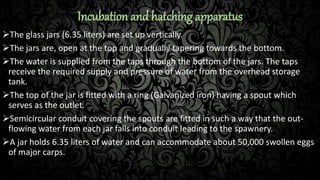
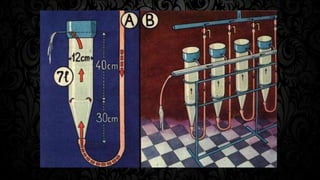
The glass jars (6.35 liters) are set up vertically.
The jars are, open at the top and gradually tapering towards the bottom.
The water is supplied from the taps through the bottom of the jars. The taps
receive the required supply and pressure of water from the overhead storage
tank.
The top of the jar is fitted with a ring (Galvanized iron) having a spout which
serves as the outlet.
Semicircular conduit covering the spouts are fitted in such a way that the out-
flowing water from each jar falls into conduit leading to the spawnery.
A jar holds 6.35 liters of water and can accommodate about 50,000 swollen eggs
of major carps.
Spawnery
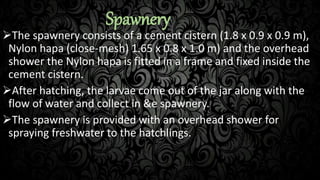
The spawnery consists of a cement cistern (1.8 x 0.9 x 0.9 m),
Nylon hapa (close-mesh) 1.65 x 0.8 x 1.0 m) and the overhead
shower the Nylon hapa is fitted in a frame and fixed inside the
cement cistern.
After hatching, the larvae come out of the jar along with the
flow of water and collect in &e spawnery.
The spawnery is provided with an overhead shower for
spraying freshwater to the hatchlings.
OPERATIONAL TECHNIQUE
The hatchery at Cuttack, consists of 40 jars with a capacity to
accommodate 20 lakh eggs at the rate of 50,000 in each jar, for
incubation and hatching at a time. The two spawneries can
accommodate spawn produced from 20 lakhs of eggs.
The Indian and exotic carps are induced to spawn by pituitary
hormone injections. The indigenous carps breed inside hapas fixed
either in ponds or in the breeding tank in hatchery.
During incubation the flow of water in the jars is regulated to ensure
that the eggs are stirred up gently without being split.
Cont….The rate of flow may be slightly increased after the completion of
hatching so as to expedite escape of the hatchlings from the jars.
Since the newly hatched hatchlings have the habit of vertical
upward movement they come to the water surface and pass out
through the outlet along with the flow of water leading to the
spawnery.
Bad eggs, egg shells, abnormal and dead hatchlings are left behind
in the jars which are subsequently removed by disconnecting the jars
from the tap.
In the spawnery, water is sprayed continuously for about 3 days until
the fry are ready for stocking.
Advantages over hapa hatchery
1. Once a hatchery is established it can last for years.
2. Recurring expenditure on hapa is almost nil.
3. Mortality of hatchlings during various stages of development due
to fluctuating water temperature, predation, oxygen depletion,
algal bloom, crab menace and other unforeseen hazards can be
controlled.
4. Bad eggs and the egg shells cannot pass out of the jars along with
hatchlings. Thus, any chance of mortality due to oxygen depletion
in the spawnery or probable infection from the rotting egg shells is
eliminated. This is not possible in the Hapa system.
Cont..
5. Since running water is supplied, the chance of water pollution and
oxygen depletion is avoided.
6. Recurring expenditures on bamboo poles, cotton ropes etc. and the
Labour for fixing hapas are saved.
7. Dead eggs, hatchlings and deformed larvae are automatically
segregated from the good ones.
8. Operation of the hatchery is so easy and sample that it can be
operated by any non-technical man.
9. Over 90% hatching success and survival of spawn are usually
achieved.
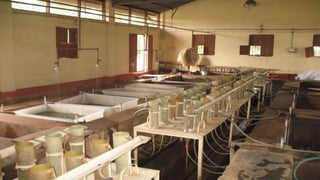
Glass jar hatchery

Glass jar hatchery

  • 2.
    Submitted by :- KatiraChiragkumar D. B.F.Sc 5th semester Reg.no. J3-003161-2014 Roll no. 18 Submitted to :- Prof. H.V.PARMAR College of fisheries, veraval.
  • 3.
    Introduction Hatcheries are inintensive use in countries like U.S.A.,Hungary and Switzerland for raising seed of cultivated fishes such as salmons, carps, perches and mullets. Subsequent to the success of induced breeding of Indian major carps. The prevalent practice for incubation and hatching of carp eggs is to use the Hapas (cloth containers) fixed in stagement pond water. (This Hapas system of hatching entails heavy loss of fish seed at various stages of development due to several factors which are beyond control under the field conditions. Apart from this, the Hapa system requires a large number of cloth hapas every year involving heavy recurring expenditure.
  • 4.
    Cont… With a viewto tackling the problems associated with incubation, hatching and survival of spawn of carps, a hatchery comprising cone-shaped glass jars has been designed and installed at Cuttack in 1970 for the first time in the country. The various components of the hatchery and the modus operandi have been designed on the basis of characteristic behavior of larvae of these carps. The jars have similarity to the zoug jar used in Switzerland
  • 5.
    Water installation The installationconsists of 3 overhead tanks, 5 HP pump set and a freshwater pond to serve as water source. From the pond water is pumped in and stored in the overhead tanks which are placed on a brick tower about 4m high. The total capacity of the overhead storage tanks is 5500 liter's. Depending on the number of jars employed, the frequency of pumping water from the pond will have to be altered.
  • 7.
    Breeding tanks Normally, Breedinghapas (square-meshed mosquito netting) are fixed in ponds and the injected breeders are released in these for spawning. After spawning the developing eggs are collected and measured quantity of eggs are then released in hatchery jars for incubation and hatching.
  • 9.
    Incubation and hatchingapparatus The glass jars (6.35 liters) are set up vertically. The jars are, open at the top and gradually tapering towards the bottom. The water is supplied from the taps through the bottom of the jars. The taps receive the required supply and pressure of water from the overhead storage tank. The top of the jar is fitted with a ring (Galvanized iron) having a spout which serves as the outlet. Semicircular conduit covering the spouts are fitted in such a way that the out- flowing water from each jar falls into conduit leading to the spawnery. A jar holds 6.35 liters of water and can accommodate about 50,000 swollen eggs of major carps.
  • 11.
    Spawnery The spawnery consistsof a cement cistern (1.8 x 0.9 x 0.9 m), Nylon hapa (close-mesh) 1.65 x 0.8 x 1.0 m) and the overhead shower the Nylon hapa is fitted in a frame and fixed inside the cement cistern. After hatching, the larvae come out of the jar along with the flow of water and collect in &e spawnery. The spawnery is provided with an overhead shower for spraying freshwater to the hatchlings.
  • 13.
    OPERATIONAL TECHNIQUE The hatcheryat Cuttack, consists of 40 jars with a capacity to accommodate 20 lakh eggs at the rate of 50,000 in each jar, for incubation and hatching at a time. The two spawneries can accommodate spawn produced from 20 lakhs of eggs. The Indian and exotic carps are induced to spawn by pituitary hormone injections. The indigenous carps breed inside hapas fixed either in ponds or in the breeding tank in hatchery. During incubation the flow of water in the jars is regulated to ensure that the eggs are stirred up gently without being split.
  • 15.
    Cont….The rate offlow may be slightly increased after the completion of hatching so as to expedite escape of the hatchlings from the jars. Since the newly hatched hatchlings have the habit of vertical upward movement they come to the water surface and pass out through the outlet along with the flow of water leading to the spawnery. Bad eggs, egg shells, abnormal and dead hatchlings are left behind in the jars which are subsequently removed by disconnecting the jars from the tap. In the spawnery, water is sprayed continuously for about 3 days until the fry are ready for stocking.
  • 16.
    Advantages over hapahatchery 1. Once a hatchery is established it can last for years. 2. Recurring expenditure on hapa is almost nil. 3. Mortality of hatchlings during various stages of development due to fluctuating water temperature, predation, oxygen depletion, algal bloom, crab menace and other unforeseen hazards can be controlled. 4. Bad eggs and the egg shells cannot pass out of the jars along with hatchlings. Thus, any chance of mortality due to oxygen depletion in the spawnery or probable infection from the rotting egg shells is eliminated. This is not possible in the Hapa system.
  • 17.
    Cont.. 5. Since runningwater is supplied, the chance of water pollution and oxygen depletion is avoided. 6. Recurring expenditures on bamboo poles, cotton ropes etc. and the Labour for fixing hapas are saved. 7. Dead eggs, hatchlings and deformed larvae are automatically segregated from the good ones. 8. Operation of the hatchery is so easy and sample that it can be operated by any non-technical man. 9. Over 90% hatching success and survival of spawn are usually achieved.