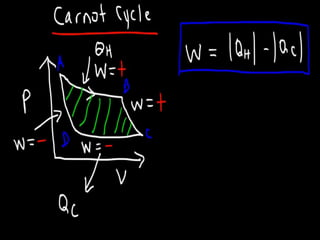
CARNOT CYCLE
I am teaching Engineering Thermodynamics using the textbook by Cengel and Boles. This
set of slides overlap somewhat with Chapter 6. But here I assume that we have established
the concept of entropy, and use the concept to analyze the Carnot cycle in the same way as
we analyze any other thermodynamic process. An isolated system conserves energy and
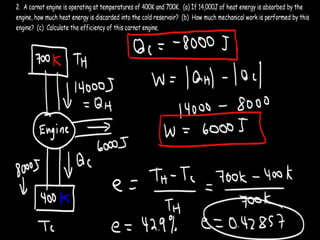
generates entropy.
I did add a few slides to show how Carnot motivated his idea of entropy using the analogy of
waterfall. I used the Dover edition of his book.
I went through these slides in one 90-minute lecture.
Zhigang Suo, Harvard University
Thermodynamics relates heat and motion
thermo = heat
dynamics = motion
Carnot’s question
How much work can be produced from a given quantity of heat?
3
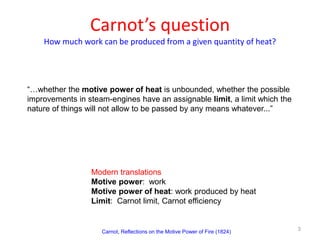
“…whether the motive power of heat is unbounded, whether the possible
improvements in steam-engines have an assignable limit, a limit which the
nature of things will not allow to be passed by any means whatever...”
Carnot, Reflections on the Motive Power of Fire (1824)
Modern translations
Motive power: work
Motive power of heat: work produced by heat
Limit: Carnot limit, Carnot efficiency
4
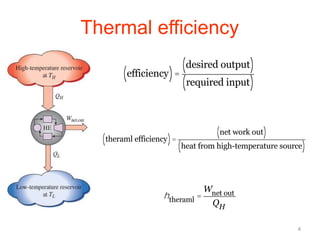
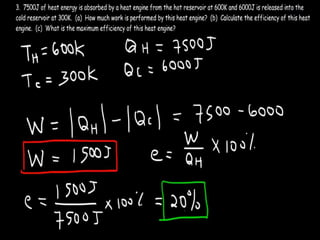
Thermal efficiency
htheraml =
Wnet out
QH
theraml efficiency
( )=
net work out
( )
heat from high-temperature source
( )
efficiency
( )=
desired output
( )
required input
( )
5
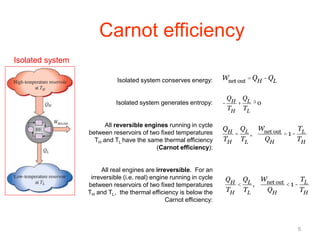
Carnot efficiency
-
QH
TH
+
QL
TL
³ 0
Isolated system conserves energy:
Isolated system generates entropy:
All reversible engines running in cycle
between reservoirs of two fixed temperatures
TH and TL have the same thermal efficiency
(Carnot efficiency):
All real engines are irreversible. For an
irreversible (i.e. real) engine running in cycle
between reservoirs of two fixed temperatures
TH and TL, the thermal efficiency is below the
Carnot efficiency:
Wnet out =QH -QL
Isolated system
QH
TH
<
QL
TL
,
Wnet out
QH
<1-
TL
TH
QH
TH
=
QL
TL
,
Wnet out
QH
=1-
TL
TH
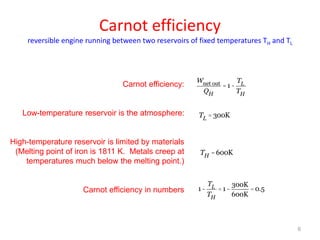
Carnot efficiency
reversible engine running between two reservoirs of fixed temperatures TH and TL
6
Wnet out
QH
=1-
TL
TH
Carnot efficiency:
Low-temperature reservoir is the atmosphere:
High-temperature reservoir is limited by materials
(Melting point of iron is 1811 K. Metals creep at
temperatures much below the melting point.)
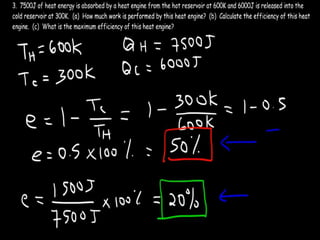
Carnot efficiency in numbers 1-
TL
TH
=1-
300K
600K
=0.5
TL = 300K
TH =600K
7
8
9
10
11
12
13
14
15
16
17
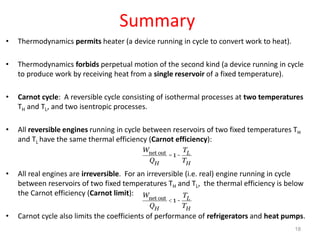
Summary
• Thermodynamics permits heater (a device running in cycle to convert work to heat).
• Thermodynamics forbids perpetual motion of the second kind (a device running in cycle
to produce work by receiving heat from a single reservoir of a fixed temperature).
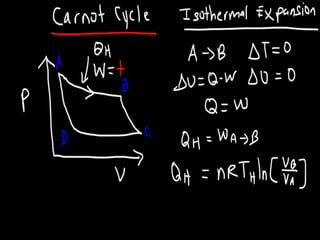
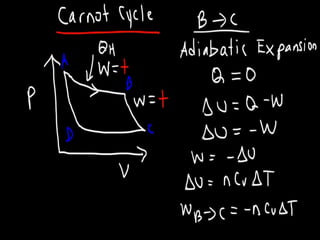
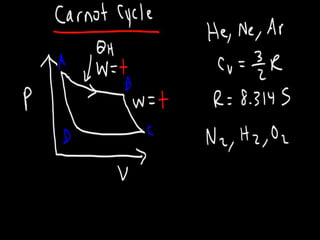
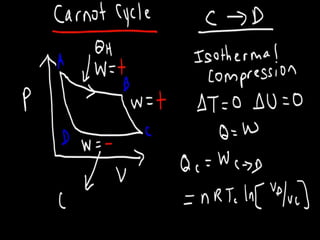
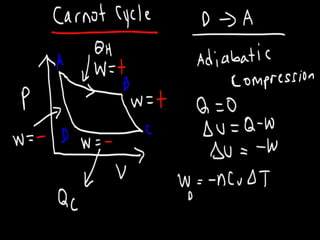
• Carnot cycle: A reversible cycle consisting of isothermal processes at two temperatures
TH and TL, and two isentropic processes.
• All reversible engines running in cycle between reservoirs of two fixed temperatures TH
and TL have the same thermal efficiency (Carnot efficiency):
• All real engines are irreversible. For an irreversible (i.e. real) engine running in cycle
between reservoirs of two fixed temperatures TH and TL, the thermal efficiency is below
the Carnot efficiency (Carnot limit):
• Carnot cycle also limits the coefficients of performance of refrigerators and heat pumps.
Wnet out
QH
=1-
TL
TH
Wnet out
QH
<1-
TL
TH
18

Carnot Cycle Lecture 6.pptx

  • 1.
    CARNOT CYCLE I amteaching Engineering Thermodynamics using the textbook by Cengel and Boles. This set of slides overlap somewhat with Chapter 6. But here I assume that we have established the concept of entropy, and use the concept to analyze the Carnot cycle in the same way as we analyze any other thermodynamic process. An isolated system conserves energy and generates entropy. I did add a few slides to show how Carnot motivated his idea of entropy using the analogy of waterfall. I used the Dover edition of his book. I went through these slides in one 90-minute lecture. Zhigang Suo, Harvard University
  • 2.
    Thermodynamics relates heatand motion thermo = heat dynamics = motion
  • 3.
    Carnot’s question How muchwork can be produced from a given quantity of heat? 3 “…whether the motive power of heat is unbounded, whether the possible improvements in steam-engines have an assignable limit, a limit which the nature of things will not allow to be passed by any means whatever...” Carnot, Reflections on the Motive Power of Fire (1824) Modern translations Motive power: work Motive power of heat: work produced by heat Limit: Carnot limit, Carnot efficiency
  • 4.
    4 Thermal efficiency htheraml = Wnetout QH theraml efficiency ( )= net work out ( ) heat from high-temperature source ( ) efficiency ( )= desired output ( ) required input ( )
  • 5.
    5 Carnot efficiency - QH TH + QL TL ³ 0 Isolatedsystem conserves energy: Isolated system generates entropy: All reversible engines running in cycle between reservoirs of two fixed temperatures TH and TL have the same thermal efficiency (Carnot efficiency): All real engines are irreversible. For an irreversible (i.e. real) engine running in cycle between reservoirs of two fixed temperatures TH and TL, the thermal efficiency is below the Carnot efficiency: Wnet out =QH -QL Isolated system QH TH < QL TL , Wnet out QH <1- TL TH QH TH = QL TL , Wnet out QH =1- TL TH
  • 6.
    Carnot efficiency reversible enginerunning between two reservoirs of fixed temperatures TH and TL 6 Wnet out QH =1- TL TH Carnot efficiency: Low-temperature reservoir is the atmosphere: High-temperature reservoir is limited by materials (Melting point of iron is 1811 K. Metals creep at temperatures much below the melting point.) Carnot efficiency in numbers 1- TL TH =1- 300K 600K =0.5 TL = 300K TH =600K
  • 7.
  • 8.
  • 9.
  • 10.
  • 11.
  • 12.
  • 13.
  • 14.
  • 15.
  • 16.
  • 17.
  • 18.
    Summary • Thermodynamics permitsheater (a device running in cycle to convert work to heat). • Thermodynamics forbids perpetual motion of the second kind (a device running in cycle to produce work by receiving heat from a single reservoir of a fixed temperature). • Carnot cycle: A reversible cycle consisting of isothermal processes at two temperatures TH and TL, and two isentropic processes. • All reversible engines running in cycle between reservoirs of two fixed temperatures TH and TL have the same thermal efficiency (Carnot efficiency): • All real engines are irreversible. For an irreversible (i.e. real) engine running in cycle between reservoirs of two fixed temperatures TH and TL, the thermal efficiency is below the Carnot efficiency (Carnot limit): • Carnot cycle also limits the coefficients of performance of refrigerators and heat pumps. Wnet out QH =1- TL TH Wnet out QH <1- TL TH 18