Comparison Between
CARNOT CYCLE AND
OTTO CYLCE
1
Orangzeb 20K-0613
Naeemullah 20k-0615
CARNOT CYCLE
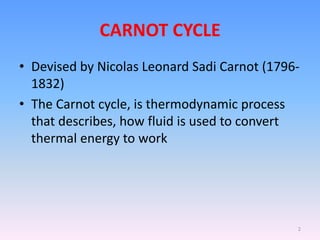
• Devised by Nicolas Leonard Sadi Carnot (1796-
1832)
• The Carnot cycle, is thermodynamic process
that describes, how fluid is used to convert
thermal energy to work
2
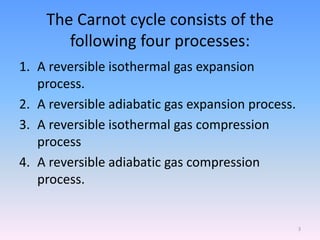
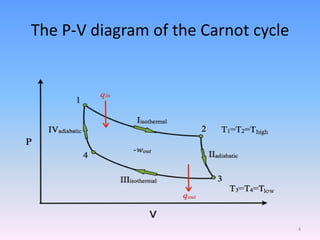
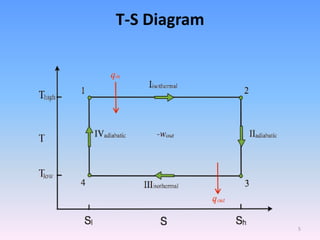
The Carnot cycle consists of the
following four processes:
1. A reversible isothermal gas expansion
process.
2. A reversible adiabatic gas expansion process.
3. A reversible isothermal gas compression
process
4. A reversible adiabatic gas compression
process.
3
The P-V diagram of the Carnot cycle
4
T-S Diagram
5
Efficiency
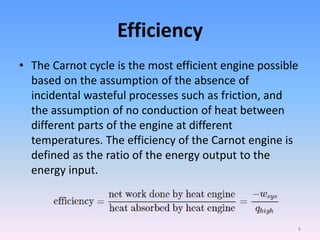
• The Carnot cycle is the most efficient engine possible
based on the assumption of the absence of
incidental wasteful processes such as friction, and
the assumption of no conduction of heat between
different parts of the engine at different
temperatures. The efficiency of the Carnot engine is
defined as the ratio of the energy output to the
energy input.
6
Internal Combustion Engine – OTTO
Cycle
• Nikolaus Otto (1832–1891, German) who is
credited as the first creator of a petroleum
fuel based internal combustion
engine operating under a four stroke cycle.
• The Otto Cycle, describes how heat
engines turn gasoline into motion
• Like other thermodynamic cycles, this cycle
turns chemical energy into thermal
energy and then into motion
7
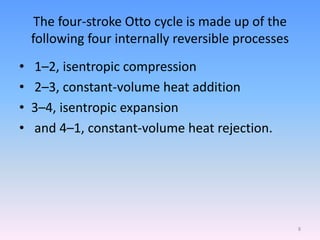
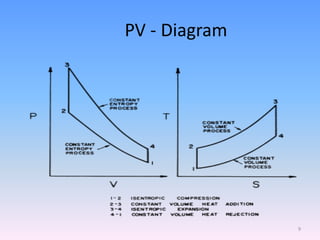
The four-stroke Otto cycle is made up of the
following four internally reversible processes
• 1–2, isentropic compression
• 2–3, constant-volume heat addition
• 3–4, isentropic expansion
• and 4–1, constant-volume heat rejection.
8
PV - Diagram
9
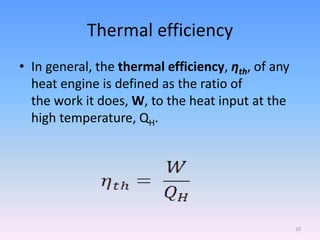
Thermal efficiency
• In general, the thermal efficiency, ηth, of any
heat engine is defined as the ratio of
the work it does, W, to the heat input at the
high temperature, QH.
10
APPLICATIONS
• The Otto Cycle provides the energy for most
transportation and was essential for the
modern world. Specifically, the vast majority
of automobiles seen on the road today use
the Otto Cycle to convert gasoline into
motion.
11

Carnot and Otto Cycle Presentation.pdf

  • 1.
    Comparison Between CARNOT CYCLEAND OTTO CYLCE 1 Orangzeb 20K-0613 Naeemullah 20k-0615
  • 2.
    CARNOT CYCLE • Devisedby Nicolas Leonard Sadi Carnot (1796- 1832) • The Carnot cycle, is thermodynamic process that describes, how fluid is used to convert thermal energy to work 2
  • 3.
    The Carnot cycleconsists of the following four processes: 1. A reversible isothermal gas expansion process. 2. A reversible adiabatic gas expansion process. 3. A reversible isothermal gas compression process 4. A reversible adiabatic gas compression process. 3
  • 4.
    The P-V diagramof the Carnot cycle 4
  • 5.
  • 6.
    Efficiency • The Carnotcycle is the most efficient engine possible based on the assumption of the absence of incidental wasteful processes such as friction, and the assumption of no conduction of heat between different parts of the engine at different temperatures. The efficiency of the Carnot engine is defined as the ratio of the energy output to the energy input. 6
  • 7.
    Internal Combustion Engine– OTTO Cycle • Nikolaus Otto (1832–1891, German) who is credited as the first creator of a petroleum fuel based internal combustion engine operating under a four stroke cycle. • The Otto Cycle, describes how heat engines turn gasoline into motion • Like other thermodynamic cycles, this cycle turns chemical energy into thermal energy and then into motion 7
  • 8.
    The four-stroke Ottocycle is made up of the following four internally reversible processes • 1–2, isentropic compression • 2–3, constant-volume heat addition • 3–4, isentropic expansion • and 4–1, constant-volume heat rejection. 8
  • 9.
  • 10.
    Thermal efficiency • Ingeneral, the thermal efficiency, ηth, of any heat engine is defined as the ratio of the work it does, W, to the heat input at the high temperature, QH. 10
  • 11.
    APPLICATIONS • The OttoCycle provides the energy for most transportation and was essential for the modern world. Specifically, the vast majority of automobiles seen on the road today use the Otto Cycle to convert gasoline into motion. 11