1
Introduction 
Flowers and post production handling 
2
Need for post harvest handling 
Flowers remain alive even after harvest and continue their 
metabolic activities causing 
Depletion of carbohydrates 
Rise in temperature and respiration rates 
Rapid deterioration due to micro-organisms 
Water stress 
Increased accumulation of ethylene 
Deterioration 
Of harvested 
Produce 
Need for appropriate post harvest 
handling technologies 
3
Factors effecting post harvest quality and 
longevity of flowers 
1.Pre harvest factors 2. Post harvest factors 
 Genetic / inherent 
4 
make up 
 Growing conditions 
 Stage of harvest 
 Respiration rate 
 RH 
 Growth regulators 
 Preservative solutions 
 Precooling and storage 
 Packing and transporting
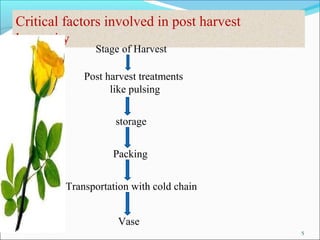
Critical factors involved in post harvest 
longevity 
Stage of Harvest 
Post harvest treatments 
like pulsing 
storage 
Packing 
Transportation with cold chain 
Vase 
5
6 
1.Stage of harvest
7 
Stage of harvest 
Plays a key role 
Varies with species 
With in species it 
varies with varieties
8 
Reviews on stage of harvest 
Yoode et al., 2013 
Acta Hort . 
Dendrobium Orchid cv.Suree 
white and Suree peach 
S1 = 25 % opened flowers 
S2 = 40 % opened flowers 
S3 = 50 % opened flowers 
S4 = 75 % opened flowers 
cv.Suree white no 
difference 
cv.suree peach – 
25 % opened 
flowers - 
increased vase life 
Singh et al., 2010 
J.Ornam. Hort. 
Chrysanthemum cv.Reagen 
S1 = ray floret diameter 1-1.5 
cm 
S2 = buds half open 
S3 = ¾ open buds 
Maximum floret 
longevity with S1 
Varu and Barad. 2010 
J.Hort.Sciences 
Tuberose 
S1= unopened florets 
S2 = one floret opened 
S3 = two florets opened 
Stem length : 45, 60, 75, 90 
cms 
90 cm stem length 
with one floret 
open stage
2.Precooling and pulsing treatments
10 
Precooling and pulsing treatments 
Removal of excess field heat 
Methods- hydro cooling / refrigeration , forced air cooling 
Brings down respiration rate- enhance post harvest quality 
Pulsing 
Pre-storage / pre shipment treatment for short and prescribed 
duration 
Sugar is the main component in pulsing solution 
To regain turgidity of flowers
11 
Reviews on preservative chemicals 
Acharyya et al ., 2013 
Acta.Hort. Gerbera var 
Sunway 
100 ppm AgNo3 + 4% sucrose Vase life correlated 
with water uptake 
Kumar et al.,2012, Annals 
of Hort. 
Gladiolus cv. yellow 
stone 
25 ppm AgNo3 + 2% sucrose Water uptake 
Flower diameter 
Rachis length 
Floret length 
Hajizadeh et al.,2012 
Rosa hybrid cv. Black 
magic 
100 ppm Al2So4 + 2% ethanol 
+ 2.5% sucrose 
Vase life extended to 
18 days 
Marandi et al.,2011 
J.Med . Plant.Res 
Gladiolus 
500 ppm Ajowan oil + 150 
ppm STS + 1.5 mM SA 
Water uptake 
Fresh weight
The Comparison of anti microbial effects silver 
nano particles and silver nitrate to extend the 
vase life of “Red ribbon” cut rose flowers. 

12 
Hatami et al.(2013) 
Trakia. J.Sci.,11 (2): 144-151.
13
14
15
16
A,B stem ends 
pulsed 
With 50 mg 
SNP/l 
For 1 hr 
17 
Longitudinal 
Section 
Cross section 
Xylem blockages 
C,D- control 
Vascular occlusion in the stem end of cut rose
18 
Conclusion 
Use of 33 nm SNP @50 mg/lt + 5 % sucrose extends 
vase life of cut flowers of rose cv. Red Ribbon 
Mobility of silver ion in stem of rose flowers is very slow 
Application of nano particles with antimicrobial effects can 
improve mobility 
Although AgNo3 maintains the flower quality , its 
application have to be avoided due its environmental risks
3.Grading of flowers 
Damaged or infested flowers if any are discarded. 
Good flowers are graded according to bud size and 
stem length 
Uniform buds of a particular grade are bunched for 
further process
20 
Potential of spectral reflectance as post harvest 
classification tool for flower development of Calla 
Lily (Zantedeschia aethiopica L. Spreng.) 
Steidle et al.,2009 
Chilean . J . Agri. Sci., 69(4) :588-592
21
22
23
Conclusion 
 Spectral reflectance has large potential 
to distinguish different postharvest development 
stages 
 Hence this can be used within automatic 
systems for flower classification 
 Automation of grading will ensure the 
availability of quality flowers with better post 
harvest life
25 
Packaging materials
Packing materials 
 cellophane paper 
 butter paper 
 CFB papers 
 aluminum laminated foil 
 polyethylene sheet 
26
27 
Polythene films 
LDPE films 
Aluminium foil
28
Packaging materials: 
 CFB boxes with holes 
Thermacol boxes 
29
30 
Reviews on packing materials 
Singh et al. 2007 
J. Ornam.Hort., 
Gladiolus 
Cellophane 
Polypropylene 
News paper 
Butter paper 
Brown paper 
Plastic coated brown paper 
Poly propylene (60 
micron) - cold stored 
upto 10 days . 
Thamirai selvi et 
al., 2010 
j.Ornam.Hort., 
Jasmine sambac 
Polypropylene without vents 
( 20 , 40,60,80) microns 
Corrugated fibre board with 4 % 
vents 
Polypropylene 
package 60 micron 
packing and CFB 
packaging with 4 % 
boric acid pre 
treatment increased 
shelf life up to 8 days
Jasmine now 
from our local 
Market to 
foreign market 
31
32 
Standardization of export packing 
technology for Jasmine sambac 
flowers. 
Jawaharlal et al., 2013 
International conference on quality management of 
supply chains of ornamentals Acta Horticulture ., 970: 81-91.
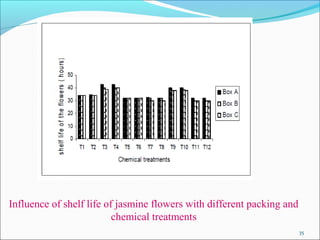
Treatments 
Box A – Aluminum foil lined cardboard boxes 
Box B – thicker polypropylene boxes 
Box C – thinner polypropylene boxes
34 
T1 - Sucrose 2 % 
T2 - Sucrose 4% 
T3 - Boric acid 2% 
T4 - Boric acid 4 % 
T5 - Salicylic acid 25 ppm 
T6 - Salicylic acid 50 ppm 
T7 - Ascorbic acid 50 ppm 
T8 - Ascorbic acid 100 ppm 
T9 - NAA 50 ppm 
T10 - NAA 100 ppm 
T 11 - distilled water 
T - without soaking 
Cont….
35 
Influence of shelf life of jasmine flowers with different packing and 
chemical treatments
36 
Influence of export packing material on PLW of jasmine
Influence of export packing material on moisture content of jasmine 
flowers 
37
Cost economics of export packing technology per Kg of Jasmine 
flowers from India to destination market in New Jersey, US 
38
Conclusion 
The export packing technology involving 
 chemical treatments of flowers – 4 % boric acid 
 packing - aluminium foil lined boxes 
 Packaging – thermacol boxes under gel-ice cold condition 
 Shelf life recorded - 42.88 hours ( including 36 hours 
of air transit) 
 BCR - 1: 2.5 
 This package found to be highly suitable for export to 
overseas market
40
Export packing technology for roses ( loose flower) with gel 
41 
ice packs
4.cold chain 
 Includes the temperature regulation at all stages in 
post harvest practices 
 Starting from precooling to shipment the optimum 
temperatures should be maintained 
 Increase the longevity of the flowers
Cold chain – an optimum temperature regulation 
Stage Temperature 
Maintained 
Pre cooling 6- 12 0C 
Cold storage 5 0 C 
Grading and packing 20 o C 
Refrigerated vans 5-8 o C 
Cargo cabin 16 O C 
43
44 
Reviews on storage temperatures 
Rungruchkananth et 
al.2013 
Acta horticulture 
Dendrobium cvs. 
Sonia 
Anna 
Sanam white 
Fatima 
an alternative to high freight 
charges shipment in sea with 
different storage (10,15,20) 
temperatures for 3 days was 
experimented 
Anna – 15o C 
Sonia, Sanan white 
,Fatima-15-20o C is 
optimum consumer 
vase life -15 days 
Gul et al.2013 
journal of 
horticultural sciences 
and ornamental 
plants 
Narcissus cv. 
Kashmir Local 
Wet storage in distilled water for 
72 hrs compared with dry storage 
at 5 and 10o C 
Cool wet storage in 
distilled water for 72 
hrs is 5o C improved 
performance in vase .
Best practices for retail display 
of fresh cut Roses and Lilies 
45 
Nell et al., 2010 
American Floral Endowment , Special research 
report # 447 
www.endowment.org
46 
Model display cooler used for studies 
Temperature – ≤ 5 o C 
RH – 65-70% 
24 hrs – day light for retail 
display
47 
Fig : 1 Changes in rose fresh weight / stem from initial weight at 
various display temperature 
Time in retail display (days) 
Fresh 
Weight 
change 
(%)
48 
Changes in Lily fresh weight / stem from initial weight at 
various display temperature. 
Fig : 2 
Time in retail display (days) 
Fresh Weight change (%)
49 
Effect of display conditions on vase life of cut Roses and 
Fig 3: Lilies
50 
‘Charlotte’ Roses 5 days after 
removal from 8 days in display 
conditions 
Lilies 8 days after removal from 
4 days in display conditions
51 
Conclusion 
Impact to the industry - using display coolers is 
an easy way to maintain flower quality during 
retail display 
Flowers longevity at the customers’ end will 
increase when flowers are displayed in coolers
52 
Preservative solutions
53 
Holding solution: 
- The flower 
1. Sucrose f ood 
 Gives nourishment 
 10-20 g/ ltr is optimum 
 More we add the faster is the life cycle - so use 
optimum concentrations
54 
2.Biocide /Germicide 
Chemicals which kills the micro- organisms 
Retard bacterial growth 
Ultimately increase water and nutrient uptake
55 
3. Acidifier 
 Brings down the pH of the water we use 
Increased water uptake
56 
4.Ethylene Inhibitor 
Senescence 
and aging 
Amino oxy acetic acid 
Amino ethoxy vinyl glycine 
Methoxyvinyl glycine 
1-methyl cyclo propane 
ETHYLENE
57 
Site of action of ethylene inhibitors
58 
Effect of Gibberlic Acid on vase life and 
oxidative activities in senescing cut 
gladiolus flowers. 
Saeed et al ., 2013 
Plant Growth Regulators DOI 10.1007/s 10725-013-9839-y 
spinger online publication
Effect of various levels of GA3 on percent fresh weight change in 
59 
Gladiolus cut flowers during 10 days vase life 
Change in fresh Weight % 
Days in vase solution
60 
Effect of various levels of GA3 on SOD activity in gladiolus cut 
flowers during 10 days vase life
Conclusion 
GA3 application at 25-50 mg/L recorded highest 
results for improving vase life and quality 
GA3 enhanced 
 Water uptake 
 Membrane stability 
 Antioxidant enzyme activity
62 
Conclusion
63 
Thank you 
Presented by 
Ch. Girija 
Sr. M.Sc 
(FLA) 
Chair person 
Sujatha. A. Nair 
Principal Scientist 
Division of Ornamental Crops 
IIHR , Bengaluru

Post Harvest Handling of Flower Crops

  • 1.
  • 2.
    Introduction Flowers andpost production handling 2
  • 3.
    Need for postharvest handling Flowers remain alive even after harvest and continue their metabolic activities causing Depletion of carbohydrates Rise in temperature and respiration rates Rapid deterioration due to micro-organisms Water stress Increased accumulation of ethylene Deterioration Of harvested Produce Need for appropriate post harvest handling technologies 3
  • 4.
    Factors effecting postharvest quality and longevity of flowers 1.Pre harvest factors 2. Post harvest factors  Genetic / inherent 4 make up  Growing conditions  Stage of harvest  Respiration rate  RH  Growth regulators  Preservative solutions  Precooling and storage  Packing and transporting
  • 5.
    Critical factors involvedin post harvest longevity Stage of Harvest Post harvest treatments like pulsing storage Packing Transportation with cold chain Vase 5
  • 6.
    6 1.Stage ofharvest
  • 7.
    7 Stage ofharvest Plays a key role Varies with species With in species it varies with varieties
  • 8.
    8 Reviews onstage of harvest Yoode et al., 2013 Acta Hort . Dendrobium Orchid cv.Suree white and Suree peach S1 = 25 % opened flowers S2 = 40 % opened flowers S3 = 50 % opened flowers S4 = 75 % opened flowers cv.Suree white no difference cv.suree peach – 25 % opened flowers - increased vase life Singh et al., 2010 J.Ornam. Hort. Chrysanthemum cv.Reagen S1 = ray floret diameter 1-1.5 cm S2 = buds half open S3 = ¾ open buds Maximum floret longevity with S1 Varu and Barad. 2010 J.Hort.Sciences Tuberose S1= unopened florets S2 = one floret opened S3 = two florets opened Stem length : 45, 60, 75, 90 cms 90 cm stem length with one floret open stage
  • 9.
  • 10.
    10 Precooling andpulsing treatments Removal of excess field heat Methods- hydro cooling / refrigeration , forced air cooling Brings down respiration rate- enhance post harvest quality Pulsing Pre-storage / pre shipment treatment for short and prescribed duration Sugar is the main component in pulsing solution To regain turgidity of flowers
  • 11.
    11 Reviews onpreservative chemicals Acharyya et al ., 2013 Acta.Hort. Gerbera var Sunway 100 ppm AgNo3 + 4% sucrose Vase life correlated with water uptake Kumar et al.,2012, Annals of Hort. Gladiolus cv. yellow stone 25 ppm AgNo3 + 2% sucrose Water uptake Flower diameter Rachis length Floret length Hajizadeh et al.,2012 Rosa hybrid cv. Black magic 100 ppm Al2So4 + 2% ethanol + 2.5% sucrose Vase life extended to 18 days Marandi et al.,2011 J.Med . Plant.Res Gladiolus 500 ppm Ajowan oil + 150 ppm STS + 1.5 mM SA Water uptake Fresh weight
  • 12.
    The Comparison ofanti microbial effects silver nano particles and silver nitrate to extend the vase life of “Red ribbon” cut rose flowers. 12 Hatami et al.(2013) Trakia. J.Sci.,11 (2): 144-151.
  • 13.
  • 14.
  • 15.
  • 16.
  • 17.
    A,B stem ends pulsed With 50 mg SNP/l For 1 hr 17 Longitudinal Section Cross section Xylem blockages C,D- control Vascular occlusion in the stem end of cut rose
  • 18.
    18 Conclusion Useof 33 nm SNP @50 mg/lt + 5 % sucrose extends vase life of cut flowers of rose cv. Red Ribbon Mobility of silver ion in stem of rose flowers is very slow Application of nano particles with antimicrobial effects can improve mobility Although AgNo3 maintains the flower quality , its application have to be avoided due its environmental risks
  • 19.
    3.Grading of flowers Damaged or infested flowers if any are discarded. Good flowers are graded according to bud size and stem length Uniform buds of a particular grade are bunched for further process
  • 20.
    20 Potential ofspectral reflectance as post harvest classification tool for flower development of Calla Lily (Zantedeschia aethiopica L. Spreng.) Steidle et al.,2009 Chilean . J . Agri. Sci., 69(4) :588-592
  • 21.
  • 22.
  • 23.
  • 24.
    Conclusion  Spectralreflectance has large potential to distinguish different postharvest development stages  Hence this can be used within automatic systems for flower classification  Automation of grading will ensure the availability of quality flowers with better post harvest life
  • 25.
  • 26.
    Packing materials cellophane paper  butter paper  CFB papers  aluminum laminated foil  polyethylene sheet 26
  • 27.
    27 Polythene films LDPE films Aluminium foil
  • 28.
  • 29.
    Packaging materials: CFB boxes with holes Thermacol boxes 29
  • 30.
    30 Reviews onpacking materials Singh et al. 2007 J. Ornam.Hort., Gladiolus Cellophane Polypropylene News paper Butter paper Brown paper Plastic coated brown paper Poly propylene (60 micron) - cold stored upto 10 days . Thamirai selvi et al., 2010 j.Ornam.Hort., Jasmine sambac Polypropylene without vents ( 20 , 40,60,80) microns Corrugated fibre board with 4 % vents Polypropylene package 60 micron packing and CFB packaging with 4 % boric acid pre treatment increased shelf life up to 8 days
  • 31.
    Jasmine now fromour local Market to foreign market 31
  • 32.
    32 Standardization ofexport packing technology for Jasmine sambac flowers. Jawaharlal et al., 2013 International conference on quality management of supply chains of ornamentals Acta Horticulture ., 970: 81-91.
  • 33.
    Treatments Box A– Aluminum foil lined cardboard boxes Box B – thicker polypropylene boxes Box C – thinner polypropylene boxes
  • 34.
    34 T1 -Sucrose 2 % T2 - Sucrose 4% T3 - Boric acid 2% T4 - Boric acid 4 % T5 - Salicylic acid 25 ppm T6 - Salicylic acid 50 ppm T7 - Ascorbic acid 50 ppm T8 - Ascorbic acid 100 ppm T9 - NAA 50 ppm T10 - NAA 100 ppm T 11 - distilled water T - without soaking Cont….
  • 35.
    35 Influence ofshelf life of jasmine flowers with different packing and chemical treatments
  • 36.
    36 Influence ofexport packing material on PLW of jasmine
  • 37.
    Influence of exportpacking material on moisture content of jasmine flowers 37
  • 38.
    Cost economics ofexport packing technology per Kg of Jasmine flowers from India to destination market in New Jersey, US 38
  • 39.
    Conclusion The exportpacking technology involving  chemical treatments of flowers – 4 % boric acid  packing - aluminium foil lined boxes  Packaging – thermacol boxes under gel-ice cold condition  Shelf life recorded - 42.88 hours ( including 36 hours of air transit)  BCR - 1: 2.5  This package found to be highly suitable for export to overseas market
  • 40.
  • 41.
    Export packing technologyfor roses ( loose flower) with gel 41 ice packs
  • 42.
    4.cold chain Includes the temperature regulation at all stages in post harvest practices  Starting from precooling to shipment the optimum temperatures should be maintained  Increase the longevity of the flowers
  • 43.
    Cold chain –an optimum temperature regulation Stage Temperature Maintained Pre cooling 6- 12 0C Cold storage 5 0 C Grading and packing 20 o C Refrigerated vans 5-8 o C Cargo cabin 16 O C 43
  • 44.
    44 Reviews onstorage temperatures Rungruchkananth et al.2013 Acta horticulture Dendrobium cvs. Sonia Anna Sanam white Fatima an alternative to high freight charges shipment in sea with different storage (10,15,20) temperatures for 3 days was experimented Anna – 15o C Sonia, Sanan white ,Fatima-15-20o C is optimum consumer vase life -15 days Gul et al.2013 journal of horticultural sciences and ornamental plants Narcissus cv. Kashmir Local Wet storage in distilled water for 72 hrs compared with dry storage at 5 and 10o C Cool wet storage in distilled water for 72 hrs is 5o C improved performance in vase .
  • 45.
    Best practices forretail display of fresh cut Roses and Lilies 45 Nell et al., 2010 American Floral Endowment , Special research report # 447 www.endowment.org
  • 46.
    46 Model displaycooler used for studies Temperature – ≤ 5 o C RH – 65-70% 24 hrs – day light for retail display
  • 47.
    47 Fig :1 Changes in rose fresh weight / stem from initial weight at various display temperature Time in retail display (days) Fresh Weight change (%)
  • 48.
    48 Changes inLily fresh weight / stem from initial weight at various display temperature. Fig : 2 Time in retail display (days) Fresh Weight change (%)
  • 49.
    49 Effect ofdisplay conditions on vase life of cut Roses and Fig 3: Lilies
  • 50.
    50 ‘Charlotte’ Roses5 days after removal from 8 days in display conditions Lilies 8 days after removal from 4 days in display conditions
  • 51.
    51 Conclusion Impactto the industry - using display coolers is an easy way to maintain flower quality during retail display Flowers longevity at the customers’ end will increase when flowers are displayed in coolers
  • 52.
  • 53.
    53 Holding solution: - The flower 1. Sucrose f ood  Gives nourishment  10-20 g/ ltr is optimum  More we add the faster is the life cycle - so use optimum concentrations
  • 54.
    54 2.Biocide /Germicide Chemicals which kills the micro- organisms Retard bacterial growth Ultimately increase water and nutrient uptake
  • 55.
    55 3. Acidifier  Brings down the pH of the water we use Increased water uptake
  • 56.
    56 4.Ethylene Inhibitor Senescence and aging Amino oxy acetic acid Amino ethoxy vinyl glycine Methoxyvinyl glycine 1-methyl cyclo propane ETHYLENE
  • 57.
    57 Site ofaction of ethylene inhibitors
  • 58.
    58 Effect ofGibberlic Acid on vase life and oxidative activities in senescing cut gladiolus flowers. Saeed et al ., 2013 Plant Growth Regulators DOI 10.1007/s 10725-013-9839-y spinger online publication
  • 59.
    Effect of variouslevels of GA3 on percent fresh weight change in 59 Gladiolus cut flowers during 10 days vase life Change in fresh Weight % Days in vase solution
  • 60.
    60 Effect ofvarious levels of GA3 on SOD activity in gladiolus cut flowers during 10 days vase life
  • 61.
    Conclusion GA3 applicationat 25-50 mg/L recorded highest results for improving vase life and quality GA3 enhanced  Water uptake  Membrane stability  Antioxidant enzyme activity
  • 62.
  • 63.
    63 Thank you Presented by Ch. Girija Sr. M.Sc (FLA) Chair person Sujatha. A. Nair Principal Scientist Division of Ornamental Crops IIHR , Bengaluru