How to Build Positive Mentoring Relationships Maximize Your Impact Presented by: April Riordan Director of Training & Community Partnerships Mentoring Partnership of MN
The Role of Peer Mentors Please walk around and respond to the questions on the four flip charts.
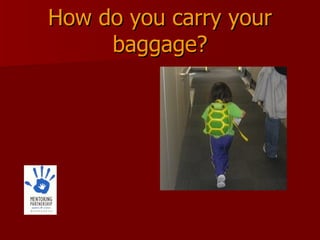
How do you carry your baggage?
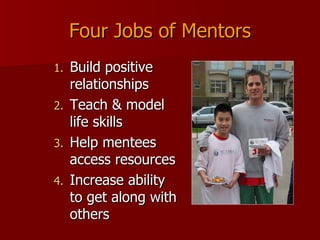
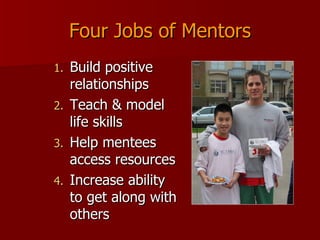
Four Jobs of Mentors Build positive relationships Teach & model life skills Help mentees access resources Increase ability to get along with others
Build positive relationships Have some fun together and earn each others’ trust.  Give each other a break from carrying your baggage.
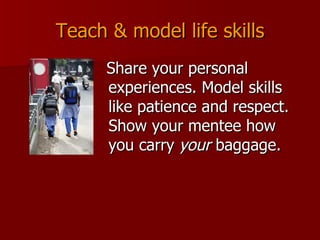
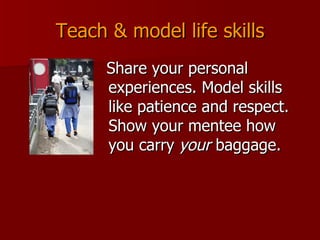
Teach & model life skills Share your personal experiences. Model skills like patience and respect.  Show your mentee how you carry  your  baggage.
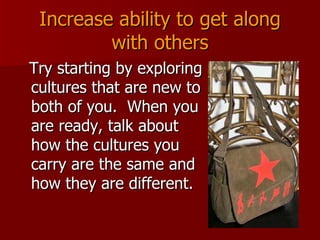
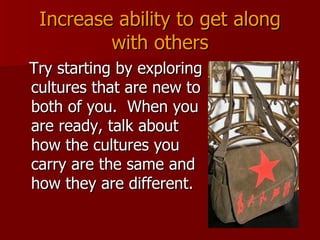
Increase ability to get along with others Try starting by exploring cultures that are new to both of you.  When you are ready, talk about how the cultures you carry are the same and how they are different.
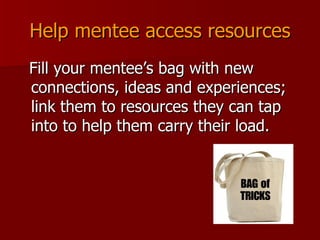
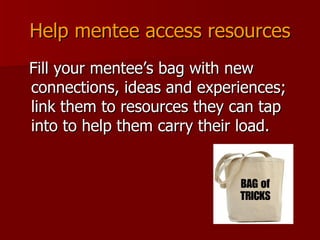
Help mentee access resources Fill your mentee’s bag with new connections, ideas and experiences; link them to resources they can tap into to help them carry their load.
Maximize Your Impact Different way of thinking Focus on “Level 2” Skills Role Modeling
Michael While you’re together one afternoon, Michael tells you that he was invited to go with his friend’s family to the Twins game in Minneapolis next weekend.  He is mad that he can’t go and tells you it is because his mom didn’t pay the $10 for his ticket.  How do you maximize your impact as a mentor?
Kathy It is a Saturday and you are at Walmart with your friends, just hanging out and shopping for clothes.  Your friend is talking loudly about a girl she doesn’t like, using a lot of profanity.  She then starts holding up plus-size shirts and pants and suggesting they should buy them for the girl.  Just as you start to laugh at the joke, you see your mentee, Kathy.  She is standing near her mom’s cart, listening and watching.  How do you maximize your impact as a mentor?
WELCOME MENTEES!
Find a partner You will introduce each other to the group: Name Experience  with mentoring? (have been or have had a mentor in the past?) Important characteristic  of a mentor What are your  Halloween  plans?
What is the Mentoring Partnership of Minnesota? The Mentoring Partnership of Minnesota (MPM)  connects kids with the power of mentoring  Our primary focus is to expand the capacity & increase the quality of mentoring across Minnesota Throughout Minnesota, we work  with more than 500 adult-to-youth mentoring programs
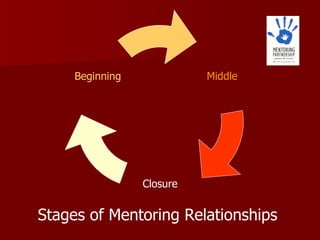
Stages of Mentoring Relationships Middle Closure Beginning
Listening We talk so much.  We’re telling kids this and that.  We forget to listen.  We forget to ask, ‘What do you think? How do you feel?’  It’s only after we know how they feel and what they think that we can know what to say.” --John Hogan, mentor
Being Mentee-Driven Most important denominator in successful matches is the ability of mentors to allow the relationship to be mentee-driven Mentors who enter the relationship with preconceived ideas about the ways in which they will help mentees are less successful
Respecting Boundaries When mentors ask young people personal questions before a solid relationship has been established, the most common response is silence.
Being Sensitive to Differences Mentors and mentees may come from different worlds (class, generational, cultural, etc.) Focus on youth, help negotiate changing relationships with parents at a stage in life when these bonds are being redefined
Providing Support & Challenge Balance - nurture youth while also pushing them toward their goals Successful mentors are consistently there for young people
Acknowledging Reciprocity Mentoring is a two-way street Growth, benefits, and struggles are present on both sides Mentors who are able to convey to mentees that they are they for mutual exchange stand the greatest chance of making a solid connection
Being Realistic Mentors are not magic Mentor who work with young people toward achievable goals can make a real contribution Thick skin, ongoing commitment & genuine caring essential to success
Mentoring is hard work Difficult to connect Social distance Young people do not exist in a vacuum, other influences must be recognized when measuring outcomes Many matches fail Program capacity
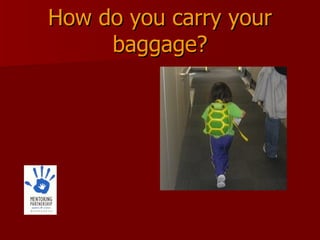
How do you carry your baggage?
Four Jobs of Mentors Build positive relationships Teach & model life skills Help mentees access resources Increase ability to get along with others
Build positive relationships Have some fun together and earn each others’ trust.  Give each other a break from carrying your baggage.
Teach & model life skills Share your personal experiences. Model skills like patience and respect.  Show your mentee how you carry  your  baggage.
Help mentee access resources Fill your mentee’s bag with new connections, ideas and experiences; link them to resources they can tap into to help them carry their load.
Increase ability to get along with others Try starting by exploring cultures that are new to both of you.  When you are ready, talk about how the cultures you carry are the same and how they are different.
Maximize Your Impact Different way of thinking Focus on “Level 2” Skills
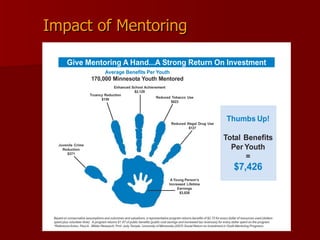
Impact of Mentoring
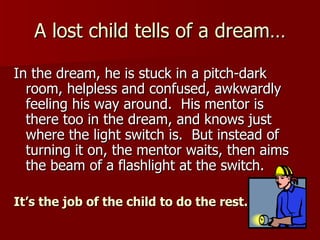
A lost child tells of a dream… In the dream, he is stuck in a pitch-dark room, helpless and confused, awkwardly feeling his way around.  His mentor is there too in the dream, and knows just where the light switch is.  But instead of turning it on, the mentor waits, then aims the beam of a flashlight at the switch.  It’s the job of the child to do the rest.
Thank you! For more information about mentoring opportunities in your community, visit: www.mentoringworks.org

Carlson Alumni

  • 1.
    How to BuildPositive Mentoring Relationships Maximize Your Impact Presented by: April Riordan Director of Training & Community Partnerships Mentoring Partnership of MN
  • 2.
    The Role ofPeer Mentors Please walk around and respond to the questions on the four flip charts.
  • 3.
    How do youcarry your baggage?
  • 4.
    Four Jobs ofMentors Build positive relationships Teach & model life skills Help mentees access resources Increase ability to get along with others
  • 5.
    Build positive relationshipsHave some fun together and earn each others’ trust. Give each other a break from carrying your baggage.
  • 6.
    Teach & modellife skills Share your personal experiences. Model skills like patience and respect. Show your mentee how you carry your baggage.
  • 7.
    Increase ability toget along with others Try starting by exploring cultures that are new to both of you. When you are ready, talk about how the cultures you carry are the same and how they are different.
  • 8.
    Help mentee accessresources Fill your mentee’s bag with new connections, ideas and experiences; link them to resources they can tap into to help them carry their load.
  • 9.
    Maximize Your ImpactDifferent way of thinking Focus on “Level 2” Skills Role Modeling
  • 10.
    Michael While you’retogether one afternoon, Michael tells you that he was invited to go with his friend’s family to the Twins game in Minneapolis next weekend. He is mad that he can’t go and tells you it is because his mom didn’t pay the $10 for his ticket. How do you maximize your impact as a mentor?
  • 11.
    Kathy It isa Saturday and you are at Walmart with your friends, just hanging out and shopping for clothes. Your friend is talking loudly about a girl she doesn’t like, using a lot of profanity. She then starts holding up plus-size shirts and pants and suggesting they should buy them for the girl. Just as you start to laugh at the joke, you see your mentee, Kathy. She is standing near her mom’s cart, listening and watching. How do you maximize your impact as a mentor?
  • 12.
  • 13.
    Find a partnerYou will introduce each other to the group: Name Experience with mentoring? (have been or have had a mentor in the past?) Important characteristic of a mentor What are your Halloween plans?
  • 14.
    What is theMentoring Partnership of Minnesota? The Mentoring Partnership of Minnesota (MPM) connects kids with the power of mentoring Our primary focus is to expand the capacity & increase the quality of mentoring across Minnesota Throughout Minnesota, we work with more than 500 adult-to-youth mentoring programs
  • 15.
    Stages of MentoringRelationships Middle Closure Beginning
  • 16.
    Listening We talkso much. We’re telling kids this and that. We forget to listen. We forget to ask, ‘What do you think? How do you feel?’ It’s only after we know how they feel and what they think that we can know what to say.” --John Hogan, mentor
  • 17.
    Being Mentee-Driven Mostimportant denominator in successful matches is the ability of mentors to allow the relationship to be mentee-driven Mentors who enter the relationship with preconceived ideas about the ways in which they will help mentees are less successful
  • 18.
    Respecting Boundaries Whenmentors ask young people personal questions before a solid relationship has been established, the most common response is silence.
  • 19.
    Being Sensitive toDifferences Mentors and mentees may come from different worlds (class, generational, cultural, etc.) Focus on youth, help negotiate changing relationships with parents at a stage in life when these bonds are being redefined
  • 20.
    Providing Support &Challenge Balance - nurture youth while also pushing them toward their goals Successful mentors are consistently there for young people
  • 21.
    Acknowledging Reciprocity Mentoringis a two-way street Growth, benefits, and struggles are present on both sides Mentors who are able to convey to mentees that they are they for mutual exchange stand the greatest chance of making a solid connection
  • 22.
    Being Realistic Mentorsare not magic Mentor who work with young people toward achievable goals can make a real contribution Thick skin, ongoing commitment & genuine caring essential to success
  • 23.
    Mentoring is hardwork Difficult to connect Social distance Young people do not exist in a vacuum, other influences must be recognized when measuring outcomes Many matches fail Program capacity
  • 24.
    How do youcarry your baggage?
  • 25.
    Four Jobs ofMentors Build positive relationships Teach & model life skills Help mentees access resources Increase ability to get along with others
  • 26.
    Build positive relationshipsHave some fun together and earn each others’ trust. Give each other a break from carrying your baggage.
  • 27.
    Teach & modellife skills Share your personal experiences. Model skills like patience and respect. Show your mentee how you carry your baggage.
  • 28.
    Help mentee accessresources Fill your mentee’s bag with new connections, ideas and experiences; link them to resources they can tap into to help them carry their load.
  • 29.
    Increase ability toget along with others Try starting by exploring cultures that are new to both of you. When you are ready, talk about how the cultures you carry are the same and how they are different.
  • 30.
    Maximize Your ImpactDifferent way of thinking Focus on “Level 2” Skills
  • 31.
  • 32.
    A lost childtells of a dream… In the dream, he is stuck in a pitch-dark room, helpless and confused, awkwardly feeling his way around. His mentor is there too in the dream, and knows just where the light switch is. But instead of turning it on, the mentor waits, then aims the beam of a flashlight at the switch. It’s the job of the child to do the rest.
  • 33.
    Thank you! Formore information about mentoring opportunities in your community, visit: www.mentoringworks.org