Universidad Marítima del Caribe
Language Coordination
English VII
Operations
Compiled and curated by César Rivas
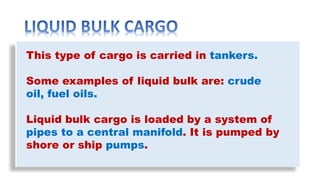
This type of cargo is carried in tankers.
Some examples of liquid bulk are: crude
oil, fuel oils.
Liquid bulk cargo is loaded by a system of
pipes to a central manifold. It is pumped by
shore or ship pumps.
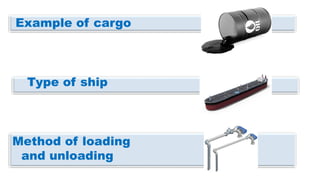
Example of cargo
Type of ship
Method of loading
and unloading
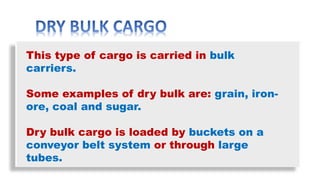
This type of cargo is carried in bulk
carriers.
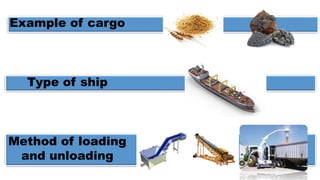
Some examples of dry bulk are: grain, iron-
ore, coal and sugar.
Dry bulk cargo is loaded by buckets on a
conveyor belt system or through large
tubes.
Example of cargo
Type of ship
Method of loading
and unloading
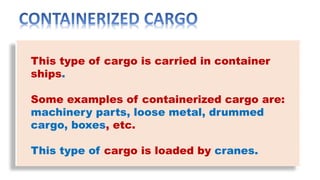
This type of cargo is carried in container
ships.
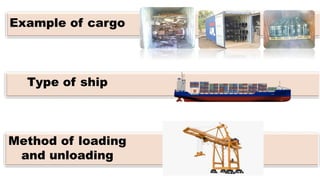
Some examples of containerized cargo are:
machinery parts, loose metal, drummed
cargo, boxes, etc.
This type of cargo is loaded by cranes.
Example of cargo
Type of ship
Method of loading
and unloading
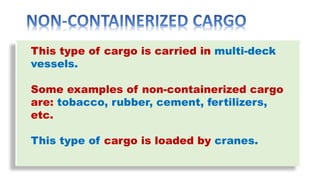
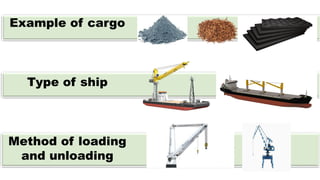
This type of cargo is carried in multi-deck
vessels.
Some examples of non-containerized cargo
are: tobacco, rubber, cement, fertilizers,
etc.
This type of cargo is loaded by cranes.
Example of cargo
Type of ship
Method of loading
and unloading
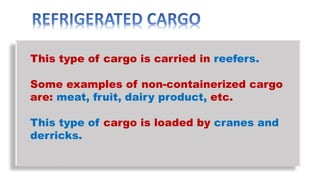
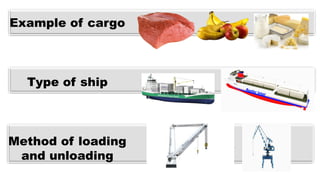
This type of cargo is carried in reefers.
Some examples of non-containerized cargo
are: meat, fruit, dairy product, etc.
This type of cargo is loaded by cranes and
derricks.
Example of cargo
Type of ship
Method of loading
and unloading
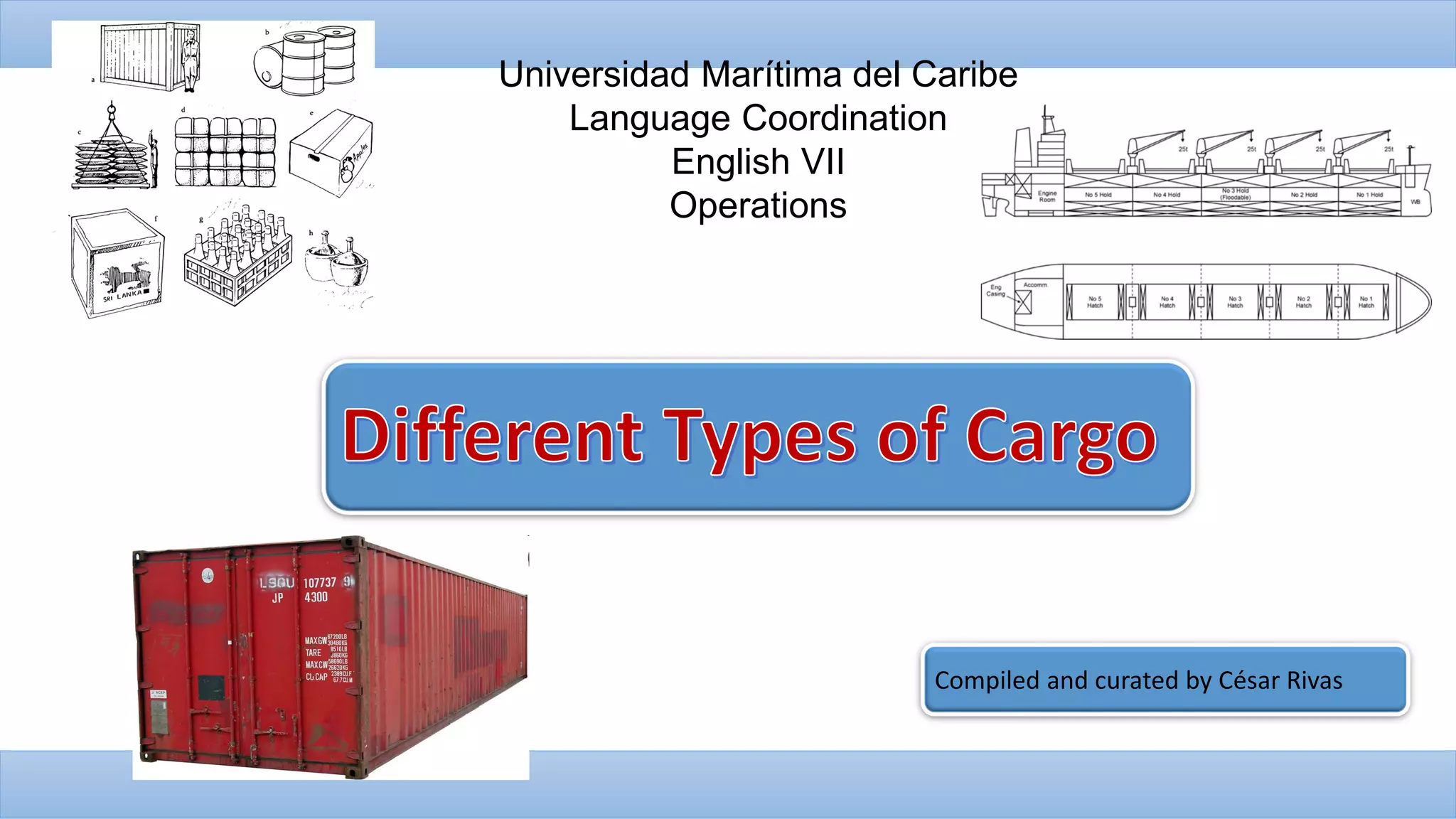
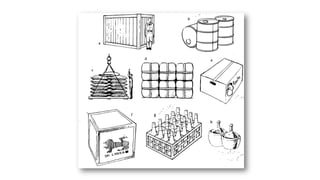
• break-bulk carrier, general cargo ship, freighter- a ship that carries general cargo
• cargo holds- place on a ship where the cargo is stored
• bulk- not packed
• drum- a large round container for substances like oil or chemicals
• box-a covered rectangular container for storing or transporting things
• bag- a container made of a flexible material (as paper or plastic
• bale- a large bundle of goods packed and tied up
• crate- a wooden box
• pallet- a platform on which you can load packages or pieces
• portside cranes- large crane on the quay of the port
• ship’s derricks- a smaller crane on a ship
• hatch- the opening through which we load cargo in a cargo hold
• multi-purpose- can be used in many different ways
• reefer – a vessel that carries refrigerated cargo
• container- a box of standard measures 20ft (1 foot is
30,48 centimetres) or 40 ft for carrying goods
• tweendecks- extra decks that can be taken out
• bulkhead- wall
• bulk carrier- cargo vessel
• coal- substance burnt as fuel
• grain- seeds such as wheat, rice
• iron ore- rock or soil from which you get metal (iron)
• fertilisers- natural or chemical substances used for
plants to grow
• petroleum- thick oil found in the ground used to produce
petrol
• DWT (Dead Weight Tonnage) total capacity of a vessel
comprising cargo, passengers, fuel, etc.
References
Cargo Work: Loading, Discharging & Stowing Cargo (n.d). Document on line Pdf.
Retrieved from: https://www.pfri.uniri.hr/bopri/documents/17-ME-tal_000.pdf
Blakey, T.N. (1987). English for Maritime Studies. Prentice Hall International English
Language Teaching. Second edition. UK Ltd.

Different types of cargo

  • 1.
    Universidad Marítima delCaribe Language Coordination English VII Operations Compiled and curated by César Rivas
  • 2.
    This type ofcargo is carried in tankers. Some examples of liquid bulk are: crude oil, fuel oils. Liquid bulk cargo is loaded by a system of pipes to a central manifold. It is pumped by shore or ship pumps.
  • 3.
    Example of cargo Typeof ship Method of loading and unloading
  • 4.
    This type ofcargo is carried in bulk carriers. Some examples of dry bulk are: grain, iron- ore, coal and sugar. Dry bulk cargo is loaded by buckets on a conveyor belt system or through large tubes.
  • 5.
    Example of cargo Typeof ship Method of loading and unloading
  • 6.
    This type ofcargo is carried in container ships. Some examples of containerized cargo are: machinery parts, loose metal, drummed cargo, boxes, etc. This type of cargo is loaded by cranes.
  • 7.
    Example of cargo Typeof ship Method of loading and unloading
  • 8.
    This type ofcargo is carried in multi-deck vessels. Some examples of non-containerized cargo are: tobacco, rubber, cement, fertilizers, etc. This type of cargo is loaded by cranes.
  • 9.
    Example of cargo Typeof ship Method of loading and unloading
  • 10.
    This type ofcargo is carried in reefers. Some examples of non-containerized cargo are: meat, fruit, dairy product, etc. This type of cargo is loaded by cranes and derricks.
  • 11.
    Example of cargo Typeof ship Method of loading and unloading
  • 13.
    • break-bulk carrier,general cargo ship, freighter- a ship that carries general cargo • cargo holds- place on a ship where the cargo is stored • bulk- not packed • drum- a large round container for substances like oil or chemicals • box-a covered rectangular container for storing or transporting things • bag- a container made of a flexible material (as paper or plastic • bale- a large bundle of goods packed and tied up • crate- a wooden box • pallet- a platform on which you can load packages or pieces • portside cranes- large crane on the quay of the port • ship’s derricks- a smaller crane on a ship • hatch- the opening through which we load cargo in a cargo hold
  • 14.
    • multi-purpose- canbe used in many different ways • reefer – a vessel that carries refrigerated cargo • container- a box of standard measures 20ft (1 foot is 30,48 centimetres) or 40 ft for carrying goods • tweendecks- extra decks that can be taken out • bulkhead- wall
  • 15.
    • bulk carrier-cargo vessel • coal- substance burnt as fuel • grain- seeds such as wheat, rice • iron ore- rock or soil from which you get metal (iron) • fertilisers- natural or chemical substances used for plants to grow • petroleum- thick oil found in the ground used to produce petrol • DWT (Dead Weight Tonnage) total capacity of a vessel comprising cargo, passengers, fuel, etc.
  • 16.
    References Cargo Work: Loading,Discharging & Stowing Cargo (n.d). Document on line Pdf. Retrieved from: https://www.pfri.uniri.hr/bopri/documents/17-ME-tal_000.pdf Blakey, T.N. (1987). English for Maritime Studies. Prentice Hall International English Language Teaching. Second edition. UK Ltd.