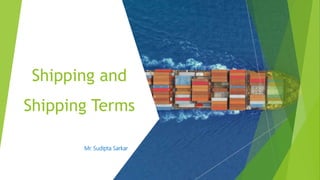

Shipping and
Shipping Terms
Mr. Sudipta Sarkar
Shipping
Shipping is the physical moving of good
from one point to another. The shipping
process follows the manufacture and
the packing of goods and will be
controlled by a shipping or logistics
company.
If goods are bulky and need to be
carried in a container, sender/exporter
need to work with a shipping line,
freight forwarding company, and
customs clearance brokers.
The shipping company removes all
complexities for the owner of the goods
by handling essential documents, like:
Commercial Invoice; Insurance
Certificate; Bill of Lading.
Participants in International
Shipping Process
 Importer
 Exporter
 Banks
 Insurance Company
 Freight Forwarders
 Customs/ Customs House Agents
(CHA)
 Shipping Company
 Port Authorities
 Intermodal Transport Providers
Agent
ConsigneeSeller
Bill of Lading (B/L)
A bill of lading is a legal document that captures
concise details of the goods being carried by the
shipper.
The B/L operates as a shipping receipt since it
points out the nature, quantity, and destination of
the goods.
The bill of lading can be classified based on
Negotiation, Execution and Method of operation
Purpose of Bill of Lading
It acts as a piece of
evidence for the carriage
contract containing the
terms and condition under
which the goods
transportation will be
carried out.
It represents as a receipt
which endorses that the
carrier has received the
cargo as per the contract
and the goods are
received in good
condition.
It is a document of title,
permitting the sale of
goods in transit and the
raising of financial credit.
Most of the local and
international system does
not consider a bill of
lading as a document of
title. It provides the right
for the delivery to be
made to the possessor
Type of B/L’s based on Negotiation
Negotiable Bill of Lading
A clear instruction is provided to make the
delivery of the goods to anyone having the
possession of the original copy of the BL at
discharge port.
This BL itself signifies the title and control
of the freight.
In the absence of original bill copy, the
freight will not be released.
Non-negotiable Bill of Lading
This type of BL fixes a specific consignee/
name of the receiver to whom the freights
will be shipped and delivered.
It does not itself serve the ownership of the
goods.
Under this bill type, the assigned receiver/
buyers can claim the cargo by confirming
their identity.
Type of B/L’s
based on
Execution
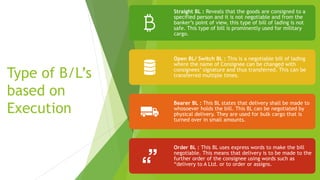
Straight BL : Reveals that the goods are consigned to a
specified person and it is not negotiable and from the
banker’s point of view, this type of bill of lading is not
safe. This type of bill is prominently used for military
cargo.
Open BL/ Switch BL : This is a negotiable bill of lading
where the name of Consignee can be changed with
consignees’ signature and thus transferred. This can be
transferred multiple times.
Bearer BL : This BL states that delivery shall be made to
whosoever holds the bill. This BL can be negotiated by
physical delivery. They are used for bulk cargo that is
turned over in small amounts.
Order BL : This BL uses express words to make the bill
negotiable. This means that delivery is to be made to the
further order of the consignee using words such as
“delivery to A Ltd. or to order or assigns.
OBL vs Sea Way/ Express BL
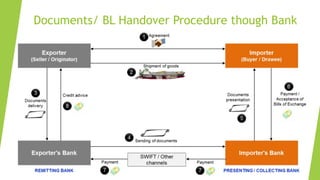
Documents/ BL Handover Procedure though Bank
INCOTERMS
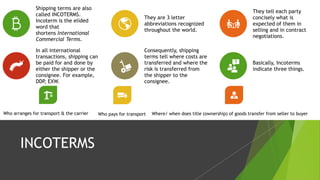
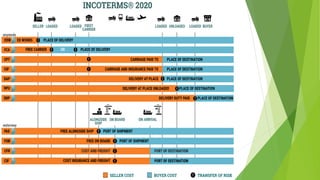
Shipping terms are also
called INCOTERMS.
Incoterm is the elided
word that
shortens International
Commercial Terms.
They are 3 letter
abbreviations recognized
throughout the world.
They tell each party
concisely what is
expected of them in
selling and in contract
negotiations.
In all international
transactions, shipping can
be paid for and done by
either the shipper or the
consignee. For example,
DDP, EXW.
Consequently, shipping
terms tell where costs are
transferred and where the
risk is transferred from
the shipper to the
consignee.
Basically, Incoterms
indicate three things.
Who arranges for transport & the carrier Who pays for transport Where/ when does title (ownership) of goods transfer from seller to buyer
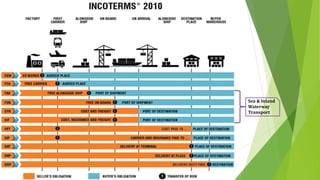
Sea & Inland
Waterway
Transport
 DAT (Delivery at Terminal) Incoterm changed to DPU (Delivery at
Place Unloaded), to broadly cover ‘any place, whether covered or
not’.
 Insurance points are clarified in CIF and CIP incoterms rules. Earlier
insurance is required under clause C. But in Incoterms 2020, CIP
requires insurance complying with Institute Cargo Clause (A) whereas
CIF requires insurance under Clause C. Because Clause A covers higher
level of insurance (e.g.- manufactured goods), whereas a lower level
of cover from Clause C would probably apply to the commodities
world.
 Costs and cost structures are now clarified. All cost allocated by each
Incoterms rule are now listed, for the seller in A9 and for the buyer in
B9. Earlier user had to look across several articles within each rule to
see who bore the costs.
 Security in relation to transport is now clearly detailed
 Provisions to allow for own transport rather than assuming 3rd party
transport. Earlier in Incoterms 2010 rules assumed that goods carried
from the seller to the buyer were via a 3rd party.
 FCA, FOB and Bills of Lading
 Presentation and design is much simpler and user friendly
7 Key
Changes to
Incoterms
2020
 THANK YOU.
Mr. Sudipta Sarkar

Shipping and Shipping Terms

  • 1.
  • 2.
    Shipping Shipping is thephysical moving of good from one point to another. The shipping process follows the manufacture and the packing of goods and will be controlled by a shipping or logistics company. If goods are bulky and need to be carried in a container, sender/exporter need to work with a shipping line, freight forwarding company, and customs clearance brokers. The shipping company removes all complexities for the owner of the goods by handling essential documents, like: Commercial Invoice; Insurance Certificate; Bill of Lading.
  • 3.
    Participants in International ShippingProcess  Importer  Exporter  Banks  Insurance Company  Freight Forwarders  Customs/ Customs House Agents (CHA)  Shipping Company  Port Authorities  Intermodal Transport Providers Agent ConsigneeSeller
  • 4.
    Bill of Lading(B/L) A bill of lading is a legal document that captures concise details of the goods being carried by the shipper. The B/L operates as a shipping receipt since it points out the nature, quantity, and destination of the goods. The bill of lading can be classified based on Negotiation, Execution and Method of operation
  • 5.
    Purpose of Billof Lading It acts as a piece of evidence for the carriage contract containing the terms and condition under which the goods transportation will be carried out. It represents as a receipt which endorses that the carrier has received the cargo as per the contract and the goods are received in good condition. It is a document of title, permitting the sale of goods in transit and the raising of financial credit. Most of the local and international system does not consider a bill of lading as a document of title. It provides the right for the delivery to be made to the possessor
  • 6.
    Type of B/L’sbased on Negotiation Negotiable Bill of Lading A clear instruction is provided to make the delivery of the goods to anyone having the possession of the original copy of the BL at discharge port. This BL itself signifies the title and control of the freight. In the absence of original bill copy, the freight will not be released. Non-negotiable Bill of Lading This type of BL fixes a specific consignee/ name of the receiver to whom the freights will be shipped and delivered. It does not itself serve the ownership of the goods. Under this bill type, the assigned receiver/ buyers can claim the cargo by confirming their identity.
  • 7.
    Type of B/L’s basedon Execution Straight BL : Reveals that the goods are consigned to a specified person and it is not negotiable and from the banker’s point of view, this type of bill of lading is not safe. This type of bill is prominently used for military cargo. Open BL/ Switch BL : This is a negotiable bill of lading where the name of Consignee can be changed with consignees’ signature and thus transferred. This can be transferred multiple times. Bearer BL : This BL states that delivery shall be made to whosoever holds the bill. This BL can be negotiated by physical delivery. They are used for bulk cargo that is turned over in small amounts. Order BL : This BL uses express words to make the bill negotiable. This means that delivery is to be made to the further order of the consignee using words such as “delivery to A Ltd. or to order or assigns.
  • 8.
    OBL vs SeaWay/ Express BL
  • 9.
    Documents/ BL HandoverProcedure though Bank
  • 10.
    INCOTERMS Shipping terms arealso called INCOTERMS. Incoterm is the elided word that shortens International Commercial Terms. They are 3 letter abbreviations recognized throughout the world. They tell each party concisely what is expected of them in selling and in contract negotiations. In all international transactions, shipping can be paid for and done by either the shipper or the consignee. For example, DDP, EXW. Consequently, shipping terms tell where costs are transferred and where the risk is transferred from the shipper to the consignee. Basically, Incoterms indicate three things. Who arranges for transport & the carrier Who pays for transport Where/ when does title (ownership) of goods transfer from seller to buyer
  • 11.
  • 12.
     DAT (Deliveryat Terminal) Incoterm changed to DPU (Delivery at Place Unloaded), to broadly cover ‘any place, whether covered or not’.  Insurance points are clarified in CIF and CIP incoterms rules. Earlier insurance is required under clause C. But in Incoterms 2020, CIP requires insurance complying with Institute Cargo Clause (A) whereas CIF requires insurance under Clause C. Because Clause A covers higher level of insurance (e.g.- manufactured goods), whereas a lower level of cover from Clause C would probably apply to the commodities world.  Costs and cost structures are now clarified. All cost allocated by each Incoterms rule are now listed, for the seller in A9 and for the buyer in B9. Earlier user had to look across several articles within each rule to see who bore the costs.  Security in relation to transport is now clearly detailed  Provisions to allow for own transport rather than assuming 3rd party transport. Earlier in Incoterms 2010 rules assumed that goods carried from the seller to the buyer were via a 3rd party.  FCA, FOB and Bills of Lading  Presentation and design is much simpler and user friendly 7 Key Changes to Incoterms 2020
  • 14.
     THANK YOU. Mr.Sudipta Sarkar

Editor's Notes

  • #13 to broadly cover ‘any place, whether covered or not’.