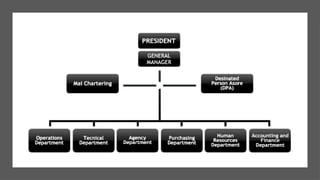
SHIP OPERATIONS AND MANAGEMENT
21MR61
MODULE 1and 2 Introduction to ship
Management
Agents and Agencies
Nithin Joshuva
SIT MANAGLORE
• Course objectives:
• ● To understand the concepts of Ship operations.
• ● To understand the concepts of Freight Rates, voyage
planning, marine Insurance
• ● To understand the organizational structure of a shipping
company.
• ● To get familiarized with various chartering methods, Bill
of Lading and different paper works on board a
• merchant vessel
• MODULE-1 8 HOURS
• Introduction to Ship Management: Modern shipping practice. Marine vehicles and
cargo, care of cargo against damage. Cargoes, stowage of cargo and cargo
information. Stowage factor. Care and securing of cargo Damage of cargo
Development in shipping and cargo handling. Multimodal transportation, Liner and
tramp shipping services. Shipping companies- Owned and ship management
company, organization structure.
• MODULE-2 8 HOURS
• Agents and Agencies: Ports and other intermediaries – Stevedores, Agent and
Agency. Port clearance, Custom clearance – Ship documents for inward and
outward clearance and procedure. Import and export procedure and documents for
import and export. Procedure to convert foreign going vessels into coastal vessels
and vice versa.
• MODULE-3 8 HOURS
• Marine Insurance: Risk and risk control. Classification of insurance business.
Principles of insurance and Types. Important clauses of Hull, cargo and freight
insurance and their importance. General average, Characteristics of General
Average Particular average P&I clubs, Underwriting claims. Insurance companies
in India. Reinsurance
• MODULE-4 8 HOURS
• Chartering: Terms used in commercial shipping- Bill of lading and types. Clauses
in Bill of lading. Issues with Bill of lading. Seaway bill Freight and type of freight,
Lein, Chartering of vessel and types of charter. In Charter, Out
charter. Charter terminology – types of days in a Charter party. Charter party
clauses. Fixation of vessel Voyage estimate
• MODULE-5 8 HOURS
• Maritime Law:
• International laws of the sea. Limitation of shipowners liability. Carriage of
Goods by Sea Act 1971. York – Antwerp rules Maritime safety and security –
Employment of seafarers, ILO, MLC convention Maritime Business
contracts. Maritime disputes and settlements, Arbitration .Maritime Jurisdictions
( Admiralty courts) and Judicial process in India
10/14/2024
Prehistory
Sea transportation dates back to 10000 years ago to
the Neolithic Period.
Though these crafts cannot be classified as ships they
marked the beginning of transport of goods by sea.
Animal skins and woven fabrics were used as sails and
the birth of the early SHIPS.
The birth of these crafts allowed men the opportunity to
explore distant lands separated by sea and the
migration of mankind.
10/14/2024
Origin of International Sea Trade
 Has been in vogue since 3000 BC – Egyptian coastal and river Ships
 1200 BC Egyptian ships have believed to have ventured upto Sumatra for
trading.
 15th Century China had established major trade expeditions including
venturing upto East Africa.
 International Trade picked up momentum with European Colonial powers
such as Spain, Portugal, French and British established trade networks
through sea and the colonization of the territorries they landed in.
10/14/2024
Types Of Ships
 Cargo ships/freighters can be divided into four groups, according to the type
of cargo they carry.
 General Cargo Vessels - carry packaged items like chemicals, foods,
furniture, machinery, motor vehicles, footwear, garments, etc.
 Dry-bulk Carriers - carry coal, grain, ore and other similar products in loose
form.
 Tankers - carry petroleum products or other liquid cargo.
 Multipurpose Vessels - as the name suggests, carry different classes of cargo
– e.g. liquid and general cargo – at the same time
 Container vessels – Vessels that carry containers.
 RO-RO Vessels –that can carry cargoes which can be rolled on and off the
vessel.
 Gas Carriers - ships that are specially designed to transport gas
10/14/2024
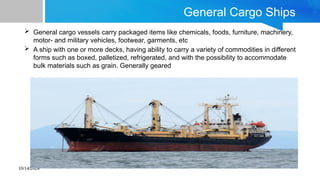
General Cargo Ships
 General cargo vessels carry packaged items like chemicals, foods, furniture, machinery,
motor- and military vehicles, footwear, garments, etc
 A ship with one or more decks, having ability to carry a variety of commodities in different
forms such as boxed, palletized, refrigerated, and with the possibility to accommodate
bulk materials such as grain. Generally geared
10/14/2024
Dry Bulk Carriers
• A bulk carrier is primarily used in carrying unpackaged bulk
cargo items such as metal ores, coal, cement, grains and
other similar cargo.
• Bulk Carrier Sizes
 Small Handy - carriers of 20,000 long tons deadweight (DWT)-28,000 DWT
 Handy - carriers of 28,000-40,000 DWT.
 Handymax, carriers of 40,000-50,000 DWT.
 Supramax (50,000 to 60,000 DWT).
 Panamax, the largest size that can traverse the Panama Canal (generally: vessels with
a width smaller than 32.2 m).
 Capesize, vessels larger than Panamax and Post-Panamax, and must traverse the
Cape of Good Hope and Cape Horn to travel between oceans.
 Chinamax, carriers of 380,000-400,000 DWT with main dimensions limited by port
infrastructure in China
10/14/2024
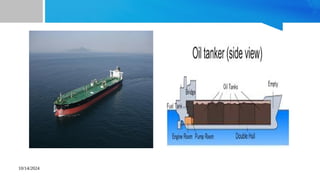
Liquid Bulk Carriers - Tankers
• A merchant vessel designed to transport liquids or gases in bulk. Major types
of tankship include the oil tanker, the chemical tanker,
• Second half of 19th
Century tanker (tankship) concept was introduced.
• Tankers can range in size of capacity from several hundred tons, which
includes vessels for servicing small harbours and coastal settlements, to
several hundred thousand tons, for long-range haulage. Besides ocean- or
seagoing tankers there are also specialized inland-waterway tankers which
operate on rivers and canals with an average cargo capacity up to some
thousand tons. A wide range of products are carried by tankers, including:
• hydrocarbon products such as crude oil and producrts
• chemicals, such as ammonia, chlorine, and styrene monomer
• fresh water, wine molasses
• Vegetable oils.
10/14/2024
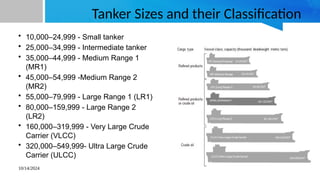
Tanker Sizes and their Classification
• 10,000–24,999 - Small tanker
• 25,000–34,999 - Intermediate tanker
• 35,000–44,999 - Medium Range 1
(MR1)
• 45,000–54,999 -Medium Range 2
(MR2)
• 55,000–79,999 - Large Range 1 (LR1)
• 80,000–159,999 - Large Range 2
(LR2)
• 160,000–319,999 - Very Large Crude
Carrier (VLCC)
• 320,000–549,999- Ultra Large Crude
Carrier (ULCC)
10/14/2024
10/14/2024
Container ships
• Revolutionized sea transportation of freight. Commenced in 1955. First container
ship Ideal X - New Jersey and Houston – Malcolm Mclean -58 containers.
• Other ships referred by the weight of cargo they can carry. Container ships -
number of TEU they can carry.
• Container vessels eliminate the individual hatches, holds and dividers of the
traditional general cargo vessels.
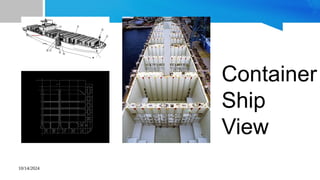
• Hull of a typical container ship is a huge warehouse divided into cells by vertical
guide rails- cells are designed to hold cargo in pre-packed units – containers.
• Shipping containers are usually made of steel, materials like aluminium, fiberglass
or plywood are also used.
• Designed to be entirely transferred to and from smaller coastal carriers, trains,
trucks and/or semi-trailers (and so are carried by different modes of transport
during one voyage, thus giving the name intermodal transport)
• Several types of containers - categorized according to their size and functions.
• Approx. 90% of non-bulk cargo worldwide is transported by container.
10/14/2024
Container
Ship
View
10/14/2024
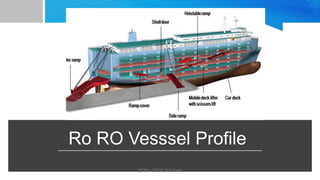
RO RO Vessels
 Roll-on/roll-off (RORO or ro-ro) ships are vessels designed to
carry wheeled cargo, such as cars, trucks, semi-trailer
trucks, trailers, and railroad cars, that are driven on and off the ship
on their own wheels or using a platform vehicle, such as a self-
propelled modular transporter.
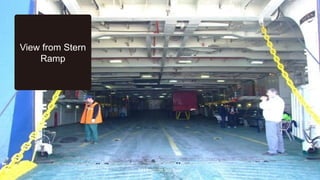
 RORO vessels have either built-in or shore-based ramps that allow
the cargo to be efficiently rolled on and off the vessel when in port.
 First cargo ships specially fitted for the transport of large quantities
of cars came into service in the early sixties.
 Today’s pure car carriers, the pure car/truck carrier (PCTC), are
distinctive ships with a box-like superstructure running the entire
length and breadth of the hull, fully enclosing the cargo.
Ro RO Vesssel Profile
2018 - 2020 3rd Sem
View from Stern
Ramp
2018 - 2020 3rd Sem
10/14/2024
Gas Carriers
• A gas carrier (or gas tanker)- ship designed to transport LPG, LNG or
liquefied chemical gases in bulk.
• Gas Carrier – Types
• Fully pressurised LPG carriers - fitted with a number of horizontal
cylindrical or spherical cargo tanks and have capacities up to 6,000 m3. A
cost-effective, simple way of moving LPG to and from smaller gas terminals.
• Semi-pressurised tankers - development of metals suitable for containment
of liquefied gases at low temperatures, semi-pressurised tankers were
developed. By installing a reliquefaction plant, insulating the cargo tanks and
making use of special steels, the thickness of the pressure vessels, and
hence there weight, could be reduced. These carriers, incorporating tanks
either cylindrical, spherical or bi-lobe in shape, are able to load or discharge
gas cargoes at both refrigerated and pressurised storage facilities.
10/14/2024
• Fully refrigerated tankers - built to carry liquefied gases at low temperature and
atmospheric pressure between terminals equipped with fully refrigerated storage
tanks.
• Prismatic-shaped cargo tanks fabricated from 3.5% nickel steel, allowing the
carriage of cargoes at temperatures as low as –48°C, marginally below the
boiling point of pure propane. Prismatic tanks enable the tanker’s cargo carrying
capacity to be maximised, thus making the fully refrigerated tanker highly suitable
for carrying large volumes of cargo such as LPG, ammonia and vinyl chloride
over long distances.
• Liquefied natural gas (LNG) carriers LNG is carried at its boiling point, being –
162°C. LNG containment systems have developed considerably. LNG carriers
are fitted with independent cargo tanks or with membrane tanks.
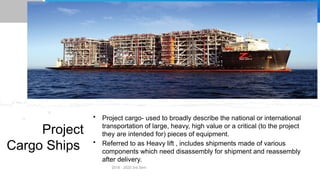
Project
Cargo Ships
• Project cargo- used to broadly describe the national or international
transportation of large, heavy, high value or a critical (to the project
they are intended for) pieces of equipment.
• Referred to as Heavy lift , includes shipments made of various
components which need disassembly for shipment and reassembly
after delivery.
2018 - 2020 3rd Sem
10/14/2024
• Heavy-lift/Project Cargo Vessels:
These, mostly purpose built, vessels specialise in the transport of extremely
heavy or bulky objects such as other ships and large industrial components.
Some heavy-lift vessels are equipped with high capacity cranes to load at ports
without a heavy-lift capability.
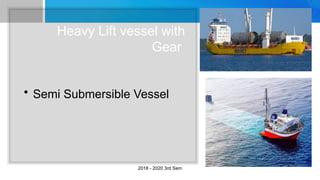
• Semi submersible - allows a cargo to be floated into position before the heavy-lift
vessel de-ballasts to lift the cargo out of the water.
• Used to transport offshore platforms from their construction site to the drilling
site.
• Common project cargoes are wind turbine blades and towers, quay cranes and
industrial machinery.
• 'Jack up' vessels -able to put down 'legs' to lift themselves out of the water.
Commonly used by vessels installing offshore wind farms where stability is
required during the placing of the turbine towers.
Heavy Lift vessel with
Gear
• Semi Submersible Vessel
2018 - 2020 3rd Sem
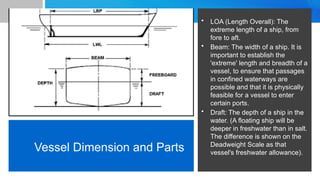
Vessel Dimension and Parts
• LOA (Length Overall): The
extreme length of a ship, from
fore to aft.
• Beam: The width of a ship. It is
important to establish the
'extreme' length and breadth of a
vessel, to ensure that passages
in confined waterways are
possible and that it is physically
feasible for a vessel to enter
certain ports.
• Draft: The depth of a ship in the
water. (A floating ship will be
deeper in freshwater than in salt.
The difference is shown on the
Deadweight Scale as that
vessel's freshwater allowance).
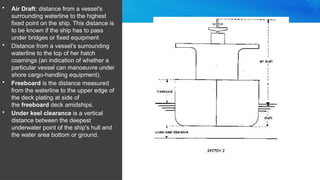
• Air Draft: distance from a vessel's
surrounding waterline to the highest
fixed point on the ship. This distance is
to be known if the ship has to pass
under bridges or fixed equipment
• Distance from a vessel's surrounding
waterline to the top of her hatch
coamings (an indication of whether a
particular vessel can manoeuvre under
shore cargo-handling equipment).
• Freeboard is the distance measured
from the waterline to the upper edge of
the deck plating at side of
the freeboard deck amidships.
• Under keel clearance is a vertical
distance between the deepest
underwater point of the ship's hull and
the water area bottom or ground.
 Modern shipping practice" refers to the contemporary methods,
technologies, regulations, and practices employed in the maritime
industry to facilitate the efficient and safe transportation of goods and
passengers by sea.
 It encompasses various aspects of maritime operations, including
vessel design and construction, navigation and seamanship, cargo
handling and stowage, safety and security, environmental protection,
regulatory compliance, and business management.
 Modern shipping practice reflects the dynamic nature of the maritime
sector, driven by advancements in technology, changes in global trade
patterns, evolving regulatory frameworks, and the adoption of best
practices to enhance efficiency, sustainability, and competitiveness in
the industry.
• care of cargo against damage
• Protecting cargo against damage is a critical aspect of maritime
industry operations, given the inherent risks associated with sea
transportation.
• Safeguarding cargo ensures that it arrives at its destination in the
intended condition, thereby maintaining customer satisfaction,
preserving the value of goods, and preventing financial losses for
shippers, carriers, and other stakeholders.
• In this essay, we will explore the various measures and practices
employed to care for cargo against damage in the maritime industry.
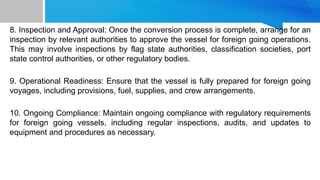
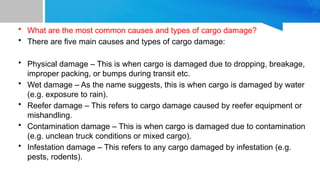
• What are the most common causes and types of cargo damage?
• There are five main causes and types of cargo damage:
• Physical damage – This is when cargo is damaged due to dropping, breakage,
improper packing, or bumps during transit etc.
• Wet damage – As the name suggests, this is when cargo is damaged by water
(e.g. exposure to rain).
• Reefer damage – This refers to cargo damage caused by reefer equipment or
mishandling.
• Contamination damage – This is when cargo is damaged due to contamination
(e.g. unclean truck conditions or mixed cargo).
• Infestation damage – This refers to any cargo damaged by infestation (e.g.
pests, rodents).
• - Preventive measures against physical damage
• 1. Use the correct type of container.. For example, when packing heavy
• cargo, you need to ensure that the container used can carry the weight of
• the cargo..
• This is easily identified by checking and following the markings on a
• container, one of which is the weight allowance displayed on the CSC
• plate on the container..
• 2. Make sure that the lashing and dunnage material and methods are
• sufficient to restrict the movement of the cargo within the container
• 3. Ensure that you follow the SOLAS VGM
• requirements at all times when packing,
• transporting and loading container
• A few other important factors to consider when packing your cargo is
to
• • plan the stowage of the cargo in the container
• • ensure that all container weight limitations of the container are met
as per the markings on the container
• • distribute the weight equally inside the container taking care not to
exceed
• permissible weight concentrations per square foot of deck
• • avoid concentrating heavy weights at one side or one end
• • stow heaviest items on the bottom for stability
• • box, crate or place on cradle the heavy items
• • ensure that incompatible cargo is not mixed in the container (like
mixing clothing with chemicals)
• Preventive measures against wet damage
• As mentioned above, it is imperative that you are aware not just of the
• vulnerability of your cargo, but also the physical route that the cargo
• takes from origin to destination..
• For example, if you are loading cargo in cartons, or iron/steel cargo, or
• cotton or other cargo that is susceptible to wet damage, it may be
• prudent for you to take cognizance of the route of the cargo and take
• proper precautions..
Climatic conditions (temperature and humidity) can affect the cargo
• inside containers especially if the ship is moving from one hemisphere to
• the other..
• Corrosion and oxidation affect metal products specifically while
• condensation can have a negative effect on all cargoes..
• While you might not be able to do much about the route the
cargo takes,or how long it takes, or the weather conditions along
the route, what you can do is take appropriate mitigation steps to
avoid condensation and moisture inside the container.
• These steps could include using antihumidity materials or you
could use “ventilated containers” with side vents
• One should also ensure that the doors of the containers seal
properly and the rubber seal gaskets are present and in good
condition
• Preventive measures against contamination damage
• If you are loading liquid bulk cargo in an ISO tank container, you should insist on a
“tank cleaning certificate” from the tank operator which tells you the last date of the
cleaning, what type of cleaning etc..
• Once you have this information, you can satisfy yourself whether this specific tank
will be suitable for your cargo or not. You can identify whether your cargo may or
may not get contaminated when using this tank container..
• It is also recommended to have a professional liquid bulk cargo surveyor to inspect
the tank or be present during loading operations to ensure that there are no issues.
• Tank operators keep their food grade tank fleet separate to their other tanks like
chemical and gas tanks.. All food tanks might not be compatible with your specific
food cargo and similarly, not all chemical tanks may be compatible with or be
suitable for your specific chemical cargo..
• Therefore it is imperative that you provide ALL information about your cargo
(Generally the MSDS is the best option that provides all information related to the
cargo) to the ISO tank operator so they may release the most suitable tank for
your cargo..
• Cargo to be loaded may react with previous cargo or cargo in adjacent
compartment through substance mixture or temperature impact, even if the
equipment is stated to be clean and ready to serve..
• Such mixture may damage the product an equipment, or cause severen
reactive incident due to contamination..
• You may be loading solid cargo that is susceptible to odour and rust
• contamination – like nuts, tobacco, clothing, fabrics etc in a normal ISO
• container..
• In such cases, you need to request the shipping line for a food grade or A
grade container which is “prepared” specifically for the carriage of your
cargo, usually at a cost..
• - Preventive measures against infestation damage
• Advise shipping line “specifically” about the type of cargo being shipped
• and if it is food cargo, then you must request for a food grade container
• for packing
• Ensure that the warehouse that your cargo is stored in is clean and free
• of pests and rodents that may cause infestation
• Dunnage made from raw and unprocessed wood may present a high risk
• of introduction/spread of quarantine pests and therefore many countries
• require wooden dunnage and pallets to be fumigated before it can be
• exported..
• stowage of cargo and cargo information
• Stowage of cargo is a critical aspect of maritime operations. It
involves the strategic arrangement, securing, and distribution of cargo
within a vessel to maintain stability, prevent shifting, and minimize
damage during transit.
• Stowage is the process of packing or arranging items in a specific
way to optimize space utilization. In the shipping industry, stowage
refers to the arrangement of cargo on board a ship to ensure that it is
secure and does not move around during transportation.
• The stowage factor indicates how many cubic metres of space one
tonne of a particular type of cargo occupies in a hold of a cargo ship.
• Importance of Proper Cargo Stowage
• Proper cargo stowage is crucial for a smooth sailing (or flying)
experience. Imagine loading a ship or an aircraft haphazardly, with
heavy items on top of delicate ones, or with minimal regard for
weight distribution. It’s like a recipe for disaster!
• Proper stowage ensures not only the safety of the cargo but also
the stability of the vessel and the efficiency of the entire
transportation process. So, it’s safe to say that proper cargo
stowage is the unsung hero of logistics.
• Cargo information
• The master should be provided with sufficient information on any
heavy cargo offered for shipment so that he can properly plan its
stowage and securing; the information should at least include the
following:
• .1 gross mass;
• .2 principal dimensions with drawings or pictorial descriptions, if
possible;
• .3 location of the centre of gravity;
• .4 bedding areas and particular bedding precautions if applicable;
• .5 lifting points or slinging positions; and
• .6 securing points, where provided, including details of their strength.
• General Principles
• All cargoes should be stowed and secured in such a way that the ship
and persons on board are not put at risk.
• The safe stowage and securing of cargoes depend on proper
planning, execution and supervision.
• Personnel commissioned to tasks of cargo stowage and securing
should be properly qualified and experienced.
• Personnel planning and supervising the stowage and securing of
cargo should have a sound practical knowledge of the application and
content of the Cargo Securing Manual.
• In all cases, improper stowage and securing of cargo will be
potentially hazardous to the securing of other cargoes and to the
ships itself.
• Procedures for Effective Stowage of Cargo
• Planning and Designing the Stowage
• Before you start playing cargo Tetris, it’s important to have a game plan. Planning
and designing the stowage involves considering factors such as the cargo’s
nature, weight, and dimensions, as well as the vessel’s limitations. It’s like
creating a blueprint for a successful stowage operation.
• Allocating Space and Weight Distribution
• Just like your favorite buffet, space, and weight distribution are all about
maximizing efficiency. You want to make sure that every nook and cranny is
utilized. That the weight has evenly distribution to maintain stability. It’s like finding
the perfect balance between filling up your plate and ensuring you don’t
accidentally topple over someone’s drink.
• Different Types of Stowage Methods
• Bulk Stowage
• Bulk stowage is like throwing everything into a giant bag and hoping for the
best. It’s commonly used for non-containerized cargo like oil, grain, or ores.
Individual packaging usually isn’t necessary. It’s the ultimate “organized chaos”
where cargo is poured or dumped into a designated space, creating a solid
mass.
• Container Stowage
• Container stowage is the superstar of modern logistics. It’s like having your
very own LEGO set, with standardized containers that neatly fit together. Each
container acts as its own little world, housing a variety of goods. It’s an efficient
method that allows for easy handling, stacking, and securing of cargo.
• Securing and Lashing Requirements
• Once your cargo is snugly in place, it’s time to secure and lash it
down. It’s like wrapping a present to ensure it doesn’t unravel
when you shake it. Securing and lashing requirements involve
using various tools and techniques to prevent your cargo from
becoming a chaotic mess on rough seas or turbulent flights. So,
grab your ropes, straps, and chains, and get ready to tie down
your cargo like a cowboy taming a wild stallion.
• What Is A Cargo Stowage Factor?
• The stowage factor is the coefficient that indicates how
much space is needed to load a unit mass onboard the
ship or loading area in a port or at a warehouse. In the
imperial system of measurements, the coefficient displays
cubic feet for one long ton, and in the metric system, the
space in cubic meters for one metric ton.
• https://maritimepage.com/cargo-stowage-factor-use-calcu
late/
• Knowing the stowage factor allows the cargo officer
onboard the vessel, operator, and broker to calculate
space in the ship’s cargo hold used by the cargo parcel or
the minimum required volume of the cargo hold required
for the shipment.
• Despite the importance of the stowage factor, for most
types of cargo, it remains an estimated value and should
be used with caution, unless it is confirmed by production
specification or historical data from the exact shipper.
• A good example of the deviation of the stowage factor will
be all kinds of grains that strongly depend on the humidity,
which can be calculated to average, but practically varies
depending on the number, time, and place of sampling.
• If the stowage factor is precisely calculated or confirmed by
the laboratory, the shape of the cargo hold, the number of
bulkheads, and frames, and the way of loading the cargo
by shippers or stevedores can have an impact on the final
stowage factor or volume used by cargo.
• Cargo Stowage Factor Formula In Cubic Meters.
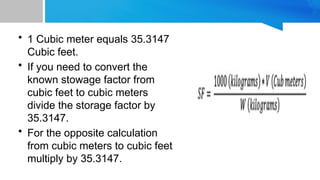
• If you are using a metric system, the formula is 1,000
kilograms times the volume in cubic meters divided by
the cargo weight in kilograms.
• It is important to note that the stowage factor can be
used as a combination of cubic feet per metric ton and
therefore you might need to convert the stowage factor to
corresponding measurements.
• 1 Cubic meter equals 35.3147
Cubic feet.
• If you need to convert the
known stowage factor from
cubic feet to cubic meters
divide the storage factor by
35.3147.
• For the opposite calculation
from cubic meters to cubic feet
multiply by 35.3147.
• Concept of Multimodal Transport
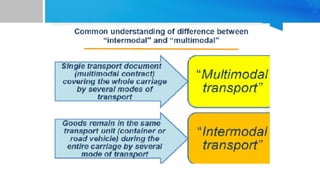
• • What is Multimodal Transport definition
• “A transport system operated by One carrier with more than one mode
of transport under the control or ownership of One Operator.”
• “International multimodal transport’ means the carriage of
goods by at least two different modes of transport on the
basis of a multimodal transport contract from a place in one country at
which the goods are taken in charge by the multimodal transport
operator to a place designated for delivery situated in a different
country”
• Advantage of Multimodal Transport
• • Reduce Complication of Liability of Intermodal Transport
• • Dealing with one operator for contract of carriage
• • Fix the limitation of liability of operator
• • One single contract of carriage for entire routes
• • Door-to-Door Deliverable
• • National Wealth as Hub of Transit
• Advantage of Multimodal Transport
• • Reduction in the costs and time for coordination and operation of
logistics.
• • Increased monitoring of shipments from stage to stage.
• • There is only one company in charge of meeting the shipment
• deadline; therefore, there is better control on management and less
risk of merchandise theft or loss while responsibility lies on just one
entity.
• • Scheduling routes, costs, staff, and logistics becomes easier
• Disadvantage of Multimodal Transport
• • The merchandise may encounter legal and operational
limitations when international standards are applied.
• • For safety reasons, inspections in terminals are frequent,
which limits operations
• Safety concerns
• Disrupted service
• Inflated shipping cost
• Lack of efficiency and sustainability
• Considerable expense due to transhipment and transaction
costs
• Who is Multimodal Transport Operator
• “Any person who on his own behalf or through another
person acting on his behalf concludes a multimodal
transport contract and who acts as a principal, not as an
agent or on behalf of the consignor or of the carriers
participating in the multimodal transport operations, and
who assumes responsibility for the performance of the
contract.”
• TYPES OF SHIPPING OPERATIONS
• There are various ways in which we can classify maritime operations.
Various shipping companies have their own methods of classifying
their shipping operations. Hence we hear about coastal shipping,
short-sea shipping and deepsea shipping. Additionally, we can
distinguish between the transport of cargoes and the movement of
passengers. A few examples here will clarify how these operations
are classified. One major British company has classified its shipping
operations as follows:
• (a) General Cargo Division
• (b) Bulk Shipping Division
• (c) Passenger Division
• In India, a major shipping carries out its operations under
the following divisions:
• (a) Liner Division
• (b) Cruise & Passenger Services
• (c) Bulk Carriers & Tankers Division
• A North-European vessel operator has made the following
operating divisions:
• (a) Short Sea Ferries
• (6) Cruise Shipping Division
• (c) Ro-Ro Sector
• What is clearly evident from the above examples is that
shipping operations tend to be divided by the type of ship
being used in the operation of the service. Hence we can
say that shipping operations may be divided into the
following four principal categories:-
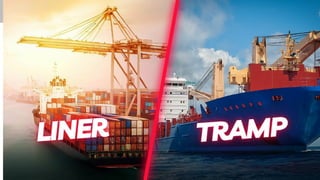
• 1. Tramp (or irregular) Services
• 2. Liner (or regular) Shipping
• 3. Specialised (or industrial) Shipping
• 4. Passenger Shipping (liner, cruise or ferries)
• EVOLUTION OF THE TRAMP
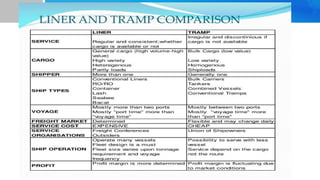
• The name tramp designates a ship that moves on routes
wherever cargo is available. It does not follow any fixed
routes and is unable to advertise its future schedules with
any certainty. The role of tramp shipping had developed
predominantly due to two major reasons:
• (a) Technicals reasons - which made ships dependent upon
the forces of nature.
• (b) Commercial reasons - merchants had to sail on the ships
resulting in irregular transactions.
• The word "tramp" therefore describes a ship which can transport any cargo,
general or bulk, over any trade route wherever such cargo is available.
• Hence the old and classical notion of tramping was based upon the
following:-
• (a) A tramp ship was not attached to any definite trade route or meant for
any particular cargo.
• (b) It was generally a multipurpose ship which could carry either dry,
general cargo or dry bulk cargo.
• (c) The ships were usually in the size of 5000-15000 dwt for deepsea
trades but smaller for coastal or short-sea trades.
• (d) A contract was usually concluded prior to proceeding on a voyage.(The
earliest contract for such a voyage is a document lying in the British
Museum which is dated AD 236. It contains all the basic elements of a
modern contract or charter party).
• Today, the tramp still does not operate on a fixed sailing
schedule. It merely trades in all parts of the world and calls
at a port depending upon the inducement of cargo.
• It primarily moves bulk cargoes e.g. coal, grain, timber,
sugar, ore, fertilizers, minerals, etc.
• Usually these parcels are complete shiploads and may be
seasonal. Tramp shipping companies are usually smaller
than the liner companies.Tramp vessels are not specialised
ships.
• EVOLUTION OF THE LINER
• Historically, the liner was a general cargo ship. It was a specially
designed ship which was planned to cope with the needs of the
route which it was serving. It was not designed for carrying bulk
cargoes.
• This type of vessel was divided into holds having 2 or 3 divisions
(between decks) so that a large variety of goods could be
successfully handled. It operated usually to one particular port or
country and sailed on longer routes.
• Britain's domination of the oceanic routes was based on the cargo
liners which were the pride of the shipping companies which
operated them.
• Liners usually have the following characteristics:-
• 1.Liners mostly carry general cargo.
• 2. The types of ships used in liner trade are either general
cargo ships, container ships, ro-ro ships, etc.
• 3. They operate at fixed rates and advertised schedules.
• 4. Freight rates for various commodities are fixed. Notices
have to be given in order to revise rates upward
• 5. The vessel operators have to bear all operating costs.
• 6. Contract: Bill of lading.
• Hence the term "liner shipping" is usually taken to mean a form of ship
operations over regular trade routes between the same ports and
usually following the same itinerary indicated in a published sailing
schedule. The liner continues to operate between these ports
independent of the load factor of the ships employed.
• The original form of liner shipping existed in the eighteenth century
when regular plying of sailing ships existed between ports of northem
Europe. However, modern liner shipping appeared only in the first half
of the nineteenth century. There were two reasons for this:
• 1. In order to provide a regular service between two distant ports one
had to have a transport that was independent of the vagaries of the
weather and other forces of nature.
• The second reason for the appearance of liner shipping was the
development of general cargo
• PASSENGER SERVICE
• This is a separate type of ship operation as this involves
the transportation of passengers from one place to another.
The passenger ship is quite distinct from a cargo ship, both
from the constructional point of view and equipment. Any
ship that has more than 12 berths for passengers would be
termed as a passenger ship.
• Passenger ships may be classed into the following types
• 1. Cruise ships
• 2. Ferries
10/14/2024
Ship Owner
• A shipowner is the owner of a merchant vessel
(commercial ship).
• A shipowner is someone who equips and exploits a ship, usually
for delivering cargo at a certain freight rate, either as a per freight
rate (given price for the transport of a certain cargo between two
given ports) or based on hire (a rate per day).
• Shipowners operate the vessel by employing a licensed crew
rather than take charge of the vessel in person.
• Shipowner is organized through a company, but also individuals,
and investment banks are present day ship owners.
10/14/2024 2018 - 2020 3rd Sem
• The legal title of ownership of the vessel is the one that appears on
the ship's registration documents.
• It may be an Owner/Manager or a wholly-owned subsidiary in a
larger shipping group, or a bank or one-ship company vehicle set
up by the bank, or of course, it may be a “brass-plate” company
created on paper to legally own a ship and possibly to limit liability
for the "real" owners and/or benefit from off-shore tax laws.
• It may also be a legal-requirement of the flag-state with whom the
ship is registered for the legal owner to be a company registered in
that country.
10/14/2024
Types of Ship Owning Companies
• Similar to most businesses there are many different types of
business models of a ship owning company and each has its own
distinctive organizational structure, commercial aims and strategic
objectives.
Family run companies ( typical example - Greek families)
Shipping Corporates – ( Major Container Carriers)
A division of a large company with interests in various industries ( e.g
Shell, BP etc)
Private Limited Company – Majority stock held by Promoters but a
portion of the shares are still public.
Financial Institutions/Investors
10/14/2024
Ship Manager
• Ship manager/Commercial Manager - The company designated by the
ship owner or charterer to be responsible for the day to day
commercial running of the ship and the best contact for the ship
regarding commercial matters.
• Including post fixture responsibilities, such as laytime, demurrage,
insurance and charter clauses.
• This company may be an owner related company, or a third-party
manager, whose purpose is primarily the management of ships for their
ship-owning clients.
• Many ships today are owned by banks or finance/leasing companies
who have no operational involvement whatever. In practice the lessee
companies, referred to as ‘Disponent Owners’ or one of their subsidiary
companies, may appear as the Manager of the ship.
10/14/2024
• Technical Manager - The company designated by the ship owner or operator or
ship manager to be specifically responsible for the technical operation and technical
super intendancy of a ship.
• This company may also be responsible for purchases regarding the fleet, such as
repairs, spares, re-engining, surveys, dry-docking, etc. In the majority of cases the
DOC Company will also be responsible for the Technical Management of the ship.
• Operator - The company responsible for the commercial decisions concerning the
employment of a ship and therefore who decides how and where that asset is
employed.
• The direct beneficiary of the profits from the operations of the ship, this company
may also be responsible for purchasing decisions on bunkers and port services. A
medium to long-term time or bareboat charterer is considered to be the operator of
the ship. Companies heading operator pools are Operators of the ships in the pool.
10/14/2024
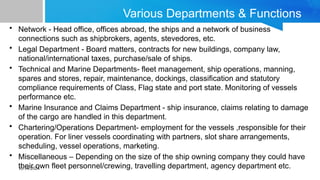
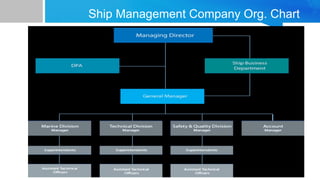
Various Departments & Functions
• Network - Head office, offices abroad, the ships and a network of business
connections such as shipbrokers, agents, stevedores, etc.
• Legal Department - Board matters, contracts for new buildings, company law,
national/international taxes, purchase/sale of ships.
• Technical and Marine Departments- fleet management, ship operations, manning,
spares and stores, repair, maintenance, dockings, classification and statutory
compliance requirements of Class, Flag state and port state. Monitoring of vessels
performance etc.
• Marine Insurance and Claims Department - ship insurance, claims relating to damage
of the cargo are handled in this department.
• Chartering/Operations Department- employment for the vessels ,responsible for their
operation. For liner vessels coordinating with partners, slot share arrangements,
scheduling, vessel operations, marketing.
• Miscellaneous – Depending on the size of the ship owning company they could have
their own fleet personnel/crewing, travelling department, agency department etc.
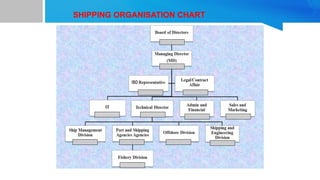
Ship Management Company Org. Chart
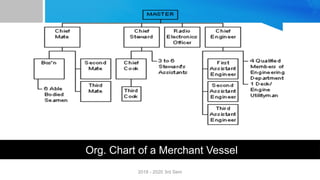
Org. Chart of a Merchant Vessel
2018 - 2020 3rd Sem
SHIPPING ORGANISATION CHART
10/14/2024
Ships Personnel Responsibility
• Captain/Master - Ship's highest responsible officer - acts on behalf of the ship's
owner. Legally responsible for the day-to-day affairs of the ship as he/she is in
command. It is his responsibility to ensure that all the departments under him
perform legally to the requirements of the ship's owner. Represents the owner
and called the Master.
• Deck department
• Chief Officer/Chief mate -- head of the deck department on a merchant vessel -
second-in-command after the ship's Master.
• Primary responsibilities - vessel's cargo operations, its stability, and supervising
the deck crew- responsible for the safety and security of the ship, as well as the
welfare of the crew on board- assumes command of the whole ship in the
absence or incapacitation of the master.
• Second officer/Second mate - is a qualified OICNW watch stander, directing the
bridge team and navigating the ship.- duty is navigational, includes updating
charts and publications, keeping them current, making passage plans, and all
aspects of ship navigation.
10/14/2024
• Third officer/Third mate - Navigational Watch keeping officer, the Third
mate directs the bridge team, maneuvering the vessel, keeping it safe and
on track. Incharge of Life saving and Fire fighting equipment onboard.
• Deck cadet/Officer cadet – Trainee deck officer who gets an hands on
experience and after serving his sea time and passing the various
Competency exams rises up the hierarchy of deck officers.
• Deck ratings
• Boatswain – Incharge of deck crew, works under the instructions of the
Chief mate and supervises the work of the deck crew.
• Able seaman/AB -An Able seaman works under the Boatswain,
completing tasks such as working mooring lines, operating deck gear,
standing anchor details, and working cargo. The AB also stands a
navigational watch, generally as a lookout or helmsman.
• Ordinary seaman/OS – Carries out the general deck maintainence.
10/14/2024
Engineering department
• The engineers are also called technical officers. They are responsible for
keeping the ship and the machinery running, including engines, generators,
boilers, pumps and the electrical equipment
• Chief engineer -The chief engineer on a merchant vessel is the official title of
someone qualified to oversee the engine department.
• Responsible for all operations and maintenance that have to do with all
machinery and equipment throughout the ship. He may be paid on par with the
captain, although he is never responsible for the action of ship.
• Second engineer- The second engineer or first assistant engineer is the officer
responsible for supervising the daily maintenance and operation of the engine
department. He or she reports directly to the chief engineer.
• Third engineer -The Second Assistant is usually in charge of boilers, fuel,
auxiliary engines, condensate and feed systems.
10/14/2024
• Fourth engineer -The fourth engineer - Responsible for electrical, sewage treatment, lube oil,
bilge, and oily water separation systems. Depending on usage, this person is called "The
Third", or "The Fourth", and usually stands a watch.
• Motorman -The Motorman is an unlicensed member of the engine department, with more
experience than an Oiler.
• Oiler - The Oiler is an unlicensed member of the engine department, with more experience
than a Wiper.
• Wiper-The Wiper is an unlicensed member of the engine department, usually with the least
experience.
• Electro-technical officer- is in charge of all the electrical systems on the ship. The electrical
engineer is one of the most vital positions in the technical hierarchy of a ship and engineer is
responsible for their assigned work under the chief engineer’s instructions.
• Catering Department – Headed by the chief Steward with a team of Cooks and Stewards,
who is responsible for procurement of provisions, food, menus and the general house keeping
of the ships accomodation.
• An Ownership Shipping Company is the entity that
purchased the vessel and is in charge of it. It performs
tasks like regular maintenance, timely inspections, and
onboarding of crew.
• Ship owners own merchant ships which are equipped
and exploited for cargo delivering for a price. Rates can
be calculated as either per freight or per day. While
technical management is usually performed by the ship
owner, outsourcing is viable.
• MODULE 2
• AGENT AND AGENCY
THE ROLE, RESPONSIBILITIES
AND OBLIGATIONS OF THE
SHIP AGENT IN THE
INTERNATIONAL TRANSPORT
CHAIN
Intermediaries play important roles in configuring, brokering, and facilitating transition
efforts and operate in different parts of socio-technical systems. Their node position
between transport and energy systems makes port authorities a potentially crucial
intermediary in transitioning the many different sectors that intersect in ports.
In trade, an intermediary middleman acts as a conduit for goods or services offered
by a supplier to a consumer. Typically the intermediary offers some added value to
the transaction that may not be possible by direct trading. Examples of intermediaries
are wholesalers and resellers.
Common usage includes the insurance and financial services industries where e.g.
mortgage brokers, insurance brokers, and financial advisers offer intermediation
services in the supply of financial products such as mortgage loans, insurance, and
investment products. In relation to energy supplies, third party intermediaries provide
energy-related advice, assistance in purchasing energy and management of energy
needs
What are Stevedores in Shipping?
Ships carry a wide array of goods ranging from foodstuff, machinery,
vehicles, oil, gas, and dry goods. At the port, the goods are unloaded
from one vessel to the warehouse or from one warehouse to another that
is ready for transportation to the next destinations or put in warehouses
as they await repackaging, customs clearance, and distribution.
Stevedores are the personnel at the port in charge of the movement of
cargo within and from port to port. A stevedore loads cargo to a ship
before it leaves the port, unloads cargo from a vessel that arrived at the
port, and coordinates all the activities of cargo movement.
You need technical skills in operating different machines and equipment to do
the stevedore job. Some cargo is heavy and requires equipment such as power
cranes to transport. Other types of equipment like wheel-loaders, hose and
shorelines, conveyor belts, and trucks help in the transport of general cargoes,
liquid, gas, and dry bulk cargoes, and knowledge on how to operate them is
crucial for every stevedore.
What Are the Functions of Stevedores in a Port?
Sorting and storage of containers. Various types of cargo arrive at the port from
different parts of the world. Some contain perishable goods in reefer containers
like fresh fruits and vegetables, others dry goods like clothes and heavy
machinery and vehicles are loaded into dry containers or even on flat racks or
open-top containers.
Driving transport vehicles. Most of the cargo at the port comes in large
quantities and can only be transported by vehicles. A stevedore is
skilled in driving vehicles that aid in transportation such as trucks,
tractors, cranes, and winches, depending on the type of the goods and
storage requirements.
Pallet fastening and lashing. While loading vessels, stevedores ensure
containers are stable by supporting them using pallets. For the pallets
to provide firm support, they are lashed and fastened before piling
goods on them.
Carrying out safety checks on equipment. Equipment used for
transportation in ports such as trucks and cranes should be in good
condition before starting any loading and unloading activity.
A ship agent is any person or company that carries out the functions of an
agent (see the following slide), irrespective of whether they are in business as a
ship agent, or they perform such functions as an adjunct to, or in conjunction
with, other activities such as shipowning or operating, providing cargo
handling or similar.
FONASBA makes no distinction between those providing agency services as
their main business activity or as a part of a portfolio of marine related
services.
AGENTS AND AGENCIES
Acting as the local representative of the principal, the agent provides local
knowledge and expertise and ensures that the principal’s requirements are
performed with the utmost efficiency and despatch.
Accordingly the agent requires to be fully conversant with all the
appropriate regulations and requirements relating to the port, area or sector
in which they operate, to have a wide range of relevant contacts and be
sufficiently well established and founded to be able to provide the level of
service and support the principal needs.
The ship agent, as enshrined by international maritime convention, is primarily the
servant of the master and owners of the vessel, the “principal”.
In practice however, the agent can act for any of the parties involved in the voyage
and in any capacity as agreed between the agent and his principal.
MAIN CATEGORIES OF SHIP AGENT:
PORT AGENT: organises and coordinates the port call, acting on behalf of the
owner or operator of the vessel.
CARGO AGENT: solicits cargo on behalf of the owner, or operator, usually within
a defined geographical area OWNERS/CHARTERERS AGENT: acts for another
party that has an interest in the port call. The specific duties undertaken vary
depending on the relationship between the parties
OTHERS: as the principal may decide or require
THE PORT AGENT
The port agent is central to all trades and is responsible for organising,
overseeing and coordinating all aspects of the port call, from booking berth
allocations and services ahead of the vessel’s arrival to finalising the accounts
and other paperwork after the vessel has sailed.
Functioning as the de facto port single window, the agent is the conduit for all
information exchanged between the vessel and the shore.
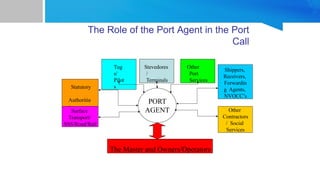
The Role of the Port Agent in the Port
Call
PORT
AGENT
Statutory
Authoritie
s
Tug
s/
Pilot
s
Stevedores
/
Terminals
Other
Port
Services
Shippers,
Receivers,
Forwardin
g Agents,
NVOCC’s
Surface
Transport/
SSS/Road/Rail
Other
Contractors
/ Social
Services
The Master and Owners/Operators
THE PORT AGENT/contd..
In order to operate effectively, the port agent is required to be fully conversant
with the safety, commercial and statutory requirements and regulations
applicable to the port and ensure the vessel complies fully, in to ensure that no
delays are caused as a result of failure to meet its obligations.
The port agent will also require wide ranging and effective contacts within the
regulators, port operators and service providers in order to ensure that the
actions taken, and information provided, are correct and appropriate.
THE PORT AGENT/ contd…
When developing its unique Port Procedures Survey, FONASBA indentified
more than 130 separate operations that a port agent may be required to
undertake. Whilst it is unlikely that an agent will have to carry out all 130+
operations in a single port call, the extent of the duties and disciplines covered
is indicative of the breadth of knowledge and experience that the port agent is
required to have and, importantly, to keep up to date.
THE CARGO
AGENT
•Operating primarily in the liner and break bulk trades, the
cargo (or liner) agent is responsible for securing cargo for
the line or ship operator. This requires the agent to be in
regular contact with local shippers and be ready to provide
information on vessel schedules, competitive rates and
conditions of carriage. The agent may also offer or provide
inland transportation, customs clearance and other related
services.
•The cargo agent may be independent and represent more
than one principal but in many cases the agent is tied to, or
is often a subsidiary of, one specific principal.
THE OWNERS/CHARTERERS AGENT
Depending on the circumstances of the port call, there
may be more than one agent attending the vessel.
One party may decide that their best interests will be
represented by appointing their own independent
representative, rather than using the primary nominated
agent.
The exact role and responsibilities of this second agent
(and indeed the title under which they operate) will be
determined on a case by case basis.
OTHER AGENCY APPOINTMENTS
An agent may be appointed to undertake other duties on
behalf of a principal and the extent of those duties may be
specific or general in nature as the principal requires.
Such appointments often derive from unscheduled
occurrences such as port calls arising as a result of an
emergency, vessel breakdowns or pollution incidents, or
action by statutory authorities such as customs or
immigration.
DUTIES OF THE AGENT /
DELEGATED AUTHORITY FROM
THE PRINCIPAL
At the time of initial appointment, the principal will issue
instructions to the agent detailing the services required
and the limits of delegated authority. Within the limits of
that authority, the agent is entitled to enter into
agreements or contracts, disburse funds and make other
arrangements that may bind the principal or incur costs
on their behalf.
“AS AGENTS ONLY”
Assuming that the agent has not exceeded the delegated
authority granted by the principal, the principal agrees to
assume the obligations and to indemnify the agent for any
costs resulting from any contract or arrangements entered
into by the agent on the principal’s behalf.
The agent is entitled to benefit from the protections
available to it under the above agreement but in order to
do so must describe itself in all correspondence,
written verbal and otherwise, “as agents only”
THE AGENCY FEE
The agent will charge the principal a fee based on the
volume of work undertaken. The fee is agreed
through negotiation between the agent and the
principal and is often subject to competition from
other agents.
The precise form of the fee, for example a flat fee or one
based on the duties undertaken, can vary widely. The flat
fee is common in port agency whilst the component based
fee is more normal for cargo agencies.
THE ROLE OF FONASBA
Established in 1969, FONASBA is the global association
for ship brokers and ship agents. With members in more
than 50 maritime nations, the Federation’s remit is to
“promote and protect the professions of ship broker and
ship agent worldwide”, an obligation it discharges
through actions in relevant international and regional
bodies and organisations and by supporting its members
on matters of a national nature.
THE ROLE OF FONASBA contd/..
FONASBA has consultative status with:
the International Maritime Organisation, the UN
Conference on Trade and Development, the World
Customs Organisation and the European Commission.
The Baltic Exchange, BIMCO, INTERTANKO and the
Shipbrokers’ Register are members of FONASBA and the
Federation maintains close relations with Intercargo, as
well as European organisations representing shipowners,
port authorities, terminal operators and others.
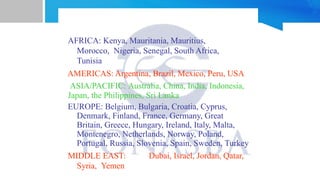
FONASBA Membership
2012
AFRICA: Kenya, Mauritania, Mauritius,
Morocco, Nigeria, Senegal, South Africa,
Tunisia
AMERICAS: Argentina, Brazil, Mexico, Peru, USA
ASIA/PACIFIC: Australia, China, India, Indonesia,
Japan, the Philippines, Sri Lanka
EUROPE: Belgium, Bulgaria, Croatia, Cyprus,
Denmark, Finland, France, Germany, Great
Britain, Greece, Hungary, Ireland, Italy, Malta,
Montenegro, Netherlands, Norway, Poland,
Portugal, Russia, Slovenia, Spain, Sweden, Turkey
MIDDLE EAST: Dubai, Israel, Jordan, Qatar,
Syria, Yemen
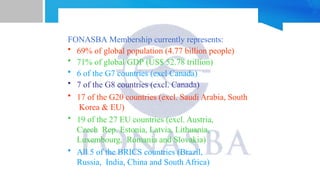
FONASBA Membership
2012
FONASBA Membership currently represents:
• 69% of global population (4.77 billion people)
• 71% of global GDP (US$ 52.78 trillion)
• 6 of the G7 countries (excl Canada)
• 7 of the G8 countries (excl. Canada)
• 17 of the G20 countries (excl. Saudi Arabia, South
Korea & EU)
• 19 of the 27 EU countries (excl. Austria,
Czech Rep. Estonia, Latvia, Lithuania,
Luxembourg, Romania and Slovakia)
• All 5 of the BRICS countries (Brazil,
Russia, India, China and South Africa)
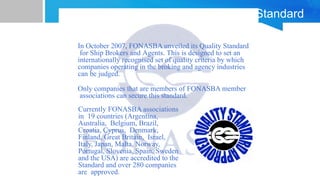
FONASBA Quality Standard
In October 2007, FONASBA unveiled its Quality Standard
for Ship Brokers and Agents. This is designed to set an
internationally recognised set of quality criteria by which
companies operating in the broking and agency industries
can be judged.
Only companies that are members of FONASBA member
associations can secure this standard.
Currently FONASBA associations
in 19 countries (Argentina,
Australia, Belgium, Brazil,
Croatia, Cyprus, Denmark,
Finland, Great Britain, Israel,
Italy, Japan, Malta, Norway,
Portugal, Slovenia, Spain, Sweden
and the USA) are accredited to the
Standard and over 280 companies
are approved.
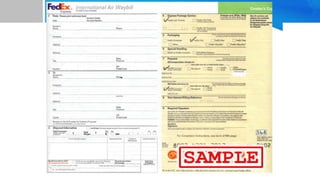
• Export and import documents
• Export and import documents are used to provide
information to all parties involved in international trade and
ensure that products make a smooth transition into or out of
a country. Some of the most common documents include:
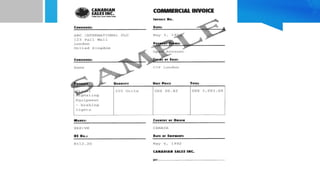
• Commercial invoices
• Bills of exchange
• Bills of lading
• Letters of credit
• Marine insurance policies
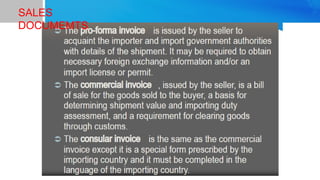
SALES
DOCUMEMTS
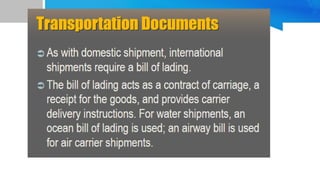
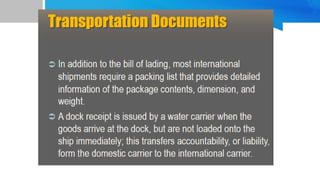
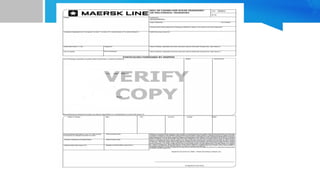
• Bill of Lading
• Bill of Lading is a document issued by the shipping company or his agent
acknowledging the receipt of cargo on board. This is an undertaking to
deliver the goods in the same order and condition as received to the
consignee or his agent on receipt of freight, the shipping company is entitled
to. It is a very important document to the exporter as it constitutes document
of title to the goods.
• Each shipping company has its own bill of lading. The exporter prepares the
bill of
• lading in the form obtained from the shipping company or agents of shipping
company.
• The goods can be consigned to order of the exporter, which means the
exporter can authorize someone else to receive the goods on his behalf. In
such a case, the exporter would discharge the bill of lading on its reverse.
• When the bill of lading is negotiated through the bank, it would be
endorsed in favour of the bank that would endorse further to the importer,
on receipt of payment.
• Bill of Lading is made in signed set of 2 originals, any one of which can
give title to the goods. The shipping company also issues non-negotiable
copies (unsigned) which are not documents of title to goods but serves the
purpose of record only.
• The reverse side of Bill of Lading contains the terms and conditions of the
contract of carriage. The clauses on most of the bills of lading are
common. A Bill of lading should be clean to facilitate the exporter to obtain
the proceeds of export without difficulty.
• Main Purposes
• It serves three main purposes.
• (A) As a document of title to the goods
• (B) As a receipt from the shipping company and
• (C) As a contract of affreightment (transportation) of
goods.
• Export and Import procedure
• Typically, the procedure for import and export activities involves
ensuring licensing and compliance before the shipping of goods,
arranging for transport and warehousing after the unloading of
goods, getting customs clearance and paying taxes before the
release of goods
• In India, imports and exports are regulated by the Foreign Trade
(Development and Regulation) Act, 1992, which empowers the
federal government to make provisions for the development and
regulation of foreign trade. The current provisions relating to exports
and imports in India are available under the Foreign Trade Policy,
2023.
• steps involved in importing goods
• To begin exporting or importing goods from India, the business or
individual must obtain an Import Export Code or IE Code from the
Directorate General of Foreign Trade(DGFT). Obtain the IE Code from
the business after obtaining PAN and opening a bank account.
• 1. IEC is mandatorily required for clearing customs, sending
shipments, and sending or receiving money in foreign currency.
However, it is not necessary for service exports unless the service
provider is seeking benefits under the Foreign Trade Policy.
• During the import-export code registration process, the DGFT instantly
confirms all information with the Income Tax Department. This means
that the IEC certificate can be generated in a single day. Prior to 2021,
an IEC certificate was valid for the entire length of that business
• 2. Ensure legal compliance under different trade laws
• Once an IEC is allotted, businesses may import goods that
are compliant with Section 11 of the Customs Act (1962),
Foreign Trade (Development & Regulation) Act (1992), and
the Foreign Trade Policy, 2023.
• 3. Procure import licenses
• To determine whether a license is needed to import a
particular commercial product or service, an importer must
first classify the item by identifying its Indian Trading
Clarification based on a Harmonized System of Coding or ITC
(HS) classification.
• 4. File Bill of Entry and other documents to complete
customs clearing formalities
• After obtaining import licenses, importers are required to
furnish an import declaration in the prescribed Bill of Entry
along with permanent account number (PAN) based
Business Identification Number (BIN), as per Section 46 of
the Customs Act (1962).
• A Bill of Entry gives information on the exact nature,
precise quantity, and value of goods that have landed or
entered inwards in the country.
• 5. Determine import duty rate for clearance of goods
• India levies basic customs duty on imported goods, as
specified in the first schedule of the Customs tariff Act,
1975, along with goods-specific duties such as anti-
dumping duty, safeguard duty, and social welfare
surcharge.
• Export procedures
• Just as for imports, a company planning to engage in
export activities is required to obtain an IEC number from
the regional joint DGFT. After obtaining the IEC, the
exporter needs to ensure that all the legal compliance
requirements are met under different trade laws.
• Further, the exporter must check if an export license is
required, and accordingly apply for the license to the
DGFT.
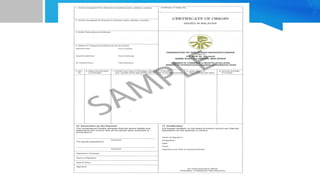
• An exporter is also required to register with the Indian Chamber of
Commerce (ICC), which issues the Non-Preferential Certificates of
Origin certifying that the exported goods are originated in India.
• In 2023, the DGFT launched the Advance Authorisation Scheme under
the Foreign Trade Policy, enabling duty-free import of inputs for export.
The eligibility of inputs is determined by Sector-specific Norms
Committees based on input-output norms. The scheme offers a grace
period for exporters who, as holders of Advance and EPCG (Export
Promotion for Capital Goods) Authorizations, default on their export
obligations once.
• Conversion of foreign going vessels to coastal vessel
• A foreign Going Vessel of Indian Flag having a General
Trading Licence can convert to Coastal run on the basis of
a Customs Conversion Order.
• A Foreign Going Vessel of Foreign Flag can convert to
coastal run on the basis of a Coastal Voyage License
issued by Director General of Shipping.
• Converting a foreign-going vessel to a coastal vessel in India
involves several regulatory and procedural steps, governed primarily
by the Directorate General of Shipping (DGS) under the Ministry of
Ports, Shipping and Waterways
• 1. Application for Change of Status
• Submit an application to the Directorate General of Shipping (DGS)
for changing the status of the vessel from foreign-going to coastal.
The application should include:
• Details of the vessel.
• Reasons for the conversion.
• Certificates and documents of the vessel.
• 2. Survey and Inspection
• The vessel must undergo a survey and inspection by the Mercantile Marine
Department (MMD) to ensure compliance with Indian coastal trade regulations.
This includes:
• Hull and machinery inspection.
• Safety equipment check.
• Compliance with Indian coastal standards.
• 3. Documentation and Certification
• Ensure that the vessel has all required documentation and certifications,
including:
• Certificate of Registry.
• Safety Management Certificate (SMC).
• Document of Compliance (DOC).
• International Ship Security Certificate (ISSC).
• Crew certifications and endorsements.
• 4. Customs and Taxation
• Handle customs and taxation issues, including:
• Payment of duties or taxes if applicable.
• Custom clearance for change of trade.
• Obtain a no-objection certificate (NOC) from Customs.
• 5. Change of Flag
• If the vessel was flying a foreign flag, it must be re-registered under the Indian
flag. This involves:
• Deregistration from the foreign registry.
• Submission of the deregistration certificate.
• Registration under the Indian flag with the appropriate authorities.
• 6. Coastal Trade License
• Obtain a Coastal Trade License from the Directorate General of Shipping. This
involves:
• Submission of the application form.
• Payment of the prescribed fee.
• Compliance with coastal trade regulations.
• 7. Compliance with Domestic Regulations
• Ensure compliance with Indian domestic regulations, including:
• Environmental regulations.
• Crew welfare standards.
• Operational standards for coastal shipping.
• 8. Port State Control
• The vessel must comply with port state control (PSC) inspections
to ensure it meets all regulatory requirements for coastal
operations.
• 9. Crew and Manning Requirements
• Ensure the crew meets the manning requirements for coastal
vessels as per Indian regulations. This includes:
• Indian crew endorsements.
• Adequate training and certification for coastal operations.
• 10. Operational Readiness
• Prepare the vessel for operational readiness, including:
• Familiarization of the crew with coastal trade routes.
• Safety drills and procedures.
• Logistic arrangements for coastal operations
• Converting a coastal going vessel to a foreign going vessel
• Converting a coastal going vessel to a foreign going vessel involves
several steps and considerations, primarily focusing on meeting
international maritime regulations and safety standards
1. Assessment and Planning: Before starting the conversion process,
assess the vessel's current condition, its intended use, and the
requirements for foreign going vessels. Plan the conversion process
accordingly, considering both regulatory and operational aspects.
2. Regulatory Compliance: Research and understand the regulations
governing foreign going vessels in the countries or regions where the
vessel will operate. This includes regulations from international bodies
such as the International Maritime Organization (IMO) and local maritime
3.Structural Modifications: Depending on the specific requirements
for foreign going vessels, structural modifications may be necessary.
This could include strengthening the hull, installing additional safety
features, or upgrading navigation equipment to meet international
standards.
4. Safety Equipment: Ensure that the vessel is equipped with all
necessary safety equipment required for foreign going voyages. This
includes life-saving appliances, firefighting equipment, navigation
lights, communication systems, and emergency provisions.
5. Documentation and Certification: Obtain the necessary documentation and
certifications for the converted vessel to operate as a foreign going vessel. This may
include obtaining a new flag state registration, classification society certification, and
compliance certificates for various international conventions such as SOLAS (Safety
of Life at Sea) and MARPOL (International Convention for the Prevention of Pollution
from Ships).
6. Crew Training and Certification: Ensure that the crew members are properly
trained and certified to operate a foreign going vessel. This may involve providing
additional training on international regulations, safety procedures, navigation, and
communication protocols.
7. Testing and Trials: Conduct thorough testing and sea trials to ensure that the
vessel and its systems are functioning correctly and comply with all relevant
regulations and standards.
8. Inspection and Approval: Once the conversion process is complete, arrange for an
inspection by relevant authorities to approve the vessel for foreign going operations.
This may involve inspections by flag state authorities, classification societies, port
state control authorities, or other regulatory bodies.
9. Operational Readiness: Ensure that the vessel is fully prepared for foreign going
voyages, including provisions, fuel, supplies, and crew arrangements.
10. Ongoing Compliance: Maintain ongoing compliance with regulatory requirements
for foreign going vessels, including regular inspections, audits, and updates to
equipment and procedures as necessary.
SHIP OPERATIONS AND MANAGEMENT module 1.pptx

SHIP OPERATIONS AND MANAGEMENT module 1.pptx

  • 1.
    SHIP OPERATIONS ANDMANAGEMENT 21MR61 MODULE 1and 2 Introduction to ship Management Agents and Agencies Nithin Joshuva SIT MANAGLORE
  • 2.
    • Course objectives: •● To understand the concepts of Ship operations. • ● To understand the concepts of Freight Rates, voyage planning, marine Insurance • ● To understand the organizational structure of a shipping company. • ● To get familiarized with various chartering methods, Bill of Lading and different paper works on board a • merchant vessel
  • 3.
    • MODULE-1 8HOURS • Introduction to Ship Management: Modern shipping practice. Marine vehicles and cargo, care of cargo against damage. Cargoes, stowage of cargo and cargo information. Stowage factor. Care and securing of cargo Damage of cargo Development in shipping and cargo handling. Multimodal transportation, Liner and tramp shipping services. Shipping companies- Owned and ship management company, organization structure. • MODULE-2 8 HOURS • Agents and Agencies: Ports and other intermediaries – Stevedores, Agent and Agency. Port clearance, Custom clearance – Ship documents for inward and outward clearance and procedure. Import and export procedure and documents for import and export. Procedure to convert foreign going vessels into coastal vessels and vice versa.
  • 4.
    • MODULE-3 8HOURS • Marine Insurance: Risk and risk control. Classification of insurance business. Principles of insurance and Types. Important clauses of Hull, cargo and freight insurance and their importance. General average, Characteristics of General Average Particular average P&I clubs, Underwriting claims. Insurance companies in India. Reinsurance • MODULE-4 8 HOURS • Chartering: Terms used in commercial shipping- Bill of lading and types. Clauses in Bill of lading. Issues with Bill of lading. Seaway bill Freight and type of freight, Lein, Chartering of vessel and types of charter. In Charter, Out charter. Charter terminology – types of days in a Charter party. Charter party clauses. Fixation of vessel Voyage estimate
  • 5.
    • MODULE-5 8HOURS • Maritime Law: • International laws of the sea. Limitation of shipowners liability. Carriage of Goods by Sea Act 1971. York – Antwerp rules Maritime safety and security – Employment of seafarers, ILO, MLC convention Maritime Business contracts. Maritime disputes and settlements, Arbitration .Maritime Jurisdictions ( Admiralty courts) and Judicial process in India
  • 6.
    10/14/2024 Prehistory Sea transportation datesback to 10000 years ago to the Neolithic Period. Though these crafts cannot be classified as ships they marked the beginning of transport of goods by sea. Animal skins and woven fabrics were used as sails and the birth of the early SHIPS. The birth of these crafts allowed men the opportunity to explore distant lands separated by sea and the migration of mankind.
  • 7.
    10/14/2024 Origin of InternationalSea Trade  Has been in vogue since 3000 BC – Egyptian coastal and river Ships  1200 BC Egyptian ships have believed to have ventured upto Sumatra for trading.  15th Century China had established major trade expeditions including venturing upto East Africa.  International Trade picked up momentum with European Colonial powers such as Spain, Portugal, French and British established trade networks through sea and the colonization of the territorries they landed in.
  • 8.
    10/14/2024 Types Of Ships Cargo ships/freighters can be divided into four groups, according to the type of cargo they carry.  General Cargo Vessels - carry packaged items like chemicals, foods, furniture, machinery, motor vehicles, footwear, garments, etc.  Dry-bulk Carriers - carry coal, grain, ore and other similar products in loose form.  Tankers - carry petroleum products or other liquid cargo.  Multipurpose Vessels - as the name suggests, carry different classes of cargo – e.g. liquid and general cargo – at the same time  Container vessels – Vessels that carry containers.  RO-RO Vessels –that can carry cargoes which can be rolled on and off the vessel.  Gas Carriers - ships that are specially designed to transport gas
  • 9.
    10/14/2024 General Cargo Ships General cargo vessels carry packaged items like chemicals, foods, furniture, machinery, motor- and military vehicles, footwear, garments, etc  A ship with one or more decks, having ability to carry a variety of commodities in different forms such as boxed, palletized, refrigerated, and with the possibility to accommodate bulk materials such as grain. Generally geared
  • 10.
    10/14/2024 Dry Bulk Carriers •A bulk carrier is primarily used in carrying unpackaged bulk cargo items such as metal ores, coal, cement, grains and other similar cargo. • Bulk Carrier Sizes  Small Handy - carriers of 20,000 long tons deadweight (DWT)-28,000 DWT  Handy - carriers of 28,000-40,000 DWT.  Handymax, carriers of 40,000-50,000 DWT.  Supramax (50,000 to 60,000 DWT).  Panamax, the largest size that can traverse the Panama Canal (generally: vessels with a width smaller than 32.2 m).  Capesize, vessels larger than Panamax and Post-Panamax, and must traverse the Cape of Good Hope and Cape Horn to travel between oceans.  Chinamax, carriers of 380,000-400,000 DWT with main dimensions limited by port infrastructure in China
  • 11.
    10/14/2024 Liquid Bulk Carriers- Tankers • A merchant vessel designed to transport liquids or gases in bulk. Major types of tankship include the oil tanker, the chemical tanker, • Second half of 19th Century tanker (tankship) concept was introduced. • Tankers can range in size of capacity from several hundred tons, which includes vessels for servicing small harbours and coastal settlements, to several hundred thousand tons, for long-range haulage. Besides ocean- or seagoing tankers there are also specialized inland-waterway tankers which operate on rivers and canals with an average cargo capacity up to some thousand tons. A wide range of products are carried by tankers, including: • hydrocarbon products such as crude oil and producrts • chemicals, such as ammonia, chlorine, and styrene monomer • fresh water, wine molasses • Vegetable oils.
  • 12.
    10/14/2024 Tanker Sizes andtheir Classification • 10,000–24,999 - Small tanker • 25,000–34,999 - Intermediate tanker • 35,000–44,999 - Medium Range 1 (MR1) • 45,000–54,999 -Medium Range 2 (MR2) • 55,000–79,999 - Large Range 1 (LR1) • 80,000–159,999 - Large Range 2 (LR2) • 160,000–319,999 - Very Large Crude Carrier (VLCC) • 320,000–549,999- Ultra Large Crude Carrier (ULCC)
  • 13.
  • 14.
    10/14/2024 Container ships • Revolutionizedsea transportation of freight. Commenced in 1955. First container ship Ideal X - New Jersey and Houston – Malcolm Mclean -58 containers. • Other ships referred by the weight of cargo they can carry. Container ships - number of TEU they can carry. • Container vessels eliminate the individual hatches, holds and dividers of the traditional general cargo vessels. • Hull of a typical container ship is a huge warehouse divided into cells by vertical guide rails- cells are designed to hold cargo in pre-packed units – containers. • Shipping containers are usually made of steel, materials like aluminium, fiberglass or plywood are also used. • Designed to be entirely transferred to and from smaller coastal carriers, trains, trucks and/or semi-trailers (and so are carried by different modes of transport during one voyage, thus giving the name intermodal transport) • Several types of containers - categorized according to their size and functions. • Approx. 90% of non-bulk cargo worldwide is transported by container.
  • 15.
  • 16.
    10/14/2024 RO RO Vessels Roll-on/roll-off (RORO or ro-ro) ships are vessels designed to carry wheeled cargo, such as cars, trucks, semi-trailer trucks, trailers, and railroad cars, that are driven on and off the ship on their own wheels or using a platform vehicle, such as a self- propelled modular transporter.  RORO vessels have either built-in or shore-based ramps that allow the cargo to be efficiently rolled on and off the vessel when in port.  First cargo ships specially fitted for the transport of large quantities of cars came into service in the early sixties.  Today’s pure car carriers, the pure car/truck carrier (PCTC), are distinctive ships with a box-like superstructure running the entire length and breadth of the hull, fully enclosing the cargo.
  • 17.
    Ro RO VessselProfile 2018 - 2020 3rd Sem
  • 18.
  • 19.
    10/14/2024 Gas Carriers • Agas carrier (or gas tanker)- ship designed to transport LPG, LNG or liquefied chemical gases in bulk. • Gas Carrier – Types • Fully pressurised LPG carriers - fitted with a number of horizontal cylindrical or spherical cargo tanks and have capacities up to 6,000 m3. A cost-effective, simple way of moving LPG to and from smaller gas terminals. • Semi-pressurised tankers - development of metals suitable for containment of liquefied gases at low temperatures, semi-pressurised tankers were developed. By installing a reliquefaction plant, insulating the cargo tanks and making use of special steels, the thickness of the pressure vessels, and hence there weight, could be reduced. These carriers, incorporating tanks either cylindrical, spherical or bi-lobe in shape, are able to load or discharge gas cargoes at both refrigerated and pressurised storage facilities.
  • 20.
    10/14/2024 • Fully refrigeratedtankers - built to carry liquefied gases at low temperature and atmospheric pressure between terminals equipped with fully refrigerated storage tanks. • Prismatic-shaped cargo tanks fabricated from 3.5% nickel steel, allowing the carriage of cargoes at temperatures as low as –48°C, marginally below the boiling point of pure propane. Prismatic tanks enable the tanker’s cargo carrying capacity to be maximised, thus making the fully refrigerated tanker highly suitable for carrying large volumes of cargo such as LPG, ammonia and vinyl chloride over long distances. • Liquefied natural gas (LNG) carriers LNG is carried at its boiling point, being – 162°C. LNG containment systems have developed considerably. LNG carriers are fitted with independent cargo tanks or with membrane tanks.
  • 21.
    Project Cargo Ships • Projectcargo- used to broadly describe the national or international transportation of large, heavy, high value or a critical (to the project they are intended for) pieces of equipment. • Referred to as Heavy lift , includes shipments made of various components which need disassembly for shipment and reassembly after delivery. 2018 - 2020 3rd Sem
  • 22.
    10/14/2024 • Heavy-lift/Project CargoVessels: These, mostly purpose built, vessels specialise in the transport of extremely heavy or bulky objects such as other ships and large industrial components. Some heavy-lift vessels are equipped with high capacity cranes to load at ports without a heavy-lift capability. • Semi submersible - allows a cargo to be floated into position before the heavy-lift vessel de-ballasts to lift the cargo out of the water. • Used to transport offshore platforms from their construction site to the drilling site. • Common project cargoes are wind turbine blades and towers, quay cranes and industrial machinery. • 'Jack up' vessels -able to put down 'legs' to lift themselves out of the water. Commonly used by vessels installing offshore wind farms where stability is required during the placing of the turbine towers.
  • 23.
    Heavy Lift vesselwith Gear • Semi Submersible Vessel 2018 - 2020 3rd Sem
  • 24.
    Vessel Dimension andParts • LOA (Length Overall): The extreme length of a ship, from fore to aft. • Beam: The width of a ship. It is important to establish the 'extreme' length and breadth of a vessel, to ensure that passages in confined waterways are possible and that it is physically feasible for a vessel to enter certain ports. • Draft: The depth of a ship in the water. (A floating ship will be deeper in freshwater than in salt. The difference is shown on the Deadweight Scale as that vessel's freshwater allowance).
  • 25.
    • Air Draft:distance from a vessel's surrounding waterline to the highest fixed point on the ship. This distance is to be known if the ship has to pass under bridges or fixed equipment • Distance from a vessel's surrounding waterline to the top of her hatch coamings (an indication of whether a particular vessel can manoeuvre under shore cargo-handling equipment). • Freeboard is the distance measured from the waterline to the upper edge of the deck plating at side of the freeboard deck amidships. • Under keel clearance is a vertical distance between the deepest underwater point of the ship's hull and the water area bottom or ground.
  • 26.
     Modern shippingpractice" refers to the contemporary methods, technologies, regulations, and practices employed in the maritime industry to facilitate the efficient and safe transportation of goods and passengers by sea.  It encompasses various aspects of maritime operations, including vessel design and construction, navigation and seamanship, cargo handling and stowage, safety and security, environmental protection, regulatory compliance, and business management.  Modern shipping practice reflects the dynamic nature of the maritime sector, driven by advancements in technology, changes in global trade patterns, evolving regulatory frameworks, and the adoption of best practices to enhance efficiency, sustainability, and competitiveness in the industry.
  • 27.
    • care ofcargo against damage • Protecting cargo against damage is a critical aspect of maritime industry operations, given the inherent risks associated with sea transportation. • Safeguarding cargo ensures that it arrives at its destination in the intended condition, thereby maintaining customer satisfaction, preserving the value of goods, and preventing financial losses for shippers, carriers, and other stakeholders. • In this essay, we will explore the various measures and practices employed to care for cargo against damage in the maritime industry.
  • 28.
    • What arethe most common causes and types of cargo damage? • There are five main causes and types of cargo damage: • Physical damage – This is when cargo is damaged due to dropping, breakage, improper packing, or bumps during transit etc. • Wet damage – As the name suggests, this is when cargo is damaged by water (e.g. exposure to rain). • Reefer damage – This refers to cargo damage caused by reefer equipment or mishandling. • Contamination damage – This is when cargo is damaged due to contamination (e.g. unclean truck conditions or mixed cargo). • Infestation damage – This refers to any cargo damaged by infestation (e.g. pests, rodents).
  • 30.
    • - Preventivemeasures against physical damage • 1. Use the correct type of container.. For example, when packing heavy • cargo, you need to ensure that the container used can carry the weight of • the cargo.. • This is easily identified by checking and following the markings on a • container, one of which is the weight allowance displayed on the CSC • plate on the container.. • 2. Make sure that the lashing and dunnage material and methods are • sufficient to restrict the movement of the cargo within the container • 3. Ensure that you follow the SOLAS VGM • requirements at all times when packing, • transporting and loading container
  • 31.
    • A fewother important factors to consider when packing your cargo is to • • plan the stowage of the cargo in the container • • ensure that all container weight limitations of the container are met as per the markings on the container • • distribute the weight equally inside the container taking care not to exceed • permissible weight concentrations per square foot of deck • • avoid concentrating heavy weights at one side or one end • • stow heaviest items on the bottom for stability • • box, crate or place on cradle the heavy items • • ensure that incompatible cargo is not mixed in the container (like mixing clothing with chemicals)
  • 32.
    • Preventive measuresagainst wet damage • As mentioned above, it is imperative that you are aware not just of the • vulnerability of your cargo, but also the physical route that the cargo • takes from origin to destination.. • For example, if you are loading cargo in cartons, or iron/steel cargo, or • cotton or other cargo that is susceptible to wet damage, it may be • prudent for you to take cognizance of the route of the cargo and take • proper precautions.. Climatic conditions (temperature and humidity) can affect the cargo • inside containers especially if the ship is moving from one hemisphere to • the other.. • Corrosion and oxidation affect metal products specifically while • condensation can have a negative effect on all cargoes..
  • 33.
    • While youmight not be able to do much about the route the cargo takes,or how long it takes, or the weather conditions along the route, what you can do is take appropriate mitigation steps to avoid condensation and moisture inside the container. • These steps could include using antihumidity materials or you could use “ventilated containers” with side vents • One should also ensure that the doors of the containers seal properly and the rubber seal gaskets are present and in good condition
  • 34.
    • Preventive measuresagainst contamination damage • If you are loading liquid bulk cargo in an ISO tank container, you should insist on a “tank cleaning certificate” from the tank operator which tells you the last date of the cleaning, what type of cleaning etc.. • Once you have this information, you can satisfy yourself whether this specific tank will be suitable for your cargo or not. You can identify whether your cargo may or may not get contaminated when using this tank container.. • It is also recommended to have a professional liquid bulk cargo surveyor to inspect the tank or be present during loading operations to ensure that there are no issues. • Tank operators keep their food grade tank fleet separate to their other tanks like chemical and gas tanks.. All food tanks might not be compatible with your specific food cargo and similarly, not all chemical tanks may be compatible with or be suitable for your specific chemical cargo.. • Therefore it is imperative that you provide ALL information about your cargo (Generally the MSDS is the best option that provides all information related to the cargo) to the ISO tank operator so they may release the most suitable tank for your cargo..
  • 35.
    • Cargo tobe loaded may react with previous cargo or cargo in adjacent compartment through substance mixture or temperature impact, even if the equipment is stated to be clean and ready to serve.. • Such mixture may damage the product an equipment, or cause severen reactive incident due to contamination.. • You may be loading solid cargo that is susceptible to odour and rust • contamination – like nuts, tobacco, clothing, fabrics etc in a normal ISO • container.. • In such cases, you need to request the shipping line for a food grade or A grade container which is “prepared” specifically for the carriage of your cargo, usually at a cost..
  • 36.
    • - Preventivemeasures against infestation damage • Advise shipping line “specifically” about the type of cargo being shipped • and if it is food cargo, then you must request for a food grade container • for packing • Ensure that the warehouse that your cargo is stored in is clean and free • of pests and rodents that may cause infestation • Dunnage made from raw and unprocessed wood may present a high risk • of introduction/spread of quarantine pests and therefore many countries • require wooden dunnage and pallets to be fumigated before it can be • exported..
  • 37.
    • stowage ofcargo and cargo information • Stowage of cargo is a critical aspect of maritime operations. It involves the strategic arrangement, securing, and distribution of cargo within a vessel to maintain stability, prevent shifting, and minimize damage during transit. • Stowage is the process of packing or arranging items in a specific way to optimize space utilization. In the shipping industry, stowage refers to the arrangement of cargo on board a ship to ensure that it is secure and does not move around during transportation. • The stowage factor indicates how many cubic metres of space one tonne of a particular type of cargo occupies in a hold of a cargo ship.
  • 39.
    • Importance ofProper Cargo Stowage • Proper cargo stowage is crucial for a smooth sailing (or flying) experience. Imagine loading a ship or an aircraft haphazardly, with heavy items on top of delicate ones, or with minimal regard for weight distribution. It’s like a recipe for disaster! • Proper stowage ensures not only the safety of the cargo but also the stability of the vessel and the efficiency of the entire transportation process. So, it’s safe to say that proper cargo stowage is the unsung hero of logistics.
  • 40.
    • Cargo information •The master should be provided with sufficient information on any heavy cargo offered for shipment so that he can properly plan its stowage and securing; the information should at least include the following: • .1 gross mass; • .2 principal dimensions with drawings or pictorial descriptions, if possible; • .3 location of the centre of gravity; • .4 bedding areas and particular bedding precautions if applicable; • .5 lifting points or slinging positions; and • .6 securing points, where provided, including details of their strength.
  • 41.
    • General Principles •All cargoes should be stowed and secured in such a way that the ship and persons on board are not put at risk. • The safe stowage and securing of cargoes depend on proper planning, execution and supervision. • Personnel commissioned to tasks of cargo stowage and securing should be properly qualified and experienced. • Personnel planning and supervising the stowage and securing of cargo should have a sound practical knowledge of the application and content of the Cargo Securing Manual. • In all cases, improper stowage and securing of cargo will be potentially hazardous to the securing of other cargoes and to the ships itself.
  • 42.
    • Procedures forEffective Stowage of Cargo • Planning and Designing the Stowage • Before you start playing cargo Tetris, it’s important to have a game plan. Planning and designing the stowage involves considering factors such as the cargo’s nature, weight, and dimensions, as well as the vessel’s limitations. It’s like creating a blueprint for a successful stowage operation. • Allocating Space and Weight Distribution • Just like your favorite buffet, space, and weight distribution are all about maximizing efficiency. You want to make sure that every nook and cranny is utilized. That the weight has evenly distribution to maintain stability. It’s like finding the perfect balance between filling up your plate and ensuring you don’t accidentally topple over someone’s drink.
  • 43.
    • Different Typesof Stowage Methods • Bulk Stowage • Bulk stowage is like throwing everything into a giant bag and hoping for the best. It’s commonly used for non-containerized cargo like oil, grain, or ores. Individual packaging usually isn’t necessary. It’s the ultimate “organized chaos” where cargo is poured or dumped into a designated space, creating a solid mass. • Container Stowage • Container stowage is the superstar of modern logistics. It’s like having your very own LEGO set, with standardized containers that neatly fit together. Each container acts as its own little world, housing a variety of goods. It’s an efficient method that allows for easy handling, stacking, and securing of cargo.
  • 44.
    • Securing andLashing Requirements • Once your cargo is snugly in place, it’s time to secure and lash it down. It’s like wrapping a present to ensure it doesn’t unravel when you shake it. Securing and lashing requirements involve using various tools and techniques to prevent your cargo from becoming a chaotic mess on rough seas or turbulent flights. So, grab your ropes, straps, and chains, and get ready to tie down your cargo like a cowboy taming a wild stallion.
  • 45.
    • What IsA Cargo Stowage Factor? • The stowage factor is the coefficient that indicates how much space is needed to load a unit mass onboard the ship or loading area in a port or at a warehouse. In the imperial system of measurements, the coefficient displays cubic feet for one long ton, and in the metric system, the space in cubic meters for one metric ton. • https://maritimepage.com/cargo-stowage-factor-use-calcu late/
  • 46.
    • Knowing thestowage factor allows the cargo officer onboard the vessel, operator, and broker to calculate space in the ship’s cargo hold used by the cargo parcel or the minimum required volume of the cargo hold required for the shipment. • Despite the importance of the stowage factor, for most types of cargo, it remains an estimated value and should be used with caution, unless it is confirmed by production specification or historical data from the exact shipper.
  • 47.
    • A goodexample of the deviation of the stowage factor will be all kinds of grains that strongly depend on the humidity, which can be calculated to average, but practically varies depending on the number, time, and place of sampling. • If the stowage factor is precisely calculated or confirmed by the laboratory, the shape of the cargo hold, the number of bulkheads, and frames, and the way of loading the cargo by shippers or stevedores can have an impact on the final stowage factor or volume used by cargo.
  • 48.
    • Cargo StowageFactor Formula In Cubic Meters. • If you are using a metric system, the formula is 1,000 kilograms times the volume in cubic meters divided by the cargo weight in kilograms. • It is important to note that the stowage factor can be used as a combination of cubic feet per metric ton and therefore you might need to convert the stowage factor to corresponding measurements.
  • 49.
    • 1 Cubicmeter equals 35.3147 Cubic feet. • If you need to convert the known stowage factor from cubic feet to cubic meters divide the storage factor by 35.3147. • For the opposite calculation from cubic meters to cubic feet multiply by 35.3147.
  • 51.
    • Concept ofMultimodal Transport • • What is Multimodal Transport definition • “A transport system operated by One carrier with more than one mode of transport under the control or ownership of One Operator.” • “International multimodal transport’ means the carriage of goods by at least two different modes of transport on the basis of a multimodal transport contract from a place in one country at which the goods are taken in charge by the multimodal transport operator to a place designated for delivery situated in a different country”
  • 53.
    • Advantage ofMultimodal Transport • • Reduce Complication of Liability of Intermodal Transport • • Dealing with one operator for contract of carriage • • Fix the limitation of liability of operator • • One single contract of carriage for entire routes • • Door-to-Door Deliverable • • National Wealth as Hub of Transit
  • 54.
    • Advantage ofMultimodal Transport • • Reduction in the costs and time for coordination and operation of logistics. • • Increased monitoring of shipments from stage to stage. • • There is only one company in charge of meeting the shipment • deadline; therefore, there is better control on management and less risk of merchandise theft or loss while responsibility lies on just one entity. • • Scheduling routes, costs, staff, and logistics becomes easier
  • 55.
    • Disadvantage ofMultimodal Transport • • The merchandise may encounter legal and operational limitations when international standards are applied. • • For safety reasons, inspections in terminals are frequent, which limits operations • Safety concerns • Disrupted service • Inflated shipping cost • Lack of efficiency and sustainability • Considerable expense due to transhipment and transaction costs
  • 56.
    • Who isMultimodal Transport Operator • “Any person who on his own behalf or through another person acting on his behalf concludes a multimodal transport contract and who acts as a principal, not as an agent or on behalf of the consignor or of the carriers participating in the multimodal transport operations, and who assumes responsibility for the performance of the contract.”
  • 57.
    • TYPES OFSHIPPING OPERATIONS • There are various ways in which we can classify maritime operations. Various shipping companies have their own methods of classifying their shipping operations. Hence we hear about coastal shipping, short-sea shipping and deepsea shipping. Additionally, we can distinguish between the transport of cargoes and the movement of passengers. A few examples here will clarify how these operations are classified. One major British company has classified its shipping operations as follows: • (a) General Cargo Division • (b) Bulk Shipping Division • (c) Passenger Division
  • 58.
    • In India,a major shipping carries out its operations under the following divisions: • (a) Liner Division • (b) Cruise & Passenger Services • (c) Bulk Carriers & Tankers Division • A North-European vessel operator has made the following operating divisions: • (a) Short Sea Ferries • (6) Cruise Shipping Division • (c) Ro-Ro Sector
  • 59.
    • What isclearly evident from the above examples is that shipping operations tend to be divided by the type of ship being used in the operation of the service. Hence we can say that shipping operations may be divided into the following four principal categories:- • 1. Tramp (or irregular) Services • 2. Liner (or regular) Shipping • 3. Specialised (or industrial) Shipping • 4. Passenger Shipping (liner, cruise or ferries)
  • 61.
    • EVOLUTION OFTHE TRAMP • The name tramp designates a ship that moves on routes wherever cargo is available. It does not follow any fixed routes and is unable to advertise its future schedules with any certainty. The role of tramp shipping had developed predominantly due to two major reasons: • (a) Technicals reasons - which made ships dependent upon the forces of nature. • (b) Commercial reasons - merchants had to sail on the ships resulting in irregular transactions.
  • 62.
    • The word"tramp" therefore describes a ship which can transport any cargo, general or bulk, over any trade route wherever such cargo is available. • Hence the old and classical notion of tramping was based upon the following:- • (a) A tramp ship was not attached to any definite trade route or meant for any particular cargo. • (b) It was generally a multipurpose ship which could carry either dry, general cargo or dry bulk cargo. • (c) The ships were usually in the size of 5000-15000 dwt for deepsea trades but smaller for coastal or short-sea trades. • (d) A contract was usually concluded prior to proceeding on a voyage.(The earliest contract for such a voyage is a document lying in the British Museum which is dated AD 236. It contains all the basic elements of a modern contract or charter party).
  • 63.
    • Today, thetramp still does not operate on a fixed sailing schedule. It merely trades in all parts of the world and calls at a port depending upon the inducement of cargo. • It primarily moves bulk cargoes e.g. coal, grain, timber, sugar, ore, fertilizers, minerals, etc. • Usually these parcels are complete shiploads and may be seasonal. Tramp shipping companies are usually smaller than the liner companies.Tramp vessels are not specialised ships.
  • 64.
    • EVOLUTION OFTHE LINER • Historically, the liner was a general cargo ship. It was a specially designed ship which was planned to cope with the needs of the route which it was serving. It was not designed for carrying bulk cargoes. • This type of vessel was divided into holds having 2 or 3 divisions (between decks) so that a large variety of goods could be successfully handled. It operated usually to one particular port or country and sailed on longer routes. • Britain's domination of the oceanic routes was based on the cargo liners which were the pride of the shipping companies which operated them.
  • 65.
    • Liners usuallyhave the following characteristics:- • 1.Liners mostly carry general cargo. • 2. The types of ships used in liner trade are either general cargo ships, container ships, ro-ro ships, etc. • 3. They operate at fixed rates and advertised schedules. • 4. Freight rates for various commodities are fixed. Notices have to be given in order to revise rates upward • 5. The vessel operators have to bear all operating costs. • 6. Contract: Bill of lading.
  • 66.
    • Hence theterm "liner shipping" is usually taken to mean a form of ship operations over regular trade routes between the same ports and usually following the same itinerary indicated in a published sailing schedule. The liner continues to operate between these ports independent of the load factor of the ships employed. • The original form of liner shipping existed in the eighteenth century when regular plying of sailing ships existed between ports of northem Europe. However, modern liner shipping appeared only in the first half of the nineteenth century. There were two reasons for this: • 1. In order to provide a regular service between two distant ports one had to have a transport that was independent of the vagaries of the weather and other forces of nature. • The second reason for the appearance of liner shipping was the development of general cargo
  • 68.
    • PASSENGER SERVICE •This is a separate type of ship operation as this involves the transportation of passengers from one place to another. The passenger ship is quite distinct from a cargo ship, both from the constructional point of view and equipment. Any ship that has more than 12 berths for passengers would be termed as a passenger ship. • Passenger ships may be classed into the following types • 1. Cruise ships • 2. Ferries
  • 69.
    10/14/2024 Ship Owner • Ashipowner is the owner of a merchant vessel (commercial ship). • A shipowner is someone who equips and exploits a ship, usually for delivering cargo at a certain freight rate, either as a per freight rate (given price for the transport of a certain cargo between two given ports) or based on hire (a rate per day). • Shipowners operate the vessel by employing a licensed crew rather than take charge of the vessel in person. • Shipowner is organized through a company, but also individuals, and investment banks are present day ship owners.
  • 70.
    10/14/2024 2018 -2020 3rd Sem • The legal title of ownership of the vessel is the one that appears on the ship's registration documents. • It may be an Owner/Manager or a wholly-owned subsidiary in a larger shipping group, or a bank or one-ship company vehicle set up by the bank, or of course, it may be a “brass-plate” company created on paper to legally own a ship and possibly to limit liability for the "real" owners and/or benefit from off-shore tax laws. • It may also be a legal-requirement of the flag-state with whom the ship is registered for the legal owner to be a company registered in that country.
  • 71.
    10/14/2024 Types of ShipOwning Companies • Similar to most businesses there are many different types of business models of a ship owning company and each has its own distinctive organizational structure, commercial aims and strategic objectives. Family run companies ( typical example - Greek families) Shipping Corporates – ( Major Container Carriers) A division of a large company with interests in various industries ( e.g Shell, BP etc) Private Limited Company – Majority stock held by Promoters but a portion of the shares are still public. Financial Institutions/Investors
  • 72.
    10/14/2024 Ship Manager • Shipmanager/Commercial Manager - The company designated by the ship owner or charterer to be responsible for the day to day commercial running of the ship and the best contact for the ship regarding commercial matters. • Including post fixture responsibilities, such as laytime, demurrage, insurance and charter clauses. • This company may be an owner related company, or a third-party manager, whose purpose is primarily the management of ships for their ship-owning clients. • Many ships today are owned by banks or finance/leasing companies who have no operational involvement whatever. In practice the lessee companies, referred to as ‘Disponent Owners’ or one of their subsidiary companies, may appear as the Manager of the ship.
  • 73.
    10/14/2024 • Technical Manager- The company designated by the ship owner or operator or ship manager to be specifically responsible for the technical operation and technical super intendancy of a ship. • This company may also be responsible for purchases regarding the fleet, such as repairs, spares, re-engining, surveys, dry-docking, etc. In the majority of cases the DOC Company will also be responsible for the Technical Management of the ship. • Operator - The company responsible for the commercial decisions concerning the employment of a ship and therefore who decides how and where that asset is employed. • The direct beneficiary of the profits from the operations of the ship, this company may also be responsible for purchasing decisions on bunkers and port services. A medium to long-term time or bareboat charterer is considered to be the operator of the ship. Companies heading operator pools are Operators of the ships in the pool.
  • 75.
    10/14/2024 Various Departments &Functions • Network - Head office, offices abroad, the ships and a network of business connections such as shipbrokers, agents, stevedores, etc. • Legal Department - Board matters, contracts for new buildings, company law, national/international taxes, purchase/sale of ships. • Technical and Marine Departments- fleet management, ship operations, manning, spares and stores, repair, maintenance, dockings, classification and statutory compliance requirements of Class, Flag state and port state. Monitoring of vessels performance etc. • Marine Insurance and Claims Department - ship insurance, claims relating to damage of the cargo are handled in this department. • Chartering/Operations Department- employment for the vessels ,responsible for their operation. For liner vessels coordinating with partners, slot share arrangements, scheduling, vessel operations, marketing. • Miscellaneous – Depending on the size of the ship owning company they could have their own fleet personnel/crewing, travelling department, agency department etc.
  • 76.
  • 77.
    Org. Chart ofa Merchant Vessel 2018 - 2020 3rd Sem
  • 78.
  • 79.
    10/14/2024 Ships Personnel Responsibility •Captain/Master - Ship's highest responsible officer - acts on behalf of the ship's owner. Legally responsible for the day-to-day affairs of the ship as he/she is in command. It is his responsibility to ensure that all the departments under him perform legally to the requirements of the ship's owner. Represents the owner and called the Master. • Deck department • Chief Officer/Chief mate -- head of the deck department on a merchant vessel - second-in-command after the ship's Master. • Primary responsibilities - vessel's cargo operations, its stability, and supervising the deck crew- responsible for the safety and security of the ship, as well as the welfare of the crew on board- assumes command of the whole ship in the absence or incapacitation of the master. • Second officer/Second mate - is a qualified OICNW watch stander, directing the bridge team and navigating the ship.- duty is navigational, includes updating charts and publications, keeping them current, making passage plans, and all aspects of ship navigation.
  • 80.
    10/14/2024 • Third officer/Thirdmate - Navigational Watch keeping officer, the Third mate directs the bridge team, maneuvering the vessel, keeping it safe and on track. Incharge of Life saving and Fire fighting equipment onboard. • Deck cadet/Officer cadet – Trainee deck officer who gets an hands on experience and after serving his sea time and passing the various Competency exams rises up the hierarchy of deck officers. • Deck ratings • Boatswain – Incharge of deck crew, works under the instructions of the Chief mate and supervises the work of the deck crew. • Able seaman/AB -An Able seaman works under the Boatswain, completing tasks such as working mooring lines, operating deck gear, standing anchor details, and working cargo. The AB also stands a navigational watch, generally as a lookout or helmsman. • Ordinary seaman/OS – Carries out the general deck maintainence.
  • 81.
    10/14/2024 Engineering department • Theengineers are also called technical officers. They are responsible for keeping the ship and the machinery running, including engines, generators, boilers, pumps and the electrical equipment • Chief engineer -The chief engineer on a merchant vessel is the official title of someone qualified to oversee the engine department. • Responsible for all operations and maintenance that have to do with all machinery and equipment throughout the ship. He may be paid on par with the captain, although he is never responsible for the action of ship. • Second engineer- The second engineer or first assistant engineer is the officer responsible for supervising the daily maintenance and operation of the engine department. He or she reports directly to the chief engineer. • Third engineer -The Second Assistant is usually in charge of boilers, fuel, auxiliary engines, condensate and feed systems.
  • 82.
    10/14/2024 • Fourth engineer-The fourth engineer - Responsible for electrical, sewage treatment, lube oil, bilge, and oily water separation systems. Depending on usage, this person is called "The Third", or "The Fourth", and usually stands a watch. • Motorman -The Motorman is an unlicensed member of the engine department, with more experience than an Oiler. • Oiler - The Oiler is an unlicensed member of the engine department, with more experience than a Wiper. • Wiper-The Wiper is an unlicensed member of the engine department, usually with the least experience. • Electro-technical officer- is in charge of all the electrical systems on the ship. The electrical engineer is one of the most vital positions in the technical hierarchy of a ship and engineer is responsible for their assigned work under the chief engineer’s instructions. • Catering Department – Headed by the chief Steward with a team of Cooks and Stewards, who is responsible for procurement of provisions, food, menus and the general house keeping of the ships accomodation.
  • 86.
    • An OwnershipShipping Company is the entity that purchased the vessel and is in charge of it. It performs tasks like regular maintenance, timely inspections, and onboarding of crew. • Ship owners own merchant ships which are equipped and exploited for cargo delivering for a price. Rates can be calculated as either per freight or per day. While technical management is usually performed by the ship owner, outsourcing is viable.
  • 87.
    • MODULE 2 •AGENT AND AGENCY
  • 88.
    THE ROLE, RESPONSIBILITIES ANDOBLIGATIONS OF THE SHIP AGENT IN THE INTERNATIONAL TRANSPORT CHAIN Intermediaries play important roles in configuring, brokering, and facilitating transition efforts and operate in different parts of socio-technical systems. Their node position between transport and energy systems makes port authorities a potentially crucial intermediary in transitioning the many different sectors that intersect in ports. In trade, an intermediary middleman acts as a conduit for goods or services offered by a supplier to a consumer. Typically the intermediary offers some added value to the transaction that may not be possible by direct trading. Examples of intermediaries are wholesalers and resellers. Common usage includes the insurance and financial services industries where e.g. mortgage brokers, insurance brokers, and financial advisers offer intermediation services in the supply of financial products such as mortgage loans, insurance, and investment products. In relation to energy supplies, third party intermediaries provide energy-related advice, assistance in purchasing energy and management of energy needs
  • 89.
    What are Stevedoresin Shipping? Ships carry a wide array of goods ranging from foodstuff, machinery, vehicles, oil, gas, and dry goods. At the port, the goods are unloaded from one vessel to the warehouse or from one warehouse to another that is ready for transportation to the next destinations or put in warehouses as they await repackaging, customs clearance, and distribution. Stevedores are the personnel at the port in charge of the movement of cargo within and from port to port. A stevedore loads cargo to a ship before it leaves the port, unloads cargo from a vessel that arrived at the port, and coordinates all the activities of cargo movement.
  • 90.
    You need technicalskills in operating different machines and equipment to do the stevedore job. Some cargo is heavy and requires equipment such as power cranes to transport. Other types of equipment like wheel-loaders, hose and shorelines, conveyor belts, and trucks help in the transport of general cargoes, liquid, gas, and dry bulk cargoes, and knowledge on how to operate them is crucial for every stevedore. What Are the Functions of Stevedores in a Port? Sorting and storage of containers. Various types of cargo arrive at the port from different parts of the world. Some contain perishable goods in reefer containers like fresh fruits and vegetables, others dry goods like clothes and heavy machinery and vehicles are loaded into dry containers or even on flat racks or open-top containers.
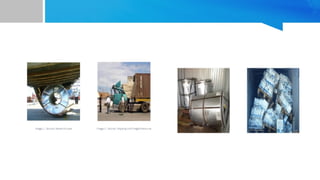
  • 91.
    Driving transport vehicles.Most of the cargo at the port comes in large quantities and can only be transported by vehicles. A stevedore is skilled in driving vehicles that aid in transportation such as trucks, tractors, cranes, and winches, depending on the type of the goods and storage requirements. Pallet fastening and lashing. While loading vessels, stevedores ensure containers are stable by supporting them using pallets. For the pallets to provide firm support, they are lashed and fastened before piling goods on them. Carrying out safety checks on equipment. Equipment used for transportation in ports such as trucks and cranes should be in good condition before starting any loading and unloading activity.
  • 92.
    A ship agentis any person or company that carries out the functions of an agent (see the following slide), irrespective of whether they are in business as a ship agent, or they perform such functions as an adjunct to, or in conjunction with, other activities such as shipowning or operating, providing cargo handling or similar. FONASBA makes no distinction between those providing agency services as their main business activity or as a part of a portfolio of marine related services. AGENTS AND AGENCIES
  • 93.
    Acting as thelocal representative of the principal, the agent provides local knowledge and expertise and ensures that the principal’s requirements are performed with the utmost efficiency and despatch. Accordingly the agent requires to be fully conversant with all the appropriate regulations and requirements relating to the port, area or sector in which they operate, to have a wide range of relevant contacts and be sufficiently well established and founded to be able to provide the level of service and support the principal needs.
  • 94.
    The ship agent,as enshrined by international maritime convention, is primarily the servant of the master and owners of the vessel, the “principal”. In practice however, the agent can act for any of the parties involved in the voyage and in any capacity as agreed between the agent and his principal.
  • 95.
    MAIN CATEGORIES OFSHIP AGENT: PORT AGENT: organises and coordinates the port call, acting on behalf of the owner or operator of the vessel. CARGO AGENT: solicits cargo on behalf of the owner, or operator, usually within a defined geographical area OWNERS/CHARTERERS AGENT: acts for another party that has an interest in the port call. The specific duties undertaken vary depending on the relationship between the parties OTHERS: as the principal may decide or require
  • 96.
    THE PORT AGENT Theport agent is central to all trades and is responsible for organising, overseeing and coordinating all aspects of the port call, from booking berth allocations and services ahead of the vessel’s arrival to finalising the accounts and other paperwork after the vessel has sailed. Functioning as the de facto port single window, the agent is the conduit for all information exchanged between the vessel and the shore.
  • 97.
    The Role ofthe Port Agent in the Port Call PORT AGENT Statutory Authoritie s Tug s/ Pilot s Stevedores / Terminals Other Port Services Shippers, Receivers, Forwardin g Agents, NVOCC’s Surface Transport/ SSS/Road/Rail Other Contractors / Social Services The Master and Owners/Operators
  • 98.
    THE PORT AGENT/contd.. Inorder to operate effectively, the port agent is required to be fully conversant with the safety, commercial and statutory requirements and regulations applicable to the port and ensure the vessel complies fully, in to ensure that no delays are caused as a result of failure to meet its obligations. The port agent will also require wide ranging and effective contacts within the regulators, port operators and service providers in order to ensure that the actions taken, and information provided, are correct and appropriate.
  • 99.
    THE PORT AGENT/contd… When developing its unique Port Procedures Survey, FONASBA indentified more than 130 separate operations that a port agent may be required to undertake. Whilst it is unlikely that an agent will have to carry out all 130+ operations in a single port call, the extent of the duties and disciplines covered is indicative of the breadth of knowledge and experience that the port agent is required to have and, importantly, to keep up to date.
  • 100.
    THE CARGO AGENT •Operating primarilyin the liner and break bulk trades, the cargo (or liner) agent is responsible for securing cargo for the line or ship operator. This requires the agent to be in regular contact with local shippers and be ready to provide information on vessel schedules, competitive rates and conditions of carriage. The agent may also offer or provide inland transportation, customs clearance and other related services. •The cargo agent may be independent and represent more than one principal but in many cases the agent is tied to, or is often a subsidiary of, one specific principal.
  • 101.
    THE OWNERS/CHARTERERS AGENT Dependingon the circumstances of the port call, there may be more than one agent attending the vessel. One party may decide that their best interests will be represented by appointing their own independent representative, rather than using the primary nominated agent. The exact role and responsibilities of this second agent (and indeed the title under which they operate) will be determined on a case by case basis.
  • 102.
    OTHER AGENCY APPOINTMENTS Anagent may be appointed to undertake other duties on behalf of a principal and the extent of those duties may be specific or general in nature as the principal requires. Such appointments often derive from unscheduled occurrences such as port calls arising as a result of an emergency, vessel breakdowns or pollution incidents, or action by statutory authorities such as customs or immigration.
  • 103.
    DUTIES OF THEAGENT / DELEGATED AUTHORITY FROM THE PRINCIPAL At the time of initial appointment, the principal will issue instructions to the agent detailing the services required and the limits of delegated authority. Within the limits of that authority, the agent is entitled to enter into agreements or contracts, disburse funds and make other arrangements that may bind the principal or incur costs on their behalf.
  • 104.
    “AS AGENTS ONLY” Assumingthat the agent has not exceeded the delegated authority granted by the principal, the principal agrees to assume the obligations and to indemnify the agent for any costs resulting from any contract or arrangements entered into by the agent on the principal’s behalf. The agent is entitled to benefit from the protections available to it under the above agreement but in order to do so must describe itself in all correspondence, written verbal and otherwise, “as agents only”
  • 105.
    THE AGENCY FEE Theagent will charge the principal a fee based on the volume of work undertaken. The fee is agreed through negotiation between the agent and the principal and is often subject to competition from other agents. The precise form of the fee, for example a flat fee or one based on the duties undertaken, can vary widely. The flat fee is common in port agency whilst the component based fee is more normal for cargo agencies.
  • 106.
    THE ROLE OFFONASBA Established in 1969, FONASBA is the global association for ship brokers and ship agents. With members in more than 50 maritime nations, the Federation’s remit is to “promote and protect the professions of ship broker and ship agent worldwide”, an obligation it discharges through actions in relevant international and regional bodies and organisations and by supporting its members on matters of a national nature.
  • 107.
    THE ROLE OFFONASBA contd/.. FONASBA has consultative status with: the International Maritime Organisation, the UN Conference on Trade and Development, the World Customs Organisation and the European Commission. The Baltic Exchange, BIMCO, INTERTANKO and the Shipbrokers’ Register are members of FONASBA and the Federation maintains close relations with Intercargo, as well as European organisations representing shipowners, port authorities, terminal operators and others.
  • 108.
    FONASBA Membership 2012 AFRICA: Kenya,Mauritania, Mauritius, Morocco, Nigeria, Senegal, South Africa, Tunisia AMERICAS: Argentina, Brazil, Mexico, Peru, USA ASIA/PACIFIC: Australia, China, India, Indonesia, Japan, the Philippines, Sri Lanka EUROPE: Belgium, Bulgaria, Croatia, Cyprus, Denmark, Finland, France, Germany, Great Britain, Greece, Hungary, Ireland, Italy, Malta, Montenegro, Netherlands, Norway, Poland, Portugal, Russia, Slovenia, Spain, Sweden, Turkey MIDDLE EAST: Dubai, Israel, Jordan, Qatar, Syria, Yemen
  • 109.
    FONASBA Membership 2012 FONASBA Membershipcurrently represents: • 69% of global population (4.77 billion people) • 71% of global GDP (US$ 52.78 trillion) • 6 of the G7 countries (excl Canada) • 7 of the G8 countries (excl. Canada) • 17 of the G20 countries (excl. Saudi Arabia, South Korea & EU) • 19 of the 27 EU countries (excl. Austria, Czech Rep. Estonia, Latvia, Lithuania, Luxembourg, Romania and Slovakia) • All 5 of the BRICS countries (Brazil, Russia, India, China and South Africa)
  • 110.
    FONASBA Quality Standard InOctober 2007, FONASBA unveiled its Quality Standard for Ship Brokers and Agents. This is designed to set an internationally recognised set of quality criteria by which companies operating in the broking and agency industries can be judged. Only companies that are members of FONASBA member associations can secure this standard. Currently FONASBA associations in 19 countries (Argentina, Australia, Belgium, Brazil, Croatia, Cyprus, Denmark, Finland, Great Britain, Israel, Italy, Japan, Malta, Norway, Portugal, Slovenia, Spain, Sweden and the USA) are accredited to the Standard and over 280 companies are approved.
  • 111.
    • Export andimport documents • Export and import documents are used to provide information to all parties involved in international trade and ensure that products make a smooth transition into or out of a country. Some of the most common documents include: • Commercial invoices • Bills of exchange • Bills of lading • Letters of credit • Marine insurance policies
  • 117.
  • 127.
    • Bill ofLading • Bill of Lading is a document issued by the shipping company or his agent acknowledging the receipt of cargo on board. This is an undertaking to deliver the goods in the same order and condition as received to the consignee or his agent on receipt of freight, the shipping company is entitled to. It is a very important document to the exporter as it constitutes document of title to the goods. • Each shipping company has its own bill of lading. The exporter prepares the bill of • lading in the form obtained from the shipping company or agents of shipping company. • The goods can be consigned to order of the exporter, which means the exporter can authorize someone else to receive the goods on his behalf. In such a case, the exporter would discharge the bill of lading on its reverse.
  • 128.
    • When thebill of lading is negotiated through the bank, it would be endorsed in favour of the bank that would endorse further to the importer, on receipt of payment. • Bill of Lading is made in signed set of 2 originals, any one of which can give title to the goods. The shipping company also issues non-negotiable copies (unsigned) which are not documents of title to goods but serves the purpose of record only. • The reverse side of Bill of Lading contains the terms and conditions of the contract of carriage. The clauses on most of the bills of lading are common. A Bill of lading should be clean to facilitate the exporter to obtain the proceeds of export without difficulty.
  • 129.
    • Main Purposes •It serves three main purposes. • (A) As a document of title to the goods • (B) As a receipt from the shipping company and • (C) As a contract of affreightment (transportation) of goods.
  • 130.
    • Export andImport procedure • Typically, the procedure for import and export activities involves ensuring licensing and compliance before the shipping of goods, arranging for transport and warehousing after the unloading of goods, getting customs clearance and paying taxes before the release of goods • In India, imports and exports are regulated by the Foreign Trade (Development and Regulation) Act, 1992, which empowers the federal government to make provisions for the development and regulation of foreign trade. The current provisions relating to exports and imports in India are available under the Foreign Trade Policy, 2023.
  • 131.
    • steps involvedin importing goods • To begin exporting or importing goods from India, the business or individual must obtain an Import Export Code or IE Code from the Directorate General of Foreign Trade(DGFT). Obtain the IE Code from the business after obtaining PAN and opening a bank account. • 1. IEC is mandatorily required for clearing customs, sending shipments, and sending or receiving money in foreign currency. However, it is not necessary for service exports unless the service provider is seeking benefits under the Foreign Trade Policy. • During the import-export code registration process, the DGFT instantly confirms all information with the Income Tax Department. This means that the IEC certificate can be generated in a single day. Prior to 2021, an IEC certificate was valid for the entire length of that business
  • 132.
    • 2. Ensurelegal compliance under different trade laws • Once an IEC is allotted, businesses may import goods that are compliant with Section 11 of the Customs Act (1962), Foreign Trade (Development & Regulation) Act (1992), and the Foreign Trade Policy, 2023. • 3. Procure import licenses • To determine whether a license is needed to import a particular commercial product or service, an importer must first classify the item by identifying its Indian Trading Clarification based on a Harmonized System of Coding or ITC (HS) classification.
  • 133.
    • 4. FileBill of Entry and other documents to complete customs clearing formalities • After obtaining import licenses, importers are required to furnish an import declaration in the prescribed Bill of Entry along with permanent account number (PAN) based Business Identification Number (BIN), as per Section 46 of the Customs Act (1962). • A Bill of Entry gives information on the exact nature, precise quantity, and value of goods that have landed or entered inwards in the country.
  • 134.
    • 5. Determineimport duty rate for clearance of goods • India levies basic customs duty on imported goods, as specified in the first schedule of the Customs tariff Act, 1975, along with goods-specific duties such as anti- dumping duty, safeguard duty, and social welfare surcharge.
  • 135.
    • Export procedures •Just as for imports, a company planning to engage in export activities is required to obtain an IEC number from the regional joint DGFT. After obtaining the IEC, the exporter needs to ensure that all the legal compliance requirements are met under different trade laws. • Further, the exporter must check if an export license is required, and accordingly apply for the license to the DGFT.
  • 136.
    • An exporteris also required to register with the Indian Chamber of Commerce (ICC), which issues the Non-Preferential Certificates of Origin certifying that the exported goods are originated in India. • In 2023, the DGFT launched the Advance Authorisation Scheme under the Foreign Trade Policy, enabling duty-free import of inputs for export. The eligibility of inputs is determined by Sector-specific Norms Committees based on input-output norms. The scheme offers a grace period for exporters who, as holders of Advance and EPCG (Export Promotion for Capital Goods) Authorizations, default on their export obligations once.
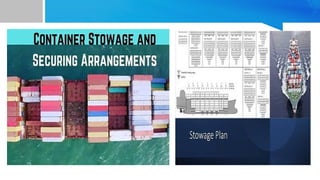
  • 137.
    • Conversion offoreign going vessels to coastal vessel • A foreign Going Vessel of Indian Flag having a General Trading Licence can convert to Coastal run on the basis of a Customs Conversion Order. • A Foreign Going Vessel of Foreign Flag can convert to coastal run on the basis of a Coastal Voyage License issued by Director General of Shipping.
  • 138.
    • Converting aforeign-going vessel to a coastal vessel in India involves several regulatory and procedural steps, governed primarily by the Directorate General of Shipping (DGS) under the Ministry of Ports, Shipping and Waterways • 1. Application for Change of Status • Submit an application to the Directorate General of Shipping (DGS) for changing the status of the vessel from foreign-going to coastal. The application should include: • Details of the vessel. • Reasons for the conversion. • Certificates and documents of the vessel.
  • 139.
    • 2. Surveyand Inspection • The vessel must undergo a survey and inspection by the Mercantile Marine Department (MMD) to ensure compliance with Indian coastal trade regulations. This includes: • Hull and machinery inspection. • Safety equipment check. • Compliance with Indian coastal standards. • 3. Documentation and Certification • Ensure that the vessel has all required documentation and certifications, including: • Certificate of Registry. • Safety Management Certificate (SMC). • Document of Compliance (DOC). • International Ship Security Certificate (ISSC). • Crew certifications and endorsements.
  • 140.
    • 4. Customsand Taxation • Handle customs and taxation issues, including: • Payment of duties or taxes if applicable. • Custom clearance for change of trade. • Obtain a no-objection certificate (NOC) from Customs. • 5. Change of Flag • If the vessel was flying a foreign flag, it must be re-registered under the Indian flag. This involves: • Deregistration from the foreign registry. • Submission of the deregistration certificate. • Registration under the Indian flag with the appropriate authorities.
  • 141.
    • 6. CoastalTrade License • Obtain a Coastal Trade License from the Directorate General of Shipping. This involves: • Submission of the application form. • Payment of the prescribed fee. • Compliance with coastal trade regulations. • 7. Compliance with Domestic Regulations • Ensure compliance with Indian domestic regulations, including: • Environmental regulations. • Crew welfare standards. • Operational standards for coastal shipping.
  • 142.
    • 8. PortState Control • The vessel must comply with port state control (PSC) inspections to ensure it meets all regulatory requirements for coastal operations. • 9. Crew and Manning Requirements • Ensure the crew meets the manning requirements for coastal vessels as per Indian regulations. This includes: • Indian crew endorsements. • Adequate training and certification for coastal operations.
  • 143.
    • 10. OperationalReadiness • Prepare the vessel for operational readiness, including: • Familiarization of the crew with coastal trade routes. • Safety drills and procedures. • Logistic arrangements for coastal operations
  • 144.
    • Converting acoastal going vessel to a foreign going vessel • Converting a coastal going vessel to a foreign going vessel involves several steps and considerations, primarily focusing on meeting international maritime regulations and safety standards 1. Assessment and Planning: Before starting the conversion process, assess the vessel's current condition, its intended use, and the requirements for foreign going vessels. Plan the conversion process accordingly, considering both regulatory and operational aspects. 2. Regulatory Compliance: Research and understand the regulations governing foreign going vessels in the countries or regions where the vessel will operate. This includes regulations from international bodies such as the International Maritime Organization (IMO) and local maritime
  • 145.
    3.Structural Modifications: Dependingon the specific requirements for foreign going vessels, structural modifications may be necessary. This could include strengthening the hull, installing additional safety features, or upgrading navigation equipment to meet international standards. 4. Safety Equipment: Ensure that the vessel is equipped with all necessary safety equipment required for foreign going voyages. This includes life-saving appliances, firefighting equipment, navigation lights, communication systems, and emergency provisions.
  • 146.
    5. Documentation andCertification: Obtain the necessary documentation and certifications for the converted vessel to operate as a foreign going vessel. This may include obtaining a new flag state registration, classification society certification, and compliance certificates for various international conventions such as SOLAS (Safety of Life at Sea) and MARPOL (International Convention for the Prevention of Pollution from Ships). 6. Crew Training and Certification: Ensure that the crew members are properly trained and certified to operate a foreign going vessel. This may involve providing additional training on international regulations, safety procedures, navigation, and communication protocols. 7. Testing and Trials: Conduct thorough testing and sea trials to ensure that the vessel and its systems are functioning correctly and comply with all relevant regulations and standards.
  • 147.
    8. Inspection andApproval: Once the conversion process is complete, arrange for an inspection by relevant authorities to approve the vessel for foreign going operations. This may involve inspections by flag state authorities, classification societies, port state control authorities, or other regulatory bodies. 9. Operational Readiness: Ensure that the vessel is fully prepared for foreign going voyages, including provisions, fuel, supplies, and crew arrangements. 10. Ongoing Compliance: Maintain ongoing compliance with regulatory requirements for foreign going vessels, including regular inspections, audits, and updates to equipment and procedures as necessary.