


How to Make the Most of Your
Internship:
Meeting your future career goals
10 May 2013
Rosie Plimmer
rosieplimmer@btinternet.com
Overview
• Step 1: The Question to Ask Before You Start?
• Step 2: Know Where You’re Heading
• Step 3: Plans, Assumptions and Mentors
• Step 4: Selling your internship
• Summary
• Questions
STEP 1:
THE QUESTION TO ASK BEFORE
YOU START
OVER TO YOU
Who?
A.Knows exactly: what role you want to do?
B.Undecided: between 2 or more options?
C.Has an inkling: but the role is not clear yet?
D.Is at 1st
base: Feels stuck/not thought about it
The more you feel sure….
1. Closing any specific gaps
– ‘Technical’ skills & knowledge
– ‘Soft’ skills
1. Taking responsibility
– Define and deliver a project
1. Collect insights of colleagues
– Criteria for interviews?
– Who is hiring?
– Good/bad places to work?
1. Growing helpful contacts
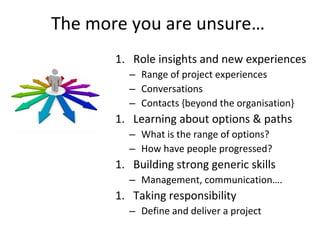
The more you are unsure…
1. Role insights and new experiences
– Range of project experiences
– Conversations
– Contacts {beyond the organisation}
1. Learning about options & paths
– What is the range of options?
– How have people progressed?
1. Building strong generic skills
– Management, communication….
1. Taking responsibility
– Define and deliver a project
STEP 2:
KNOW WHERE YOU’RE HEADING
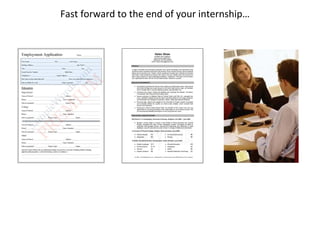
Fast forward to the end of your internship…
OVER TO YOU
In a CV, covering letter or application form,
what will employers be looking for from you so
you make it onto their short list???
EVIDENCE that
you meet the
person
specification
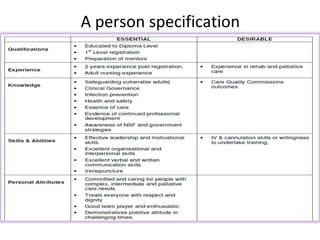
A person specification
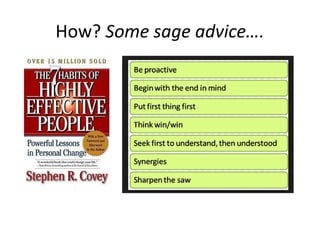
How? Some sage advice….
Creating evidence that you meet the
person specification….
• Be proactive: Find out how to find out?
• Begin with the end in mind: Identify your gaps
• Put first things first: Prioritise key gaps
• Think win/win: Time and skills for experiences
• Seek first to understand: Options, pros and cons
• Synergies: Learn, do, grow, network, all at once
• Sharpen the saw: Hone and develop skills
Where to start?
The following forms a good place to start from:
•Knowing key skills and experiences required in your field
•Honest self-assessment of skills and gaps
•Prioritise targets for skills, experiences, knowledge
•What you can offer today to get opportunities
•Opportunities for synergies
•Additional ways to build knowledge and skills (courses,
books, professional bodies, linkedin groups etc)
STEP 3:
PLANS, ASSUMPTIONS &
MENTORS
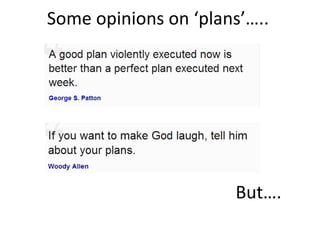
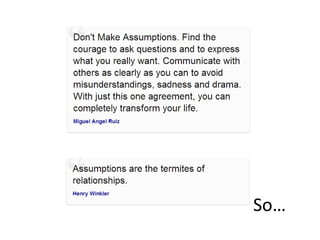
Some opinions on ‘plans’…..
But….
So…
Shared “Plan” (you + mentor + perhaps key stakeholders?)
•Objectives
•Actions / Responsibilities
•Approximate timeline
•Deliverables
•Contact times
•Opportunities for learning a/wider exposure etc (as needed)
•Training and development
•Time for reflection and feedback
Suggestion…..
OVER TO YOU
With the best will in the world things may not always go to plan.
Hopefully it won’t happen, but if you did find yourself in this
position, what could you do to improve things?
•Not enough to do
•On your own a lot
•Feeling like you aren’t being given the opportunity to make a
‘significant contribution’
Each table elect an idea collector
and a spokesperson
5 mins + 5 mins feedback
STEP 4:
SELLING WHAT YOU’VE DONE…
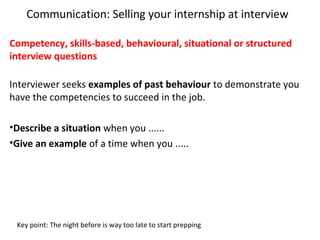
Communication: Selling your internship at interview
Competency, skills-based, behavioural, situational or structured
interview questions
Interviewer seeks examples of past behaviour to demonstrate you
have the competencies to succeed in the job.
•Describe a situation when you ......
•Give an example of a time when you .....
Key point: The night before is way too late to start prepping
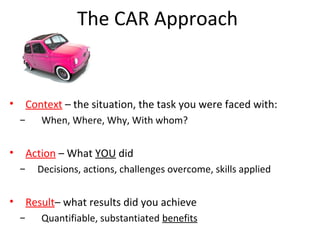
• Context – the situation, the task you were faced with:
̶ When, Where, Why, With whom?
• Action – What YOU did
̶ Decisions, actions, challenges overcome, skills applied
• Result– what results did you achieve
̶ Quantifiable, substantiated benefits
The CAR Approach
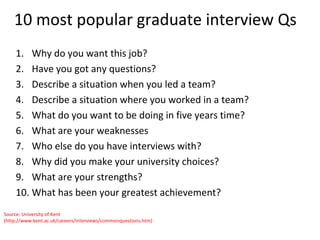
10 most popular graduate interview Qs
1. Why do you want this job?
2. Have you got any questions?
3. Describe a situation when you led a team?
4. Describe a situation where you worked in a team?
5. What do you want to be doing in five years time?
6. What are your weaknesses
7. Who else do you have interviews with?
8. Why did you make your university choices?
9. What are your strengths?
10. What has been your greatest achievement?
Source: University of Kent
(http://www.kent.ac.uk/careers/interviews/commonquestions.htm)
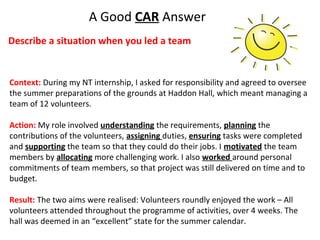
A Good CAR Answer
Describe a situation when you led a team
Context: During my NT internship, I asked for responsibility and agreed to oversee
the summer preparations of the grounds at Haddon Hall, which meant managing a
team of 12 volunteers.
Action: My role involved understanding the requirements, planning the
contributions of the volunteers, assigning duties, ensuring tasks were completed
and supporting the team so that they could do their jobs. I motivated the team
members by allocating more challenging work. I also worked around personal
commitments of team members, so that project was still delivered on time and to
budget.
Result: The two aims were realised: Volunteers roundly enjoyed the work – All
volunteers attended throughout the programme of activities, over 4 weeks. The
hall was deemed in an “excellent” state for the summer calendar.
OVER TO YOU
Working together, all of you come up with a CAR answer based on
an internship experience so far for the following interview
questions:
4. Tell me a situation when you worked in a team
9.Describe a situation where you used problem solving skills
(5 mins + 5 mins feedback)
Each table elect an idea collector and a
spokesperson (different to last time)
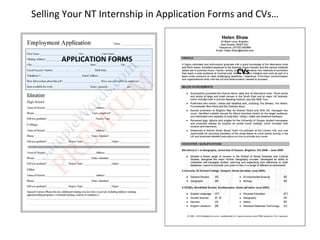
Selling Your NT Internship in Application Forms and CVs…
APPLICATION FORMS
CVs
Content: gather your evidence as you go….
• Keep a diary/ journal/ list of the tasks you’ve
undertaken throughout the internship
• Identify skills/ knowledge / attributes you’ve
used / demonstrated
• Use CAR technique (Context, Action, Result)
• Use DYNAMIC/ ACTIVE vocabulary that
reflects job descriptions and requirements
Organised, Managed, Liaised, Negotiated, Coordinated,
Interviewed, Led, Identified, Communicated, Persuaded,
Established, Participated, Developed, Researched,
Demonstrated, Monitored, Planned, Arranged, etc...
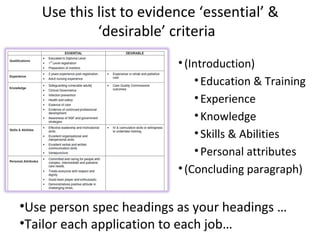
Use this list to evidence ‘essential’ &
‘desirable’ criteria
•Use person spec headings as your headings …
•Tailor each application to each job…
•(Introduction)
•Education & Training
•Experience
•Knowledge
•Skills & Abilities
•Personal attributes
•(Concluding paragraph)
OVER TO YOU
Each table elect an idea collector and a spokesperson (different to
the previous times)
5 mins + 5 mins feedback
Bearing in mind the habits of successful job seekers, list your
group’s top four ways that your NT internship can help your be
happy and successful in your future job hunt.
SUMMARY
In summary: Getting the Most
Out of Your Internship: Top 4 tips
1.Understand where you are on the spectrum
between “Clarity” and “Cloudiness” …. & tailor your
approach accordingly
2.Work effectively to gather evidence of your
employability (7 Habits….)
3.Agree key parameters of your internship with your
mentor.
4.Think CAR! To sell the value of your experience
Thank you for
listening…
Any questions?

How to make the most of your Internship

  • 1.
    How to Makethe Most of Your Internship: Meeting your future career goals 10 May 2013 Rosie Plimmer rosieplimmer@btinternet.com
  • 2.
    Overview • Step 1:The Question to Ask Before You Start? • Step 2: Know Where You’re Heading • Step 3: Plans, Assumptions and Mentors • Step 4: Selling your internship • Summary • Questions
  • 3.
    STEP 1: THE QUESTIONTO ASK BEFORE YOU START
  • 4.
    OVER TO YOU Who? A.Knowsexactly: what role you want to do? B.Undecided: between 2 or more options? C.Has an inkling: but the role is not clear yet? D.Is at 1st base: Feels stuck/not thought about it
  • 5.
    The more youfeel sure…. 1. Closing any specific gaps – ‘Technical’ skills & knowledge – ‘Soft’ skills 1. Taking responsibility – Define and deliver a project 1. Collect insights of colleagues – Criteria for interviews? – Who is hiring? – Good/bad places to work? 1. Growing helpful contacts
  • 6.
    The more youare unsure… 1. Role insights and new experiences – Range of project experiences – Conversations – Contacts {beyond the organisation} 1. Learning about options & paths – What is the range of options? – How have people progressed? 1. Building strong generic skills – Management, communication…. 1. Taking responsibility – Define and deliver a project
  • 7.
    STEP 2: KNOW WHEREYOU’RE HEADING
  • 8.
    Fast forward tothe end of your internship…
  • 9.
    OVER TO YOU Ina CV, covering letter or application form, what will employers be looking for from you so you make it onto their short list???
  • 10.
    EVIDENCE that you meetthe person specification
  • 11.
  • 12.
    How? Some sageadvice….
  • 13.
    Creating evidence thatyou meet the person specification…. • Be proactive: Find out how to find out? • Begin with the end in mind: Identify your gaps • Put first things first: Prioritise key gaps • Think win/win: Time and skills for experiences • Seek first to understand: Options, pros and cons • Synergies: Learn, do, grow, network, all at once • Sharpen the saw: Hone and develop skills
  • 14.
    Where to start? Thefollowing forms a good place to start from: •Knowing key skills and experiences required in your field •Honest self-assessment of skills and gaps •Prioritise targets for skills, experiences, knowledge •What you can offer today to get opportunities •Opportunities for synergies •Additional ways to build knowledge and skills (courses, books, professional bodies, linkedin groups etc)
  • 15.
  • 16.
    Some opinions on‘plans’….. But….
  • 17.
  • 18.
    Shared “Plan” (you+ mentor + perhaps key stakeholders?) •Objectives •Actions / Responsibilities •Approximate timeline •Deliverables •Contact times •Opportunities for learning a/wider exposure etc (as needed) •Training and development •Time for reflection and feedback Suggestion…..
  • 19.
    OVER TO YOU Withthe best will in the world things may not always go to plan. Hopefully it won’t happen, but if you did find yourself in this position, what could you do to improve things? •Not enough to do •On your own a lot •Feeling like you aren’t being given the opportunity to make a ‘significant contribution’ Each table elect an idea collector and a spokesperson 5 mins + 5 mins feedback
  • 20.
    STEP 4: SELLING WHATYOU’VE DONE…
  • 21.
    Communication: Selling yourinternship at interview Competency, skills-based, behavioural, situational or structured interview questions Interviewer seeks examples of past behaviour to demonstrate you have the competencies to succeed in the job. •Describe a situation when you ...... •Give an example of a time when you ..... Key point: The night before is way too late to start prepping
  • 22.
    • Context –the situation, the task you were faced with: ̶ When, Where, Why, With whom? • Action – What YOU did ̶ Decisions, actions, challenges overcome, skills applied • Result– what results did you achieve ̶ Quantifiable, substantiated benefits The CAR Approach
  • 23.
    10 most populargraduate interview Qs 1. Why do you want this job? 2. Have you got any questions? 3. Describe a situation when you led a team? 4. Describe a situation where you worked in a team? 5. What do you want to be doing in five years time? 6. What are your weaknesses 7. Who else do you have interviews with? 8. Why did you make your university choices? 9. What are your strengths? 10. What has been your greatest achievement? Source: University of Kent (http://www.kent.ac.uk/careers/interviews/commonquestions.htm)
  • 24.
    A Good CARAnswer Describe a situation when you led a team Context: During my NT internship, I asked for responsibility and agreed to oversee the summer preparations of the grounds at Haddon Hall, which meant managing a team of 12 volunteers. Action: My role involved understanding the requirements, planning the contributions of the volunteers, assigning duties, ensuring tasks were completed and supporting the team so that they could do their jobs. I motivated the team members by allocating more challenging work. I also worked around personal commitments of team members, so that project was still delivered on time and to budget. Result: The two aims were realised: Volunteers roundly enjoyed the work – All volunteers attended throughout the programme of activities, over 4 weeks. The hall was deemed in an “excellent” state for the summer calendar.
  • 25.
    OVER TO YOU Workingtogether, all of you come up with a CAR answer based on an internship experience so far for the following interview questions: 4. Tell me a situation when you worked in a team 9.Describe a situation where you used problem solving skills (5 mins + 5 mins feedback) Each table elect an idea collector and a spokesperson (different to last time)
  • 26.
    Selling Your NTInternship in Application Forms and CVs… APPLICATION FORMS CVs
  • 27.
    Content: gather yourevidence as you go…. • Keep a diary/ journal/ list of the tasks you’ve undertaken throughout the internship • Identify skills/ knowledge / attributes you’ve used / demonstrated • Use CAR technique (Context, Action, Result) • Use DYNAMIC/ ACTIVE vocabulary that reflects job descriptions and requirements Organised, Managed, Liaised, Negotiated, Coordinated, Interviewed, Led, Identified, Communicated, Persuaded, Established, Participated, Developed, Researched, Demonstrated, Monitored, Planned, Arranged, etc...
  • 28.
    Use this listto evidence ‘essential’ & ‘desirable’ criteria •Use person spec headings as your headings … •Tailor each application to each job… •(Introduction) •Education & Training •Experience •Knowledge •Skills & Abilities •Personal attributes •(Concluding paragraph)
  • 29.
    OVER TO YOU Eachtable elect an idea collector and a spokesperson (different to the previous times) 5 mins + 5 mins feedback Bearing in mind the habits of successful job seekers, list your group’s top four ways that your NT internship can help your be happy and successful in your future job hunt.
  • 30.
  • 31.
    In summary: Gettingthe Most Out of Your Internship: Top 4 tips 1.Understand where you are on the spectrum between “Clarity” and “Cloudiness” …. & tailor your approach accordingly 2.Work effectively to gather evidence of your employability (7 Habits….) 3.Agree key parameters of your internship with your mentor. 4.Think CAR! To sell the value of your experience
  • 32.

Editor's Notes