Obtaining Internships Edward Mosley & Richard Mendez
Overview The process Where to search for opportunities  Articulating your skills to employers What to do before, during and after your internship
Activity: Internship clinic  Mention a concern or issue you have when trying to obtain internships or work experience in general  Examples: I don’t know what career I want, therefore I am unsure what work experience to do. I don’t know where to look for opportunities. So far I have just received rejections from employers. I don’t know what I am doing  wrong.  We will revisit these later on in the session
What next?  Before applying for internships, it is important to determine  what your overall goal/objective is.  Some key questions:  Do you know what career you want?  If so, have you researched this area thoroughly?  If not, have you investigated your options?
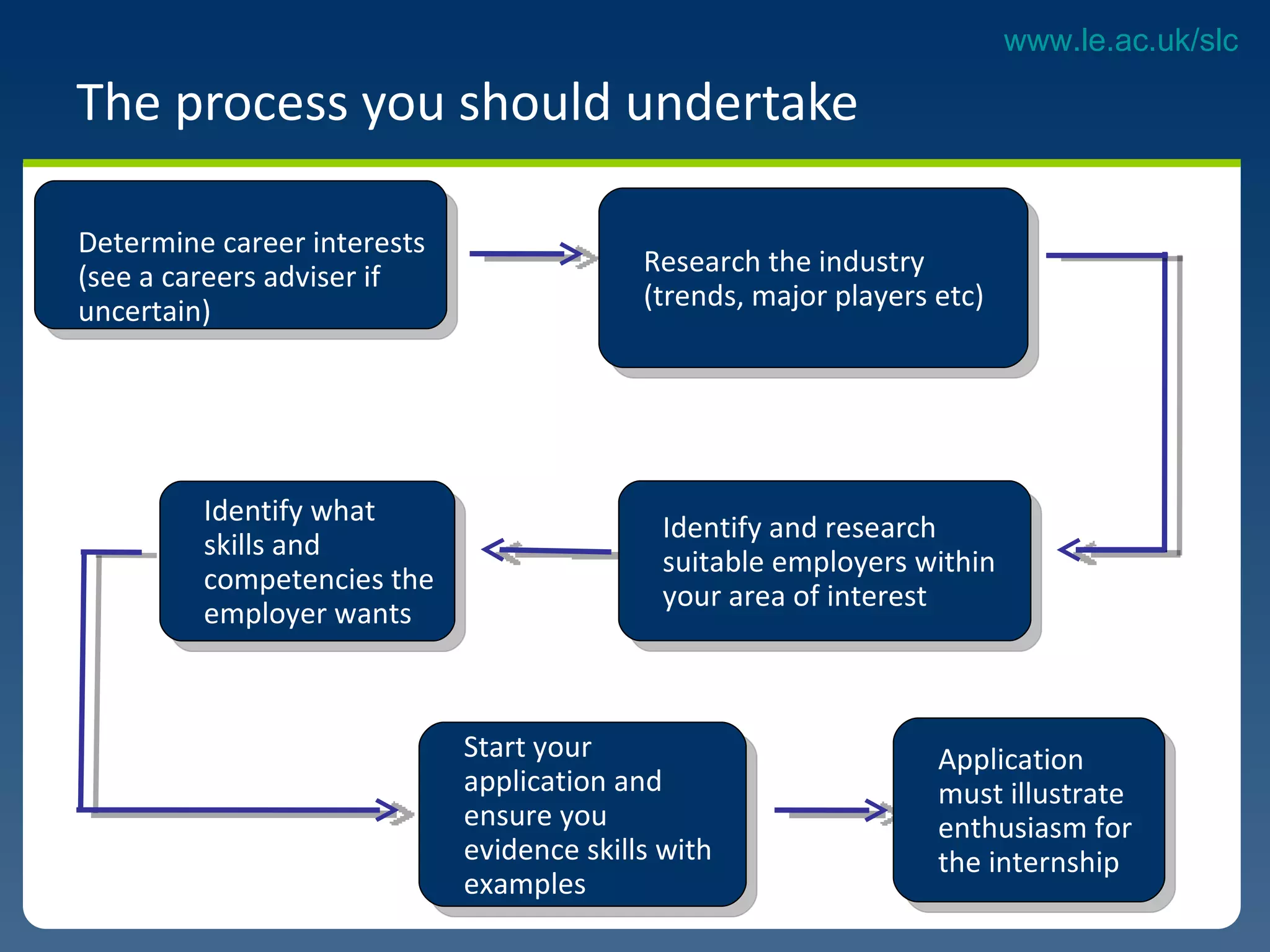
The process you should undertake Determine career interests (see a careers adviser if uncertain) Research the industry (trends, major players etc) Identify and research suitable employers within your area of interest Start your application and ensure you evidence skills with examples  Identify what skills and competencies the employer wants Application must illustrate enthusiasm for the internship
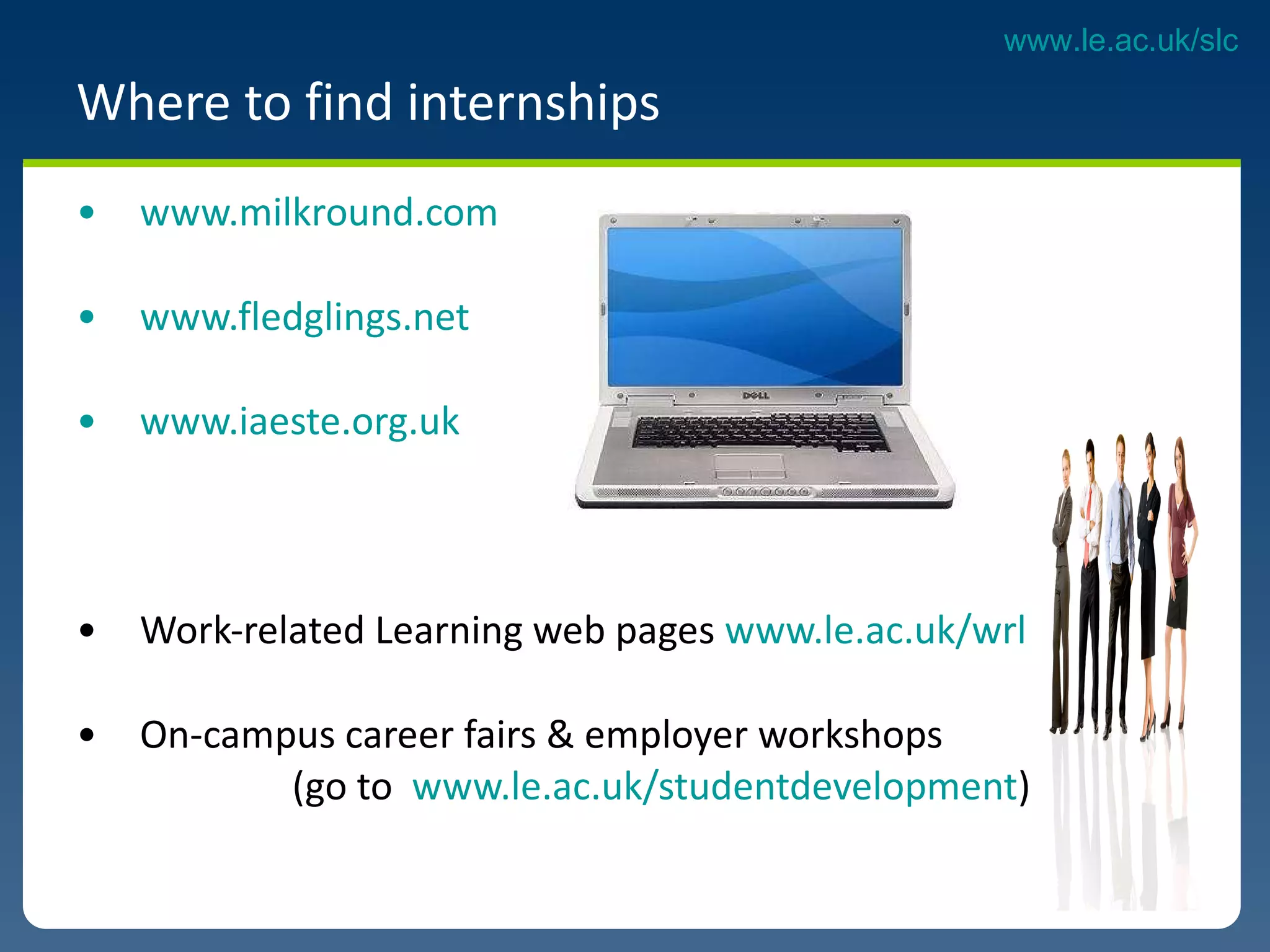
Where to find internships www.milkround.com   www.fledglings.net www.iaeste.org.uk   Work-related Learning web pages  www.le.ac.uk/wrl   On-campus career fairs & employer workshops  (go to  www.le.ac.uk/studentdevelopment )
Searching for opportunities  Any other ideas/sources? Share your ideas
Approaches Formal advertised internship opportunities  usually offered by  larger employers. These typically run over the summer time, or as  a 12-month industrial placement. Structured internship opportunities  through the University of  Leicester. Various internship opportunities usually with  small/medium employers within the East Midlands. Speculative approach . For situations where the employer has not officially advertised an internship opportunity.
Activity: Recruiter  Imagine you are the recruiter for the role of a trainee intern Pharmacologist Examine the role descriptor (to follow)  Then examine the handout of a CV application for that role Identify the  good  and  bad  points of the CV as an application for the role What would you do differently?
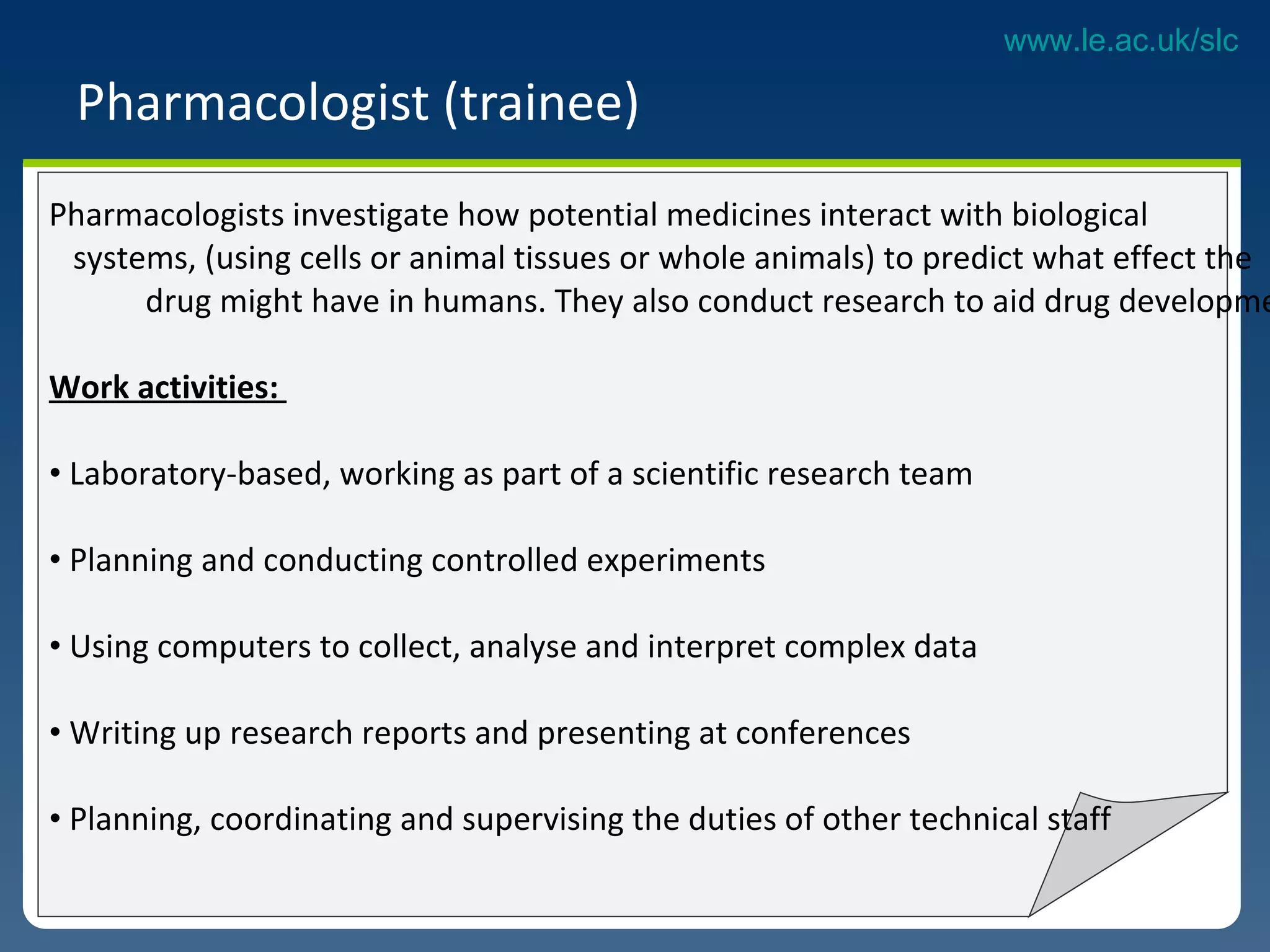
Pharmacologist (trainee)  Pharmacologists investigate how potential medicines interact with biological  systems, (using cells or animal tissues or whole animals) to predict what effect the  drug might have in humans. They also conduct research to aid drug development.  Work activities:  Laboratory-based, working as part of a scientific research team Planning and conducting controlled experiments  Using computers to collect, analyse and interpret complex data Writing up research reports and presenting at conferences Planning, coordinating and supervising the duties of other technical staff
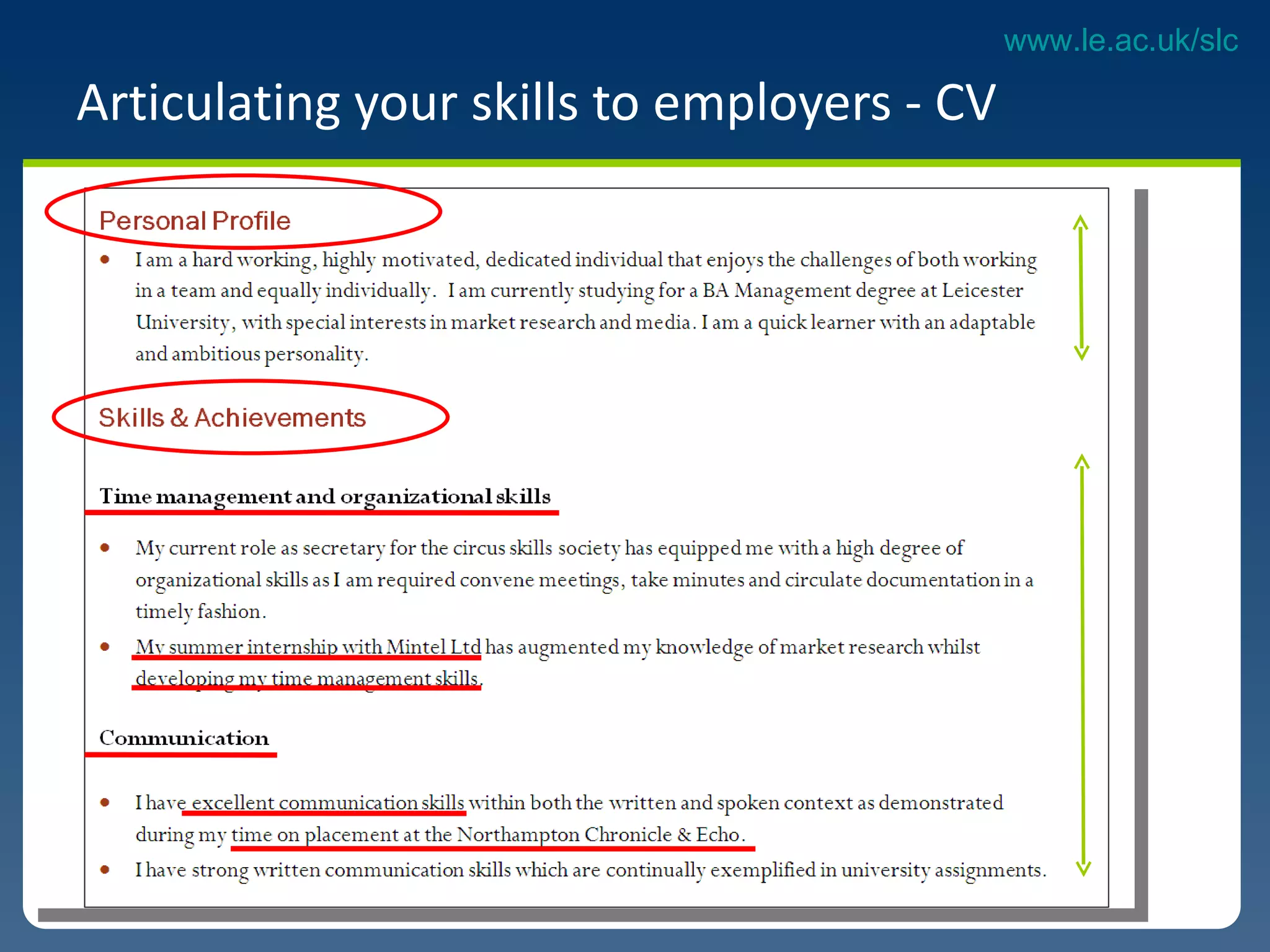
Articulating your skills to employers - CV
Articulating your skills – application form Competence-based questions Please demonstrate a time when you have worked effectively within a team to fulfill a task. [Overview of situation here] [Explanation of skills and processes in the next paragraph] [End by describing what you learnt and mention a positive outcome]  Ensure you answer the question Briefly explain the situation Explain the skills and processes in detail  Positive outcome  and what you learnt
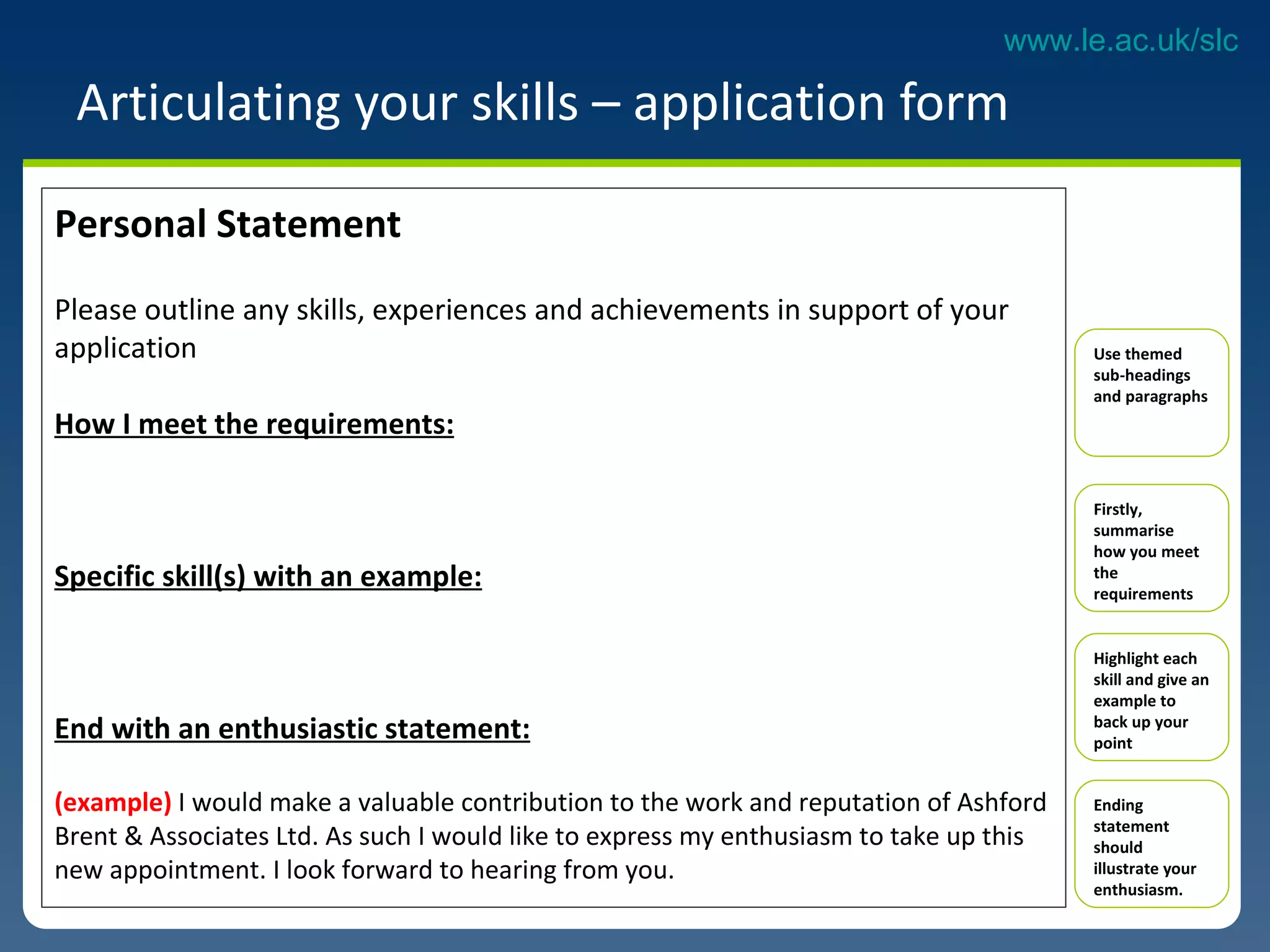
Articulating your skills – application form Personal Statement Please outline any skills, experiences and achievements in support of your application How I meet the requirements: Specific skill(s) with an example: End with an enthusiastic statement: (example)  I would make a valuable contribution to the work and reputation of Ashford Brent & Associates Ltd. As such I would like to express my enthusiasm to take up this new appointment. I look forward to hearing from you.  Use themed sub-headings and paragraphs Firstly, summarise how you meet the requirements  Highlight each skill and give an example to back up your point Ending statement should illustrate your enthusiasm.
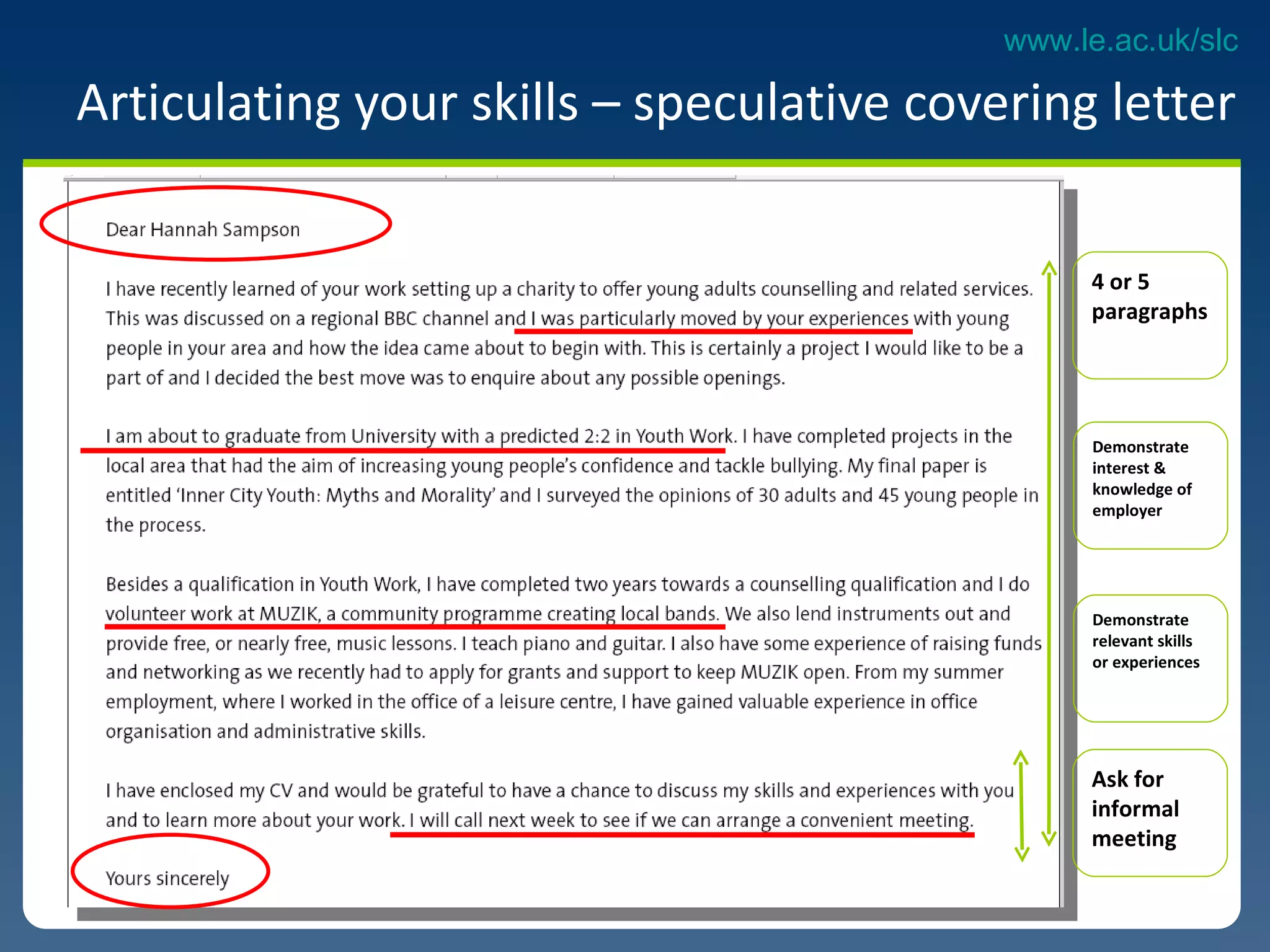
Articulating your skills – speculative covering letter 4 or 5 paragraphs  Demonstrate interest & knowledge of employer Demonstrate relevant skills or experiences  Ask for informal meeting
Activity: Most employable?  Quick-fire statements to follow Please can everyone  stand-up  If your answer to any of the following series of statements is no,  please sit down and remain seated
Activity: Most employable?  Those who have  not  attended a  careers fair ,  employer talk  or a  recognition award programme  (e.g. tomorrow's managers)  in the last 12 months, sit down
Activity: Most employable?  Those who have  not  seen a careers advisor  in the last 12 months, please sit down
Activity: Most employable?  Those who have  not  updated their CVs in  the last  6 months , please sit down
Activity: Most employable?  Finally, those who have  not  begun to  explore/look into relevant internship or  work experience opportunities, please sit  down.
CONCLUSION:  For those who are still standing, you are on the right track For those of you who are sitting down, start to benchmark the actions of those standing up Therefore ensure you:  see a careers advisor/myself to get your CV checked update your CV begin researching some form of relevant internship or work experience  Activity: Most employable?
 
Research employers that you are interested in working for – websites, contacting personnel dept for information etc.  Establish your own learning outcomes Prepare a log book or diary to record achievements  Things to do before your internship National Council for Work Experience (2006) Apply early
Ensure you are assigned a mentor Meet regularly with your mentor to discuss your progress Maintain your logbook/diary of achievements Things to do during your internship National Council for Work Experience (2006) Methodically review your learning outcomes  Ask the employer to act as a referee when you apply for jobs in the future  Request an exit interview to discuss how you can develop further
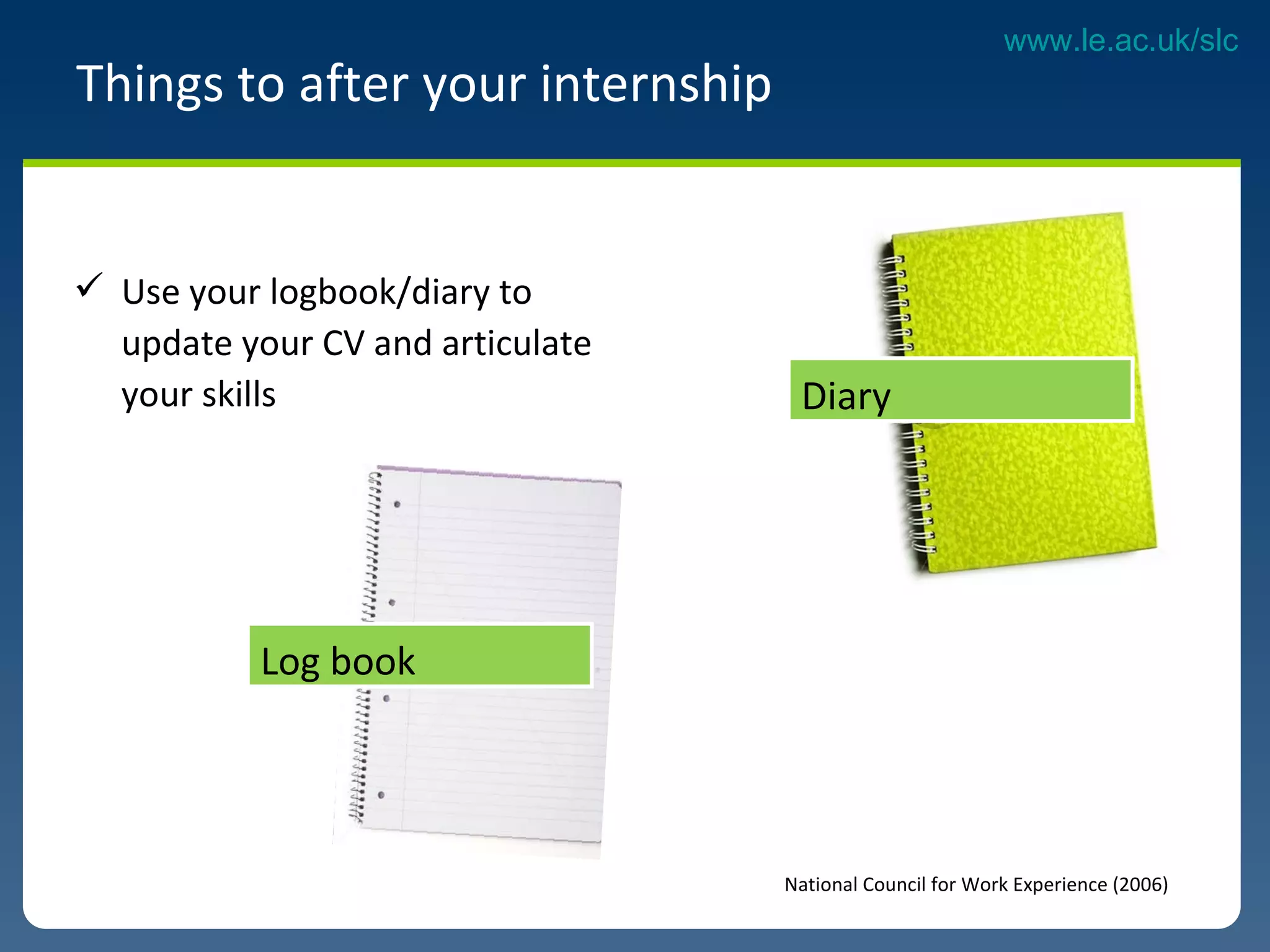
Use your logbook/diary to update your CV and articulate your skills  Things to after your internship National Council for Work Experience (2006) Diary  Log book
Activity: Work experience clinic - PART 2  The issues/problems listed, to be addressed
 
Work-related Learning consultations Academic-related work placements  Summer internships Help with your CVs and application forms  Richard Mendez, Work-related Learning Manager  Edward Mosley, Enterprise Learning Officer   Email:  [email_address]   [email_address]

Obtaining internships

  • 1.
    Obtaining Internships EdwardMosley & Richard Mendez
  • 2.
    Overview The processWhere to search for opportunities Articulating your skills to employers What to do before, during and after your internship
  • 3.
    Activity: Internship clinic Mention a concern or issue you have when trying to obtain internships or work experience in general Examples: I don’t know what career I want, therefore I am unsure what work experience to do. I don’t know where to look for opportunities. So far I have just received rejections from employers. I don’t know what I am doing wrong. We will revisit these later on in the session
  • 4.
    What next? Before applying for internships, it is important to determine what your overall goal/objective is. Some key questions: Do you know what career you want? If so, have you researched this area thoroughly? If not, have you investigated your options?
  • 5.
    The process youshould undertake Determine career interests (see a careers adviser if uncertain) Research the industry (trends, major players etc) Identify and research suitable employers within your area of interest Start your application and ensure you evidence skills with examples Identify what skills and competencies the employer wants Application must illustrate enthusiasm for the internship
  • 6.
    Where to findinternships www.milkround.com www.fledglings.net www.iaeste.org.uk Work-related Learning web pages www.le.ac.uk/wrl On-campus career fairs & employer workshops (go to www.le.ac.uk/studentdevelopment )
  • 7.
    Searching for opportunities Any other ideas/sources? Share your ideas
  • 8.
    Approaches Formal advertisedinternship opportunities usually offered by larger employers. These typically run over the summer time, or as a 12-month industrial placement. Structured internship opportunities through the University of Leicester. Various internship opportunities usually with small/medium employers within the East Midlands. Speculative approach . For situations where the employer has not officially advertised an internship opportunity.
  • 9.
    Activity: Recruiter Imagine you are the recruiter for the role of a trainee intern Pharmacologist Examine the role descriptor (to follow) Then examine the handout of a CV application for that role Identify the good and bad points of the CV as an application for the role What would you do differently?
  • 10.
    Pharmacologist (trainee) Pharmacologists investigate how potential medicines interact with biological systems, (using cells or animal tissues or whole animals) to predict what effect the drug might have in humans. They also conduct research to aid drug development. Work activities: Laboratory-based, working as part of a scientific research team Planning and conducting controlled experiments Using computers to collect, analyse and interpret complex data Writing up research reports and presenting at conferences Planning, coordinating and supervising the duties of other technical staff
  • 11.
    Articulating your skillsto employers - CV
  • 12.
    Articulating your skills– application form Competence-based questions Please demonstrate a time when you have worked effectively within a team to fulfill a task. [Overview of situation here] [Explanation of skills and processes in the next paragraph] [End by describing what you learnt and mention a positive outcome] Ensure you answer the question Briefly explain the situation Explain the skills and processes in detail Positive outcome and what you learnt
  • 13.
    Articulating your skills– application form Personal Statement Please outline any skills, experiences and achievements in support of your application How I meet the requirements: Specific skill(s) with an example: End with an enthusiastic statement: (example) I would make a valuable contribution to the work and reputation of Ashford Brent & Associates Ltd. As such I would like to express my enthusiasm to take up this new appointment. I look forward to hearing from you. Use themed sub-headings and paragraphs Firstly, summarise how you meet the requirements Highlight each skill and give an example to back up your point Ending statement should illustrate your enthusiasm.
  • 14.
    Articulating your skills– speculative covering letter 4 or 5 paragraphs Demonstrate interest & knowledge of employer Demonstrate relevant skills or experiences Ask for informal meeting
  • 15.
    Activity: Most employable? Quick-fire statements to follow Please can everyone stand-up If your answer to any of the following series of statements is no, please sit down and remain seated
  • 16.
    Activity: Most employable? Those who have not attended a careers fair , employer talk or a recognition award programme (e.g. tomorrow's managers) in the last 12 months, sit down
  • 17.
    Activity: Most employable? Those who have not seen a careers advisor in the last 12 months, please sit down
  • 18.
    Activity: Most employable? Those who have not updated their CVs in the last 6 months , please sit down
  • 19.
    Activity: Most employable? Finally, those who have not begun to explore/look into relevant internship or work experience opportunities, please sit down.
  • 20.
    CONCLUSION: Forthose who are still standing, you are on the right track For those of you who are sitting down, start to benchmark the actions of those standing up Therefore ensure you: see a careers advisor/myself to get your CV checked update your CV begin researching some form of relevant internship or work experience Activity: Most employable?
  • 21.
  • 22.
    Research employers thatyou are interested in working for – websites, contacting personnel dept for information etc. Establish your own learning outcomes Prepare a log book or diary to record achievements Things to do before your internship National Council for Work Experience (2006) Apply early
  • 23.
    Ensure you areassigned a mentor Meet regularly with your mentor to discuss your progress Maintain your logbook/diary of achievements Things to do during your internship National Council for Work Experience (2006) Methodically review your learning outcomes Ask the employer to act as a referee when you apply for jobs in the future Request an exit interview to discuss how you can develop further
  • 24.
    Use your logbook/diaryto update your CV and articulate your skills Things to after your internship National Council for Work Experience (2006) Diary Log book
  • 25.
    Activity: Work experienceclinic - PART 2 The issues/problems listed, to be addressed
  • 26.
  • 27.
    Work-related Learning consultationsAcademic-related work placements Summer internships Help with your CVs and application forms Richard Mendez, Work-related Learning Manager Edward Mosley, Enterprise Learning Officer Email: [email_address] [email_address]