Week 1-4
Update and develop hospitality
industry knowledge (Week 2)
Ten years ago the hospitality industry was seen as
a low to medium skilled employment.
But the growth of the Tourism industry has
produced many changes.
The tourism industry today is the biggest money
earner for Aust. Economy.
It requires professional with high level of skill.
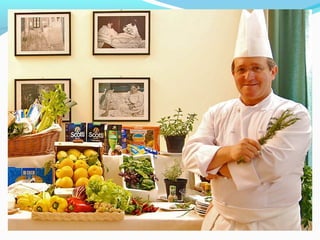
The need for trained hospitality staff will increase
in the operational areas of catering/kitchen, food
and beverage and accommodation sectors.
Hospitality
From the French word “hospices…
 “To provide care/shelter for travellers”
 “The reception and entertainment of guests or
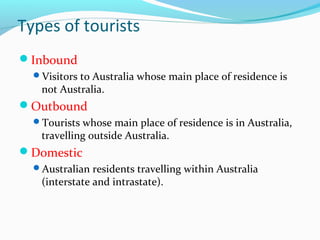
strangers with (quality) and kindness”
 Providing hospitality means: Offering a welcoming
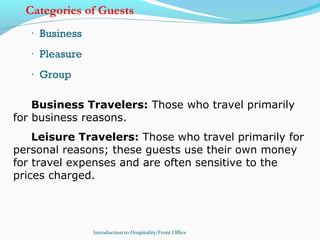
environment to visitors.
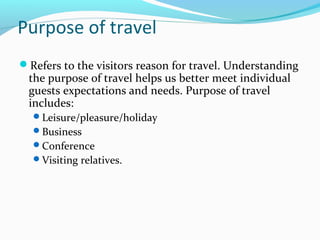
 hospitality business is people business
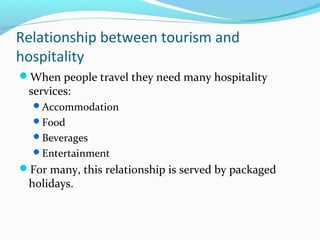
The basis of Hospitality
Hospitality is based upon:
 a service relationship (between the host and guest)
 providing a service that is valued by the guest or
customer
 Meeting and exceeding guest/ customer expectations
It involves:
 Consideration and service of each guest as an
individual
 The art of providing a valued intangible product
The host
At the core of the hospitality industry is the host-
guest relationship.
The host is the entity giving the hospitality
Individual person
Company/business
Region
Country
The guest
A guest is the entity receiving hospitality
Individual person
Company/business
Region
Country
Hospitality industry sectors
A sector is one area or division of an industry.
Each of the following can be said to be sectors of
the hospitality industry:
Restaurants
Clubs
Resorts
Cruise ships
Fast food outlets
Hotels.
Each sector offers different products and services.
COMMERCIAL AND NON-COMMERCIAL OPERATIONS
The hospitality sector can be divided into commercial
and non-commercial operations:
commercial establishments charge for their services
and seek to make a profit from their operations for
their owners, investors or shareholders
non-commercial operations do not seek to make a
profit and include those that act in a charitable
capacity or out of public need funded by government
Commercial hospitality
Hospitality businesses that offer food, beverages
and/or accommodation for a profit.
Non-commercial hospitality
Hospitality organisations that provide food,
beverages and/or accommodation free of charge (not
for profit).
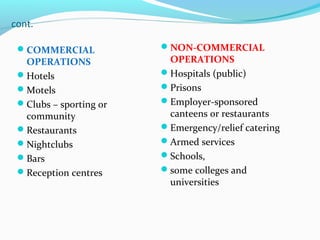
cont.
COMMERCIAL
OPERATIONS
Hotels
Motels
Clubs – sporting or
community
Restaurants
Nightclubs
Bars
Reception centres
NON-COMMERCIAL
OPERATIONS
Hospitals (public)
Prisons
Employer-sponsored
canteens or restaurants
Emergency/relief catering
Armed services
Schools,
some colleges and
universities
Introduction to Hospitality/Front Office
· Commercial hotels/corporate
hotels
· Airport hotels
· Suite hotels
· Serviced apartment hotels
· Residential hotels
· Resort hotels
Types of Hotels
Introduction to Hospitality/Front Office
Types of Hotels (continued)
· Bed and breakfast hotels
· Casino hotels
· Convention hotels
· Alternative lodging properties
Introduction to Hospitality/Front Office
Hotels
 Commercial
/corporate Hotels
Located in downtown or
business districts- area
that are convenient and
of interest to their target
markets.
Guest amenities at
commercial hotels may
include complimentary
newspapers, cable
television, swimming
pool, health club, high
speed internet access.
Airport hotels
Located near the airports-
especially international
airports.
Target Market: airline
passengers, cancelled
flight, airline personnel.
Hotel-owned courtesy vans
transport guests between
the hotel and the airport.
Introduction to Hospitality/Front Office
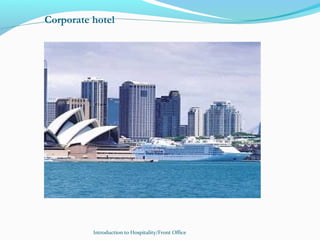
Corporate hotel
Hotels ( continued)
Suite Hotels
Suite hotels are among the newest
and fastest-growing segments of
the lodging industry.
These suite hotels feature
guestrooms with a living room
and separate bedroom. Some
guest suites includes a compact
kitchenette with fridge and mini
bar.
Target Market: Professionals such
lawyers, accountants
Resorts Hotels
Resort hotels are located in the
mountains, on an island or
exotic location away from
crowded residential areas.
More leisurely, relaxed
atmosphere
Resort hotels provide special
activities such as golf, sailing,
skiing.
Types of tourists
Inbound
Visitors to Australia whose main place of residence is
not Australia.
Outbound
Tourists whose main place of residence is in Australia,
travelling outside Australia.
Domestic
Australian residents travelling within Australia
(interstate and intrastate).
Types of tourists
Interstate
Australian tourists travelling within Australia, to a
state/territory other than where they usually reside.
Intrastate
Australian tourists travelling within the state/territory
in which they usually reside.
Introduction to Hospitality/Front Office
Business·
Pleasure·
Group·
Business Travelers: Those who travel primarily
for business reasons.
Leisure Travelers: Those who travel primarily for
personal reasons; these guests use their own money
for travel expenses and are often sensitive to the
prices charged.
Categories of Guests
Purpose of travel
Refers to the visitors reason for travel. Understanding
the purpose of travel helps us better meet individual
guests expectations and needs. Purpose of travel
includes:
Leisure/pleasure/holiday
Business
Conference
Visiting relatives.
Relationship between tourism and
hospitality
When people travel they need many hospitality
services:
Accommodation
Food
Beverages
Entertainment
For many, this relationship is served by packaged
holidays.
Factors affecting accommodation
choice
Cost (how much can guest afford/how much do
they want to spend)
Standard or quality (how important is the
standard/what standard or quality of
accommodation is available at the destination)
Availability (what accommodation is available for
the required dates)
Length of stay (how long does guest want to
stay/relative to cost).
Factors affecting accommodation
choice
Destination/location (what is available at the
destination/what choices are there)
Purpose of travel
Star rating
Types of services available (does this suit the
guests needs – business facilities, family
orientation, choice of dining experiences,
accessibility to other
facilities/attractions/infrastructure at the
destination.
What is a ‘package holiday’?
An inclusive arrangement usually for transport,
accommodation, transfers, some meals, occasionally
tours and various other aspects of a trip for an all-
inclusive price.
Career Avenues
There is a high demand for hotel managers and staff in the
international hospitality industry.
““The manpower shortage is also being felt in EuropeThe manpower shortage is also being felt in Europe
(including the UK), the US, Australia, Singapore, Hong Kong(including the UK), the US, Australia, Singapore, Hong Kong
etc.etc.
They like to hire Hospitality graduates because of theirThey like to hire Hospitality graduates because of their
high level of education and experience in the industry,“high level of education and experience in the industry,“
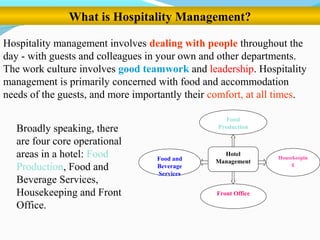
What is Hospitality Management?
Food
Production
Hotel
ManagementFood and
Beverage
Services
Housekeepin
g
Front Office
Hospitality management involves dealing with people throughout the
day - with guests and colleagues in your own and other departments.
The work culture involves good teamwork and leadership. Hospitality
management is primarily concerned with food and accommodation
needs of the guests, and more importantly their comfort, at all times.
Broadly speaking, there
are four core operational
areas in a hotel: Food
Production, Food and
Beverage Services,
Housekeeping and Front
Office.
Can you manage a career in Hospitality Management?
Do you love people and understand them?Do you love people and understand them? Do you likeDo you like
catering to the needs of others?catering to the needs of others?
If you have good communication skills and an outgoing
attitude, then the hospitality industry is a highly
recommended career option.
However, being part of the world's most dynamic and
exciting industry is not for everyone, you have to be
ambitious, creative and have the passion to work in an
industry that’s constantly generating new ideas.
continued
 Some of the personal skills essential to succeed in
the Hotel Industry are:
 An interest in food and changing styles
 A friendly and outgoing disposition
 Good communication and interaction skills
 Good organising abilities and an eye for detail
 Pleasant and cheerful personality.
Can you manage a career in Hotel Management?
Skills for Front Office
Management
-Strong communication skills
-Good command over
English, and other preferred
languages
-Ability to be on your feet for
long hours
-An energetic and cheerful
personality
Skills for
Housekeeping
•Excellent problem-
solving skills
•Strong ability to grow
and learn
•Ability to multi-task
•Good know-how of
various equipments
Can you manage a career in Hotel Management?
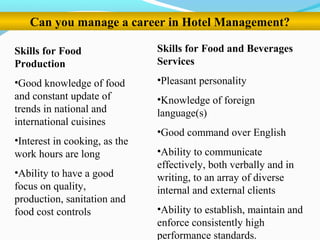
Skills for Food
Production
•Good knowledge of food
and constant update of
trends in national and
international cuisines
•Interest in cooking, as the
work hours are long
•Ability to have a good
focus on quality,
production, sanitation and
food cost controls
Skills for Food and Beverages
Services
•Pleasant personality
•Knowledge of foreign
language(s)
•Good command over English
•Ability to communicate
effectively, both verbally and in
writing, to an array of diverse
internal and external clients
•Ability to establish, maintain and
enforce consistently high
performance standards.
Tracing the Career PathTracing the Career Path
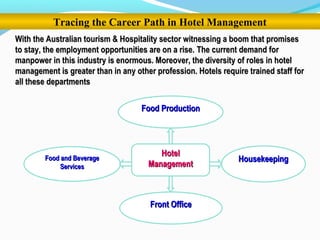
Tracing the Career Path in Hotel Management
Food ProductionFood Production
HotelHotel
ManagementManagement
Food and BeverageFood and Beverage
ServicesServices
HousekeepingHousekeeping
Front OfficeFront Office
With the Australian tourism & Hospitality sector witnessing a boom that promisesWith the Australian tourism & Hospitality sector witnessing a boom that promises
to stay, the employment opportunities are on a rise.to stay, the employment opportunities are on a rise. The current demand forThe current demand for
manpower in this industry is enormous. Moreover, the diversity of roles in hotelmanpower in this industry is enormous. Moreover, the diversity of roles in hotel
management is greater than in any other profession. Hotels require trained staff formanagement is greater than in any other profession. Hotels require trained staff for
all these departmentsall these departments
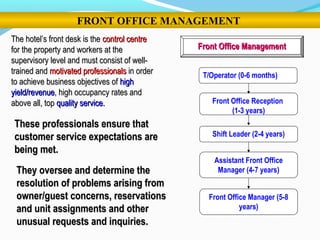
Front Office ManagementFront Office ManagementFront Office ManagementFront Office Management
Front Office Reception
(1-3 years)
Shift Leader (2-4 years)
T/Operator (0-6 months)
Assistant Front Office
Manager (4-7 years)
Front Office Manager (5-8
years)
FRONT OFFICE MANAGEMENT
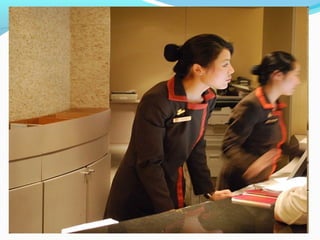
The hotel’s front desk is theThe hotel’s front desk is the control centrecontrol centre
for the property and workers at thefor the property and workers at the
supervisory level and must consist of well-supervisory level and must consist of well-
trained andtrained and motivated professionalsmotivated professionals in orderin order
to achieve business objectives ofto achieve business objectives of highhigh
yield/revenueyield/revenue, high occupancy rates and, high occupancy rates and
above all, topabove all, top quality service.quality service.
They oversee and determine theThey oversee and determine the
resolution of problems arising fromresolution of problems arising from
owner/guest concerns, reservationsowner/guest concerns, reservations
and unit assignments and otherand unit assignments and other
unusual requests and inquiries.unusual requests and inquiries.
These professionals ensure thatThese professionals ensure that
customer service expectations arecustomer service expectations are
being met.being met.
HousekeepingHousekeepingHousekeepingHousekeeping
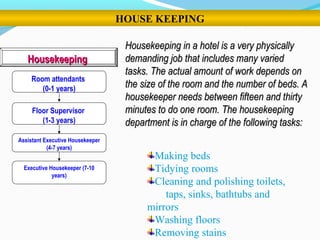
Room attendants
(0-1 years)
Floor Supervisor
(1-3 years)
Assistant Executive Housekeeper
(4-7 years)
Executive Housekeeper (7-10
years)
HOUSE KEEPING
Housekeeping in a hotel is a very physicallyHousekeeping in a hotel is a very physically
demanding job that includes many varieddemanding job that includes many varied
tasks. The actual amount of work depends ontasks. The actual amount of work depends on
the size of the room and the number of beds. Athe size of the room and the number of beds. A
housekeeper needs between fifteen and thirtyhousekeeper needs between fifteen and thirty
minutes to do one room. The housekeepingminutes to do one room. The housekeeping
department is in charge of the following tasks:department is in charge of the following tasks:
Making beds
Tidying rooms
Cleaning and polishing toilets,
taps, sinks, bathtubs and
mirrors
Washing floors
Removing stains
Food ProductionFood ProductionFood ProductionFood Production
Associate Chef- I
(2-3 years)
Associate Chef- II
(0-2 years)
Chef (3-4 years)
Sous Chef (4-6 years)
Head Chef (6-7 years)
Assistant Executive Chef (7-
9 years)
Executive Chef
(9-10 years)
FOOD PRODUCTION
Food Production is an operating system and the
quality of food that a hotel delivers to its customers
is a key part of its product offer.
Therefore, chefs play a vital role in the hotel setTherefore, chefs play a vital role in the hotel set
up.up. The reputations of hotels ride on foodThe reputations of hotels ride on food
quality and thus food production operations arequality and thus food production operations are
a critical issue.a critical issue.
A career inA career in Food ProductionFood Production
involves administratinginvolves administrating thethe
procedures used inprocedures used in quantity foodquantity food
production management includingproduction management including
quality controlquality control,, food costingfood costing, work, work
methods, menu planning, foodmethods, menu planning, food
production systems and service.production systems and service.
Food & BeverageFood & Beverage
ServicesServices
Food & BeverageFood & Beverage
ServicesServices
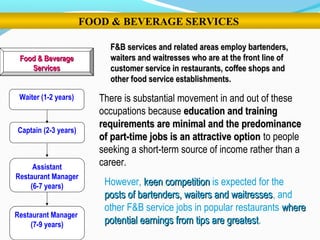
Captain (2-3 years)
Waiter (1-2 years)
Assistant
Restaurant Manager
(6-7 years)
Restaurant Manager
(7-9 years)
FOOD & BEVERAGE SERVICES
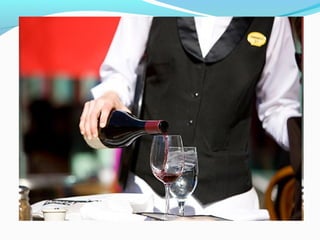
F&B services and related areas employ bartenders,F&B services and related areas employ bartenders,
waiters and waitresses who are at the front line ofwaiters and waitresses who are at the front line of
customer service in restaurants, coffee shops andcustomer service in restaurants, coffee shops and
other food service establishments.other food service establishments.
There is substantial movement in and out of these
occupations because education and trainingeducation and training
requirements are minimal and the predominancerequirements are minimal and the predominance
of part-time jobs is an attractive optionof part-time jobs is an attractive option to people
seeking a short-term source of income rather than a
career.
However, keen competitionkeen competition is expected for the
posts of bartenders, waiters and waitressesposts of bartenders, waiters and waitresses, and
other F&B service jobs in popular restaurants wherewhere
potential earnings from tips are greatestpotential earnings from tips are greatest.
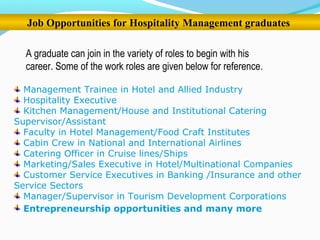
Job Opportunities for Hospitality Management graduates
A graduate can join in the variety of roles to begin with his
career. Some of the work roles are given below for reference.
Management Trainee in Hotel and Allied Industry
Hospitality Executive
Kitchen Management/House and Institutional Catering
Supervisor/Assistant
Faculty in Hotel Management/Food Craft Institutes
Cabin Crew in National and International Airlines
Catering Officer in Cruise lines/Ships
Marketing/Sales Executive in Hotel/Multinational Companies
Customer Service Executives in Banking /Insurance and other
Service Sectors
Manager/Supervisor in Tourism Development Corporations
Entrepreneurship opportunities and many more
Alternate CareersAlternate Careers
Public RelationsPublic Relations
The importance of PR is expected to grow, more so as
globalisation has revolutionised the business
environment.
Also, quick thinking, being able to work under
pressure, an outgoing personality and excellent
communication - skills which you acquire as a hotel
management professional will help you build a
successful career in the PR industry. 
Event ManagementEvent Management
Event Management is a multi-million-dollar industry,
growing rapidly, with thousands of mega shows and events
hosted regularly.
On the professional side, event management is aOn the professional side, event management is a
glamorous and exciting profession that demands a lotglamorous and exciting profession that demands a lot
of hard work and dynamism.of hard work and dynamism.
As a professional with a background in the hospitality
industry, you may already possess the skill sets and
experience needed to manage events (parties,
conferences, etc.) and a career in Event management
would be essentially, an extension of your present role.
Hospitality Service Model
 Smile
 Make Eye contact
 Respect and welcome all guests
 Value the guest
 Initiate guest contact
 Creative service solutions
 End with a “thank you”
Making it Happen
 People who work in the hospitality industry must
possess:
 Good interpersonal skills
 Sound communication skills
 Flexibility in working hours
 High level of technical skills
 Organisational skills
 Self motivation
 Teamwork ability and
 Well-groomed/well presented

career path in hospitality

  • 1.
    Week 1-4 Update anddevelop hospitality industry knowledge (Week 2)
  • 2.
    Ten years agothe hospitality industry was seen as a low to medium skilled employment. But the growth of the Tourism industry has produced many changes. The tourism industry today is the biggest money earner for Aust. Economy. It requires professional with high level of skill. The need for trained hospitality staff will increase in the operational areas of catering/kitchen, food and beverage and accommodation sectors.
  • 3.
    Hospitality From the Frenchword “hospices…  “To provide care/shelter for travellers”  “The reception and entertainment of guests or strangers with (quality) and kindness”  Providing hospitality means: Offering a welcoming environment to visitors.  hospitality business is people business
  • 4.
    The basis ofHospitality Hospitality is based upon:  a service relationship (between the host and guest)  providing a service that is valued by the guest or customer  Meeting and exceeding guest/ customer expectations It involves:  Consideration and service of each guest as an individual  The art of providing a valued intangible product
  • 5.
    The host At thecore of the hospitality industry is the host- guest relationship. The host is the entity giving the hospitality Individual person Company/business Region Country
  • 6.
    The guest A guestis the entity receiving hospitality Individual person Company/business Region Country
  • 7.
    Hospitality industry sectors Asector is one area or division of an industry. Each of the following can be said to be sectors of the hospitality industry: Restaurants Clubs Resorts Cruise ships Fast food outlets Hotels. Each sector offers different products and services.
  • 8.
    COMMERCIAL AND NON-COMMERCIALOPERATIONS The hospitality sector can be divided into commercial and non-commercial operations: commercial establishments charge for their services and seek to make a profit from their operations for their owners, investors or shareholders non-commercial operations do not seek to make a profit and include those that act in a charitable capacity or out of public need funded by government
  • 9.
    Commercial hospitality Hospitality businessesthat offer food, beverages and/or accommodation for a profit.
  • 10.
    Non-commercial hospitality Hospitality organisationsthat provide food, beverages and/or accommodation free of charge (not for profit).
  • 11.
    cont. COMMERCIAL OPERATIONS Hotels Motels Clubs – sportingor community Restaurants Nightclubs Bars Reception centres NON-COMMERCIAL OPERATIONS Hospitals (public) Prisons Employer-sponsored canteens or restaurants Emergency/relief catering Armed services Schools, some colleges and universities
  • 12.
    Introduction to Hospitality/FrontOffice · Commercial hotels/corporate hotels · Airport hotels · Suite hotels · Serviced apartment hotels · Residential hotels · Resort hotels Types of Hotels
  • 13.
    Introduction to Hospitality/FrontOffice Types of Hotels (continued) · Bed and breakfast hotels · Casino hotels · Convention hotels · Alternative lodging properties
  • 14.
    Introduction to Hospitality/FrontOffice Hotels  Commercial /corporate Hotels Located in downtown or business districts- area that are convenient and of interest to their target markets. Guest amenities at commercial hotels may include complimentary newspapers, cable television, swimming pool, health club, high speed internet access. Airport hotels Located near the airports- especially international airports. Target Market: airline passengers, cancelled flight, airline personnel. Hotel-owned courtesy vans transport guests between the hotel and the airport.
  • 15.
    Introduction to Hospitality/FrontOffice Corporate hotel
  • 16.
    Hotels ( continued) SuiteHotels Suite hotels are among the newest and fastest-growing segments of the lodging industry. These suite hotels feature guestrooms with a living room and separate bedroom. Some guest suites includes a compact kitchenette with fridge and mini bar. Target Market: Professionals such lawyers, accountants Resorts Hotels Resort hotels are located in the mountains, on an island or exotic location away from crowded residential areas. More leisurely, relaxed atmosphere Resort hotels provide special activities such as golf, sailing, skiing.
  • 17.
    Types of tourists Inbound Visitorsto Australia whose main place of residence is not Australia. Outbound Tourists whose main place of residence is in Australia, travelling outside Australia. Domestic Australian residents travelling within Australia (interstate and intrastate).
  • 18.
    Types of tourists Interstate Australiantourists travelling within Australia, to a state/territory other than where they usually reside. Intrastate Australian tourists travelling within the state/territory in which they usually reside.
  • 19.
    Introduction to Hospitality/FrontOffice Business· Pleasure· Group· Business Travelers: Those who travel primarily for business reasons. Leisure Travelers: Those who travel primarily for personal reasons; these guests use their own money for travel expenses and are often sensitive to the prices charged. Categories of Guests
  • 20.
    Purpose of travel Refersto the visitors reason for travel. Understanding the purpose of travel helps us better meet individual guests expectations and needs. Purpose of travel includes: Leisure/pleasure/holiday Business Conference Visiting relatives.
  • 21.
    Relationship between tourismand hospitality When people travel they need many hospitality services: Accommodation Food Beverages Entertainment For many, this relationship is served by packaged holidays.
  • 22.
    Factors affecting accommodation choice Cost(how much can guest afford/how much do they want to spend) Standard or quality (how important is the standard/what standard or quality of accommodation is available at the destination) Availability (what accommodation is available for the required dates) Length of stay (how long does guest want to stay/relative to cost).
  • 23.
    Factors affecting accommodation choice Destination/location(what is available at the destination/what choices are there) Purpose of travel Star rating Types of services available (does this suit the guests needs – business facilities, family orientation, choice of dining experiences, accessibility to other facilities/attractions/infrastructure at the destination.
  • 24.
    What is a‘package holiday’? An inclusive arrangement usually for transport, accommodation, transfers, some meals, occasionally tours and various other aspects of a trip for an all- inclusive price.
  • 25.
    Career Avenues There isa high demand for hotel managers and staff in the international hospitality industry. ““The manpower shortage is also being felt in EuropeThe manpower shortage is also being felt in Europe (including the UK), the US, Australia, Singapore, Hong Kong(including the UK), the US, Australia, Singapore, Hong Kong etc.etc. They like to hire Hospitality graduates because of theirThey like to hire Hospitality graduates because of their high level of education and experience in the industry,“high level of education and experience in the industry,“
  • 26.
    What is HospitalityManagement? Food Production Hotel ManagementFood and Beverage Services Housekeepin g Front Office Hospitality management involves dealing with people throughout the day - with guests and colleagues in your own and other departments. The work culture involves good teamwork and leadership. Hospitality management is primarily concerned with food and accommodation needs of the guests, and more importantly their comfort, at all times. Broadly speaking, there are four core operational areas in a hotel: Food Production, Food and Beverage Services, Housekeeping and Front Office.
  • 27.
    Can you managea career in Hospitality Management? Do you love people and understand them?Do you love people and understand them? Do you likeDo you like catering to the needs of others?catering to the needs of others? If you have good communication skills and an outgoing attitude, then the hospitality industry is a highly recommended career option. However, being part of the world's most dynamic and exciting industry is not for everyone, you have to be ambitious, creative and have the passion to work in an industry that’s constantly generating new ideas.
  • 28.
    continued  Some ofthe personal skills essential to succeed in the Hotel Industry are:  An interest in food and changing styles  A friendly and outgoing disposition  Good communication and interaction skills  Good organising abilities and an eye for detail  Pleasant and cheerful personality.
  • 29.
    Can you managea career in Hotel Management? Skills for Front Office Management -Strong communication skills -Good command over English, and other preferred languages -Ability to be on your feet for long hours -An energetic and cheerful personality Skills for Housekeeping •Excellent problem- solving skills •Strong ability to grow and learn •Ability to multi-task •Good know-how of various equipments
  • 30.
    Can you managea career in Hotel Management? Skills for Food Production •Good knowledge of food and constant update of trends in national and international cuisines •Interest in cooking, as the work hours are long •Ability to have a good focus on quality, production, sanitation and food cost controls Skills for Food and Beverages Services •Pleasant personality •Knowledge of foreign language(s) •Good command over English •Ability to communicate effectively, both verbally and in writing, to an array of diverse internal and external clients •Ability to establish, maintain and enforce consistently high performance standards.
  • 31.
    Tracing the CareerPathTracing the Career Path
  • 32.
    Tracing the CareerPath in Hotel Management Food ProductionFood Production HotelHotel ManagementManagement Food and BeverageFood and Beverage ServicesServices HousekeepingHousekeeping Front OfficeFront Office With the Australian tourism & Hospitality sector witnessing a boom that promisesWith the Australian tourism & Hospitality sector witnessing a boom that promises to stay, the employment opportunities are on a rise.to stay, the employment opportunities are on a rise. The current demand forThe current demand for manpower in this industry is enormous. Moreover, the diversity of roles in hotelmanpower in this industry is enormous. Moreover, the diversity of roles in hotel management is greater than in any other profession. Hotels require trained staff formanagement is greater than in any other profession. Hotels require trained staff for all these departmentsall these departments
  • 34.
    Front Office ManagementFrontOffice ManagementFront Office ManagementFront Office Management Front Office Reception (1-3 years) Shift Leader (2-4 years) T/Operator (0-6 months) Assistant Front Office Manager (4-7 years) Front Office Manager (5-8 years) FRONT OFFICE MANAGEMENT The hotel’s front desk is theThe hotel’s front desk is the control centrecontrol centre for the property and workers at thefor the property and workers at the supervisory level and must consist of well-supervisory level and must consist of well- trained andtrained and motivated professionalsmotivated professionals in orderin order to achieve business objectives ofto achieve business objectives of highhigh yield/revenueyield/revenue, high occupancy rates and, high occupancy rates and above all, topabove all, top quality service.quality service. They oversee and determine theThey oversee and determine the resolution of problems arising fromresolution of problems arising from owner/guest concerns, reservationsowner/guest concerns, reservations and unit assignments and otherand unit assignments and other unusual requests and inquiries.unusual requests and inquiries. These professionals ensure thatThese professionals ensure that customer service expectations arecustomer service expectations are being met.being met.
  • 36.
    HousekeepingHousekeepingHousekeepingHousekeeping Room attendants (0-1 years) FloorSupervisor (1-3 years) Assistant Executive Housekeeper (4-7 years) Executive Housekeeper (7-10 years) HOUSE KEEPING Housekeeping in a hotel is a very physicallyHousekeeping in a hotel is a very physically demanding job that includes many varieddemanding job that includes many varied tasks. The actual amount of work depends ontasks. The actual amount of work depends on the size of the room and the number of beds. Athe size of the room and the number of beds. A housekeeper needs between fifteen and thirtyhousekeeper needs between fifteen and thirty minutes to do one room. The housekeepingminutes to do one room. The housekeeping department is in charge of the following tasks:department is in charge of the following tasks: Making beds Tidying rooms Cleaning and polishing toilets, taps, sinks, bathtubs and mirrors Washing floors Removing stains
  • 38.
    Food ProductionFood ProductionFoodProductionFood Production Associate Chef- I (2-3 years) Associate Chef- II (0-2 years) Chef (3-4 years) Sous Chef (4-6 years) Head Chef (6-7 years) Assistant Executive Chef (7- 9 years) Executive Chef (9-10 years) FOOD PRODUCTION Food Production is an operating system and the quality of food that a hotel delivers to its customers is a key part of its product offer. Therefore, chefs play a vital role in the hotel setTherefore, chefs play a vital role in the hotel set up.up. The reputations of hotels ride on foodThe reputations of hotels ride on food quality and thus food production operations arequality and thus food production operations are a critical issue.a critical issue. A career inA career in Food ProductionFood Production involves administratinginvolves administrating thethe procedures used inprocedures used in quantity foodquantity food production management includingproduction management including quality controlquality control,, food costingfood costing, work, work methods, menu planning, foodmethods, menu planning, food production systems and service.production systems and service.
  • 40.
    Food & BeverageFood& Beverage ServicesServices Food & BeverageFood & Beverage ServicesServices Captain (2-3 years) Waiter (1-2 years) Assistant Restaurant Manager (6-7 years) Restaurant Manager (7-9 years) FOOD & BEVERAGE SERVICES F&B services and related areas employ bartenders,F&B services and related areas employ bartenders, waiters and waitresses who are at the front line ofwaiters and waitresses who are at the front line of customer service in restaurants, coffee shops andcustomer service in restaurants, coffee shops and other food service establishments.other food service establishments. There is substantial movement in and out of these occupations because education and trainingeducation and training requirements are minimal and the predominancerequirements are minimal and the predominance of part-time jobs is an attractive optionof part-time jobs is an attractive option to people seeking a short-term source of income rather than a career. However, keen competitionkeen competition is expected for the posts of bartenders, waiters and waitressesposts of bartenders, waiters and waitresses, and other F&B service jobs in popular restaurants wherewhere potential earnings from tips are greatestpotential earnings from tips are greatest.
  • 41.
    Job Opportunities forHospitality Management graduates A graduate can join in the variety of roles to begin with his career. Some of the work roles are given below for reference. Management Trainee in Hotel and Allied Industry Hospitality Executive Kitchen Management/House and Institutional Catering Supervisor/Assistant Faculty in Hotel Management/Food Craft Institutes Cabin Crew in National and International Airlines Catering Officer in Cruise lines/Ships Marketing/Sales Executive in Hotel/Multinational Companies Customer Service Executives in Banking /Insurance and other Service Sectors Manager/Supervisor in Tourism Development Corporations Entrepreneurship opportunities and many more
  • 42.
  • 43.
    Public RelationsPublic Relations Theimportance of PR is expected to grow, more so as globalisation has revolutionised the business environment. Also, quick thinking, being able to work under pressure, an outgoing personality and excellent communication - skills which you acquire as a hotel management professional will help you build a successful career in the PR industry. 
  • 44.
    Event ManagementEvent Management EventManagement is a multi-million-dollar industry, growing rapidly, with thousands of mega shows and events hosted regularly. On the professional side, event management is aOn the professional side, event management is a glamorous and exciting profession that demands a lotglamorous and exciting profession that demands a lot of hard work and dynamism.of hard work and dynamism. As a professional with a background in the hospitality industry, you may already possess the skill sets and experience needed to manage events (parties, conferences, etc.) and a career in Event management would be essentially, an extension of your present role.
  • 45.
    Hospitality Service Model Smile  Make Eye contact  Respect and welcome all guests  Value the guest  Initiate guest contact  Creative service solutions  End with a “thank you”
  • 46.
    Making it Happen People who work in the hospitality industry must possess:  Good interpersonal skills  Sound communication skills  Flexibility in working hours  High level of technical skills  Organisational skills  Self motivation  Teamwork ability and  Well-groomed/well presented

Editor's Notes

  • #5 Exoectatons / Needs: Help Satisfaction Respect Comfort Empathy Value Friendliness Safety & privacy EXPECTATIONS Vary according to purpose of visit Each person has their own expectations Dependent upon attitudes, perception & culture
  • #6 Refer to page 6
  • #7 Refer to page 6
  • #8 Refer to page 6
  • #10 Refer to page 7
  • #11 Refer to page 7
  • #18 Refer to page 12
  • #19 Refer to page 12
  • #21 Refer to page 13
  • #23 Refer to page 13
  • #24 Refer to page 13
  • #25 Refer to page 13