Cardiac Cycle, E.C.G, and Heart sounds
PREPARED BY: Dr. Jaishree Tiwari (P.T)
2
• Upon completing this chapter students should be able to:
1.Describe Cardiac Cycle and E.C.G .
2. Describe Heart sounds.
3
Learning Objectives
INTRODUCTION
DEFINITION -
The complete sequence of events in the heart
from the beginning of one beat to the
beginning of the following beat : a complete
heartbeat including systole (contraction)and
diastole ( relaxation)
4
5
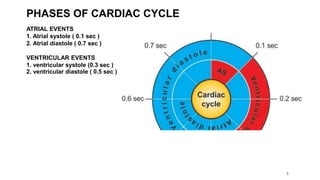
PHASES OF CARDIAC CYCLE
ATRIAL EVENTS
1. Atrial systole ( 0.1 sec )
2. Atrial diastole ( 0.7 sec )
VENTRICULAR EVENTS
1. ventricular systole (0.3 sec )
2. ventricular diastole ( 0.5 sec )
6
ATRIAL CYCLE
Atrial systole ( 0.1 sec)
Coincides with last rapid filling
phase of ventricles
Before these valves are open ,
ventricles relaxed with already 75 %
blood
Contracting add only remaining 25
% of blood
7
It is also known as last rapid filling phase or presystolic
It is usually considered as last phase of ventricular diastole
Atrial systole is not essential for maintenance of circulation
Many persons with atrial fibrillation survive for years , without suffering from circulatory
insufficiency
However , these persons find it difficult to cope up with physical stress like exercise
ATRIAL DIASTOLE ( 0.7 sec )
Coincide with ventricular systole & most of the ventricular diastole
ATRIAL RELAXATION – gradual filling of atria , pressure slowly increases
8
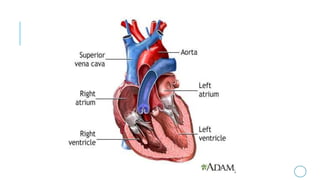
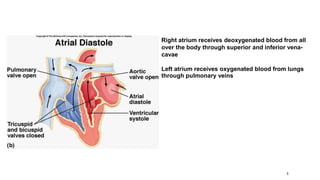
Right atrium receives deoxygenated blood from all
over the body through superior and inferior vena-
cavae
Left atrium receives oxygenated blood from lungs
through pulmonary veins
9
VENTRICULAR EVENTS
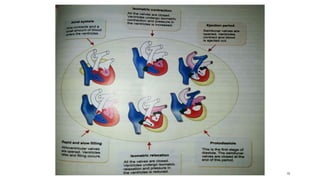
1. ISOMETRIC CONTRACTION PERIOD
2. EJECTION PERIOD
3. PROTODIASTOLE
4. ISOMETRIC RELAXATION PERIOD
5. RAPID FILLING PHASE
6. SLOW FILLING PHASE
7. LAST RAPID FILLING PHASE
10
Isometric contraction period-
1. First phase of ventricular systole
2. Lasts for 0.05 sec
3. Increase in tension , without change in length of muscle fibres
4. Also known as iso volumetric contraction
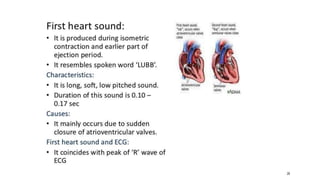
5. Immediately after atrial systole the AV valves are closed due to increase in ventricular pressure
6. This causes production of first heart sound
7. When the ventricular pressure increases above the pressure in the aorta & pulmonary artery ,
semilunar valves open that leads to ejection of blood from ventricles to aorta
Ejection period ( 0.22 secs )
1 st stage – Rapid Ejection ( 0.13 sec)
2 nd stage – slow ejection ( 0.09 sec )
11
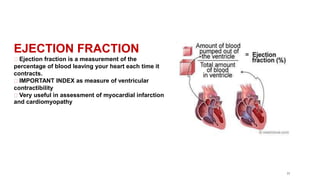
EJECTION FRACTION
Ejection fraction is a measurement of the
percentage of blood leaving your heart each time it
contracts.
IMPORTANT INDEX as measure of ventricular
contractibility
Very useful in assessment of myocardial infarction
and cardiomyopathy
12
PROTODIASTOLE
First stage of ventricular diastole
Duration - 0.04 sec
Due to ejection of blood , pressure in ventricles decreases and pressure in aorta &
pulmonary artery increases
When intraventricular pressure becomes less than the pressure in aorta and pulmonary
artery, the semilunar valves closed
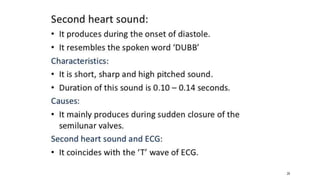
Produces second heart sound
ISOMETRIC RELAXATION PERIOD
Is a type of muscular relaxation , caused by decrease in tension without any change in
length of muscle fibres
so called iso volumetric relaxation
Again All heart valve closed
Intraventricular pressure decreases
Duration = 0.08 sec
13
Significance of isometric relaxation -
During this phase ventricular pressure decreases greatly
Due to pressure difference in atria and ventricles AV Valves open resulting in filling of
ventricles
RAPID FILLING PHASE
When AV valves open , there is sudden rush of blood from atria
70 % of blood filling takes place during this phase
Duration – 0.11 sec
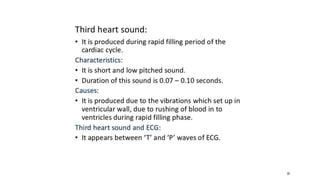
Rushing of blood into ventricles produces Third heart sound
14
Slow filling phase
Also known as diastasis
20 % of blood filling occurs during this phase
Duration – 0.19 secs
LAST RAPID filling phase-
Occurs because of atrial systole
After slow filling , atria contracts and push small amount of blood into ventricles
About 10 % of ventricular filling takes place during this period
Flow of additional amount of blood into ventricle is known as atrial kick
End diastolic volume = 130-150 ml per ventricle
15
QUESTIONS RELATED TO CARDIAC CYCLE
1.Cardiac output is determined by
a)Heart rate
b)Stroke volume
2.Describe the phases of cardiac cycle?
3.Which events are not happening during disorder of human heart?
a)The ventricles are filling with blood
b)The Av valves are open
c)The semilunar valves are open
d)The heart is relaxed
16
E.C.G(ELECTRO CARDIOGRAM)
17
18
INTRODUCTION
 ECG is a three letter acronym for Electro Cardio Graphy.
 The word is derived from electro(Greek for electricity),cardio(greek for heart) and graph(Greek root
meaning "to write“)
 It is a transthoracic interpretation of the electrical activity of the heart over time captured
and externally recorded by skin electrodes.
 The device used to produce this non invasive record is called the electrocardiograph.
 ECG is the gold standard for the non invasive diagnosis of cardiac diseases and may occasionally be the
only marker for the presence of heart disease.
19
INDICATIONS OF ECG
 Gold standard for diagnosis of cardiac arrhythmias
 Helps detect electrolyte disturbances (hyper- & hypokalaemia)
 Allows for detection of conduction abnormalities
 Screening tool for ischemic heart disease during stress tests
 Helpful with non-cardiac diseases (e.g. pulmonary embolism or hypothermia
20
BASIC ELECTROPHYSIOLOGY
PHYSIOLOGICAL PROPERTIES OF MYOCARDIAL CELL
Automaticity: ability to initiate an impulse
Excitability: ability to respond to a stimulus
Conductivity: ability to transmit an impulse
Contractility: ability to respond with pumping action
Depolarization and repolarization of a cardiac cell generates action potential ECG is the composite
representation of action potential of all cardiac cell.
21
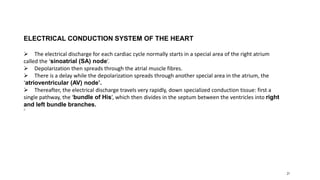
ELECTRICAL CONDUCTION SYSTEM OF THE HEART
 The electrical discharge for each cardiac cycle normally starts in a special area of the right atrium
called the ‘sinoatrial (SA) node’.
 Depolarization then spreads through the atrial muscle fibres.
 There is a delay while the depolarization spreads through another special area in the atrium, the
‘atrioventricular (AV) node’.
 Thereafter, the electrical discharge travels very rapidly, down specialized conduction tissue: first a
single pathway, the ‘bundle of His’, which then divides in the septum between the ventricles into right
and left bundle branches.
8
22
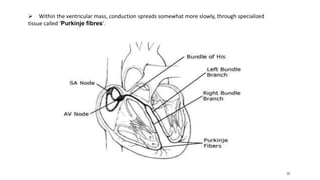
 Within the ventricular mass, conduction spreads somewhat more slowly, through specialized
tissue called ‘Purkinje fibres’.
23
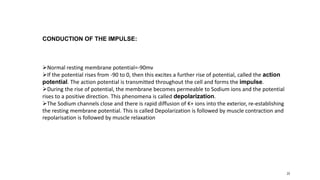
CONDUCTION OF THE IMPULSE:
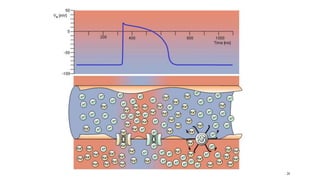
Normal resting membrane potential=-90mv
If the potential rises from -90 to 0, then this excites a further rise of potential, called the action
potential. The action potential is transmitted throughout the cell and forms the impulse.
During the rise of potential, the membrane becomes permeable to Sodium ions and the potential
rises to a positive direction. This phenomena is called depolarization.
The Sodium channels close and there is rapid diffusion of K+ ions into the exterior, re-establishing
the resting membrane potential. This is called Depolarization is followed by muscle contraction and
repolarisation is followed by muscle relaxation
24
25
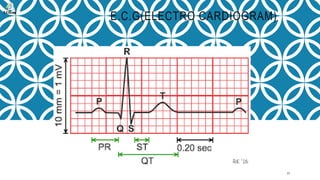
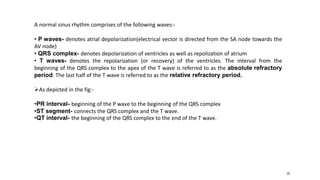
A normal sinus rhythm comprises of the following waves:-
• P waves- denotes atrial depolarization(electrical vector is directed from the SA node towards the
AV node)
• QRS complex- denotes depolarization of ventricles as well as repolization of atrium
• T waves- denotes the repolarization (or recovery) of the ventricles. The interval from the
beginning of the QRS complex to the apex of the T wave is referred to as the absolute refractory
period. The last half of the T wave is referred to as the relative refractory period.
As depicted in the fig:-
•PR interval- beginning of the P wave to the beginning of the QRS complex
•ST segment- connects the QRS complex and the T wave.
•QT interval- the beginning of the QRS complex to the end of the T wave.
26
HEART SOUNDS
27
28
29
30
31
QUESTIONS RELATED TO HEART SOUNDS
1.What effect would serve mitral valve stenosis on 1st heart sound.
a) Widened splitting
b) Absence of splitting
c) Increase intensity
d) Decrease intensity
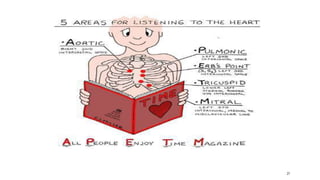
2.At which location is the S1 heart sound best heard ?
a)Right upper sternal border
b)Left upper sternal border
c)Left lower sternal border
d)Cardiac apex
32
REFERENCES
Reference Books : BD chaurasia Vol 3 anatomy
https://teachmeanatomy.info/thorax/organs/heart/atria-ventricles/
33
34

Cardiac cycle,e.c.g,heart sounds

  • 1.
    Cardiac Cycle, E.C.G,and Heart sounds PREPARED BY: Dr. Jaishree Tiwari (P.T)
  • 2.
  • 3.
    • Upon completingthis chapter students should be able to: 1.Describe Cardiac Cycle and E.C.G . 2. Describe Heart sounds. 3 Learning Objectives
  • 4.
    INTRODUCTION DEFINITION - The completesequence of events in the heart from the beginning of one beat to the beginning of the following beat : a complete heartbeat including systole (contraction)and diastole ( relaxation) 4
  • 5.
    5 PHASES OF CARDIACCYCLE ATRIAL EVENTS 1. Atrial systole ( 0.1 sec ) 2. Atrial diastole ( 0.7 sec ) VENTRICULAR EVENTS 1. ventricular systole (0.3 sec ) 2. ventricular diastole ( 0.5 sec )
  • 6.
    6 ATRIAL CYCLE Atrial systole( 0.1 sec) Coincides with last rapid filling phase of ventricles Before these valves are open , ventricles relaxed with already 75 % blood Contracting add only remaining 25 % of blood
  • 7.
    7 It is alsoknown as last rapid filling phase or presystolic It is usually considered as last phase of ventricular diastole Atrial systole is not essential for maintenance of circulation Many persons with atrial fibrillation survive for years , without suffering from circulatory insufficiency However , these persons find it difficult to cope up with physical stress like exercise ATRIAL DIASTOLE ( 0.7 sec ) Coincide with ventricular systole & most of the ventricular diastole ATRIAL RELAXATION – gradual filling of atria , pressure slowly increases
  • 8.
    8 Right atrium receivesdeoxygenated blood from all over the body through superior and inferior vena- cavae Left atrium receives oxygenated blood from lungs through pulmonary veins
  • 9.
    9 VENTRICULAR EVENTS 1. ISOMETRICCONTRACTION PERIOD 2. EJECTION PERIOD 3. PROTODIASTOLE 4. ISOMETRIC RELAXATION PERIOD 5. RAPID FILLING PHASE 6. SLOW FILLING PHASE 7. LAST RAPID FILLING PHASE
  • 10.
    10 Isometric contraction period- 1.First phase of ventricular systole 2. Lasts for 0.05 sec 3. Increase in tension , without change in length of muscle fibres 4. Also known as iso volumetric contraction 5. Immediately after atrial systole the AV valves are closed due to increase in ventricular pressure 6. This causes production of first heart sound 7. When the ventricular pressure increases above the pressure in the aorta & pulmonary artery , semilunar valves open that leads to ejection of blood from ventricles to aorta Ejection period ( 0.22 secs ) 1 st stage – Rapid Ejection ( 0.13 sec) 2 nd stage – slow ejection ( 0.09 sec )
  • 11.
    11 EJECTION FRACTION Ejection fractionis a measurement of the percentage of blood leaving your heart each time it contracts. IMPORTANT INDEX as measure of ventricular contractibility Very useful in assessment of myocardial infarction and cardiomyopathy
  • 12.
    12 PROTODIASTOLE First stage ofventricular diastole Duration - 0.04 sec Due to ejection of blood , pressure in ventricles decreases and pressure in aorta & pulmonary artery increases When intraventricular pressure becomes less than the pressure in aorta and pulmonary artery, the semilunar valves closed Produces second heart sound ISOMETRIC RELAXATION PERIOD Is a type of muscular relaxation , caused by decrease in tension without any change in length of muscle fibres so called iso volumetric relaxation Again All heart valve closed Intraventricular pressure decreases Duration = 0.08 sec
  • 13.
    13 Significance of isometricrelaxation - During this phase ventricular pressure decreases greatly Due to pressure difference in atria and ventricles AV Valves open resulting in filling of ventricles RAPID FILLING PHASE When AV valves open , there is sudden rush of blood from atria 70 % of blood filling takes place during this phase Duration – 0.11 sec Rushing of blood into ventricles produces Third heart sound
  • 14.
    14 Slow filling phase Alsoknown as diastasis 20 % of blood filling occurs during this phase Duration – 0.19 secs LAST RAPID filling phase- Occurs because of atrial systole After slow filling , atria contracts and push small amount of blood into ventricles About 10 % of ventricular filling takes place during this period Flow of additional amount of blood into ventricle is known as atrial kick End diastolic volume = 130-150 ml per ventricle
  • 15.
  • 16.
    QUESTIONS RELATED TOCARDIAC CYCLE 1.Cardiac output is determined by a)Heart rate b)Stroke volume 2.Describe the phases of cardiac cycle? 3.Which events are not happening during disorder of human heart? a)The ventricles are filling with blood b)The Av valves are open c)The semilunar valves are open d)The heart is relaxed 16
  • 17.
  • 18.
    18 INTRODUCTION  ECG isa three letter acronym for Electro Cardio Graphy.  The word is derived from electro(Greek for electricity),cardio(greek for heart) and graph(Greek root meaning "to write“)  It is a transthoracic interpretation of the electrical activity of the heart over time captured and externally recorded by skin electrodes.  The device used to produce this non invasive record is called the electrocardiograph.  ECG is the gold standard for the non invasive diagnosis of cardiac diseases and may occasionally be the only marker for the presence of heart disease.
  • 19.
    19 INDICATIONS OF ECG Gold standard for diagnosis of cardiac arrhythmias  Helps detect electrolyte disturbances (hyper- & hypokalaemia)  Allows for detection of conduction abnormalities  Screening tool for ischemic heart disease during stress tests  Helpful with non-cardiac diseases (e.g. pulmonary embolism or hypothermia
  • 20.
    20 BASIC ELECTROPHYSIOLOGY PHYSIOLOGICAL PROPERTIESOF MYOCARDIAL CELL Automaticity: ability to initiate an impulse Excitability: ability to respond to a stimulus Conductivity: ability to transmit an impulse Contractility: ability to respond with pumping action Depolarization and repolarization of a cardiac cell generates action potential ECG is the composite representation of action potential of all cardiac cell.
  • 21.
    21 ELECTRICAL CONDUCTION SYSTEMOF THE HEART  The electrical discharge for each cardiac cycle normally starts in a special area of the right atrium called the ‘sinoatrial (SA) node’.  Depolarization then spreads through the atrial muscle fibres.  There is a delay while the depolarization spreads through another special area in the atrium, the ‘atrioventricular (AV) node’.  Thereafter, the electrical discharge travels very rapidly, down specialized conduction tissue: first a single pathway, the ‘bundle of His’, which then divides in the septum between the ventricles into right and left bundle branches. 8
  • 22.
    22  Within theventricular mass, conduction spreads somewhat more slowly, through specialized tissue called ‘Purkinje fibres’.
  • 23.
    23 CONDUCTION OF THEIMPULSE: Normal resting membrane potential=-90mv If the potential rises from -90 to 0, then this excites a further rise of potential, called the action potential. The action potential is transmitted throughout the cell and forms the impulse. During the rise of potential, the membrane becomes permeable to Sodium ions and the potential rises to a positive direction. This phenomena is called depolarization. The Sodium channels close and there is rapid diffusion of K+ ions into the exterior, re-establishing the resting membrane potential. This is called Depolarization is followed by muscle contraction and repolarisation is followed by muscle relaxation
  • 24.
  • 25.
    25 A normal sinusrhythm comprises of the following waves:- • P waves- denotes atrial depolarization(electrical vector is directed from the SA node towards the AV node) • QRS complex- denotes depolarization of ventricles as well as repolization of atrium • T waves- denotes the repolarization (or recovery) of the ventricles. The interval from the beginning of the QRS complex to the apex of the T wave is referred to as the absolute refractory period. The last half of the T wave is referred to as the relative refractory period. As depicted in the fig:- •PR interval- beginning of the P wave to the beginning of the QRS complex •ST segment- connects the QRS complex and the T wave. •QT interval- the beginning of the QRS complex to the end of the T wave.
  • 26.
  • 27.
  • 28.
  • 29.
  • 30.
  • 31.
  • 32.
    QUESTIONS RELATED TOHEART SOUNDS 1.What effect would serve mitral valve stenosis on 1st heart sound. a) Widened splitting b) Absence of splitting c) Increase intensity d) Decrease intensity 2.At which location is the S1 heart sound best heard ? a)Right upper sternal border b)Left upper sternal border c)Left lower sternal border d)Cardiac apex 32
  • 33.
    REFERENCES Reference Books :BD chaurasia Vol 3 anatomy https://teachmeanatomy.info/thorax/organs/heart/atria-ventricles/ 33
  • 34.